Warning: the following post contains graphic details which may upset readers (webmaster FVDK)..
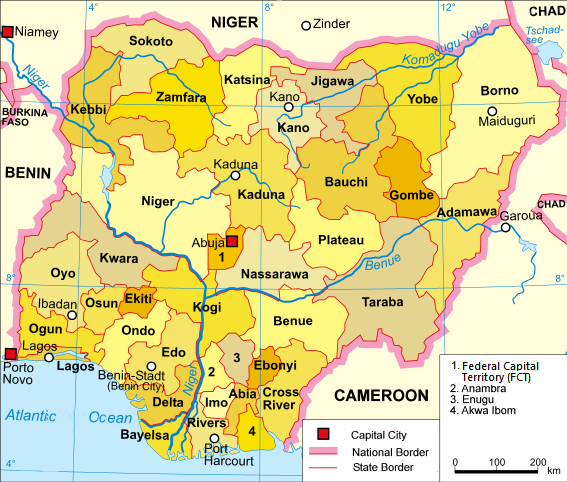
Nigeria is a federal republic comprising 36 states and the Federal Capital Territory (FCT) of Abuja. The 36 states are divided into six geopolitical zones commonly called zones.

The North West (NW), North East (NE) and North Central (NC) zones constitute Northern Nigeria. Politically, historically and culturally we may distinguish Northern and Southern Nigeria, but these broad categories don’t do justice to the great differences that exist within these areas. When I first went to Nigeria, in 1999, I asked a friend who knows the country very well what to expect. ‘Nigeria is a nice set of countries‘, she said.
This short statement says it all. It’s hard to speak of one country, although it has one constitution and one flag and is a member of many international organizations.
The Northern region consists of 19 states and the Federal Capital territory (FCT) of Abuja, the Southern region houses 17 states.

In the past I have on many occasions paid attention to the scourge of ritualistic murders in Nigeria and related practices such as abductions and torture. Let me suffice to refer to my recent post dated March 15, The horror of ritual killings in Nigeria, which also includes ritual murder cases in Northern Nigeria.
The article below provides several examples of reported ritual murders both in Northern and Southern Nigeria. The author, Hadiza Musa, pleading for more attention to the surge in ritual killing in northern states, reports that ‘Between January and April 2025 alone, at least 10 cases have been reported across Kwara, Nasarawa, Jigawa, Benue, Abuja and Bauchi states.’ Not surprisingly, residents of northern states (Kaduna, Kano, Katsina) came into the public eye calling for the death penalty for ritual killers and cannibals.
Moreover, it is necessary to emphasize that the number mentioned above refers only to reported ritual killings, and thus in all likelihood is only the tip of the iceberg.
On more than one occasion I’ve stated here that most likely Nigeria holds a dismal continental record of being the country with the highest number of ritual murders – only partly explained by being Africa’s most populous country. Hadiza Musa refers to research by an NGO, the West African Network for Peace Building, revealing that Nigeria recorded 185 ritual-related deaths between January 2021 and January 2022.
In addition, the National Bureau of Statistics (NBS) reported that over 150 ritual killing cases often linked to young people seeking quick wealth, were recorded in Nigeria in the past six months.
(FVDK)
Ritual killings: Experts call for urgent action over rising cases in Northern Nigeria

Published: April 8, 2025
By: Hadiza Musa – Daily Post, Nigeria
“Ritual Killing” a term referring to the intentional murder of individuals for spiritual, economic, or supernatural purposes, often involving body mutilation or organ harvesting were often associated with Southern Nigeria where they were linked to wealth-seeking practices, political power struggles, and deep-rooted traditional beliefs.
Over the years, several high-profile cases have reinforced this perception.
One of the most infamous cases was the 2004 Okija Shrine discovery in Anambra State, where the police uncovered dozens of human skulls and decomposing bodies allegedly used for sacrifices by politicians and businessmen.
Similarly, in 2014, the Ibadan ‘Forest of Horror’ was exposed, revealing a den of ritualists who had abducted, killed, and harvested body parts from their victims.
In recent years, however, there has been a notable shift, with cases of ritual killings increasingly reported in Northern states such as Kwara, Nasarawa, Jigawa, and Bauchi.
While ritual killings were once largely associated with Southern Nigeria, the rising economic challenges and the erosion of moral values have played a significant role in their spread to the North.
Between January and April 2025 alone, at least 10 cases have been reported across Kwara, Nasarawa, Jigawa, Benue, Abuja and Bauchi states.
In January and in Nasarawa State, Timileyin Ajayi, described as a gospel singer, allegedly murdered a lady, 24-year-old Salome Adaidu, and dismembered her body.
He was caught carrying the severed head of his victim in a bag, which alarmed onlookers, leading to his apprehension.
When he was arrested by the police, other dismembered parts of the deceased’s body were recovered from his home.
The deceased, Salome Adaidu was identified as a member of the National Youth Service Corps who was serving in Abuja.
Also, in Kwara, a final-year student, Hafsoh Lawal, was lured and killed by Abdulrahman Bello, a self-proclaimed cleric and her boyfriend whom she met on Facebook.
According to the Kwara State Police Command, the 29-year-old suspect killed Lawal and dismembered her for alleged ritual purposes at a location in the Olunlade area of Ilorin on Tuesday, February 11, 2025.
The headless corpse of the pupil was discovered by the roadside in Jikas-Dabaja village, Gwaram Local Government Area, Jigawa on March 12 (Wednesday).
The body was mutilated, with the private parts removed, prompting the police to launch an investigation into the circumstances surrounding the gruesome act.
On Sunday, March 16, the Police Command in Jigawa State announced the arrest of a 45-year-old suspect in connection with the crime.
The suspect, a teacher of the deceased, was apprehended and detained following a tip-off.
Experts call for urgent action as ritual killings surge in Northern Nigeria
The incidents and many others highlighted the urgent need for comprehensive measures to address ritual killings in the region with stakeholders, attributing the trend to economic struggles, poverty, and lack of education.
Comrade Umar Hamisu Kofar Naisa, Executive Director of the Society for Educational Development and Socio-Democratic Activities (SEDSAC), linked the surge in ritual killings to poverty and the worsening economic conditions in the region.
He told DAILY POST that illiteracy and lack of education play a significant role in fueling such heinous acts.
According to him, ritual killings violate human rights, instill fear, and create insecurity in communities.
“If we examine the situation closely, ritual killings not only violate human rights but also instill fear and insecurity in communities. The psychological trauma experienced by victims’ families and survivors is immeasurable,” he stated in an interview with DAILY POST.
On legal responses, he urged the government to strengthen policies that protect human rights and enact specific legislation to prosecute perpetrators of ritual killings.
He also stressed the need for collaboration among various stakeholders to curb the menace.
Hamisu called on NGOs to intensify awareness campaigns on the dangers of ritual killings, provide support to victims’ families, and advocate for policy reforms.
“We must ensure that policies are created and enforced to put an end to ritual killings in Nigeria,” he added.
He further advocated for grassroots strategies and community engagement, emphasizing the role of traditional and religious leaders in tackling the issue.
“What was once seen as a problem in the South is now happening here. We must work together to stop it,” he urged.
Suleiman Hamza, a student in Ibrahimul Ahmadul Qadhi Islamiyya, highlighted the strong stance of both Islam and Christianity against killings.
He referenced Islamic teachings, noting that taking a life unjustly is akin to killing all of humanity.
“In Islam, the sanctity of human life is paramount. Even in cases of accidental killing, compensation is required, which today can amount to as much as ₦344.8 million,” he explained in an interview with DAILY POST.
Hamza described ritual killings as a new and disturbing phenomenon in the North, stating that in some cases, perpetrators even resort to exhuming corpses from graves for ritualistic purposes.
According to him, there have been more sermons in both churches and mosques, as well as intersectoral conferences and seminars, emphasizing the need to address ritual killings and their root causes.
He called on religious leaders to intensify sermons against such practices and educate the public on the severe consequences of engaging in ritual killings.
Nigeria accounts for a significant number of ritual killings
According to research by an NGO, the West African Network for Peace Building, Nigeria recorded 185 ritual-related deaths between January 2021 and January 2022.
The National Bureau of Statistics (NBS) revealed that over 150 ritual killing cases often linked to young people seeking quick wealth, were recorded in Nigeria in the past six months.
The experts argued that the surge in ritual killings in Northern Nigeria signals a disturbing shift that demands urgent intervention and unless decisive action is taken by policymakers, security agencies, and societal leaders, ritual killings could become an even greater threat to public safety and human rights in the region.
Source: Ritual killings: Experts call for urgent action over rising cases in Northern Nigeria