Nigeria: Lagos ‘madwoman’ caught with human parts, corpses: “I pose as prostitute to get victims”

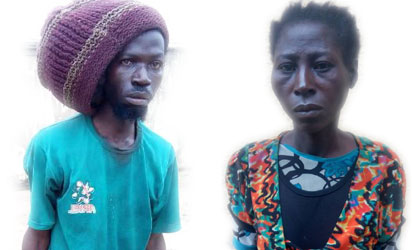
‘Madwoman’ – who was not mad after all – Folake Folade (right) and accomplice Emmanuel Gbenga (left)

Published: August 29, 2018, 3:54 am
By: Esther Onyegbula

The ‘madwoman’ who was arrested on Monday with decomposing corpses and other human parts under Cele Nicer Bridge in Ijanikin, Ojo area of Lagos State, has said she, at times, posed as a sex worker to get victims for her human parts business, which she has been operating for nine years.

Preliminary investigation also revealed that the suspect, identified as Folake Folade, was not mad after all. Rather, she was discovered to be the ringleader of a syndicate that sells human parts.

The suspect, who was arrested alongside her accomplice, identified as Emmanuel Gbenga, disclosed that some of her victims were men who she lured from hotels where she posed as a commercial sex worker.

When Vanguard visited the scene yesterday, some youths in the area and security agents were seen combing the tunnel under the bridge for more clues.

One of the residents of the area, Mojisola Kehinde, who claimed to be at the scene when Folake sang like a canary, said: “She opened a can of worms when she was caught.
She said she had been here (Cele Nicer Bridge) for nine years and that her business was to sell human parts to ready buyers.

“She said her customers usually parked on the bridge at night with their vehicles bonnets opened, pretending that their vehicles had one fault or the other, unknown to people that they were waiting to get human parts.

“She said her boys would be beneath the vehicle pretending to be working on the car to douse any suspicion and, in the process, hand over a nylon bag which contained the needed human parts.”

Another resident, Lawrence Oke, also claimed that Folake revealed that “whenever she failed to find preys to meet up with the demands of clients, she would dress up and head straight to any hotel of her choice at night.

“Any man that picks her for the night becomes a prey as he would end up in her den, where his body parts were later harvested and sold off to waiting clients.”

Lawrence also alleged that Folake confessed that she had boys that worked for her.

According to him, “she said once her hands touched someone, the person would lose his senses and follow her sheepishly.

She said her husband came there at times to have sex with her at night.”
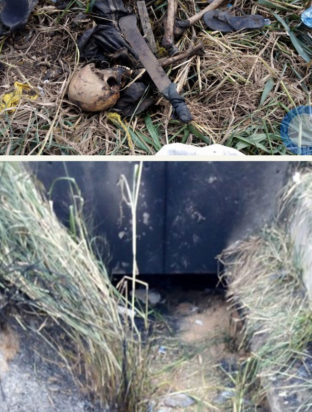
The tunnel’s entrance and some things found in it (top).

Bodies in the tunnel

Vanguard gathered that when she was being interrogated by the mob, she allegedly threw her phone into the bush.

While looking for the phone, the mob discovered a tunnel where some decomposing corpses were found.

The recovered bodies included those of a middle-aged man, a baby that was less than three months and a nine-year-old boy said to have been returning from holiday classes. Also recovered inside the tunnel were school uniforms, lunch boxes, schools bags and adult clothes.

Two Ghana-must-go bags of foreign currencies and wads of N1000 notes were also found.

A mechanic, Bamijoko Ayinde, who has a workshop in the area, told Vanguard: “Do you know she was always found with new N1000 note each time she went to buy anything? And she would not collect the balance. We all assumed she was mad.”

At 1p.m. yesterday, Deputy Commissioner of Police, in charge of Operations, Mohammed Alli, was sighted at the scene in the company of other policemen.

However, Lagos State Police Command condemned the mob action on one of the suspects, who was set ablaze.

Police to probe mob action

Spokesman for the command, Chief Superintendent Chike Oti, confirmed the incidents, including the lynching of the suspects’ accomplice.

Meanwhile, the Commissioner of Police, Imohimi Edgal, has directed the Divisional Police Officer in charge of Ijanikin to cordon off the scene and ensure that the remains found in the tunnel are not tampered with, pending the arrival of police forensic experts.

According to Oti, “the Commissioner said it is regrettable that despite the various town hall meetings he held to sensitise communities in the state to the evil of jungle justice, some people at Olorunshogo community constituted themselves into a mob and took laws into their hands by killing one of the suspects, who might have been very useful in the ongoing investigation, had they handed him over to the Police.

“He warned that anybody found to have participated in the killing of the yet-to-be-identified man, will be arrested and charged for murder to serve as a deterrent to others with penchant for taking the law into their hands.”

Source:
Lagos ‘madwoman’ caught with human parts, corpses: I pose as prostitute to get victims 
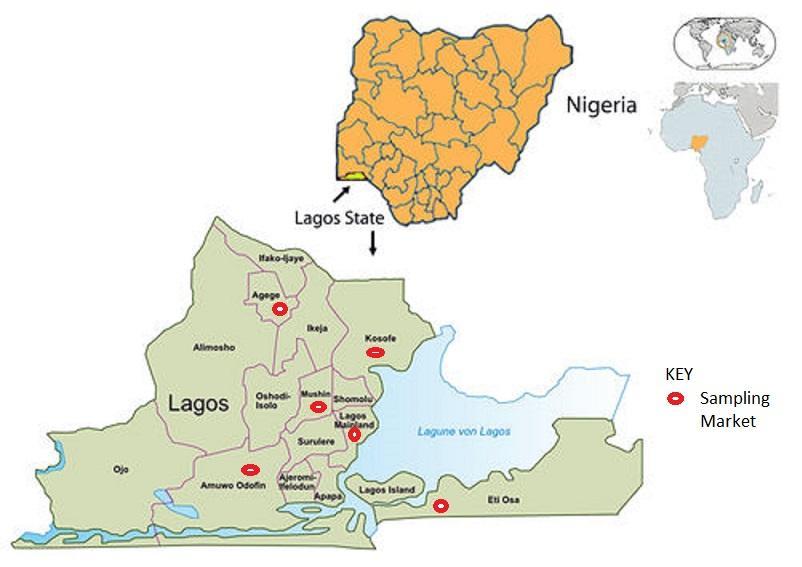
Lagos State – Nigeria
Gabon election raises fears of ritual killings (2008)

Published: April 16, 2008
Writing by Daniel Flynn; Editing by Clar NiChonghaile
Antoine Lawson
Reuters

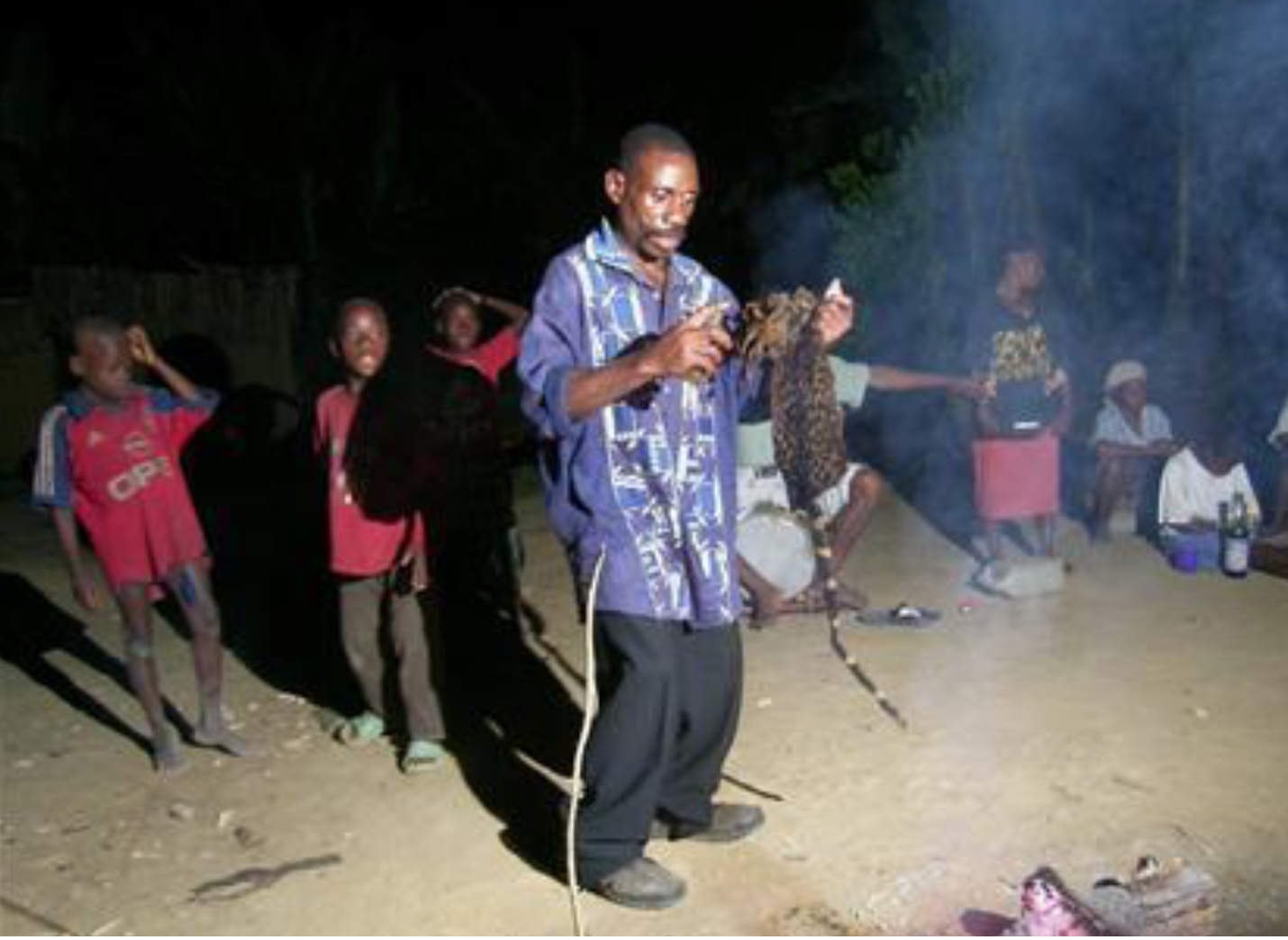
A sorcerer performs a dance in front of a sacred fire in Bitouga, some 600 km from the Gabon capital Libreville, in this September 2007 photo. REUTERS/Antoine Lawson

LIBREVILLE (Reuters) – When the body of 13-year-old Ralph Edang N’na was found drained of blood and with gaping wounds in his genitals, chest and neck last month, many in Gabon thought it was politicians who had ordered his killing.

The murder of children and young adults, whose organs are eaten or used to make magical amulets, has increased in recent years in the oil-rich central African nation. Campaigners say some Gabonese politicians use the black magic rituals to boost their chances of winning lucrative government posts.

With elections to local municipal councils due on April 27, many fear a spate of gruesome child murders.

Every week, mutilated bodies are discovered in the capital Libreville, despite police patrols, and streets quickly empty after nightfall. Anxious parents are keeping a close watch around schools to prevent children from being snatched.

“It’s before elections and ministerial reshuffles that the vilest crimes are committed and the capital empties of certain kinds of politicians who go to the interior to carry out witchcraft,” said pastor Francois Bibang, a member of the Association to Fight Ritual Crimes (ALCR).

In ritual killings, which still take place in several African countries, people, often children, are killed to obtain body parts and blood in the belief they will bring social success and political power.

The ALCR says that in February alone there were 12 such killings in Gabon.

“Unfortunately, this practice seems to be spreading again in Gabon,” said Jean-Elvis Ebang Ondo, who founded ALCR after his 12-year-old son was kidnapped, killed and mutilated in 2005.

The government set up a National Observatory for the Rights of Children in November 2006 to implement the U.N. charter on children’s rights, enshrining the right to health, education and protection from abuse.

Gabon, with just 1.6 million people, is one of sub-Saharan Africa’s largest oil producers but most of its population continue to live in poverty, while members of a rich elite drive shiny new cars along Libreville’s sea front boulevard.

Omar Bongo, the world’s longest-serving president, has ruled the country since 1967 and used the oil funds to weave a web of patronage which has created bitter competition for lucrative political jobs.

Ondo condemned “the silence of the state” and called on residents to “fight off these assassins who sow terror in the heart of Gabonese society”.

After a penal code approved in January omitted any mention of ritual crimes, Ondo called on the government to find out how many people had been killed in this way.

“Spare parts”

But no clear figures exist for how many children and teenagers are slain in ritual killings in Gabon.

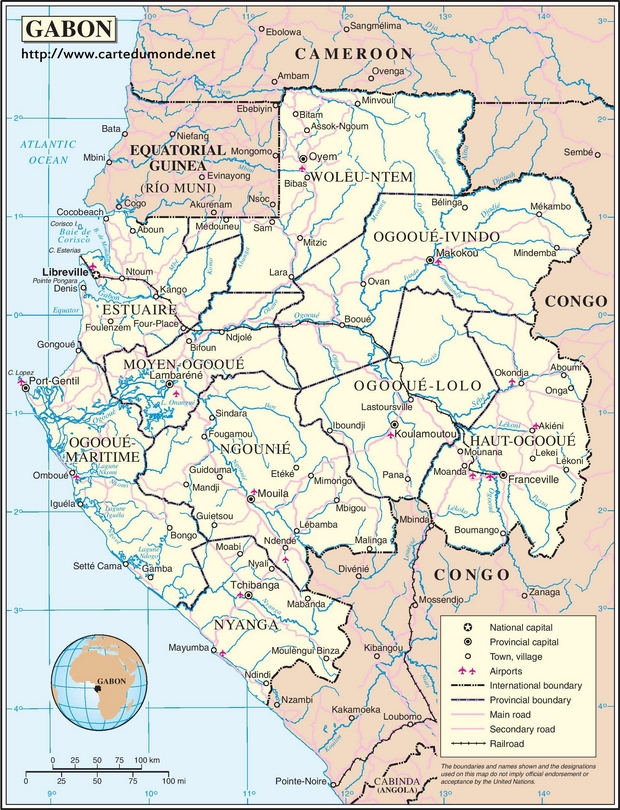
The head of an association against ritual crimes, Frederic Ntera Etoua, said 290 killings had occurred since 1986 in the thick jungles of the Ogooue-Ivindo province in the northeast, where Ralph Edang N’na was killed.

“There is a pyramid organization with politicians at its head who pursue the famous ‘spare parts’ then the recruiters who are middle men and then the suppliers and sellers who find the innocent victims,” said Bibang.

Parliamentary speaker Guy Nzouba Ndama opened the latest session of the assembly on March 3 by denouncing ritual crimes by politicians.

So far no politicians have been convicted for involvement in such crimes. An attempt to prosecute a legislator from the oil-rich region of Gamba last year failed after he claimed parliamentary immunity.

Philippe Ndong, a psychology teacher at Libreville university, traces the rise in ritual crimes to 2001.

“As legislative elections approached, mutilated bodies were discovered around the country,” said Ndong. “An 8-year-old girl was snatched in Ndolou department and killed in Mouila. The man allegedly responsible was a candidate to parliament who entered the government after this crime.”

Ndong cites other ritual murders. In 2002, a man in his 20s, Lucien Bigoundou, was killed in the Digoudou forest of central Gabon while on a hunting trip with companions who cut off his genitals and other parts of his body.

In March 2005, the bodies of two 12-year-old boys were washed up on a Libreville beach — one was Ebang Ondo’s son. A month later, six-year-old Warlys Igor Mboumba was found dead in a Libreville gutter, his body drained of blood.

In January 2006, the bodies of three children under four were discovered in the trunk of a car in a private yard.

And last April, two men suspected of sodomizing a 3-year-old boy and draining his blood in a ritual killing were lynched.

“It is up to the government to put a swift end to this impunity or risk seeing a rise in mob justice,” said pastor Emile Ngoua, a member of the ALCR.

Source: Gabon election raises fears of ritual killings
April 16, 2008