Ritual crimes: Gabon considers reinstating the death penalty

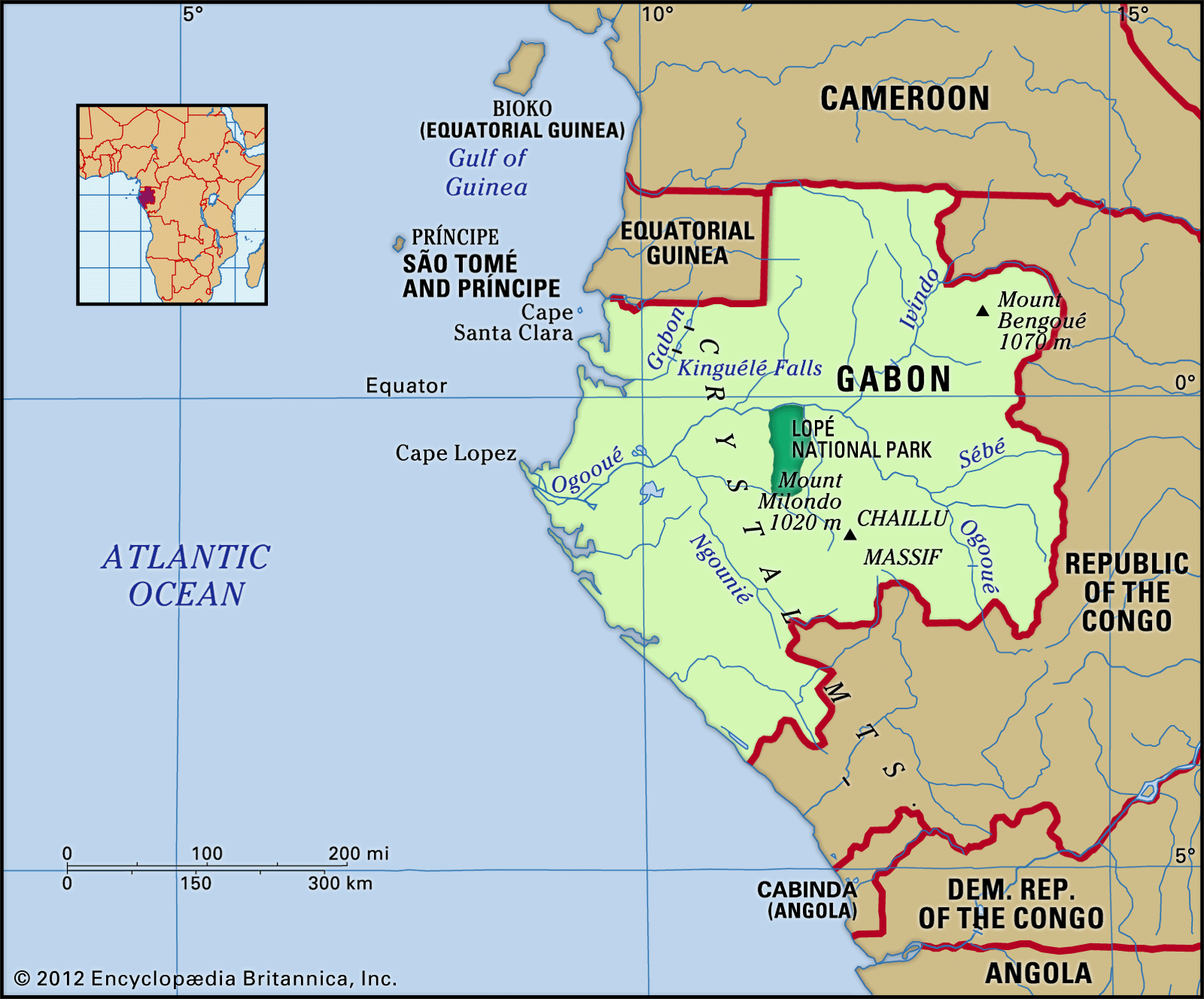
Gabon is a country in Central Africa. With an area of 270,000 square km (100,000 square miles) it belongs to the group of small African countries. Its population is estimated to be less than 3 million people. Though it is considered one of the wealthiest African countries in terms of per capital income – Gabon’s nominal GDP per capita was $10,149 in 2023 – many Gabonese people live in poor conditions whereas a minority leads a life of luxury. Reportedly, the richest 20% of the population earn over 90% of the income while about a third of the Gabonese population lives in poverty.

At present, the president of the country is Brice Oligui Nguema. The general and former military government ruler, who led a successful military coup in August 2023, ending 55 years (!) of rule of father and son Bongo – Omar Bongo Ondimba (1967-2009) and Ali Bongo Ondimba (2009-2023) – won the presidential elections in April last year with nearly 95 percent of the vote. He was sworn in as the country’s fourth president (since independence in 1960) after leading a 19-months transition government. Interestingly, Brice Oligui Nguema is a maternal cousin of his predecessor, Ali Bongo.

In a recent post I already reported a rise of ritual killings in the country. An explanation is lacking. Ritual murders are not uncommon in this country. The death penalty was abolished in 2010. Recently there have been renewed calls for reinstating the capital punishment for ritual crimes. It is doubtful whether this will stop this gruesome practice.
(webmaster FVDK)

Ritual Crimes: Gabon Considers Reinstating the Death Penalty

Attention: screenshot. To access the video please click here
Sources : Fides/cath.ch / FSSPX Actualités
Illustration : Lukasz Kobus – Wikimedia Commons / Union européenne (CC BY 4.0)

Published: January 26, 2026
By: FSSPX NEWS

Brice Oligui Nguema, President of Gabon

In Gabon, a wave of ritual crimes has once again plunged the population into terror. Faced with the horror, the head of state has reopened the debate on the reinstatement of the death penalty. The Catholic Church finds itself at a crossroads, between absolute condemnation of the barbaric crimes and its alignment with the recent positions of the magisterium regarding the death penalty.

A Resurgence That Sows Terror

Emotions are running high since the discovery of mutilated bodies, often those of children or women, deprived of vital organs. These macabre removals, intended for occult practices supposedly conferring power and wealth, are fueling a collective psychosis. The recent case of young Cameron, whose murder sparked a wave of outrage, is only the tip of the iceberg that the Association for the Fight Against Ritual Crimes (ALCR) has been denouncing for decades.

The Possible Return of Capital Punishment

Faced with popular pressure and the growing feeling of insecurity, General Oligui Nguema has taken a symbolic step. During his New Year’s address to the nation in January 2026, the head of state suggested a public consultation, or even a referendum, on the reinstatement of the death penalty, which was abolished in Gabon in 2010. For the transitional government, this is a way to respond to a thirst for immediate justice and to mark the end of impunity perceived as an admission of complicity. Supporters of the “yes” vote see this measure as the only safeguard capable of deterring the perpetrators and those who commission these bloody rituals.

The Episcopate’s Dilemma

The Gabonese Catholic Church, a historical moral force in the country, finds itself in a delicate position. While it condemns in the strongest terms what it calls the “profanation of the human being,” the Church, like most episcopates, has aligned itself with the 180-degree shift made by the Vatican on this issue. While the Catechism of the Catholic Church, published in 1992 under the reign of Pope John Paul II, still defended the legitimacy of capital punishment, Pope Francis has—almost entirely—said the exact opposite. It is a position followed so far by his successor. Thus, for the bishops, ritual crime is the expression of a “culture of death” that cannot be fought by shedding more blood. This is an idealistic position that is too “Western” in flavor for many Africans, and one that the Church risks creating a misunderstanding.

The Gabonese prelates prefer to encourage the authorities to address the root causes of the problem, which they have, moreover, identified very well: the corruption of the judicial system, the poverty that makes the population vulnerable, and especially the influence of esoteric sects within the administration.

For a Stronger Church

The ALCR, for its part, emphasizes that, in the past, sentences of life imprisonment have not been sufficient to stem the tide of this scourge, due to a lack of strict application of the law and protection of witnesses.

The fight against ritual crimes demands immediate, exemplary punishments and requires a rehabilitation of moral values ​​as well as a radical reform of the state apparatus so that every citizen feels protected by the law, and not by perverted ancestral rituals. To achieve this, the Church will need to rediscover a powerful doctrine and voice, which the era inaugurated at Vatican II has not helped strengthen.

Source: Ritual Crimes: Gabon Considers Reinstating the Death Penalty

Anger rises in Gabon after rash of ritual killings (2013 article) 

Not much is known about the occurrence of ritualistic murders and related activities in Gabon. The 2013 article cited below strongly suggests that the belief in the supernatural powers derived from ritualistic murders exists and may even be widespread in this Central African country. According to the president of Gabon’s Association for the Prevention of Ritual Crimes, Jean-Elvis Bang Ondo, there were more than 20 ritual murders in the country in the first quarter of 2013, a staggering number,

The article also refers to a 2009 ritual murder implicating a senator. It wasn’t the first time a high-profile politician was involved in a ritual murder case (also see my earlier posting on the case) and I’m afraid it won’t be the last time. After all, though President Ali Bongo is no longer president of Gabon (he was deposed earlier this year, on August 30) and the country has a new leader, Transitional President Brice Clotaire Oligui Nguema, this does not mean that ritual killing has stopped. Recently new reports emerged with details of ritual murders. Gabon’s new leaders face many challenges including the fight against superstition and ritualistic violence.
(webmaster FVDK)

Anger rises in Gabon after rash of ritual killings

Screenshot – not related to the article below

Published: March 26, 2013
By: Jean Rovys Dabany – Reuters

LIBREVILLE (Reuters) – A rising number of mutilated bodies washing up on Gabon’s beaches this year has sown fear in the normally sleepy capital Libreville of a resurgence in ritual killings.

The body parts of humans and animals are prized by some in central Africa for their supposed supernatural powers, including among some politicians bent on gaining influence.

“We have seen 20 killings since the start of the year,” said Jean-Elvis Ebang Ondo, the president of Gabon’s Association for the Prevention of Ritual Crimes, in Libreville.

He said most of the victims were young girls whose lips, tongues, genitals and other organs had been removed.

The killings have stirred rising anger against President Ali Bongo’s government for doing too little to halt the murders.

“We want to shout out our fury and tell the authorities that this needs to stop,” said Jessy Biyambou, a member of the Cry of Women advocacy group, which is organizing an April 6 rally in support of victims’ families.

Roland Akoumba, whose 8-year-old daughter was found dead in mid-March, told Reuters he was losing hope for justice.

“When the police removed the body from the water, they saw that the tongue, the lips, and the genitals were cut off,” he said. “I filed a complaint but I know it will go nowhere.”

Officials from the notoriously closed-door government of the former French colony have declined to comment publicly on the killings.

Bongo was elected president in 2009 in polls that triggered days of rioting and opposition complaints of fraud. He succeeded his father Omar Bongo, who held a tight grip on power in the oil producing state from 1967 until his death 42 years later.

“The phenomenon of ritual crimes is real. But no one here is willing to turn anyone else in for fear they too will be in danger,” said a member of parliament, who asked that his name not be used for fear of reprisals.

In the most high-profile ritual murder court case in Gabon to date, a convicted killer accused a Gabonese senator of ordering the 2009 murder of a 12-year-old girl for her organs.

The senator’s immunity was lifted after the accusation was made late last year, but he has not been indicted. The senator has denied any involvement.

Gabon is not the only African country with a black market trade in human organs.

Tomb raiders dug up more than 100 graves in Benin’s capital in November. Cameroonian authorities in September arrested five people for trafficking after they were stopped at a checkpoint with a severed human head.

He said most of the victims were young girls whose lips, tongues, genitals and other organs had been removed.

The killings have stirred rising anger against President Ali Bongo’s government for doing too little to halt the murders.

“We want to shout out our fury and tell the authorities that this needs to stop,” said Jessy Biyambou, a member of the Cry of Women advocacy group, which is organizing an April 6 rally in support of victims’ families.

Roland Akoumba, whose 8-year-old daughter was found dead in mid-March, told Reuters he was losing hope for justice.

“When the police removed the body from the water, they saw that the tongue, the lips, and the genitals were cut off,” he said. “I filed a complaint but I know it will go nowhere.”

Officials from the notoriously closed-door government of the former French colony have declined to comment publicly on the killings.

Bongo was elected president in 2009 in polls that triggered days of rioting and opposition complaints of fraud. He succeeded his father Omar Bongo, who held a tight grip on power in the oil producing state from 1967 until his death 42 years later.

“The phenomenon of ritual crimes is real. But no one here is willing to turn anyone else in for fear they too will be in danger,” said a member of parliament, who asked that his name not be used for fear of reprisals.

In the most high-profile ritual murder court case in Gabon to date, a convicted killer accused a Gabonese senator of ordering the 2009 murder of a 12-year-old girl for her organs.

The senator’s immunity was lifted after the accusation was made late last year, but he has not been indicted. The senator has denied any involvement.

Gabon is not the only African country with a black market trade in human organs.

Tomb raiders dug up more than 100 graves in Benin’s capital in November. Cameroonian authorities in September arrested five people for trafficking after they were stopped at a checkpoint with a severed human head.

Source: Anger rises in Gabon after rash of ritual killings

Witchcraft killer decapitates five-year-old albino boy and hacks off his legs in Congo (DRC)

It’s again a sad (and cruel) story. The reader is warned: the following article contains graphic details of a barbaric crime. This time it occurred in an eastern region of the vast Central African country Democratic Republic of Congo (DRC). Two tiny Central African countries Rwanda and Burundi are nearby. Is there a relationship with these countries where people with albinism are also often targeted by unscrupulous individuals? Who is responsible for this horrific act which left a young boy dead, a crime which was based on superstition and motived by greed? As soon as more will be known I will share it with you. Meanwhile we hope that the authorities are swift in their reaction, effective in their investigations, and without mercy to bring the perpetrator(s) to court to account for their ruthless and disgusting deed.
(webmaster FVDK)

Witchcraft killer decapitates five-year-old albino boy and hacks off his legs in Congo

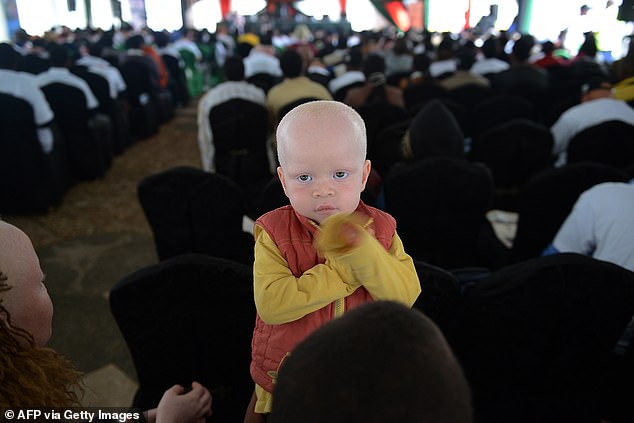
Albinos in the DRC are sometimes targeted due to the belief that their body parts can be used in magic rituals (file image of a boy with albinism in Kenya)

Published: February 2, 2023
By: Jack Newman – Mail Online, UK

  • Some believe people with albinism have magical powers in sub-Saharan Africa
  • Their body parts are often sold for thousands on the black market 

A five-year-old albino boy has been decapitated and had his legs cut off by a witchcraft killer in the DR Congo.

Occult believers in sub-Saharan Africa believe the body parts of people with albinism carry magical powers and are regularly sold on the black market. 

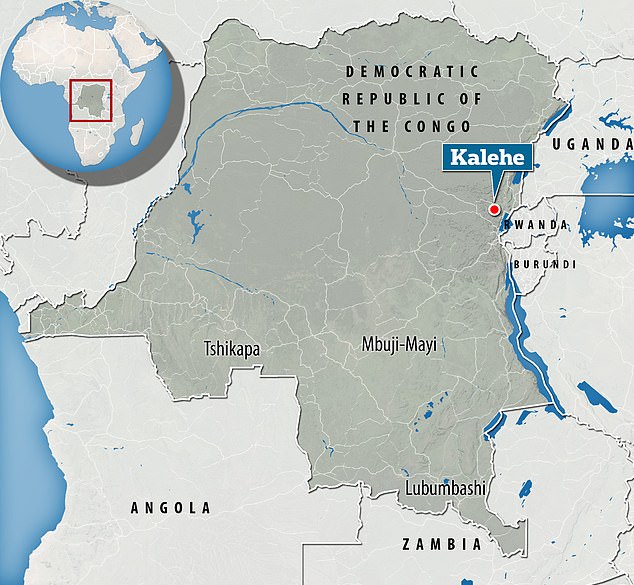
The young boy’s body was found in eastern DR Congo’s South Kivu province in the Kalehe area of South Kivu – a province that borders Rwanda and Burundi.

Only the arms and torso remained of the boy when he was discovered on Wednesday, and police are hunting for the killer.

Archimedes Karhebwa, assistant administrator of Kalehe territory said: ‘We condemn and deplore this new case of the murder of a 5-year-old albino, who was kidnapped by armed bandits for ulterior motives.’

Juvenal Lushule, who works for an albino association in South Kivu, said that 18 albinos had been killed in similar circumstances in the province since 2009.

He said: ‘This recent case disgusts us and does not surprise us, because we have always been victims of these barbarisms.’ 

Ten albino graves had also been profaned during that period, according to Lushule, and there were 22 kidnapping attempts.

As in several other African countries, albinos in the DRC are sometimes targeted due to the belief that their body parts can be used in magic rituals to bring fame and fortune.

Because of the superstition, their body parts can be sold for thousands of dollars and they are often targeted in ritual killings. 

Some believe that having sex with an albino woman can also cure AIDS. 

Albinism, caused by a lack of melanin, the pigment that colours skin, hair and eyes, is a genetic condition that affects hundreds of thousands of people worldwide, especially in Africa.

Source: Witchcraft killer decapitates five-year-old albino boy and hacks off his legs in Congo

The young boy’s body was found in eastern DR Congo’s South Kivu province in the Kalehe area of South Kivu – a province that borders Rwanda and Burundi