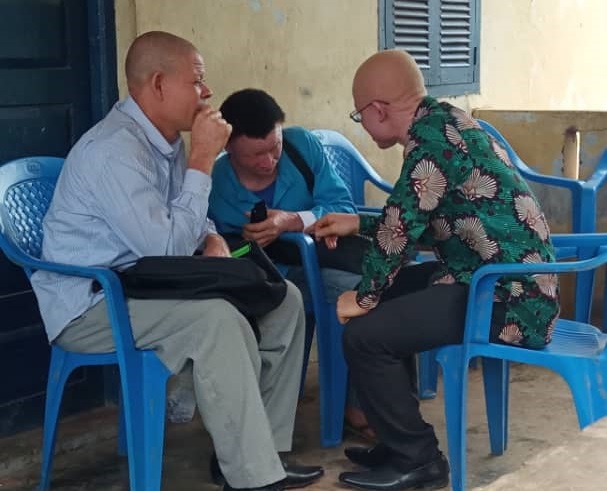
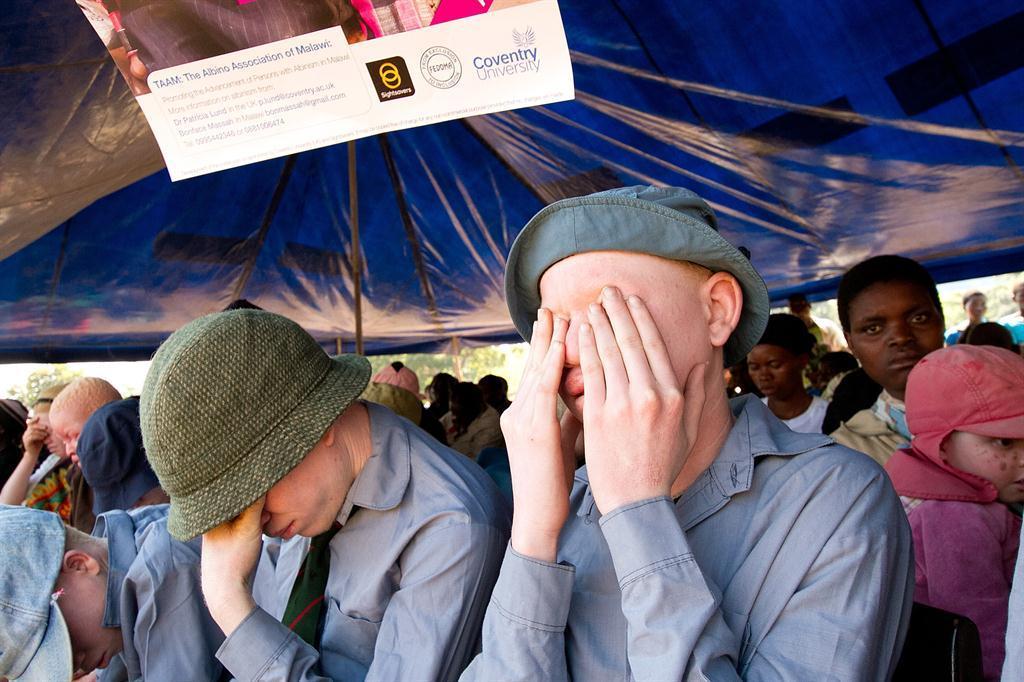
Persons with Albinism are trying to engage the public to help deal with climate change. Photo: Africa Feeds Media
Published: May 21, 2019 By: Senyo Esah
Albinism is a rare, non-contagious, genetically inherited condition that leads to a lack of pigmentation in the hair, skin and eyes, causing vulnerability to the sun and bright light.
Persons with albinism in Ghana are dying at an alarming rate as a result of climatic change and harsh weather conditions.
The association of Persons with Albinism (PWAs) in Ghana has lamented the harsh weather condition. It said although global warming is a worldwide headache, its members are the hardest hit by its effects.
This is because persons with albinism have peculiar skin condition.
Albinism is a rare, non-contagious, genetically inherited condition that leads to a lack of pigmentation in the hair, skin and eyes, causing vulnerability to the sun and bright light.
The condition is characterized by lack of melanin pigment in the skin, hair, and eyes.
Global warming records
According to co2.earth, the temperature across the global land and ocean surfaces in the year 2018 was 0.86°C (1.55°F).
That is above the 20th-century average and places October temperature as the second highest since global records began in 1880.
Director of the association of Persons with Albinism in Ghana, Newton Katseku told Africafeeds.com that the current era of global warming is a very unbearable time for his members.
He explained that due to the absence of melanin in their skins, they suffer skin cancers as a result of direct exposure to the ultraviolet rays.The association is, therefore, calling on the public to engage in tree planting and other environmental health support programmes to remedy global warming.
Newton Katseku has also called on the government of Ghana to commit resources to Sustainable Development Goal 13 (SDGs 13) which enjoins all nations across the world to adopt environmentally friendly policies to help salvage the increasing rise in global temperature.
He believes fulfilling the goal will bring relief to persons living with albinism as they will have a congenial ecosystem to survive and also contribute their quota to the well-being of the society.
Persons with Albinism are trying to engage the public to help deal with climate change. Photo: Africa Feeds Media
Anti-albino cultural practices
According to recent statistics, as of 2009, between one in 17,000 and one in 20,000 people were albinos globally.
But in parts of Africa including Ghana persons with albinism also suffer various forms of discrimination.
In certain parts of Africa including Malawi, Tanzania, South Africa among others, albinos are killed for ritual purposes. The belief is that, using their body parts for ritual sacrifices engender success in businesses and other endeavours. (italics added by the webmaster FVDK)
In some communities in Ghana, they are not welcomed and supported.
There are ongoing public engagements with traditional rulers of some communities to amend their cultural practices that are inimical such persons.
Newton Katseku told Africa Feeds that his outfit intends to expand the engagements to other parts of the nation.
“This is as a result of our finding that certain communities in Ghana do not tolerate persons with albinism, neither do they allow them to live in the communities.
These communities are not welcoming to persons with albinism because of their cultural practices and beliefs. So, we have thought it wise to dialogue with the traditional leaders of the communities to fashion out how to amend some of their cultural practices and beliefs,” Katseku said.
The initiative is supported by the Open Society Initiative for West Africa, a West African organization that promotes democratic values.
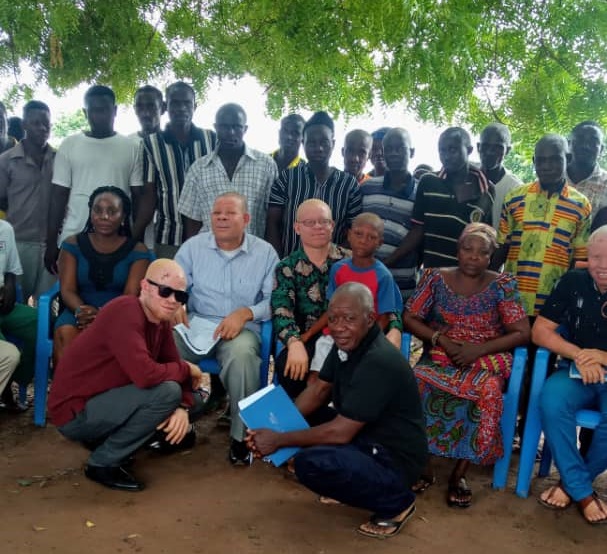
A public gathering in a community in Ghana to seek support for Albinos. Photo: Africa Feeds Media
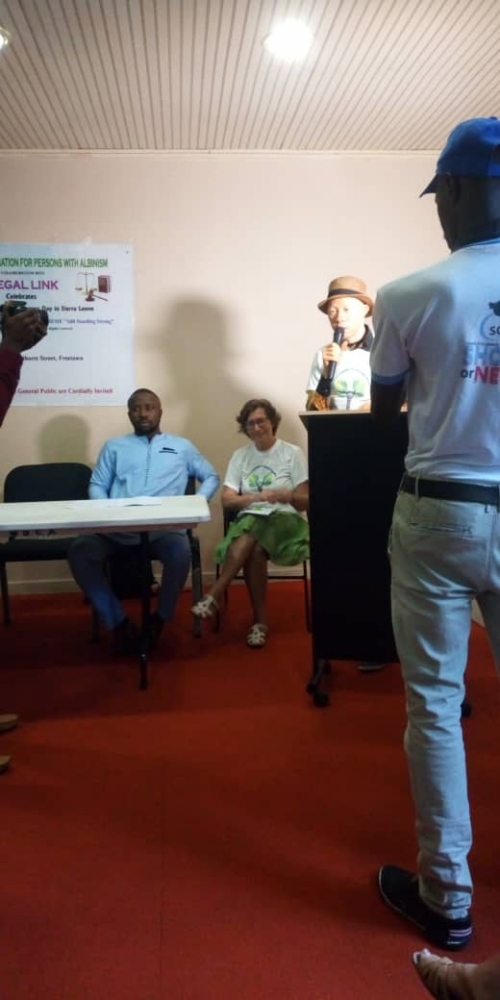
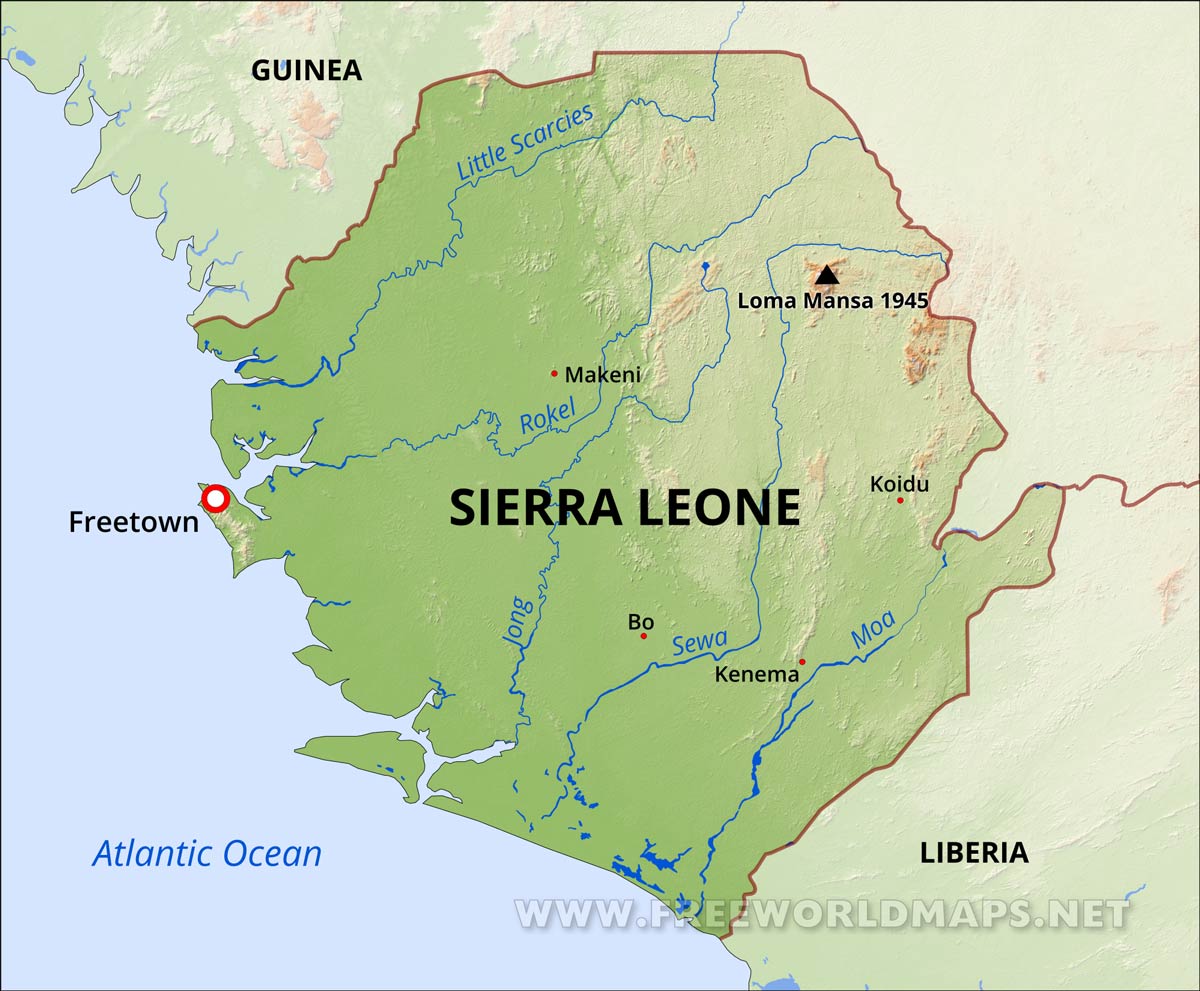
This posting is NOT about ritual killings of people with albinism in Sierra Leone. It contains a public lecture by Rashid Dumbuya on the occasion of Albinism Awareness Day celebrations in this West Africa Country. However, also in Sierra Leone people with albinism face discrimination and barriers that limit their full participation in society on an equal basis with others.
In Sierra Leone, people with albinism are considered people with disabilities. Rashid Dumbuya concludes his public lecture with a number of recommendations to improve the position of people with albinism in Sierra Leone. (webmaster FVDK)
The picture presented here is not related to the article below on people living with albinism in Sierra Leone
Published: June 19, 2019 By: The Patriotic Vanguard (Sierra Leone)
Albinism Awareness Day Celebrations in Sierra Leone
Public lecture by Rashid Dumbuya Esq
Them: Still standing strong; realizing the rights of Persons with Albinism in Sierra Leone.
General introduction
Due to the immense challenges that were being faced by persons with albinism coupled with the increased momentum and outcry for their protection across the world, the United Nations Human Rights Council adopted a resolution in 2013 (A/HRC/RES/23/13) calling for the prevention of attacks and discrimination against persons with albinism around the world.
Consequently, on the 18th December 2014, the United Nations General Assembly heeded to the call and adopted Resolution 69/170 proclaiming 13th June as International Albinism Awareness Day.
Following this Resolution, the UN Human Rights Council on the 26 of March 2015 in resolution 28/6 established the mandate of the Independent Expert on the enjoyment of human rights by persons with albinism.
The work of the Independent Expert among many other things as provided in its mandate is to engage in dialogue and consult with States and other relevant stakeholders; to identify, exchange and promote good practices relating to the realization of the rights of persons with albinism and their participation as equal members of society; to promote and report on developments, challenges and obstacles relating to the realization of the enjoyment of human rights by persons with albinism and to make recommendations in that regard to the Human Rights Council.
On 3 July 2015, the Human Rights Council appointed Ms. Ero of Nigeria as the first mandate holder and Independent Expert on the enjoyment of human rights by persons with albinism.
She assumed her duties on 1st August 2015 and in January 2016, she submitted her first report on Albinism to the UN Human Rights Council.
STILL STANDING STRONG has been chosen as the international theme for this year’s International Albinism Awareness Day Celebrations.
The theme is a call to recognize, celebrate and stand in solidarity with persons with Albinism around the world, to support their cause, their accomplishments as well as their challenges and to promote and protect their fundamental human rights.
LEGAL LINK is therefore proud to have associated and collaborated with the Sierra Leone Association of Persons with Albinism in commemorating this historic and symbolic day here today in Sierra Leone.
But why does the UN mark international days like this?
International days have been embraced by the UN because it affords an occasion to educate the world on issues of concern, to mobilize political will and resources to address global problems; and to celebrate and reinforce achievements of humanity.
They also serve as powerful advocacy tool to draw attention and make strong case for reforms.
What is Albinism?
Albinism is a rare, non-contagious, genetically inherited condition that affects people worldwide regardless of ethnicity or gender.
It results from a significant deficit in the production of melanin and is characterized by the partial or complete absence of pigment in the skin, hair and eyes. In order for a person to be affected by albinism, both parents must carry the gene and, in that case, there is a 25per cent chance that a child will be born with albinism at each pregnancy.
What are the prevailing statistics on Albinism across the world?
The proportion of persons affected by albinism in the world differs from region to region.
In North America and Europe, it is estimated that 1 in 17,000 to 20,000 people are affected by the condition, while in sub-Saharan Africa,1 in 5,000 to 15,000 could be affected, with specific countries having a much higher tendency, including estimated rates of 1 in 1,400, and about 1 in 20 persons in the general population carrying the gene for albinism.
Other studies suggest that in specific groups in Panama or in the Pacific region, the rate of people affected could be as high as 1 in 70 to 1 in 125.13.
However, in Sierra Leone, a report done by OSIWA in 2018 puts the statistics at a little over 500 people affected by albinism.
What are the different types of albinism?
Albinism is of different types. The most common and visible type is oculocutaneous albinism (OCA), which affects the skin, the hair and the eyes.
Within this type, there are subtypes, which reflect varying degrees of melanin pigment deficiency in an individual.
The main subtypes of OCA are tyrosinase negative albinism (OCA1) and tyrosinase positive albinism (OCA2).
In OCA1, there is little or no production of melanin and it is often characterized by white hair and opaque or transparent irises.
In OCA2, which is more prevalent particularly in African countries, some melanin is produced and it is characterized by yellow-blonde or sandy-coloured hair and grey to light brown irises.
A less common form of albinism is ocular albinism which affects the eyes alone, while albinism accompanied by Hermansky-Pudlak syndromeis is another less common form, which is characterized by bleeding disorders, bowel (colitis) and lung diseases.
*What are the legal frameworks protecting the rights of persons with albinism?*
At the International level:
Universal Declaration of Human Rights
International Covenant on Civil and Political RightsUnited Nations Convention on the Rights of Persons with Disabilities
Independent Expert on the enjoyment of human rights by persons with albinism.
All of the above international frameworks promotes equality and non-discrimination.
At the African regional level:
The African Charter on Human and Peoples Rights
The Regional Action Plan on Albinism in Africa
Resolution by the Pan African Parliament to facilitate the investigation and prosecution of perpetrators of attacks on persons with Albinism
At the domestic level:
The 1991 Constitution of Sierra Leone – (talks about protection from discrimination)
The Sierra Leone Disability Act of 2011.- (classify them generally as PWD’s)
The National Commission for Persons with Disabilities
The Human Rights Commission of Sierra Leone -(promote and protect their rights)
Sierra Leone Association for persons with Albinism- (umbrella body in SL)
Challenges and areas of concern
Persons with albinism face discrimination and barriers that restrict their participation in society on an equal basis with others every day.
Due to those many challenges, persons with albinism throughout the world are unable to enjoy the full range of human rights and the same standards of equality, rights and dignity as others.
While some of those challenges are global, others have predominantly been identified in certain regions.
In the Independent Expert’s report of 2016, some of the challenges identified include human rights violations such as attacks, desecration of graves, trafficking of body parts, displacement, discrimination against persons with albinism, as well as human rights violations based on disabilities, deprivation of the right to the highest attainable standard of health and the right to education.
1. Witchcraft and related offences
It has been widely reported and documented that persons with albinism are hunted and physically attacked due to prevailing myths such as the misbelief that their body parts, when used in witchcraft rituals and potions or amulets, will induce wealth, good luck and political success.
Other dangerous myths that facilitate the perpetration of attacks are those linked to perceptions of their appearance, including misbeliefs and myths that persons with albinism are not human beings, but ghosts, that they are subhuman and that they do not die, but disappear.
An increase of those attacks, referred to as “ritual attacks”, has been reported by to have been high in Africa especially during periods of political elections.
2. Brutal and deadly nature of the Attacks on PWA’s
In Africa, it is reported that, attacks directed at persons with albinism are usually carried out with machetes, resulting in severe mutilation or death.
In most cases, the persons attacked are dismembered; body parts such as fingers, arms, legs, eyes, genitals, skin, bones, the head and hair have been severed from the body and taken. In several of those cases, body parts have been hacked off while the person was alive.
Reportedly, there is a corollary witchcraft belief that it is preferable to harvest body parts from live victims because screams increase the potency of the potion for which the parts are used.
Since 2007, civil society organizations have reported hundreds of attacks against persons with albinism in 25 countries.
All of those physical attacks appear to be, at least in part, related to the erroneous beliefs and myths linked to witchcraft practices.
3. Lucrative Trade and markets for the body parts of persons with albinism.*
It has been reported that there is a market for body parts of persons with albinism. The body parts are reportedly sold both locally and across borders.
The prices of body parts reportedly range from $2,000 for a limb to $75,000 for a “complete set” or a corpse. Civil society reports indicate that, motivated by those prices, family members and communities have sold, or attempted to sell, persons with albinism, thereby fuelling the supply side of this macabre trade.
Recent cases of body-parts trafficking that were brought to the attention of the Independent Expert by civil society include cases where law enforcement agencies acted promptly and were able to prevent the sale and save the persons with albinism involved.
In a few other cases, however, the body parts were harvested and have still not been recovered.
4. Forced migration
Attacks against persons with albinism in some areas have caused hundreds of persons, particularly women and children, to flee their homes and seek refuge in temporary shelters.
Most of these shelters were neither designed nor prepared for an influx of persons with albinism, and are also not equipped to address the special needs of persons with albinism. Reports show that inhabitants with albinism are exposed to early skin cancer risk and various forms of abuse.
5. Discrimination and stigmatization
One of the main barriers to the implementation of the human rights of persons with albinism is discrimination and stigmatization, both of which are historically and culturally entrenched. Information on discrimination against persons with albinism is a common reality around the world. However, the expression and severity of the discrimination faced by persons with albinism vary from region to region.
In sub Saharan Africa in particular, bullying of school-age children owing to their appearance is on the increase.
Also, discrimination takes more extreme forms, including infanticide, physical threats and attacks.
Lack of information on the condition facilitates the spread of myths to explain albinism, most of which are erroneous and in some cases dangerous, including myths that people with albinism are ghosts or the result of conception during menstruation or the result of a general curse.
Challenges faced by persons with albinism in Sierra Leone
Though not severe and deadly like those encountered in East and Southern parts of Africa, Persons with Albinism (PWA) in Sierra Leone also face huge challenges in the realization of their rights.
Firstly, they have been largely excluded and sometimes forgotten by government, civil society, donors and development partners in the democratic and governance agenda of the country. Issues affecting them have generally gone unnoticed and has resulted to deep engraved stigma, exclusion, discrimination and sometimes violence against them.
Furthermore, they have little or no voice compared to other marginalized groups such as persons with disabilities, children and women.
Also, there is little activism on the part of civil society as well people living with the condition to advocate for the promotion and protection of their rights and wellbeing which may be a consequence of lack of knowledge and understanding and/or interest.
Other challenges include access to justice, education, health, employment and even political representation in the democratic governance architecture of the country.
More negative still, the lack of effective, functional and genuine bodies, organizations or CSO’s in Sierra Leone to help advocate on the rights of PWA’s has also left them vulnerable to exploitation by unscrupulous persons and organizations.
Finally, the challenges encountered by Persons with Albinism in Sierra Leone could be best summarized in the words of the Founder and Executive Director of Sierra Leone Association for Persons with Albinism, Mohamed Osman Kamara aka Jay Marvel, as posted on their Facebook page.
*‘’We Demand Action to be taken Now! We Crying Since Yesterday Night…… About the Demise Of Mahid Jalloh, Who Was Also Admitted At Connaught For Skin Cancer With The Late Ruth. He Was Transfered To The Shepherd Hospital At Tombo. There He Passed Away On The 23rd At Around 12:00pm. We Are Calling On the Sierra Leone Government, And All Organizations Around the World… Skin Cancer Is Killing Us. These Are Just The Two ( 2) Known Cases.. Who Knows How Many Persons With Albinism Are Dying From Skin Cancer In The Country? , Because We Lack Proper Health Care. This is a Serious National Issue. Every Citizen Should Be Concerned and Try in His or Her Own Way.!!! Ministry Of Health, National Commission For Persons With Disability, Ministry Of Social Welfare Children and Gender Affairs etc YOU SHOULD TAKE THE LEAD IN THIS CASE! Rest In Peace Our Beloved Brother! We Love You Both and Pray the Government Puts An End To Skin Cancer Affecting Persons With Albinism In Sierra Leone.!’’*
Recommendations
From the above points raised, it stands to reason that human right abuses and violations of the rights of persons with albinism is still commonplace in Sierra Leone.
*LEGAL LINK* therefore joins the Sierra Leone Association for Persons with Albinism in calling on the government of Sierra Leone to adopt and implement the Regional Action Plan on Albinism in Africa as well as the newly adopted resolution by the Pan African Parliament to facilitate the investigation and prosecution of perpetrators of attacks on persons with albinism and further ensure effective education and awareness training on the human rights of people with albinism. Also, we call on the government and Parliament of the Republic of Sierra Leone to pass a specific law that will adequately protect the rights of albinism in the country.
Furthermore, we call on the government to ensure that victims and members of their families have access to appropriate remedies.
More significantly, we call on the government, the human rights commission, the National Commission for persons with disabilities and other civil societies organizations with human rights mandate to increase education and public awareness-raising activities on the rights of persons with albinism so as to deconstruct stereotypes and existing myths.
We further call on government to ensure that PWA’s are not discriminated in schools and are provided with scholarship support to pursue their education to the highest of levels. Free healthcare for PWA’s must also be guaranteed so as to help address the problem of skin cancer.
The Government of Sierra Leone should also ensure that PWA’s are included in the three arms of government as well as the public service and other sectors crucial for the running of the affairs of the state. This will help to de- mystify myths and erroneous beliefs about PWA’s not being human.
Finally, inclusion of information on the situation of persons with albinism in reports submitted by the Government of Sierra Leone to the African Commission on Human and Peoples’ Rights under article 62 of the African Charter on Human and Peoples’ Rights and also to the UN Human Rights Council under the UPR, is good practice in the protecting and promoting of the rights of persons with albinism.
Conclusion
Persons with Albinism have faced and continue to face, ongoing hurdles and challenges that seriously undermine their enjoyment of fundamental human rights in Sierra Leone and the world at large. From stigma and discrimination, to barriers of access to health and education as well as marginalization from socio-political and democratic institutions in the country.
In addition, PWA’s have also become subjects of attacks for ritual killings and political power in many parts of Africa.
But despite all of these challenges, PWA’S have remained undaunted and are STILL STNDING STRONG! WE CAN DO BETTER FOR THEM BY ACCEPTING THEM AS HUMAN BEINGS THAT DESERVES TO LIVE, ENJOY EQUAL RIGHTS, DIGNITY AND RESPECT WITH US!
Thank You
Rashid Dumbuya ESQ
Executive Director – LEGAL LEGAL LINK
Christian Lawyers Centre (a.k.a LEGAL LINK) is registered with the Corporate Affairs Commission of Sierra Leone as a non-profit legal advocacy group comprising of lawyers, law students and human right activists that seeks to provide legal assistance to religious communities and vulnerable groups in Sierra Leone through legal advocacy, public interest litigations, state and private sector accountability, enforcement of the rule of law and respect for domestic and international laws that guarantee fundamental human rights and freedoms.
Published: January 28, 2019 By: Bukola Adebayo – CNN
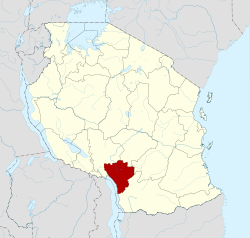
Ten children kidnapped in Tanzania have been found dead with their body parts mutilated, authorities told CNN on Monday.
Tanzania’s deputy health minister Faustine Ndugulile said all 10 children had been missing since December in Njombe district, southwest Tanzania. Their bodies were discovered last week after police launched a search operation in the area.
“So far, we have found 10 bodies, and most of their private parts and teeth had been removed,” Ndugulile said. “These murders are linked to witchcraft practices because that is the trend for such crimes, where herbalists ask people to get these human parts for money rituals,” he added. The children, some as young as seven, were kidnapped from their homes last month.
Many children have been reported missing by their parents in the community since December, according to Ndugulile, who said the health ministry was also investigating the wave of killings. “We want to identify the perpetrators, but our focus is to educate the traditional practitioners in the area quickly and those in surrounding communities on the need to stop these acts,” Ndugulile told CNN.
The Deputy health minister told CNN that these killings are not linked albino ritual murders which are prevalent in Tanzania and other parts of east Africa. “These murders are not linked to albino killings,” he said. “But it is very sad because they are children and they don’t deserve to be used like this,” Ndugulile said.
Tanzania has one of the highest rates of albinism in the world, at one in 1,500 people.
Despite its prevalence, there’s still a lack of education and tolerance and albinos are regularly killed for their bones and organs, which are sold to witch doctors for “charms and magical potions”, according to Amnesty International.
Published: December 13, 2018 9:40 PM EST By: Brad Hunter
Witch doctor Nino Mbatha, 33, was jailed for life for murdering and eating a young woman
Two cannibals have been jailed for life after one was busted carrying a bag with a human hand and a leg inside.
When one surrendered to cops in South Africa, he told stunned detectives: “[I’m] tired of eating human flesh.”
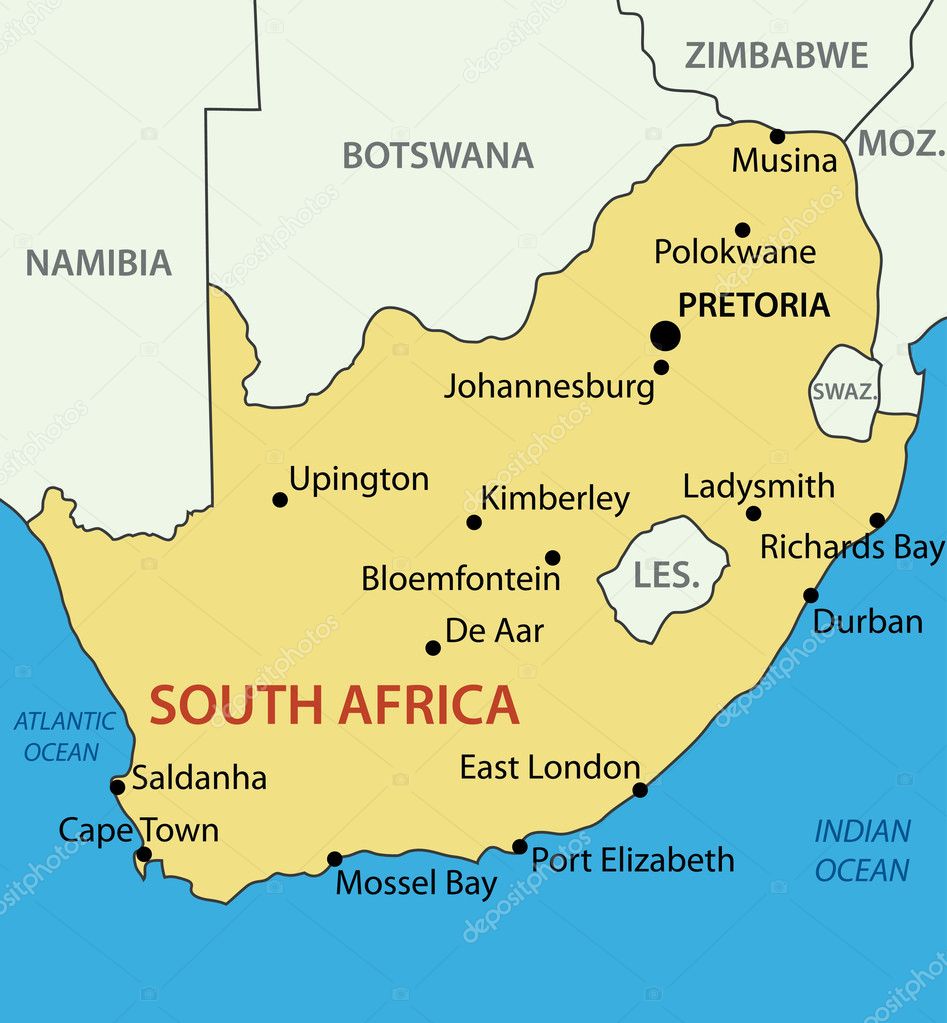
Nino Mbatha, 33, and Lungisani Magubane, 32, were jailed for life Thursday for the murder of Zanele Hlatshwayo.
According to the Daily Mail, it was Mbatha — a self-proclaimed ‘traditional healer’ — that served up the sinister duo’s unappetizing antics to cops.
At first, cops believed Mbatha was pulling a sick joke on them.
But when he took detectives to a nearby house, they discovered more body parts.
Cops say Hlatshwayo was murdered and decapitated as part of a ritual killing performed by witch doctors to bring good luck.
Judge Peter Olsen described the murder as “heinous.”
The court was told that the female victim was beheaded by Mbatha who, with the help of Magubane, removed her internal organs, hands and feet in order to gain luck.
Mbatha told Magubane to eat the 24-year-old woman’s flesh for “good luck,” before claiming he was forced into cannibalism.
Another witch doctor killed himself before he could be brought to trial.
Nino Mbatha and Lungisani Magubane sentenced to life for murder of woman
Zanele Hlatshwayo said to have been raped and murdered as part of ritual killing
Traditional ‘healer’ Mbatha said cannibalism would bring Magubane good luck
Members of small community of Esigodlweni dug up graves to give to Mbatha
Two cannibals, one of which was found carrying a bag with a human hand and a leg inside, have been jailed for life in South Africa.
One of the cannibals told officers when he turned himself into police that he was ‘tired of eating human flesh’.
Nino Mbatha, 33, and Lungisani Magubane, 32, were jailed for life today for the murder of Zanele Hlatshwayo.
Mbatha, said to be a ‘traditional healer’, was arrested after handing himself in at a police station in Estcourt, a town in KwaZulu-Natal province last year.
He was carrying a bag containing a human leg and a hand, telling officers he was ‘tired of eating human flesh’.
Police refused to believe his claims until he took officers to a house where more body parts were found.
‘Traditional healer’ Nino Mbatha (pictured) and accomplice Lungisani Magubane were jailed for life for the murder in KwaZulu-Natal province last year. Thanks Mydrim JonesVictim Zanele Hlatshwayo was murdered and decapitated as part of a ‘muthi’ ritual killing performed by witch doctors to bring good luck Thanks Mydrim Jones
Sitting at the Pietermaritzburg High Court, judge Peter Olsen, said the pair were guilty of ‘the most heinous crime’, the Witness newspaper said.
The court heard that Ms Hlatshwayo had been beheaded by Mbatha who, with the help of Magubane, removed her internal organs, hands and feet in order to gain luck through ‘muthi’ – a term for traditional medicine in parts of southern Africa.
Mbatha was said to have instructed Magubane to eat the 24-year-old woman’s flesh for ‘good luck’, before claiming he was forced into cannibalism.
At earlier hearings in Estcourt, angry residents gathered outside the courthouse to protest against the grisly murder.
South Africa has no direct law against cannibalism, but mutilating a corpse and being in possession of human tissue are criminal offences.
Lungisani Magubane, 32, were jailed for life today along with Nino Mbatha at Pietermaritzburg High Court in KwaZulu-Natal Thanks Mydrim Jones The house in the village of Esigodlweni where the murder was said to have taken place. One of the suspects turned himself in at a South African police station, saying he was ‘tired of eating human flesh’ Thanks Mydrim Jones
A third man was acquitted today, with seven people initially arrested during the investigation.
A fourth man arrested and charged, Sithembiso Sithole, 31, died in prison after apparently killing himself while awaiting trial.
The trio of men were arrested after Mbatha went to police and more remains were found in a nearby house, leading to the discovery of a woman’s mutilated body, who was also said to have been raped.
After a meeting was held in the village of Esigodlweni, home to just 971 people, it emerged almost a third of the population had been digging up graves or eating residents.
In the aftermath of the arrests, villagers gathered in the community hall allegedly admitted tasting human flesh.
Two of the men initially arrested were said to be witch doctors, or traditional healers, and a third was on parole from jail at the time of the killing.
Sithembiso Sithole who was arrested and charged in connection with the investigation, died in prison after apparently killing himself while awaiting trial Thanks Mydrim Jones Estcourt police station in KwaZulu-Natal where Nino Mbatha handed himself in and angry protesters gathered during the trial Thanks Mydrim Jones
Community members were also said to have dug up graves under the orders of Mbatha to give him the bones.
When police were investigating officers discovered eight ears in a pot, local councillor Mthembeni Majola told the media.
People with albinism in some African countries are particularly at risk of ‘muti’ killings due to the belief held by some that their body parts impart power and health to those who eat them.
A man Durban was found with a human head in his backpack last July, as he was thought to be attempting to sell the head to a witch doctor.