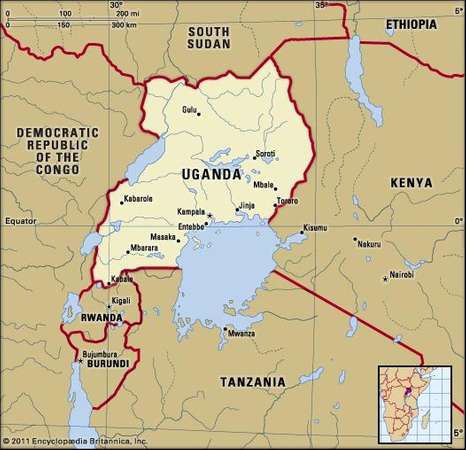
The Ugandan press and the national as well as regional and local authorities are pretty open in publishing confirmed and suspected cases of murders for ritualistic purposes. First of all, I would like to compliment these institutions on this.
This openness may suggest that ritual murders occur more frequently in this East African country than in other African countries. However, this conclusion is premature unless it is based on comparative research and takes certain caveats into account. However, notwithstanding the foregoing, we can say that Uganda is a country where ritual murders occur frequently. Human sacrifice for ritualistic motives and notably child sacrifice is a plague in this country. The Prevention and Prohibition of Human Sacrifice Act (adopted in 2021), which explicitly permits the death penalty for perpetrators of ritual murders (human sacrifices) and the financing thereof, haven’t had the envisaged deterrent effect. Last year, on Christmas Eve, in his annual Christmas message, the Kabaka of Buganda commented on the growing number of children who were reported missing and were later found dead, brutally murdered, and in some cases with body parts missing.
In an earlier post in 2024, I reported that the number of reported murders for ritualistic purposes in the 2021 – 2023 period were 46 (2021), 72 (2022) and 84 (in 2023). In other words, the frequency of reported ritual murders nearly doubled between 2021 and 2023. Moreover, only 11 cases out of the 84 reported ritual murders in 2023 resulted in the prosecution of the suspected perpetrators.
In March this year, Uganda’s Criminal Investigations Directorate (CID) published its 2025 Annual Crime Report covering a broad array of crimes. We’ll focus here on the present website’s topic, ritualistic murders.
Compared to 2023 there was a decrease in the number of reported ritual murders cases in 2025 (unfortunately, data for 2024 are lacking). In 2025 there were 61 reported cases – hence an average of 5 murders each month, or one ritual murder discovered each week – every week, throughout the year… A harrowing thought.
Generally speaking, the highest incidence of murders (all categories combined) was reported in Kyegegwa District (67 cases), followed by Mubende and Kyenjojo with 58 cases each, Rukungiri with 54, and Oyam with 53. It would be interesting to analyze the CDI report to determine whether there is a correlation between regionally reported murder cases and the frequency of ritual-related crimes. (webmaster FVDK)
2025 CDI Crime report: 25 Ugandans die daily in murders
Published: March 31, 2026 By: URN, Uganda
At least 25 Ugandans died daily from murders and road crashes in 2025, according to the annual crime report compiled by the Criminal Investigations Directorate (CID).
The report shows that 4,328 people were deliberately killed, translating into an average of 11 murders per day. Assault was the leading cause of killings, accounting for 1,326 deaths, followed by mob action with 950 cases.
Other causes of murder included strangulation (415 cases), hacking (338), stabbing (292), assault using blunt objects (289), domestic violence (208), shooting (190), poisoning (111), ritual sacrifice (61), and arson (58).
Regionally, Kyegegwa District recorded the highest number of murders at 67 cases, followed by Mubende and Kyenjojo with 58 cases each, Rukungiri with 54, and Oyam with 53.
Infographic showing murders by cause and districts
CID director Maj Tom Magambo said overall crime registered a 10.2 per cent drop between 2022 and 2025, indicating a consistent downward trend.
Meanwhile, traffic police reported 4,602 fatal crashes in 2025, resulting in 5,383 deaths — an average of 14 fatalities per day. The figure represents a 4.7 per cent increase from the 5,144 deaths recorded in 2024.
Serious injuries rose by 8.4 per cent from 17,013 in 2024 to 18,444 in 2025, while minor injuries increased slightly from 3,651 to 3,668. However, total crashes dropped to 322,441 in 2025 from 426,632 in 2024.
December recorded the highest number of crashes at 2,443, while June registered the lowest at 1,978. Fatalities peaked in October with 523 deaths and were lowest in June at 390.
Director of Traffic and Road Safety AIGP Lawrence Nuwabine attributed the rise in fatalities to increased travel demand, particularly during festive periods.
Inspector General of Police Abas Byakagaba said police will fully implement the sub-county policing model to further reduce crime, which currently stands at 56 per cent nationwide.
“Other initiatives like CCTV cameras, enhanced K9 and forensic services, and targeted operations have contributed to a 10.2 per cent crime reduction in 2025, compared to 4.1 per cent in 2024,” Byakagaba said.
Overall, police-recorded cases dropped from 218,715 in 2024 to 196,405 in 2025. Of these, 79,291 cases were taken to court involving 99,004 accused persons, while 31,732 suspects were convicted.
Warning: this post contains graphic details which may upset some readers.
The following article, about the trial of a ritual murderer in Tanzania, was published in a Kenyan online newspaper. The author articulates very well what this is all about: the clash between modernity and archaic, harmful superstition. Reading of the article is highly recommended.
With respect to the death sentence in Tanzania: whereas the capital punishment is in accordance with the law in Tanzania, de facto there exists a moratorium on the actual execution. Those sentenced usually remain in prison for the rest of their lives.
The importance of imposing the death penalty lies primarily in its symbolic value and the deterrent it may provide, although I have serious doubts about the latter. (webmaster FVDK)
Shadows of Superstition: Court Upholds Death Sentence in Ritual Murder
A Tanzanian court has upheld the death sentence for a Babati man who murdered his stepson on the promise of wealth, highlighting a grave social crisis.
Published: March 16, 2026 By: Streamlinefeed – Kenya
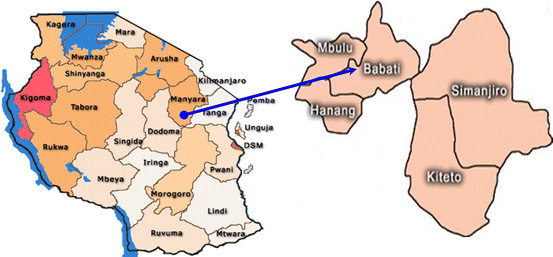
The heavy doors of the Court of Appeal in Tanzania swung shut, effectively sealing the fate of Emmanuel Safari, a man whose actions in a quiet Manyara village shattered the sanctity of familial protection. In a chilling judgment delivered by Justices Winfrida Korosso, Lilian Mashaka, and Paul Ngwembe, the judiciary affirmed a death sentence for the murder of an innocent child, a crime rooted not in sudden passion, but in the dark, persistent belief in occult practices intended to manifest wealth.
This judicial affirmation serves as a grim marker of the persistent collision between modern legal standards and archaic, harmful superstitions that continue to plague rural communities in East Africa. For a one-and-a-half-year-old child in Babati District, the betrayal was absolute entrusted to his stepfather, he instead became the focal point of a lethal, misguided ritual. As the court documents detail, the child’s life was extinguished in a manner that defies comprehension, leaving behind a community grappling with the dual scars of grief and the unsettling reality that such practices remain a motivation for violence in the modern age.
The Anatomy of a Heinous Betrayal
The tragedy unfolded on March 21, 2021, at Maganjwa Village in Babati District. Emmanuel Safari, who had entered into a household with a mother and her two children, occupied a position of trust—a role that the prosecution proved he abused with devastating brutality. While the defense attempted to navigate the complexities of circumstantial evidence, the Court of Appeal found the narrative of innocence unsustainable.
Court records depict a harrowing timeline of the events leading to the child’s death. Safari, having been instructed by a local practitioner of witchcraft that ritual sacrifice would bring him prosperity, turned his attention to his stepson. The physical evidence presented at the High Court of Tanzania at Manyara and subsequently reviewed by the appellate judges was damning. Upon being rushed to Dareda Mission Hospital, the child exhibited severe internal trauma, including the penetration of the rectal intestine, accompanied by extensive swelling and bruising in the pelvic region. Safari, despite having been the sole caregiver in the hours preceding the discovery of the injuries, claimed ignorance of the cause—a defense that collapsed under the weight of medical and circumstantial scrutiny.
The Evidence Behind the Verdict
The legal process relied on the strength of circumstantial proof, a common necessity in cases where the victim is unable to speak and witnesses are scarce. The prosecution, led by Senior State Attorney Saada Mohamed, successfully argued that the chain of events left no logical room for an alternative perpetrator.
Incident Date: March 21, 2021
Location: Maganjwa Village, Babati District, Manyara Region
Victim Age: One-and-a-half years old
Legal Outcome: Death sentence for murder and unnatural sexual offence upheld by the Court of Appeal
Primary Evidence: Medical examination from Dareda Mission Hospital confirming physical trauma consistent with violent assault
The appellate justices underscored the necessity of the verdict by noting that the deceased was under Safari’s exclusive care during the timeframe in which the fatal injuries were inflicted. The lack of explanation for the child’s condition, juxtaposed with the timeline of events, led the court to conclude that the appellant was solely responsible. This ruling reinforces a zero-tolerance approach toward such crimes, signaling that no claim of superstition can mitigate the legal consequences of child murder.
The Societal Scourge of Occult Violence
This case is far from an isolated anomaly in the region. Across Tanzania and neighboring nations, the intersection of economic desperation and belief in witchcraft creates a dangerous environment for the most vulnerable, particularly children and the elderly. Human rights organizations, including the Legal and Human Rights Centre, have long documented how the promise of wealth, or the fear of supernatural curses, can drive individuals to commit horrific acts of violence.
Sociologists observing the region point out that rapid socioeconomic shifts, which have seen wealth disparities widen, often correlate with a resurgence in occult-linked crime. When traditional avenues for economic stability feel inaccessible, vulnerable populations are sometimes exploited by opportunistic individuals claiming spiritual authority. These “witchdoctors” provide a convenient, albeit deadly, mechanism for individuals to project their frustrations and desires onto defenseless victims.
The Legal Landscape and the Death Penalty
The imposition of the death sentence in this case brings into focus the complex legal reality of capital punishment in Tanzania. While the death penalty remains on the statute books, the nation has maintained a long-standing de facto moratorium on actual executions, with those sentenced often remaining on death row for decades or having their sentences commuted to life imprisonment.
However, the judicial commitment to handing down such sentences—and the appellate court’s refusal to overturn them—acts as a significant punitive statement. It sends a chilling signal regarding the gravity with which the Tanzanian judiciary views the murder of children. As the country balances international human rights obligations against the local demand for justice in the face of brutal crimes, the ruling remains a stark reminder that legal systems are evolving to prioritize the protection of the innocent above all else.
As Emmanuel Safari faces the finality of his legal journey, the tragedy in Maganjwa Village leaves behind an uncomfortable question: what further efforts are required to sever the link between superstition and violence in rural communities? Until the promise of occult shortcuts is replaced by tangible socioeconomic opportunity, the shadow of such tragedies will continue to loom over the most vulnerable among us.
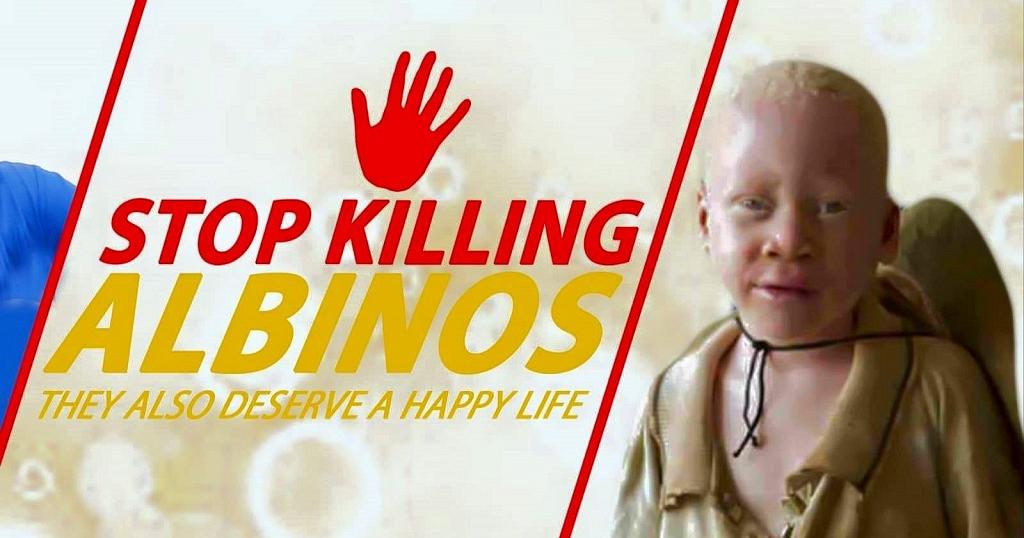
Unfortunately, the below article contains a too familiar story. Attacks on persons with albinism, mutilation, murder, involvement of high-placed politicians, cover up practices. The President of the Associations of Persons with Albinism in Malawi (APAM), Ian Simbota, again turned his attention to the country’s rulers and requested the government of President Lazarus Chakwera to speed up all abduction and murder cases which targeted people with albinism (PWA) for ritualistic purposes, often involving high-profile politicians.
It is shocking to read the following article. I won’t repeat here what follows. Once more, however, I want to draw attention to these heinous crimes which threaten people with albinisme on a daily basis. Ritual murders must end. Politicians and other culprits who are involved must be apprehended, put on trial and sentenced. Simultaneously, a national awareness campaign must start, emphasizing the sanctity of life, the need to protect innocent people, the promotion of human rights notably to right to live and the right to live without fear. The government must take its responsibility and act accordingly – or resign. (webmaster FVDK).
APAM asks Tonse Alliance Govt. to speed upon ‘albino’ cases
Published: April 29, 2021 By: Nyasa Times – Tiwonge Kumwenda
Browsing on internet I found this 2011 article written by Fanuel Hadzizi from Zimbabwe. The article could have been written in the year 2000, or much earlier, and even nowadays, in the year 2020 !
I find it encouraging reading this article on a topic which it too often swept under the carpet although its main message is a sad one. The author pleads to break the silence on ritual killings in Africa and points to several cases of ritual killings in Southern Africa to warrant his plea. He concludes “It is time governments turn up the heat on culprits and put an end to this violation of human rights.”
What else can I say? Highly recommended – read ‘AFRICA: BREAKING THE SILENCE IN RITUAL KILLINGS’ by Fanuel Hadzizi, Gender Links Justice Program Officer of PeaceWomen. Peacewomen is the Women, Peace and Security Program of the Women’s International League for Peace and Freedom (WILPF), the oldest women’s peace organization in the world.
Warning: The following article contains graphic details of ritual murders (FVDK)
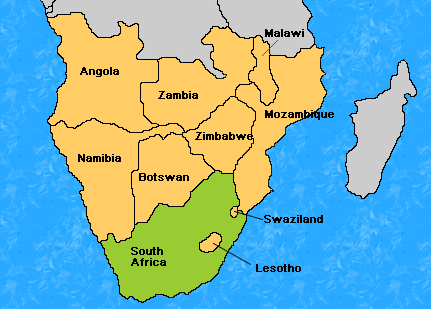
Ritual killings and human sacrifice happen in many, if not all countries in Africa. Cases have been reported in such countries as Botswana, Lesotho, South Africa, Swaziland, Zambia and Zimbabwe.
In Zambia, there have been cases whereby people’s heads were found in Asian owned shops whilst in Swaziland, some politicians commissioned ritual killings so that they could win elections. The grossness of the ritual murders is quite scary to imagine as victims’ bodies are mutilated and certain body parts go missing. Needless to mention that in South Africa for instance, body parts can be sold for as little as R3000.
On 24 September, South Africa celebrated Heritage Day under the banner “celebrating the Heroes and Heroines of the Liberation Struggle in South Africa.” According to the Department of Arts and Culture, the theme allowed the nation to “celebrate the lasting legacy of the national liberation struggle.”
Most importantly, Heritage Day provides an opportunity for South Africans to celebrate their cultural heritage and diversity of beliefs and traditions. As a concerned resident, I also feel that this is an opportunity for us to break the silence around the negative cultural practice of ritual killings that is prevalent in society and yet violates the basic universal human right to life.
During the course of Women’s Month in August, South Africa became the ninth Southern African Development Community (SADC) country to ratify the Protocol on Gender and Development. This brought to two thirds the number of countries that have done so, and means that the Protocol is now in force.
As we also celebrate the coming into force of this crucial instrument, let us ponder what is meant by the provision that all states adopt laws and policies to protect the girl and boy child from “harmful cultural attitudes and practices in accordance with the United Nations Convention on the Rights of the Child and the African Charter on the Rights and Welfare of the Child.”
I recall vividly growing up in one township in Zimbabwe. This was just when public transport in the form of the Toyota Hiace taxi had just been introduced in the country. At that tender age, we were scared to death by the stories doing the rounds in the township of the disappearance of children. We were told how kids were being lured by strangers who promised them some sweets.
The next thing, their bodies would be found in the bushes with some body parts missing. Rumours were that business people were taking the children’s heads for instance to Durban in South Africa and were trading them off for the taxis. Weren’t we all scared!
Ritual killings or muti killings are committed for the purpose of taking human body parts which are used to prepare charms and other traditional medicines. These charms are believed to have supernatural powers which are greatly enhanced if the organs are removed whilst the victim is still alive.
In Southern Africa there is a belief that female body parts possess supernatural powers that bring good fortune or make criminals invisible to police and other authorities. Research has shown that in other countries, especially in East Africa, the breast and a woman’s private parts enhance business success, a man’s private parts are believed to increase virility whilst a tongue can smooth one’s path to a lover’s heart.
In fact, ritual killing is perceived as an act of spiritual fortification.
In an article titled New Magic for New Times: Muti Murder in Democratic South Africa, Louise Vincent (2008) says that “the use of human body parts for medicinal purposes is based in the belief that it is possible to appropriate the life force of one person through its literal consumption by another.” The victim is thus carefully chosen.
The Sowetan reported in July this year that the brother of Gladys Mogaramedi (61) killed her for her body parts. Police discovered the badly mutilated body without the private parts. I felt a very cold chill down my spine as I read through the story with shock and disbelief. Even after reading it twice I still found myself at a loss for words, trying to comprehend how a person could execute such a diabolic act moreover to a sibling without any conscience.
The South African case highlighted above is but the tip of the iceberg to some of the cultural problems that our society is still grappling with in relation to gender based violence. More often than not, these crimes evade the spotlight because they are largely unreported or recorded merely as murder. Ritualists target vulnerable members of society such as the poor, women, children, people with disabilities and albinos whose families often do not have the resources to demand justice.
It is time governments turn up the heat on culprits and put an end to this violation of human rights. Heavy sentences should be given to those who commission as well as carry out the ritual killings. It is heartening to note that in a July 2010 ruling, the High Court of Mwanza region sentenced 50 year old Kazimiri Mashauri to death. The Tanzanian court convicted him for hacking to death a 5 year old girl for muti-related purposes.
Fanuel Hadzizi is the Gender Links Justice Program Officer of Peace Women,
A bizar incident occurred recently in the Ugandan capital Kampala. Allegedly, a man, carrying the severed head of a five to eight-years-old child, hidden in a gift box, tried to enter the building which houses the nation’s parliament. Not surprisingly, rumors started floating suggesting a case of ritual murder. True or not true? And was maybe a parliamentarian involved? If yes, who? The mere fact of the rumors is an indication, in my opinion, of the phenomenon of ritualistic murders in Uganda – besides, previous posts on this site confirm the occurrence of ritual murders in the East African country. The rumors also show the people’s suspicion and mistrust of rich and famous people in cases of ritualistic activities. Moreover, it is interesting to note and very significant that the incident occurred when Ugandan parliamentarians are discussing a law which intends to punish the crime of human sacrifice with the death penalty!
I hope that the police will do its work independently and will reveal the truth. If again a ritual murder has been committed, the perpetrators must be arrested and tried. If not, let it be established. Of course, it is crystal clear that a crime has been committed and that a child was the victim. The rule of law must apply, as I have repeatedly underlined in this place. Without the rue of law there is no justice, no progress, no development (webmaster FVDK).
Man carrying a child’s severed head arrested outside Ugandan parliament
Published: September 15, 2020 By: Metro, Uganda – Joe Roberts
A man has been arrested after attempting to enter the Ugandan parliamentary building carrying the severed head of a child in a gift box. The child was aged about five to eight-years-old, but no more details were given by police.
It comes as politicians in the east African country consider a bill that would punish the crime of human sacrifice with the death penalty. Ugandans on social media expressed outrage over the incident, with some pointing out that it had the hallmarks of a ritual killing.
Children are frequently targeted in such killings across Uganda, according to police and some watchdog groups. Officers said they can ‘assure the general public that the investigations are vigorously being undertaken to ensure that the perpetrators are taken to court’.
The gruesome package was apparently intended to be delivered to the office of the parliamentary speaker, Rebecca Kadaga. A spokesman for Ms Kadaga, a member of the governing National Resistance Movement party, who has held the speaker’s post for two terms, declined to comment.
Ugandan police nab man entering parliament with severed head
Published: September 14, 2020 By: Sports grind Entertainment
KAMPALA, Uganda (AP) — Ugandan police on Monday arrested a man attempting to enter the parliamentary building in the capital carrying the severed head of a child in a wrapped gift box.
Police said in a statement that the victim was a child of about five to eight years, giving no more details.
Police “assure the general public that the investigations are vigorously being undertaken to ensure that the perpetrators are taken to court,” said the statement.
Parliamentary Watch Uganda, a local group that monitors the activities of the legislature, said the gruesome package was intended to be delivered to the office of the parliamentary speaker, Rebecca Kadaga.
A spokesman for Kadaga, a member of the governing National Resistance Movement party who has held the speaker’s post for two terms, declined to comment.
Lawmakers are currently considering a bill that would punish the crime of human sacrifice with the death penalty. Supporters of the bill say such legislation is long overdue.
Ugandans on social media expressed outrage over the incident, with some pointing out that it had the hallmarks of a ritual killing. Children are frequently targeted in such killings across the East African country, according to the police and some watchdog groups.
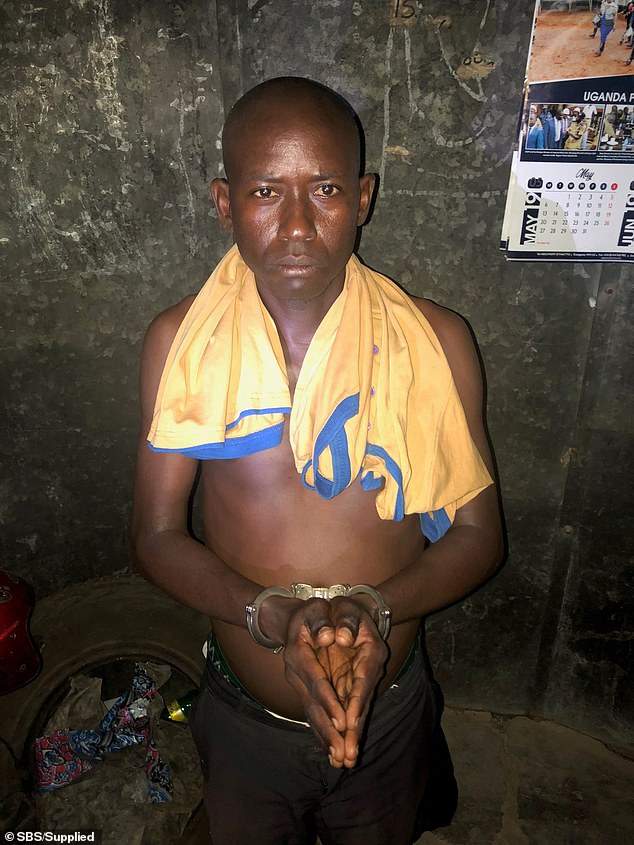
In the villages of Uganda a new breed of witch doctors is hunting and kidnapping children to cut off their ears, noses and genitals. Often the witch doctors decapitate the boys or remove whole arms and legs of victims. Witch doctor Kivumbi Awali is pictured after his arrest
Ritual killing of children by witch doctors takes place in Uganda, in East Africa
Body parts, blood or tissue are removed from boys and girls while they are alive
Pastor Peter Sewakiryanga saves mutilated victims and hunts the witch doctors
His work is partly funded by generous donations from a small Australian charity
In the villages of Uganda a new breed of witch doctor is hunting and kidnapping children to cut off their ears, noses and genitals.
Sometimes the medicine men remove whole arms and legs or drain blood from a boy or girl’s body while the victim is still alive.
Sometimes the victim’s parents help decapitate their child.
Human sacrifice is not some ancient cultural ritual practised in this east African country, rather it is a barbaric modern way for cruel charlatans to make money.
Children in rural Uganda are kidnapped by witch doctors who torture and often murder them as part of a supposed spiritual sacrifice.
The witch doctors mutilate the children and use their blood, tissue or organs in rituals they promise can bring clients protection, prosperity and good health.
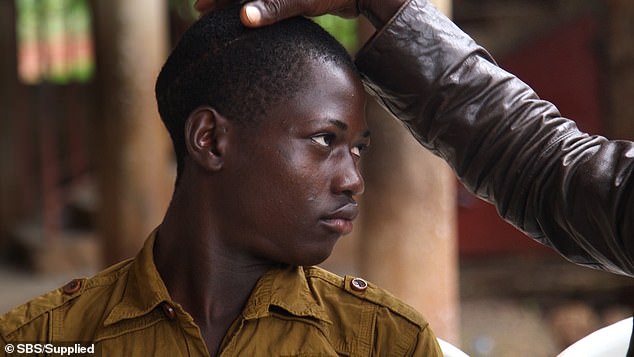
Child sacrifice survivor Allan Ssembatya was set upon in a Ugandan village called Busolo in 2009. ‘My son was coming home from school,’ his father says. ‘They took him to the bush. They cut him. This cut on his head, this cut on his neck, damage to his private parts…’
In one of the most macabre practices to have developed, children are decapitated and their heads buried in new building foundations to bring success to businesses.
Fighting this terrible trade is pastor Peter Sewakiryanga who saves children scarred by ritual mutilation, and helping him is a small group of Australians.
Pastor Peter, a former accountant, started campaigning against child sacrifice about a decade ago and runs charity Kyampisi Childcare Ministries.
He helps rehabilitate survivors and raise awareness of the practice, working with politicians, police, prosecutors and judges to bring offenders to justice.
Pastor Peter’s work features in an episode of the SBS program Dateline called How to Catch a Witch Doctor to air on Tuesday night.
The program follows Pastor Peter and Brisbane civil engineer Rodney Callanan as they hunt for a witch doctor who allegedly almost killed six-year-old Allan Ssembatya ten years ago.
Reporter Amos Roberts speaks to Allan’s father Hudson Semwanga about what happened to his boy in a village called Busolo in the district of Kayunga on October 21, 2009.
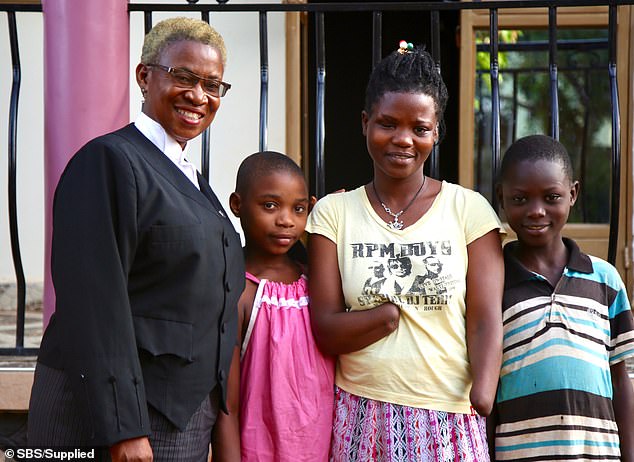
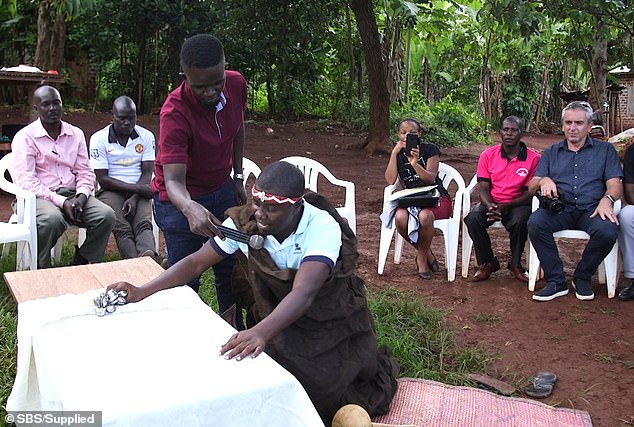
Justice Margaret Mutonyi is pictured with a girl whose hands have been cut off. ‘We have a society that believes in witchcraft,’ she tells the SBS program Dateline. ‘The majority of the population including Christians who go to church, they consult these witch doctors’Robert Mukwaya suffered spinal injuries so serious it was thought he would never walk again. He had been snoozing in his grandmother’s kitchen in a village near Lake Victoria when a man dragged him out of the room and stabbed him in the neck. He underwent surgery in Australia
‘My son was coming home from school,’ Mr Semwanga says. ‘They took him to the bush. They cut him.
‘This cut on his head, this cut on his neck, damage to his private parts, in my view it’s very surprising that Allan is alive.
‘What hurts me the most is that they were people that knew me really well, I grew up with them, I went to school with them. We used to treat each other as family.’
One of the two men accused of kidnapping and cutting up Allan is witch doctor Kivumbi Awali, who was secretly filmed by a BBC crew in 2011.
The crew posed as members of a construction company looking for a witch doctor who could bring their business prosperity.
They were introduced to Awali, who killed a goat for good luck at their first meeting, then a few days later explained what he said was his most powerful spell: human sacrifice.
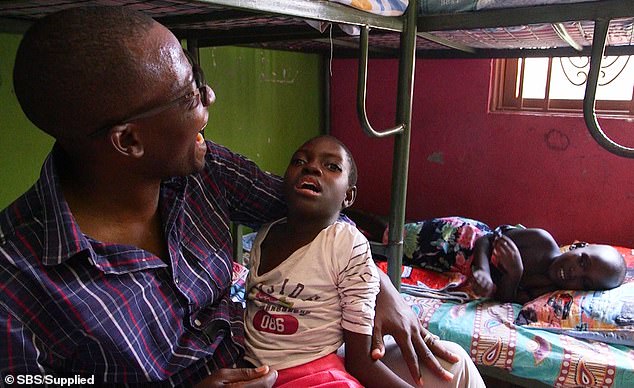
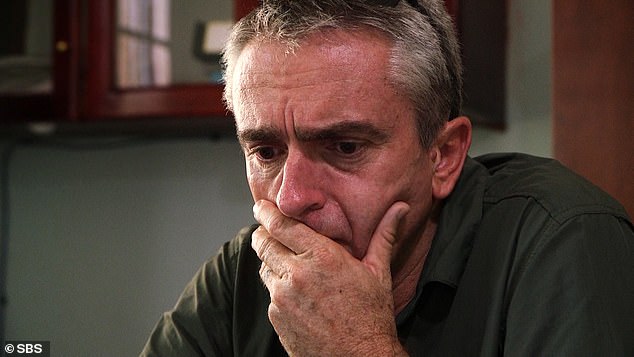
Pastor Peter Sewakiryanga holding Hope, a young victim of child sacrifice. ‘They prey on the desperation of the people who are sick and are poor,’ Pastor Peter told Daily Mail Australia. ‘Even the elite who live in the city and are rich are now engaged’ Rodney Callanan, from the Brisbane charity Droplets In A Stream, helps fund the pursuit of Ugandan witch doctors who have not been brought to justice. ‘Unfortunately, the police, the courts in Uganda are grossly underfunded,’ Mr Callanan tells Dateline
‘There are two ways of doing this,’ Awali was recorded telling the bogus businessmen. ‘We can bury the child alive on your construction site.’
‘Or we cut the child, and put their blood in a bottle of spiritual medicine. If it’s a male, the whole head is cut off, and his genitals.’
When Awali was finally arrested by police in the company of Pastor Peter and Mr Callanan he had a machete in his custody. As he was led away he complained his handcuffs were too tight.
Awali was charged with attempted murder and aggravated trafficking.
His case is still before the courts and if convicted he could face a death sentence or life in jail.
Allan is one of five child victims of human sacrifice Pastor Peter has helped bring to Australia for life-changing surgery.
‘Sometimes it’s difficult to talk about what happened to me,’ the now 16-year-old tells Dateline. ‘And sometimes when I talk about it I start crying.
‘I remember the injuries I got, I remember when I was taken, I tried to struggle to run, they hit me up and they did whatever they wanted. So when I think about it I cry.’
Pastor Peter is supported by a Brisbane-based charity called Droplets In A Stream which provides education and health care opportunities to victims of child sacrifice who survive.
A witch doctor advertises his work outside his house in Kampala, the Ugandan capital. ‘A traditional healer with powers over spirits solves all cases, demons, thieves, tooth decay, madness, fevers, appelipse, genital affairs’.
Doctors at Newcastle’s John Hunter Hospital and Brisbane’s Mater Children’s Private Hospital have operated on rescued children free of charge.
‘Australia has been so kind,’ Pastor Peter said. ‘These children would otherwise be dead.’
Witch doctors practising child sacrifice are motivated solely by money but pretend to be adhering to cultural beliefs to justify their crimes.
‘They prey on the desperation of the people who are sick and are poor,’ Pastor Peter told Daily Mail Australia. ‘Even the elite who live in the city and are rich are now engaged.
‘The problem is a national issue. It started in poor pockets of the community. Now it’s widespread.
‘It has crossed boundaries into families killing their own children.’
The extent of this trade is hard to judge but Pastor Peter says he works with between 20 and 25 cases each year.
‘The issue is done under such secrecy it’s hard to estimate numbers. I can trace it to ten to 15 years ago.’
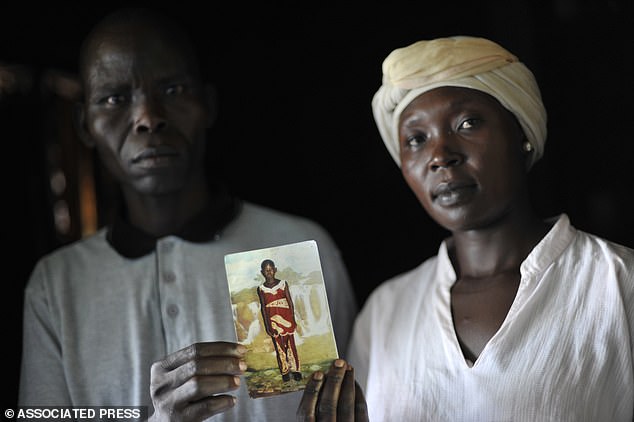
Balluonzima Christ (left) and Rose Ajiba (right) hold a photograph of their daughter Caroline Aya, who was allegedly killed in a sacrificial ceremony in the town of Jinja in southern Uganda
‘It’s not part of our culture. It hides in our culture. It must be condemned.’
Droplets In A Stream, which Mr Callanan co-founded, also helps fund the pursuit of witch doctors who have not been brought to justice.
‘Unfortunately, the police, the courts in Uganda are grossly underfunded,’ Mr Callanan tells Dateline.
‘Many cases actually don’t go to court or to trial because of lack of funding. And that’s one of our biggest roles in this area and that’s financial support.’
Judge Margaret Mutonyi tells the program: ‘We have a society that believes in witchcraft.’
‘The majority of the population including Christians who go to church, they consult these witch doctors.’
Paul Odida, a repentant witch doctor, now helps Pastor Paul raise awareness of the issue of human sacrifice. He visits villages to explain how the witch doctors instill fear in communities
In one scene Pastor Peter examines photographs of a boy approximately ten years old whose body was found dumped in the bush.
‘So they cut off the ears, they cut through the neck and cut out the throat and cut off the limbs,’ he says. ‘Body parts were missing. The tongue, the legs, the genitals.’
The program also features Robert Mukwaya who in 2014 suffered spinal injuries so serious it was thought he would never walk again.
Robert had been snoozing in his grandmother’s kitchen in a village near Lake Victoria when a man dragged him out of the room and stabbed him in the neck.
He was left paralysed but surgery at Newcastle’s John Hunter Hospital two years ago has allowed him to regain the use of his legs.
In another scene Pastor Peter and Mr Callanan visit a village to warn about the practice of child sacrifice.
‘Why we are here is we heard of a story of a child who was sacrificed here and unfortunately the people that kill these children are among us,’ Pastor Peter says.
‘Please, if you know who killed our child, just come and tell us, call the number, we will even put a reward. Please don’t fear. If you fear, next time it will be your child.’
How To Catch A Witch Doctor airs on Dateline on Tuesday, June 25 at 9.30pm on SBS. It can be watched later on SBS On Demand.
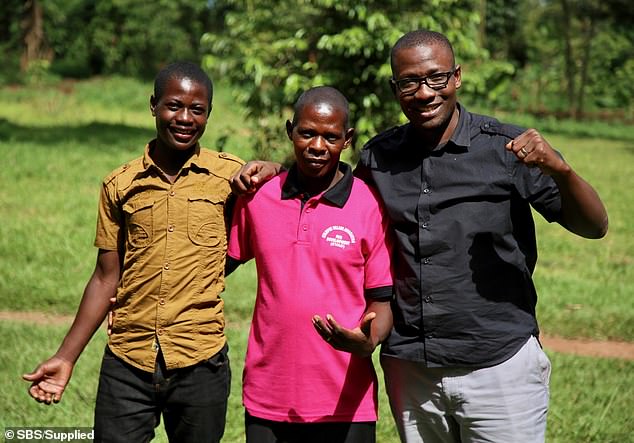
Allan Ssembatya (left) with father Hudson and Pastor Peter (right) after learning of one of his alleged attackers, Kivumbi Awali, has been arrested
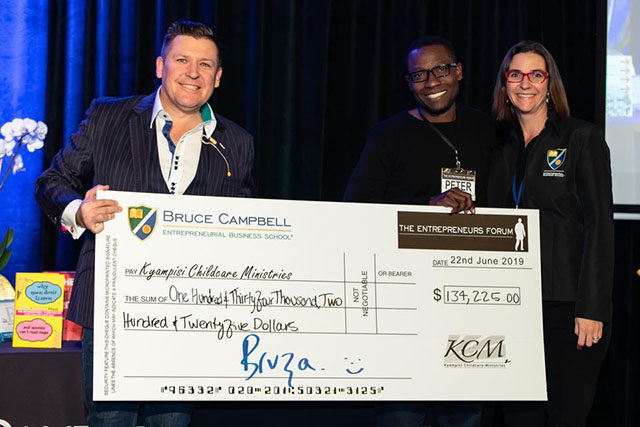
Executive director of Kyampisi Childcare Ministries in Mukono, Pastor Peter Sewakiryanga (M) receives a financial boost for his efforts to end Child sacrifice in Uganda during The Entrepreneurial Business School (EBS) Gala Charity Awards Dinner in Australia (Courtesy Photo)
Pastor receives funding boost for iconic rehab centre for child sacrifice survivors
Together, we will end child sacrifice, Pastor Peter Sewakiryanga says.
Pastor Peter Sewakiryanga who runs Kyampisi Childcare Ministries, a Christian charity seeking to stamp out child sacrifice in Uganda, has received a cash donation of $134,225 (approximately Ush491 million) for a rehabilitation centre expected to be a safe place for children who have been victims of child sacrifice and trafficking.
Pastor Peter received the funds from the Bruce Campbell Entrepreneurial Business School whose founder and Principal Business Coach, Mr Bruce Campbell, has been extensively awarded for his work through various international bodies.
This happened in Australia over the weekend.
“We are humbled by the incredible continuous support of the Bruce Campbell Entrepreneurial Business School,” Kyampisi Childcare Ministries said in an update on Sunday.
“Thank you for this generosity, partnering with us in our efforts to build a new Trauma Rehabilitation Centre for kids abused through Child sacrifice and trafficking. What a community full of love and compassion. Together we will End Child Sacrifice,” they added.
Pastor Peter takes care of several child survivors of trafficking and human sacrifice and has built an extensive network linking communities and security to track suspected cases.
In his remarks earlier in March, Mr Bruce Campbell said, “This will be the largest rehab centre of its kind in Uganda (& maybe Africa). So honored to be a board member and help guiding this life changing organisation.”
The organisation, Kyampisi Childcare Ministries (KCM) condemns witch doctors’ brutal ritual of child sacrifice, and has brought to books several culprits this year in the capital of Kampala alone.
In his recent interview with local media, Pastor Peter explained that victims of child sacrifice in Uganda carry with them serious and disturbing life scars and injuries which include complete genital mutilations, castration, deep stab wounds, missing tongues, ears, as well as emotional and psychological scars that need life time healing.
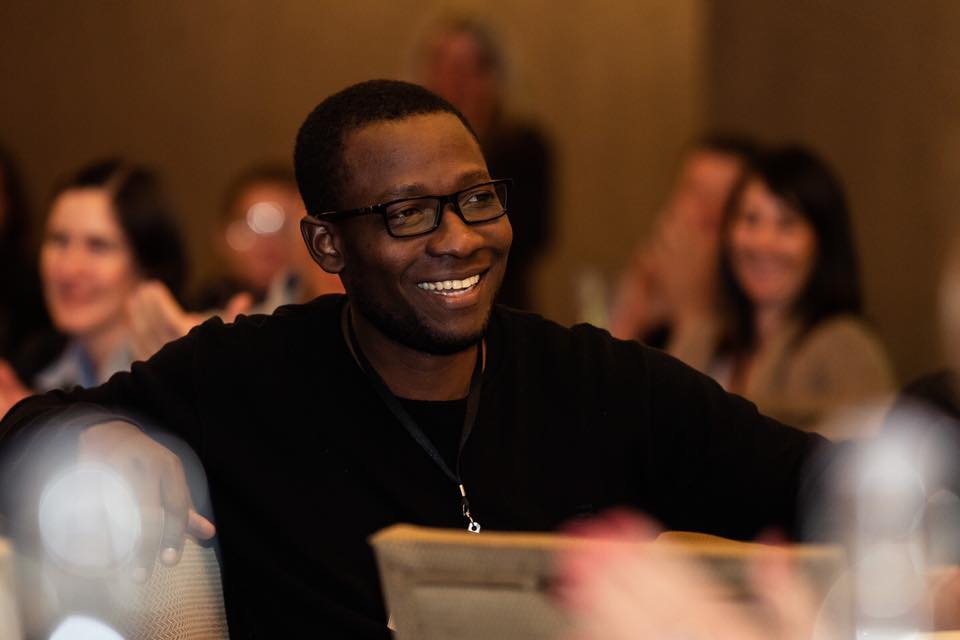
Pastor Peter Sewakiryanga (Courtesy Photo)
Working each day to bring Christ’s hope and healing to these children, Sewakiryanga’s devotion to the cause in 2017 attracted The Christian Broadcasting Network (CBN) who during an interview with the preacher, joined undercover detectives and armed police in a hunt for witch doctors accused of kidnapping and killing children.
“When they get the child, most times they cut the neck, they take the blood out, they take the tissue, they cut the genitals or any other body organs that they wish that the spirits want.” Pr Sewakiryanga said.
Child body parts are especially prized in rituals because people believe mixing their blood with herbs makes a strong concoction that can cure diseases and appease local spirits. Genitalia are especially prized.
“The problem is increasing and many children are killed, and there are very few actually that survive, most of them die.” Pr Sewakiryanga added.
According to CBN News, Kyampisi Childcare Ministries is the only organization in the country providing long-term financial and medical care to survivors of child sacrifice.
“We want to see that the life of a child who has survived is supported, that they are socially able to stand and heal from the injuries, and that they can have a life after that,” said Pastor Sewakiryanga.
He also works with Ugandan lawmakers to help draft specific laws targeting perpetrators of child sacrifice.
In 2018, Pastor Peter was one of two Ugandan activists recognised by The European Union (EU) for their tireless campaign to stop child trafficking.
He was credited for championing research and spearheading an awareness campaign in communities to stop the crime.
Published: May 7, 2019 By: BBC – Jose Tembe – BBC Africa, Maputo
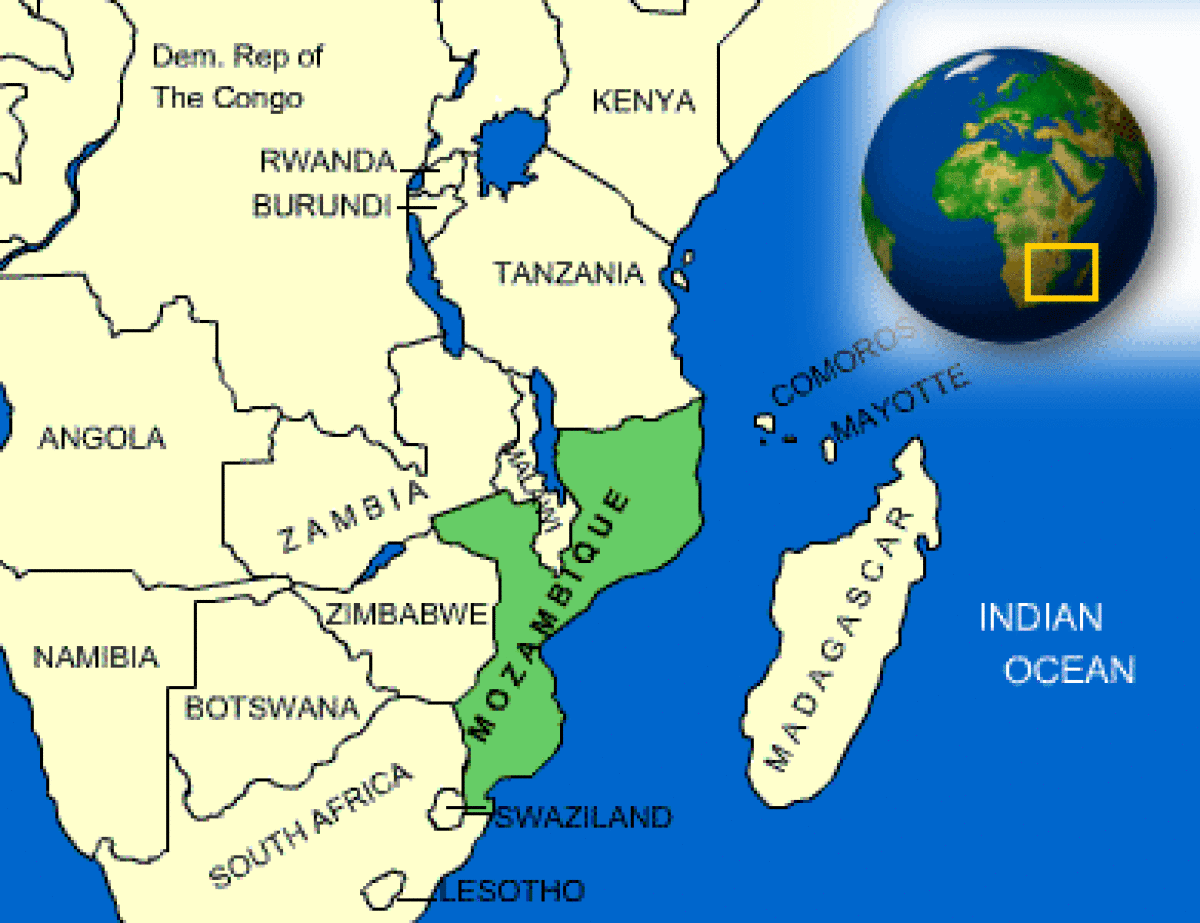
Police in Mozambique say they have arrested two people over the abduction and murder of a 12-year old boy with albinism.
The suspects confessed to the murder, with one of them saying that they had killed the boy “to extract his bones”. A third suspect is being sought, police said.
The 12-year-old’s body has been recovered. He was abducted from his home in the Muchelelene locality in northern Nampula province last week.
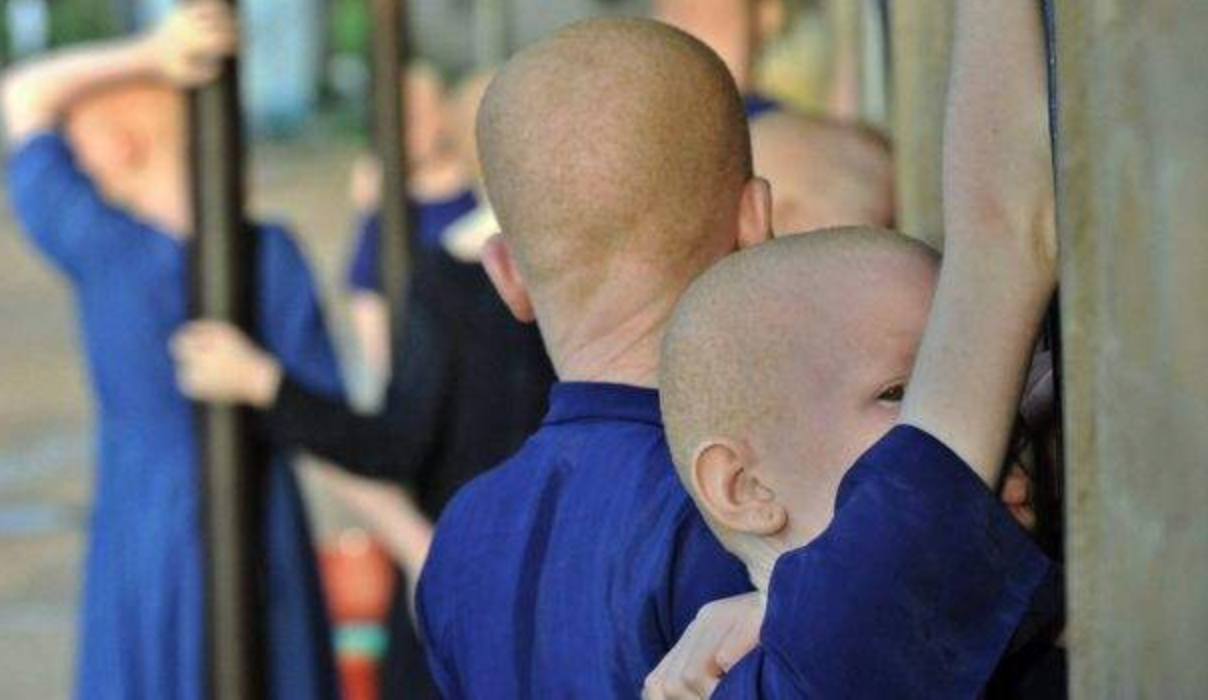
There has been a spate of killings of people with albinism in parts of southern and East Africa, with their body parts used to make charms and potions by witchdoctors.
In Mozambique, people convicted of kidnapping and killing albinos have been sentenced to up to 40 years in prison.
Published: January 28, 2019 By: Bukola Adebayo – CNN
Ten children kidnapped in Tanzania have been found dead with their body parts mutilated, authorities told CNN on Monday.
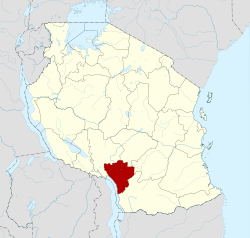
Tanzania’s deputy health minister Faustine Ndugulile said all 10 children had been missing since December in Njombe district, southwest Tanzania. Their bodies were discovered last week after police launched a search operation in the area.
“So far, we have found 10 bodies, and most of their private parts and teeth had been removed,” Ndugulile said. “These murders are linked to witchcraft practices because that is the trend for such crimes, where herbalists ask people to get these human parts for money rituals,” he added. The children, some as young as seven, were kidnapped from their homes last month.
Many children have been reported missing by their parents in the community since December, according to Ndugulile, who said the health ministry was also investigating the wave of killings. “We want to identify the perpetrators, but our focus is to educate the traditional practitioners in the area quickly and those in surrounding communities on the need to stop these acts,” Ndugulile told CNN.
The Deputy health minister told CNN that these killings are not linked albino ritual murders which are prevalent in Tanzania and other parts of east Africa. “These murders are not linked to albino killings,” he said. “But it is very sad because they are children and they don’t deserve to be used like this,” Ndugulile said.
Tanzania has one of the highest rates of albinism in the world, at one in 1,500 people.
Despite its prevalence, there’s still a lack of education and tolerance and albinos are regularly killed for their bones and organs, which are sold to witch doctors for “charms and magical potions”, according to Amnesty International.
Superstition, ignorance, lack of education, they’re all part of the explanation for the bizarre ritual killings that shook Mozambique last year. Bald men were targeted!
(webmaster FVDK)
Superstition: some people believe that the heads of bald men contain gold.
Bald men in Mozambique could be targets of ritual attacks, police have warned, after the recent killing of five men for their body parts.
Two suspects have been arrested in the central district of Milange, where the killings occurred.
“The belief is that the head of a bald man contains gold,” said Afonso Dias, a police commander in Mozambique’s central Zambezia province.
Albino people have also been killed in the region for ritual purposes.
Three men have been killed in the past week alone.
The BBC’s Jose Tembe in the capital, Maputo, says police think the notion of a bald head containing gold is a ruse by witchdoctors to get clients to take a person’s head to them.
“Their motive comes from superstition and culture – the local community thinks bald individuals are rich,” Commander Dias is reported as having told a press conference in Maputo.
The suspects are two young Mozambicans aged around 20, the AFP news agency reports.
A regional security spokesman, Miguel Caetano, told AFP that one of the victims had his head cut off and his organs removed.
The organs were to be used in rituals to advance the wealth of clients in Tanzania and Malawi, Mr Caetano said, citing the suspects.
There has been a spate of killings of people with albinism in East Africa in recent years, with their body parts used to make charms and potions by witchdoctors.