Ritual killings: Experts call for urgent action over rising cases in Northern Nigeria

Warning: the following post contains graphic details which may upset readers (webmaster FVDK)..

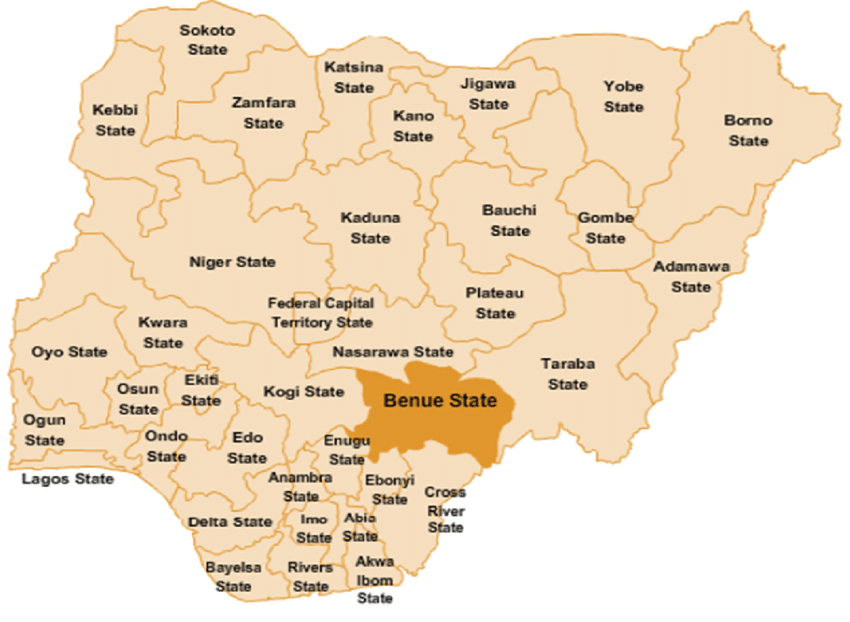
Nigeria is a federal republic comprising 36 states and the Federal Capital Territory (FCT) of Abuja. The 36 states are divided into six geopolitical zones commonly called zones.

Nigeria’s six geopolitical zones

The North West (NW), North East (NE) and North Central (NC) zones constitute Northern Nigeria. Politically, historically and culturally we may distinguish Northern and Southern Nigeria, but these broad categories don’t do justice to the great differences that exist within these areas. When I first went to Nigeria, in 1999, I asked a friend who knows the country very well what to expect. ‘Nigeria is a nice set of countries‘, she said.

This short statement says it all. It’s hard to speak of one country, although it has one constitution and one flag and is a member of many international organizations.

The Northern region consists of 19 states and the Federal Capital territory (FCT) of Abuja, the Southern region houses 17 states.

Map of Nigeria showing states in the northern and southern regions.

In the past I have on many occasions paid attention to the scourge of ritualistic murders in Nigeria and related practices such as abductions and torture. Let me suffice to refer to my recent post dated March 15, The horror of ritual killings in Nigeria, which also includes ritual murder cases in Northern Nigeria.

The article below provides several examples of reported ritual murders both in Northern and Southern Nigeria. The author, Hadiza Musa, pleading for more attention to the surge in ritual killing in northern states, reports that ‘Between January and April 2025 alone, at least 10 cases have been reported across Kwara, Nasarawa, Jigawa, Benue, Abuja and Bauchi states.’ Not surprisingly, residents of northern states (Kaduna, Kano, Katsina) came into the public eye calling for the death penalty for ritual killers and cannibals.

Moreover, it is necessary to emphasize that the number mentioned above refers only to reported ritual killings, and thus in all likelihood is only the tip of the iceberg.

On more than one occasion I’ve stated here that most likely Nigeria holds a dismal continental record of being the country with the highest number of ritual murders – only partly explained by being Africa’s most populous country. Hadiza Musa refers to research by an NGO, the West African Network for Peace Building, revealing that Nigeria recorded 185 ritual-related deaths between January 2021 and January 2022.

In addition, the National Bureau of Statistics (NBS) reported that over 150 ritual killing cases often linked to young people seeking quick wealth, were recorded in Nigeria in the past six months.
(FVDK)

Ritual killings: Experts call for urgent action over rising cases in Northern Nigeria

Published: April 8, 2025
By: Hadiza Musa – Daily Post, Nigeria

“Ritual Killing” a term referring to the intentional murder of individuals for spiritual, economic, or supernatural purposes, often involving body mutilation or organ harvesting were often associated with Southern Nigeria where they were linked to wealth-seeking practices, political power struggles, and deep-rooted traditional beliefs.

Over the years, several high-profile cases have reinforced this perception.

One of the most infamous cases was the 2004 Okija Shrine discovery in Anambra State, where the police uncovered dozens of human skulls and decomposing bodies allegedly used for sacrifices by politicians and businessmen.

Similarly, in 2014, the Ibadan ‘Forest of Horror’ was exposed, revealing a den of ritualists who had abducted, killed, and harvested body parts from their victims.

In recent years, however, there has been a notable shift, with cases of ritual killings increasingly reported in Northern states such as Kwara, Nasarawa, Jigawa, and Bauchi.

While ritual killings were once largely associated with Southern Nigeria, the rising economic challenges and the erosion of moral values have played a significant role in their spread to the North.

Between January and April 2025 alone, at least 10 cases have been reported across Kwara, Nasarawa, Jigawa, Benue, Abuja and Bauchi states.

In January and in Nasarawa State, Timileyin Ajayi, described as a gospel singer, allegedly murdered a lady, 24-year-old Salome Adaidu, and dismembered her body.

He was caught carrying the severed head of his victim in a bag, which alarmed onlookers, leading to his apprehension.

When he was arrested by the police, other dismembered parts of the deceased’s body were recovered from his home.

The deceased, Salome Adaidu was identified as a member of the National Youth Service Corps who was serving in Abuja.

Also, in Kwara, a final-year student, Hafsoh Lawal, was lured and killed by Abdulrahman Bello, a self-proclaimed cleric and her boyfriend whom she met on Facebook.

According to the Kwara State Police Command, the 29-year-old suspect killed Lawal and dismembered her for alleged ritual purposes at a location in the Olunlade area of Ilorin on Tuesday, February 11, 2025.

The headless corpse of the pupil was discovered by the roadside in Jikas-Dabaja village, Gwaram Local Government Area, Jigawa on March 12 (Wednesday).

The body was mutilated, with the private parts removed, prompting the police to launch an investigation into the circumstances surrounding the gruesome act.

On Sunday, March 16, the Police Command in Jigawa State announced the arrest of a 45-year-old suspect in connection with the crime.

The suspect, a teacher of the deceased, was apprehended and detained following a tip-off.

Experts call for urgent action as ritual killings surge in Northern Nigeria

The incidents and many others highlighted the urgent need for comprehensive measures to address ritual killings in the region with stakeholders, attributing the trend to economic struggles, poverty, and lack of education.

Comrade Umar Hamisu Kofar Naisa, Executive Director of the Society for Educational Development and Socio-Democratic Activities (SEDSAC), linked the surge in ritual killings to poverty and the worsening economic conditions in the region.

He told DAILY POST that illiteracy and lack of education play a significant role in fueling such heinous acts.

According to him, ritual killings violate human rights, instill fear, and create insecurity in communities.

“If we examine the situation closely, ritual killings not only violate human rights but also instill fear and insecurity in communities. The psychological trauma experienced by victims’ families and survivors is immeasurable,” he stated in an interview with DAILY POST.

On legal responses, he urged the government to strengthen policies that protect human rights and enact specific legislation to prosecute perpetrators of ritual killings.

He also stressed the need for collaboration among various stakeholders to curb the menace.

Hamisu called on NGOs to intensify awareness campaigns on the dangers of ritual killings, provide support to victims’ families, and advocate for policy reforms.

“We must ensure that policies are created and enforced to put an end to ritual killings in Nigeria,” he added.

He further advocated for grassroots strategies and community engagement, emphasizing the role of traditional and religious leaders in tackling the issue.

“What was once seen as a problem in the South is now happening here. We must work together to stop it,” he urged.

Suleiman Hamza, a student in Ibrahimul Ahmadul Qadhi Islamiyya, highlighted the strong stance of both Islam and Christianity against killings.

He referenced Islamic teachings, noting that taking a life unjustly is akin to killing all of humanity.

“In Islam, the sanctity of human life is paramount. Even in cases of accidental killing, compensation is required, which today can amount to as much as ₦344.8 million,” he explained in an interview with DAILY POST.

Hamza described ritual killings as a new and disturbing phenomenon in the North, stating that in some cases, perpetrators even resort to exhuming corpses from graves for ritualistic purposes.

According to him, there have been more sermons in both churches and mosques, as well as intersectoral conferences and seminars, emphasizing the need to address ritual killings and their root causes.

He called on religious leaders to intensify sermons against such practices and educate the public on the severe consequences of engaging in ritual killings.

Nigeria accounts for a significant number of ritual killings

According to research by an NGO, the West African Network for Peace Building, Nigeria recorded 185 ritual-related deaths between January 2021 and January 2022.

The National Bureau of Statistics (NBS) revealed that over 150 ritual killing cases often linked to young people seeking quick wealth, were recorded in Nigeria in the past six months.

The experts argued that the surge in ritual killings in Northern Nigeria signals a disturbing shift that demands urgent intervention and unless decisive action is taken by policymakers, security agencies, and societal leaders, ritual killings could become an even greater threat to public safety and human rights in the region.

Source: Ritual killings: Experts call for urgent action over rising cases in Northern Nigeria

When wealth demands blood: The horror of ritual killings in Nigeria

Warning: the following post and related articles contain graphic details which may upset readers.

On previous occasions I have stated here that the numbers of abductions and murders for ritual motives are running sky-high in Nigeria, not to speak of missing persons leaving no trace. Having a brief look at the contents of this site since I started it in 2018, one is tempted to say that this West African country is well covered but by far I do not report all recorded cases of ritualistic murders in Africa’s most populated country (over 225 million inhabitants in 2024).

On March 4, the Daily Champion, a Nigerian online newspaper, reported that a group of community women under the name, ” concerned mothers” have raised alarm over the increase in ritual killings in Imo State. Two days later, another online newspaper, the Daily Post, published an alarming article, Kogi, Nasarawa, Niger residents decry rising cases of ritual killings. The following day, a fashion’s designer’s head was cut off in a suspected ritual killing in Edo State. On Monday, March 10, Lagos State police arrested a fourth suspect after the discovery of the mutilated body of a Lagos State University graduate student – who had been missing since January 16, 2025 – in a shallow grace. The same day, Delta State police announced it intensified the hunt for killers of two women who were found dead on farms. They were allegedly killed for ritual purposes, as locals claimed that some of their vital organs were missing. In the same week, women took to the streets in Anambra State protesting against gender-based violence and ritual killings.

The list is too long to continue. Each day new ritual killing cases are unearthed, sometimes literally.

Given this background, the article below is not surprising and the reader will not be surprised that I fully support the author’s view: that greed is a basic ingredient and motive for ritualistic violence.

However, after having read the article I remain with two – related – unanswered questions.

Why is it that superstition is so widespread in Nigeria? Ritual murders and the harvesting of organs, other body parts, in short, ‘money rituals’, are carried out – by ‘ordinary criminals’ as well as by ‘ordinary citizens’ – because it is believed that ritual murders can make people rich or famous. Why is it that the belief in ‘juju’, the power of the supernatural, is so persistent?
(webmaster FVDK)

it is believed that ritual killings can make people rich

When wealth demands blood: The horror of ritual killings in Nigeria

Published: March 13, 2025
By: Kelly Odaro – The Nigerian Observer

Amidst Nigeria’s economic quagmire, a more sinister affliction festers — ritual killings. This grotesque practice, once whispered in hushed tones and relegated to the annals of folklore, has metamorphosed into an alarming commonplace reality.   

    The nation wakes up to a grim litany of media headlines detailing the heinous acts of individuals who, in their insatiable pursuit of material prosperity, desecrate human life with blood ritual. The moral fabric of our society is unravelling at an alarming pace, frayed by an unsettling obsession with overnight wealth.

    The recent gruesome murder in the Evbuotubu community of Benin City, where a young man’s head was severed, has once again spotlighted the disturbing prevalence of ritual killings in the region. This heinous act is not an isolated incident but part of a growing pattern of bloodshed fuelled by a dangerous obsession with instant wealth and power.

Ritual killings, often driven by superstitious beliefs and occult practices, have persisted in many parts of Nigeria despite modernisation and law enforcement efforts. In Benin City, several cases have been reported over the years, each more chilling than the last. Many of the unsuspecting victims are young men and women, often lured, kidnapped, and gruesomely murdered in rituals meant to bring fortune to perpetrators.

    In past years, there have been numerous reports of mutilated bodies discovered in forests, abandoned buildings, or shallow graves, their organs harvested for money-making rituals. In 

2020, a similar case rocked the Otuo community in Owan East Local Government Area of Edo State where three young men and a woman were set ablaze by a mob for allegedly beheading a secondary school student in a suspected ritual killing (Punch, 25 February, 2020). In 2018, four brothers allegedly unalived their grandmother for money rituals in Ohovbe quarters, Ikpoba Hill in Benin City, according to Vanguard News (January 9, 2018). 

    Likewise, in 2019, police uncovered a shrine where human skulls and body parts were found, indicating that ritual killings were being carried out on a large scale. More so, over twenty mummified bodies were discovered in a building in Benin City (The Guardian, August 8, 2022), and a myriad of similar incidents occurred across Nigeria.

   Despite widespread condemnation, these horrific acts continue, largely because of deep-rooted societal attitudes that glorify sudden wealth without questioning its source. Many individuals with dubious riches are still celebrated, given chieftaincy titles, and honoured in religious circles simply because of their financial influence. This cultural acceptance creates an environment where desperate individuals, especially young men, resort to extreme measures to attain wealth and social status.

Addressing this crisis requires more than just police crackdowns. There must be a fundamental shift in societal values —one that prioritises ethical wealth over ill-gotten riches. Religious institutions, traditional rulers, and community leaders must take a firm stand against the glorification of questionable affluence.    

    The Evbuotubu incident is a grim reminder that Nigeria is still battling the scourge of ritual killings. Until society collectively condemns and rejects wealth acquired through bloodshed, such horrors will persist, leaving a trail of innocent victims in their wake.

    Once upon a time, wealth in Nigerian society was synonymous with industry, resilience, and ingenuity. The elders of old (traders, craftsmen, farmers, and entrepreneurs) prided themselves on the sweat of their brows. A man’s affluence was a direct reflection of his diligence and years of toil. 

    Today, however, a corrosive paradigm has taken root, one that glorifies instant affluence, irrespective of the means through which it is obtained. The insidious doctrine of “making it by any means necessary” has replaced the time-honoured principle of hard work.

    This paradigm shift is not accidental. It is the consequence of a deeply flawed value system where wealth, no matter how dubiously acquired, commands reverence. The very individuals who should be ostracised for their morally reprehensible conduct are, instead, venerated. This toxic culture emboldens desperate youth to explore even the most abhorrent means to attain affluence.

The most disheartening aspect of this trend is the complicity (both tacit and overt) of society’s supposed moral gatekeepers. Religious leaders, who should be the custodians of righteousness, have too often become enablers of corruption. In the grandiose edifices of faith, where the gospel of prosperity is preached with fervour, those with questionable sources of wealth are celebrated.    

    They are given front-row seats, called upon for prayers, and sometimes elevated to positions of religious leadership, all because their ill-gotten wealth fuels the construction of mega worship centres.

    Traditional rulers, the custodians of Nigeria’s cultural ethos, are equally culpable. The hallowed institution of chieftaincy, once reserved for men of impeccable character, has been commercialised. Titles that once symbolised honour are now available to the highest bidder. The affluent, irrespective of their moral standing, are conferred with chieftaincy titles in elaborate ceremonies attended by society’s crème de la crème. 

    In many instances, these so-called ‘chiefs’ are known for their nefarious dealings, yet they are paraded as paragons of success.

    The elite, politicians, and corporate magnates are not innocent either. Many continue to patronise, endorse, and associate with individuals whose wealth bears the stench of blood money. By doing so, they lend credibility to criminality and normalise the abnormal. When men who are rumoured to have amassed their fortunes through dark means are invited to state functions, given government contracts, or honoured in grand events, the message to the struggling youth is clear — wealth, regardless of its origin, is the ultimate measure of success.

The media, which should serve as society’s watchdog, is often a double-edged sword. While some journalists and media houses expose the nefarious activities of ritual killers, others glorify the very individuals whose sources of wealth are dubious. The extravagant lifestyles of these questionable figures are routinely splashed across the pages of newspapers, magazines, television, and online platforms, painting them as role models rather than cautionary tales.

    Reality television, social media influencers, and music videos further exacerbate the problem by promoting a culture of ostentation. Young people, bombarded with images of expensive cars, lavish mansions, and extravagant vacations, begin to equate self-worth with material possessions. Those who lack the patience for legitimate wealth creation resort to criminality, with some taking the ultimate plunge into the dark world of ritual killings.

    At the core of ritual killings is the utter dehumanization of victims. The perpetrators, in their frenzied pursuit of wealth, strip their victims of all humanity, reducing them to mere commodities for sacrifice. The gruesome nature of these killings — dismembered bodies, missing vital organs, and ritualistic symbols points to an eerie level of barbarism that should have no place in civilised society.

    Many victims are unsuspecting individuals. Children are lured with sweets or money, young women deceived by fake lovers, and travellers waylaid by ritual syndicates. The lack of stringent security measures, poor law enforcement, and a failing judicial system embolden these criminals, who often evade justice or buy their way out of prosecution.

    One of the greatest tragedies of Nigeria’s legal system is its failure to serve as a deterrent to ritual killers. Reports of arrests are frequent, but convictions are rare. The wheels of justice turn at a sluggish pace, and in many cases, perpetrators with financial clout secure their freedom.

Corruption within the police force further compounds the problem. Cases of ritual killings are sometimes swept under the carpet in exchange for bribes, leaving families of victims without closure. Even when cases proceed to court, the judiciary’s lethargy allows them to drag on indefinitely, creating a loophole for criminals to manoeuvre their way back into society.

    If Nigeria is to rid itself of the scourge of ritual killings, a fundamental societal reorientation is imperative. The following measures must be taken:

Schools must incorporate value-based education that emphasises the dignity of labour and the dangers of illicit wealth.

   The youth must be taught that wealth, when pursued through righteous means, is more fulfilling and sustainable; religious leaders must take an uncompromising stance against those who amass wealth through dubious means. Places of worship should cease to be sanctuaries for financial criminals.

    Besides, traditional rulers should uphold the sanctity of their institutions by ensuring that only men and women of impeccable character are honoured – chieftaincy titles must not be ‘commoditised.’

More so, the media as watchdog of the society must prioritise investigative journalism that exposes ritual killers rather than glorify ostentatious lifestyles. Content creators should promote positive role models rather than individuals with questionable affluence.       

    Again, the police and judiciary must be restructured to ensure that ritual killers are swiftly apprehended, tried, and convicted. 

There must be no sacred cows; the law must take its course without favouritism.

    Moreover, citizens must become more vigilant and report suspicious activities. Neighbourhood watch groups should be empowered to work with security agencies in identifying and apprehending suspected ritualists.

   Ritual killings in Nigeria are symptomatic of a deeper societal malaise — a value system that places wealth above humanity. The tragedy is not merely in the blood spilt but in the indifference with which society treats this growing menace. If the nation does not recalibrate its moral compass, the ritualistic shedding of human blood will continue unchecked, and our collective humanity will be the ultimate casualty.

Ritual killers are on the prowl, preying on unsuspecting victims across the country. These criminals lurk in both rural and urban areas, taking advantage of isolated locations, late hours, and unsuspecting individuals.

    Parents and guardians must take proactive measures to safeguard their children and wards from falling victim to these nefarious acts. Educating young people about the dangers of accepting rides from strangers, wandering off alone, or engaging with unknown individuals is crucial. Additionally, people must exercise caution in their daily movements, ensuring they avoid desolate areas, especially at night.

    Men and women alike must remain vigilant and prioritise personal safety. Walking alone on lonely paths or deserted streets, particularly in poorly lit areas, increases the risk of being targeted. Instead, people should move in groups whenever possible and be mindful of their surroundings. Until then, everyone must stay alert because in a society where ritual killers operate with impunity, personal vigilance is the first line of defence.

    Let those who have ears listen and let those in positions of influence act. Posterity will not forgive a society that sacrifices its own on the altar of unbridled greed.

Odaro, a columnist, lectures in the Department of Mass Communication, Auchi Polytechnic, Auchi.

Source: When wealth demands blood: The horror of ritual killings in Nigeria

Nigeria: ritual killers disguised as lovers

One of the craziest stories I read yesterday (see yesterday’s posting) follows below. It contains a wise lesson but also a chilling story. Whereas at fist sight it reports on ‘ordinary’ criminal activities, the reader soon discovers that more is going on: ritualistic activities, ‘money business’, ‘money rituals’ – and that’s the reason why the article has been included here.

The incidents took place in various parts of the country, not related to a particular region, social class, or ethnic group. The first mentioned murder occurred recently in Lagos (June 2021), but other reported ‘money rituals’ happened in Benue State, Ogun State, Ondo State, Osun State, and – again – Lagos State (2012, 2018, 2019, 2020, 2021). Some of these murder cases have been reported on extensively earlier on this site.

Warning: Some readers may find the following story disturbing (FVDK).

MORE AND MORE NIGERIANS ARE FALLING VICTIM TO HARBINGERS OF DEATH DISGUISING AS LOVERS, KUNLE AKINRINADE REPORTS FOLLOWING THE CASE OF A COMPANY’S CHIEF EXECUTIVE FOUND DEAD LAST SUNDAY IN A LAGOS SERVICE APARTMENT HE ALLEGEDLY LODGED IN WITH A SIDE CHIC.

Published: June 26, 2021
By: The Nation, Nigeria- Kunle Akinrinade

Incidents of individuals’ death in the process of romance with the opposite sex increased by one early in the week with the demise of billionaire businessman and chief executive officer of Super TV, Michael Usifo Ataga, allegedly after an outing with a side chic.

Ataga, a resident of highbrow Banana Island in Lagos, was said to have been reported missing on Sunday by concerned friends and family members as his whereabouts became unknown.

Everyone, including his wife and children who were resident in Abuja, was said to have become worried when the checks made at Ataga’s office in Victoria Island, Lagos showed that he was nowhere in sight while he could also not be found at his Banana Island residence.

It turned out later that his lifeless body was found in a three-bedroom service apartment in Lekki Phase 1, Lagos with multiple wounds inflicted on his body and several withdrawals made from his bank account supposedly by a mystery woman he had checked into the apartment with.

Investigation conducted by security agents would later reveal that Ataga’s death occurred about two weeks after he met the woman in question and they checked into the said apartment at Lekki Phase 1.

A combined team of the police and DSS operatives from Abuja were said to have unveiled the identity of the owner of the apartment in which Ataga was found dead and it was discovered that she had received payments from the side chic’s bank account into which Ataga himself had previously made a transfer.

Happily, the side chic in question has since been tracked down by security operatives and arrested alongside the owner of the Lekki Phase 1 apartment.

One death too many

Ataga’s case is one in the long list of Nigerians who in recent times have fallen victim to murderous fraudsters disguising as lovers. For instance, when Akin Alupaida invited his girlfriend from her base in Ibadan, Oyo State to his base in Apomu, Isokan Local Government Area, Osun State on June 8, the unnamed lady had no reason to suspect that she was about to be murdered by the man that had professed love to her.

However, the said lady was butchered into pieces by her supposed lover after a romp at an apartment belonging to the latter’s friend. The police said that Akin’s accomplice and owner of the apartment, Kabiru Oyeduntan, barged into the room and assisted his friend in strangling the 20-year-old lady to death and dismembering her for ritual purposes.

Parading Oyeduntan at the Osun Police Command headquarters on June 11, the Commissioner of Police, Wale Olokode, explained that the suspect was arrested based on a tip-off from members of the public. Olokode said the head, wrist, and other parts of the lady’s body were found by detectives inside a box in one of the suspect’s rooms.

In his confession, Oyeduntan said the lady in question was killed for the purpose of using her for money rituals by his identified as Akin (O’clumsy) Alupaida.

He said: “It was my friend that brought the lady to my place from Ibadan. But he already told me that he wanted to do a money ritual. He sought my assistance and promised to give me N50,000. I agreed.”

“While he was having sex with her, I came in and assisted him to hold her two legs, and he strangled her to death.

“Akin was the one who dismembered the lady’s body. He removed the heart, private parts and took them away.”

Eighteen months after she mysteriously disappeared amid preparations for her wedding in December 2019, the remains of Josephine Cynthia Onche, an operative of the Nigerian Security and Civil Defence Corps (NSCDC), were found in a shallow grave in the Obi Local Government Area, Benue State, where her body was dumped after she was killed for rituals by the same man she had announced in a wedding invite as her husband to-be.

The arrest of Josephine’s would-be husband, Christopher, led to the exhumation of her body from a shallow grave in a local government close to Otukpo.

It was said that a commercial motorcyclist who knew about the incident reported to Josephine’s family.

Christopher had allegedly brought in a native doctor from Ogun State to carry out money rituals with Josephine’s body parts.

“The commercial motorcycle rider led security operatives to arrest Christopher, an Igbo man, and he led the police to Ogun State where they arrested a native doctor who allegedly performed a ritual with the woman’s body in Obi Local Government Area of Benue State before returning to Ogun State,” a source reportedly said.

Like Osun and Benue incidents, the murder of the first daughter of former Deputy Governor of Ondo State, Khadijat Olubiyo, made headlines in 2018.

Khadijat, a final year student of Adekunle Ajasin University in Akungba Akoko (AAUA) was allegedly strangled to death by her boyfriend, Seidu Adeyemi, who was said to have buried her remains in a shallow grave in his room in Okearo area of Akure, the state capital, covered it with the rug and slept on the grave for five days.

In 2019, one Abosede Adeyemi Iyanda was gruesomely murdered by her former boyfriend, Segun Olaniyi, who dismembered her and used her body parts for money-making rituals.

As the story goes, Olaniyi, 42, was Abosede’s ex-lover, who promised to help her with some money but instead hatched a plan to use her for money rituals.

Olaniyi called one Akanbi Babalola and Ayo Adeleye on the phone to come and do the slaughtering of the woman who was formerly his girlfriend but now married to another man when she visited him in his offshore office.

While in his office, Olaniyi told Adeleye to go and buy food for the woman, who they said felt very tired after walking a long distance to get there. Segun then put in the food a drug that would make her feel weak and sleepy.

Olaniyi later told her to go to the stream beside his office and wash her hair while she was completely naked. He asked Adeleye and Akanbi to lead her there.

But while Abosede was washing her hair, Adeleye pushed her head into the river, brought out a pocket knife and killed her. Both of them then pulled her body out from the river and dismembered it, separating the flesh from the bones as instructed by Olaniyi.

They later cut the flesh into pieces and sold them to some herbalists, alfas and a pastor who needed them for money rituals. Some of them also allegedly roasted the meat and ate it, washing it down with hot drinks.

Police said that Olaniyi was tracked and arrested, and his arrest led to the recovery of Abosede’s body parts from different Ogun villages where he buried or sold her mutilated remains.

Other suspects arrested in connection with Abosede’s murder include Adeifa Sogbeyinde (37), Rasaq Rasaq Arabs (27), Sunday Akinyemi (41), Adewole Olwafemi aka Pastor (38), Mustapha Ajibola aka Alfa (31), Mustapha Iliya (30), Shilola Amodu aka Alfa (38), Jamiu Abass (25), Smooth  Kazeem aka Alfa (37) and Adesola  Oduyemi (56).

Confessing, Olaniyi said: “She called me on the phone saying that she was coming to see me. I asked her the reason for her visit and she said she wanted financial assistance to boost her business.

“I called Akanbi, who is my helping hand, and told him to come around because someone would be visiting us. Already, we had work at hand, so Akanbi suggested that we use her for the work.

“We killed her beside my house. I took the head, two hands and part of the meat. I sold the head to Africa for N40,000. I sold one of the hands to an orthodox doctor named Murideen for N15,000 and the other hand to Tonight for N15,000. I sold the flesh to one Alfa named Sunday Akinyemi (N10,000), Rasaq (N5,000) and Mustafa (N5,000).

“It was Ajibola that introduced Mustapha Iliya to me. I used part of the flesh to do powdered medicine which if taken with a hot drink would draw customers.

“At times, we kill the husbands of some of our customers to turn them into widows so that they would join us in bringing victims to be slaughtered.”

His confession led the IRT detectives to Abeokuta and different Ogun villages like Ifo, Itori, Papalanto and Adigbe, where eleven suspects were arrested and eight of them confessed to the kidnapping, killing and selling of the body parts of the victim.

Among the items recovered by IRT operatives were decomposed human breasts, burnt human flesh mixed with  liquid substance in a bottle and calabash, one complete human foot, pieces of dry human skull, a Laura SUV with registration number KTU801FP, one Bajaj Boxer motorcycle with Registration number JGB019VC, one unregistered Toyota Corolla and one Toyota Matrix with Registration number AKD703FU.

Other recent cases

It will be recalled that in June 2020, a 39-year-old man, Chris Ndukwe, committed suicide in Lagos after killing his 25-year-old girlfriend, Olamide Alli.

Police said that Ndukwe and Alli were found dead at the former’s residence at Road 5, House 16A, Victory Point Estate, Ilasan, Lagos, after a tip-off to officers of Ilasan Police Station.

A statement issued by the then police spokesman, Bala Elkana, said: “The woman was found lying in a pool of blood, with deep cuts on her head, while the man’s mouth was foaming with whitish substance.

“It was alleged that the man stabbed the woman to death with a kitchen knife and thereafter drank some poisonous substances suspected to be insecticides.

“Two blood-stained kitchen knives, two empty bottles of the poisonous substances, three empty cans of Red Bull energy drink and a plier were recovered from the scene.”

Elkana added that family members of the deceased lovers revealed that they were not married but had a relationship for over seven years, adding that they had two boys, aged seven and three.

He said: “Their relationship is described as complicated, as the couples were on and off over the years. While the man lives at Victory Point Estate Ibadan, the woman lives at Ogba (Lagos).

“The woman was said to have visited the man alongside her 22-year-old sister a night before the incident, on his invitation.

He said that Alli’s sister was the first to have noticed that they were both dead and raised the alarm.

Elkana added: “In her (Alli’s sister) statement, she was woken up by a loud music from the room where the corpses were found, as herself and the kids slept in a different room.”

On July 21, 2012, a postgraduate student of Nasarawa State University, Cynthia Osokogu, then 25 years old, was lured from Abuja to Lagos by Okwumo Nwabufo, who she had met and befriended on Facebook.

Nwabufo had paid for the deceased’s flight ticket from Abuja and lodged her in Room C1 at Cosmilla Hotel, Lake View Estate, Festac Town, Lagos, where he later connived with one Olisaeloka Ezike, and murdered the young lady.

The duo drugged Cynthia by putting Rohypnol in her drink after which they tied her hands and legs and also gagged her mouth with a handkerchief and part of her hair weave on.

Cynthia’s killers thereafter stole her two Blackberry mobile phones, jewellery, sex toy vibrator, passport and a pair of shoes.

In December 2019, a 23-year old man, Adeeko Owolabi, reportedly connived with a 42-year-old self-acclaimed pastor of a white garment church, Segun Philip, to murder his girlfriend and final year Sociology student at the Lagos State University, Favour Daley-Oladele.

According to the spokesman of Ogun State Police Command, Owolabi, who was arrested in Ikoyi-Ile area of Osun State, confessed that he used his girlfriend to prepare a ritual meal for himself and his own mother who he claimed had been broke.

According to Oyeyemi, “the deceased was reported to have left home to an unknown destination since the 8th of December, 2019 and had not been seen since then; hence, she was reported missing by her parents at Mowe Police Station.

“Upon the report, the DPO Mowe Division, SP Marvis Jayeola, detailed his crack detectives to unravel the mystery behind the sudden disappearance of the 22-year-old woman.

Source: Killer lovers on the prowl – Concerns over activities of crime merchants disguising as lovers
Nigeria: Benue Police paraded a man who murdered his son for ritual purposes

The decision of the Nigerian Police to parade arrested individuals suspected of (serious) crimes is a violation of their human rights (webmaster FVDK).

Published: March 1, 2019
By: Nigeria Today

The Benue State Police Command on Tuesday, paraded suspects arrested for various crimes in the state.

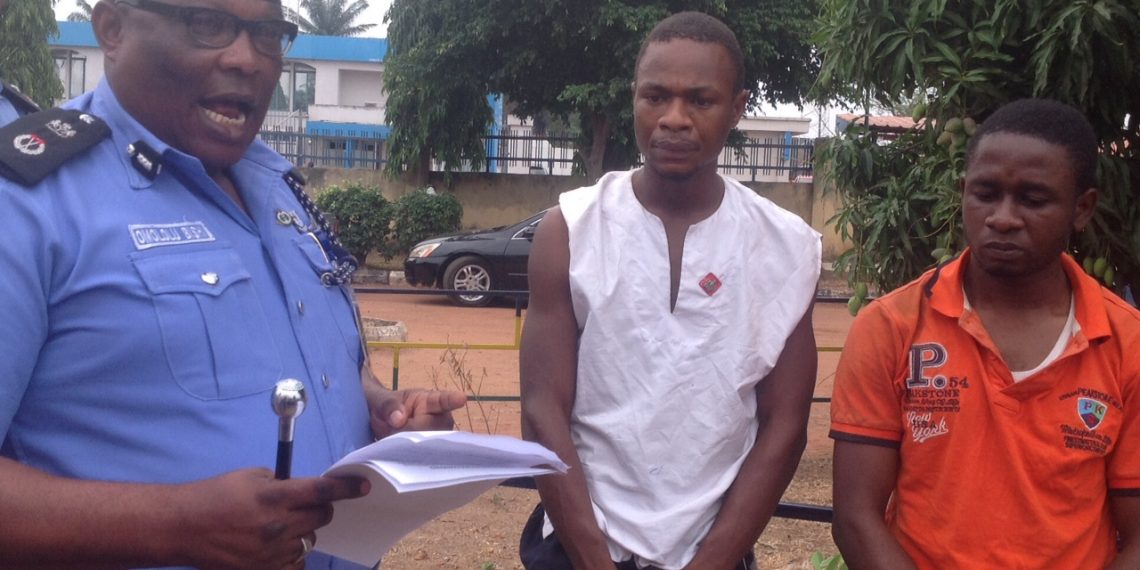
Briefing newsmen at the Command Headquarters in Makurdi, the Commissioner of Police, CP Omololu Bishi, said two of the suspects confessed to killing a young man for a ritual purpose.

According to the CP, the father of the victim, Mr. Iorumbur Amanger of Tombo-Mbaya Buruku Local Government Area wrote a petition to the Command stating that Hyginus Lubem Mbachi of the same address defrauded him of the sum of Two Hundred and Nine Thousand; One Hundred and Fifty Naira (₦209, 150) only being fee for the admission of his son Afa Amanger into a University in Cameroon. The said suspect left his house with his son to Cameroon and since then he could not communicate with his son.

“During investigation Hyginus Lubem Mbachii and one Gambo Bulus alias Murphy of Akwanga, Nasarawa State was arrested at Lafia, Nasarawa State on 22/02/2019 in connection with the case. The suspects confessed to have killed Afa Amanger since 05/01/2019 for ritual purpose and has been collecting money from the complainant for his own personal use”

The corpse of the deceased has been recovered from the Hospital where the suspects earlier abandoned the victim and ran away. The suspect will soon be arraigned in Court.

The Command also arrested (….) (omitted since not relevant for the present site – webmaster VDK). 

Source: Benue Police Parade A Man Who Defrauds Another Man Of ₦200k, Murders His Son For Ritual Purposes

Related article: Police nab 2 for ritual killing in Benue
Published: February 28, 2019
By: Rose Ejembi – The Sun – Voice of the Nation

Nemesis has caught up with two young men, Hyginus Mbachi and Gambo Bulus who killed a young man for ritual after one of them took him from his father on the pretext that he was going to help him gain admission in the Republic of Cameroon.

Parading the suspects on Thursday, Benue State Police Commissioner, Omololu Bishi, said the police acted on a petition written by the deceased father, Iorumbur Amanger, stating that Mbachi defrauded him the sum of N208,150 being fee for the admission of his son, Afa, into a university in Cameroon.

“He (Amanger), said the suspect left his house with his son to Cameroon and since then, he could not communicate with his son,” adding that during investigation, Mbachi (22) and Bulus (23) were arrested in Nasarawa State on February 22, 2019, in connection with the case.

Bishi who disclosed that the suspects had already confessed to the crime, said the suspects confessed to have killed Afa since January 5, this year for ritual purposes adding that the herbalist was still on the run with the blood-stained knife.

The CP who said the suspects had also been collecting money from the complainants for their own personal use, revealed that after stabbing Afa, they took him to a hospital on the claims that he was their friend who was involved in an accident.

“As soon as the hospital took the patient into the emergency ward, the two suspected criminals disappeared and never returned to the hospital.”

Bishi who posited that the suspect would soon be arraigned in court said the corpse of the deceased has been recovered from the hospital where the suspects earlier abandoned him and ran away.

Speaking with newsmen while being paraded, the suspects, Mbachi and Bulus who confessed to the crime said the victim whom they alleged was a member of the Young Vikings confraternity was actually not the target for their ritual purpose but was stabbed in error.

Bishi warned parents against giving out their wards to people they don’t really know, stressing that ritual killings, kidnapping and other social vices are now happening at an alarming rate in the country.

Nigeria: ritual murders, human parts dealers on the rise

Published: November 10, 2018 – 2:25 AM
By: Nathaniel Bivan (Abuja) & Itodo Daniel Sule (Lokoja)
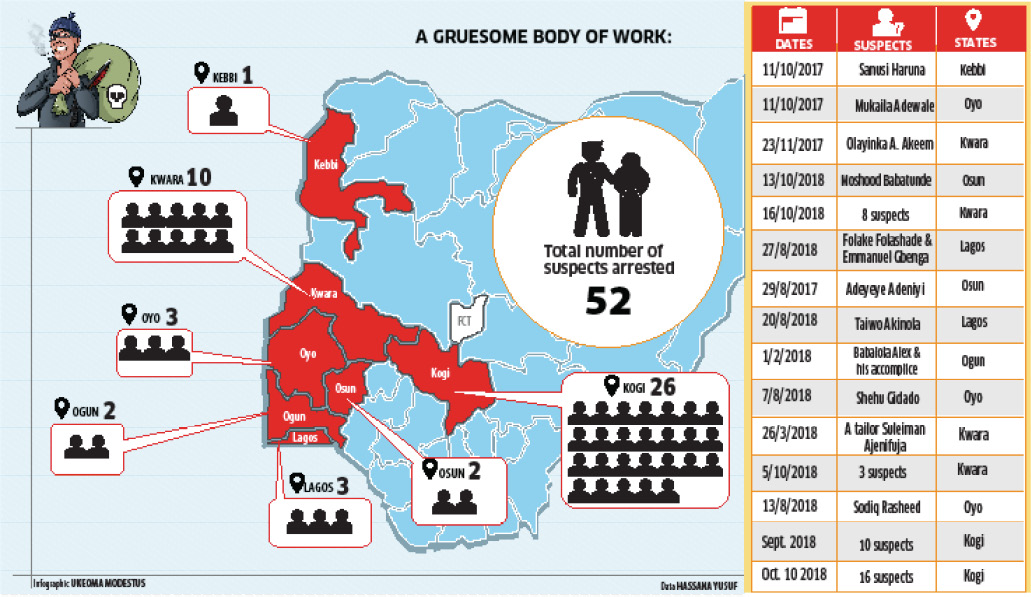
Ritual killings and trade in body parts is one crime that has refused to go away in Nigeria. So far, not less than 55 suspects have been arrested in the past one year for human parts-related crimes in states such as Kebbi, Oyo, Kwara, Osun, Lagos, Ogun, Kogi and Nasarawa.

One of the most recent took place in Nasarawa State, where three men were arrested by the Nasarawa State Police Command for allegedly being in possession of human parts. They were reported to have, on November 1, exhumed a freshly buried corpse from a cemetery at Mararaban-Akunza and chopped off an arm.

Then in Ankpa LGA of Kogi State, neighbouring communities have had long-drawn cases of abductions, ritual killings, harvests of human parts, deadly cult activities and gruesome murders. Alarmed, some locals lodged complaints to the police. After months of discreet investigations, the Inspector General of Police Special Tactical Squad first busted a 10-man gang that allegedly specialized in selling  human parts, also responsible for various crimes perpetrated in Ankpa and environs sometime in September 2018.

The kingpin of the gang, 39-year-old Yakubu Hamidu, had prior to their arrest held positions of Secretary of the Local Vigilante Group for five years and was its chairman for one year in Ankpa LGA where he hails from.

Hamidu told the police that in his capacity as leader of the vigilantes, he had access to arms and ammunitions with which he hunted down victims for human parts, especially male and female private organs. He also revealed how they killed four local vigilante men and a police officer in Ofu LGA during one of their operations.

But following the mop-up of arms and ammunitions by the police as directed by the IGP, the crime business nosedived, thus forcing Hamidu to resort to recruiting youths in the community to resuscitate the human parts trade. He had allegedly promised handsome rewards to those he recruited, but the bubble burst when he failed to keep his promise. One of the gang members, 18-year old Ubile Attah decided to turn in  the group to the Inspector-General of Police Special Tactical Squad.

Following the arrest and revelations made by the 10-man gang, the police High Command made further arrests of those allegedly behind the killings and human parts trade.

Force Public Relations Officer, DCP Jimoh Moshood who paraded the suspects in Abuja, said the police began investigation into the group’s activities following repeated cases of abduction, killing, and removal of vital body parts of victims which were reported in Ankpa town and environs as well as the killing of a Police Inspector, Abdul Alfa, at Ejule Police outpost in Ofu LGA while on foot patrol on November 28, 2017. A total of 16 suspects alleged to be responsible for the criminal activities were paraded in Abuja by the police.

The suspects are: Abdulahi Ibrahim Ali, Alhaji Shaibu Adamu, Yakubu Hamidu, Ubile Attah, Julius Alhassan, Shehu Haliru, Abdullahi Tijani, Akwu Audu, Alhaji Abdullahi Zakari, Sale Adama, Musa Abdulahi, Yakubu Yahaya, Adama Shagari, Baba Isah, Isaac Alfa, and Idoko Benjamin. Arms and ammunition recovered from them, according to police, include one pump action rifle, two locally fabricated single barrel guns, and three short axes.

According to Moshood, Hamidu, 39, who is gang leader and native of Ankpa, and the vigilante leader in the community, along with his vigilante guards “are the hit-men responsible for the killings and removal of mostly male and female organs of several victims, including other body parts, such as the head, kidney, and other vital body organs, which they sell within and outside the state for rituals.”

According to the Police spokesperson, Yakubu and his members confessed to the crime and admitted that they were working for one Abdullahi Ibrahim Ali a.k.a Halims and Alhaji Shaibu Adamu a.k.a Aye-Marina, whom they sold the body parts to.

Moshood noted that Ibrahim has allegedly “used the proceeds of crime to build and own many properties, including big hotels and several filling stations in Kogi State, while Alhaji Adamu who is without any known profession or means of livelihood was suspected to have built mansions and four filling stations in Ankpa, and another four at Onyangede in Benue State with the proceeds of the crime.”

According to him, the suspects further confessed to the killings and removal of body parts of victims whose names they gave as James, Christopher, Mohammed, Small Case, Omu and one Inspector Abdul Alfa who was ambushed and axed to death in Ofu.

Some of the suspects confessed that they paid N500,000 for female organs and N300,000 for male organs by those that contracted them. The police have since charged the suspects before a Kogi Senior Magistrate Court in Lokoja.

Ibrahim, who was alleged to be one of the ‘contractors’, however said that he knew nothing about the said crime, adding that his ordeal was orchestrated by his political enemies. He is currently the All Progressives Congress’s (APC) House of Representatives candidate for Ankpa/Olamaboro/Omala constituency in the 2019 general election.

In the meantime, Ibrahim, Adamu and Ukubile had been granted bail by the court while the other suspects were still being remanded in police custody in Abuja. Hearing on the matter comes up at the Magistrate Court in Lokoja, on November 12.

The cases continue to pile up nationwide: On August 13, a suspected ritualist, Ganiyu Idowu, 62, confessed he connived with one Alfa Bamigbola Edun, to use his apprentice for money rituals. The two were paraded by the Ogun State Police Command alongside another accomplice, Matthew Odunewu, at the state police headquarters, Eleweran, Abeokuta for allegedly kidnapping Ganiyu Akanni for money rituals.

Idowu, a herbalist, said Edun asked him to provide one person for a ritual that would yield N11 million. But Edun denied the accusation, saying he only engaged the herbalist in a mutual exchange of knowledge.

The Ogun State Commissioner of Police, Ahmed Iliyasu, said the suspects were arrested at the Ogun River bank in the act of preparing to slaughter the victim for a ritual. “On interrogation, they confessed that the polythene bags found with them were to be used to collect their respective shares of the victim’s body parts after killing him,” he said.

Lagos is also not left out: In August this year a ‘mentally deranged’ couple who resided under a bridge at Cele NICA bus stop, Ojo in Mile 2, Badagry Expressway were nabbed by detectives attached to Ijanikin Police Station of the Lagos State Command, who found them in possession of various human parts.

Another case is that of an Ilorin group of eight suspects allegedly responsible for kidnapping, murder, ritual killings and exhuming dead bodies. They were also said to have been removing and trading in human skulls and other human body parts in Ilorin, Kwara State by police spokesman DCP Moshood. He narrated that during a search operation, eleven human skulls, some pieces of human bones, human hair, and powder suspected to be ground human bones and charms were recovered.

Moshood said the suspects confessed and admitted to have sold 31 human heads to some personalities in Ilorin, other towns in Kwara State and neighbouring states.

Some locals spoke to Daily Trust Saturday, expressing fears that cases will only increase, as the general elections approach. “Some of them believe in arcane things, and subscribe to fetish activities,” one of them said. “They think ritual killings or severed human parts and organs will help them win elections, but they’re wrong. They’re just monsters, with a taste for human life,” he added, “And God will certainly visit his wrath on them.”

– With data compiled by Hassana Yusuf

Source: Ritual murders, human parts dealers on the rise

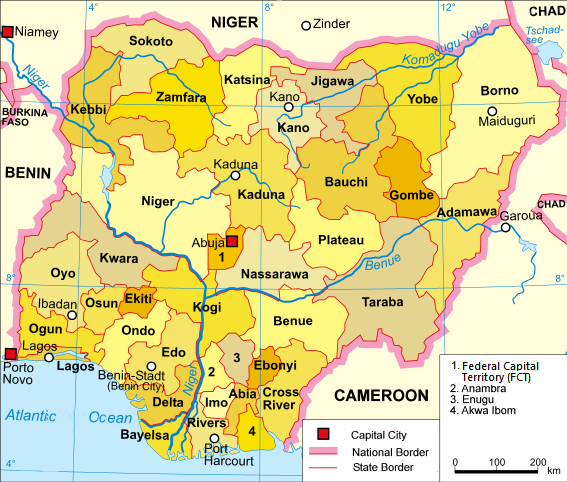
Nigeria – political map