Liberia is not known to actively fight ritualistic murders or to prosecute and condemn perpetrators of these heinous crimes. Yet, according to a recent newspaper article (reproduced below) it has a anti-ritual killing taskforce – which is quite revealing. Is the Taskforce just window-dressing or is it a sincere attempt to fight these criminal, traditional practices which are so hard to wipe out? I do not know the taskforce’s mandate, year of creation or its yearly budget, but will try to do some research and will let you know my findings asap.
Recently, Montserrado County District #1 Representative Lawrence Morris donated two brand new motorbikes to the anti-ritual killing Taskforce. At the occasion, he again expressed his condolences to the families of Elijah Porluma, 9 and Thomas Kollie, 10, who were reportedly abducted and killed allegedly for ritual purposes in early June 2019 (see my August 4, 2019 posting with the article entitled ‘Ritual Killings’ Spark Riot in Kingsville, dated June 25, 2019).
Representative Morris made a generous gesture by donating two motorbikes to the anti-ritual killing taskforce, but will his donation solve the endemic problem of ritualistic killings in the country, or make a significant contribution to fighting these crimes?
I have my doubts. In my view, more needs to be done to effectively end ritual killings in a country where superstition, ignorance, poverty, greed, lack of rule of law and impunity are responsible for the continuation of these criminal practices (webmaster FVDK).
Montserrado County District #1 Representative Lawrence Morris donates two brand new motorbike for Anti-Ritual Killings
Two brand new motorbikes, in the tune of L$490,000, have been donated to the Anti-Ritual Killing Community Watch-Team in Number 7 Community, Kingsville Township, Montserrado County District #1 on Thursday, October 24, 2019 to assist the Liberia National Police (LNP) to protect lives and properties.
Montserrado County District #1 Representative Rep. Lawrence Morris called on the District to choose peace over violence and end violence and ritualistic killings that would have the propensity to cause civil war or divide the district and, at large, the nation.
Montserrado County District #1 Representative Lawrence Morris
He again expressed his condolences to the bereaved families of the two children, Elijah Porluma, 9 and Thomas Kollie, 10, who were reportedly abducted and killed allegedly for ritual purposes in early June 2019 (italics added by the webmaster FVDK).
The House’s chairman on Refugees Repatriation, Resettlement and Reintegration urged his constituencies to join him not to applaud the ritualistic killings, and must never choose violence instead of peace; lies instead of truth and laugh at obscenities instead of correcting them.
He pointed out the new bikes are in fulfillment of his promise to support the Community Watch-Team to save lives and protect properties.
The Montserrado County lawmaker said: “You shall not murder or You shall not kill, is a moral imperative included as one of the Ten Commandments in the Holy Bible and it’s a sin against God.”
It may be recalled that, on Monday, June 24, 2019, aggrieved citizens of the Kingsville town blocked the main road from Red-Light to Kakata in demand for justice for two boys, Elijah Porluma, 9 and Thomas Kollie, 10, who were reportedly abducted and later killed allegedly for ritual purposes (italics added by the webmaster FVDK).
The demonstrators were holding aloft placards bearing inscriptions that read, “We want justice,” as they occupied the middle of the road with themselves and abandoned pieces of timber and metallic objects used to set up the roadblock.
Not all ritualistic murders follow the same pattern. Even though the case presented below differs from the ‘traditional’ ritual murders, the perpetrators are also driven by greed and superstition (webmaster FVDK).
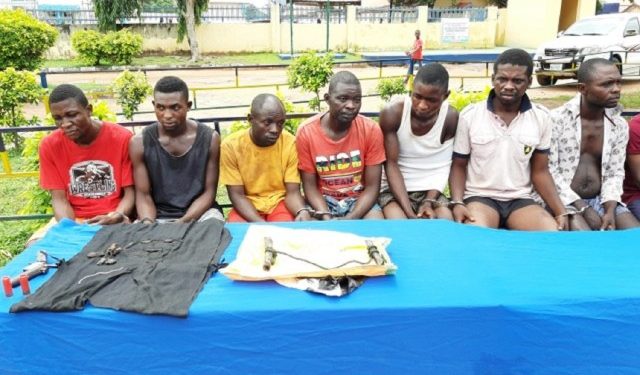
A notorious kidnap kingpin who led a gang that specialized in the abduction and murder of his victims even after collecting ransom has revealed that he slaughtered 16 persons and offered their blood for a ritual to acquire wealth and power.
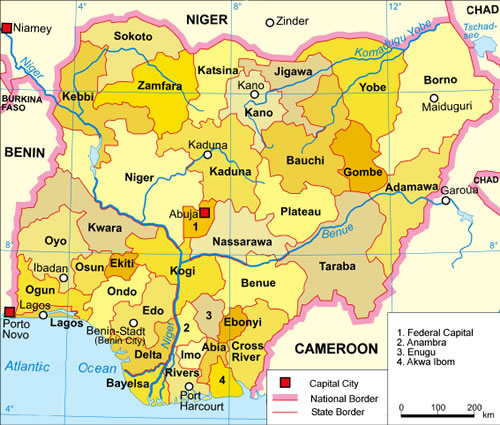
The kidnapper, Iorwuese Ikpila aka Dr. Kwagh Akorom Me Nenge (catch me if you can), who was paraded on Thursday by the Benue Police command alongside six other accomplices claimed he was the son of a native doctor and usually had communion with a ‘Queen’ in the spirit realm who directed his gang to sacrifice 20 persons after which they would become rich and powerful.
“So from there I and my people kidnap people and when we kidnap them we kill them and give their blood to our ‘Queen’ for power to get anything we want both power and money.
“I have been in the business for three months because the ‘Queen’ mandated that we should complete the blood sacrifice with 20 people for us to acquire whatever we needed but so far we have killed 16 persons.
“After abducting our victims, we dispossess them of their belongings, we strangulate them and give their blood to the ‘Queen’ and after that we bury them.
“But I have now realized that all powers belong to God. Before now I confessed my sins to the Policeman that arrested me. He also took me to a Pastor in Katsina/Ala even before taking him to the graves where I confessed my sins,” he added.
Iorwuese Ikpila who claimed to be 30 years old said he had four wives and four children.
Earlier the Benue state Police Commissioner, Mr. Garba Mukaddas said the arrests of the gang followed a tip-off.
They specified that the gang kidnapped sixteen persons, robbed them of their vehicles, motorcycles and other belongings, killed their victims, buried the corpses and planted cassava on the graves as a way of covering the crime.
Further investigation led to the discovery of sixteen shallow graves. Eleven corpses have been exhumed and identified by their family members.
“A receiver of the properties stolen by this gang, one Shizoon Nyityo has also been arrested. Items recovered from the suspects include one locally made single barrel gun, a rope used by the gang members to strangulate their victims and assorted charms. Investigation into the matter is ongoing,” Mr. Mukaddas said.
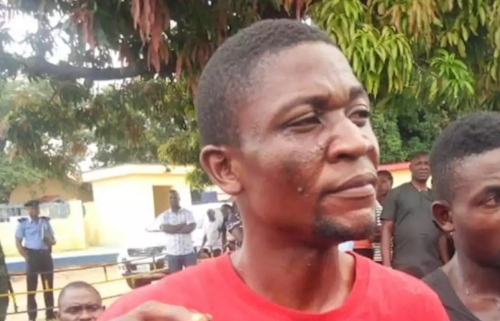
Leader of the kidnap gang in Benue State, Iorwuese Kpila
Related articles:
Bizarre Confession: Our Target Was To Kill 20 People, Says Benue Kidnap Kingpin
Published: September 27, 2019 By: SAHARAREPORTERS, NEW YORK
The 30-year-old said that he wanted to be powerful and influential in his community even beyond Benue State that was why he engaged in criminal activities.
Leader of a kidnap gang in Benue State, Iorwuese Kpila, 30, has said that he and his colleagues were given a target by one ‘queen spirit’ to kill 20 people and take the victims’ blood for ritual purposes.
Iorwuese made the confession on Friday while being paraded at the Benue State Police Command headquarters in Makurdi, the capital, alongside six members of his gang and five others arrested for child trafficking, armed robbery and other crimes.
The 30-year-old said that he wanted to be powerful and influential in his community even beyond Benue State that was why he engaged in criminal activities.
He said, “I was born in 1989 and I’m married with four children and four wives but so far, only one wife is staying with me and she is not aware that I’m into this.
“My father was a native doctor and he worked with so many spirits. When we kidnap people, we kill them and dispossess them of their valuables.
“We give them concoction that make them carry out whatever task we ask them before killing them.
“So far, we have kidnapped 16 persons, robbed them of their vehicles, motorcycles and other belongings, killed the victims, buried the corpses and planted cassava on the graves.
“The ‘queen spirit’ directed us to do so and after meeting the target of 20, we would acquire whatever we want in life.
“It is the ‘queen spirit’ that consumed the blood of our victims.”
Police have arrested another suspected serial killer and kidnap kingpin, Iorwuese Kpila, in Benue state.
Kpila reportedly confessed to killing 16 persons who are mostly commercial motorcycle operators.
According to him, a spirit known as ‘Queen’ told him to kill 18 persons to acquire supernatural powers ’to appear and disappear’.
Iorwuese Kpila, another suspected serial killer and kidnap kingpin in Benue state arrested for killing 16 persons has made more mind-blowing confessions. According to a report filed by The Nation, Kpila said he buried the victims in mass graves, adding that he killed his victims for ritual and supernatural powers. The 30-year-old suspect made the shocking confession while he was paraded on Friday, September 27, alongside six other members of his gang by the Benue state police commissioner, Mukaddas Garba. Kpila further confessed that he planted cassava on the mass graves as a decoy.
Confessing further, the suspects said they lured their victims who are mostly commercial motorcycle operators and killed them with a rope and afterwards sell the victims’ motorcycles. “We would tell okada riders to drop us at a certain location and immediately we reached there, me and my gang members would grab the victim and strangulate him with a rope. We would dig a grave, bury him and plant cassava on top of the grave, thereafter sell the motorcycle,’’ Kpila confessed.
Kpila also claimed that a spirit known as ‘Queen’ told him to kill 20 persons to acquire supernatural powers ’to appear and disappear.’
Garba urged members of the public to always feel free provide his command genuine information about criminals and their activities in the state.
Published: October 17, 2019 By: Takunda Shumba – Zw News
Scores of angry villagers last week filled Chitakatira Police Base demanding local police to take action against the increasing numbers of ritual killing of people in their area.
Many people have been killed by a suspected group of human slayers (mabhinya) since mid-August 2019. (italics added by webmaster FVDK)
A member of Mugodhi Apostolic Church John Muponda went missing on Monday last week and family and church mates found his remains dumped partially decayed at Makuti Farm in Vumba on Saturday.
A church congregant who refused to be named for own security reasons suspects that Muponda was murdered even though post-mortem results were not yet out by the time of writing.
The female church member also expressed her concern about what she considered to be lax policing and investigative work by authorities.
“John was someone close to me. It’s so sad that he is no more. I am here out of anger. Why they are killing others like chickens,” said the congregant.
Local traditional leaders were also amongst the villagers who took part in the demonstrations.
One of them is Headman Simon Chigodora who described the situation in the area as a very weird one.
“We have not come here to damage police property. We just want to express our worries. Most of these people has relatives and friends killed by those criminals. More than three people were killed since the end of August. The Chigodora community needs police attention,” Headman Chigodora told TellZim News.
Manicaland provincial police spokesperson Assistance Inspector Luxson Chananda confirmed the rise in cases of murders saying authorities were doing their work to fight all forms of crime.
A mob of angry Mutare villagers last week filled Chitakatira Police Base demanding the police to take action against the increasing numbers of ritual killing of people in their area.
Many people are being killed in the area and their body parts are being harvested for ritual use.
A member of Mugodhi Apostolic Church John Muponda went missing on Monday last week and family and church mates found his remains dumped partially decayed at Makuti Farm in Vumba on Saturday.
A church member suspects that he was murdered.
“John was someone close to me. It’s so sad that he is no more. I am here out of anger. Why they are killing others like chickens,” said the congregant.
Among the protesters was the village Headman Simon Chigodora who described the situation in the area as a very weird one.
“We have not come here to damage police property. We just want to express our worries. Most of these people has relatives and friends killed by those criminals. More than three people were killed since the end of August. The Chigodora community needs police attention,”
Manicaland provincial police spokesperson Assistance Inspector Luxson Chananda confirmed the rise in cases of murders to TellZim saying the authorities have all hands on deck and are working hard to end the rampant killings.
Published: October 17, 2019 By: Munyaradzi Goche – Radio VOP
MUTARE – Scores of angry villagers last week filled Chitakatira Police Base demanding local police to take action against the increasing numbers of ritual killing of people in their area.
Many people have been killed by a suspected group of human slayers (mabhinya) since mid-August 2019.
A member of Mugodhi Apostolic Church John Muponda went missing on Monday last week and family and church mates found his remains dumped partially decayed at Makuti Farm in Vumba on Saturday.
A church congregant who refused to be named for own security reasons suspects that Muponda was murdered even though post-mortem results were not yet out by the time of writing.
The female church member also expressed her concern about what she considered to be lax policing and investigative work by authorities.
“John was someone close to me. It’s so sad that he is no more. I am here out of anger. Why they are killing others like chickens,” said the congregant.
Local traditional leaders were also amongst the villagers who took part in the demonstrations.
One of them is Headman Simon Chigodora who described the situation in the area as a very weird one.
“We have not come here to damage police property. We just want to express our worries. Most of these people has relatives and friends killed by those criminals. More than three people were killed since the end of August. The Chigodora community needs police attention,” Headman Chigodora told TellZim News.
Manicaland provincial police spokesperson Assistance Inspector Luxson Chananda confirmed the rise in cases of murders saying authorities were doing their work to fight all forms of crime.
Published: October 21, 2019 By: Zika Bobby, The Sun, Voice of the National – Sun New online
The Anifowose family of Ikorodu are grieving the loss of their son, Kudus, a JSS 1 student who was declared missing since on October 14.
The lad’s dismembered body was found yesterday in a compound in Ikorodu.
A 17-year-old boy and his grandmother were arrested by the police.
Kudus’ body was discovered in an unoccupied building near his friend’s compound, but the friend has denied any involvement. The grandmother has since been released by the police.
Family members are alleging ritual killing, calling on the police high authority to investigate the matter properly.
“The way things are going, we suspect that some people in high places could be involved in this killing. When the compound was sealed by the police, some people came in company of the boy’s grandmother saying they want to take a certificate from the compound. Thanks to the OPC that refused them entry.
‘Yahoo, in Nigeria,’ is not necessarily linked to ritualistic activities or – worse – murders. However, what ‘Yahoo’ has in common with ritualistic activities is the ‘get-rich-quick-mentality’. From the hijacking of email accounts and related ‘419 crimes’ to ‘money rituals’ is just one step. ‘Yahoo-plus’ represents this step.
‘Yahoo-plus’ includes using diabolical means to get rich or become famous, and – according to the article produced below – usually involves the use of human blood. ‘Yahoo-boys’ now kill and use human parts for rituals. They use charms to get control over their victims who fear the ‘juju’ in the hands of these ‘Yahoo Yahoo boys’ (webmaster FVDK).
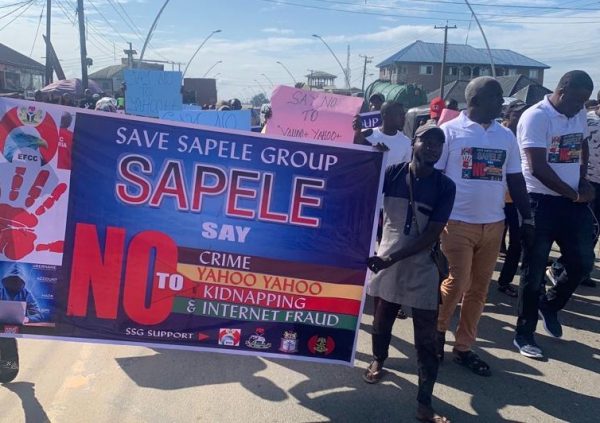
Sapele youths march against Yahoo Yahoo boys
Published: September 18, 2019 By: PM New Nigeria
Youths in Sapele and its environ have staged a peaceful rally in support of the efforts of the Economic and Financial Crimes Commission, EFCC, to rid Delta State and the entire country of cybercrimes and other forms of economic and financial crimes.
The youths under the aegis of Save Sapele Group, carried banners and placards bearing various messages such as “Sapele Say No to Crime, Yahoo Yahoo, Kidnapping and Internet Fraud”, “Say No to Corruption”, “Protect our Youths, Daughters and Sisters – Say No to Yahoo Yahoo” and ” Say No to 419″, as they marched through the streets of Sapele.
They also wore T-shirts with inscriptions condemning internet fraud popularly known as ‘yahoo yahoo’.
The youths said the rally which is coming on the heels of several arrests of cybercrime suspects in the city, was to demonstrate their disapproval of the activities of elements that engage in activities such as internet fraud, cybercrimes and kidnapping in Sapele.
“We don’t want yahoo yahoo. We don’t want internet fraud, We say no to 419 and ritual killing”, a spokesman declared.
Tuesday’s rally in support of the Commission came few days after some youths in the area staged a protest against a sister agency, claiming that officers of the agency were instigating the frequent EFCC raid of Internet fraudsters in the city.
From ‘Yahoo’ to ‘Yahoo-Plus’: Evil acts of Internet fraudsters
Published: September 19, 2019 By: Sun News Online
Internet fraudsters have intensified their means of operation by adding some diabolical features to their game. The perpetrators, who are mainly youths, now adopt all manner of conjurations to keep the cash coming their way.
The development has become disturbing to all concerned Nigerians. Many pundits believe that the trend, popularly known as ‘Yahoo,’ is creating a lazy and purposeless generation that is desperate to get rich overnight without minding the inherent long or short-term consequence.
It is indisputable that this get-rich-quick syndrome is already denting the image of not just Nigerian citizens but the country as well. Many have expressed concern over the negative impacts the illicit activities are having on Nigeria.
Gone are the days when the major means of getting funds by these yahoo boys was to hijack email accounts or email servers to intercept business transactions and redirect payments, or to spoof email addresses from external accounts pretending to be a company and authorising irregular payment transactions. Some of the fraudsters also used their victims’ credit cards to buy anything they wanted.
But it appears those tricks are no longer in vogue as their targets are in full grasp of virtually all the old gimmicks. Before their tactics were exposed, they had exploited many unsuspecting people, within and outside Nigeria. Their victims were fleeced of billions of naira and foreign currencies, as well as prized personal belongings.
An undergraduate of the Federal Polytechnic, Auchi, Edo State, told the reporter that two of his schoolmates were involved in ‘Yahoo-Plus,’ meaning using diabolical means to make wealth, usually involving the use of human blood.
“People should no longer be deceived over Internet fraud. What the boys do now is killing and using human parts for rituals. Many of them also use charms to manipulate the minds and thoughts of their victims. Honestly, if you have experienced the use of juju, you will understand that it works on many people. The victims would lose control of their thoughts or actions. They would become puppets in the hands of their manipulators. It may not last for long, but for the short period it is in effect, the victims might give all they have to the fraudsters.
“Recently, a student I know very well, who was in National Diploma 2, bought a car worth over N7 million. Everybody knew him as a yahoo boy. But something mysterious happened to his mother the last time he travelled to his hometown in Delta State. The news went round the campus of how his mother bled to death as soon as the boy stepped into their family house.
“Some of his siblings quickly raised the alarm and out of the fear of being mobbed by his own people, he fled and has not returned till date. He didn’t also come back to the campus. He abandoned his studies and his property at the apartment that he rented,” he said.
The source said the news did not come to most of the students as a surprise because the student in question had always boasted that he was making his money through the Internet. He stated that the student, who is now on the run, lived a flamboyant life and spent money as if it was going out of fashion.
“There is also another student who allegedly used his younger sister for money rituals. But something seemed to have gone wrong along the line that resulted in the young man running mad. Some said that he confessed to have killed his sister to get rich. Meanwhile, everyone knew him in school as an Internet fraudster.
“There are many others who are driving exotic cars on campus but they can’t take such vehicles home so that they won’t be questioned by their parents on their source of wealth. We know these people very well and many of them don’t hide their identities. They also belong to a clique and they don’t fail to intimidate others with their ill-gotten wealth.
“Yahoo-Plus is the reigning thing now. Some would travel to as far as Ghana only to return within a few months and begin to spend millions of naira. They call it ‘Ghana connection.’ They organise parties now and then for no tangible reason. Any lady they want is at their beck and call, because money is there to throw around. They would disturb their neighbourhoods by blasting music,” he said.
Different security agencies are now waging war against these breed of criminals, but they keep devising different techniques and coming out strong. It was learnt that most youths who are into this ignoble act are ready to take their chances of being caught rather than to remain poor.
But some observers have opined that the fight against them should be intensified, urging all stakeholders, including parents and guardians, to contribute their quota to correcting societal ills.
Investigations also revealed that some of the youth who engage in these nefarious activities are as young as 15 years. Immediately they finish their secondary education, they begin to explore the world of quick wealth. At the moment, one significant thread runs through the operations of these fraudsters: almost all of them are believed to have one form of spiritual backing that enables them to entice their victims.
Some of these fraudsters have vowed that they would not mind dying for a chance to get rich quickly through any available scheme.
“If you don’t belong to the new system, you cannot make a huge amount of money. Everybody is now into the ritual aspect because the old techniques have been exposed,” a vehicle mechanic, Eric Udoh, said in Lagos.
A Benin-based trader, who is in her 60s, Mrs. Eunice Efewedo, told the correspondent that the rate at which young boys were embracing Internet fraud and other illegitimate means of making money was alarming.
She expressed worry that, with the way things were going, only a few youths would be enthusiastic to pursue a degree at higher institutions or learn a legitimate trade.
Said she: “The other day, one of them, who could not be more than 20 years old, bought a car for his mother. But his father quickly condemned the move by questioning his son’s source of money. The youngster just secured admission to the University of Benin that same year.
“The father insisted on getting to the root of the matter and threatened to summon an extended family meeting to discuss the issue. But before anyone knew what was happening, the boy bought a house in Government Reservation Area and relocated his mother there.
“Sadly, the mother died two weeks after moving into the new house. The boy refused to attend her burial but he gave the family five million naira for funeral. He lied that he had an international competition to attend. Everybody became afraid of entering the well-furnished house that he built for his mother.”
She added that some of the fraudsters who have soiled their hands in diabolical ways of making money would never give out physical cash to anyone. She said those categories of people would prefer to make an online transfer or buy whatever gift using the credit card.
“The new yahoo boys in town won’t give you money by hand but they can buy any expensive gift for you. They are doing all sorts of charms but feigning to be Internet fraudsters. Unfortunately, some parents are not rebuking their children to desist from such evil ways,” she said.
Many have argued that the expansive spread of Internet fraud could be attributed to multiple factors, such as weak moral values among youths, peer pressure and youth unemployment, among others. But some others have countered such assertions, insisting that such crimes have no justification, as there were many acceptable ways youths could make ends meet in Nigeria, irrespective of harsh economic conditions.
A pastor at the Redeemed Christian Church of God, Province 27, Lagos, Mr. Albert Wilson, told Daily Sun that the home and society have failed in raising children with high morals.
“The quest to possess material things by all means at the expense of contentment has caused us a lot of damage. Except we begin to have a reorientation and set our priorities right, there will continue to be a moral decay. What we preach on the pulpit, act as films, sing and discuss in politics go a long way to shape us.
“If you shield your child or relative, it means that you are part of the societal problem. We need useful information from the general public about people who engage in such acts and can be relayed to the law enforcement agencies for prompt action to be taken”, he said.
The objectives of this website is not to expose crimes committed by disturbed people, maniacs, but what matters is the link with superstition: the belief that committing a ritualistic murder and using body parts to make ‘juju’ or ‘muti’ are instrumental in increasing one’s wealth, prestige or power.
Since I want to inform the readers of this site as correct and objective as possible, I post here the article concerned on the arrest of a suspect and the (likely) real character of the murders of which he is being accused. (webmaster FVDK).
Published: September 18, 2019 By: New24, AFP
Nigerian police investigating the murders of at least eight women lured to hotels in the southern city of Port Harcourt said they had arrested a suspect.
Five deaths in the last month have sparked fears of “serial killings” targetting suspected sex workers, and a wave of protests by women activists in the city, the capital of oil-rich Rivers State.
Officers have arrested a suspect who had made “useful confessions” and they were pursuing other accomplices, Rivers State police commissioner Mustapha Dandaura said in a statement late Tuesday.
They suspected the murders were for ritual practices, he added.
“After the killings, a white cloth material is rolled on the victims’ necks or waists. So, there is an element of cultism in all the killings in the hotels that have taken place,” Dandaura said.
“The serial killer normally drugs his victims and thereafter, he strangles them,” he added.
Although local reports suggested more than 10 women had been killed, Dandaura said they had only eight verifiable cases, with the first of the victims murdered in July.
In recent days, women took to the streets of Port Hartcourt in a series of protests calling for better police protection.
Outrage at the killings and the police response spilled over on to social media after police told protestors that women should abandon prostitution to avoid being targetted.
“We must go back to try to educate them (women) and discourage them from going into prostitution because that is how they fall victim to these crimes,” deputy commissioner of police, Chuks Enwonwu told demonstrators, according to local reports.
Protesters and activists condemned the police response, saying all women were vulnerable to the rising attacks.
Prostitution is illegal in Nigeria, and police have enforced restrictions on hotels in the city, forcing hotel owners to install closed-circuit cameras to monitor activity or face closure.
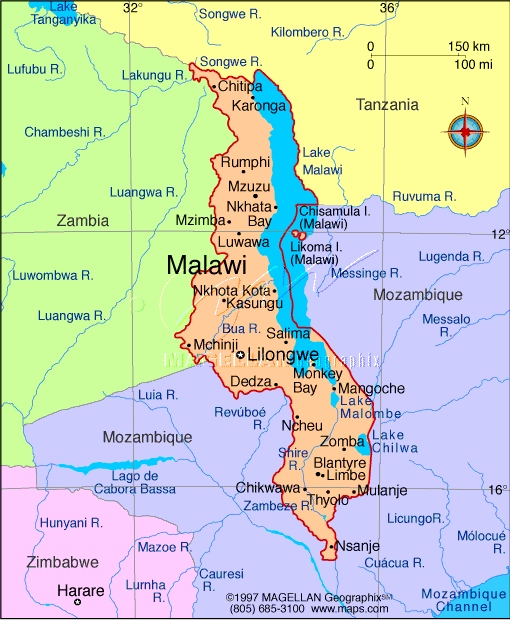
This site is meant to expose the atrocities committed by persons who believe in superstition, who violate the law, and to draw attention to the – often – lack of action by national governments. Lack of action, to protect their citizens, and lack of action to arrest and prosecute the perpetrators of ritualistic murders and related crimes. This time I have good news: the Malawian government has allocated 400 million Malawi Kwacha (about US$ 536,000) of its 2019/2010 national budget to the welfare and protection of its citizens who live with albinism. The budgetary allocation is to be seen in light of Malawi’s Four Year National Action Plan on Persons With Albinism which the government announced last year (June), following a spate of atrocities against people with albinism. Of course, the good news does not mean that we can lean back and be less alert on possible lack of action of the Malawian government when it comes to protecting its albino citizens. But the budgetary allocation and the National Four Year Plan are steps in the right direction for which the Malawi government of President Mutharika is to be commended. (webmaster FVDK).
Published: September 15, 2019 By: Ghana News
Malawi government has allocated 400 million Malawi Kwacha (about 536,000 U.S. dollars) of its 2019/2020 national budget to the welfare and protection of country’s persons with albinism.
Country’s Minister of Finance, Economic Planning and Development Joseph Mwanamvekha disclosed on Monday at the New Parliament Building in the capital Lilongwe where he presented the 2019/2020 national budget.
In the recent past, the Southern African country has been faced with barbaric acts of violence on persons with albinism, including killing, dismembering and exhuming their bodies for ritual beliefs.
Following the atrocities against the persons with albinism, the Malawi government June last year developed a four year National Action Plan on Persons With Albinism which was designed to guide efforts of dealing with the challenges.
Mwanamvekha said the allocation was meant to help in the successful implementation of the Action Plan.
In addition to this allocation, 600 million Malawi Kwacha under the Decent and Affordable Housing Project has been earmarked for the construction of houses for persons with albinism.
The National Action Plan on Persons With Albinism focuses on all aspects of life including education, health, economic activity, protection from abuse and human rights.
Ritualistic murders and alleged ritual killings are not only a violation of the law. They scare people. In many sub-Saharan African countries people fear what might never happen, but their fear is real. Too often they hear of children and adults who disappeared only to be found back ‘with several parts missing’. Reporting on alleged or real ritual murders is erratic. Not all cases are reported and very often we don’t hear what happened to the victims and their families – and the perpetrators. Even when caught and arrested, its is relatively rare to read reports about their trial, and subsequent sentencing when found guilty.
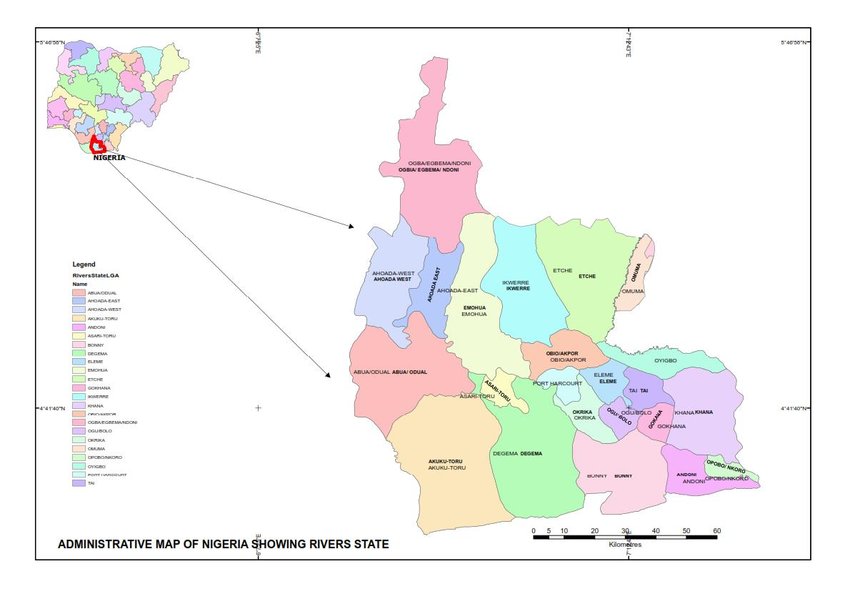
In Port Harcourt. Rivers State, Nigeria, a group of women took to the streets and demanded more protection of women and urged the police to take more measures to stop the recent wave of alleged ritualistic murders by one or more serial killers. (webmaster FVDK)
Published: September 14, 2019 By: The Sun (Nigeria)
Irked by the ugly pattern of supposed ritual killings of women in hotels in Port Harcourt, a body known as Rivers Female Youths yesterday, on a protest, took their grievance to the state police command, demanding stronger measures to protect women. The youths, who displayed placards with different inscriptions, decried what they see as the deliberate targeting of women by suspected serial killers operating in the state. Some of the placards read: “Hotel owners must be accountable and be responsible for their guests”, “She could be your sister, daughter, wife or friend” and “There is no life without women.”
Convener of the protest, Soibi Ibibo Jack, said that the female youths were at the state police command to demand stronger measures by the police to apprehend the killers. She said once apprehended, the killer must be made to face the full weight of the law, irrespective of his/her political or social status.
“There is a serial killer on the loose in Rivers State,” she insists. “We want to go out and return home without fear. We acknowledge the police for what they are doing, but we urge them to do more so that the killer is arrested, tried and made to face the full weight of the law.”
In her remarks, a protester, Cecilia Dikibo, urged the police to deploy more resources to ensure the safety of women in Port Harcourt. Also speaking, Peace Pepple from Opobo-Nkoro added that as the police works to secure women, there is the need for everyone to be careful. Bidemi Edward-Odoi suggested that the arrest and strict interrogation of affected hotel managers would help to compel others to take the security of their hotels seriously.
My September 12, 2019 posting – the day before yesterday – was about an old case of ritualistic murder in Ghana (then still called Gold Coast colony), ‘A chieftaincy dispute and ritual murder in Elmina, Ghana, 1945-6’. I have been following ritualistic murders and related incidents in Ghana for well over ten years now and reported on these crimes on a special page of my website Liberia’s Past and Present, called ‘ritual murders, not only in Liberia‘. The oldest case reported on the relevant Ghana page of the website dates from March 9, 2009 and although the main theme of the article concerned is quite different – it deals with the question who is to be credited for the foundation of ‘Ghana’ and the naming of the new republic which succeeded to the English colony of Gold Cost – my attention was drawn to a paragraph dealing with an old ritualistic murder case.
It reads as follows:
“Among the five causes of the deterioration in public confidence identified by the Colonial Office, was what they described as “the bitterness of the group of politicians, led by Dr. J.B. Danquah, over the hanging of the Kibi murderers”. According to a Colonial Office report on the disturbances in the Gold Coast, “[t]he Kibi affair changed the pattern of Gold Coast politics. A number of Kibi people were tried for the ritual murder at the time of the funeral, in 1944, of Nana Sir Ofori Atta, Omanhene of Akyem Abuakwa. They were defended in a notoriously long trial by many lawyers led by Dr. J.B. Danquah and employed by their relatives. The bitterness of this family over the trial and the conviction of some among their relatives as murderers resulted in their instituting an uncompromising political campaign against the Governor and the Government. This group subsequently formed the hard core of the extreme nationalists who in August 1947 founded the United Gold Coast Convention”.
The original article is presented below.
One reason why I post it here is to demonstrate that ritualistic killings are no new phenomenon in Ghana. Another reason is to show that the colonial authorities acted against these inhuman crimes. The third and last reason is to draw attention to the fact that ritualistic killings have never been eradicated in Ghana. The main question which immediately arises is : Why?
This will be the subject of another posting. (webmaster FVDK)
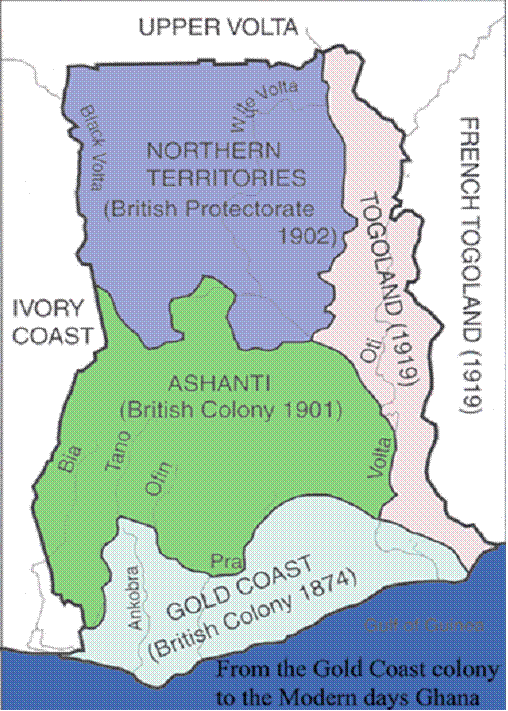
From the Gold Coast colony to present-day Ghana
Published: March 9, 2009 By: Ekow Nelson – GhanaWeb
President Evans Atta Mills’ proposal to honour our first president Dr. Kwame Nkrumah has generated a lot of debate on both sides of Ghana’s historical political divide. Apart from a minority who are opposed to another public holiday, the divisions are over whether the proposed Founder’s Day should be bestowed only on Nkrumah or be made Founders’ Day, extended to include the so-called ‘Big Six’ who were arrested after the 1948 riots and disturbances following the shooting and killing of three ex-servicemen.
The argument in favour of extending the President’s proposed honour is predicated on the belief that the arrests of the then leaders of the U.G.C.C. and the establishment of the Commission of Enquiry into the 1948 riots under the chairmanship of Aiken Watson Q.C., was a watershed moment in our country’s history and marked the beginning of the final journey toward independence. But is this credible?
From the end of World War II until the appointment of the Watson Commission, there was a gradual but palpable deterioration in public confidence in the Government of the Gold Coast, among other things, because of soaring inflation and growing shortages of consumer goods. Farmers were dissatisfied with the policy of cutting-out cocoa trees ravaged by the swollen-shoot disease with no compensation. Ex-servicemen who had fought in World War II for ‘King and country’ had only been awarded meagre gratuity and were experiencing similar hardships to the general populace. Neither the chiefs in the Joint Provincial Council, nor the elite political class, championed the cause of the growing mass of disaffected people and it fell upon Nii Kwabena Bonnne II, Osu Alata Mantse, to lead the agitation against increasing economic hardship and in particular, inexorable rises in the prices of consumer goods.
Just over a month after Nkrumah’s arrival in the Gold Coast in 1947, this growing discontent found expression in the boycott of mostly foreign-owned trading firms organized by Nii Kwabena Bonnne on 26th January 1948. The boycott continued for a month while its leaders negotiated price reductions with the government and the trading firms – the Association of West African Merchants (AWAM). However, on 28th February 1948 when the boycott was due to be called off, ex-servicemen set-off on a march to the Castle to present a petition to the Governor. In the ensuing kerfuffle, the British officer in charge of Castle security Superintendent Colin Imray gave orders to open fire, killing three ex-servicemen – Sgt. Adjetey, Private Odartey Lamptey and Corporal Attipoe – and injuring many others in the process.
News of the shooting sparked days of rioting in Accra by alr eady angry crowds incensed by the high price of food, which they blamed on the greed of foreign merchants. Shops and offices owned by foreigners were attacked, looted and the violence soon spread to other towns. Faced with widespread disorder, Governor Sir Gerald Creasy declared a state of emergency. Troops were called out while police arrested the ‘trouble makers’. Leaders of the U.G.C.C. – the so-called Big Six: J. B. Danquah, Ofori Atta, Akufo Addo, Ako Adjei, Obetsebi Lamptey and Kwame Nkrumah – were arrested and flown to the Northern Territories where they were detained for six weeks.
While it is true that both Kwame Nkrumah and Dr. Joseph Boakye Danquah addressed the ex-servicemen at a rally in Accra on 20th February 1948 where their petition to the Governor was drawn up, it is clear that the leaders of U.G.C.C. did not anticipate or plan the 1948 riots which was triggered by a combination of public disaffection over rising prices and shortages and the shooting of innocent ex-servicemen whose only crime appears to have been to petition the Governor.
After interrogating the accused the Watson commissioners concluded that Nkrumah was mainly to blame for the disorders. Curiously, the other leaders of the U.G.C.C also blamed Nkrumah for the riots and some, including Obestebi Lamptey and William Ofori-Atta, ransacked his house looking for evidence that he was a communist.
So, isn’t it rather breathtakingly hypocritical that while the U.G.C.C. leadership washed its hands of the 1948 riots and blamed Nkrumah for the disturbances that led to their arrests and earned them the sobriquet of the ‘Big Six’, 52 years on, their supporters wish to claim credit for triggering the process that led to the establishment of the Watson Commission and in consequence, the Coussey Constitutional Commission (from which Nkrumah and the Trades Unions were excluded) and the march toward independence? Without the 1948 riots it is unlikely the constitutional process that paved the way for our independence may have been initiated and the so-called ‘Big Six’ had no role in those events.
The other argument put forward by opponents of President Mills’s proposal is that prior to Nkrumah’s arrival, the U.G.C.C. leadership had started the agitation for self-rule. It is worth, however, examining the motivations behind the establishment of the U.G.C.C. to test this claim.
Among the five causes of the deterioration in public confidence identified by the Colonial Office, was what they described as “the bitterness of the group of politicians, led by Dr. J.B. Danquah, over the hanging of the Kibi murderers”. According to a Colonial Office report on the disturbances in the Gold Coast, “[t]he Kibi affair changed the pattern of Gold Coast politics. A number of Kibi people were tried for the ritual murder at the time of the funeral, in 1944, of Nana Sir Ofori Atta, Omanhene of Akyem Abuakwa. They were defended in a notoriously long trial by many lawyers led by Dr. J.B. Danquah and employed by their relatives. The bitterness of this family over the trial and the conviction of some among their relatives as murderers resulted in their instituting an uncompromising political campaign against the Governor and the Government. This group subsequently formed the hard core of the extreme nationalists who in August 1947 founded the United Gold Coast Convention”.
It is also far from clear that the immediate aim of the movement was to seek independence. In a letter to the Secretary of State for the Colonies Mr Creech Jones in December 1947, Sir Kenneth Bradley, officer administering the Gold Coast, argued that the motivations for the establishment of the U.G.C.C. had much to do with the personal ambitions of its leadership to supplant the Chiefs on the Joint Provincial Council in the power-sharing arrangement with the colonial government.
According Bradley, “one of the [U.G.C.C.’s] immediate aims is to wrest power from the chiefs. Those leading chiefs of the Colony with whom I have discussed the Convention agree that this is the main immediate aim of promoters of the party; and they are somewhat disturbed by the party’s activities. This assessment of the Convention’s present objective is borne out also by the reports of the meetings so far held. None of the leading chiefs of the Colony have been invited to take any part in the framing of the Constitution, nor has any approach been made to the Joint Provincial Council or the Ashanti Confederacy Council.”
While it was clearly a nationalist movement, the U.G.C.C. was not national in its reach, at least until Nkrumah’s arrival four months after its inauguration in Saltpond. As Bradley pointed out, its supporters were mainly in the large coastal towns of Accra, Saltpond, Cape Coast, Sekondi and Kibi the home of Dr Danquah, which was also the mainspring of the movement. The Watson Commission too observed that the “U.G.C.C. did not really get down to business until the arrival of Mr Nkrumah on 16 December 1947” who was singularly responsible for broadening the appeal of the movement across the country.
The role and contribution of U.G.C.C. in the struggle for independence is not in doubt but to hoist it, almost exclusively, as the harbinger organisation for Ghana’s independence is to overstate its case. It was neither the first nationalist movement in neither the Gold Coast nor the last; indeed it supplanted the Aborigines’ Rights Protection Society which until then championed the interests of natives of the colony. Like the Aborigines’ Rights Protection Society, it too, was supplanted – by the Nkrumah’s Convention People’s Party – when it [the U.G.C.C.] became a “spent political force” (as the some founding members of the U.G.C.C. said of the Society in 1947). Ghana’s struggle for independence began long before the U.G.C.C. and the Big Six and there is a case for honouring all of those like Joseph Casley-Hayford, John Mensah Sarbah Nii Kwabena Bonnne II and William Essuman Gwira (Kobina) Sekyi, who have contributed immensely to our nationhood. But are we to believe that the likes of Obetsebi Lamptey, Ako Adjei, Edward Akuffo-Addo and William Ofori-Atta, their contributions notwithstanding, are more deserving than these stalwarts of 19th and 20th century Gold Coast only because they were part of the ‘Big Six’ arrested after the 1948 riots? No!
The final leg of the argument against declaring 21st September Founder’s Day is that Nkrumah was not the founder of Ghana. If anything, in addition to his other immense intellectual and political achievements, Dr. J.B. Danquah was founder by virtue of proposing we adopt the name Ghana, his supporters argue. It is true that Dr. J.B. Danquah demonstrated in his paper “The Ghana Hypothesis” that the inhabitants of the then the Gold Coast were descended from the first of the three major empires of Western Sudan. In a Colonial Office despatch in 1949, the officer administering the government then observed that “Nkrumah’s axial fantasy – Ghanaland – [had] been cribbed from Dr. Danquah. With some malversation of history and considerable recourse to mystical interpretation, Dr. Danquah demonstrated some time ago that the Gold Coast is the ancient state of Ghana. The romantic notion was enthusiastically received and much elaborated by local bards but it was Mr. Nkrumah who transformed it into a political conception”. In other words, Nkrumah could have chosen not to take inspiration from Dr. Danquah’s hypothesis but he complimented him by making what was a vague and ropey conception the reality that became the motion of independence tabled on August 3rd 1956. However, when the time came for Dr. Danquah and Nkrumah’s opponents to make the former’s hypothesis a reality, they spurned the opportunity. In a memorandum on 29th August 1956 to the United Kingdom cabinet, the then Secretary of State for Colonies described the events leading up to the motion: “The new Legislative Assembly was opened on 31st July, and on 3rd August the Government introduced its expected motion calling for independence within the Commonwealth. All the Opposition members boycotted the debate …and the motion was passed nem con. If there had been a vote, the Opposition could not have mustered more than 32 votes against the Governments 72. I must regard the motion therefore as having been passed by a “reasonable majority.” . The full text of the motion reads as follows: “that this Assembly do authorise the Government of the Gold Coast to request Her Majesty’s Government in the United Kingdom, as soon as practicable this year, to procure the enactment by the United Kingdom Parliament of an Act to provide for independence of the Gold Coast as a sovereign and independent State within the Commonwealth under the name of Ghana.|”” That motion was not drafted by Dr. Danquah; indeed as noted Dr. Danquah’s party boycotted the debate to request independence and to change our name from the Gold Coast to Ghana. He may have borrowed the idea from Dr. Danquah but it was Nkrumah who ‘christened’ the Gold Coast, Ghana.”
The arguments against President Mills’ proposition from the UP/NPP side is not credible, especially when one comes to think of the fact that they presided over the golden jubilee celebrations and had eight years in which they could have honoured the ‘Big Six’ beyond having their portraits put in the new currency notes. Now they are attempting opportunistically to gate-crash President Mills’s bash for Nkrumah with rather weak and hollow arguments.
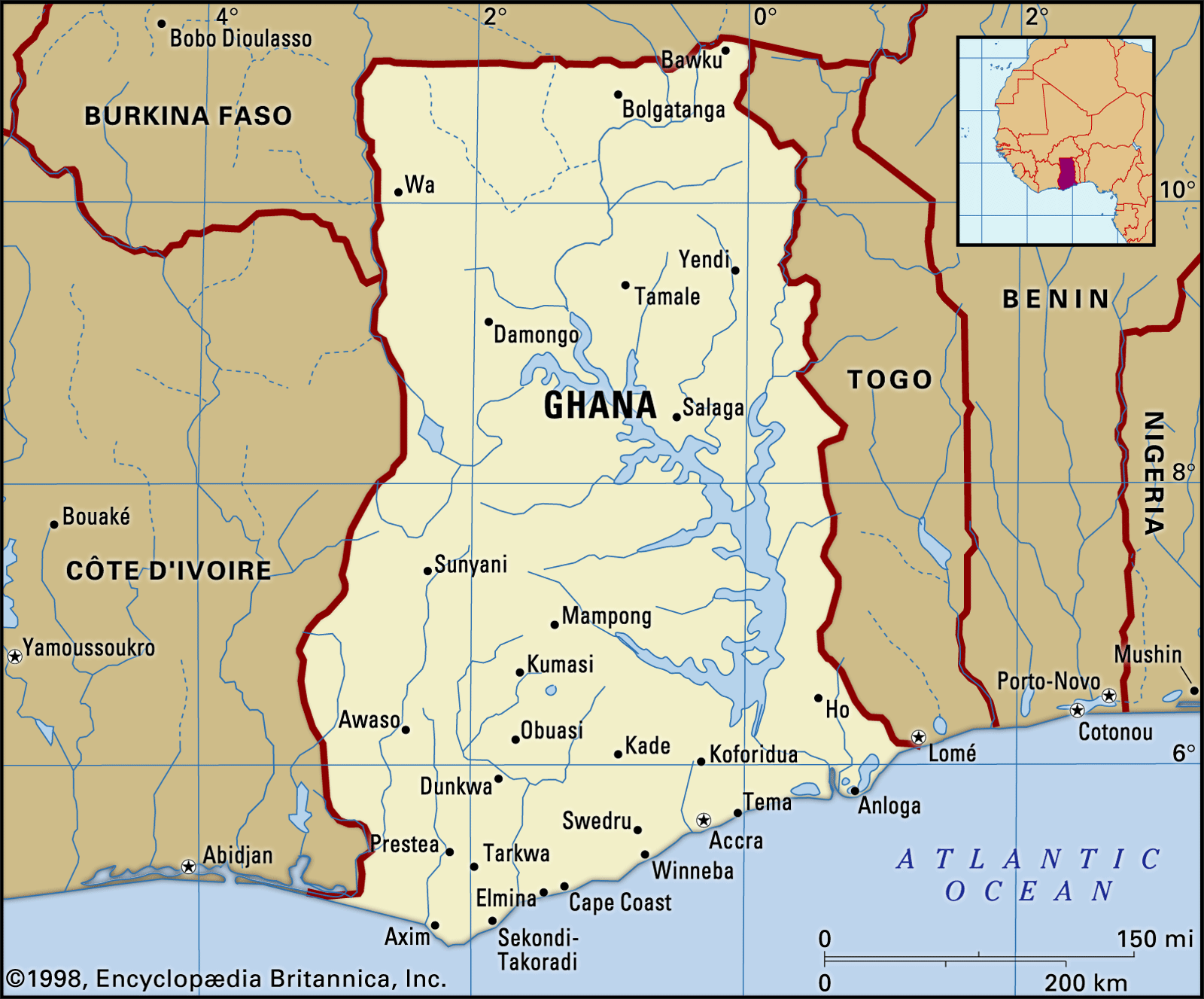
The current geographic borders of Ghana which integrates parts of what was Trans-Volta Togoland for example was negotiated by Nkrumah. It was Nkrumah who stopped separatists for dismembering and balkanizing the country as we know it. If the so-called Big Six had their way in 1956 Ghana would not look anything like what we know today. In its administrative structure, organisation and physical boundaries, the idea of Ghana as we know it today is by and large Nkrumah’s ‘creation’.
A refreshing sound. An honest voice. Though Dr Mbaimbai Hlathi was speaking on the theme of the day, which was ‘Traditional Medicine is the Answer’, his speech was more than a plea for traditional medicine. It also was a speech against age-old practices such as human sacrifices and muti killings – muti murders!
There is no place in a modern society for muti murders. Using traditional medicine means killing two birds with one stone: ending cruel practices such as muti murders which constitute serious human rights violations and preserving indigenous plants at the same time (webmaster FVDK).
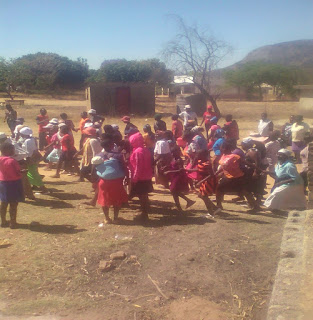
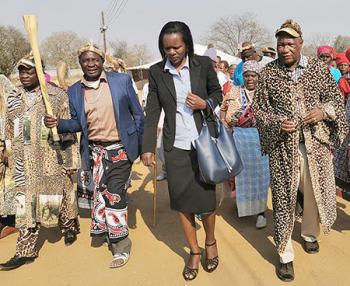
Dr Mbaimbai Hlathi (right) leads guests and traditional healers during the ceremony.
Published: September 9, 2019 By: Elmon Tshikhudo – ZoutNet
A well-known traditional healer and president of the SADC Unified Ancestors Practitioners Associations, Dr Mbaimbai Hlathi, has called on traditional healers “not to tarnish their God-given skills of healing people with the use of herbs by using human body parts”.
Hlathi, who made a name for himself by helping many barren people have children, was speaking during a function to celebrate traditional medicine. The event took place on Saturday at the Giyani Stadium and was attended by many traditional healers from around the country, officials from the Kruger National Park, government officials and many community members.
The theme of the day was Traditional Medicine is the Answer.
In an interview, Hlathi said that celebrating and preserving traditional medicine as it had been used by communities for decades as an effective treatment was important. He further indicated that traditional healers should stick to their traditions and desist from killing people for ritual purposes.
“Our gods gave us a whole land for herbs that are used to cure the different diseases. Why should we go out and kill others for their body parts? We are saying it here that those who use body parts are not part of us. They are fake healers who are tarnishing our noble profession of healing people.”
He described them as “fly-by-nights” and said that they should be exposed and punished by the law. “Ours is the task to heal people and not to kill others in order to heal,” he said.
Hlathi urged traditional practitioners to take an effective part in preserving indigenous plants. He called on traditional practitioners to help save the rhino by not working with criminals, giving criminals muti to go and kill rhinos and committing any other crimes in communities.