The following article, below, resonates deeply with me. In recent years, I have written so often about ritual murders in Nigeria (‘money business’) that it will surprise no one what moved the writer of this article. In Africa’s most populous country, ritual murders are committed perhaps daily: murders with ritual motives, superstition, belief in the power of ‘juju’, with the aim of enriching oneself, acquiring a better political or social position, or other selfish purposes.
Why is it so difficult to put an end to these vile, outdated and criminal acts? (FVDK)
The scourge of ritual killings
Published: June 3, 2026 By: This Day, Editorial, Nigeria
The criminals should be served full weight of the law
Increasingly, many Nigerians are now living in fear over growing cases of ritual killings. Last week, security operatives arrested a suspected serial killer who reportedly confessed to murdering dozens of people in the Odukpani Local Government Area of Cross River State. The suspect claimed he was assisted by a woman who usually lured unsuspecting victims to isolated locations where they were murdered, obviously for ritual purposes. But the Odukpani killings are not isolated incidents. While there may be no reliable statistics, the menace of missing persons and ritual killings across the country has become pronounced. Indeed, it has become so obvious that a civil society organisation, ‘Enough is Enough’, has since opened a website to document the trend.
From Lagos to Port Harcourt, Enugu and other cities across the country, hardly a week passes without tales of some people killed for what are attributed to ritual purposes. Last November, a Federal Road Safety Corps (FRSC) officer and her 12-year-old daughter, were gruesomely murdered in Osun State by a family friend who lured them to the shrine of a herbalist where they were slaughtered and dismembered, with their vital organs removed. And in April this year, the Kwara State Police Command apprehended a man with the skull of a deceased family member whose remains he had exhumed.
Ritual killing is not a new criminal challenge. In March 2014, the nation was thrown into confusion when a kidnappers’ den was discovered in Soka community, Ibadan, Oyo State. After the den was raided by some commercial motorcyclists who were searching for two of their missing colleagues, human skulls, dried human parts alongside malnourished victims reportedly reserved for ritual purposes, were discovered. In August 2018, the Lagos police arrested one Taiwo Akinola, a suspected cult member, for allegedly attempting to kill his mother for money rituals.
But perhaps one of the most celebrated cases was that of the Port Harcourt serial killer, Gracious David-West who reportedly lured seven young ladies with high-risk lifestyle across Lagos, Imo and Rivers State to hotels and murdered them for rituals. Similarly, a young graduate who was raped and murdered while searching for a job in Uyo environs, Akwa Ibom State, few years ago, was reportedly used for ritual purposes. There was also the horrifying murder of a 300-Level undergraduate of Delta State University, Abraka, by a gang of four yahoo boys. One of the criminals told the police that they took the young lady to a bush where they plucked out her eyes, removed her breast and heart.
But the questions inevitably arise: What are the motives? What could be the cause of these grim acts of violence against fellow human beings, and indeed, the society? What could account for these barbaric acts of violence even among the supposedly educated citizens? Many attribute the menace to the growing sense of desperation to acquire wealth, without work. Amid the prevailing poverty and joblessness in the land, many have resorted to doing anything, no matter how weird, for wealth. Yet, there is no proven link between the costly rituals and the instant wealth promised through magical potions by herbalists and voodoo practitioners even when our society is now ravaged by it.
Today, many of our university campuses have become breeding grounds for Yahoo boys and girls who are looking for instant wealth. Sadly, the education they received does not rid them of the superstition that wealth comes from productive enterprises and not from human body. And with that, many innocent citizens are becoming victims to barbaric killings.
I have no doubt that Nigerian human rights activist Leo Igwe is among the top five fighters against superstition, witchcraft, ritual killings, and impunity on the African continent, and he is most likely the most active and best known.
Dr. Leo Igwe is active in numerous human rights groups, among others he directs the organization ‘Advocacy for Alleged Witches‘ (AfAW), an advocacy group defending the rights and dignity of people who have been accused of witchcraft, and working and campaigning to end all forms of human rights abuses linked to witchcraft allegations in African countries.
I have mentioned and quoted Dr. Igwe numerous times on this site, for which I owe him a great debt of gratitude.
The article below focuses on a recent case in Rivers state, Nigeria. In February, a man, accused of witchcraft, was killed. AfAW is concerned for his relatives and calls on the authorities to bring the perpetrator to justice. Between the lines, it can be read that the organization—learned from past experiences—has little faith in the Nigerian rule of law.
Dr. Leo Igwe, thanks again for this timely intervention! (webmaster FVDK).
Witchcraft and Killing in Rivers State: Nobody Can Hamper the Progress of Others Through Magical Means
Local sources informed AfAW that Isaiah had a wife and four children. His first child just finished secondary school. AfAW plans to visit the community and meet with family and community members to understand what happened and explore ways of supporting the family of the deceased during these difficult moments. Advocates will continue to pressure the police to bring the suspect to justice. Witchcraft accusations and jungle justice are against the law. The inability of the police to enforce the law drives these abuses.
Leo Igwe directs the Advocacy for Alleged Witches
The Advocacy for Alleged Witches is saddened by the brutal murder of Chidiebere Isaiah by a relative, Nwalozie Chiwendu, following an accusation of witchcraft in Ofeh, Rivers State, in Southern Nigeria. The tragic news reached AfAW on February 15, 2026. AfAW contacted The Punch and Vanguard correspondents in Port Harcourt for the phone number of the youth president of the Ofeh community in Omuma Local Government Area. Through an advocate in the state, AfAW contacted a legal counsel from the community who confirmed the incident and has volunteered to facilitate any intervention. This legal counsel said he knew the victim and the suspected murderer very well. As reported, Chiwendu accused and murdered Isaiah for being responsible for his lack of progress. The legal counsel stated that Chiwendu dropped out of primary school. He never went to secondary school. “How did he expect to make significant progress and become rich if he was not educated?” He queried.
Chiwendu reportedly fled after the incident. The local police claimed that he was at large. As in previous cases in Rivers state, this matter will fizzle out after a while. The police stated that the investigation was ongoing, but that was all that would be heard about the case. There are no indications that the police are taking the case seriously, that they are tracking the suspect, or that they will bring him to justice soon. Witch persecution persists in the region due to impunity and lack of accountability, due to a failure of the police and the justice system. Last year, the police in Rivers state refused to prosecute pastors arrested for abusing children during exorcism and ritual cleansing in the state. All efforts and pressures on police authorities to bring these violators to justice came to nothing.
Meanwhile, advocates have been reacting and expressing their outrage following the horrific murder of Isaiah. One advocate stated, “See what ignorance has done: a tragedy for that community and the family. One brother is dead, and another brother is certainly going to be hanged for murder. Terrible!. Meanwhile, the pastors who preached this rubbish mentality into his ignorant head are walking about free, indoctrinating other ignorant people”. Another noted: “This is evil. So you claim to do something good by killing your brother because he is a witch, and you are running? You are not supposed to run away; rather, you should stay so we can tell you what a hero you are. Witchcraft does not exist. Say no to witch-hunts”. Furthermore, one advocate described the incident as: ” Absolutely tragic. No one should ever be killed over superstition or accusations of witchcraft. Education, awareness, and justice are the only answers. End the witch hunts now”.
Local sources informed AfAW that Isaiah had a wife and four children. His first child just finished secondary school. AfAW plans to visit the community and meet with family and community members to understand what happened and explore ways of supporting the family of the deceased during these difficult moments. Advocates will continue to pressure the police to bring the suspect to justice. Witchcraft accusations and jungle justice are against the law. The inability of the police to enforce the law drives these abuses.
In addition, AfAW will organize public awareness programs to reorient the minds of people in Rivers State. AfAW will educate the public to understand that nobody can harm, frustrate, or undermine the progress of others through magical or occult means.
That such a belief is superstitious and based on fear and ignorance!
Opinion Nigeria is a practical online community where both local and international authors through their opinion pieces, address today’s topical issues. In Opinion Nigeria, we believe in the right to freedom of opinion and expression. We believe that people should be free to express their opinion without interference from anyone especially the government.
Give to Gain: Justice for Women Accused of Witchcraft in Africa
On March 6, 2026, the online Ghanaian newspaper ‘Modern Africa’ published an article written by Leo Igwe, ‘Give to Gain: Justice for Women Accused of Witchcraft in Africa’ presenting three cases of women who were victims of witch hunts in Nigeria: (1) 49-year-old Obiageri Ottih from Imo state, (2) 86-year-old Arit Inyang from Akamkpa, in Cross River state, and (3) Adijat Pereira from Lagos, Lagos state, Nigeria.
The three women were accused of witchcraft, but the police failed to intervene or to seriously investigate the matter. It is feared that Arit Inyang has been murdered. Advocacy for Alleged Witches is following the cases.
Sanwo-Olu, others seek continental battle against human trafficking, ritual killings
Published: October 28, 2025 By: Adebisi Onanuga – The Nation Online, Nigeria
Governor Babajide Sanwo-Olu of Lagos State yesterday urged African leaders to form a united continental front against human trafficking and ritual killings.
He described human trafficking and ritual killings as “heinous crimes that strip victims of their dignity and humanity.”
The governor spoke through the Secretary to the Lagos State Government, Mrs. Abimbola Salu-Hundeyin, at the First Annual Africa Colloquium Against Human Trafficking.
The colloquium was convened by the state’s Ministry of Justice and held at Radisson Blu Hotel, Isaac John Street, GRA, Ikeja.
Governor Sanwo-Olu said the fight against ritual abuse and human trafficking must transcend borders, institutions, and communities if Africa must reclaim its moral integrity.
“Human trafficking is not an abstract problem — it is real and close to home.
“It affects millions across Africa, especially women and children, through forced labour, sexual exploitation, domestic servitude, and ritual abuse. Behind every statistic is a name, a face, and a story of pain that we must never ignore.”
The governor described the colloquium, themed ‘A United Front Against Ritual Abuse and Sacrifice’, as a “continental rallying point for Africa’s moral awakening,” stressing that collaboration among governments, NGOs, law enforcement, and communities is key to dismantling trafficking networks.
According to him, “The words ‘A United Front’ remind us that this evil knows no boundaries. It can only be defeated through shared action, intelligence, and compassion.
He condemned the myths and superstitions fuelling ritual killings, describing them as “barbaric relics that have no place in a modern, progressive Africa.”
“Governments must work with civil society, religious and traditional leaders, and even the private sector to expose traffickers and protect victims”, he said
Sanwo-Olu emphasized that public enlightenment remains crucial in breaking the chain of silence that sustains human trafficking and ritual practices.
“We must educate our communities about the signs of trafficking and empower them to report suspicious activities.
“We must also strengthen our laws to ensure offenders are swiftly prosecuted while victims receive proper care and rehabilitation.”
The Governor noted that the Lagos State Task Force Against Human Trafficking, in partnership with the National Agency for the Prohibition of Trafficking in Persons (NAPTIP) and international organisations, has intensified prosecution, public education, and survivor rehabilitation.
“But the government alone cannot win this fight. It demands a coalition of justice ministries, law enforcement, community leaders, and faith-based organisations.”
“We must defeat these dangerous myths that equate human life with power, success, or protection.
“Our progress must be built on knowledge, empathy, and faith in lawful advancement — not blood”, he said.
“Let this colloquium mark the day we moved from words to work.
“Together, as one united front, we will protect our people, punish the perpetrators, and restore dignity to those harmed”, he said.
“This is our moment to declare that our people are not for sale, our children are not sacrifices, and our future will never be built on fear or blood,” he said.
The Governor affirmed Lagos State’s commitment to lead Africa’s regional campaign against human trafficking and ritual abuse.
The Attorney General of the Federation (AGF) Prince Lateef Fagbemi (SAN), in his address at the colloquium reaffirmed federal government’s commitment to intensifying the fight against human trafficking, ritual exploitation, and migrant smuggling across Africa describing them as “crimes that diminish humanity and betray the principles of human rights.”
The AGF who was represented by Team Lead for Trafficking in Persons and Smuggling of Migrants (TIPSOM) at the Ministry of Justice, Mrs. Ezinne Nwokoro, said the government is determined to dismantle trafficking networks through coordinated legal, diplomatic, and community-based responses.
Mrs Nwokoro said the Attorney-General of the Federation has prioritized anti-trafficking reform through a combination of legislative review, enhanced partnership with NAPTIP, and expanded international cooperation frameworks.
“These reforms are building systems that not only punish offenders but prevent trafficking before it begins,” she said.
“We are creating a future where justice is accessible, survivors are supported, and the vulnerable are no longer prey.”
She declared the federal government’s full support for the outcomes of the colloquium and urged all participants to move from dialogue to action.
“This is not just another event,” she said, adding ,“it is a call to conscience — a gathering of people working, in different ways, to confront the painful reality of human trafficking, ritual abuse, and human sacrifice in Africa.”
According to her, ritual-linked trafficking represents an even darker evolution of the crime. “Traffickers no longer just exploit poverty and desperation — they exploit belief systems and cultural fears.
“Victims are often made to take oaths or undergo rituals designed to enslave them psychologically, making escape almost impossible. We’ve seen this pattern in cases within Nigeria and from other African countries”, she said.
Mrs. Nwokoro noted that this emerging dimension makes collaboration indispensable, adding, “if traffickers can collaborate across borders, so must we.
“We need more than laws; we need communities that are vigilant, justice systems that protect, and survivor voices that lead.
“Let this not just be a conference,” she said, “but a call to action — one guided by the stories of survivors and the responsibility we all share to protect them.
“The fight against human trafficking is not one government’s struggle; it is humanity’s shared duty. Together, we can build an Africa where no one is for sale, no one is sacrificed, and every life is valued,”, he said.
The Lagos State Attorney-General and Commissioner for Justice, Mr. Lawal Pedro, (SAN), urged African nations to unite in action against the growing scourge of ritual killings and human trafficking, describing the crimes as “commercialised evil” that thrive on poverty, desperation, and silence.”
Pedro said the event was “not just another conference but a continental call to conscience aimed at reclaiming the sanctity of human life in Africa.
“Ritual abuse and human sacrifices are not myths. They are real, expanding, and destroying lives across our communities,” the Attorney-General declared.
Pedro cited disturbing cases across Nigeria that reveal the deepening connection between human trafficking and ritual crimes.
He recalled recent incidents including the abduction and murder of two seven-year-old cousins, Chizaram and Chidinma Onuche, in Port Harcourt; the killing of a college student in Ilorin for ritual purposes; and the arrest of two pastors in Rivers State found with coffins and skulls.
“These are not isolated tragedies,” he said.
According to him, “the National Bureau of Statistics recorded over 150 ritual killings in six months, many involving youths deceived by the false promise of quick wealth.”(italics added by the webmaster FVDK).
He lamented that human trafficking has evolved into a global, organised, and highly profitable enterprise.
He described human trafficking as a high-profit, low-risk crime linked to organised criminal networks.
He said globally, profits from human trafficking are estimated at 236 billion dollars annually,” he said.
Pedro, who also chairs the Lagos State Task Force Against Human Trafficking, outlined the state’s multi-pronged response to the menace.
He said: “between 2022 and 2024, over 4,700 victims were rescued and supported, while five million residents were reached through community awareness campaigns.”
He highlighted the enactment of the Lagos State Organ Harvesting Prohibition Law 2024, which criminalises organ trafficking and imposes severe penalties on offenders, including medical professionals involved in illegal human organ trade.
Pedro stressed that no single nation can win the battle alone, urging African countries to collaborate across borders in prevention, prosecution, and victim protection.
“This evil will continue to thrive where nations fail to collaborate,” he said. “Africa must rise — not in rhetoric but in responsibility.”
He commended Pepperdine University and the Sudreau Global Justice Institute for partnering with Lagos since 2022 on justice reforms, adding that their collaboration had grown into a continental mission against human trafficking and ritual crimes.
“Let history say that from Lagos in 2025, Africa took a stand and never turned back,” he said. “Let us refuse to accept the killing of our children as normal, reject the exploitation of women, and silence that empowers crime. When Africa chooses unity over isolation, we can protect the vulnerable and safeguard human dignity.”
The Chief Judge of Lagos State, Justice Kazeem Alogba, in his address, described human trafficking and ritual abuse as a global pandemic deeply rooted in the history of slavery.
He called for stronger community vigilance, legal enforcement, and international collaboration to eradicate the menace.
Justice Alogba urged local communities to take the lead in identifying and reporting suspicious activities. “If the community does not perceive human trafficking and ritual abuse as wrong, perpetrators will continue to go unpunished. Every citizen must be their neighbour’s keeper,” he added.
Justice Alogba lamented that centuries after the abolition of slavery, its modern offshoots — human trafficking, ritual killings, and organ trade — still thrive under different guises for economic purposes.
“Ritual abuse and sacrifice are grim offshoots of slavery, initially driven by economic motives,” he stated.
The Chief Judge stressed that the problem cannot be effectively addressed without tackling the social and cultural beliefs that continue to justify the exploitation of human beings.
“Our cultural ethos must be properly investigated. The use of human beings for rituals or any form of abuse, no matter how it is rationalized, is evil. The fight must start from our communities,” he said.
Justice Alogba emphasized the need for proper training and motivation for law enforcement and investigative officers, describing them as the “foot soldiers” in the anti-trafficking campaign. According to him, traffickers are now well-organized and heavily funded, requiring equal sophistication in combating their operations.
While acknowledging the efforts of the Lagos State Government, Justice Alogba commended the legislature for enacting stiff penalties against offenders and pledged that the judiciary would enforce the law with strictness.
“The Lagos judiciary will ensure that anyone found guilty of trafficking or ritual abuse faces stringent punishment in accordance with the law,” he assured.
The Chief Judge called for broader collaboration beyond Africa, noting that trafficking networks have become intercontinental. He concluded by stressing that sustained public sensitization and awareness are critical to winning the battle.
“Government, communities, and individuals must unite against this social pandemic. Sensitization and education remain our strongest tools,” he said.
The Director-General of the National Agency for the Prohibition of Trafficking in Persons (NAPTIP), Mrs. Binta Bello warned that the growing nexus between ritual abuse, human sacrifice, and human trafficking poses a grave threat to Africa’s moral fabric and security.
The NAPTIP DG who was represented by the Director of Intelligence, Mr. Josiah Emerole, described ritual-linked trafficking as one of the “darkest and most complex forms of human exploitation” that has for too long escaped direct confrontation.”
“The intersection between ritual abuse and human trafficking is not theoretical — it is a lived reality for countless victims,” she said. “In Nigeria and across West Africa, young people are being trapped in cycles of exploitation by fear, superstition, and coercion disguised as culture.”
Bello explained that from the early years of NAPTIP’s operations, investigators confronted the use of juju oaths, fetish rituals, and sacrifices to silence victims trafficked abroad for sexual exploitation. “Victims were forced to take deadly oaths before native priests, binding them into fear and obedience,” she said. “These rituals were more powerful than chains; they enslaved the mind.”
Although NAPTIP has since achieved major progress — including the 2017 intervention of the Benin Monarch to abolish ritual oaths — Bello lamented that ritual abuse has not disappeared.
“It has simply evolved, travelling across borders and taking new forms in destination countries,” she said.
She cited a 2008 incident in which a voodoo priest arrested by NAPTIP died mysteriously in custody after warning officers not to cross certain rivers — a case that led to the arrest of NAPTIP officers by police investigators.
“Such incidents complicate prosecutions, stall investigations, and sometimes erode public confidence,” she explained. “These crimes are not just spiritual or cultural; they are legal and human rights issues that demand coordinated action.”
Bello also revealed that investigating ritual-linked trafficking remains one of the most challenging aspects of law enforcement.
The NAPTIP boss cited data from the National Bureau of Statistics showing that over 150 ritual killings were recorded in the first half of 2025 alone, with women and youths as major victims. The National Institute for Legislative and Democratic Studies (NILDS), she noted, also documented over 168 ritual-related deaths in 2022 and nearly 100 in 2024.(italics added by the webmaster FVDK)
“These are not random acts of violence,” she stressed. “They are symptoms of a deeper disease — poverty, inequality, erosion of values, and belief in the efficacy of human sacrifice as a path to success. Weak law enforcement and judicial bottlenecks have further emboldened perpetrators.”
According to her, the Lagos colloquium marks a historic moment for Africa’s anti-trafficking movement.
Bello said the gathering aligns with Nigeria’s National Action Plan on Human Trafficking (2022–2026), which rests on five pillars: Policy, Prevention, Protection, Prosecution, and Partnerships.
Bello pledged NAPTIP’s full commitment to implementing the outcomes of the colloquium in collaboration with domestic and international partners.
“By putting ritual abuse at the centre of this global discussion, we are redefining the future of counter-trafficking work,” she affirmed.
“The lives of our children and women are too precious to be sacrificed at the altar of greed or superstition. The dignity of our people is sacred — and the cost of inaction is far too high.”
Director of the Sudreau Global Justice Institute, Pepperdine University, USA, Prof. Cameron Collum, also called for a united African response to end ritual abuse and human sacrifice, describing the practices as “pure evil” that must be confronted through collective action, policy reform, and justice system strengthening across the continent.
Prof. Collum praised Nigeria’s renowned hospitality and the choice of Lagos as the host city, saying the state represents “the heartbeat of Africa” and a continental leader capable of influencing change.
He explained that Pepperdine University, based in Los Angeles, California, operates on five continents and is committed to using academic resources to make tangible social impact.
“We don’t want to be a university lost in academic theories; we want to work alongside leaders to achieve real results,” he said.
According to him, Pepperdine’s partnership with Africa began over 20 years ago in Uganda, when the university helped establish a fast-track juvenile justice system that expedited trials for detained minors. The initiative, he said, led to the creation of a broader plea-bargaining system that improved access to justice and reduced prolonged pre-trial detentions.
“Uganda’s success story inspired other countries to replicate similar reforms, and today, we are working with nearly 20 African nations on justice initiatives — including anti-human trafficking and rule of law projects,” Collum noted.
He stressed that while human trafficking is widely acknowledged and addressed globally, ritual abuse and human sacrifice remain largely unspoken issues. “Everywhere I go, leaders acknowledge ritual killings as a real problem, yet few programs tackle it. This conference aims to change that by starting a Pan-African conversation to end these atrocities,” he declared.
Collum said the two-day colloquium was designed to be action-oriented rather than academic, bringing together about 200 delegates from 15 African countries, including policymakers, judges, prosecutors, NGOs, and community leaders.
“With collaboration, courage, and leadership from places like Nigeria, I believe we can end the evil of ritual sacrifice once and for all,” he concluded.
What can I add? I am so glad with the mounting interest in the importance of the fight against ritual killing, human sacrifice, witchcraft and superstition! Read the good news below. (webmaster FVDK)
Lagos AG, CJ call for continental front to confront ritual killings, trafficking
Published: October 23, 2025 By: Israel Arogbonlo – Nigerian Tribune
Lagos State Attorney-General and Commissioner for Justice, Mr Lawal Pedro, SAN
The growing scourge of ritual killings and human trafficking, described as commercialised evil thriving on poverty and silence, has drawn a firm call for united continental action from the Lagos State Attorney-General and Commissioner for Justice, Mr Lawal Pedro, SAN and the Chief Judge of Lagos State, Justice Kazeem Alogba.
Speaking at the inaugural Africa Colloquium Against Human Trafficking: A United Front Against Ritual Abuse and Sacrifice in Lagos, Pedro stressed that the event was not merely a conference, but a continental call to conscience aimed at reclaiming the sanctity of human life in Africa.
“Ritual abuse and human sacrifices are not myths. They are real, expanding, and destroying lives across our communities”, the Attorney-General declared.
He warned that “Silence has never protected the vulnerable, it only protects the oppressor,” and urged all stakeholders to break that silence with truth, collaboration, and action.
Pedro stressed the disturbing convergence of human trafficking and ritual crimes, citing recent, high-profile tragedies across Nigeria.
These included the abduction and murder of two seven-year-old cousins, Chizaram and Chidinma Onuche, in Port Harcourt; the ritual-related killing of a college student in Ilorin; and the arrest of two Rivers State pastors found in possession of human skulls and coffins.
He backed his warnings with statistics, noting that the National Bureau of Statistics recorded over 150 ritual killings in six months (bold letter-type added by the webmaster FVDK) many of which involved youths lured by the false promise of quick wealth.
The Attorney-General pointed out that human trafficking has evolved into a global, highly profitable enterprise.
He cited global estimates placing the profits from human trafficking at a staggering $236 billion annually, confirming its status as a high-profit, low-risk crime linked to organised criminal networks.
Pedro, who also chairs the Lagos State Task Force Against Human Trafficking, detailed the state’s proactive steps to combat the menace.
According to the AG, “Between 2022 and 2024, the state rescued and supported over 4,700 victims and reached five million residents through extensive community awareness campaigns.
“Furthermore, Lagos trained 109 local government focal persons as anti-trafficking advocates and expanded shelter facilities for survivors.”
He also pointed out the enactment of the Lagos State Organ Harvesting Prohibition Law 2024.
This legislation, he said, criminalises organ trafficking and imposes severe penalties on offenders, including medical professionals involved in the illegal human organ trade.
Stressing the need for borderless cooperation, Pedro insisted that no single nation can defeat crime alone.
“This evil will continue to thrive where nations fail to collaborate. Africa must rise, not in rhetoric but in responsibility,” he posited.
Pedro commended international partners, Pepperdine University and the Sudreau Global Justice Institute, for their collaboration on justice reforms, which has now grown into a continental mission.
Reinforcing the call to action, the Chief Judge of Lagos State, Justice Kazeem Alogba, described human trafficking and ritual abuse as a global pandemic deeply rooted in the history of slavery.
He lamented that centuries after slavery’s formal abolition, its modern offshoots, human trafficking, ritual killings, and organ trade, continue to thrive under new guises, primarily for economic gain.
“Human trafficking is a business because financial considerations are involved,” Justice Alogba stated, adding that “Ritual abuse and sacrifice are grim offshoots of slavery, initially driven by economic motives.”
The Chief Judge insisted that an effective solution must address the deep-seated social and cultural beliefs that still attempt to rationalise the exploitation of human beings.
He called for a proper investigation of cultural ethos, stressing that “The use of human beings for rituals or any form of abuse, no matter how it is rationalised, is evil. The fight must start from our communities.”
Justice Alogba urged local communities to serve as the first line of defence by enhancing vigilance and reporting suspicious activities.
“If the community does not perceive human trafficking and ritual abuse as wrong, perpetrators will continue to go unpunished.
Every citizen must be their neighbour’s keeper,” he asserted.
The CJ also called for improved training and motivation for law enforcement and investigative officers, who he termed the foot soldiers in the anti-trafficking campaign, noting that traffickers’ operations are now well-organised and heavily funded.
Pledging the judiciary’s commitment, the Chief Judge assured that the Lagos judiciary would ensure that anyone found guilty of trafficking or ritual abuse faces stringent punishment in accordance with the law.
Lagos Calls for United African Action Against Ritual Killings
Lagos State Governor, Babajide Sanwo-Olu, has called for a united continental effort to combat ritual abuse and human sacrifice, emphasizing that the fight cannot be won in isolation but must be pursued collectively across borders, institutions, and communities. Speaking at the opening of the First …
Lagos State Governor, Babajide Sanwo-Olu, has called for a united continental effort to combat ritual abuse and human sacrifice, emphasizing that the fight cannot be won in isolation but must be pursued collectively across borders, institutions, and communities.
Speaking at the opening of the First Annual Africa Colloquium Against Human Trafficking in Lagos, Governor Sanwo-Olu stressed that collaboration is essential, noting that “this evil knows no boundaries.”
The Lagos state government through the Ministry of Justice organized the two-day programme in partnership with U.S.-based Pepperdine University, with the theme, “A United Front Against Ritual Abuse and Sacrifice.”
Described as one of the most heinous crimes against humanity, the governor says, “Human trafficking is not an abstract problem. It is real, and it is close to home. It affects millions across Africa especially women and children through forced labour, sexual exploitation, domestic servitude, and the deeply troubling cases of ritual abuse and sacrifice. Behind every statistic is a face, a name, and a story of pain that must never be ignored.”
(….. illegible….) we are strengthening prosecution systems, rehabilitating survivors, and raising public awareness. But the government alone cannot win this fight. It demands a united front, a coalition of justice ministries, law enforcement, traditional and religious leaders, community-based organizations, and the private sector.” The event also serves as a united move to dispel the dangerous myths that wrongly link power, success, or protection to the taking of human life, which fuel ritual abuse. On his part, the Attorney General of the Federation, Lateef Fagbemi (SAN), represented by Ezinne Nwaokoro, says the fight against human trafficking is now a national priority, which is why this colloquium matters. ”If traffickers can collaborate across borders, so must we. And beyond just legal tools, we need strong communities, survivor voices, regional partnerships, and a justice system that protects — not traumatises — those who come forward.” The Chief Judge of Lagos State, Justice Kazeem Alogba, commended the legislature for enacting stiff penalties against offenders and pledged that the judiciary would enforce the law with strictness. “The Lagos judiciary will ensure that anyone found guilty of trafficking or ritual abuse faces stringent punishment in accordance with the law,” he assured.
He also urged local communities to take the lead in identifying and reporting suspicious activities. “If the community does not perceive human trafficking and ritual abuse as wrong, perpetrators will continue to go unpunished. Every citizen must be their neighbour’s keeper,” he added. The Lagos State Attorney-General and Commissioner for Justice, Lawal Pedro, SAN, who also chairs the Lagos State Task Force Against Human Trafficking, outlined the state’s multi-pronged response to the menace. Between 2022 and 2024, he said, over 4,700 victims were rescued and supported, while five million residents were reached through community awareness campaigns. Lagos also trained 109 local government focal persons as anti-trafficking advocates and expanded shelters for survivors.
He further highlighted the enactment of the Lagos State Organ Harvesting Prohibition Law 2024, which criminalises organ trafficking and imposes severe penalties on offenders, including medical professionals involved in illegal human organ trade. “Let history say that from Lagos in 2025, Africa took a stand and never turned back,” he said. “Let us refuse to accept the killing of our children as normal, reject the exploitation of women, and silence that empowers crime. When Africa chooses unity over isolation, we can protect the vulnerable and safeguard human dignity.” The Director of the Sudreau Global Justice Institute, Pepperdine University, USA, Prof. Cameron Collum, called for a united African response to end ritual abuse and human sacrifice, describing the practices as “pure evil” that must be confronted through collective action, policy reform, and justice system strengthening across the continent. “While human trafficking is widely acknowledged and addressed globally, ritual abuse and human sacrifice remain largely unspoken issues. Everywhere I go, leaders acknowledge ritual killings as a real problem, yet few programs tackle it. This conference aims to change that by starting a Pan-African conversation to end these atrocities,” he declared.
The Director-General of the National Agency for the Prohibition of Trafficking in Persons (NAPTIP), Binta Bello, also warned that the growing nexus between ritual abuse, human sacrifice, and human trafficking poses a grave threat to Africa’s moral fabric and security.
(… illegible….) over 150 ritual killings were recorded in the first half of 2025 alone (bold letter-type added by the webmaster FVDK), with women and youths as major victims. The National Institute for Legislative and Democratic Studies (NILDS), also documented over 168 ritual-related deaths in 2022 and nearly 100 in 2024. According to her, the Lagos colloquium marks a historic moment for Africa’s anti-trafficking movement. “For too long, global discussions on trafficking have focused narrowly on sexual and labour exploitation,” she said. “Today, we are expanding that conversation to include ritual abuse and sacrifice — equally grave violations of human rights and dignity.” The programme brought together about 200 delegates made up of lawyers, policymakers, judges, prosecutors, NGOs, and community leaders, from across the country and 15 African countries, Including Kenya, Uganda, Cameroun, and Tanzania. The conveners say the Colloquium would become an annual event to track progress, strengthen partnerships, and sustain reforms across the continent.
Nigerian human rights activist and lawyer Dr. Leo Igwo needs no introduction on these pages.
Dr. Leo Igwe and I have more in common than a birthday (26 July); we both abhor human rights violations, mob justice, superstition, ritual murders, impunity and other forms of injustice.
I would like to take this opportunity to congratulate Dr. Leo Igwe on his relentless fight against superstition, witch hunting and ritual murders, and encourage him to continue to do so. (webmaster FVDK)
How can Nigeria’s legal system be strengthened to effectively prosecute witchcraft-related abuses?
Dr. Leo Igwe is a Nigerian human rights advocate, scholar, and founder of the Advocacy for Alleged Witches (AfAW). With decades of activism, Igwe has dedicated his career to defending those falsely accused of witchcraft, combating superstition, and advancing secular human rights. He has partnered with international and national organizations to confront harmful practices rooted in fear and cultural beliefs, particularly targeting women, children, and people with disabilities. A vocal critic of religious extremism and media sensationalism, Igwe promotes critical thinking, education, and legal reform. His work stands at the intersection of grassroots advocacy, public enlightenment, and global humanism.
In this interview with Scott Douglas Jacobsen, Igwe intensified campaigns across Nigeria in 2025 to defend victims of witchcraft accusations. Through unprecedented collaborations with organizations such as the International Federation of Women Lawyers, the National Human Rights Commission, and disability rights groups, AfAW has expanded its outreach to over 15 states. Initiatives include memorial events, legal interventions, media engagement, and direct support for victims. Despite cultural and religious resistance, Igwe emphasizes that witchcraft is a myth, urging communities to shift from fear-driven persecution to rights-based advocacy. His work highlights growing momentum, though challenges remain entrenched.
Scott Douglas Jacobsen: Today, we are here with the prolific activist, Dr. Leo Igwe of Nigeria, founder of the Advocacy for Alleged Witches (AfAW). Our primary focus is advocacy for people accused of witchcraft. A lot has happened this year, and we can dive into some specific events because I have notes. In your view, what have been the most significant achievements so far?
Dr. Leo Igwe: One of the most significant developments this year is that we have organized more meetings and awareness programs than in any previous year since 2020. Even as I speak with you, I am in Port Harcourt, in Rivers State, where we are organizing an awareness event—an event to remember victims of witch hunts and ritual attacks. It is the first of its kind in the country and in the history of our campaign: victims are being remembered rather than demonized.
These victims are not being pre-judged as guilty or condemned. There has also been considerable interest from groups wanting to partner with us. We have seen unprecedented requests and welcoming gestures from different organizations and civil society groups. For instance, the International Federation of Women Lawyers (FIDA)—several state chapters—has reached out to co-organize events. Historically, their focus has been on women and children, and accusations of witchcraft were not central; that is changing as AfAW’s work gains traction.
We have also engaged with the National Human Rights Commission of Nigeria (NHRC). Nigeria has 36 states and the Federal Capital Territory (Abuja), and some NHRC state offices are reaching out to co-organize events like the one we are holding on Saturday. They are ready to collaborate to highlight these abuses.
The Down Syndrome Foundation Nigeria has also contacted us to partner. They work on disability issues. Unfortunately, people with disabilities are often stigmatized or labelled as “possessed,” which leads to ostracism and harmful so-called “spiritual” interventions.
A recent example that drew national attention was a reported case in Calabar in February 2025, where a pastor allegedly killed his daughter, a child with Down syndrome, claiming she could transform into a snake. Cases like this show how superstition and stigma can turn deadly, and we are working with disability advocates to confront these beliefs and protect vulnerable families.
In terms of people who are accused, demonized, or stigmatized—whether because of disability or because of problems within the community—this has been a significant focus this year. We have now organized or collaborated in organizing events in over 15 states across Nigeria. By next week, we are planning an event in Niger State, in the north of the country. That will be the first event we have organized there, and we hope to use the opportunity to strengthen our partnerships with local groups and build a more robust mechanism for defending the accused.
That said, these collaborations do not come without challenges. For instance, in Niger State, we are partnering with women’s rights and children’s rights groups. They told us they would prefer not to have accused persons present, because their presence might trigger confrontation with accusers or with those who suspect them of being witches. This has been difficult, but we see it as a step toward educating people that everyone should stand as an advocate for the accused.
Many people still hold on to those beliefs and fears, even while showing some sympathy for the accused. However, sympathy is not enough. The accused are innocent. The law is on their side. So we want to find ways to reduce fear and anxiety and encourage communities to join us in openly and categorically supporting those accused of witchcraft.
Our meetings are not always characterized by unanimous support for advocacy on behalf of alleged witches. Sometimes, participants insist that witchcraft oppression is real. For example, at a recent meeting in Owerri, a pastor argued that witchcraft affliction must be addressed.
This is the contradiction we face. People say they oppose torture, killing, and persecution, but at the same time, they continue to insist witches exist. For us at AfAW, this is contradictory. If anyone claims people really are witches, then the burden is on them to prove it—to vindicate or exonerate those accused, rather than subject them to persecution.
Religion and culture also reinforce these challenges. Christianity, Islam, and Nollywood movies all perpetuate the belief that witchcraft and demonic possession are real. These institutions and cultural products continue to fuel the mindset that sustains witchcraft accusations.
In the churches and in the mosques, these harmful ideas are still being promoted. We are working to weaken the grip of these narratives on people’s minds and to chip away at what I call “witchcraft evangelism.” It does enormous damage and undermines our work. We also want people to recognize that Nollywood films and African movies are fiction, not fact.
The filmmakers reflect the myths and beliefs of society, but they are still telling stories, not recording reality. We want to help reorient society so that these movies are understood as cultural fiction. These are some of our successes, but also some of our challenges. Still, we see steady progress as more people begin to realize that something does not add up when it comes to witchcraft accusations. More groups are welcoming us and reaching out to cooperate, so that together we can address and dispel this phenomenon.
Jacobsen: Now, about specifics, in Owerri, Imo State, on September 2–3, we observed the International Day Against Witch Hunts. That was an event reaffirming material and psychosocial support. What was the big takeaway from that event this year?
Igwe: A lot. In Owerri, for the first time, we marched through the streets of the city, sharing flyers and speaking with people about the problem. We also visited the palace of the traditional ruler, Eze Clinton, who received us warmly and pledged his support to our campaign. That was an important milestone.
Another highlight was a presentation by our legal counsel, Mr. Okorie, on witchcraft accusations and the law. In Nigeria, accusing someone of witchcraft is a criminal offence. It is a form of criminal defamation, but most Nigerians are unaware of this—or if they are, they do not take it seriously, because their beliefs often outweigh what is written in the law. Mr. Okorie made it clear that even calling someone a witch can lead to prosecution. If this is done in a church or public gathering, the entire act is criminal.
He gave the example of a crusade organized in Imo State shortly after our event. The theme was “That Witch Must Die.” We reported it to the police, who summoned the pastor, but unfortunately did not prosecute him. Mr. Okorie explained to our participants that such gatherings are legally actionable, and anyone who participates in them could also be held liable. His legal perspective shocked many people, as they were unaware that the law was so clear on this matter.
We also had some victims from different communities share their experiences, which reinforced the urgency of our campaign.
We also heard from victims who recounted their stories and experiences. One woman in particular, Mrs. Regina, told us that after some people in her family died, she was forced to undergo a ritual. They bathed the corpse, washed the body, and gave her the water to drink as an “exoneration” ritual. She is one of the people we are supporting now, trying to provide her with all the necessary help to get back on her feet.
Another experience I had was visiting a street named after a victim of ritual killing, Ikechukwu Okoroho, who was murdered about 30 years ago. A street was named in his memory. I went to that street and to the scene where he was killed, according to reports. These are some of the key takeaways from the Owerri, Imo State event.
Jacobsen: There was also a case intervention in Ebonyi State on August 20, involving the banishment of Joseph Agwu from Unwuhu community. The case called on the state to prosecute the attackers, compensate the victim, and end the practice of banishment. Could you elaborate on that specific case?
Igwe: Yes, Joseph’s case is one of several in Ebonyi. He was accused of witchcraft and banished from his community. His property was destroyed, and he was forced to leave. We reached out to him, and he recounted his ordeal. We are appealing to the state authorities to step in and protect people like him.
Another successful intervention we made was in the case of Mr. Kingsley, who had also been accused. He was paraded through the streets, humiliated, and substances were poured over his body. When we got the information, we immediately contacted the police.
Thanks to that intervention, Kingsley is now back in his community. I met him recently, and he told me how happy and relieved he was. People now look at him with respect rather than the scorn he used to face. This was a real success story.
Of course, not all cases succeed. Sometimes incidents happen in rural communities where it is difficult for us to intervene. Accessing those areas can be dangerous—there are threats of beatings, mob attacks, or even killings. People in those communities often suspect that anyone investigating is there to help the police prosecute them. So yes, we have had some successes, but the challenges remain significant.
Jacobsen: There were also several roundtables. For example, in Ekiti State from August 19 to 21, there was a stakeholder roundtable aligned with the World Day Against Witch Hunts. There were also NHRC partnerships in Kano, Okoro, Ondo, and Yola, Adamawa. Across the year, there were several such meetings—on January 21, March 6, July 21, and August 19–21. What is the role of these roundtables, and what were the key takeaways from each?
Igwe: For the one we held in Yola early in the year, the big takeaway was that too often, when these cases are reported, nothing is done. They appear in the news and then disappear. Victims receive no help or support.
Since 2020, AfAW has been a game-changer. We step in on the side of the accused to support and empower them. In Yola, our message was clear: there is now an organization that stands for the accused. We introduced ourselves, explained what we do, and intervened in a specific case where a parent and his partner tortured a girl to death. The mother had been accused of witchcraft, and the children were said to have “inherited” it from her. The girl was tortured and died. We have been working hard to support the mother and her three surviving children, and to push for justice.
That was our first meeting in Yola, and like with many of these events, participants told us nobody else was doing what we are doing. We know why—few people have the conviction and understanding that we at AfAW bring. However, we made it clear there is now a place where the accused can seek support, and an organization keeping watch on these cases. That was our takeaway from Yola.
In Ondo, we also held an event and combined it with a radio program. A woman named Olaemi Ijogun attended after hearing us on the radio. She told us how she had been accused as a child and beaten. Her case was heartbreaking. She said that both she and her sister had been accused of being initiated into a coven when they were very young.
In Olaemi’s case, the accusations came from a relative who claimed to have seen her and her sister in a dream. The parents were told the girls were going to covens at night. As a result, they were not allowed to sleep. They were forced to kneel and raise their hands through the night because the parents believed that if they slept, they would travel spiritually to the coven. The girls were denied sleep for several nights.
The stigma followed Olaemi to school, where it negatively impacted her social life. She still breaks down when recounting the trauma, which she did at our event. She called on people to stop making accusations because they leave an indelible mark on the minds and psyches of children. Since then, she has been working with us to advocate against witchcraft accusations.
For instance, she joined us in Ekiti State during the World Day Against Witch Hunts event. There, we encountered a case where a 10-year-old girl accused her grandmother of initiating her into a coven and of spiritually murdering people. This accusation was made on the radio after a station invited the family to speak. As a result, the grandmother’s business collapsed, and she was ostracized; the community avoided her. We intervened to reassure her that she had no hand in such things.
The background is that the family’s youngest child, about two years old, had been sick since birth. The grandmother was blamed for the illness. When I interviewed the mother of the 10-year-old, she even told me that the grandmother had “taken away the intelligence” of the children, causing them to do poorly in school, and was also responsible for the family’s financial struggles. In other words, they blamed the grandmother for virtually every problem.
To address this, we provided the family with money to conduct a medical test on the child, so we can determine the real medical problem and treat it appropriately. This shows that we are not only holding events, but also taking practical steps to intervene. We extend solidarity by combining advocacy with direct support. We are helping the grandmother, the victim of the accusation, while also ensuring that the sick child receives medical treatment. These are some of the key outcomes from the Ekiti State event.
Jacobsen: How did the World Day Against Witch Hunts itself go?
Igwe: It was observed on August 10. That year it fell on a Sunday. In Nigeria, the best thing you can do on a Sunday is either go to church or stay at home. Suppose you organize anything else on that day. In that case, it is not likely to attract much participation—except for the few atheists and humanists in the country.
On August 10, the World Day Against Witch Hunts, I attended a church where the pastor regularly preaches against witch hunting. In our work, we identify religious leaders who speak out against these practices. It is not easy, of course, but we make every effort to find such churches. I was told about this one, contacted the pastor, and he confirmed that he preaches against witch hunting. So I went there to listen to his sermon. We also recorded it so that we could use it later to show other churches that this kind of preaching is possible and necessary.
It was a small church, with maybe 50 participants—tiny compared to the massive congregations you see in Nigeria, where tens or even hundreds of thousands gather. That probably explains why this church holds what you might call a minority position in the religious landscape. Still, that was where I spent the day.
Before and after August 10, we have continued organizing events in various states to remember victims of witch hunts and ritual attacks. It has gone well. People are coming out and saying, “At last, there is a space where we can feel vindicated, where we can share our stories in front of an audience that supports us, rather than seeing us as guilty.” That has been the spirit of these gatherings. In fact, we could not accommodate all the events in August, which is why some of them were pushed into September. For us at AfAW, the World Day Against Witch Hunts has not really ended. Our event this Saturday will conclude this year’s cycle of activities tied to that observance.
Jacobsen: Let us turn to the media side of things—ongoing public education, advocacy, op-eds, and briefings. Which news and opinion publications have been most effective in disseminating information about this campaign, the organization, and the harm caused by these superstitions?
Igwe: We have had coverage of our activities in several online and mainstream media outlets. Some journalists have even drawn our attention to cases in which we later intervened. Among Nigerian media organizations, I must mention Sahara Reporters, ThisDay, and The Eagle Online, which have been supportive.
We have also had coverage in other outlets, such as the Nigerian Tribune, Punch, and The Sun. Some of these online and print organizations have tried to highlight the work we are doing.
However, let me be clear—before now, media agencies have overwhelmingly been part of the problem. Their reporting on witchcraft accusations often reinforces the very narratives we are trying to dismantle. This is something I consistently point out to them during media interactions.
Many journalists still report accusations in sensational ways. They tell me the more spectacular, the better—for clicks and traffic. They call it “clickbait.” So, you see headlines like “Witch Crash-Lands” or “Bird-Woman Found in Village.” It is absolute nonsense, but it generates attention. Moreover, in their pursuit of attention, they misinform the public, mislead communities, and do real harm.
These reports are unprofessional and unethical. Journalism should be about reporting facts, and it should be balanced. Instead, in their quest for traffic, media houses end up endangering lives. For example, there was a radio program where a child accused her grandmother of initiating her into witchcraft. We intervened, and when we left, the station manager admitted to me, “Leo, it was this radio program that caused the problem.” He realized it had put an innocent woman in danger and destroyed her socially.
So yes, the media have been part of the problem. However, with the kind of engagement we are doing at the Advocacy for Alleged Witches (AfAW), some outlets are beginning to rethink. Some are realigning and realizing just how unprofessional and unethical their reporting has been. They are slowly starting to highlight our perspective. However, we still have a long way to go. Nigerian media organizations still thrive on sensationalism.
The media still thrives on sensational headlines—stories designed to attract attention and appeal to primitive superstitions that people find exciting. Slowly and steadily, some outlets are beginning to support what we are doing. However, there is still a tremendous amount of work ahead.
Another challenge is this: while media agencies are quick to publish sensational, false, and misleading reports about witchcraft—often for free—when we want to put forward our perspective, they demand large sums of money. Both online and broadcast outlets do this.
For example, if we want to appear on television, they charge between $500 and $1,000 just for the appearance. Additionally, you may need to travel, pay for flights, and cover accommodation costs. This makes enlightenment and advocacy extremely expensive, even though it is precisely what the country needs to counter these harmful narratives.
Jacobsen: Do you have any final points on that last topic?
Igwe: Yes, while a few media organizations are beginning to report witchcraft accusations more responsibly—rather than treating witchcraft itself as a fact or as a “certified” part of African culture—the progress is limited. Some outlets are starting to understand AfAW’s position and provide more balance. However, we are still far from the cultural shift we need. That kind of change will not happen through one report or even one event. It requires intensive public education and sustained enlightenment.
Unfortunately, in this area, many media stations have not been supportive. They are quick to publish sensational stories, like “an elderly woman turned into a bird” or “a witch crash-landed on her way to a meeting,” as was recently reported in Delta State. These kinds of stories get free publicity.
However, when AfAW attempts to purchase airtime to educate the public, we encounter significant costs. Media outlets charge us considerable amounts of money, making enlightenment campaigns very expensive. The imbalance is stark: free space for superstition, but costly barriers for rational education.
Meanwhile, churches and religious organizations that actively promote witchcraft narratives are given abundant airtime. They advertise events with themes like “That Witch Must Die” or “Exposing the Mysteries of Witchcraft.” These programs receive free promotion, which reinforces harmful beliefs.
By contrast, when we present our position—saying plainly that witchcraft is a myth—we are given little space, asked to pay heavily, and sometimes even put under pressure during media interviews. The pressure is on us to “prove” that something imaginary does not exist, instead of challenging those who claim it does.
The media landscape is still heavily skewed toward reinforcing witchcraft beliefs. We have not yet reached the paradigm shift where media establishments themselves start questioning and dismantling these narratives. That remains the challenge before us.
The cultural shift we need will only come when the media itself transforms. Until then, they will not welcome our programs in the way they should. Even when we pay for airtime, they often schedule us in the middle of the day, when people are busy at work. They refuse to give us prime slots in the evening or late at night—times when churches preach about witchcraft to audiences at home around the dinner table.
Without media on our side, we cannot fully succeed in making witch-hunting history in this region. That is why this work is so critical.
Jacobsen: There was a memorial action on August 29, connected to victims of ritual killings. You visited a hotel site linked to one of those incidents, to connect memory with today’s anti–witch hunt work. Could you explain what happened at that hotel, and how many victims are we talking about?
Igwe: I visited because of the incident that happened there in September 1996, almost 29 years ago. What happened then is still happening today. For example, earlier this year, in February 2025, in Lagos, a young man murdered his girlfriend, used an axe to break her head, and drained her blood into a calabash, supposedly for rituals. That case mirrors what happened at the Otokoto Hotel in 1996.
At Otokoto, the victim was an 11-year-old boy who sold peanuts on the streets. A hotel gardener lured him inside, gave him a drugged drink, and when the boy became unconscious, he cut off his head. The man was apprehended while attempting to deliver the head to someone who had ordered it for ritual purposes.
The news caused a massive uproar. There were riots in the city, and people began burning the houses of those suspected of being involved.
The people labelled as “ritualists,” in other words, those involved in ritual syndicates or racketeering, were the focus of that uproar. My visit to the Otokoto Hotel aimed to remind the people of Imo State that this practice has been ongoing for far too long and must come to an end.
The government seized the hotel property, and today it is used by the police. Not far from the police station, there is a street named after the young boy who was murdered. Those responsible were eventually arrested, and some received life imprisonment while others were sentenced to death.
I visited that property to show that the same problem we saw nearly three decades ago is still with us today—only in new forms. Now, people kill their girlfriends, relatives, or acquaintances for what they call organ harvesting. They believe specific organs can be used in rituals to produce wealth, success, or power.
The narratives of religion, miracles, magic, and supernatural intervention fuel these beliefs. All of them reinforce the idea that ritual killings can deliver prosperity. What we are confronting is a Herculean task—a complex, many-headed monster of superstition and fear. Only the flame of reason, compassion, critical thinking, and skeptical inquiry can provide hope for society and for the victims.
Jacobsen: Thank you for the opportunity and your time, Leo.
The article below is from my heart. I will resist the temptation to quote from it, with one exception, the last sentence: It is time we put an end to these criminal and barbaric practices.
Also read my previous – yesterday’s – post. (FVDK)
Enugu’s fight against ‘juju’ man
Published: June 18, 2025 By: Editorial, This Day – Nigeria
The society must be united against barbaric acts.
To stem the tide of the get-rich-quick syndrome that has become a national menace, Governor Peter Mbah of Enugu State is taking the battle to spiritualists of various shades and nomenclatures. These ‘native doctors’ are believed to be driving the surge in ritual killings, kidnapping, robbery, internet and advance-fee fraud, among others. Although such reports have become rampant across the country, the Enugu approach includes pragmatic steps to execute existing laws while also taking proactive legislative steps to mitigate future occurrences.
Driven largely by ignorance and poverty, the bizarre practice of killing for rituals has become commonplace in Nigeria. So rampant is the crime that in many cosmopolitan cities like Lagos, Ibadan, Enugu and Port Harcourt, there is a growing group of desperadoes murdering innocent people, particularly women, children and sometimes the physically challenged, for ritual purposes. These murderers, sometimes called head-hunters, go to any extent in search of body parts. Due to these nefarious activities, ritual killing is said to account for many missing people in the country. That is the menace that the Enugu State government has chosen to confront.
Mbah’s intervention followed the rescue of an 11-year-old boy from a notorious ritualist in the state in whose house were discovered many dead bodies, including that of a pregnant woman. In line with Section 315 (Second Amendment) of the Criminal Code Law, Cap 30, Laws of Enugu State, the suspect is now in police custody. Mbah has equally initiated the ‘Maintenance of Internal Security, Vigilance and Order Bill’ to checkmate criminal activities among native doctors, herbalists and related persons in the state. The proposed legislation, while making registration with the government mandatory for anyone who claims to render spiritual services, outlaws outright money rituals, and criminal bulletproof charms. It also prescribes 20-year jail term without an option of fine for anyone, who performs, facilitates, demands, directs, or participates in any ritual or traditional practice involving the use of human parts.
Again, where a person claims spiritual powers under this law, the burden shall lie on such a person, during investigation, to provide reasonable proof of the purported supernatural abilities claimed. Going further, the Bill places obligations of surveillance and crime reporting on communities, traditional rulers and Presidents-General of towns, failing which they will henceforth be deemed as accomplices in illicit spiritual services. Landlords and proprietors of hotels, guest houses, and estate associations are to obtain and transmit valid means of identification and other details of their prospective tenants and guests to the relevant authority.
Even though the belief lacks common sense, perpetrators of rituals indulge in these bestial acts for the purpose of making ‘instant wealth’ or what some have aptly dubbed ‘blood money’. Many students of tertiary institutions in the country are also now involved in what is called, ‘Yahoo Plus’ with the aid of these rituals. Meanwhile, it is difficult to prove that these sacrifices, done at the instruction of some crafty traditional medicine practitioners and witch doctors, can catapult people from penury into instant wealth.
We endorse the approach by Enugu State. But beyond legislation, the society must be united in taking a stand against the perpetrators of these evil acts and the increasing erosion of our values, which indeed recognise and place hard work, rectitude, and morality way above riches and power. The churches, mosques, and traditional institutions must revive the crusade against money worship and illicit affluence as were the days of old. There is also an urgent need for enlightenment campaigns to put a lie to the erroneous belief that money can grow out of the body parts of murdered people. It is time we put an end to these criminal and barbaric practices.
Early December 2024 there was a tsunami of articles focusing on the nexus prostitution – missing girls – ritual killings. The facts are horrifying. Young women between the age of 20 and 32 are most likely to be the victim of ritualistic killers.
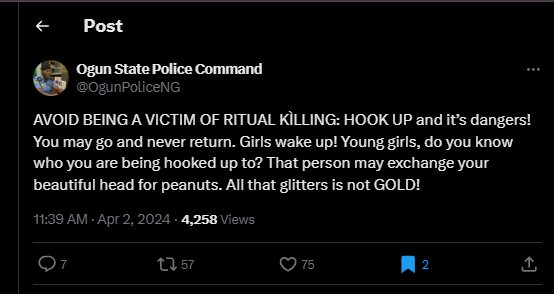
The Public Relations Officer of the Ogun State Command, Omolola Odutola, even mentioned a number of ten young women disappearing daily in the southwestern state, one of Nigeria’s 36 states. She blamed the ‘hookup culture’ of facilitating the disappearances and ‘money rituals’, as murders for ritualistic purposes are being labeled in Nigeria. (webmaster FVDK)
Ogun State Police link missing girls, ritual killings to hook-ups
Published: December 4, 2024 By: Vanguard, Nigeria
The Nigeria Police Force has linked many cases of missing young women to ritual practices, with a growing connection to the rising hook-up culture in the country.
The Public Relations Officer of the Ogun State Command, Omolola Odutola, revealed this, yesterday, when she was featured on Channels Television’s Morning Brief.
During the discussion on “Hookup Culture: Impact on Youth Values and Relationships,” Odutola revealed that young women aged 20 to 32 were the most affected.
She added that many young people, especially males, believe that ritual killings was a way to become wealthy.
“This particular menace is very serious and I will like a lot of young people to understand the danger in the hookup culture. Today, we have lots of reports of missing persons. By the time we start an investigation, not less than 10 young girls and ladies go missing daily.
“In-depth investigations also reveal that those cases are not by accidents. Most of them are connected to hookup channels and apps. They fall victim to strangers who causally invite them to unknown places, and eventually fall victim to being used for ritual purposes.
“Most cases of missing girls and ritual killings occurring in Ogun State of recent, I will like to say that it is not new. But as much as possible, the Ogun State Commissioner of Police has been able to tame these ugly incidents.
“It stems from the ugly perspective of young persons who believe that ritual killing could enrich them. We have some of these unscrupulous elements who deceive young people to get human skulls or human body parts, which they use for some kind of concoction to get them rich.”
“That is why we are having advocacy and sensitization, to enlighten young persons to make them understand that engaging in ritual killings does not in any way make them rich,” she said.
She stated that the police command was collaborating closely with the state Women Affairs Commission to tackle and curb the menace.
She stated, “The Ogun State government, particularly the Women Affairs Commission works in tandem with the police command by providing counselling sessions.
“Apart from that, whenever we have cases such as this if per adventure the girls escape the rituals, we also have a proper way of helping them go through the distress of mental health and anxiety they might have felt during the incident.
“The hookup culture is prevalent among young girls between the ages of 20 to about 32 years. The reason they get involved in this menace is because they feel they don’t get enough from their parents, and then the get-rich syndrome.”
Hookup culture refers to casual sexual relationships, like one-night stands, that often don’t involve emotional attachment or long-term commitment. While this trend has existed since the 1920s, it has become more common and accepted in recent years.
Some argue that hookup culture is a step forward for women’s freedom and empowerment, but others believe it harms the development of healthy and meaningful relationships.
Police Link Missing Girls Cases, Ritual Killings To Hookups
Published: December 4, 2024 By: Samuel – Tori, Nigeria
The Public Relations Officer of the Ogun State Command, Omolola Odutola, revealed this on Wednesday when she was featured on Channels Television’s Morning Brief.
The Nigerian Police Force has linked many cases of missing young women to ritual practices, with a growing connection to the rising hookup culture in the country.
The Public Relations Officer of the Ogun State Command, Omolola Odutola, revealed this on Wednesday when she was featured on Channels Television’s Morning Brief.
During the discussion on “Hookup Culture: Impact on Youth Values and Relationships,” Odutola revealed that young women aged 20 to 32 are the most affected.
She added that many young people, especially males, believe that ritual killings are a way to become wealthy. “This particular menace is very serious and I would like a lot of young people to understand the danger in the hookup culture. Today, we have lots of reports of missing persons. By the time we start an investigation, not less than 10 young girls and ladies go missing daily.
“In-depth investigations also reveal that those cases are not by accidents. Most of them are connected to hookup channels and apps. They fall victim to strangers who causally invite them to unknown places, and eventually fall victim to being used for ritual purposes,” she said.
“Most cases of missing girls and ritual killings occurring in Ogun State of recent, I would like to say that it is not new. But as much as possible, the Ogun State Commissioner of Police has been able to tame these ugly incidents.”
The police boss added, “It stems from the ugly perspective of young persons who believe that ritual killing could enrich them. We have some of these unscrupulous elements who deceive young people to get human skulls or human body parts, which they use for some kind of concoction to get them rich.
“That is why we are having advocacy and sensitization, to enlighten young persons to make them understand that engaging in ritual killings does not in any way make them rich,” she said.
She stated that the police command is collaborating closely with the State Women Affairs Commission to tackle and curb the menace.
She stated, “The Ogun State government, particularly the Women Affairs Commission works in tandem with the police command by providing counselling sessions.
“Apart from that, whenever we have cases such as this if per adventure the girls escape the rituals, we also have a proper way of helping them go through the distress of mental health and anxiety they might have felt during the incident.
“The hookup culture is prevalent among young girls between the ages of 20 to about 32 years. The reason they get involved in this menace is because they feel they don’t get enough from their parents, and then the get-rich syndrome.”
Hookup culture refers to casual sexual relationships, like one-night stands, that often don’t involve emotional attachment or long-term commitment. While this trend has existed since the 1920s, it has become more common and accepted in recent years.
Some argue that hookup culture is a step forward for women’s freedom and empowerment, but others believe it harms the development of healthy and meaningful relationships.
This culture also reflects a double standard, with women often judged more harshly than men for engaging in casual encounters. For instance, women who hook up frequently or go too far in a single encounter may face derogatory labels like “hoe,” while men in similar situations are often praised.
Ogun police blame ‘hookup’ for high rate of missing girls
Published: December 4, 2024 By: The Citizen, Nigeria
The Public Relations Officer for the Ogun State Police Command, Omolola Odutola, has blamed the high rate of missing girls and ritual killings involving females in the state on “hookups”.
The Ogun PPRO made this statement on Channels Television’s Morning Brief on Wednesday, where she was invited as a special guest to speak on the topic ‘Hookup Culture: Impact on Youth Values and Relationships’.
Hookup is a slang used to describe brief, casual sexual relations between individuals. Odutola described the hookup culture as a menace prevalent among young girls and attributed this to the surge in cases of missing girls and female victims of ritual killings in the state.
“Today, we have lots of reports of missing persons. By the time we start an investigation, not less than 10 young girls and ladies go missing daily.
“In-depth investigations also reveal that those cases are not by accidents. Most of them are connected to hookup channels and apps. They fall victim to strangers who causally invite them to unknown places, and eventually fall victim to being used for ritual purposes,” said Odutola.
The PPRO noted that Ogun State has an ugly history with the cases of missing girls and ritual killings.
In October, the Ogun Police Command declared Testimony John, an 18-year-old girl, missing. The 18-year-old was sent on an errand to Saabo Market in Sagamu and did not return home.
A month before then, in September, the police launched a manhunt for the killers of Habibat Akinsanya, a 17-year-old secondary school student who was abducted and murdered in the state.
Police Uncover 1 Reason for High Cases of Missing Girls, Ritual Killings In Nigeria, Details Emerge
Police link h0okup activities to missing girls and ritual activities Photo credit: @PoliceNG/Pius Utomi Ekpei Source: UGC
Published: December 5, 2024 By: Ezra Ukanwa – Legit, Nigeria
Police reveal the dark side of hookup culture Odutola emphasized that the hookup culture, characterized by casual sexual encounters without commitment, has fueled a surge in cases involving young girls who fall prey to ritual killings, Channels Television reported.
“Today, we have lots of reports of missing persons. By the time we start an investigation, not less than 10 young girls and ladies go missing daily. “Most of these cases are linked to hookup channels and apps,” she explained. The police noted that many young men are motivated by the belief that ritual killings can lead to wealth, The Punch reported. “Most cases of missing girls and ritual killings in Ogun State have their roots in this misguided idea. “We have some unscrupulous elements who deceive people into providing human body parts for rituals,” she stated.
To combat this, according to her, the Ogun State Police Command, in collaboration with the Women Affairs Commission, has been actively raising awareness and providing counselling to victims and their families.
UNIPORT student found dead in boyfriend’s apartment
In another development, Legit.ng reported that a 300-level Biological Chemistry student of the University of Port Harcourt (UNIPORT), Otuene Justina Nkang, has been found dead in her boyfriend’s apartment in the River State capital. Nkang has been declared missing four days after leaving her place of work, where she was doing her industrial training at a private hospital in Port Harcourt.
Hookups to blame for most cases of missing girls, ritual killings in Nigeria – Police
Published: December 4, 2024 By: Nurudeen Shotayo – The Pulse, Nigeria
The hookup culture encourages casual sexual encounters in some cases between two strangers who could engage in one-night stands without necessarily involving any emotional bonding or long-term commitment.
The Nigeria Police have attributed the increasing cases of missing young ladies and girls being used for ritual purposes in the country to the prevalent hookup culture pervading society.
This is according to Omolola Odutola, the Public Relations Officer, Ogun State Police Command, who spoke on Channels Television‘s Morning Brief on Wednesday, December 4, 2024.
Odutola, who contributed to the topic, ‘Hookup Culture: Impact on Youth Values and Relationships,’ observed that young girls and ladies within the age range of 20 and 32 fall victim to the menace.
The hookup culture encourages casual sexual encounters in some cases between two strangers who could engage in one-night stands without necessarily involving any emotional bonding or long-term commitment.
This is hardly a new concept given that non-romantic sexual encounters, especially prostitution have been around since almost the beginning of time.
“This particular menace is very serious and I would like a lot of young people to understand the danger in the hookup culture.
“Today, we have lots of reports of missing persons. By the time we start an investigation, not less than 10 young girls and ladies go missing daily.
“In-depth investigations also reveal that those cases are not by accidents. Most of them are connected to hookup channels and apps. They fall victim to strangers who casually invite them to unknown places, and eventually fall victim to being used for ritual purposes,” she said.
Odutola says young people believe in ritual wealth
The police spokesperson added that most young Nigerians, especially males believe that ritual killings can make them rich.
“Most cases of missing girls and ritual killings occurring in Ogun state of recent, I would like to say that it is not new. But as much as possible, the Ogun state commissioner of police has been able to tame these ugly incidents.
“It stems from the ugly perspective of young persons who believe that ritual killing could enrich them. We have some of these unscrupulous elements who deceive young people to get human skulls or human body parts, which they use for some kind of concoction to get them rich.
“That is why we are having advocacy and sensitization, to enlighten young persons to make them understand that engaging in ritual killings does not in any way make them rich,” she said.
Police link missing girls cases, ritual killings to hookups
Published: December 4, 2024 By: Adetutu Sobowale – Punch, Nigeria
The Nigerian Police Force has linked many cases of missing young women to ritual practices, with a growing connection to the rising hookup culture in the country.
The Public Relations Officer of the Ogun State Command, Omolola Odutola, revealed this on Wednesday when she was featured on Channels Television’s Morning Brief.
During the discussion on “Hookup Culture: Impact on Youth Values and Relationships,” Odutola revealed that young women aged 20 to 32 are the most affected.
She added that many young people, especially males, believe that ritual killings are a way to become wealthy.
“This particular menace is very serious and I would like a lot of young people to understand the danger in the hookup culture. Today, we have lots of reports of missing persons. By the time we start an investigation, not less than 10 young girls and ladies go missing daily.
“In-depth investigations also reveal that those cases are not by accidents. Most of them are connected to hookup channels and apps. They fall victim to strangers who causally invite them to unknown places, and eventually fall victim to being used for ritual purposes,” she said.
“Most cases of missing girls and ritual killings occurring in Ogun State of recent, I would like to say that it is not new. But as much as possible, the Ogun State Commissioner of Police has been able to tame these ugly incidents.”
The police boss added, “It stems from the ugly perspective of young persons who believe that ritual killing could enrich them. We have some of these unscrupulous elements who deceive young people to get human skulls or human body parts, which they use for some kind of concoction to get them rich.
“That is why we are having advocacy and sensitization, to enlighten young persons to make them understand that engaging in ritual killings does not in any way make them rich,” she said.
She stated that the police command is collaborating closely with the State Women Affairs Commission to tackle and curb the menace.
She stated, “The Ogun State government, particularly the Women Affairs Commission works in tandem with the police command by providing counselling sessions.
“Apart from that, whenever we have cases such as this if per adventure the girls escape the rituals, we also have a proper way of helping them go through the distress of mental health and anxiety they might have felt during the incident.
“The hookup culture is prevalent among young girls between the ages of 20 to about 32 years. The reason they get involved in this menace is because they feel they don’t get enough from their parents, and then the get-rich syndrome.”
Hookup culture refers to casual sexual relationships, like one-night stands, that often don’t involve emotional attachment or long-term commitment. While this trend has existed since the 1920s, it has become more common and accepted in recent years.
Some argue that hookup culture is a step forward for women’s freedom and empowerment, but others believe it harms the development of healthy and meaningful relationships.
This culture also reflects a double standard, with women often judged more harshly than men for engaging in casual encounters. For instance, women who hook up frequently or go too far in a single encounter may face derogatory labels like “hoe,” while men in similar situations are often praised.
Police raise the alarm over rising missing persons cases in Ogun
Published: January 8, 2025 By: Punch, Nigeria
The Ogun State Police Command has raised concerns over an increase in reports of missing persons in the state.
The command’s spokesperson, Omolola Odutola disclosed this in a statement in Abeokuta, the state capital, on Tuesday.
She explained that the command had noticed an unprecedented rise in the number of missing persons across all age groups.
Odutola noted that only a small fraction of the individuals had been found, with many regrettably not returning home.
The police spokesperson urged residents to remain vigilant and more security-conscious while prioritising their safety.
She added that, as a proactive and community-oriented force, the command was committed to raising public awareness about this concerning trend.
“We encourage everyone to prioritise their safety by maintaining a heightened sense of security to avoid becoming a victim.
“The Commissioner of Police, Lanre Ogunlowo, has outlined essential measures and guidelines to keep residents informed about the most pressing issues.
“Based on insights from individuals who were rescued, the Commissioner advises parents not to allow their children to use commercial transportation services with strangers.
“Additionally, he encourages restless youth to activate the digital communication and sharing features on their mobile devices, especially when travelling or in moments of distress,” Odutola said.
Odutola further emphasised that the public could contact the police control room at 09164859299 and the Police Public Relations Department at 09159578888 for assistance.
Most Missing Girls Cases, Ritual Killings In Nigeria Connected With Hookups — Police
The Hookup culture encourages and accepts casual sexual encounters, such as one-night stands, without necessarily involving emotional bonding or long-term commitment.
Published: December 4, 2024 By: Channels Television
The Nigerian Police Force has identified most cases of missing young ladies and girls being used for ritual purposes in Nigeria connected to the prevalent hookup culture sweeping across the country.
The Public Relations Officer, Ogun State Command, Omolola Odutola who was a special guest on Channels Television’s Morning Brief on Wednesday, to discuss the topic ‘Hookup Culture: Impact on Youth Values and Relationships’, said young girls and ladies within the age range of 20 and 32 fall victim of the menace.
The Hookup culture encourages and accepts casual sexual encounters, such as one-night stands, without necessarily involving emotional bonding or long-term commitment.
The idea of casual, non-romantic sexual encounters has been around since the 1920s.
Some social critics argue that hooking up is a feminist achievement, while others worry that it is a step backwards for healthy, intimate relationships.
The hookup culture can also be gendered, with women being judged by a different standard than men. For example, women who hook up with too many people or go too far in the first hook-up are often judged by terms like “hoe”.
“This particular menace is very serious and I would like a lot of young people to understand the danger in the hookup culture.
“Today, we have lots of reports of missing persons. By the time we start an investigation, not less than 10 young girls and ladies go missing daily.
“In-depth investigations also reveal that those cases are not by accidents. Most of them are connected to hookup channels and apps. They fall victim to strangers who casually invite them to unknown places, and eventually fall victim to being used for ritual purposes,” she said.
She added that most young persons, especially males believe that ritual killings can make them get rich.
‘Most cases of missing girls and ritual killings occurring in Ogun state of recent, I would like to say that it is not new. But as much as possible, the Ogun state commissioner of police has been able to tame these ugly incidents.
“It stems from the ugly perspective of young persons who believe that ritual killing could enrich them. We have some of these unscrupulous elements who deceive young people to get human skulls or human body parts, which they use for some kind of concoction to get them rich.
“That is why we are having advocacy and sensitization, to enlighten young persons to make them understand that engaging in ritual killings does not in any way make them rich,” she said.
According to her, the police command is working closely with the Women Affairs Commission of the state to stem the menace in the tide.
“The Ogun State government, particularly the Women Affairs Commission works in tandem with the police command by providing counselling sessions.
“Apart from that, whenever we have cases such as this if per adventure the girls escape the rituals, we also have a proper way of helping them go through the distress of mental health and anxiety they might have felt during the incident.
“The hookup culture is prevalent among young girls between the ages of 20 to about 32 years. The reason they get involved in this menace is because they feel they don’t get enough from their parents, and then the get-rich syndrome,” she said.
A Development expert, Dorothy Njemanze who also joined the conversation from Abuja, urged the Nigerian Police to provide full security and encourage the reporting culture to deal with the crime.
Development expert Dorothy Njemanze
“A lot of the predatory trends that we see have existed in the society all along. But instead of tackling them headlong, we make excuses and try to guilt-trip people. If you stay in your house, harm can happen to you. You go out, harm can happen to you. A lot of healthy marriages in Nigeria happen through hookups. We are expected to meet people irrespective of how it happened, especially when we are adults.
“But my concern is that the predation system extends to children. A lot of children are being lured through the predation system. Every state needs to have a mandatory reporting system so that when suspicious movements are seen, such activities can be reported. And then for law enforcement, when people report things to you, and you are lax and expect people to write petitions and ply certain routes before you can take action, then there is a problem.
“The proactiveness of law enforcement agencies is what we bank on.
“Bad people plan very well, to gain the trust of who they want to harm to minimise chances of their victims raising alarm for them to be caught.
“I heard the policewoman talking about people going to parties. And I also read about a lady killed by her pastor in the church. So it could be anybody.
“Whatever the dimension that bad people choose to operate, the law enforcement should be able to ready to swoop in and ensure that there is minimal to no damage done, and then the mandatory reporting culture of the society is one thing that can help to minimise these things.
“As long as we can’t control what adults do among each other, we can minimize such occurrences because the hookup culture affects both men and women, but more among the women. There is more pressure on men to have resources that can make them look like big men. But make sure as much as possible whenever you are going out, somebody knows where you are going,” she said.
Screenshot – to access the video please open the link included in the Source (below)
Ogun police blame hookup for high rate of missing girls
Published: December 4, 2024 By: Olayide Soaga – The Guardian, Nigeria
Omolola Odutola, the Public Relations Officer for the Ogun State Police Command, has blamed the high rate of missing girls and ritual killings involving females in the state on “hookups”.
The Ogun PPRO made this statement on Channels Television’s Morning Brief on Wednesday, where she was invited as a special guest to speak on the topic ‘Hookup Culture: Impact on Youth Values and Relationships’.
Hookup is a slang used to describe brief, casual sexual relations between individuals. Odutola described the hookup culture as a menace prevalent among young girls and attributed this to the surge in cases of missing girls and female victims of ritual killings in the state.
“Today, we have lots of reports of missing persons. By the time we start an investigation, not less than 10 young girls and ladies go missing daily.
“In-depth investigations also reveal that those cases are not by accidents. Most of them are connected to hookup channels and apps. They fall victim to strangers who causally invite them to unknown places, and eventually fall victim to being used for ritual purposes,” said Odutola.
The PPRO noted that Ogun State has an ugly history with the cases of missing girls and ritual killings.
In October, the Ogun Police Command declared Testimony John, an 18-year-old girl, missing. The 18-year-old was sent on an errand to Saabo Market in Sagamu and did not return home.
A month before then, in September, the police launched a manhunt for the killers of Habibat Akinsanya, a 17-year-old secondary school student who was abducted and murdered in the state.
Published: December 4, 2024 By: Titilope Adamo – The Osun Defender, Nigeria Titilope Adako is a talented and intrepid journalist, dedicated to shedding light on the untold stories of Osun State and Nigeria. Through incisive reporting, she tackles a broad spectrum of topics, from politics and social justice to culture and entertainment, with a commitment to accuracy, empathy, and inspiring positive change.
The Nigerian Police Force has attributed a significant number of cases involving missing young women to ritual practices closely tied to the rising hookup culture in Nigeria.
Omolola Odutola, the Public Relations Officer for the Ogun State Command, discussed this issue on Wednesday during an appearance on Channels Television’s Morning Brief programme.
Highlighting the impact of hookup culture on youth values, she noted that women aged 20 to 32 are the most vulnerable.
“This particular menace is very serious and I would like a lot of young people to understand the danger in the hookup culture. Today, we have lots of reports of missing persons. By the time we start an investigation, not less than 10 young girls and ladies go missing daily.
She further explained, “It stems from the ugly perspective of young persons who believe that ritual killing could enrich them. We have some of these unscrupulous elements who deceive young people to get human skulls or human body parts, which they use for some kind of concoction to get them rich.
“That is why we are having advocacy and sensitization, to enlighten young persons to make them understand that engaging in ritual killings does not in any way make them rich,” she said.
She also stated that the police command is collaborating closely with the State Women Affairs Commission to tackle and curb the menace.
She added, “The Ogun State government, particularly the Women Affairs Commission works in tandem with the police command by providing counselling sessions.
“Apart from that, whenever we have cases such as this if per adventure the girls escape the rituals, we also have a proper way of helping them go through the distress of mental health and anxiety they might have felt during the incident.
“The hookup culture is prevalent among young girls between the ages of 20 to about 32 years. The reason they get involved in this menace is because they feel they don’t get enough from their parents, and then the get-rich syndrome.”
Hookup culture, which refers to casual sexual relationships like one-night stands, has been debated for its effects on youth.
While some argue it empowers individuals, others criticize its impact on relationships and societal values.
This culture often highlights double standards, with women judged more harshly than men for casual encounters, facing derogatory labels such as “hoe,” while men are often praised.
THE Nigerian Police Force has linked many cases of missing young women and girls to the rising hookup culture in Nigeria, which is believed to be contributing to their exploitation for ritual purposes.
The Public Relations Officer of the Ogun State Command, Omolola Odutola, highlighted during an interview today that young women aged 20 to 32 are particularly vulnerable to this issue.
The hookup culture promotes casual sexual encounters, such as one-night stands, without emotional attachment or long-term commitment.
The idea of casual, non-romantic sexual encounters has been around since the 1920s.
While some social critics view hooking up as a feminist achievement, others express concern that it undermines healthy intimate relationships.
The culture can also be gender-biased, with women facing harsher judgments than men, often labeled derogatorily if they engage with multiple partners or go too far on a first encounter.
Odutola emphasized the seriousness of this issue, stating, “I want young people to understand the dangers of the hookup culture. We receive numerous reports of missing persons, with at least 10 young women disappearing each day. Investigations indicate that these cases are often not accidental; many are linked to hookup platforms and apps, where victims are lured by strangers to unknown locations and subsequently exploited for ritual purposes.”
She noted that many young individuals, particularly males, believe that ritual killings can lead to wealth.
“The recent cases of missing girls and ritual killings in Ogun State are not new, but the Ogun State Commissioner of Police has been working to address these disturbing incidents. The belief that ritual killings can bring wealth is prevalent among some young people, who are often deceived into providing human remains for various rituals.”
To combat this issue, advocacy and awareness campaigns are being conducted to educate young people about the dangers of ritual killings.
The Ogun State Police Command is collaborating with the Women Affairs Commission to tackle the problem effectively.
“The Ogun State government, particularly the Women Affairs Commission, is working alongside the police to provide counseling sessions. In cases where girls escape from rituals, we have established support systems to help them cope with the mental health challenges and anxiety they may experience,” she explained.
Odutola pointed out that the hookup culture is particularly common among young women aged 20 to 32, who may feel financially unsupported by their families and are drawn to the allure of quick wealth.
Development expert Dorothy Njemanze, who joined the discussion from Abuja, urged the Nigerian Police to enhance security measures and promote a culture of reporting suspicious activities to address these crimes.
Njemanze said, “Many predatory behaviors have long existed in society, yet we often make excuses instead of confronting them. Harm can occur whether one stays at home or goes out. While hookups can lead to healthy relationships, my concern is that children are being lured into dangerous situations. Every state should implement a mandatory reporting system for suspicious activities.”
She emphasized the need for law enforcement to act proactively.
“Criminals often plan meticulously to gain their victims’ trust, minimizing the chances of being caught. The police should be prepared to intervene swiftly to prevent harm.
“Regardless of the circumstances, whether at parties or other venues, it is crucial to ensure that someone knows your whereabouts when going out,” she added, highlighting the importance of awareness and caution in navigating the hookup culture, which disproportionately affects women.
Most cases of missing persons, related to hookup – Police
Published: December 4, 2024 By: Nkiruka Gloria – Gistreel, Nigeria
The Nigerian Police Force (NPF), has disclosed that most cases of people who have been reported to be missing, is linked to ‘hookup‘.
This was disclosed by the Public Relations Officer of the Ogun State Command, Omolola Odutola, while speaking on Channels Television’s Morning Brief, on Wednesday.
She noted that the rising hookup culture in the country, has a growing connection to the many cases of missing young women to ritual practices.
She added that this stems from the ugly perspective of young persons who believe that ritual killing could enrich them.
Odutola stated that young women aged 20 to 32 are the most affected.
She said, “This particular menace is very serious and I would like a lot of young people to understand the danger in the hookup culture. Today, we have lots of reports of missing persons. By the time we start an investigation, not less than 10 young girls and ladies go missing daily.
“In-depth investigations also reveal that those cases are not by accidents. Most of them are connected to hookup channels and apps. They fall victim to strangers who causally invite them to unknown places, and eventually fall victim to being used for ritual purposes.
“Most cases of missing girls and ritual killings occurring in Ogun State of recent, I would like to say that it is not new. But as much as possible, the Ogun State Commissioner of Police has been able to tame these ugly incidents.”
Nigeria Police Link Missing Girls Cases, Ritual Killings to Hookups
Published: December 4, 2024 by: Naijapals Base – Gist Mania, Nigeria
The Nigerian Police Force has raised concerns about the alarming trend of missing young women and girls, many of whom have reportedly fallen victim to money ritual killings. According to SP Omolola Odutola, the spokesperson of the Ogun State Police Command, a significant number of these cases are linked to the growing “hookup culture” in the country.
Odutola shared these insights during a live appearance on Channels Television’s Morning Brief program on Wednesday, December 4, 2024, where the discussion focused on the topic: “Hookup Culture: Impact on Youth Values and Relationships.”
She highlighted that young women aged 20 to 32 are particularly vulnerable, often lured into dangerous situations under the guise of casual relationships or financial arrangements.
She added that many young people, especially males, believe that ritual k!llings are a way to become wealthy.
“This particular menace is very serious and I would like a lot of young people to understand the danger in the hookup culture. Today, we have lots of reports of missing persons. By the time we start an investigation, not less than 10 young girls and ladies go missing daily,” the PPRO stated.
“In-depth investigations also reveal that those cases are not by accidents. Most of them are connected to hookup channels and apps. They fall victim to strangers who causally invite them to unknown places, and eventually fall victim to being used for ritual purposes
“Most cases of missing girls and ritual killings occurring in Ogun State of recent, I would like to say that it is not new. But as much as possible, the Ogun State Commissioner of Police has been able to tame these ugly incidents.
“It stems from the ugly perspective of young persons who believe that ritual killing could enrich them. We have some of these unscrupulous elements who deceive young people to get human skulls or human body parts, which they use for some kind of concoction to get them rich
“That is why we are having advocacy and sensitization, to enlighten young persons to make them understand that engaging in ritual killings does not in any way make them rich,” she said.
She stated that the police command is collaborating closely with the State Women Affairs Commission to tackle and curb the menace.
“The Ogun State government, particularly the Women Affairs Commission works in tandem with the police command by providing counselling session.
Published: December 5, 2024 By: Abimbola Abatta – Foundation for Investigative Journalism, Nigeria
How did she know the killer? Girls, stop doing hookup, but you won’t listen.
FIJ has observed a trend where Nigerians engage in victim blaming whenever women are reported missing. It is worse when they wind up dead and their deaths are linked to ritual killings or intimate partner violence.
Victim blaming essentially implies that a victim deserved the violent crime committed against them, and it comes in various forms.
Sometimes veiled as words of caution, victim blaming springs out in comments such as, “What was she looking for?” “What was she wearing?” “How did she know the killer?” “Stop doing hook up; women no dey hear” “No justice for anybody o,” “Stop dating Yahoo boys,” “Girls will never learn,” “She will think twice in her next life.”
FIJ came across similar comments on X, captured more screenshots and uploaded them to this folder.
One of the comments
What makes this more alarming is how the Nigeria Police Force (NPF) reinforces the culture of victim blaming through careless statements. In 2019, when a suspected serial killer was on a killing spree, having killed the 10th victim, the Rivers State Police Command told young women to shun prostitution.
Chuks Enwonwu, the Deputy Commissioner of Police in charge of administration at the time, said, “In as much as societal values are disintegrating, we must go back to try to educate them (women) and discourage them from going into prostitution because that is how they fall victim to these crimes.”
A similar sentiment from law enforcement played out on Wednesday when Omolola Odutola, the police public relations officer in Ogun State, linked missing women and ritual killings to the hookup culture. This culture encourages casual sex encounters, often paid, without emotional commitment.
According to a publication by the Canadian Resource Centre for Victims of Crime, victim blaming occurs when the victim of a crime or an accident is held responsible, whether in whole or in part, for the crimes that have been committed against them.
This blame can be in the form of negative social responses from legal, medical and mental health professionals, as well as from the media, immediate family members and other acquaintances. Some types of crimes victims get blamed for are intimate partner violence, sexual assault, homicide and sex trade.
Odutola was featured on Channels Television’s Morning Brief when she said the hookup culture gives men, who believe ritual killings could enrich them, the platform to lure women to their deaths.
“Most girls who find themselves in hookup acts get missing and slaughtered for ritual purposes,” she said.
Although she noted that the police had been sensitising young persons to make them understand that ritual killings do not in any way make them rich, she stressed the need for women to beware of the hookup culture.
That was not the first time Ogun Police would be warning women about their lifestyle rather than condemning their attackers.
While detailing the arrest of three ritual killers in a post on February 29, the security agency stated, “The Command is using this avenue to advise our young ladies at this umpteenth time to desist from untoward movements. They are advised to use social media and attendant technology positively. It is through the social media platform that all these victims were surreptitiously lured to their untimely death.”
The warning for ladies. Source: Ogun State Police Command’s X page.
Also, in April, the Ogun police wrote on X: “Avoid being a victim of ritual killing: hook up, and its dangers. You may go and never return. Girls, wake up! Young girls, do you know who you are being hooked up to? That person may exchange your beautiful head for peanuts. All that glitters is not gold!”
Meanwhile, Dorothy Njemanze, a communication strategist and development expert who was featured on the television programme along with the Ogun police spokesperson, opined that law enforcement agencies and the government have key roles to play in tackling the underlying issues.
“Instead of tackling them (the issue) head-on, we guilt trip people. Bad people plan very well. They gain the trust of people, but regardless of the dimension that bad people choose to operate, the law enforcement should sweep in and ensure that the impact is reduced,” she said.
Njemanze differed from the police PRO’s argument that the hookup culture was to blame for the prevalent cases of missing women and ritual killings.
She explained that, as someone working in a survivor centre, she encountered cases of children who had been lured through predatory systems. Njemanze pointed out that such cases cannot be classified as hookups.
“The biggest currency that is exploited is trust. The government needs to step in into the get-rich-quick syndrome and empower people who are under the pressure of wanting to break the jinx of poverty,” Njemanze added.
Roseline Adewuyi, a gender and social advocate, told FIJ that the culture of blaming victims is a deep social issue that calls for genuine concern.
“We have had cases of women in Nigeria who are killed for ritual purposes or who have been sexually assaulted and the society goes on to subtly or expressly blame these victims,” Adewuyi stated.
She also said that factors such as existing cultural norms, social conditioning and lack of concrete understanding of the root causes of heinous crimes influence victim-blamers.
For her, the complex root cause of violence against women cannot be understood without first challenging social conditioning and reshaping the ingrained beliefs about gender and victims. Rather than make comments that imply that victims are partly culpable, the responsibility for crimes should be placed squarely on the shoulders of the perpetrators.
“It is when the responsibility of the crime has been rightly placed that we can find out the root cause and motivation of that violence. Commenting about the movements or actions of women in this context distracts the society from the real causes of the problem of gender-based violence,” Adewuyi explained.
To address the victim-blaming biases, Adewuyi said, focus must be on critical stakeholders like the police, who are the first responders in cases of violence against women. She also said that there should be sensitisation programmes on gender issues against the reinforcement of stereotypes, and the police must prioritise the safety of everyone, no matter their gender.
“NGOs, media organisations, communities, schools and others must also be targeted to replace the culture of victim blaming and silence with the culture of respect, consent and gender equality,” the social advocate told FIJ.
Abimbola Abatta is a reporter with FIJ, writing reports in partnership with Report for the World which matches local newsrooms with talented emerging journalists to report on under-covered issues around the globe.
Hook-ups reason for missing girls, ritual killings – Police
Published: December 4, 2024 By: Matthew Atungwu – Daily Post, Nigeria
The Nigeria Police said many cases of missing young women to ritual practices are caused by the surge of hook-up culture in the country.
The Public Relations Officer of the Ogun State Command, Omolola Odutola, made this revelation on Wednesday when she was featured on Channels Television’s Morning Brief.
According to her, young women aged 20 to 32 were the most affected.
She added that many young people, especially males, believe that ritual killings were a way to become wealthy.
“This particular menace is very serious and I will like a lot of young people to understand the danger in the hookup culture. Today, we have lots of reports of missing persons. By the time we start an investigation, not less than 10 young girls and ladies go missing daily.
“In-depth investigations also reveal that those cases are not by accidents. Most of them are connected to hookup channels and apps. They fall victim to strangers who causally invite them to unknown places and eventually fall victim to being used for ritual purposes.
“Most cases of missing girls and ritual killings occurring in Ogun State of recent, I will like to say that it is not new. But as much as possible, the Ogun State Commissioner of Police has been able to tame these ugly incidents,” she said.
She further said that the Ogun State Police Command was collaborating closely with the state Women Affairs Commission to tackle and curb the menace.
DAILY POST reports that hookup culture refers to casual sexual relationships, like one-night stands, that often don’t involve emotional attachment or long-term commitment.
Actress Kate Henshaw reacts to police blaming ritual killings on hookup culture
Published: December 7, 2024 By: Jessica Gistlover – Nigeria
Nigerian actress Kate Henshaw has reacted to police reports blaming hookup culture for ritual killings after facing backlash on social media for her statement about Yahoo boys using girls for rituals.
On December 4, 2024, Omolola Odutola, the PRO of the Ogun state command, highlighted the dangers of the hookup culture on Channels Television’s Morning Brief.
Nigerian actress Kate Henshaw has responded to police reports attributing ritual killings to hookup culture, following significant criticism on social media in November 2024 regarding her comments about Yahoo boys exploiting women for rituals.
During an appearance on Channels Television’s Morning Brief on December 4, 2024, Omolola Odutola, the Public Relations Officer of the Ogun State Command, emphasized the risks associated with hookup culture.
She said, “Today, we have numerous reports of missing persons. By the time we start an investigation, not less than 10 young girls and ladies go missing daily. These cases are not accidental. Most are tied to hookup arrangements where young women are invited by strangers to unknown places, ultimately leading to their harm or use in ritual killings.”
This report garnered significant media attention and elicited various reactions on social media. A user on X recalled the time when Kate Henshaw faced accusations of promoting femicide for expressing a similar viewpoint.
The post read, “There was a time not too long ago @HenshawKate made a statement as regards this and some people came for her. Alas!!! She has been vindicated.”In response to the post, Kate Henshaw wrote, “Let the role model females who spouted I was promoting femicide show naa.. Alas, their mouths are shut!!”
It is worth noting that on October 31, 2024, Henshaw commented on a viral video featuring a young girl who expressed her intention to date a Yahoo boy, a known fraudster. At that time, Henshaw warned that the young girl was at risk of being exploited for rituals due to her choice.
She wrote, “Na so dem go take pieces you for ritual…Yeye mindset.”
Henshaw’s remarks were met with backlash from many social media users, who accused her of insensitivity and of endorsing femicide.
An X user asked her, “This is so wrong to say. How is murder justifiable?”
The actress responded, “That’s the value she placed on herself with her words and actions. That’s how she reduced herself to be used by all and sundry. That’s the green light she has put on but that’s OK with you.”
The following plea for stiffer punishment for convicted ritual murderers contains a staggering fact: according to research conducted by an NGO, the West African Network for Peace Building, Nigeria recorded 185 ritual-related deaths between January 2021 and January 2022. Among the victims were 43 women, and 30 children in 80 cases across 20 states.
Please note that we talk here about recorded cases. The total number of missing persons who have fallen prey to ritual murderers is unknown, but estimated to be very high. (webmaster FVDK)
Nigeria: The wave of ritual killings – a plea for stiffer punishment to deter the murderers
Published: December 11, 2024 By: Press Reader – Nigeria News
The criminal nature of ritualistic killings goes without saying. Ritual killings are a crime and ritual killers are liable to prosecution. People who kill other people for ritual purposes usually do it for specific reasons related to their personal situation: to gain (more) power, prestige or wealth. The ‘engine’ of their criminal behavior is a combination of greed and superstition.
However, there are also criminals who use this combination of greed and superstition of other people as an income-generating model. They specialize in murdering innocent people for the sole purpose of harvesting their organs which then are sold for ritual purposes. A gruesome crime.
This what happened in Rivers state. The police in Rivers State, a state in the Niger Delta region of southern Nigeria, tracked a criminal syndicate that has been specializing in murdering e-hailing cab-drivers and harvesting their organs which were subsequently sold to unscrupulous individuals who wanted these organs and body parts for ritual purposes (‘money rituals’).
Unfortunately, the phenomenon of ‘money rituals’ is widespread in Africa’s most populated country, Nigeria. This is also the reason why the Federal Government recently imposeda ban on ritual killings in Nollywood movies in an attempt to curb the popularity of this phenomenon which is basically a crime based on superstition.
Rivers State, also known as Rivers, is located in the South-South geopolitical zone of Nigeria. The Federal Republic of Nigeria is divided into six geopolitical zones commonly called zones.
Police Burst Organ Harvesting Syndicate In Rivers, Trail Fleeing Members
Organ harvesting suspect
Published: June 2, 2024 By: Itode Akari – Independent, Nigerią
PORT HARCOURT – The Police in Rivers State have arrested a member criminal syndicate, that specialises in murdering e-hailing cab drivers and harvesting their organs for ritual purposes in the state.
The arrested suspect, a 35-year-old graduate of political science from the Ignatius Ajuru University of Education, identified as Anthony Chima, confessed to have recently lured an innocent cab driver into his gang’s ambush, where the driver was waylaid before he was murdered in cold blood by the gang.
A statement signed by the Public Relations Officer for the Rivers State Police Command, SP Grace Iringe-Koko on Sunday, stated that the suspect was arrested following an investigation into the mysterious disappearance of one e-hailing cab driver on January 10, 2024, identified as Oghenevwarhe Barry Akpobome.
According to the police, a member of the syndicate confessed to have posed as a passenger to lure the unsuspecting driver to a remote area in Aminigboko community, Abia/Odual Local Government Area of the state, where other armed gang members laid an ambush and pounced on the driver, bound him both arms and legs, gagging his mouth and eventually killing him for the purpose of harvesting his organs.
The statement reads, “In a shocking turn of events, the Rivers State Police have uncovered a disturbing criminal enterprise that has been targeting Uber drivers in the region. The investigation was sparked by the disappearance of one such driver, Oghenevwarhe Barry Akpobome, leading to the arrest and confession of 35-year-old Anthony Chima, a political science graduate from the Ignatius Ajuru University of Education.
“According to Chima’s testimony, he was recruited into a gang that specialized in luring cab drivers into ambushes, stealing their vehicles, and ultimately murdering them for ritualistic purposes and organ harvesting.
“Chima revealed that he was brought into the fold by a friend, Amfoh Abu, who introduced him to the gang’s armourer, a man known as “Reason,” and the notorious ringleader, “General Effizy,” a prominent figure in the Greenland cult and a seasoned kidnapper.
“The chilling details of Akpobome’s demise emerged as Chima recounted the events of January 10, 2024. On that fateful day, he was summoned to Reason’s residence and instructed to call a driver whose number he had previously collected. Posing as a passenger, Chima then lured the unsuspecting Uber driver to a remote area in Aminigboko, where he and Reason were met by General Effizy and four armed gang members.
“The driver was forcibly removed from the vehicle and taken to Effizy’s shrine, where he was bound, gagged, and ultimately murdered. Chima’s involvement in the gruesome act was confirmed when the police, following his confession, recovered the victim’s skull and a locally fabricated Beretta pistol from Effizy’s residence.”
Iringe-Koko quoted the state Commissioner of Police, CP Olatunji Disu to have advised citizens of the state and drivers to be circumspect while boarding passengers to remote areas in the state.
She noted that while the police continues to trail fleeing members of the syndicate, emphasising that the case serves as a stark reminder of the dangers that lurk in the shadows, and the importance of vigilance and cooperation between law enforcement and the public in maintaining the safety of all citizens.
“This disturbing revelation has sent shockwaves through the community, prompting the Rivers State Police Commissioner, Cp Tunji Disu, to advise both citizens and Uber drivers. He urged them to exercise caution when boarding or transporting passengers, especially to remote or potentially dangerous areas.
“The investigation is ongoing, with the authorities still searching for the fleeing suspects involved in this chilling criminal enterprise. The case serves as a stark reminder of the dangers that lurk in the shadows, and the importance of vigilance and cooperation between law enforcement and the public in maintaining the safety of all citizens. Meanwhile, the suspect would be charged to court immediately.”
Recently, I posted on this site a large number of ritual murder cases in Nigeria. For this reason I wished to draw the readers’s attention to other African countries where similar crimes are being committed. However, these days Nigeria is making headlines which one cannot ignore. The number of ritual murders in Africa’s most populated country can no longer be counted – if that ever was the case. In my research and reporting on ‘money rituals’ in Nigeria – as ritualistic killings are commonly called in this West African country – I already experienced that I could hardly cope with the fast rising number of reported ritualistic murders committed by Yahoo boys, Yahoo Plus boys and whatever the names are that are given to these criminals who have no respect for a human life.
The below article by Hakim Jamiu is a cry to end these gruesome practices. She offers a grim insight in the recent spate in ritual murder cases in Nigeria, a devastating picture, and sketches a possible explanation for these practices which are based on superstition and fed by greed. I recognize a number of cases she mentions, some are notorious cases, whereas I am always unpleasantly surprised to learn about more ritual murder cases hitherto unknown. She does not have to dig deep to unveil ritual murder cases in nine states: Akwa Ibom, Ekiti, Kwara, Lagos, Plateau, Rivers, Ogun, Ondo, Osun. I can without much effort add nine more states. Also see my previous posts on Nigeria (click on the category African countries in the top bar and select Nigeria in the drop down menu thus appearing).
I have repeatedly mentioned on this site that Nigeria ranks Number One in ritual murder cases in Africa. The following article confirms this sad conclusion. (FVDK)
Nigeria: a harvest of ritual deaths
Published: March 17, 2022 By: Hakim Jamiu – The Cable, Nigeria
Nigeria is fast gaining notoriety as a country of ritualists with stories of ritual killings daily reported in the traditional and social media. The latest of this cannibalistic atrocity is the gruesome murder of 22-year-old Oluwabamise Ayankole who was abducted after boarding a Lagos state government-owned Bus Rapid Transport (BRT) bus and was later murdered and had parts of her body removed which confirmed the suspicion that she may have been killed for ritual purposes. Bamise, who was on her way home from work, was thereafter tossed out of the BRT Bus at Ebute Ero. Bamise, according to eyewitnesses, was still alive after she was tossed out of the vehicle at the Ebute Ero bridge but she gave up the ghost because she did not get help on time. Social media was awash with her last chat and video expressing fears for her safety inside the desolate BRT bus in which she and another lady and three men were the only occupants. As if she knew, her instinct warned her of the danger ahead but she was helpless. Murder in a BRT bus which is expected to be one of the safest means of transportation owned by the government of Lagos state is a sacrilege.
Bamise’s gruesome murder is only an addition to the harvest of deaths by ritualists in the last few weeks across Nigeria. While many Nigerians are yet to grapple with the shock of the gruesome beheading of Sofiat Kehinde, a 17-year-old girl in Abeokuta by four ritualists between ages 18 and 20, the murder of Bamise sent shock waves to all as anybody’s child, relative or friend could be the next victim. Late last year in Ado Ekiti, a seven-year-old girl, Demilade was sent on an errand by her mother four houses away but the little girl disappeared immediately and all efforts to find her proved abortive until her corpse was found in a pastor’s house the following day! Timothy Adegoke checked into a hotel in Ile-Ife to write his postgraduate examinations but he never came out alive as he was murdered overnight and buried some metres away from the hotel. The proprietor of the hotel is currently standing trial!
In Ogun state, a woman connived with her husband to kill her visiting friend and dismembered her. The remains of the victim were later found in a bucket in the couple’s room. A ritual killer, Timothy Odeniyi who was arrested by Amotekun Corps in Ondo state confessed that he used to harvest human parts at burial grounds which he sells to his clients. In Jos, 20-year-old Moses Oko killed Jennifer, a student of the University of Jos and removed some of her body parts. In Ikorodu, Lagos state, a suspected internet fraudster (Yahoo+), 32-year-old Afeez Olalore killed his younger brother for ritual purposes. In Uyo, Akwa Ibom state, Uduak Akpan, a serial ritual killer killed 20-year-old Iniobong Umoren, a job seeker and buried her in a shallow grave. In Ilorin, Kwara state, a next-door neighbour allegedly murdered a groom-to-be for ritual purposes.
In 2019, Nigerians were alarmed about the arrest of one of Nigeria’s notorious ritual killers called Gracious David West in Port Harcourt who confessed to having killed at least 15 women for ritual purposes. In November 2019, one-year-old boy Eniola Kolawole was declared missing at Sotitobire Miracle Centre, Akure, Ondo state and has not been found till today. Irate youths set the church ablaze but the pastor who had been on trial has since been discharged and acquitted. One Shakirat was murdered in Iwo, Osun state and her body was dumped behind her mother’s shop with some of her parts missing!
It is an understatement to say that Satan has taken over our affairs completely as cases of ritual killings keep rising by the day! The question now is, are rituals for money-making real? Perhaps this is why the Nigerian-American media scholar, newspaper columnist and activist, Farooq Kperogi while bemoaning the unending spate of ritual murders in Nigeria argued, “the only solution lies in the liberation of Nigerians from stupid, backward, unproductive and murderous superstitions. The witch doctors who tell people to bring the body parts of murdered people to make them rich are often one of the most wretched people you can find on earth. If money rituals were real, they would be wealthy and won’t let anybody in on the secret”. Not many people agree with the view of Kperogi because if money-making rituals do not exist, why is ritual killing on the increase across the country? There have been many unverifiable variants and anecdotes concerning how money rituals work especially among yahoo boys which is called Yahoo plus. There is a type whereby ebora (a spirit) will bring the money to the yahoo boy after necessary sacrifices with human parts have been done. There is another type that will make the victim, usually, a foreigner obey whatever the yahoo boy says including sending millions of dollars on request. There is yet another type that involves using the pant of a woman. The pant, as they say, will fetch the ritualist a lot of money. It is not only yahoo boys that are into the ritual killing but they may have influenced others who are not into internet fraudsters to kill for rituals because of the belief that it is working for them. Some yahoo boys even go to the extent of eating human faeces, having spiritual baths in broad daylight at a public place, appearing only in pants in broad daylight to withdraw money from ATMs and so many bizarre and silly things!
The question remains, how much is ritual killing giving those involved in it that is worth the desperation of taking the life of a fellow human being? Definitely, it cannot give billions because many of the Yahoo plus boys even get broke after about three to six months while some go mad! So what’s the need for ritual killing? Apart from Yahoo boys, there are reports of a well-organised clientele of ritual killers which means that not all who are involved in ritual killing directly use the human parts but they are agents of some powerful personalities who buy the parts from them. There are reports that human parts markets exist in some areas of Lagos. It is also ridiculous that human life has been so reduced to nothingness that a human head is sold for as low as N20,000. Research also shows that many people who seek power and wealth like politicians and businessmen also use human parts for charms for good fortune and for fortification against real and perceived enemies! I wish to remind this group of politicians and businessmen that the greatest fortification and blessings come from God who is the custodian of power and fortune.
The underlying factor responsible for the present malaise is desperation on the part of our young ones who are eager to get rich quick. There is unprecedented moral bankruptcy and total collapse of family values of hard work, honesty and integrity. We should go beyond lamentations and take drastic actions. We must dig into the root cause of this barbaric act and approach it from there. What we are seeing are symptoms rather than cause. Our society has been sold to the dogs and many souls sold to the devil, the result is what is confronting us. A 17-year-old wanting to ride the latest automobile sold for millions of naira, not through any work but by any means. Society celebrating any rich person not minding the source of his or her wealth is responsible for the present madness. Images of boys displaying wealth on social media and messages that all that matter is money and the message is sinking fast and spreading like wildfire!
In one of the videos that circulated on the social media, a boy was asked if he could use her mother for rituals, he didn’t hesitate before saying yes as long as he will be rich! That’s what our society has turned to! We are breeding monsters and heartless beings who would not mind going to any length just to be rich! A child who would not blink an eyelid before killing his own mother for rituals would kill anybody without thinking about it! It is such a pity! It is common these days to find human head in a cellophane bag carried by a teenager sitting next to you in a bus! Human parts have become very common like animal parts ! It is such a shame that we have become a cannibalistic society! It is now normal to suspect the man or woman sitting next to you in a public place as a ritualist! It is that bad!
Beyond lamentations that have not helped, we must all resolve to end this monster that is threatening to consume all of us. Nobody is immune from ritual death. Bamise and other victims of ritual killings must not die in vain. Now that the driver of the BRT bus and his cohorts have been apprehended, their trial must be swift and transparent. Cameras must be installed in all BRT buses that would be monitored at a base station and on no account must this be switched off by any BRT driver.
The national and state houses of assembly should begin to work on laws to empower special courts to try ritual murder cases with stiffer penalties. Everybody must be vigilant and we must de-emphasise material wealth in our society while the source of wealth of emergency millionaires and new kids on the block must be questioned and such characters ostracized by the rest of the society as it was the practice on the days of yore when there was sanity.
We must say no to ritual killings! We are neither animals nor vampires! Even animals don’t kill themselves senselessly as we are witnessing presently!