Following the murder of LASU student Favour Daley-Oladele for ritual purposes – a practice often referred to a as ‘money ritual’ in Nigeria – a wave of articles and comments appeared in local and international newspapers and magazines. Much too much to include here – although I find it important to at least mention the publication of a number of these valuable sources of information.
As a reminder: in December 2019, Favour Daley-Oladele, a final year student of Lagos State University (LASU), was murdered and partly cannibalized for a ritualistic motive, a ‘money ritual’, allegedly by her boyfriend Adeeko Owolabi, aided by Segun Philip, a white garment church pastor and his mother, Mrs. Bola Adeeko.
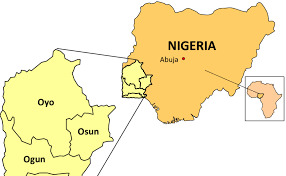
Favour and her parents lived in Mowe, Ogun State, but she was allegedly killed in Osun State. Also see my posts dated January 6, 4, 3, and 2 of the current year.
For practical purposes I present here only the links and thus not the full contents of a number of recent publications on Favour Daley-Oladele’s untimely and gruesome death, thus accepting the risk that within a few months or years some of these publications will have disappeared from the internet. It is important to mention that losing the accessibility of these links constitutes a risk which is the main reasons for choosing for this site the methodology to copy-paste news on ritual murders in African countries – a maybe controversial approach which I though am able and willing to defend, in case needed.
From time to time, as more news emerges, I will update the contents below (webmaster FVDK).
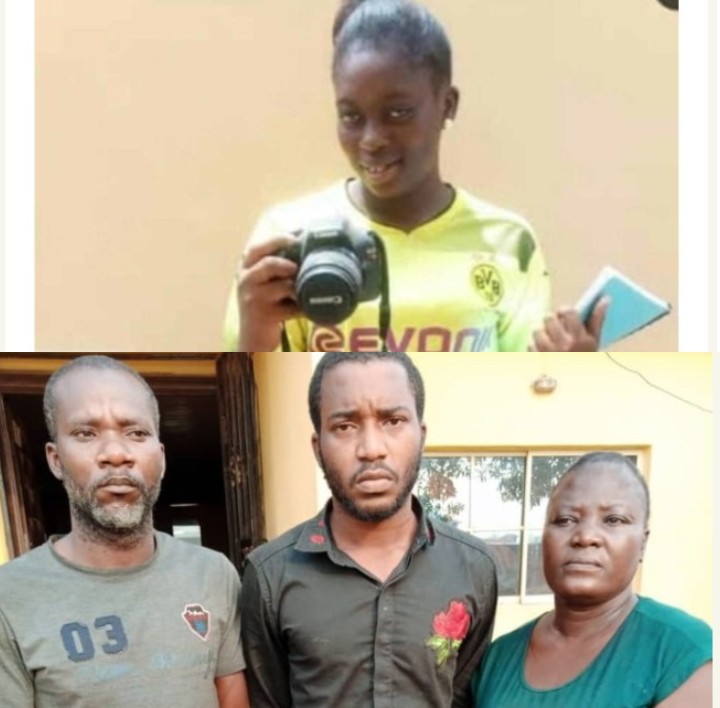
The deceased (above) and the suspects.
Wretched riches Published: January 6, 2020 By: The Sun, Voice of the nation
Segun Philip, a white garment church pastor; Adeeko Owolabi, the boyfriend of slain Lagos State University (LASU) student Miss Favour Daley-Oladele; and his mother, Mrs. Bola Adeeko, will be handed over to the Osun Police Command for prosecution.
Ogun Police Command spokesman Abimbola Oyeyemi disclosed this to The Nation yesterday.
He said although Favour and her parents lived in Mowe, Ogun State, she was allegedly killed in Osun State.
Oyeyemi, a Deputy Superintendent of Police (DSP), said that the detectives handling the case would investigate to find out if the suspects had carried out a similar action in the past.
He said that upon conclusion of the investigations, the command would transfer the suspects to the police in Osun State, who would prosecute them.
Twenty-three-year-old Adeeko Owolabi allegedly lured Miss Favour Daley-Oladele, 22, to a far-away white garment church in Ikoyi-Ile, Osun State, where he allegedly brutally murdered the girl while she was asleep by using a pestle to crush her head. He, thereafter, removed her heart for a ‘get-rich-quick’ money making concoction.
He was allegedly assisted in the act by a self-acclaimed pastor of a white garment church in Ikoyi-Ile, Segun Philip, who slit the girl’s throat, removed her heart, breasts and other organs before feeding Owolabi and his mother with a delicacy prepared with Favour’s vital organs.
The grieving father of the deceased, Mr. Daley-Oladele, said he couldn’t believe that a daughter, who was born into the family after years of delayed birth, would just be brutally killed by someone she knew.
He described his daughter as “the golden girl of the family,” saying losing her a few months to her graduation was emotionally unbearable.
Daley-Oladele said: “It’s quite emotional having raised that girl for that number of years. Favour happened to be a golden girl to the family. We waited for some years before having her.
“And having done that she went to school and when one is envisaging that within the next few years she would be going for the National Youth Service Corps (NYSC) and one starts celebrating that one has a graduate in one’s home, a woman; some people conspired to kill her.
“What she actually told us that day was that she was returning to school to prepare for her final examination. She said she was going to join her group and it was in that process that somebody called her. And she said she would also be going to see a friend. That was all.
“All we want is justice for Favour. It will act as a deterrent to others.”
LASU students have resolved to mobilise to attend the court proceedings on the gruesome murder of their colleague, Favour.
The President of the Students’ Union, Oladele Oluwatayo, who spoke to The Nation on the phone yesterday, said that the decision was arrived at during a short meeting after the candlelight procession on Monday.
He said that was the only way they could identify with Favour, even in death, while also ensuring justice was done.
More details on the murder of LASU final year female student Favour Daley-Oladele who was murdered for a money ritual by her boyfriend. See my January 2 post. Warning: this article includes graphic contents. (webmaster FVDK).
Men of of Nigerian police have exhumed the body of Favour Daley-Oladele
The LASU student was murdered by her boyfriend for ritual purpose
When the remains was exhumed, the head, the two breasts, neck and part of the two legs were no longer there
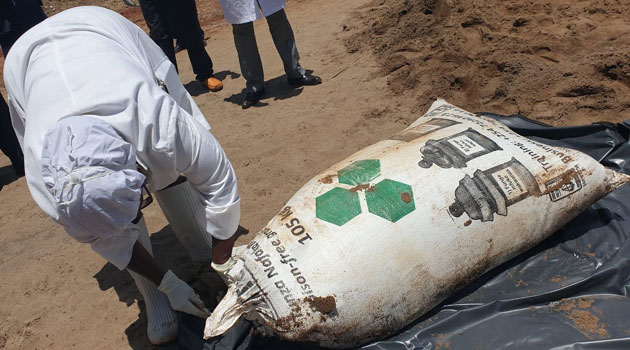
Osun homicide police detectives have exhumed the body of Favour Daley-Oladele, the murdered final year Sociology student of Lagos State University (LASU) who was gruesomely murdered for money rituals at Ikoyi-Ile in Osun. The victim’s dismembered body was was exhumed from a dry shallow well at Ikoyi-Ile. NAN reports that Babatunde Kokumo, Osun commissioner of police, led detectives from the Homicide Section of the command during the exhumation operation.
When the remains was exhumed, the head, the two breasts, neck and part of the two legs were no longer there. NAN recalls that the deceased was allegedly killed by a prophet, Segun Philip, 42, and her boyfriend, Adeeko Owolabi, 22, in Ikoyi-Ile, Osun, on Dec. 8, for money rituals. Owolabi’s mother, Ruth was also said to have played a role in the dastardly act.
Owolabi, also a graduate of LASU, told newsmen during operation that he conspired with the prophet to murder her girlfriend for money rituals. According to him, he lured the deceased to Ikoyi-Ile and lodged her in an hotel before killing her. “After I lodged her in a guest house, I took her to a house which I claimed to be my uncle’s house, knowing fully well that the place was a ritualists den. ” I smashed a pestle on her head and she collapsed. “The prophet thereafter used a knife and cutlass to dismember her body which was divided into three parts breasts, head and legs with other vital parts. “We buried the remaining part of her body beside Prophet Philip’s Church called ‘Solution Salvation Chapel’, while some vital parts was given to my mother to eat for spiritual cleansing,” he said.
Also speaking with newsmen, Segun Philip, who claimed to be a prophet in Solution Salvation Chapel, said the deceased was murdered to make money rituals for Owolabi.
“I am not a prophet but a herbalist who engages in spiritual cleansing for whosoever come to my place. “I used the Solution Salvation Chapel as a cover up not to allow people know the true picture of who I am and what I do. “Owolabi came to my place for money rituals and I told him that we need a complete human being for the rituals. “And on December 8, he brought his girlfriend to my church and we killed her and as well dismembered her body part for money rituals.”
Owolabi’s mother, Ruth, who also spoke with newsmen said she was not aware that the concoction given to her to eat and the cream was made of human part. Meanwhile, Legit.ng had reported that students of LASU held candlelight procession on Monday, December 29, in honour of their colleague, Favour Sewanu Daley-Oladele.
Police Exhume Corpse Of Female LASU Student Allegedly Killed For Money Ritual By Boyfriend
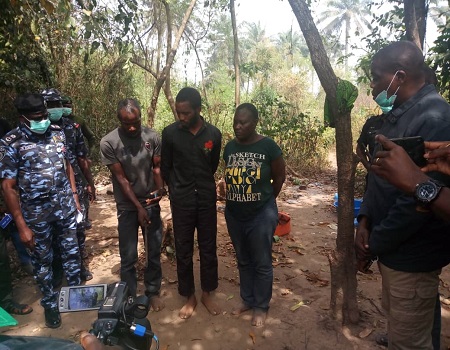
From left: Police forensic experts, Pastor Segun Phillip of Cherubim and Seraphim Church, Solution Chapel, Ikoyi-Ile pointing at the spot where Favour Daley-Oladele was buried while Owolabi Adeeko and her mother looks on
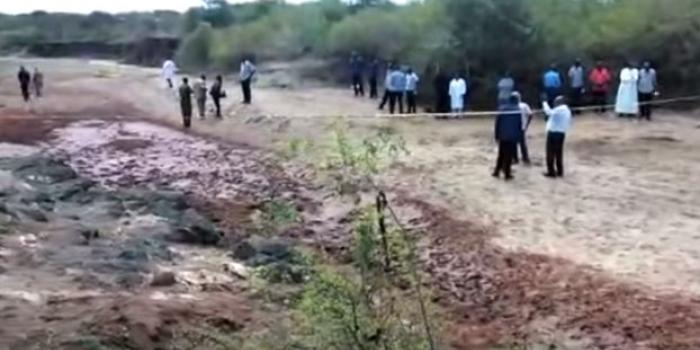
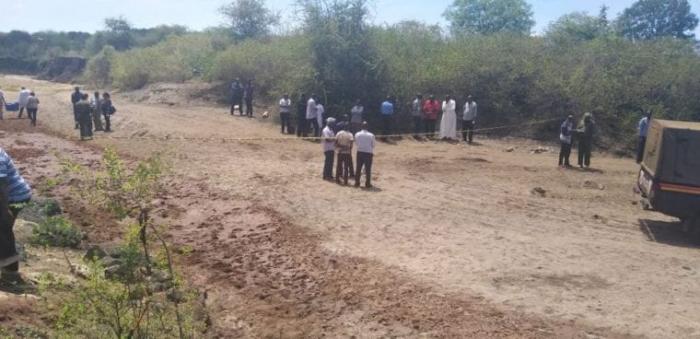
It was a gory scene on Saturday in Ikoyi-Ile community of Isokan Local Government Area of Osun State, when policemen exhumed the decomposing corpse of a female Lagos State University student, Favour Daley-Oladele, allegedly killed by her boyfriend, Owolabi Adeeko, for money ritual.
The Police team that went to the church where the lady was buried in a shallow grave was led by the Commissioner of Police in Osun State, Babatunde Kokumo, who explained that the exhumation of the remains of the 23-year-old student would enhance the completion of investigation started by the Ogun State Police command.
He, however, assured the people that the Police would look into the fear raised over the number of churches in Ikoyi-Ile, just as he tasked parents to strike a balance between moral upbringing and the academic programme of their children.
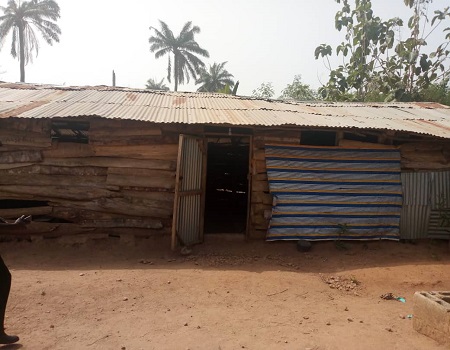
The Cherubim and Seraphim Church, Solution Chapel Ikoyi-Ile, Osun State
Kokumo said, “we are all aware of the gruesome killing of a student of LASU. The killing has been traced to Ikoyi -Ile. In furtherance of the investigation started by the Ogun State command. We have brought our homicide experts to exhume and help in the furtherance of the investigations started by the Ogun State police command with a view to prosecuting the suspects.
“It is a gruesome murder and the whole thing is quite horrible. We will not fold our arms and watch lawless citizens take laws into their hands, destroying peoples lives.
“We have been informed that we have a number of churches in this community. It is our responsibility to conduct our investigation. What we are doing is intelligence policing driven by the people’s need. If the community are making us know that they are no longer comfortable with the number of churches in the community or the calibre of such people running the churches then it becomes our responsibility to conduct an investigation on their activities and check them.
“My advice is that parents have a lot of roles to play. We have a lot of children in schools, the parents owe them the responsibility to let them know that apart from their academic pursuit they must see to their moral training. It is only when the two are well combined that you can have a complete human being. They should see to the peer group they belong,” Kokumo remarked.
It is recalled that Owolabi Adeeko had in December 2019 lured Favour Daley-Oladele to a church in Ikoyi-Ile, where she was brutally murdered. Her heart, breast and other vital organs were removed to prepare a concoction by Pastor Segun Phillip of Cherubim and Seraphim Church, Solution Chapel. The concoction was reportedly eaten by Adeeko and his mother. The trio has since been arrested by policemen.
“We have been informed that we have a number of churches in this community. It is our responsibility to conduct our investigation. What we are doing is intelligence policing driven by the people’s need. If the community are making us know that they are no longer comfortable with the number of churches in the community or the calibre of such people running the churches then it becomes our responsibility to conduct an investigation on their activities and check them.
“My advice is that parents have a lot of roles to play. We have a lot of children in schools, the parents owe them the responsibility to let them know that apart from their academic pursuit they must see to their moral training. It is only when the two are well combined that you can have a complete human being. They should see to the peer group they belong,” Kokumo remarked.
It is recalled that Owolabi Adeeko had in December 2019 lured Favour Daley-Oladele to a church in Ikoyi-Ile, where she was brutally murdered. Her heart, breast and other vital organs were removed to prepare a concoction by Pastor Segun Phillip of Cherubim and Seraphim Church, Solution Chapel. The concoction was reportedly eaten by Adeeko and his mother. The trio has since been arrested by policemen.
The December 2019 murder of Favour Seun Daley-Oladele, a LASU State University student (see my previous posts) has led to many comments and condemnations. One comment that went deeper than the majority of the reactions was from Olusegun Adeniyi (email: Olusegun.adeniyi@thisdaylive.com) tapping on an academic paper of Dr Adagbada Olufadekemi, a lecturer at the Olabisi Onabanjo University, entitled “Sociological analysis of money rituals as a recurrent theme in Yoruba films” and commenting on it. He also refers to a lecture given at the 2019 convocation of the Nigerian Academy of Letters (NAL) last August by Emeritus Professor of Philosophy, Godwin Sogolo, who dwelled on the factors that render a social system dysfunctional, using Nigeria as an illustration. See below.
Superstition is widespread in many African countries, notably in Nigeria, but not only in this West African country. Only a few years ago, in 2017, bald men in Mozambique were warned by the police that they could be targets of ritual attacks, after five men had been murdered within a week. “The belief is that the head of a bald man contains gold,” Afonso Dias, a police commander in Mozambique’s central Zambezia province, then explained.
The second part of Adeniyi’s essay is less relevant to our topic, which focuses on superstition, money-making rituals in Nigeria en ritual killings in general, but I nevertheless reproduce it here, for completeness sake (webmaster FVDK).
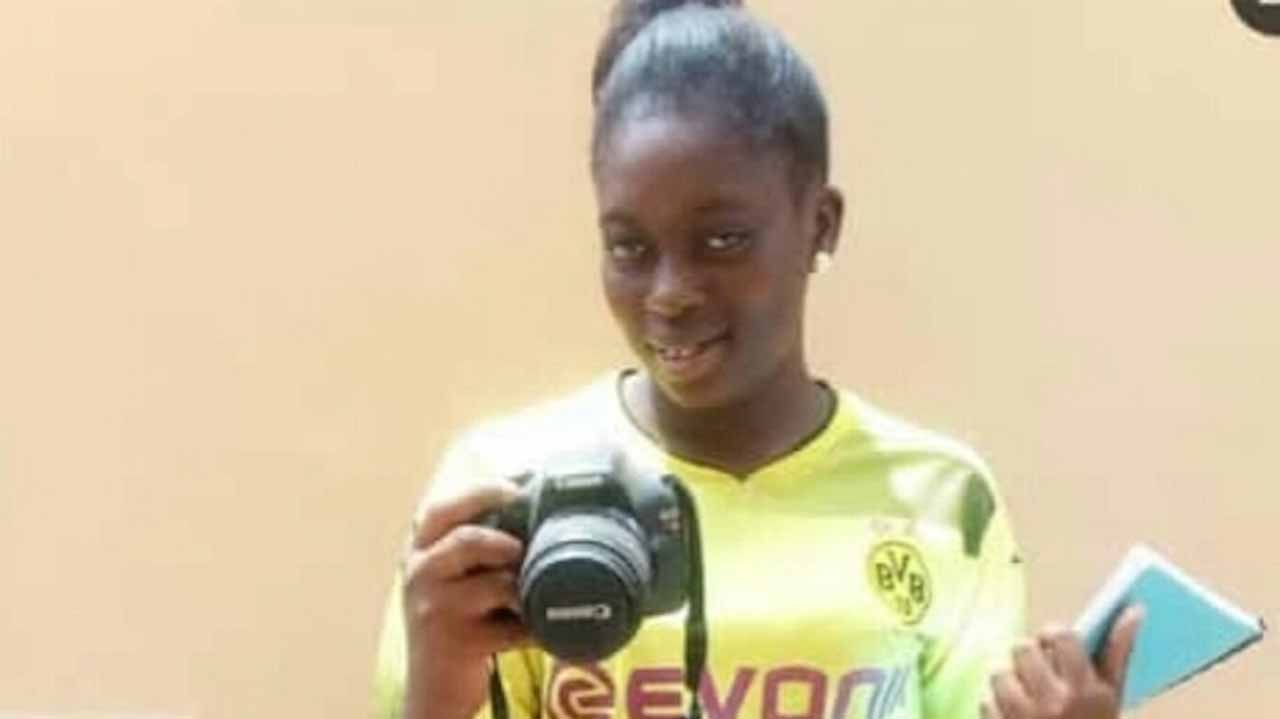
The late Favour Seun Daley-Oladele, victim of a money-making ritual, Lagos State, Nigeria
Money Rituals and the Head Hunters
Published: January 2, 2020 By: Olusegun Adeniyi – This day, Nigeria
It is painful enough that the parents of Favour Seun Daley-Oladele lost their 22-year old daughter, a 400 level theatre art student, in tragic circumstances. But the gory details of how she was dismembered with her organs cooked and eaten by a wealth-seeking mother and son is heartrending. The disgusting belief that money can grow from the sacrifice of human beings has sent too many innocent people to their untimely death, especially in the southern part of the country. So how desperate or gullible must someone be not to see that if herbalists could create money by performing rituals, they themselves would not be so poor?
In his paper, “Sociological analysis of money rituals as a recurrent theme in Yoruba films”, Dr Adagbada Olufadekemi, a lecturer at the Olabisi Onabanjo University, Ago Iwoye, argued that instant riches through money rituals that is often projected in Nollywood movies is a reflection of our reality in which “esoteric forces tapped from nature are used by the initiate to send the soul of the sacrificial victim to a supra-physical realm, wherein it labour to bring wealth to the ritualist.” Olufadekemi locates the challenge in “the apparent downward trend in the socio-economic conditions of the average Nigerian” which has led to “increase in the number of people using occult practices to come to terms with contemporary socio-economic demands.”
What the paper ignores is the factor of greed and the growing penchant by many of our young people for one of the ‘Seven Social Sins’ identified by Mohandas Gandhi as ‘Wealth without work’. The young man who killed the Lagos State University (LASU) undergraduate to make money reportedly dropped out of the same university. So, having failed in his academics, he was looking for a short cut to success; he wants to ‘hammer’ through diabolical means, without having to work. It is a growing sociological problem in Nigeria that we need to address.
While dark powers exist, the notion that anybody can conjure money after killing and harvesting the head or internal organs of another human being is ludicrous. This belief is prevalent not only in Nigeria but across the African continent. It is for this reason that albino and people suffering with a hunched back are perpetually endangered. In 2017, bald men in Mozambique were warned by the police that they could be targets of ritual attacks, after five men were murdered within a week. “The belief is that the head of a bald man contains gold,” Afonso Dias, a police commander in Mozambique’s central Zambezia province, explained.
In his lecture at the 2019 convocation of the Nigerian Academy of Letters (NAL) last August, Emeritus Professor of Philosophy, Godwin Sogolo, FNAL, spoke to the factors that render a social system dysfunctional, using Nigeria as an illustration. While moral disruptions due to ineffective education or damage caused by failure in governance tend to be more gradual and less perceptible, according to Sogolo, “the effects of disruptions caused by severe material needs and cultural invasions are more dramatic and impactful on human character” because such “derails the mind of the individual and causes havoc to the collective psyche. The result, in most cases, is the failure to comprehend the purpose of life, leading to moral apathy and unwholesome acts of violence, aggression and criminality, especially among the youths.”
Although money rituals have been with us for a long time, the current prevalence can be situated within the context of Sogolo’s thesis. If you listen to the lyrics of most of the artistes who now rule the airwaves and are idolized in the social media, dishonest living to make money is all they glorify; in addition to peddling obscenities. And many of their followers are being conditioned to believe that in life, only the end justifies the means. That is why some young men would engage in daylight bank robbery in Abuja!
In my 1st May 2015 Platform Abuja lecture, I recounted an October 2012 experience when I visited Ekiti State during the first tenure of Dr Kayode Fayemi. He was on a working visit to the Ikogosi Spring then under reconstruction and I escorted him. In the course of inspecting the project, Fayemi noticed he couldn’t comprehend the language being spoken by the artisans. He asked where they came from and they said Cotonou, Republic of Benin. Turning to the contractor, Fayemi asked why he would deny local people jobs from which they could earn income. The contractor said the job required some special skills that were not readily available in the country. “Then teach our people”, Fayemi dictated. The contractors replied that the local boys were not willing to learn because they don’t want to work. When Fayemi called the boys, they were more interested in him ‘dropping something’. Those are the kind of people who engage in money rituals and their population is growing across the country.
While I commiserate with the Daley-Oladele family for the gruesome murder of their daughter, I hope the police will speed up their investigation and charge the culprits to court. But as a society, we must deal with this moral decay in which young men believe that the way to ‘make it’ in life is not by work but rather by killing fellow human beings and removing their body parts for money rituals.
The Point Adenuga Has proved
During the Christmas holiday, I spent a considerable amount of time watching television. In the process I saw numerous Globalcom commercials promoting our rich culture and the nation’s entertainment industry. By using local musicians, actors, actresses as well as global stars with Nigerian ancestry for endorsement, Globacom has helped to empower many of our people at home and in the diaspora. But it is in the content of these promotions that Globacom has deployed its network to project Nigeria’s image beyond the call of business. It is a patriotic duty for which its chairman, Dr Mike Adenuga Jnr must be commended.
For instance, if there is anything the commercial by the British World Heavyweight boxing champion, Anthony Joshua, demonstrates, it is the Nigerian spirit of resilience in the face of adversity. We see that all the time in the manner we laugh at our problems and survive against odds. But Anthony Joshua puts it in a way that resonates. “There has always been a big piece of my heart as a Nigerian and I do believe that it is that piece that sets me apart. It always says to me, ‘never give up, dream big’! We come from a nation of warriors and that is why I believe in Glo. We have that same tenacity, that Nigerian fighting spirit that makes us game changers! We are relentless. We don’t just face our challenges, we step into the ring to win again and again and again. If you believe in yourself, there is no limit to what you can achieve. Yeah, I used to be a bricklayer in England but now I am heavyweight champion of the world!” he declared. And then this: “You need strength? Yeah, that comes from the hard knocks that life throws at us. And we are Nigerians, we know all about that”. He then added: “It’s like when we are up against the rope. You don’t stay down; you’ve got to fight. You have to dig deep to be a world champion”.
Profound!
Meanwhile, the contribution of Globacom to the entertainment industry goes beyond sponsorships and endorsements to Corporate Social Investment (CSI) initiatives that have helped to resurrect and nurture the career of many veteran artistes who may have ended up in penury in a society that places little premiums on art. Given the array of stars they promote, Globacom must be investing billions of Naira annually on these artistes and their crafts. And the multiplier effects on the economy must be enormous.
On a personal note, I derive joy from the fact that Adenuga has validated my position. During the licensing bidding round which earned Nigeria global applause because of the transparent manner Dr Ernest Ndukwe handled the entire process, there were people who dismissed the argument some of us were making (that we also needed a Nigerian business man on the telecoms table) as mere sentiment. But we have been vindicated by Globacom. Despite being launched more than two years after two foreign operators (MTN and Econet) had been firmly entrenched in the market, Adenuga has succeeded where others before and after him have failed. But more commendable is the disruptive role Globacom has played in the industry: From putting a lie to the claim that per second billing was impossible in Nigeria to crashing the prohibitive cost of acquiring a GSM line to bringing down the cost of airtime etc.
In my column on this page on 31st October 2002 (more than 17 years ago now!) titled “Unto Whom Much is Given…”, I reminded Adenuga that while he may have won the battle for a licence, he had to prove to Nigerians and the world that he could run an efficient telecoms system. I also argued that it made no sense to exclude our people from such an important sector. “For us to grow as a nation, we surely need daring people who are ready to invest their money…men who are prepared to dream big, take the biggest gamble, men who will never accept No for an answer regardless of how hopeless the situation may seem,” I concluded.
While Globacom has made considerable investment in the development of sports in Nigeria, what is not known to the public is the role Adenuga played in the qualification of Nigeria for the 2010 World Cup in South Africa. When the late President Umaru Musa Yar’Adua decided to intervene at a time it was looking like Nigeria might not qualify for a tournament holding for the first time on African soil, he turned to Adenuga. But at his meeting with Yar’Adua, Adenuga said he would prefer to operate from the background with financial support and both settled for the then Rivers State Governor, Mr Rotimi Amaechi to chair the presidential committee of which I was a member. True to his word, he was the single largest donor to our assignment. Incidentally, the last time I had any contact with Adenuga was on 17th June 2010 at the stadium in Bloemfontein where Nigeria played Greece during the tournament.
The critical challenge of our country, as I have argued on several occasions, is that we have too many idle billionaires with neither credible sources of livelihood nor feasible investments who can help put our people to work. Many of them stash their money abroad, buying Yacth and ferrying around Supermodels while employing only domestic staff who minister to their vanities without adding any value to our society. To confront our economic challenges in this new year and decade, we need the patriotic zeal and courage of men like Adenuga who will not only invest their money but also empower our people.
On Christmas
Since ‘Oversabi’ or ITK (I too know) is a national ideology in our country, it is no surprise that some Nigerians believe they are wiser than billions of people all over the world who celebrate Christmas. While they are entitled to their opinion, I found a piece on WhatsApp that I have edited and adapted to a simple message: You never argue on any of the Days declared by the United Nations to celebrate diseases and infirmities: World Cancer Day, World Aids Day, World Diabetes Day etc. It is therefore sheer ignorance to argue that dedicating ONLY ONE DAY to celebrate the King of kings and the Lord of lords is wrong. I don’t care on what day of the calendar Jesus Christ was born. But while you are free to choose your own date, I look forward to joining the rest of the world on 25th December every year to celebrate Christmas!
Fortunately, there are Nigerians who speak out against this ugly practice of money-making rituals, which caused the death of a student of the Lagos State University, Favour Daley-Oladele. Read the statement made by the Director-General of the National Council for Arts and Culture, Otunba Segun Runsewe. (webmaster FVDK).
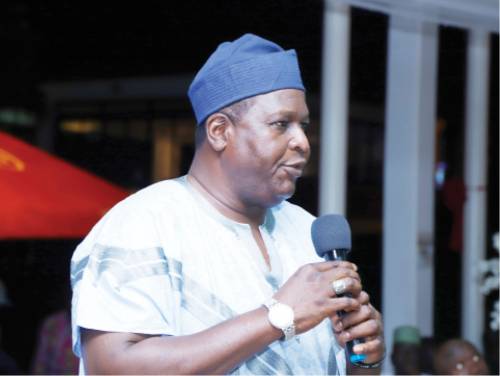
Segun Runsewe
Published: December 31, 2019 By: Sahara Reporters
Director-General of the National Council for Arts and Culture, Otunba Segun Runsewe, has said that every Nigerian must collaborate to end ritual killings in the country.
Runsewe, who was reacting to the gruesome killing of a final year student of the Lagos State University, Favour Daley-Oladele, by her boyfriend in connivance of his mother and pastor a few days back, said that it was important for the mentality of young people to be changed so that the love of money can be abandoned for rational reasoning.
The NCAC boss stated that the silence of women groups over the incident was quite disturbing, adding that as mothers they must rise up to combat the scourge of ritual killings.
He said, “The spirit of extreme love for money at all costs and by all means among Nigerian young persons must be tamed to avoid total collapse of the Nigeria family system.
“The killing of Miss Favour Daley-Oladele, a final year Sociology student of Lagos State University by her friend and his mother for money ritual is unacceptable and has nothing to do with the rudiments and culturally accepted means of survival and of money making.
“Killing somebody for money ritual is never a business neither does it have anything to do with being poor or lacking anything good in life but of a spirit not associated with our people and our way of life.
“NCAC under my watch from 2020 will embark on nationwide cultural advocacy to help call attention and re-educate Nigerians to stop the quest to become rich or make money by all means which if unchecked will destroy the entire fabric of the family system and the Nigerian culture of love for one another.
“We are not going to allow this to continue and we shall take the battle to various communities, institutions and leaders at all levels both religious so that we can bring Nigeria back to what it used to be culturally.
“Our women and mothers can do it and I want them to fight it right from the homes.
“If our mothers says no to this type of unacceptable attitude from our children, then we can go to sleep.
“We shall engage our women and they will take the matter and solve it.”
It is not known with certainty how many people in Africa are affected by OCA, which stands for ‘Oculocutaneous albinism’ (see below). It maybe a quarter of a million, it may be more. What we do know is the plight of persons with albinism. The lack of melanin which brings this condition with it, results in unhealthy effects of ultraviolet radiation exposure. Moreover, widespread superstition causes many wicked people to believe that albino body parts bring wealth and/or power. As a result, persons with albinism are chased, kidnapped, murdered.
The article below contains many examples of these gruesome practices which occur in many African countries. The author, Edmund Zar-Zar Bargblor of the Liberian newspaper, The Daily Observer , is to be commend for drawing attention to these outdated and cruel practices which constitute a serious violation of the human rights of people with albinism and have no place in a modern society.
Warning: the following article contains graphic details of cruel ritualistic activities (webmaster FVDK).
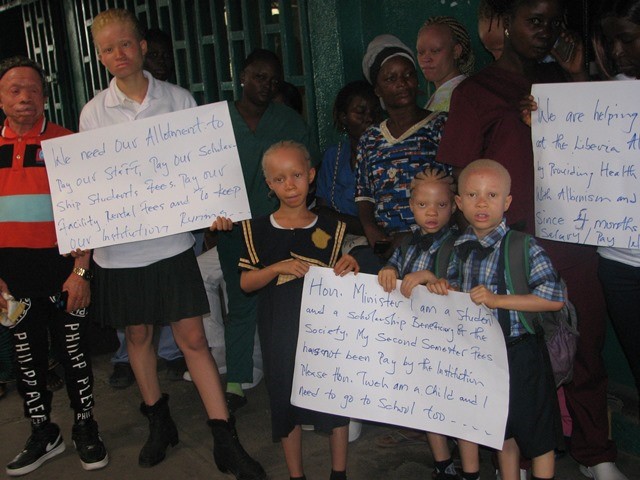
Some of the protestors with various placards that called on the Liberian Government among other things, increase their budgetary support (Courtesy of Daily Observer, Liberia).
Africa’s Shameful Acts of Racism: The Plight of Persons with Albinism (PLWA) in Africa
Published: December 2, 2019 By: Edmund Zar-Zar Bargblor, The Daily Observer (Liberia), Webmaster Admin
Racism is the belief that a particular race is superior to another, and that a person’s social and moral traits are predetermined by his or her inborn biological characteristics. On the African Continent, we have seen the impact of colonialism and its attributes of racism and discrimination.
The former Apartheid system in South Africa and its institutionalized racial segregation was an extreme expression of European treatments of Africans. The miserable treatment of people living with Albinism by fellow Africans is not only unfortunate, it is shameful.
The condition known as ‘Oculocutaneous albinism’ (OCA) is a genetically inherited autosomal recessive condition and OCA2, tyrosine-positive albinism, is the most prevalent type found throughout Africa. Due to the lack of melanin, people with albinism are more susceptible to the harmful effects of ultraviolet radiation exposure.
The National Institutes of Health reported that about 200,000 Americans are affected; and around the world, it is between one in 17,000 and one in 20,000 people are people living with albinism. However, it is prevalence in parts of Africa, but it is far higher than the global average. People living with Albinism makeup about one in 4,000 people in South Africa and perhaps one in 5,000 in Nigeria. According to a 2006 review published in the journal BMC Public Health, the prevalence in Tanzania is one in 1,400, but this estimate is based on incomplete data. Since Tanzania’s total population is more than 40 million that would suggest an albinism community of about 30,000. A census is underway, however, and the Albinism Association of Tanzania believes the total figure could be more than 150,000.
People living with Albinism suffered in the hands of fellow Africans
The human rights organization Amnesty International quoted the Malawian police’s description of the gruesome murder of Mr. Machinjiri: “About four men trafficked him to Mozambique and killed him. The men chopped off both his arms and legs and removed his bones. Then they buried the rest of his body in a shallow grave.”
There are superstitions in some parts of Africa that albino body parts bring wealth, power or sexual conquest, and that having sex with a person living with the condition of albinism cures HIV and AIDS. Attackers sell albino body parts to witch doctors for thousands of dollars, according to Amnesty International. In Tanzania, some 75 people living with albinism were reported killed between 2000 and 2016.
Also, there have been reports of people living with albinism killings in South Africa; although such crimes are less common there than in Malawi, Tanzania and Burundi. Last February, a South African court sentenced a traditional healer to life in prison for murdering a 20-year-old woman living with albinism.
The Office of the UN High Commissioner for Human Rights (OHCHR), the UN agency that deals with human rights issues reported in 2016 that hunters of people living with albinism sell an entire human corpse for up to $75,000, while an arm or a leg could fetch about $2,000”.
In many African countries, it is sad and shameful the atrocious manner in which people living with albinism are treated; their lives are compounded by “exclusion, stigmatization, and denial of basic rights such as the right to education and health,” according to Amnesty International. People living with Albinism continue to experience social isolation and stigma which includes name-calling, mockery, and exclusion from certain community activities.
It is reported in Zambia that at least ten people living with albinism are murdered in ritual killings every year. Some believe their body parts bring wealth or luck. Those born with the genetic condition are calling for an end to this madness. There are more than 25,000 people living with the condition in Zambia.
Madame Janet Kakusa Wonani of Zambia, Founder/President of Light of The World Foundation. She works closely with children with Albinism in Zambia, irrespective of limited financial support.
According to the Albinism Foundation of Zambia (AFZ), Executive Director John Chiti, more than 25,000 persons with albinism in Zambia are currently in need of sunscreen lotion.
In an interview with Africa Renewal, Ms. Ero, said that the albinism situation in Africa, “is a tragedy.” She referred to the 7,000 to 10,000 people living with albinism in Malawi and thousands of others in Tanzania, Mozambique and other countries as “an endangered people”, facing a “risk of extinction if nothing is done.” Tanzanians call people living with albinism zeru,zeru, meaning “ghosts.”
Prevailing Superstitious Mindsets
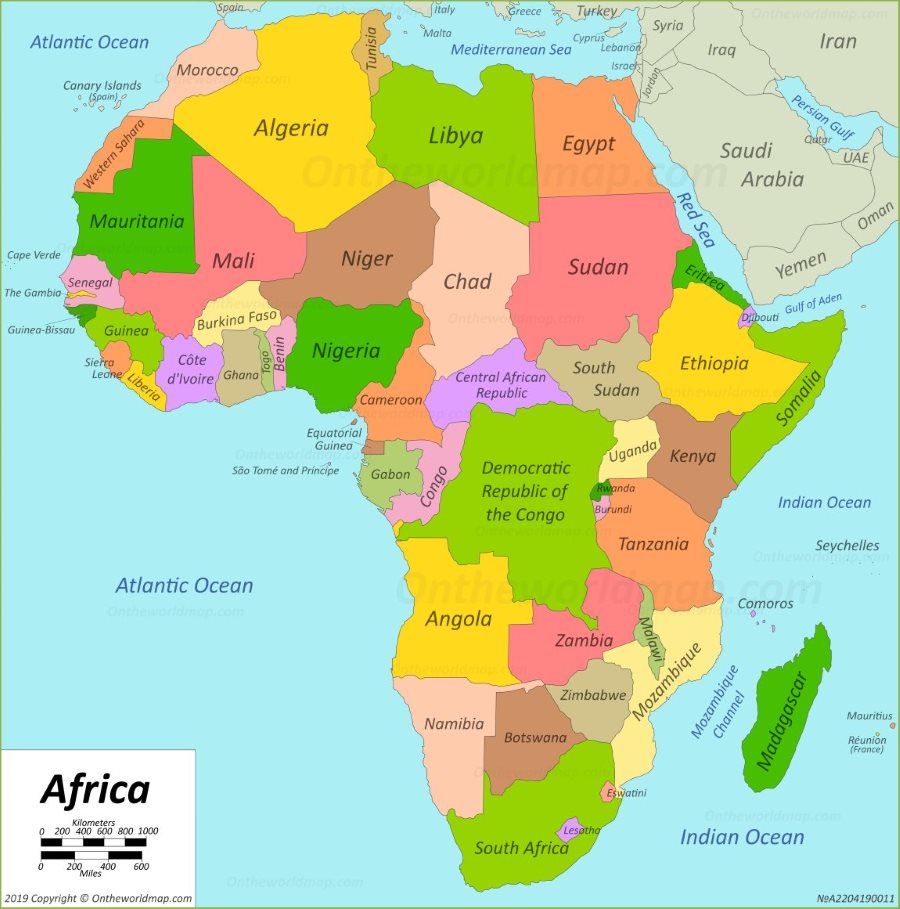
Superstitious mindsets in some African countries continue to seek murdered for body parts, including infants and babies. Most of the attacks have taken place in Tanzania. Murders and attempted attacks, though in smaller numbers, have also been documented in Burundi, Kenya, Swaziland, Guinea, Nigeria, South Africa, Congo, Zambia, Namibia, Ivory Coast, and Burkina Faso.
The Converson.com conducted research and looked at media reports published between 2008 and 2011 on albinism and murders in Tanzania. It published a data set of 563 media reports in both English and Swahili from Tanzanian national newspapers.
The data showed that the Tanzanian press portrayed and explained violent attacks against persons with albinism in four ways. They were:
criminal activity,
cultural practices,
a socio-economic phenomenon,
a human rights issue.
Ms. Kway-Geer, the first Member of Parliament in Tanzania with albinism described her individual testimonials, first-hand accounts of difficulties as:
“When I was at primary school, people used to laugh at me, tease me – some didn’t even like to touch me, saying that if they touched me they would get this color. People used to abuse me on the road when I took the buses to school. They would run after me – crowds of kids following me – shouting ‘zeru, zeru’. (zeru, zeru, is a derogatory term).
Recommendations
The Conversation.com has identified the following recommendations.
There is an urgent need to address the violence faced by this vulnerable group. Public health awareness is an important first step.
Adequate health services for skin and vision disabilities should be prioritized.
Putting out messages that counter the stigma against people living with Albinism is also important, as is access to education.
Interventions must consider Albinism’ human rights. For example, putting children with albinism in camps may protect their right to life and security,but it restricts their rights to freedom of movement, and family life.
In addition, African Governments should seriously advocate against harmful practices against people living with albinism. State parties should take all appropriate measures and offer support and assistance to victims of harmful practices, including legal sanctions, education, and advocacy campaign to eliminate harmful practices perpetrated on persons with albinism, such as witchcrafts, abandonment concealment, ritual killings, etc.
Conclusion
One thing for sure, the people living with Albinism did not create themselves; they were created in the same way you and I were created by the God who doesn’t make a MISTAKE. Their birth process is the same as you and me! Their mothers’ carried them for nine (9) months in their wombs before giving birth to them.
Who are we – be it an individual or government to decide that they should not live because they are different? Did God ask he needs our HELP to make His decision? The Almighty God does not need the assistance of mortal humans to run his affairs. The actions of those individuals perpetuating violence against persons suffering from albinism are no different than King Leopold II of Belgium, Adolph Hitler of Germany, Napoleon Bonaparte of France, and White racists today.
In Genesis 1:31(NIV): “God saw all that he had made, and it was very good…” God himself said it was Good, NOT bad. God doesn’t create anything UGLY! So, why individuals, including governments, are killing these innocent people? In addition, 1 Thessalonians 5:22 instructs us to “Abstain from all appearance of evil.” Accordingly, the GENOCIDE against these poor innocent people must be STOPPED!
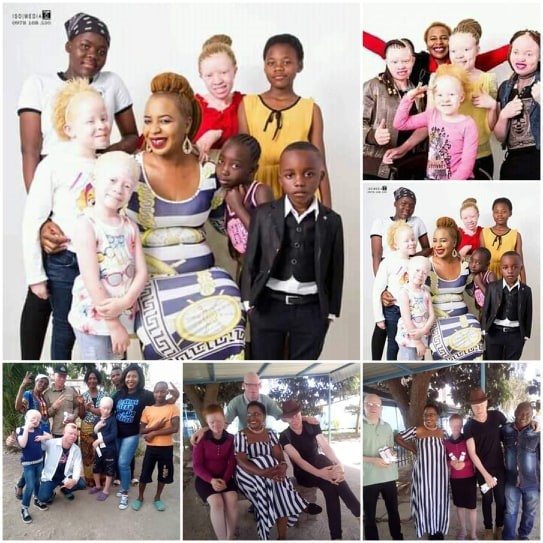
Now, take a closer look at the beautiful tapestry of the people living with Albinism provided here. The question that readily comes to mind is any of you better looking than the people living with Albinism provided in these photos? I DOUBT IT! Therefore, let the persecution and killing of people living with Albinism STOP before the wrath of God descends upon us.
As Africans, it is embarrassing to read or hear that other Africans are discriminated against due to their race. Racism is contrary to God’s plan for humanity. The divisions we face today in contemporary Western nations are due to Race, the color of one’s skin or ethnic background. And obviously, this perception is not part of God’s plan.
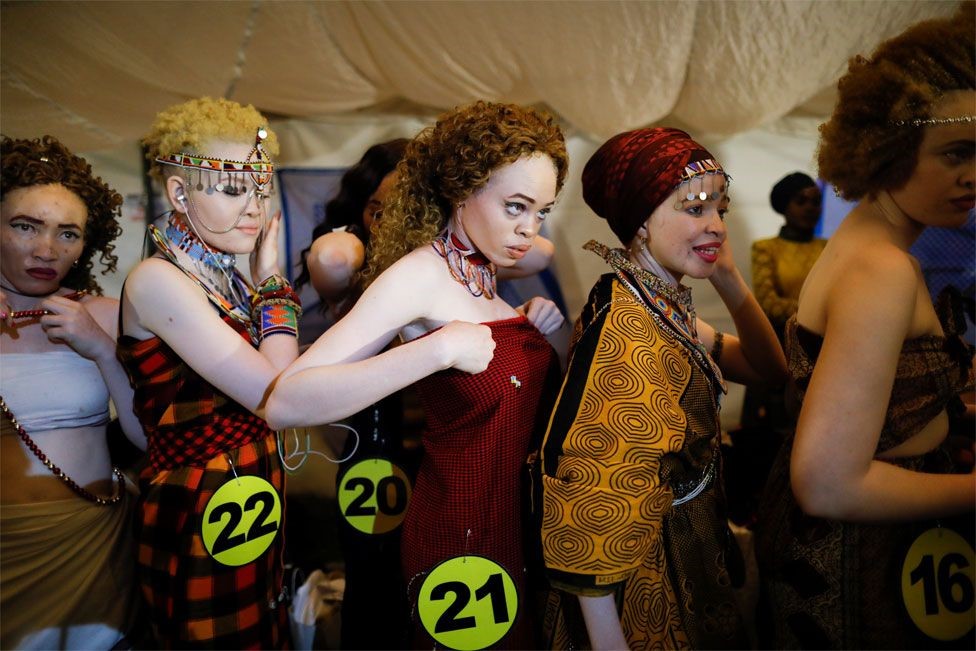
The Albinism Society of Kenya held a Mr. and Miss Albinism beauty pageant in Nairobi to support those with the hereditary condition. (https://www.bbc.com/news/in-pictures-46439699).
In the words of Maya Angelou: “We, the black people, the most displaced, the poorest, the most maligned and scourged, we had the glorious task of reclaiming the soul and saving the honor of the country. We, the most hated, must take hate into our hands and by the miracle of love, turn loathing into love. We, the most feared and apprehensive must take the fear and by love, change it into hope. We, who die daily in large and small ways, must take the demon death and turn it into life.”
Indeed, Children living with albinism in Africa are our brothers, sisters, daughters, and sons, let us protect them always, they are all God’s children as well.
This is the second murder within a short period of time.
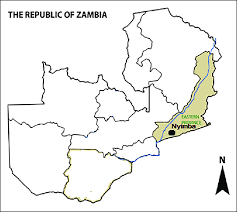
It is being alleged that Eastern Province has so far recorded the highest number of ritualistic murder cases (….). Zambia Albino Foundation president John Chiti stated that he suspects the province is recording a lot of cases because of the border with Malawi. “Something could be going on regarding the selling of body parts from one country to the other,” he said.
Maybe he’s right. However, it is common to blame foreigners when crimes are committed whereas the perpetrators of these heinous crimes, attacks on people with albinism, mutilating or murdering them for muti purposes, are often Zambians (webmaster FVDK).
CHIEF Ndake of the Nsenga people in Nyimba district has called for an urgent meeting with his indunas and village headmen following the brutal killing of an albino man last Thursday.
And Anglican Diocese of Eastern Zambia Bishop William Mchombo has called on the government to come up with strong intervention with traditional doctors to dispel the myth that albino body parts can bring immediate success in terms of wealth.
Meanwhile, Zambia Albino Foundation president John Chiti has expressed concern at the increase in albino killings in Eastern Province.
Gift Tembo, 39 of Abraham village, was murdered by unknown people around 01:00 hours on October 31.
Eastern Province deputy police commissioner Geoffrey Kunda confirmed the incident, saying Tembo’s throat was cut and his body dumped few metres from his house.
Commenting on the matter, chief Ndake said there was need for the local community to find ways of protecting people living with albinism.
“This is very devastating to me and the entire chiefdom. I will soon call for an urgent meeting with village head persons and indunas so that we find ways on how we can protect people living with albinism. If they are targeted like this then there is need for us as a community to find ways on how we can protect them,” he said.
Chief Ndake appealed to people to be on the lookout for those who were killing albinos.
“Those who have tips regarding the people who are killing albinos should come forward and report because it will not help us to hide these people. We don’t know what government can do so that we assist these people because it’s like albinos are on wanted list,” he said.
Ndake said Tembo was put to rest on Sunday.
“This is a very sad story. This young man who was staying alone struggled with his attackers. When the family members heard the deceased screaming, they went to check. They found that the attackers had carried the deceased and were running away with him,” he said.
“So when the relatives gave chase, the attackers dumped the body and ran away. Upon checking the body, the family members discovered that the deceased had been stabbed with a knife and his throat was cut off. This is sad and up to now we are deeply shocked because this is the second incident to have happened in the area within a short period of time,” he said.
Chief Ndake described the killing as cold blooded and unfortunate.
He said during Tembo’s funeral on Sunday, he pleaded with people to work together and end such killings.
Commenting on the incident, Bishop Mchombo said Tembo’s killing was unfortunate.
“This is very unfortunate. I think this has to do with the ritual killing where people believe that parts of an albino can bring them immediate success in terms of wealth, which is a myth. It’s not true,” he said.
“I think the sooner that is addressed, the better especially if government can bring about strong interventions with traditional doctors. This is where the whole thing come from because that’s what people are told, that when you do such a thing then you will be a rich person.”
Bishop Mchombo also called for more sensitisation on albinos.
“These are human beings and should be appreciated as they are. It’s just a deficient of some scientific proven attributes that make them the way they look but in terms of humanity they are as good as anybody else and they should be left alone and do what they want,” he said. “My advice is that let there be serious interventions from government and if people are found in such situations, the perpetrators of such heinous crimes let there be rules that will deter other people from committing similar crimes.”
Bishop Mchombo said the church and other stakeholders should ensure that they bring about awareness on matters relating to albinos who were also created in the image of God.
And Chiti said his foundation would contact Tembo’s family to see the kind of support it could provide.
“It is always a sad moment when we hear such news, we are saddened by the loss. What we are trying to do is to get in touch with the family and see what kind of support and anything else that can be done. We strongly condemn such killings. We just appeal to the relevant authorities to make sure that the culprits are brought to book,” he said.
Chiti also advised families with albinos to be careful because their lives were at risk.
“Eastern Province has so far recorded the highest number of cases, so it is a source of concern to us. We suspect the province is recording a lot of cases because of the border with Malawi. Something could be going on regarding the selling of body parts from one country to the other,” said Chiti.
Police have since arrested several people in connection with Tembo’s murder.
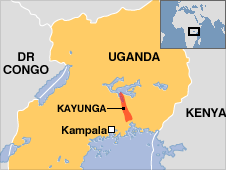
Also see my posts dated August 30, 2018 – “Get rid of this evil”: High Court judge calls govt to ban all shrines in Uganda – and August 20, 2018 – We wanted wealth!’ Four witch doctors arrested over ritual murders tell Police and and more articles – on the ritual murders in Kayunga District (webmaster FVDK).
Published: November 12, 2019 By: Jalira Namyalo
One of the persons implicated in ritual killing and burial of five people in a shrine in Kisoga Village, Nazigo Sub-county in Kayunga District has been sentenced to five years in prison after he pleaded guilty. Joseph Kibuuka, alias Junior, pleaded guilty to murder charges but court reduced the charge to being an accessory to the murder under the plea bargain process.
After the sentencing, Kibuuka turned into a prosecution witness. He entered the witness box and testified against the five other accused persons with whom he had been indicted for murder of five people among them Zulaika Nansamba Mirembe.
Other suspects are Ssebuyungo alias Owen Sonko (witchdoctor/ herbalist); Muhammad Wamala alias Vincent Bob; James Lutwama; Fred Kiiza Ssemanda and Issa Walakira.
In his testimony, Kibuuka said the deceased Mirembe came to Ssebuyungo’s shrine one evening in May and they had a meal with her and Wamala in a trading centre before going back to Ssebuyungo’s shrine.
“At around 9pm, we (Wamala, Mirembe and Barbara, a sister of Ssebuyungo) drove back and they dropped me at my place near Ssebuyungo’s shrine. Wamala told me not to close the door because he was to sleep at my place but he did not come. In the morning when I went to clean the shrine, I found a fresh grave and did not see Mirembe. I was scared and feared to say anything,” Kibuuka narrated. According to Kibuuka, after sometime Ssebuyungo and Wamala had disagreements which prompted Wamala to report a case of murder to police.
He said it is Wamala who trained Ssebuyungo in witchcraft but could not tell how other bodies were buried in the same shrine. He said he worked at the shrine for few months as a cleaner.
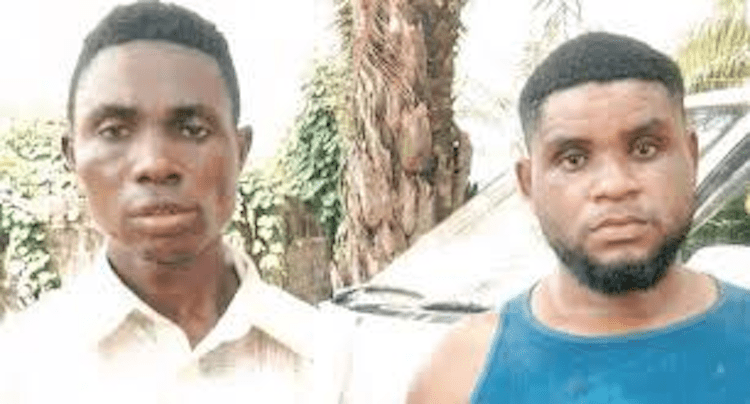
Screenshot from ICIR Nigeria website showing suspects Uche, Onoriode, Desmond and Obajero.
The International Center for Investigative Reporting, ICIR, is an independent, nonprofit news agency that seeks to promote transparency and accountability through robust and objective investigative reporting. The ICIR’s mission is to promote good governance and entrench democratic values by reporting, exposing, and combating corruption.
Comment webmaster FVDK under construction. Check Elozino Delta State University in earlier posts (webmaster FVDK)
Confession of Yahoo Plus Boys: “Ritual does not give us money”
Published: November 8, 2019 By: Ejiro Umukoro
IN their desperation to join the ranks of their compatriots who have been making millions of dollars out of online-scams, young Nigeria- based wannabe scammers known as ‘yahoo boys’ are resorting to the use of traditional charms and mystical powers to charm potential victims.
Yahoo Boys are young men —usually aged between 22-29 years—who specialize in various types of cybercrime. Many of them may be undergraduates or college dropouts whose distinct lifestyles of fast cars, wealth and ostentation is the envy of many of their age-mates. The Yahoo Boys are not limited by geography— the internet is their home— and their victims are as diverse as there are naive and people ready to fall for get-rich-quick scams.
There are numerous websites dedicated to providing tips for those interested in joining the growing ranks of Yahoo Boys. According to a research report, Understanding Cybercrime Perpetrators and the Strategies They Employ in Nigeria, the use of voodoo and charms for spiritual protection and to charm potential victims is very common among Yahoo Boys in Nigeria. The practice is referred to as “Yahoo Plus. According to the report, another level in the use of charms is known as Yahoo Plus Plus, which “involves the use of human parts and may need kidnapping other human beings for rituals, which is not necessary in ‘‘Yahoo Plus.’’ In Yahoo Plus Plus, the use of things such as victims finger nails, rings, carrying of corpses, making incision on their body, sleeping in the cemetery, citing of incantation, using of their fingers for rituals, and having sex with ghosts are common.”
Two suspects: Emudiaga and Desmond
Getting a Victim – The Kidnapping
The car drives by in a lazy fashion. Its three passengers, all male: Macaulay Desmond Oghenemaro, Emese Emudiaga Kelvin and Onoriode Enaike are good spotters. They know a victim when they see one. The signs are usually obvious: a response to a cat-call, eye contact, a smile, a wave of the hand, a thumbs up or just the mere sight of their expensive car is enough to pull a vulnerable, or even, willing participant. This is their fourth recon for their next task. The last three girls they got had been easy catch, their names unremembered, their bodies long decomposed; each one, a girl on the lookout for quick money, free food, or free drinks in return for a one night, short term, or simply a girl keen on dating only men who drive cars.
The three of them sight a potential victim. She flags them down and gets in. She looks about twenty-years-old. She’s not a student; a fashion designer she tells them. They drive to the hottest spot in town for drinks, skewered meat and food. They continue to pour alcohol into her glass, ordering more bottles of beer. She guzzles down the beer as she feasts on the meat and other goodies that they push before her.
The night was about to be ushered in. Their day job as ‘Yahoo boys’(online fraudsters) has taken a new twist. They are now Yahoo Plus Plus, a code name for ‘ritualists’ – or those who are in the business of getting human body parts for use in rituals and occult practices which are supposed to guarantee success of their internet scams. They signaled each other: it was time to take her out. They get her into the car in a drunken stupor then drive several kilometres to the outskirts of Oghara into a bush where they first plucked out one of her eyes while she was still alive. The young lady was crying, begging them to forgive her and let her go, but they went ahead and pluck the other eye, remove her breasts and heart before she died.
Three hours later they are done with her. They abandon her body out in the open, her hands and feet bound with marine ropes. Within three hours they cut off her organs: breasts, heart and eyes. Once they were done, they head for their next stop at the ‘Jazz Man’s’ shrine in Alegbo, Warri.
His name is Ojokojo Robinson Obajero, a 63-years-old man, who though an expert in herbal medicines, mixes his craft with occult practices. They call him the ‘Jazz Man’ in pidgin patois. When the three men meet him and presented the human organs, Obajero tells them when to return. They leave. Four days later, Obajero summons the three men and hands over the burnt ashes of the deceased’s body parts he claims he used in preparing a “money ritual concoction”, which he tells them will guarantee that their online victims fall prey for their tricks to obtain money through fraud.
Several weeks later they returned to Obajero, disappointed and angry. Their business of internet fraud has not been booming as they expected. Instead, it seems that the online victims they have been targeting have become smarter and are no longer falling for their scams. It’s also been several months since they made any money from female victims looking for love on the internet.
They demand to know from Obajero why his ritual did not work. He tells them that he has been testing them – the first three victims whose body parts they brought to him for conjuring was a test to confirm they would not divulge his identity as the person making the charms. He tells them he is confident they will keep their mouths shut and demands that they must get a fifth victim whose body parts he will use to make a new charm.
The three scammers are not happy with this new request. Desmond tells Obajero that they had put in a lot of effort to get the body parts from their four previous victims, and yet they had not got any results. Desmond is angry that even though they had invoked the occult, they were not as successful in luring victims as they had been before they started engaging with Obajero. But this time, Obajero makes a firm promise: “This time you will make money through the death of the girl and the ritual I will do for you.”
The three men left wondering where to get their next victim. Less than 24 hours later, Onoriode calls Desmond and Emese. He tells them there is a possible victim — a student in Abraka University where he works as a security guard. The girl, Elozino Ogege is a 300 level Mass Communication student of the Delta State University who had a few days earlier, asked him if he could help her with information regarding available rooms for rent within the school’s staff quarters, and he had now has asked the girl to return the next day. He told his two accomplices this would be an opportunity for them to kidnap her and take her out of the school premises with the help of the head of security, Nwosisi Benedict Uche, who will be paid N30,000 for allowing them to pass through the gate without the boot of the car being subjected to a search.
One of the victims: Elozino
Inside the Lecturers Staff Quarters, the three of them waylay Elozino, incapacitate her with a toxic fume, and dump her in the boot of the jeep they brought. While Onoriode waited behind at his guard post, the other two drove to Emese’s house in Umeghe and waited for Onoriode to join them after work hours. Once Onoriode arrived, they drive towards Abraka just before Obiaruku by the right when coming from Warri axis into a large expansive land thick with vegetation. They drive through the bush track of lined palm trees. The bush track leads to Ugunu Community but they do not drive inwards, parking the Corolla car a few metres from the expressway. It was already dark. They get their tools and torchlight.
Desmond had drank half a bottle of strong expensive alcohol but his two friends had no need to dull their senses before they mutilated the girl they had successfully kidnapped. Elozino was crying, begging them to let her go but they ignored her pleas while they plucked her eyes out, removed her heart and cut off her nipples. Two and a half hours later, they are done with the deed. They drive off and deliver the dismembered parts to the occultist who once again instructs them to return after two days when he would have completed preparing the charms.
This was their 5thvictim. In their desperation to make money through ritual killings and sacrifices, they covered an estimated distance of at least 78KM, a journey of about 1hour 27mins between Abraka to Otefe, Oghara in at least 10 instances (780KM) (870 minutes); including traveling back and forth from Abraka to Warri on at least 10 occasions to meet with the occultist who prepared charms, estimated distance of 490KM both ways, a total of 660 minutes; in addition to navigating their way from their home base in Abraka to Delta State University, DELSU, towards the expressway some distance from Obiaruka where they committed their last crime, a journey of at least 41KMboth ways and roughly 50mins at the least. On average, it took them about 3 hours on each victim to extract the organs, an average total of 15 hours spent.
While they were at home awaiting the call from the jazz man, in less than 48 hours later, in the early hours of Saturday 10thNovember 2018, all three men including the occultist were rounded up by the police. A tipoff from the victim’s family led to an investigation that helped the police trace the girl’s cell phone, a Tecno K7 Mobile, to the murderers. Elozino Ogege was their fifth victim.
Four suspects: Uche, Onoriode, Desmond and Obajero
ON MISSING GIRLS
A follow-up investigation into the other 4 missing girls was made. Reports from Police Missing Person data does not have any record of reported missing girls during this period when the acts were carried out. According to the Police IPO in charge of Elozino’s case, who followed up on the perpetrators confession, no bodies of the missing girls were found when they went to inspect the areas where their bodies were dumped in the bushes in Oghara.
The late Elozino-Ogege
When the police was asked why there was no missing persons’ report, one theory postulated was that since the bodies of the girls according the yahoo boys were left abandoned in the open, decomposition was fast and the decayed bodies and bones likely eaten up by animals.
The other reason he explained was that, as a rule, because police don’t trust anyone, many people prefer not to report such cases of dead or mutilated bodies found so they are not mistaken or held for being responsible for such deaths or incidences. To remedy this, he suggests that citizens in general can report such cases to NGOs whose focus covers such issues who will then bring the case to the police. That way, the person who made the report is at first protected until investigations into the matter are completed.
But most importantly, citizens should begin to take it upon themselves to report suspicious activities and suspicious persons to the police early on as a preemptive call-to-action. Neighbourhood Watch is a must in combating crimes, illicit and illegal activities in all communities, especially more so in the ‘ember’ months ahead, where end of year activities are highest.
Efforts were also made to reach the EFCC (Economic and Financial Crimes Commission) to give us data on activities surrounding violent killings of females within the context of Yahoo Plus Plus using the FOI Request but no response, over two months before this report was filed, was gotten from EFCC regarding this. Violence of any kind against women: yahoo plus plus, other occult related killings, rape, assault, etc., are human rights abuses that must not be condoned by society. Cases must be reported and speedy justice administered to stop the scourge and prevent future incidents.
More needs to be done to collect data on missing women in Nigeria, to better understand the scope of the problem and work towards making university campuses a safe space for female students.
THE SCAM
As foreign law enforcement crackdown on online scams in a bid to protect their citizens from online fraud, it will become harder and harder for the Yahoo Boys to keep operating as they have in the past. Ritual killings and the belief that their victims’ body parts will create charms that will enable them to earn a living from scams are just one of the results from a population of young people who are turning to crime to make a living.
Nigeria’s youth unemployment rate averaged 36.5% iin the third quarter of 2018, while the national average rose to 23.1%. With graduates entering the workplace in greater numbers, there needs to be a concerted effort by national and state governments to provide an environment that will enable job creation to give young people better choices.
Yahoo Boys as also adept at cyber-enabled financial fraud. A six month operation wire wire conducted by the U.S. Department of Justice, U.S. Department of Homeland Security, U.S. Department of the Treasury and the U.S. Postal Inspection Service resulted in 74 arrests in the United States and overseas, including 29 in Nigeria, and three in Canada, Mauritius and Poland. The operation also resulted in the seizure of nearly $2.4 million, and the disruption and recovery of approximately $14 million in fraudulent wire transfers. Many of these scammers who were in Nigeria have since fled to other countries eg Ghana, Dubai ,South Africa, Gambia as the Nigerian Economic and Financial Crimes commission closed in on them.
I set out to interview Desmond and Onoriode who admitted to practicing Yahoo Plus Plus rituals. Together as a gang they spent an estimated 1,311KM, equaling a total of 1,580 minutes on the prowl looking for vulnerable women they can lure. Their lead-man, Emese, was alleged to have slumped and died when the police were close to catching him. Desmond and Onoriode were both in police custody while awaiting trial when this interview was conducted. During the interview, they were unemotional as they narrated how they kidnapped their victims and mutilated their bodies.
Sitting down on a short bench close to a hedge of plants, the sun shining overhead with a white plastic table separating us, this is an excerpt from the interview I conducted in the presence of the police:
Yahoo Plus Boys Onoriode and Desmond
Q: What’s your name and how old are you?
Macaulay Desmond. I’m 32 years. I Finished secondary school in 2008 (Urhuoka Secondary School, Abraka) but I was born in Lagos. I did my primary school in Benin and secondary school in Abraka.
Q: Were you in business before?
Desmond: I was into photography work and sand dredging from high sea. My job was to pile it up. I dredged in Bayelsa and with Delta Glass for two years and six months. Photography was from 2006 to 2013. I was learning photography as an apprentice at the same time I was schooling in secondary school. After school I go to do my apprenticeship. I was good with snapping photos, creating handbills, all types of photo enlargements, making complimentary cards, CD plate transfers and so on. But after I finished secondary school I stop my apprenticeship and left the job. Because I didn’t have the money to open my own shop I decided to work for my boss. After a while I left the job because it wasn’t paying that well. So I went to Lagos to work for another construction company. But that too wasn’t paying me well.
So I approach my Uncle to help me with money to further my studies. So my Uncle put me in the line of dredging sand from 2013 up till 2016 when I now leave for Ghana. I left because the dredging contractors who supplied the sands to Beta Glass was not paying, they owed us for long periods. Life was difficult. When I complain to my uncle he no show concern; im own be say e don put you for line. His own is to build the barge, rent it out or sell it out. The weather in the place too was a problem especially when I was hungry. So I got fed up.
Q: Why didn’t you learn how to make barges yourself from your Uncle? Or you didn’t want to learn how to make barges?
That’s not what I discussed with him actually. I told him I have finished my photography work and I just need money to finish my studies. My Uncle told me he does not have that kind of money. But the best he can do for me is put me in the line of working in the barge.
Q: So how did you get into this other line of business?
When things got rough with the dredging business, I called my friend and told him things are rough with me here (Nigeria) that’s when my friend now ask me to come in 2016.
Q: So what happened in Ghana? What were you now doing in Ghana?
We are doing the yahoo yahoo.
Q: Where exactly in Ghana?
Kasoa.
Q: How long were you there for?
I was there like 8 months.
Q: So you were living with your friend there? How were you paying or compensating him for living in his house?
There was no compensation because he’s my childhood friend. We went to the same secondary school. The agreement we have is that if I collect money, then the percentage we’ll share it. If I collect N300,000 we can share it 40/60 because he’s the one providing for the network and feeding. That’s how they do it everywhere. Everybody that travels to Ghana that’s how they do it. It’s 40/60. Or some chairman the one that’s not greedy 50/50.
Q: Describe this your yahoo business for me.
Yahoo is kind of internet relationship. When you meet a woman.
Q: So you target women?
Yea its women. Some people do male one or female, depends on the one you want. You tell the woman that you love her and you want her to be your wife for the starting when you propose to her if she agree. For the first week you push love to her then may be for the second week you still push love to her. From there she will give you her number so you can be communicating with her so both of you can be talking. Then may be she can tell you that you cannot be talking on phone-phone that she want you to come over. That’s when she’s in love. She’ll tell you to come over. Because them they believe in love. Once they tell you that they’re in love they’re really in love.
Q: Which kind of women are you targeting? African women or …?
Any woman. Let me say in Africa, only South African women because it is the currency we’re looking at. We target women in Germany, U.S, Italy, London,
Q: So do you target this women? You look at their profile or you randomly choose anyone you want?
We bond them through Facebook. Facebook show your location, your name. So you can use your name and put your phone number and everything about you will show. And if you like to accept you accept, and if you don’t like to accept…
Q: So once I accept your friendship, the next thing you’ll be sending me messages?
We’ll be chatting.
Q: How long does it take before a woman gives in?
It depends on how long it takes for the woman to fall in love. In the past it used to take two weeks for her to ‘fall in love’. But these days it can take up to three years because many are now aware that there are scammers. So most of them are very careful. So if you tell her you love her, she will say no, because most of them have been played before. Those ones that have been played before will tell us so and so person did this to me. Those types of women, we leave them. No need wasting time with them. Once they tell you they’ve been played before its best to leave them because nothing you’ll tell that person will change them. You dump her and look for another one. Those who have money will give you.
Q: What language do you speak to these women?
For English women, you speak English. For Spanish women, you download an App to translate English to Spanish or English to German or English to Portuguese.
Q: When did you start Yahoo business?
January 2016. But my friend has been in it since 2013.
Q: How much do you make on a weekly or monthly basis?
Money doesn’t come in like that. But within a month, if you meet a woman who fall for you, you can get as much as $3,000 – $4,000. Once she pays you that money, you leave her for some time so you can build trust. Else if you demand too quick after the first one, she will not believe you.
Q: What do you tell her that moves her to give you such money?
The type of work I’m doing is what I used to get her. I tell her I’m an engineer. I pose as an engineer working at sea into rig drilling. That’s the only way to get a vacation from my boss. Then I’ll tell her to write to him because he’s the only one who can grant me my vacation since I’m not due for leave yet. And the only way to get out of the sea is through a helipad. If she can pay for that, plus other expenses like ground transportation, accommodation and feeding, then I can be with her fast fast. So the cost will be like $3,000 to hire the helipad plus another $1,000.
Q: But how does she know which company you work for?
I design a website that looks exactly like a popular offshore drilling website company but my pictures will not be on it because once she sees who I really am, she won’t fall for it. So I will send the company email to her which I have already created. She now writes to by ‘boss’ using that email. But the email is coming back to me. I will now reply to the email as the ‘boss’ telling her that “the message she sent has been received. And will get back to her in a few days.” After she has received this first email she’ll now copy it and send it to me to say this was the response she got from my boss.
Two days later, the ‘boss’ will now write back to me saying: “We have granted the vacation. Since this is not his normal vacation time, it will require a helipad to take him out from the sea.”
She will now copy this and send to me. That is when I will now tell her it would cost $3,000-$4,000 to pay for the helipad that will take him out of the sea to land including expenses for hotel, feeding and accommodation.
Q: How does she send the money to you?
We keep a collection of women on the internet for different reasons. Some we propose marriage to and keep promising them that to keep the relationship going but tell them we’re struggling in Nigeria with a business we want to grow so that when need for her arises like in transferring money from one European country to another, she provides the bank account needed for the transaction. By this time I would have told her I only trust her and I have a big contract in Nigeria worth $300,000 that is going to run for a year and six months (or whatever time I like to give her), but because I don’t have all the money yet to execute it, I will tell her I’m asking money from friends and families within and outside Nigeria to help me with some money so I can succeed in the business. Then the monies would be sent to her account and after the contract is done, the entire money will be paid into her account then we can be together. I will now ask her to assist too since the other monies will be dropping into her account. Because the woman sees herself as wife to be married to me, her future husband she believes me. So when I get a new client ready to pay money, I will reach out to my ‘wife’ who now provides me with the bank account and the money is wired in it. Already I’m posing as a non-Nigerian. And although I am in Nigeria, I’m working as a contractor but don’t have an account yet. I will now tell her to send the money to my supervisor who is a black man. Then I will provide her with my own account details. Or any other account needed for the purpose.
Q: Is the pickup woman part of the yahoo team?
No she’s not. She’s just like the other women looking for love too who I have already proposed to.
Q: Why send the money through her? Are you not worried she will keep it for herself?
There’s a lot of problems that will come up if I give her my account. Money transfer from inter country takes 6-7 days. And if you use your own account, your face as a black man will show and that will terminate the transactions.
Q: At what point does the woman know that she’s been deceived?
She cannot know. She does not know. The only time she begins to think so is when her daughter, friends or even husband tells her that the person she’s dealing with is scamming her.
Q: From the point she sends in the first money, how long does it take from that time for her to know she’s been scammed?
It takes a while. Even after the first payment, some of them will send more money again as long as she doesn’t realise. But once she realises, she would stop. In the past it used to take four years of continuously sending money before she realises she’s being scammed. But these days it may not take up to two years.
Q: How many women have you gotten money from like this?
Since 2016 till December 2018 I only succeeded in getting two women to give me money. But I have spoken to many women who think I’m in love with them. Many of them are genuinely in love but don’t have money. The reason being that once you mention money even after you have proposed to them and keep promising love, some will tell you they don’t have or will just stop talking to you.
Q: How much have you made since 2016-2018?
We split the money into 60/40. So the money that has come to me is up to N3.5 million naira.
Q: What do you do with this money?
I use it for myself and give my sisters too. I also have cousins I share it with.
Q: Do they know that this is how you got the money between 2016 and 2018? They didn’t ask you?
I told them I was travelling. And even after I came back to Nigeria and continued, they don’t know what I do. I don’t stay with them. I stay with my friend and we live very far from them even though we’re all in Abraka. They call me whenever they need money and I send it to them.
Q: Why did you leave Ghana?
My friend asked us to come back to Nigeria with the promise that we will return to Ghana. But to my surprise, he said we were no longer going back. He deceived me. I was very angry at him because his attitude towards me changed. It wasn’t about money. I quarreled with him. Another friend of his, a guy in the same line of business came between us. I was very angry with my friend so I left him. Later he came to beg me and I went back to stay with him.
Q: Why didn’t you just go back to Ghana on your own?
There was no money.
Q: At what point did you now add ‘ritual killings’ to your business?
It was after we got to Nigeria when the money was no longer coming in again like before. That was one of the reasons I quarreled with my friend. Nigeria wasn’t favourable. I even went back to loading tipper and dredging sand to see if I can raise money but I wasn’t even making enough money to save so that we can use it to go back to Ghana.
Q: So who introduced you to ‘ritual killings’?
My friend, Emese, who was here with us in the prison. But he’s dead now.
Q: Are you convinced ‘ritual’ gave you the money?
To me what I see there is that it’s just being manipulator. Let me say so. Or is just when things will just happen. Now I don’t believe that anybody on earth, nobody can tell me this kind of thing.
Q: Desmond you took the lives of 5 girls. Elozino was not drunk, nor drugged but awake while you guys cut her up … How did you feel when you were doing that? How were you able to do that Desmond?
It was not easy to do. But that was why I drink.
Q: But that was not your first time, Desmond. You did it 5 times. Each of the times you did it to the girls, they begged you to stop? Were they not crying?
YES.
Q: So when you saw the tears and heard their begging, how come that didn’t move you to stop? Why didn’t you feel sorry enough to let them go, to free the girls?
It’s because of what the herbalist told us. That was why we were afraid. He said we would go mad or die.
Since Desmond made his confession, he is still very much alive in 2019, several months since he committed the act in 2018.
ONORIODE’S CONFESSION:
Q: How Old are you?
23 years
Q: How long have you been a security man in Abraka?
6 months. Sometime in May. Before June.
Q: Before this time, what were you doing?
I was studying nursing at a private hospital in Eku. Life Care Hospital.
Q: What kind of nurse were you? Auxiliary or Regular?
Auxiliary
Q: What was your job in the hospital?
I learn how to stitch people. I can stitch. After that, we learn pharmacy, to know more about drugs. I go chemist go learn drugs. You can discuss with the person to do apprentice for 6 months or 1 year.
Q: Why did you want to learn about drugs?
Because nurses just treat and do stitches and put drugs into drips using injection but don’t know drugs. That’s all they know. But when you go into pharmacy, you know more drugs. That is the reason why I go to pharmacy, to know more drugs.
Q: How long did you practice as an auxiliary nurse?
2 years.
Q: How many hospitals did you go to learn this auxiliary nursing?
Nursing was in Eku, Life Care Hospital. I Learn how to treat, how to pass drip. But I do pharmacy in Obiarukwu.
Q: What year did you learn all these?
2015 to 2018.
Q: So before 2015 what were you doing?
I wasn’t doing anything then. I finished my secondary school in 2007.
Q: So between 2007 and 2013, what were you doing these 6 years?
I was farming in Abraka.
Q: What kind of farming were you into?
Cassava farming.
Q: Was it your land or you rented it?
Family land
Q: How was the business back then?
It was okay.
Q: So why did you leave it to enter nursing?
I cannot just rely on farming every time. I must look for something to do.
Q: Was the farming not a good business? If it was paying, why leave it?
I always love nursing. That’s why I go for the nursing.
Q: Why didn’t you study for JAMB (Joint Admissions and Matriculation Board conducted exam for every student seeking entrance to university), pass your exams and go to university to learn it instead?
I no get helper.
Q: Are you the first child? How many are you?
My father has three wives. Out of the three wives children, I am the last. My mother has 5 children and my stepmother has 6 children. And the third wife has 2. But my father is late. He died in 1995.
Q: But you do everyday business? And you make some money too?
Yes.
Q: So why didn’t you use the funds to help you further your education if you made money from farming?
What I plan before as I finish the nursing, na to open chemist so better income will help me further my education.
Q: So what now happened that you didn’t open the chemist or go to school, but instead became a security man? What happened between this time?
I go to the chemist union. Dem tell me that before I fit open a chemist shop, I must be a union member as they cannot allow me run chemist shop without joining association first. That was when they tell me I have to register with N300,000, plus I will buy drinks and kill goat as part of the registration process before they will allow me stock my store with medicines, apart from the money to rent the store, employ a store keeper, and so on, so I gave up and tell myself to focus on other things or business until I can meet up with the requirements.
Q: So how did you get into this business of using human parts?
It was Desmond’s friend who introduced me to it. We all live in the same community in Abraka.
Q: What is the friend’s name?
Emudiaga Emese. He is from Umeghe. I am from Ovuso/Abraka. Mudiagha who is boss to Desmond came to meet one day like that asking if I remember him. I said yes. That was when he told he will teach me about his business so I can join him. He asked me if I didn’t admire him for how he has money? I said yes, I’ll like to. He now said he will put me in line so I can learn how to make money like him.
Q: Police record shows that before you got your job as a security guard in Abraka University you were put in jail. How did you get to be in prison?
I was arrested sometime in January/February of 2014 and released in December 2015. What happened was that there was a party in my compound. Someone brought a car into the compound with another person but by morning that person died. So what happened was that police raid the area and pack all of us into cell. They charged us to court then sent to prison. This happened when courts go on strike. So when I was supposed to get bail, court did not sit. So that was how I was kept in jail for one year. The court was waiting for DPP advice, so they kept me there in jail in Sapele Prison.
Q: Are you a cult member?
No.
Q: Who bailed you out from prison?
My mother and older brothers get lawyer for me. I am the youngest of my mother’s children.
Q: When you came out of prison, what happened before you became security guard in Delta State University (DELSU)?
It was after I came out of prison I went to learn nursing work.
Q: So when exactly did they recruit you?
But they only approach me to join them for ritual killings after I started work as a security guard in DELSU.
Q: During this time you were ‘moving about’ with them, what were you guys doing?
Because Mudiagha had money, he will come to and take us in his car and then we all stroll together.
Q: What do you mean by stroll together?
We go to beer parlours to drink, carry girls, tour the town then go back home.
Q; When you carry girls. What do you do to them?
If it is a girl Mudiagha wanted to use, we carry the girl, get her drunk, take her to the bush and thereafter take the parts we want.
Q: Do you drug the drinks the girls take?
No we don’t drug their drinks. Is just a simple thing we do. We get in the car, girls see us in this beautiful car and they agree to join us then we go to a beer parlour and just get her drunk.
Q: Which kinds of girls do you target? How you know if you speak to a particular girl she will do your bidding?
We don’t target the girls! Girls dem too like cars! They like to flex, have fun, party. So when they see a young boy with a car they like to hang out with you. We don’t even spin them before they just jump into the car because they assume that before you can own a car, it means you’re loaded. You have money. So they just follow you.
Q: So how many girls have you gone and targeted like that with Desmond and Mudiagha that you were a part of?
5.
Q: How much have you made from this online money since you started 2 years ago?
Sometimes I get N50,000 or N100,000
The next question is directed to Desmond
Q: Is that how much you give him, Desmond?
DESMOND: It depends on how the money comes. Sometimes Onos gets N200,000.
ONORIODE: You have never given me up to N200,000 at once.
DESMOND: Yes we have. 200,000 up to N300,000 sef. Will I lie against you (he turns to look at Onoriode).
ONORIODE: But I don’t have a say on how they share the money. They are the bosses that does the sharing. So whatever they give me as my share I simply take it.
Q: So how many times did you collect N50,000 and N100,000 separately?
ONORIODE: I was given money 5 times. I collected N100,000 on three different occasions. Then N50,000 on 3 different occasions too.
Q: So between 2016-2018 you made at least N550,000?
Yes.
Q: What did you do with the money?
I used it to buy shoes and clothes.
Q: Did you give any of the money out as gifts to anyone? Family? Friends?
I flex with the money: beer parlours, nights in hotels, buy suya, spend money on restaurant food, and so on.
Q: Out of the N550,000 you made, who did you share part of the money with?
Nobody.
Q: Not even your mother?
NO.
Q: Why didn’t you give anybody out of the money?
You know, when money is in your hands, all you think of is have your bath, think of the next place to go and spend money and just flex around. You hear there’s a birthday party, and other such things and you’re there. Just like that that’s how I spent the money.
Q: So this period you didn’t extend any money gift to your mother or sister like a way of showing care or supporting them?
NO.
Q: So why did you take the security work in Abraka since you’re already making money through this?
I use it to patch up.
Q: Who recommended you to the management of Abraka to hire you?
Abraka na my area. I know it well and I am part of the community so they know me. I already know the man in charge of security too. So I approached him for the job and got it.
Q: What other reason did you have for applying for this security job?
To gather myself up to raise enough to start my chemist shop.
Q: Why did you go after Elozino, the last girl?
It was just a coincidence. We already get a plan to get a girl for the next ritual as the jazz man tell us to do. So our mind is set to look out for a girl that will provide the parts for us. So when the opportunity just show the day after we had discuss, and this girl approached me two days before na then I make up my mind that she go be the one. So I tell my guys. So when she show up the next day we kidnap her.
Q: In what condition were you guys when you carry out this act? Do you take any drink?
DESMOND: Yes. I take a lot of alcohol and spirits before we go out to do it. I take up to half bottle.
ONORIODE: Me I no dey take anything. No drink. No drugs. No smoking of any kind.
Q: So you do it with clear eyes, Onos?
Nods his head in the affirmative.
Q: Why do you take drink before you start, Desmond?
I take it so that when I feel the pain, because na human being like me too, na that alcohol go give strong mind to finish the work.
Q: So Onos, you said you do it with your eyes wide open, no weed, no alcohol or drugs to douse your senses. And you have done it 5 times like that?
Wetin we just talk be say e tell me say if we do this one finish before, we go get money. So na the stuff, money wey be say I no get naim make me fit do am.
Q: So you don’t feel sorry for the girls you’re doing this to as long as it’s money you’re after?
It’s not as if I don’t feel sorry for them. I feel sorry. But based on the fact that I have struggled to get money and haven’t succeeded, I just focus on the work so I can get the money.
Q: But you already have a job as a security guard. Why did you have to take this girl’s life?
ONORIODE: Wetin be N20,000? That one na money?
Q: Onos, since you started this ritual business, have you made money?
ONORIODE: No. no. no. I have not made money.
Q: So if after all this time, you didn’t make money, why did you continue?
ONORIODE: It is because the Baba, the Jazz Man, promise that this last one will bring us money. He said we will go mad or die if we talk.
Q: But the man promised you this, 1sttime, 2nd, 3rd, and 4thtime, yet did not fulfil this promise and the money you’re looking for you didn’t get it, why go for the 5thone?
ONOS: The Baba promise that this 5thone is what will give us the money.
Q: So why didn’t the others give you money?
ONORIODE: The Baba said he was testing us to see whether we will reveal the secret and now that he’s sure we will not do so, he then promise us that this 5thone will bring us the money. He said if we follow through on this one we will get money from it.
Q: The baba who is promising you all these riches, how rich is he?
ONOS: No he’s not as rich.
Q: Where does the herbalist live?
ONOS: In Warri. Alegbo Axis. He lives in the last street before Alegbo Primary School.
Q: Do people in the area know him for his ritual activity?
DESMOND: No. I’m not sure. But we hear people address him Doctor. They call the Baba Doctor. The man na herbalist.
Q: What is the role of your fellow security man who is in custody? Many feel you just named him to rope in.
ONORIODE: See the matter. He did not join us in any ritual cutting. But the thing is that anybody who drives into the school with a car must have the car searched and because he is head of security at the post he has veto power to search and approve any car passing at the main gate. So there was no way my guys can leave the school without being searched after we have capture the girl in the car. So I tell him about the deal and told him one of my big bros is a Ghana Burger and he has money. I discuss this with him two days before we get the girl.
Q: So you told this senior security man that this your boss is a Ghana Burger and he has money?
Yes. So I told him we cannot do this without his permission, and he’ll get his cut after we succeed. He asked me what I mean. So I explain to him that the person we wanted to carry is within the school premises and since he’s the one always at the gate, we need his help as the supervisor to allow our vehicle pass out of the gate without check. That we need him to pass the order so that the junior security men at the post will allow the car pass through without being held up. Once he give the order to raise the bar at the gate, nobody will challenge it because he’s the supervisor. Any order he gives they must obey him. After I explain all this to him he accept the offer and promise to do his part. The other part of the arrangement was for him to post me on my next shift to the lecturer’s lodge area the next day since I had already made arrangement with my guys to call the girl to meet me where she met me the day before. If I no reach arrangement with him, he will post me elsewhere. Because the lecturers lodge is very far we can carry our plan and nobody will see us. Any other security post by the roundabout or near the school gates is not a good hiding place. So the supervisor agree.
Q: How much did you promise to give the supervisor, the head of security?
ONORIODE: I did not mention bulk amount to him. But I told him he will get some huge cash. I tell am say better money go enter eim hand. And I know too that once we made the money the supervisor could get up to N30,000 to N40,000.
Q: What’s the supervisor’s name?
ONORIODE: Supervisor’s name is Uche Benedict Nwosisi
Q: From your experience now, does ritual killing actually bring in money?
DESMOND: NO. Na circumstances they make everything correct, just rhyme. Let me say, is just being manipulator or is just the way things will just happen.
ONORIODE: I be follow follow first. I never sabi.
DESMOND: Onos know everything already. Na the yahoo dey give us money.
Q: But since you do the ritual e bring money for you?
ONOS: e no bring money for me.
Q: So, if e no bring money for you why you kon dey do am dey go till you kill 5 girls? Sense dey the thing?
ONOS: No sense
Q: So why did you continue doing it when you realised there was no sense in continuing killing more girls?
AWKWARD SILENCE
Q: So what will happen to you now? Do you know what will happen to you going forward?
DESMOND and ONORIODE: I don’t know.
Q: What do you think you deserve to be done to you for what you both did to those 5 girls?
DESMOND: Imprisonment.
Q: Is that the only thing you deserve?
SILENCE
Q: what about you Onos? What do you deserve for all the atrocities you committed?
LIFE imprisonment
Q: So if you’re to give advice to people who think ritual brings money, what would you say to them?
DESMOND: That it is not how to make money. You make money with your hands, and make money from the right source, not quick money. If you have opportunity fine. But if you don’t have, you wait until God blesses you.
Q: What if you get hungry, is it enough to do this kain thing?
DESMOND: If you’re get hungry then you die. But I know that hunger does not kill somebody.
ONORIODE: it is better to build with your hand than to do this.
Q: how many were you in this yahoo ring in Ghana?
Me, my friend and two other guys from Nigeria.
Q: Where in Ghana were you living?
Kasoa. Many Nigerians are into yahoo in Ghana. We are many. They are still there. We all stayed in a popular estate, Obo(lu) Estate in Kasoa. Kasoa is big. Take a bike and tell them you want to get to Obolu estate. They’ll take you there. They will ask which of the estate. So you tell them but I can’t remember the exact name of ours. But when you say Obolu estate, they will take you there. The man Obolu has many estate. So you’ll have to tell them the specific estate because the Obolu estate is very big and there are different estates there too.
Q: The police thinks ritual killings with yahoo boys started from Ghana. Except you don’t know it?
DESMOND: People do it here in Nigeria before them go Ghana. They are the ones who introduced it in Ghana. A week, two weeks they have made money then they now come back to Nigeria. But when I was there in Ghana for eight months (2016-2017), there was nothing like ritual killing.
Desmond and Onoriode are currently under trial in Delta State, and the status of their conviction is yet to be determined.
This story is supported by WanaData a project of Code For Africa
Kenya – A string of ritualistic killings led to 86 people – among whom politicians and religious leaders – being questioned by detectives of the Directorate of Criminal Investigations (DCI) on suspicion of involvement in the occult underworld. The DCI notably alleges that slain priest Father Michael Maingi’s murder was linked to cult activities. A suspect was arrested.
Warning: the articles below contain graphic details and may shock readers (webmaster FVDK).
The Directorate of Criminal Investigations (DCI) detectives on Thursday, October 24 discovered more shocking details on the murder of Father Michael Maingi.
The Directorate of Criminal Investigations (DCI) on Thursday, October 24 reported that slain priest Father Michael Maingi’s murder was linked to cult activities.
The detectives arrested 46-year-old Kavivya Mwangangi at Kategi, Mbeere Embu County on Thursday, October 24 and found out the scary details of the murder.
DCI, through their Twitter, stated that Father Maingi’s murder was the subject of investigations with the possibility of illuminati involvement.
Police are investigating the murder of Reverend Michael Maingi Kyengo who went missing on Tuesday, October 8
“The detectives are further investigating the possibility of the murder by the said suspect and his accomplice Michael Mutunga, being connected to a cult which Mutunga is suspected to be part of, after a filled application form by him to join illuminatiam cult in September 2018 was recovered from Mwangangi’s rented house,” the tweet read.
The detectives also found blood-stained clothes at the suspect’s house. They also discovered a mobile phone and a SIM card reported to have received money from the late priest before he was killed.
A notebook bearing a list of names and phone numbers of probable members of the secret society was also retrieved from the house.
Mwangangi was taken into custody to assist with further investigations into the murder of the priest who was found buried in a shallow grave in Machakos on Tuesday, October 15.
Father Michael was last seen driving on Tuesday, October 8 at Kaewa Location, Matungulu prompting fellow priests to report him missing to the police.
His was found buried in a shallow grave along the Mashamba River in Makima location, Mbeere South. Another suspect; 25-year-old Michael Muthini Mutunga who was accused of kidnapping the priest, killing him and burying his body at the said place, was placed in lawful custody.
Detectives drawn from the Special Crimes Unit stated that one of the suspects led the police to the scene on Tuesday.
According to the police, 43-year-old Kyengo was kidnapped on October 7. The kidnappers slit his throat and cut his body before burying him
The suspected killers then stole Kyengo’s vehicle and drove to Malindi where they withdrew part of the priest’s money.
A notebook found by DCI at one of the suspect’s house on Thursday, October 24 with a list of names and phone numbers of potential members of the cult.
Police and local residents on the banks of Mashamba River in Makima location Embu County where Father Michael Kyengo’s body was buried in a shallow grave on October 16, 2019.
Police are yet to conclude why and how a Catholic priest from Machakos Diocese was kidnapped, murdered and buried in a shallow grave on Tuesday, October 15, 2019.
Reverend Michael Maingi Kyengo was last seen driving on Tuesday, October 8 at Kaewa Location, Matungulu.
Police are investigating the murder of Reverend Michael Maingi Kyengo who went missing on Tuesday, October 8
The body of Father Kyengo was found buried in a shallow grave along the Mashamba River in Makima location, Mbeere South. One suspect; 25-year-old Michael Muthini Mutunga who is suspected to have kidnapped the priest, killed and buried his body at the said place, is in lawful custody.
Detectives drawn from the Special Crimes Unit stated that one of the suspects led the police to the scene on Tuesday.
According to the police, 43-year-old Kyengo was kidnapped on October 7. The kidnappers slit his throat and cut his body before burying him
The suspected killers then stole Kyengo’s vehicle and drove to Malindi where they withdrew part of the priest’s money.
Cyrus Ombati, a crime reporter told Kenyans.co.ke that police officers arrested two of the four suspects in Nairobi – Mombasa Highway in Makindu.
However, detectives are yet to establish why the kidnappers murdered Kyengo.
Head of Special Crimes Prevention Unit Pius Gitari mentioned that investigators were following crucial leads on the whereabouts of the missing suspects.
Two suspects were arrested on Monday, October 14 on the Nairobi-Mombasa Highway in connection to the murder of Reverend Michael Maingi Kyengo. The priest was buried on the banks of a river.
Machakos Catholic priest Father Michael Kyengo whose body was found buried in Embu.
The gruesome murder of Machakos Catholic priest, Father Michael Maingi Kyengo, has blown the lid off his relationship with a 25-year-old nursery school trained teacher.
A report byThe Standard indicated that the cleric exchanged romantic messages with the man who is now being probed over his murder.
According to the police, the two often referred to each other as ‘my dear’ and ‘my love’ which proves that Kyengo and the man might have been in a relationship.
Residents watch the exhumation of the body of murdered priest Father Michael Kyengo.
Sources privy to the matter revealed that authorities were considering a second round of examination to confirm if the deceased had intercourse before his death.
On Thursday, October 17, officers from the Special Crimes Prevention Unit (SPCU) travelled to Gaitegi village in Embu County where they confirmed that Kyengo was killed inside a rented house belonging to the suspect.
The knife which was allegedly used to commit the heinous act was recovered in a pit latrine in the suspect’s home.
Villagers who spoke to the publication on condition of anonymity revealed that Kyengo and the suspect have known each other since 2008 when they met at a seminary.
A motorbike operator who drove the priest’s vehicle from Embu to Malindi on the night of October 9 is being considered as a state witness.
Police claim that the suspect asked the boda boda rider to drive him to Malindi since he did not have a driving license despite knowing how to drive.
The National Police Service (NPS) has issued an alert on a new cult allegedly recruiting university students in Kenya.
The group is known as Young Blud Saints and is said to have a growing presence in universities within Nairobi.
According to the Directorate of Criminal Investigations (DCI), members of the group believe in three gods; true god, false god and random god.
Random god, they believe, is the one who fails them as he is not firm with decisions and does not offer straight answers.
Police further claimed that members of the cult are expected to sacrifice what they love the most to prove their loyalty to the organization.
Police called on the public to stay vigilant and asked parents to ensure their children are not recruited into what they termed ‘evil organizations’.
They were also asked to seek psychological guidance from professional counsellors and religious institutions if they noticed strange behaviour from their children.
The DCI disclosed that they were closely monitoring the group’s activities.
A number of Kenyans came out to question the alert as they argued that Freedom of Worship is enshrined in the constitution.
“But there is freedom of worship in Kenya so I don’t know why you people feel that some religions are not right while yours is right,” one wrote in response.
In Nigeria, ritual killing is not a small problem – at least, according to the Chief Justice of Nigeria, Ibrahim Muhammad, who puts ritualistic murders on the same level as internet fraud, armed robbery, kidnapping and drug trafficking. The Chief Justice of Nigeria spoke at the 7th Convocation ceremony of the Nile University of Nigeria, in Abuja, urging authorities of the various institutions of learning to take necessary steps to reverse the unsavoury trend.
It is common knowledge that ritualistic murders – in Nigeria known as ‘money business’ or ‘money rituals’ – occur in many states. These heinous crimes are often committed by so-called Yahoo boys, but – according to Ibrahim Muhammad – also by university and college students.
One of the root causes of ritual murders is superstition, the belief that body parts used to make ‘juju’ guarantee success, power and wealth. One would expect that students in tertiary institutions are well educated and reject such superstitious ideas. The fact that this is not the case shows that something is fundamentally wrong in the Nigerian educational system. I sincerely hope that Chief Justice Ibrahim Muhammad’s speech will serve as a wake-up call for the Nigerian authorities (webmaster FVDK).
Chief Justice Ibrahim Muhammad speaks out against Nigerian students committing armed robbery, kidnapping, ritual killing, internet fraud
Published: October 28, 2019 By: SaharaReporters, New York
Justice Ibrahim Muhammad, the Chief Justice of Nigeria (CJN), has lamented the increased rate of criminalities amongst students of the country’s tertiary institutions.
The CJN, while speaking at the 7th Convocation ceremony of the Nile University of Nigeria, in Abuja, urged authorities of the various institutions of learning to take necessary steps to reverse the unsavoury trend.
He said, “The Nigerian Judiciary will always be the hope of everybody, irrespective of his or her status in the society. The various acts of criminalities currently pervading our various university campuses across the country is a sad commentary, to say the least.
“It is very unfortunate to now see our students engaging in armed robbery, kidnapping, internet fraud, ritual killings, trafficking in illicit drugs, and several other vices. It is a trend that must, as a matter of urgency, be nipped in the bud.
“If our most cherished and celebrated future leaders are allowed to wallow in such dangerous and inimical venture, then the future looks very bleak. Our hope rests on you and you must not let us down.”
Muhammad added, “As I look through this beautiful convocation arena, I can see the galaxy of stars that are poised to change the world for the best and make indelible marks in their various professions, even on the global stage.
“My candid advice to you all, this morning, is to shun crime and any act capable of smearing the good reputation and image that the nation has carved for you. As we all know, virtue is its own reward.
“Let me assure you that hard work attracts tremendous reward and with concerted effort, your success in life will know no bounds.
“The sky will ultimately serve as your foot mat. From this moment on, you should begin to walk towards the direction of your dreams. By so doing, you can rest assured that failure will have no affinity with you.”
Continuing, the nation’s chief justice stated, “Like I always say, the Nigerian Judiciary will always be the hope of everybody, irrespective of his or her status in the society.
“We will, as usual, be pursuing the total adherence to the tenets of the rule of law by all citizens because it has always been the bastion of genuine democracy. Needless to say that disobedience of lawful court orders is antithetical to a nation’s growth and progress.
“It is our passionate desire to place the Nigerian judiciary in that strategic position where the country can occupy a pride of place among the comity of nations.
“By the grace of the Almighty Allah, Nigeria will be great and we all shall be very proud of our heritage.”