Ritual murder in Sierra Leone: ‘Murder for black magic’

Unfortunately, murders for ritualistic purposes are not an exception in the West African country of Sierra Leone even though reported cases are relatively scarce. But, as in many other African countries, there might be a substantial gap between reported cases and the reality. Cases may go unreported for various reasons: protection of the perpetrator or the person who ordered the crime for ritualistic purposes, fear of reprisal, or simply because the victim of the crime was successfully hidden, e.g. in a dense forest area.

The article below is a living testimony that also in Sierra Leone the trade in human body parts makes innocent victims. The criminalization of what was once a traditional ceremony—albeit a deadly one—is not limited to Sierra Leone, unfortunately. The BBC investigation below exposes the grim reality of contemporary ritual killings for individual, personal gain: get-rich-quick schemes, increased social status, or for political purposes.

Warning: some readers may find the following articles disturbing because of their graphic contents.
(webmaster FVDK)

Hunting down those who kill people to sell their body parts for ‘magic charms’

Papayo’s mother Sally Kalokoh has not come to terms with her son’s death and wants his killers found

Published: November 24, 2025
By: BBC – Tyson Conteh, Sierra Leone

With many families left traumatised by killings apparently linked to supposed magic rituals in Sierra Leone, BBC Africa Eye looks into those behind the trade in human body parts.

Warning: This article contains details some readers may find disturbing.

The mother of an 11-year-old boy murdered as part of a suspected black magic killing four years ago is devastated that no-one has yet been brought to justice for his death.

“Today I’m in pain. They killed my child and now there is just silence,” Sallay Kalokoh told BBC Africa Eye, explaining how her son Papayo was found with parts of his body removed, including his vital organs, eyes and one arm.

He had gone out to sell fish at the market and never came back. 

His family searched for him for two weeks – and finally found his mutilated corpse at the bottom of a well.

“We always tell our children to be careful. If you are selling, don’t go to a corner or take gifts from strangers. It happens frequently in this country,” Ms Kalokoh said.

This murder in my hometown of Makeni, in central Sierra Leone, has haunted me as we often hear of reports of killings linked to black magic, also known as juju, that are never followed up or properly investigated by the authorities.

In Papayo’s case, the police did not even confirm that it was a “ritual killing” – when a person is murdered so that parts of their body can be used in so-called magic rituals by illicit juju practitioners.

They promise things like prosperity and power to clients who pay large sums in the false belief that human body parts can make such charms more potent.

But with the authorities severely under-resourced – there is only one pathologist in a country that has a population of 8.9 million – it is often impossible to gather the evidence needed to track down the culprits.

Belief in witchcraft is also so deeply ingrained in Sierra Leone, even among many police officers, that there is often a fear of pursuing cases further – and most go unsolved.

But I wanted to find out more about this underground trade in human body parts that leaves tragedy in its wake.

Our BBC Africa Eye team was able to find two people who claimed they were juju practitioners and offered to obtain body parts for ritual purposes.

Both said they were part of much larger networks – and one boasted that he had powerful clients across West Africa. The BBC was unable to verify these claims.

One member of our team went undercover, using the name Osman, to pose as a politician who wanted to achieve power through human sacrifice.

We first travelled to a remote area of Kambia district, in the north of the country near the Guinean border, to meet the juju man in his secret shrine – an area in dense bush where he consulted with his clients.

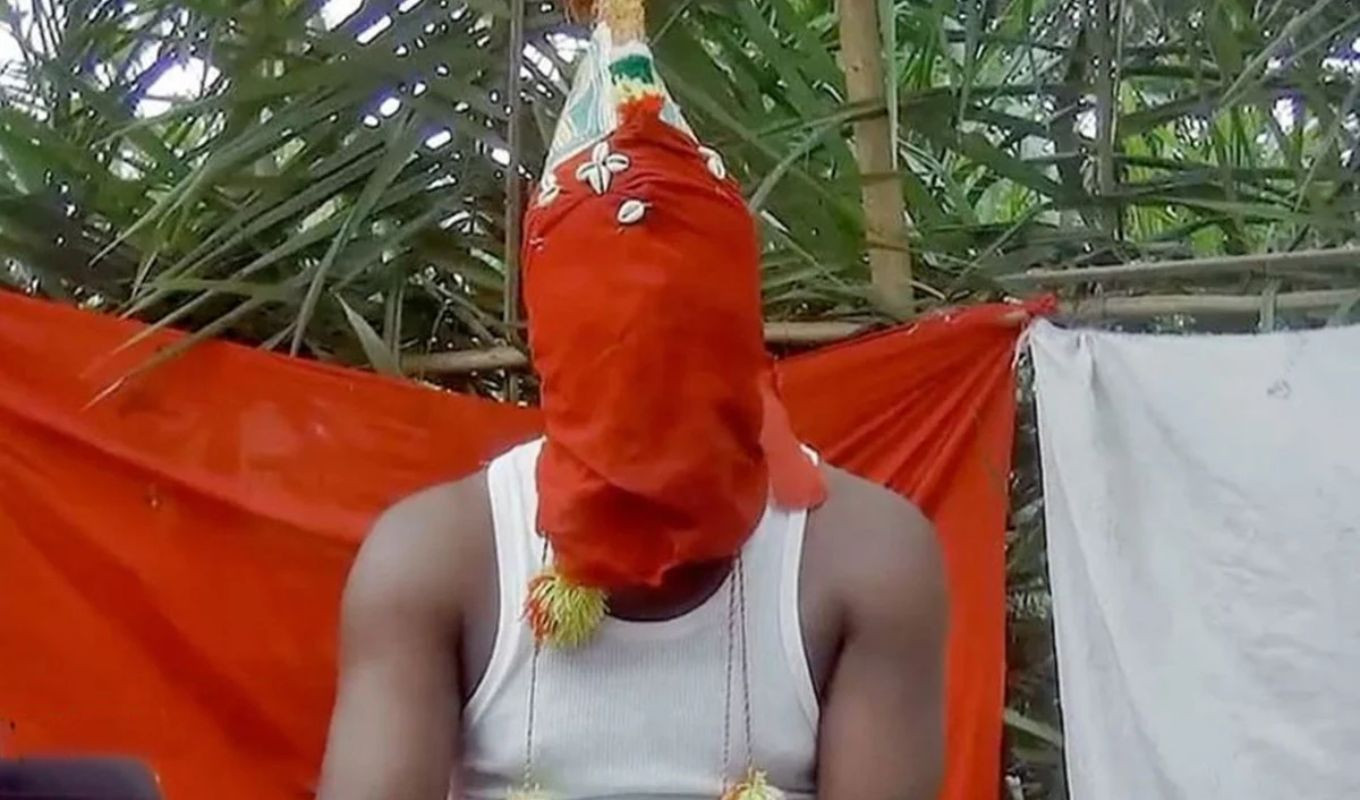
Calling himself Kanu, he wore a ceremonial red mask covering his whole face to conceal his identity and boasted of his political connections.

“I was working with some big, big politicians in Guinea, Senegal and Nigeria. We have our team. Sometimes during election time, at night, this place is full of people,” he claimed.

Election season is regarded by some as a particularly dangerous time when parents have been warned to take special care of their children because of the heightened risk of abductions.

On a second visit, Kanu became more confident and showed Osman what he said was evidence of his trade – a human skull.

“You see this? This belongs to someone. I dried it for them. It is a woman’s skull. I am expecting the person to pick this up today or tomorrow.”

He also pointed to a pit behind his shrine: “This is where we hang human parts. We slaughter here, and the blood goes down there… Even big chiefs, when they want power, come here. I give them what they want.”

When Osman specified that he wanted limbs from a woman to be used in a ritual, Kanu got down to business: “The price of a woman is 70m leones [£2,500; $3,000].”

Sierra Leone is one of the world’s poorest countries and is recovering from the legacy of a brutal 11-year civil war

Anxious not to put anyone at risk, we did not meet Kanu again. He may have been a scammer, but we handed over our evidence to the local police to investigate further.

Such juju men sometimes refer to themselves as herbalists, the name given to healers who use traditional medicine often made from local plants to treat common illnesses.

World Health Organization data shows that Sierra Leone – which suffered a brutal civil war in the 1990s and was at the centre of the Ebola epidemic a decade ago – had around 1,000 registered doctors in 2022, compared to reported estimates of 45,000 traditional healers.

Most people in the West African nation rely on these healers, who also help with mental health issues and treat their patients in shrines where there is an element of mysticism and spiritualism culturally associated with their craft and the remedies they sell.

Sheku Tarawallie, president of Sierra Leone’s Council of Traditional Healers, is adamant that “diabolic” juju men like Kanu are giving healers a bad name.

“We are trying very hard to clear our image. The ordinary person doesn’t understand, so they class us [all] as bad herbalists. One rotting fish can destroy the batch of fish… We are healers, we are not killers,” he told BBC Africa Eye.

Mr Tarawallie is in fact trying to work with the government and another non-governmental organisation to open a traditional medicine clinic to treat patients.

It was those with a lust for power and money who were often behind the ritual killings, he believed.

“When somebody wants to become a leader… they remove parts from human beings. They use that one as a sacrifice. Burn people, use their ashes for power. Use their oil for power.”

The number of ritual killings in Sierra Leone, where most people identify as Muslim or Christian, is not known.

“In most African countries, ritual murders are not officially recorded as a separate or sub-category of homicide,” Emmanuel Sarpong Owusu, a lecturer at the UK’s Arden University, told the BBC.

“Some are misclassified or misreported as accidents, deaths resulting from attacks by wild animals, suicides, natural deaths… Most perpetrators – possibly 90% – are not apprehended.”

When we found another suspected supplier of body parts, he was located in a suburb of the capital, Freetown, called Waterloo, which is notorious for drug abuse and other crime.

“I’m not alone, I have up to 250 herbalists working under my banner,” the man calling himself Idara told Osman, who was again undercover and wearing a secret camera.

“There are no human parts that we don’t work with. Once we call for a specific body part, then they bring it. We share the work,” Idara said.

He went on to explain how some of his collaborators were good at capturing people – and on Osman’s second visit played a voice message from one of them who claimed they were prepared to start going out every night in search of a victim.

If you’re outside the UK, you can watch the documentary on YouTube

Osman told him not to proceed yet but when he later received a call from Idara claiming his team had identified a victim, we contacted Police Commissioner Ibrahim Sama.

He decided to organise a raid – but said his officers would not do so without the involvement of Mr Tarawallie, who often assists the police on such operations.

“When we got intelligence that there is a particular dangerous witchdoctor operating a shrine, we will work with the traditional healers,” said an officer on the raid, Assistant Superintendent Aliu Jallo.

He went on to express the superstitions some officers have about tackling rogue herbalists: “I will not go and provoke situations. I know that they have their own powers that are beyond my knowledge.”

After Idara was captured – discovered hiding in the roof clutching a knife – Mr Tarawallie began searching the property for evidence, saying there were human bones, human hair and piles of what looked like dirt from cemeteries.

This was enough for the police to arrest Idara and two other men, who were charged in June with practising sorcery as well as being in possession of traditional weapons used in ritual killings. They pleaded not guilty to the charges and have since been granted bail, pending further investigations.
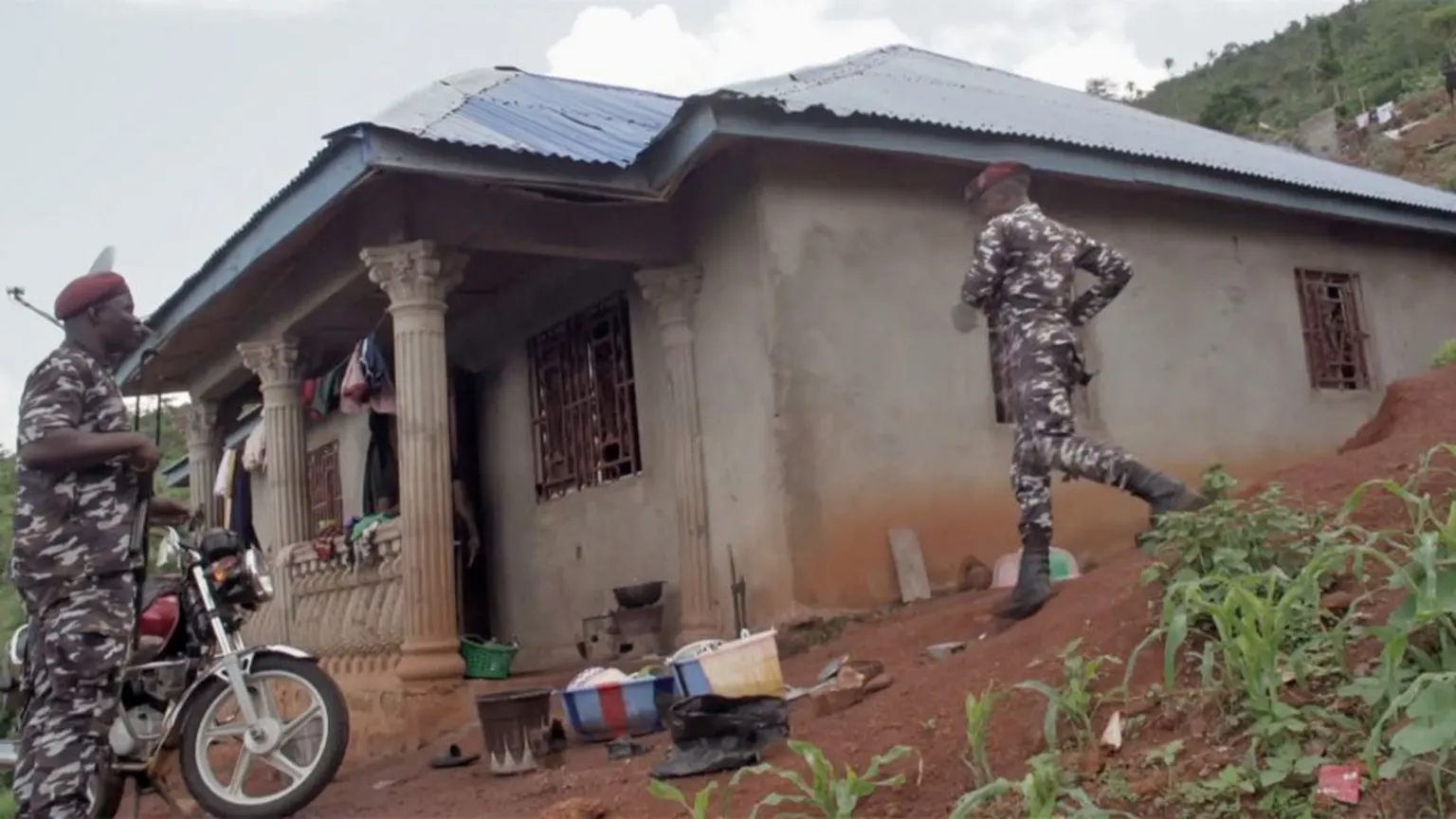
The police raided this house in Waterloo and arrested the occupants, including Idara, who were later charged under anti-witchcraft laws

As we never heard back from the police in Kambia about Kanu, I tried to call him myself to challenge him about the allegations directly, but he was unreachable.

There are occasions when even high-profile cases appear to stall. Two years ago, a university lecturer went missing in Freetown and his body was later found buried in what police say was the shrine of a herbalist in Waterloo.

The case was referred in August 2023 by a magistrate to the High Court for trial, but two sources have told the BBC it has not been pursued so far and those detained by police have been released on bail.

My family is facing similar hurdles finding justice. In May, during our BBC investigation, my 28-year-old cousin Fatmata Conteh was murdered in Makeni.

A hairdresser and mother of two, her body was dumped the day after her birthday by the side of the road where a resident told the BBC two other bodies had been found in recent weeks.

Several of her front teeth were missing, leading the community to believe it was a ritual killing.

“She was a lady that never did harm. She was very peaceful and hard-working,” said one mourner as family, friends and colleagues gathered for a big funeral at her local mosque.

We may never know the true motive for Fatmata’s murder. The family paid for her body to be transported to Freetown for an autopsy – something the authorities could not afford to do – but the post-mortem was inconclusive and no arrests have yet been made.

As is the case for Papayo’s mother, the lack of closure and feeling of abandonment by the police fuels fear and terror in poor communities like Makeni.

Additional reporting by Chris Alcock and Luis Barrucho

Source: Hunting down those who kill people to sell their body parts for ‘magic charms’

Also:

‘Murder for black magic’: when body parts are sold for ‘magical amulets’

A series of murders suspected of being caused by black magic rituals has shaken Sierra Leone

“Murder for black magic”: The horrific stories in Africa where body parts are sold for ‘magical amulets’

Published: November 26, 2025
By: Vox News 

Four years ago, 11-year-old Papayo was killed in a crime believed to have been part of a black magic ritual. His mother, Sallay Kalokoh, is devastated that no one has yet been brought to justice. Papayo was found butchered at the bottom of a well, with body parts removed, including vital organs, eyes and one arm. He had gone to sell fish at the market and never returned.

“We always advise children to be careful. If you sell something, don’t go to some remote corner and don’t accept gifts from strangers. This happens a lot in this country,” Kalokoh said.

Papayo’s murder in the central city of Makeni is just one of many suspected cases of black magic (juju) that are often not investigated or pursued by authorities. In his case, police never confirmed that it was a “ritual killing.”

The dark market for body parts

Juju practitioners promise prosperity and power to clients who pay large sums, believing that human body parts make their spells more powerful. However, with authorities having limited resources – just one pathologist for a population of 8.9 million – it is difficult to gather evidence to prosecute the perpetrators.

Belief in witchcraft is so ingrained in Sierra Leone, even among some police officers, that there is often a fear of pursuing cases, and most remain unsolved.

According to a BBC Africa Eye investigation, the team managed to contact two people who claimed to be juju practitioners and offered body parts for rituals. They said they were part of larger networks and one claimed to have powerful clients in West Africa, but the BBC was unable to verify these claims.

A team reporter went by the name Osman, posing as a politician seeking power through human sacrifice. In a remote area of ??Kambia district, he met a practitioner who wore a red ceremonial mask and threatened to work with top politicians in Guinea, Senegal, and Nigeria. He showed a human skull and a pit where body parts were placed.

When Osman asked for body parts from a woman for the ritual, the practitioner estimated the price at 70 million leones (around £2,500 / $3,000). For the safety of the team, the BBC did not meet the practitioner again, but handed over the evidence to the local police.

The role of traditional healers

Some practitioners are also called traditional healers and use plants to treat common ailments. Sierra Leone has about 1,000 registered doctors and about 45,000 traditional healers, who often also help with mental health issues.

Sheku Tarawallie, president of the Traditional Healers Council, points out that “evil” practitioners give all healers a bad name: “We are healers, not killers. One rotten fish can spoil all the wheat… We are trying to clean up our image.”

He believes that behind the ritual killings are those who covet power and money “when someone wants to become a leader… they remove parts from people. They use them as sacrifices, they burn people, they use the ashes and oil for power.”

Police operations and arrests

A suspected supplier was found in Waterloo, a Freetown neighborhood known for crime and drug use. He claimed to have 250 healers working under him and could provide any body part required.

The police, in collaboration with Tarawallie, organized a raid. Idara was caught hiding on the roof with a knife. Bones, human hair, and cemetery soil were found on the property. He and two others were charged with practicing witchcraft and possessing ritual weapons. They pleaded not guilty and were released on bail.

Other cases and lack of justice

Two years ago, a university lecturer disappeared in Freetown and was later found in a ritual square. Families like Papayo’s and those of her 28-year-old cousin Fatmata Conteh, who was killed in Makeni, face the same obstacles to justice. The autopsy was inconsistent and there were no arrests.

The market for body parts for witchcraft rituals in Sierra Leone remains secretive, dangerous and largely unsolved. A lack of resources, deep-rooted belief in witchcraft and challenges to proper investigation leave communities impoverished and terrified, as families seek justice for their loved ones.

Source: “Murder for black magic”: The horrific stories in Africa where body parts are sold for ‘magical amulets’

And:

Human Sacrifice in Sierra Leone Driven by Black Magic Practices
Published: November 26, 2025
By: Khaborwala International Desk

The superstition surrounding black magic remains deeply rooted in Sierra Leone, where numerous families have suffered killings linked to the illegal trade in human body parts. Shocking details have emerged in an investigation by BBC Africa Eye.

Four years ago, 11-year-old Papayo was murdered in the name of black magic. His mother, Sallai Kaloka, is still waiting for justice. She told the BBC, “I am in great pain. They killed my child, and now there is only silence.”

Sallai said Papayo never returned home after she left for the market to sell fish. When his body was found, vital organs, his eyes, and one hand had been removed. After being missing for two weeks, his mutilated body was discovered in an abandoned well.

She said, “We always warn our children—don’t go to deserted places, be cautious before accepting anything from strangers. Incidents like this happen frequently here.”

According to Sallai, such killings are common in their town, Makeni. Police often do not even classify them as ritual killings. Juju practitioners use human body parts for charms or rituals and lure clients by promising wealth or power. With only one pathologist for a population of 8.9 million, proper investigations are nearly impossible.

Belief in black magic is so strong in Sierra Leone that even police officers are often afraid to investigate these cases, leaving most crimes unresolved. BBC Africa Eye found two individuals who claimed to be juju practitioners and offered to supply human body parts.

One of them said they had clients across several West African countries. A BBC Africa Eye member, disguised as a politician named Osman, travelled to Kambia district near the Guinea border to meet a juju practitioner named Kanu, whose face was covered with a red cloth throughout the meeting.

Kanu said, “I have worked with major politicians in Guinea, Senegal, and Nigeria. People flock here during election periods.” He then showed a dried human skull, claiming, “This belonged to a woman. Someone will take it within a few days.” According to him, female body parts cost 70 million leones, or around 3,000 dollars.

For safety reasons, the BBC made no further contact with him. The collected information has been handed to the police.

Many juju practitioners in Sierra Leone identify themselves as herbalists. Yet, as of 2022, the country had only about 1,000 registered doctors, compared to nearly 45,000 traditional healers. Many people seek help from these healers for mental health and other issues.

Sheku Tarawali, president of the Sierra Leone Council of Traditional Healers, said black magic practitioners like Kanu are tarnishing the reputation of herbalists. He accused some individuals of committing these murders for power and money.

BBC Africa Eye also identified another suspected supplier of body parts in Waterloo. The man, using the alias “Idara”, claimed to have 250 witchdoctors and spirit practitioners working under him and said they could provide any body part if required.

During one meeting, he played a voice note from an associate saying they were ready to hunt for a “victim” that night. After receiving this information, Police Commissioner Ibrahim Sama launched a raid with Sheku Tarawali and a specialist team. Human bones, hair, and various body parts were recovered.

Earlier, the body of a university lecturer had been found in a temple in Waterloo. The case went to the High Court but never progressed, and the suspects were released on bail.

During the BBC investigation, 28-year-old Fatmata Conteh was murdered in Makeni. Her body was found by the roadside the day after her birthday, with several front teeth missing—leading locals to believe it was a ritual killing. Her family sent the body to Freetown for an autopsy at their own expense, but no findings emerged.

Like Papayo’s mother, many families continue to suffer without justice. Police inaction and a culture of fear have intensified widespread panic across the region.

Khaborwala/TSN

Source: Human Sacrifice in Sierra Leone Driven by Black Magic Practices

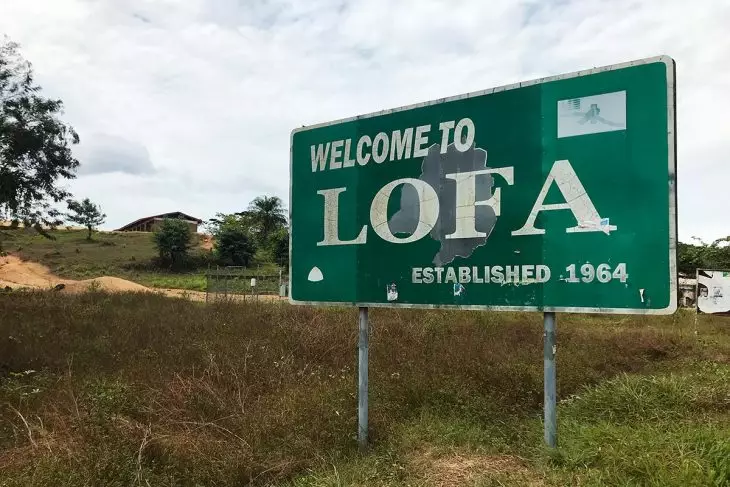
Chopped up with an axe and a heart eaten out – an atrocious crime committed in Lofa County, Liberia, in 1993

Warning: the following article contains a graphic description of an inhumane act

I’ve written on an earlier occasion on the atrocities, ritualistic murders, cannibalism and other war crimes committed during Liberia’s civil war – for shortness sake let me refer to my October 20, 2022 posting, entitled ‘Atrocities, witchcraft, superstition and ritualistic cannibalism during Liberia’s First Civil War (1989-1997)‘.

There’s not much to add without risking repeating myself. Let me just briefly mention what I consider the triple motive of the perpetrator(s): first, to intimidate the bystander, the perceived enemy; secondly, to make clear that he, the actor, is the strongest, the conquerer, and thirdly, without doubt, there is a religious or superstitious drive, a belief in the supernatural powers of eating the heart of the enemy. Notably the latter motive makes it a ritualistic act, and murder, a despicable crime.

The 2009 report of Liberia’s Truth and Reconciliation Commission (TRC) includes many examples of ritualistic acts committed during the back-to-back civil wars (1989-2003). For reasons only known to herself, President Sirleaf (2006-2018) never implemented the TRC recommendations including the prosecution of the rebel leaders responsible for war crimes and human rights violations, possibly because she was also recommended for a sanction because of her (admitted) support of the NPLF, the rebel organization which started the civil war in 1989. Also President Weah (2018 – present) decided not to start procedures establishing a war crimes court, backtracking on previous statements when still in opposition.

The result is impunity for the perpetrators. Injustice. An insult to the survivors and victims.

Liberians will go to the polls on October 10 to elect a president, vice president and 88 lawmakers. The incumbent president, George Weah, has shown his position when it comes to justice for the victims and survivors. His main challengers are a former Vice President under President Sirleaf, Joseph Boakai, from Lofa County, whose running mate is a political protégé of warlord-turned-senator Prince Johnson – yes, the rebel commander who in 1990 gave his men orders to torture and kill then President Samuel Doe – and Alexander Cummings, who has promised to establish a war crimes tribunal when elected into the highest office.

We’ll closely watch events in Liberia during the coming month(s).
(FVDK)

Chopped up with an axe and a heart eaten out: some crimes never die

Published: September 13, 2023
By: Alain Werner – Civitas Maxima

Exactly 30 years ago, in the summer of 1993, a group of rebel soldiers sowed unheard-of terror in the town of Foya, in the small West African country of Liberia, then ravaged by civil war.

Here, 450 kilometers north of the capital Monrovia, a pious man respected by his community had the courage to denounce the rebel group that occupied the premises, ULIMO (United Liberation Movement of Democracy for Liberia). He did so to a humanitarian group, and told them that ULIMO was responsible for the looting of a hospital financed by humanitarian aid.

Once the foreigners had left, the pious man was taken to what was then used as an airstrip and his thorax was cut out by the rebels, his heart extracted and eaten in front of the population. “Try ULIMO, your heart” – which could be translated as “Defy ULIMO, we’ll take your heart” – was one of the slogans used to terrorize the population, a slogan that some civilians who survived that inferno still remember.

The most bloodthirsty of the ULIMO commanders, who opened the pious man’s chest with an axe and spread his killing spree to Foya, was known by the war nickname of “Ugly Boy”, despite his handsome features. The local population, who spoke a different dialect than the ULIMO soldiers, had nicknamed this commander differently among themselves, so as to be able to alert each other to his arrival without being understood by the rebels. They called him “Saah Chuey”, or “the man with the axe” in the Kissi language, as this commander was famous for chopping up civilians with his axe.

“Ugly Boy” was never tried for his ignominious deeds. Indeed, legend has it that he died by popular vindication, having been recognized in Guinea by refugees who had fled Liberia. However, if he were still alive today, “Ugly Boy” would still not have been tried in Liberia.

Indeed, in August we will be celebrating 20 years since the end of the wars in this country, and yet no one has been tried by a court in the country; the government and the United Nations having done nothing for the forgotten victims of Liberia. Despite the fact that a national Truth and Reconciliation Commission recommended in 2009 that the main players in the war should be brought to justice, and that at least 250,000 people lost their lives during these bloody conflicts between 1989 and 2003.

However, on Thursday June 1, 2023, the Federal Criminal Court of Appeal in Switzerland convicted a man, Alieu Kosiah, of participating in the axe murder of the Pious Man. Jurisdiction was given in our country because Mr. Kosiah had been resident in Lausanne since the late 1990s. The conviction came exactly 30 years after the events, and was handed down in Bellinzona, seat of the Federal Criminal Court, some 7,000 kilometers from the scene of the crimes, Foya.

Alieu Kosiah had already been convicted in June 2021 by the Criminal Court for multiple acts of war crimes, including having eaten a piece of the pious man’s heart in the company of “Ugly Boy”. At the time, however, he was found not guilty of the axe-murder, the first judges considering that he had not played an active role in this crime.

The appeal judges decided otherwise and sentenced Alieu Kosiah for complicity in the murder of the pious man, an act qualified as a war crime and a crime against humanity. During the reading of the verdict, the President of the Court, Olivier Thormann, explained that, according to the Court, Alieu Kosiah had handed the pious man over to “Ugly Boy” to be taken to the Foya airstrip, knowing full well what would happen next.

This appeal judgment marks Swiss legal history, as it is the very first conviction in our country for crimes against humanity. It now opens the way for prosecutions in Switzerland for such crimes, even if committed before 2011 and the entry into force of the new provisions of the penal code.

As a lawyer and Director of Civitas Maxima, since 2014 I have represented several Liberian victims in this case alongside Me Romain Wavre, including a friend of the pious man who was present at the scene and witnessed his ordeal, having himself been a victim of ULIMO crimes.

Our clients and other victims have shown exceptional resilience, dignity and courage. Most of them came to Switzerland three times to testify throughout the proceedings, and overcame the obstacles posed by the Ebola epidemic in 2014-2015 and the Covid-19 pandemic in 2020-2021 to finally obtain justice.

War crimes and crimes against humanity are unique in that they “never die”. Indeed, because they concern the international community as a whole, these offences are not extinguished by a statute of limitations after a certain number of years, as is the case for most ordinary crimes. Prosecutions for war crimes and crimes against humanity are thus theoretically possible as long as the person accused of committing them is alive and evidence exists, theoretically even if the victims are all dead. Just as the forgotten victims of Liberia obtained justice in Switzerland in 2023 for crimes committed so far away in 1993, victims of international crimes committed during current or recent armed conflicts must never lose hope. Even if we must do everything to ensure that they obtain justice before 2053 for the crimes they have suffered.


The article first appeared in French on Heidi News on the 16th of July, 2023.

Source: Chopped up with an axe and a heart eaten out: some crimes never die

Liberia: Citizens protest against ritual murders – release on bail of arrested ANC supporter who posted Facebook message on ritual killings

The unrest in Liberia continues and even gets to a higher, organized, level. On Tuesday, October 5, a civil society organization, Citizens United Against Ritual Killing (CURK), staged a peaceful protest against the alleged wave of ritual murders across the country. The Liberian National Police continues to downplay the allegations though it admitted that at least one ritual murder had taken place.

A worrying trend is the arrest of a Facebook user, Jethro Harris, who was accused of ‘inciting disorder and chaos’ because of a post about an alleged ritual murder. Harris’ arrest comes in the aftermath of accusations by government officials that members of opposition parties are responsible for spreading ‘fake news’.

Ritual murders, which are a violation of the right to live and to live without fear, have thus become another threat: an attack on the freedom of speech, the freedom of expression. Hence the arrest of Jethro Harris, a supporter of the Alternative National Congress – one of a coalition of four political parties opposing the ruling CDC, Congress for Democratic Change – has added another dimension to the politicization of the phenomenon of ritual murders in Liberia:  a battlefield between ruling and opposition political parties (webmaster FVDK).

Citizens protest against mysterious death

Published: October 6, 2021
By: Lincoln G. Peters – The New Dawn, Liberia

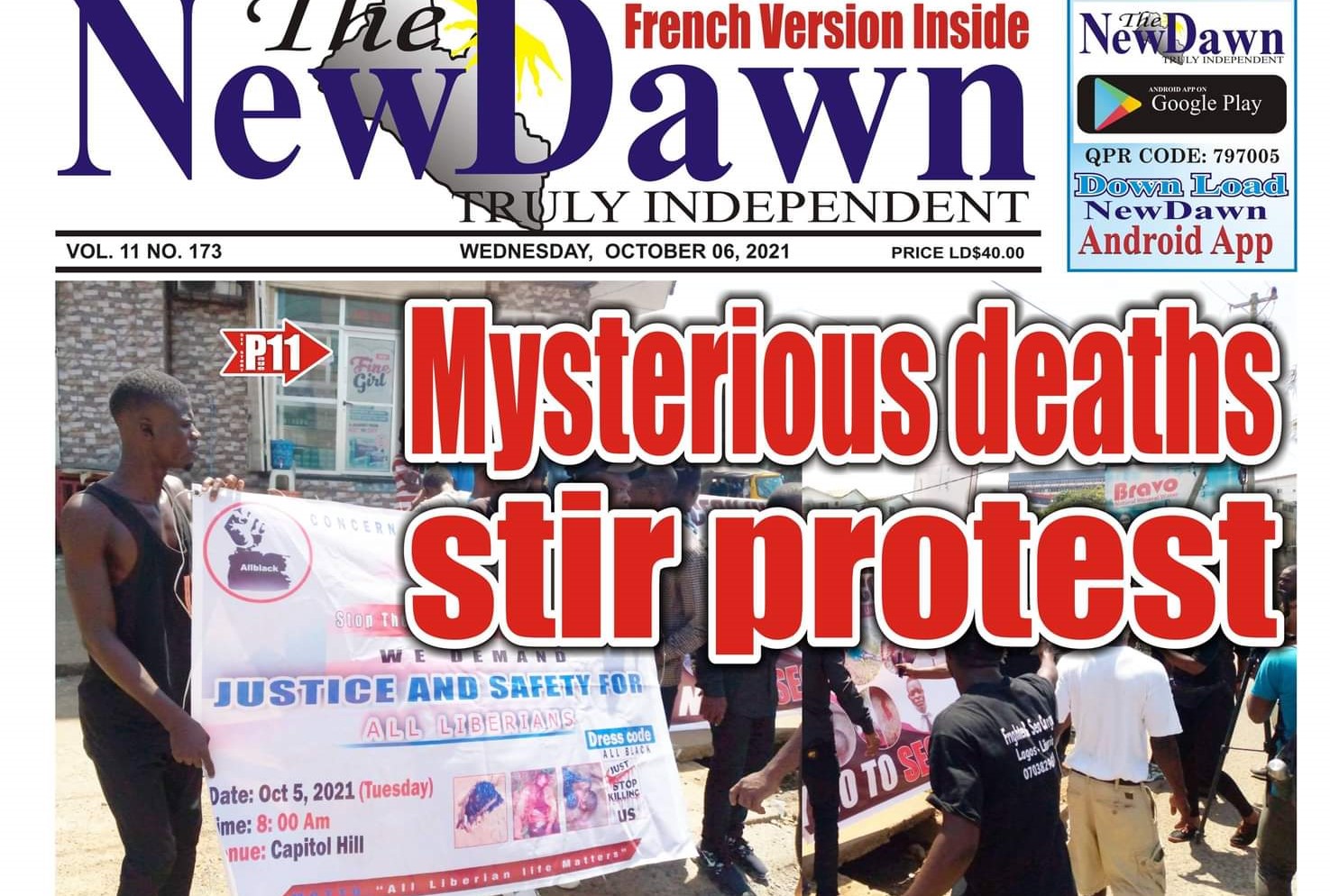
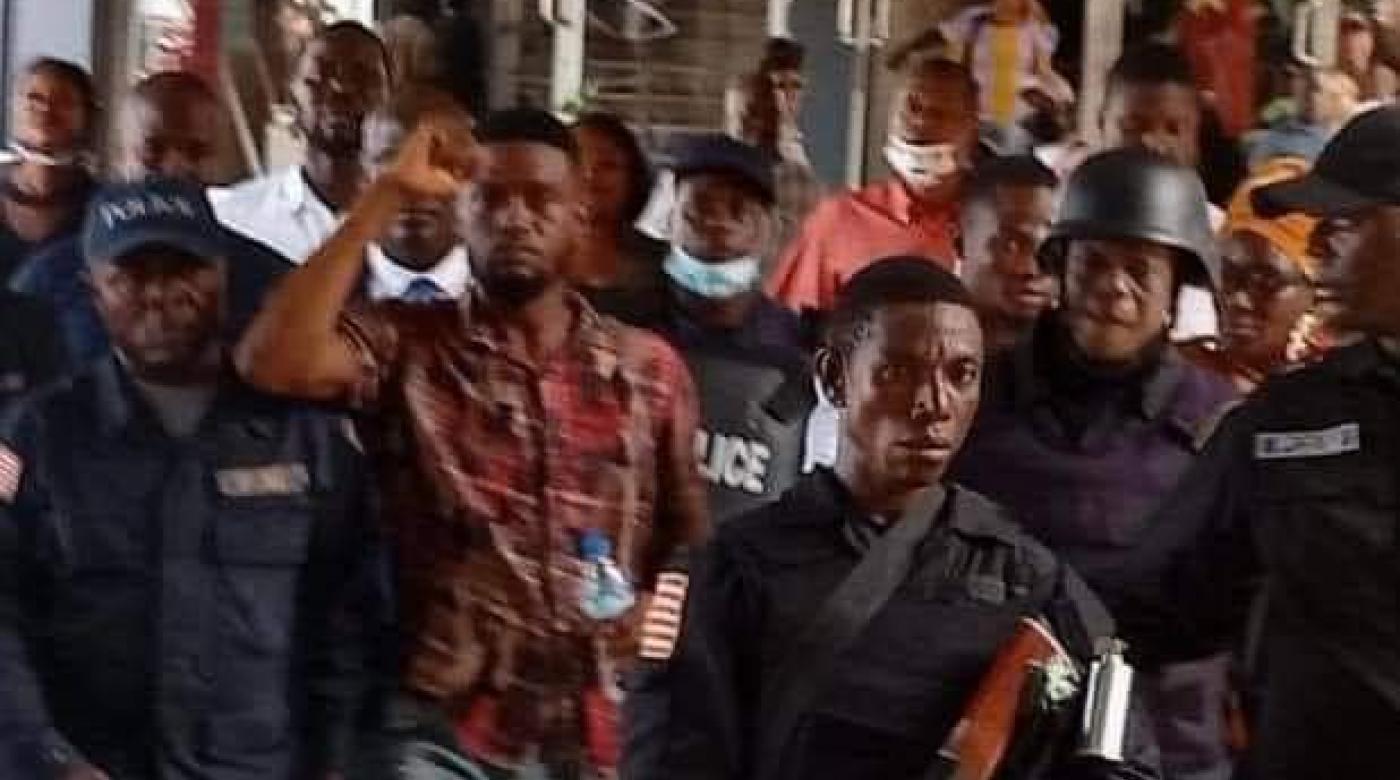
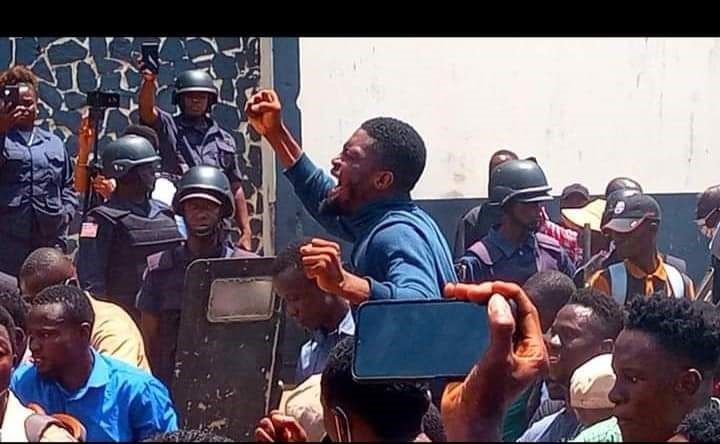
Several residents of Monrovia under the banner Citizens United Against Ritualistic Killing (CURK) staged a peaceful protest Tuesday 5 October 2021 against the alarming wave of alleged ritualistic killings across the country.

According to the group, the current increase in the wave of ritualistic killings across the country is alarming, adding that there is no safety and protection for citizens in the country.

The Liberian National Police says reports of increase ritualistic killings here are fake news being propagated by the opposition.

But speaking in an interview with journalists at the protest scene in Bassa Community in Monrovia, the group’s spokesperson and chairman of the Collaborating Political Parties (CPP) Solidarity Brigade Byron Brown said their peaceful protest was meant to call the attention of the world to the alarming wave of alleged ritualistic killings across the country.

“The Government of President [George Manneh] Weah continues to show little or no interest in finding [a] solution to the problem and fear that is in citizens,” Byron Brown alleged.

Contrary to Brown’s allegation, the Liberian Government is blaming members of the opposition parties here for spreading fake news surrounding reports of ritualistic killings in the country.

Reports of killing for the past weeks have taken the country by storm, followed by social media posts that petrified the public with gruesome photos and testimonies of killings taking place in the country.

But in their reaction, the Liberian authorities say two ladies and a man launched podcasts on Facebook in which they explained they were seized from different locations, taken to woods, and escaped death at the hands of their captors.

But Byron insisted that since the ascendancy of the Coalition for Democratic Change (CDC) to the leadership of the country, there have been uncontrollable waves of alleged mysterious disappearances, kidnapping, and ritualistic deaths in the country.

“These things have [a] negative impact on the country and economy. This action today is void of politics and we are doing this to save our country and open it up to international investment and economic progress,” Brown claimed.

He denounced as disingenuous to the country and its people, Liberia National Police (LNP Inspector General Col. Patrick T. Suede’s claim that there is only one ritualistic death in the country, alleging instead that are ten reported ritualistic deaths across the country.

“We are going to our Legislature, the United States Embassy near Monrovia and we will petition them to call their attention to what is happening in the country that [the] government continues to give deaf ears to,” Brown continued.

“We are living in total fear in our country. Our peace and security are not sure. We are standing up for what we believe will liberate our country and secure international investors’ confidence to help our economy grow,” he added.

Byron noted that peaceful protest is expected to last for a week until the Government of Liberia can respond to their plight and assure their security and protection in the country.

Source: Citizens protest against mysterious death

And:

Hundreds of Liberians protest alleged ritual murders

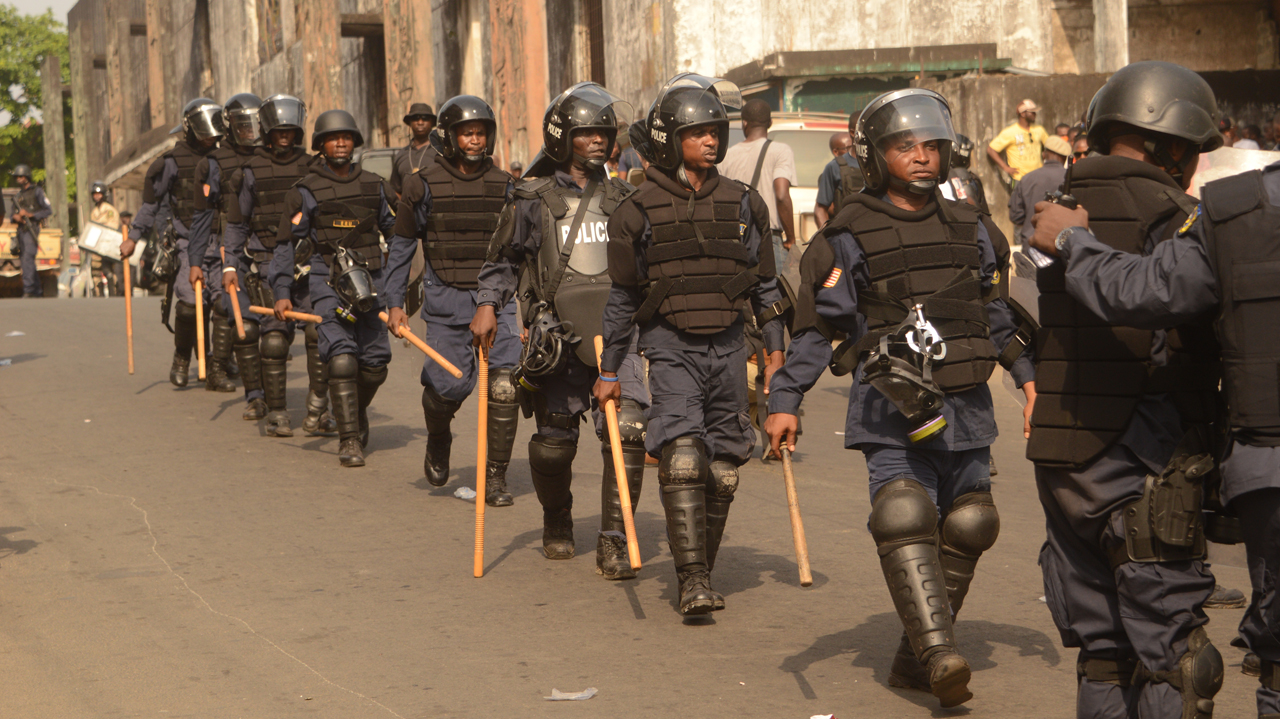
Archive photo / [FILES] Liberian policemen .(Photo by Zoom DOSSO / AFP)

Published: October 5, 2021
By: AFP – The Guardian, Nigeria

Hundreds of women protested in Liberia’s capital Monrovia on Tuesday against a wave of alleged ritual killings in the country, an AFP journalist saw.

Rumours of ritual murders have been spreading on social media for weeks in the West African nation, with reports of corpses found with body parts removed — ostensibly for occult purposes.

Liberian police have denied the bulk of the reports, however, and arrested a member of the political opposition accused of fanning the rumours. (See below – the webmaster FVDK)

On Tuesday, hundreds of women gathered in front of Monrovia’s capitol building, which houses the country’s legislature, to protest the alleged slayings. 

The group also delivered a statement to legislators, seen by AFP, demanding that the government and police examine “the exponential rate of ritualistic killing”.

Ritual murders are not unheard of in Liberia and were common during the country’s back-to-back civil wars from 1989 to 2003. 

Body parts severed from the victim’s corpse are thought to be used in rituals designed to benefit the murderer. 

However late last month, Police Inspector General Patrick Sudue announced that most of the recent alleged incidents are baseless, according to local media.

“These are paid agents,” he was reported as saying, referring to the people circulating the rumours.

Sudue nonetheless clarified that one ritual murder did occur recently in southeastern Liberia.

Last week, Liberian police arrested a member of the opposition party Alternative National Congress for posting misinformation about ritual killings online.

Liberia is a poor country still recovering after its brutal civil wars and the West African 2014-16 Ebola pandemic, which killed 4,800 people in the country.

Source: Hundreds of Liberians protest alleged ritual murders

And:

ANC Partisan jailed for ‘False Alarm’ — but the party says police tramples on his right to speech

“This is a misdemeanor and the police sent a whole container of people to Nimba County to arrest this young Defendant Jethro S. K. Harris for exercising his right to free speech,” Mr. Cummings said.  

Published: October 5, 2021
By:  Tina S. Mehnpaine – Daily Observer, Liberia

The Monrovia City Court on Monday, October 4,2021 jailed Jethro S. K. Harris, a stalwart of the Alternative Nation Congress (ANC) for allegedly spreading ‘False Public Alarm’ through his Facebook post.

On Monday, September 27, 2021, Defendant Jethro Harris posted a photo of the late Ms. Rolisa N. Gbeintor, a Liberian and alumnae of the Lenn Miller High School in Sinkor, Monrovia along with a graphic, claiming that it was the body of the late Gbeintor with parts extracted from her body.  

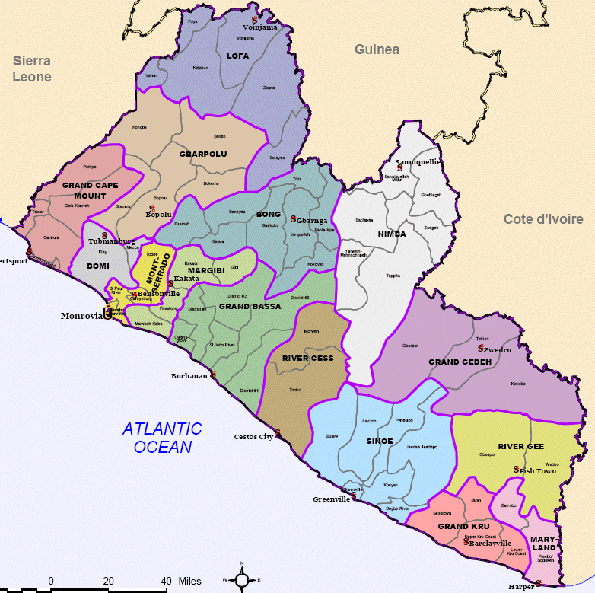
Harris was arrested last week in Nimba County while on a tour with fellow partisans and political leader, Alexander B. Cummings. According to the police charge sheet, defendant Harris was invited for questioning but did not show up. 

“Investigation established that Ms. Gbeintor got sick for a protracted period and subsequently died, that defendant Harris willingly, purposely and intentionally did the post so as to buttress falsehood already being circulated by some persons to be identified that the country is unsafe,” the LNP said. 

“In view of the foregoing, the investigation herewith charges Harris with the commission of the crime ‘False Public Alarms in Violation of chapter 17, section 17.4 of the revised penal law pending trial by the court of competent jurisdiction,” the police said. “In cognizance of article 12 (b) of the 1986 Constitution of Liberia, defendant Jethro was arrested and subsequently informed of his Miranda rights.”

The police added that the post by defendant Harris does not have any Iota of truth and was intended to instigate citizens and persons residing in the country against the National Security apparatus, create economic hardships, and stall the movement of peaceful people. The police also said Harris’s post creates the impression that “investors closing down their business and leaving the country.”

The police believe that Article 15 (a) of the 1986 Constitution provides that every person shall have the right to freedom of expression but also reminds citizens they are fully responsible for abuse thereof. 

Of late, reported cases of ritual killings and survivors’ stories have been on the rise. In Caldwell, for instance, a lifeless body of a lady was discovered with body parts extracted, same as with, to create, the Soul Clinic community.  The victim this time around was a male. 

But for police authorities, pictures and videos about ritualistic incidents are not a representation of what is unfolding in the country. The police added that they were posted to instill fear in the citizens and to tarnish the image of the country and raise false national security alerts. Police then warned those involved in orchestrating a negative image about the country to desist or face the full weight of the law. The arrest of Jethro is reportedly the first by the police days after warning against the spread of fake news about an issue that has to do with a mysterious death.

For the ANC, Harris committed no crime and broke no law or violates the Penal code of Liberia. Rather, his Facebook post is a protected speech under the Liberian Constitution (Article 15) and under Constitutional Law. 

“Sections 12.33 and 17.4 of the Penal Code do not fit into Jethro’s post. He did not falsely post about an IMPENDING bombing or other crime as required by 17.4; neither did he report to any law enforcement official as required by 12.33.  He simply posted on his Facebook page,” argued ANC Secretary General Aloysius Toe.

Toe added Jethro’s post was a recreation of an alleged gruesome act of ritualistic killing, even if false and untrue, that has been making rounds on social media; and may have reasonably believed that what he came across on social media, coupled with massive public outcry about ritualistic killings, and thus recreated on his Facebook page, was intended only to draw public attention.

“He alleged that an act had already been committed, he didn’t say the act was impending (about to happen) as required by Section 17.4 of the Penal Code. The charges against him are   bogus and politically motivated,” the ANC said. “This is a CDC government clamp down on the opposition, using a rather professional police force to carry on partisan policing.”

The ANC Secretary General added Jethro was only targeted and falsely arrested and falsely imprisoned because of his association with the opposition community, and in particular, Alexander B. Cummings. 

“Police IG Patrick Sudue knows and should have reason to know that he’s proceeding wrongly and illegally by ordering the false arrest, and false imprisonment of Harris. There will be legal consequences. But Jethro Harris is spending 3 nights in a filthy police cell on bogus charges without investigation simply because of his root with an opposition political party. “

The ANC’s standard-bearer, Alexander B. Cummings, who has been making efforts to get Harris released, alleged that the entire case has been politicized.  “This is a misdemeanor and the police sent a whole container of people to Nimba County to arrest this young man for exercising his right to free speech,” Mr. Cummings said.

Cummings, accompanied by his lawyer, had gone to the Monrovia City Court to bail out defendant Harris, only to be informed that Harris had been taken to the Monrovia Central Prison at South Beach.

“Today we showed up with his bond to have him bailed. He was taken to South Beach prison.” ANC political leader said. “This is a minor misdemeanor. It’s a bailable offense, but it has been politicized. We politicize the rule of law and we wonder why we are not getting investors.” 

Mr. Cummings vowed to follow the court procedures. “We are a party of rule of law and we will follow the rules. If the judge doesn’t do the right thing, we will go to the Supreme court,” he said.

Recently there have been several mysterious killings in and around Monrovia, including two women and an elderly man. Police Inspector General, Patrick Sudue, said people were posting these pictures to instill fear among citizens and present the country as though it is unsafe. 

“People are portraying the gloomy image of the country as though it is not safe,” he said.  LNP have earlier warned that people caught posting dead pictures on social media to cause fear among the citizenry without investigating will be arrested.

Source: ANC Partisan Jailed for ‘False Alarm’ — but the party says police tramples on his right to speech

and:

Opposition Alternative National Congress’ Youth Official lands in jail for ‘Inciting’ Facebook post

Published: October 6, 2021
By: Joyclyn Weah – Front Page Africa, Liberia

MONROVIA – A stalwart of the Youth League of the opposition Alternative National Congress (ANC), Jethro Saylah Kangar Harris, has been jailed for allegedly circulating false content on social media.

Suspect Jethro Harris was forwarded to the Monrovia City Court on Monday for onward prosecution after being charged by the Liberia National Police (LNP) with the commission of the crime of false public alarms in violation of chapter 17, section 17.4 of the revised Penal Law of Liberia.

On Saturday, the police claimed that suspect Harris posted on his Facebook page, a picture of a young lady he identified as Rolisa N. Gbeintor, a Liberian and alumnae of the Len Miller High School in Sinkor, Monrovia. He placed a corpse that appeared to have gone under post mortem examinations alongside the picture, claiming it was Rolisa’s body and that she has been killed and body parts extracted for ritualistic purposes.

On his Facebook page, he reportedly wrote:

I’m in tears tonight.

It’s so painful how the young people of Liberia are dying mysteriously…

This is the late Rolisa N. Gbeintor, an alumnae of the Len Millar High School…

She was murdered and parts of her body were extracted.

His post immediately caught the attention of the LNP and they launched an investigation to establish its veracity.

Harris was on invited by the LNP for questioning but did not turn out; stating that he was in Ganta, Nimba County. A team of LNP officers headed by assistant commissioner Alphonso A. Paypay, headed to Nimba County on Friday, October 1, and arrested Suspect Harris for “spreading false information to the Liberian public and the world at-large; thus committing the crime false public alarm.”

The police charge sheet claimed that Harris’ post which is established to be unfounded, is also intended to create economic hardship and the likelihood of investors closing down their businesses and leaving the country.

The post, the police maintained, is intended to stall movement of peaceful residents. The document noted that the suspect ‘willingly, purposely and intentionally’ did the Facebook post so as to buttress falsehood already being circulated by some unidentified people that the country is unsafe.

The Police wrote in their charge sheet that the post, which do not have any iota of truth is also intended to put some of citizens and persons residing within Liberia’s borders against the national security apparatus, scare away investors and some people intended to travel to Liberia.

The ANC has condemned the Police action against its partisan, and said it is in gross violation of his constitutional rights.

Article 15 (A) of the Constitution of Liberia provides that every person shall have the right to freedom of expression. However, it adds that they should be held responsible for the abuse of such freedom.

The ANC political leader, Mr. Alexandra Cummings, swam by party executives and supporters, stormed the courtyard but were prevented from securing the release of the suspect, even though the crime he is charged with, is a billable offense.

Speaking to reporters minutes after suspect Harris was taken to the South Beach by heavily guarded armed police officers, Mr. Cummings said that a bond to have their partisan release was made available, but the judge insisted on taking the defendant to jailed.

Cummings termed as unfortunate and unfair, the government’s action against his partisan, noting that government is not being helpful and cooperative by punishing suspect Harris for a social media post.

He further indicated that the judiciary should not be politicized.

“We got to give the judges the freedom to interpret the laws. This is not how we want to run our Judiciary and not how we want to run the country and for the manner of misdemeanor this whole thing is being politicized.” According to him, ANC is an opposition party of law, and as such they will follow the law and ensure that Harris is released.

Source: Opposition Alternative National Congress’ Youth Official Lands in Jail for ‘Inciting’ Facebook Post

And:

Liberia: Alternative National Congress’ Youth released on bail

Published: October 7, 2021
By: Willie N. Tokpah – Front Page Africa, Liberia

Monrovia – The Assistant Secretary General of the opposition Alternative National Congress (ANC), jailed at the Monrovia Central Prison over alleged false public alarm and false statement, was freed on bail on Wednesday amid intense pressure from his party and the campus-based Vanguard Students Unification Party.

Jethro Harris, who had spent four days in prison over a Facebook post in which he alarmed about the ritualistic killing of his ‘friend’, was charged in violation of section 17.4 of the revised Panel Code of Liberia.

His lawyers Atty. Lafayette Gould, Atty. Aloysius Toe and Cllr. Findley Karngar call the charges frivolous. The three lawyers had filed Summary Proceedings against Magistrate Joma Jallah for reportedly refusing to approve their client’s appearance bond after Circuit Judge Roosevelt Willie had heard the petition and ordered Magistrate Jallah to approve the bond in keeping with law. 

However,  more than 24 hours after said mandate, the magistrate later released the defendant to his lawyers Wednesday on bail.

Following his release, Cllr. Toe told journalists that Harris was imprisoned for standing against injustice, adding that said his client is now a free man and will remain free.

However, he noted that the legal battle surrounding Harris’s allegation is expected to take place Friday, noting that no amount it intimidation will make those who are speaking against ills in the country keep silent.

“No no amount of witch-hunt, attempt and decision and no amount of scare tactic will make us to keep silent, neither will the ANC be scare to stand up for a cause,” Cllr. Toe says.

He described the action of Defendant Harris as a “passive resistance”, which he believes is in the right direction.“If any of you will have a sad experience of going to jail because you believe in what is right, and on the account you are arrested, tell other people to stand up for the same thing and let them be arrested, Cllr. Toe says.

Source: Liberia: Alternative National Congress’ Youth Released on Bail

Liberia: Rise in ritual killings prompts president Sirleaf to pledge security crackdown

On numerous occasions Liberian leaders have publicly denounced the ritual murders that take place in the country. We can mention President William Tolbert (1971-1980), Gyude Bryant (Chair of the Transitional Government after the Second Civil War, 2003-2006) and President Ellen Johnson Sirleaf (2006-2018). The fact that the presidents Samuel Doe and Charles Taylor were not so outspoken on this subject, certainly not in public, has special reasons……..  

The article below on Ellen Johnson Sirleaf’s warning and reaction does not constitute the first and only time that she denounced the phenomenon of ritualistic killings in her country. More on it at a later stage.
(Webmaster FVDK) 

Ellen Johnson Sirleaf says increase in ritualistic killings and armed robbery are threatening security

Published: November 20, 2015
By: The Guardian 

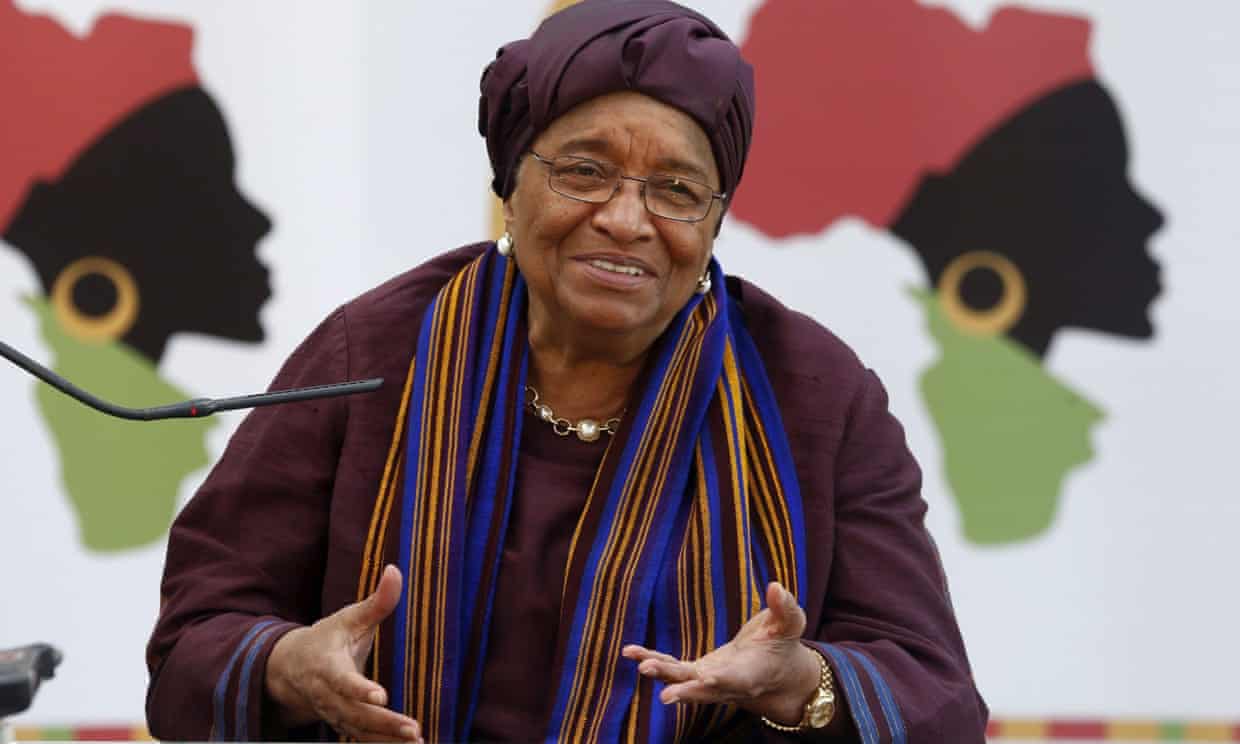
Liberia’s president, Ellen Johnson Sirleaf, vowed on Thursday to crack down on those responsible for a rise in ritual killings in the West African country as it seeks to emerge from the shadow of an Ebola epidemic.

In some areas of central Africa, body parts are prized for their supernatural powers and are used in black magic ceremonies. Local media have reported at least 10 related murders in Liberia in the past few months. (Italics added by the webmaster, FVDK).

Johnson Sirleaf said in a speech: “We are witnessing the rise in what appears to be ritualistic killings and armed robbery in the country, thus threatening our security.” 

“I am instructing the security forces to rigorously enforce the law to the letter and bring this ugly situation under immediate control.”

It is not yet clear why ritual killings are rising and Johnson Sirleaf offered no explanation. Some residents have speculated that presidential hopefuls seeking to replace Johnson Sirleaf when her final term expires in 2017 are using black magic to boost their chances.

Liberia was declared Ebola-free for the second time in September after reporting more than 4,800 deaths but its economy is struggling to recover.

Johnson Sirleaf said in the same speech she would seek to boost power supply and access to electricity and build additional infrastructure in the last two years of her term.

Source: Rise in ritual killings in Liberia prompts president to pledge security crackdown