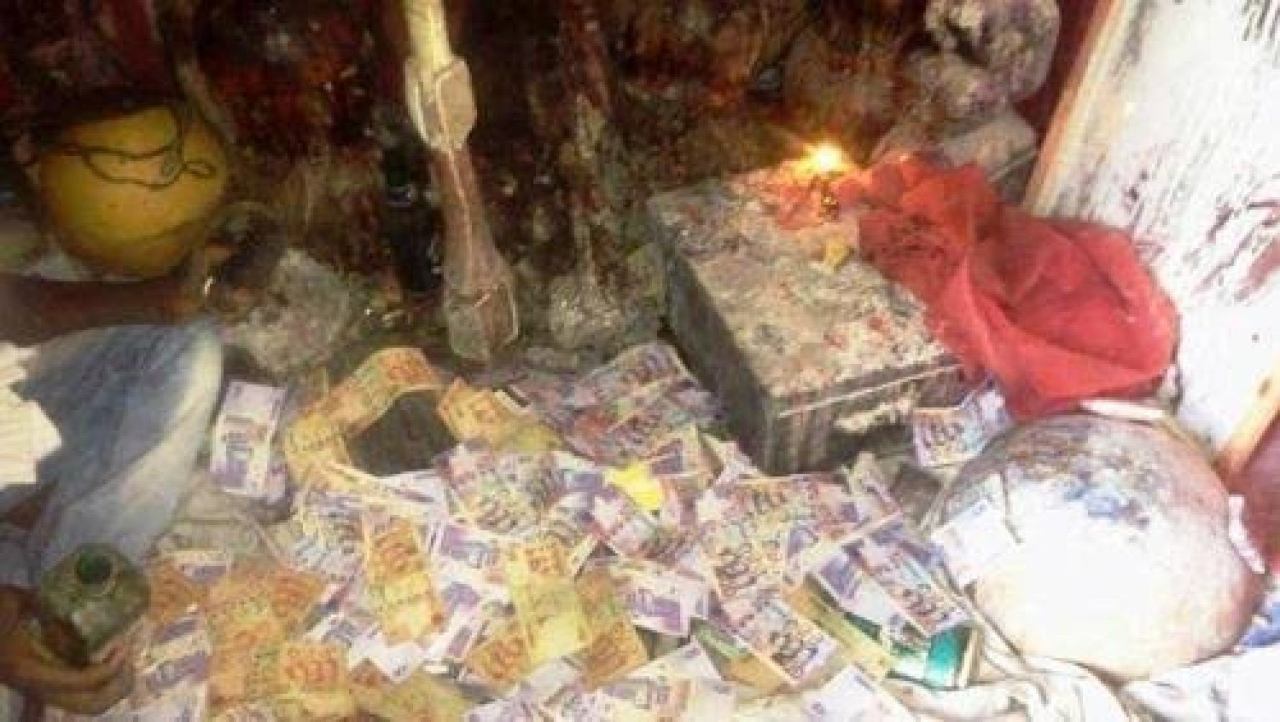
The fear is warranted, but we have to be careful and we should not rush to conclusions without firm evidence or an official announcement. However, the immediate reaction of a ritualistic act is telling and significant (webmaster FVDK).
Missing Giyani girl found dismembered and thrown in Klein Letaba dam
An 11-year-old child, reported missing on Monday, was found dismembered on Tuesday. Her body was thrown into the Klein Letaba dam. Image: 123RF/Paul Fleet
Published: March 18, 2020 By: TimesLive – South Africa
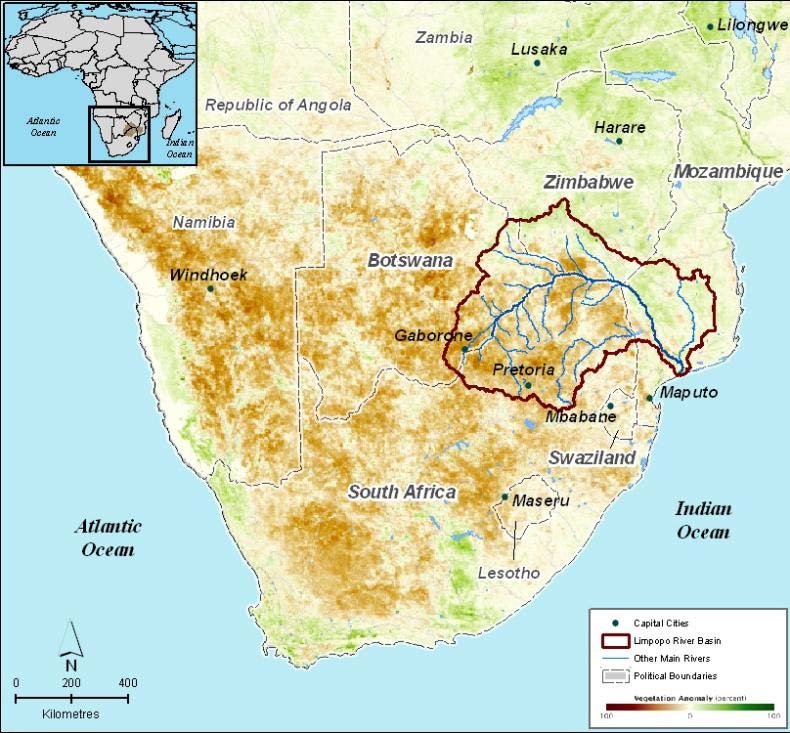
An 11-year-old girl, who was reported missing in Dengeza, outside Giyani, on Monday, was found murdered and dismembered on Tuesday, said Limpopo police.
Brig Motlafela Mojapelo said the child was found dumped at the Klein Letaba dam.
“The discovery was made by community members, who called the police. The police retrieved the body and discovered that some of her body parts were missing,” said Mojapelo.
“The motive for this murder is unknown, but ritual murder cannot be ruled out,” he added.
Provincial police commissioner Lt-Gen Nneke Ledwaba condemned the brutal killing of the child and called on police to hunt down her killers.
‘Ritual murder cannot be ruled out’ after body of missing girl (11) found in Limpopo dam
Her dismembered body was found in the local Klein Letaba Dam
Published: March 18, 2020 By: Review (online) – South Africa
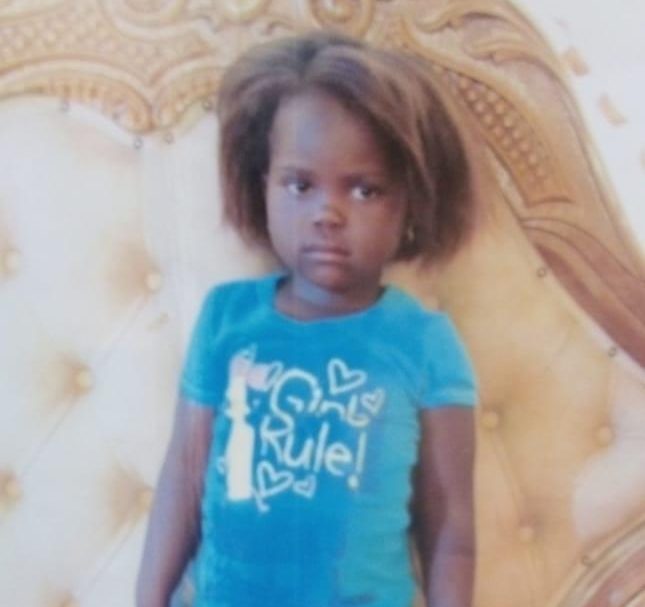
Tiyiselani Nokuthula Rikhotso was reported missing on Monday, 16 March. Photo: SAPS
LIMPOPO – The body of 11-year-old Tiyiselani Nokuthula Rikhotso, who was reported missing on Monday, 16 March has been found. Rikhotso, from Dengeza (A) outside Giyani, was last seen when she left home on Sunday, 15 March.
The police commenced with a search operation after Rikhotso was reported missing, but without success. Her dismembered body was found in the local Klein Letaba Dam on Tuesday, 17 March and the police in Giyani have launched a manhunt for the killer (s) as a result.
Klein Letaba Dam. Photo: SAPS Limpopo
Residents from the local community made the discovery and called the police who retrieved the body from the dam and found some of her body parts were missing. According to Police Spokesperson, Brig Motlafela Mojapelo, the motive for the killing is unknown but ritual murder cannot be ruled out.
The brutal killing of Rikhotso has been strongly condemned by the Provincial Police Commissioner, Lt Gen Nneke Ledwaba who also instructed the police to hunt down the people responsible for her death.
The police appeal to anyone with information that can lead to the arrest of the suspect(s) to contact Col Chris Mabasa at 082 469 0739, their nearest police station or the Crime Stop number at 086 001 0111
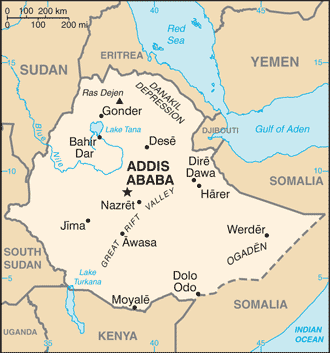
The ritualistic infanticide practiced by the Kara, Banna and Hamar tribes of southern Ethiopia is as old as their cultures. The Kara, Banna and Hamar are not the only ethnic groups in Sub-Saharan Africa (SSA) that kill ‘cursed’ or ‘mingi’ infants. Also in e.g. Ghana, Burkina Faso, Benin and Nigeria tribal elders decide that the well-being of their clan or ethnic group is best served by the killing of young, innocent and often defenseless life – and I am certain that infanticide is practiced in more SSA countries.
As with other ritualistic killings (murders!), superstition ‘is the root of all evil’. Ignorance, superstition, AND the lack of law enforcement keeps this ugly practice alive. Let’s all work hard to eradicate these practices from society. Today is 2020. We’re living in the 3rd millennium!
I highly recommend the article below. CNN is to be commended for its publication! (webmaster FVDK)
Is the tide turning against the killing of ‘cursed’ infants in Ethiopia?
Published: November 5, 2011 By: CNN – Matthew D. LaPlante
His top teeth came in before his bottom teeth. That is how elders of the Kara tribe determined that a healthy baby boy needed to be killed.
The child was “mingi” — cursed, according to their ancient superstitions. With every breath, they believed, the boy was beckoning an evil spirit into their village.
Murderous though it was, the decision to kill the boy was the easy part. It was the sacrifice of one infant for the good of the entire tribe — a rite that some of the elders had witnessed hundreds of times throughout their lives in Ethiopia’s remote Omo River Valley.
The tribe’s leaders were less certain of what they should do about the boy’s twin brother, who had died of sickness shortly after birth. After some debate, including a pensive examination of a goat’s intestines, they decided the dead child must have been mingi, too.
So they dug up the corpse, bound it to the living boy, paddled a canoe into the center of the Omo River and threw them both into the murky brown water.
That was five years ago — a time before many outside of this isolated basin had ever heard of mingi.
Today, nudged out of acquiescence by a slow-growing global condemnation of the ritualistic infanticide practiced by the Kara, Banna and Hamar tribes of southern Ethiopia, regional government officials have begun to take action — threatening prison for those complicit in mingi killings.
Meanwhile, a small band of Banna Christians has taken it upon itself to give sanctuary to the mingi children of their tribe; an enlightenment among some young and educated tribesmen of the Kara has spawned an orphanage for the condemned; and global Samaritans, drawn by the plights of these defenseless children, have offered money and adoptive homes.
The combined efforts have saved scores of children.
But none of the interventions has brought an end to the deep fear that stokes the slaughter. And so it is estimated by some government officials, rescue workers and village elders that hundreds of children are still being killed each year, by drowning, suffocation and deliberate starvation.
‘All the people’ Bona Shapo steers a dugout canoe through crocodile-infested waters, guiding the craft ashore where the Omo River bends at the bottom of a crumbling precipice near the tiny stick-and-thatch village of Korcho.
The sun is setting into the ravine. Across the river, a troop of colobus monkeys whoops and howls, stirring a flock of gangly marabou storks from their perches on a stand of flat-topped acacia trees.
“This is where they do it,” says Bona, who stood upon these same muddy banks on the day the twin boys were thrown into the river. “Sometimes they take the babies out in a boat. Other times, they just take them to the edge of the water and throw them in.”
The mingi rites of the Kara are slightly different from those of the Banna, which are, in turn, different from the Hamar. But common among all is a profound fear of what might happen if the killings were to stop.
There has been little academic scholarship on the subject, but some observers have speculated that it might have started many generations ago as a way to purge people who are more likely to become a burden or who cannot contribute to the propagation of their people. That might explain why children who break a tooth or injure their genitals are among those singled out for death. Others are killed because they are born out of wedlock or to married parents who have not completed a ceremony announcing their intention to have children — a brutal enforcement, perhaps, of the deep-rooted duty that members have to the tribe first, their family second.
As far as the Kara elders are concerned, these rules are as old and unyielding as the Omo River — and every bit as crucial to their survival. Allowing a mingi child to live among the Kara, they believe, could cause the rains to stop falling and the sun to grow hotter.
“If they have the mingi, there will be no water, no food, no cattle,” Bona says. “But when they throw the baby away, everything is good again.”
Elders bitterly recall times in which their sympathy for mingi children prevailed over their fear. They believe that heedlessness cost the tribe most of its cattle and many of its members. Today, Kara leaders say, a more respectful adherence to the brutal obligations of their beliefs has allowed their tribe to thrive.
“So yes, it is sad, but we are thinking about the village, the family, all the people,” Bona says. “We tell the parents, ‘don’t cry for your baby, because you will save everyone. You can always make another baby.’ ”
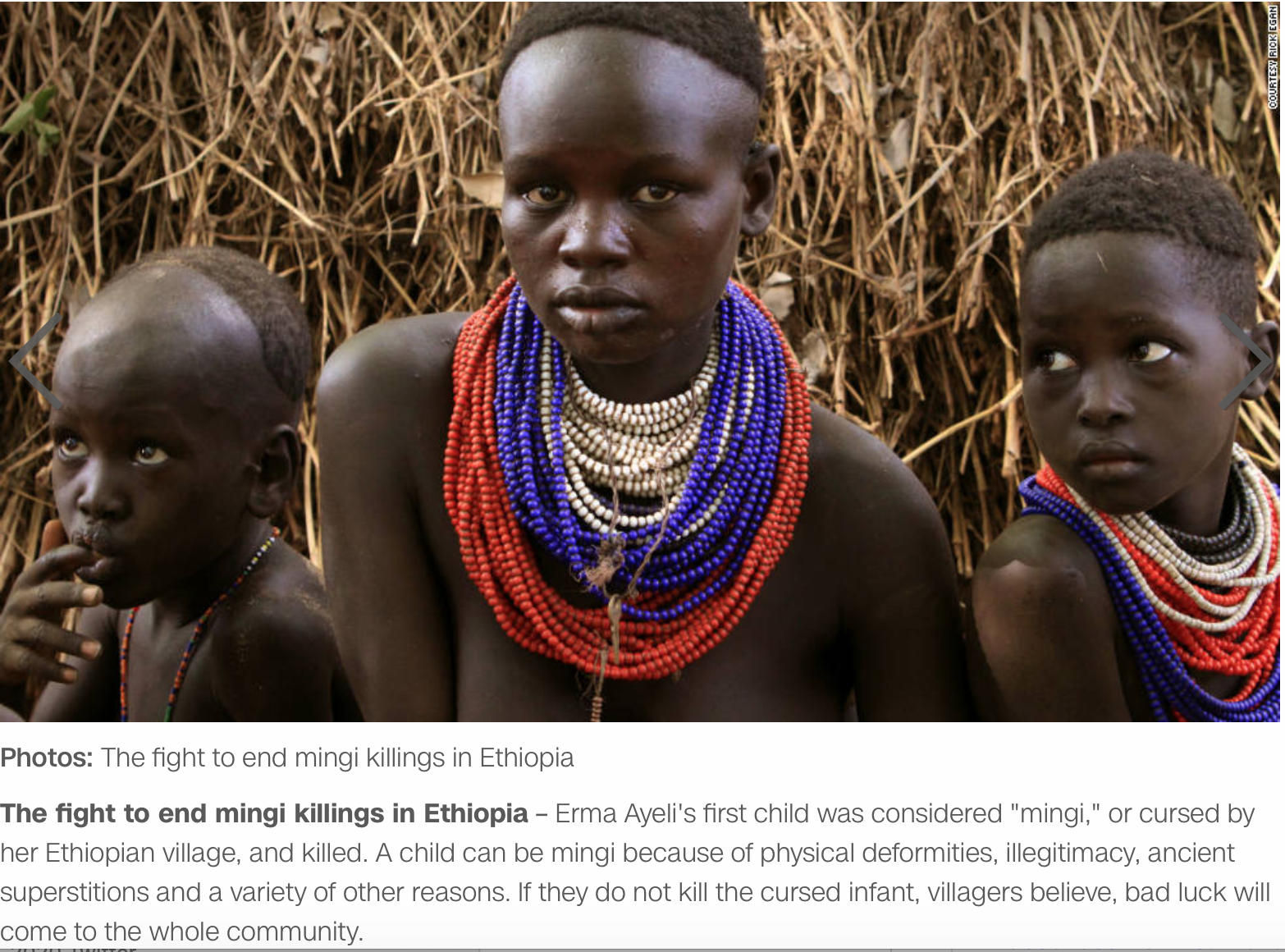
‘No other option’ She wasn’t permitted to nurse him, hold him or even see him. But Erma Ayeli still clings to an image of the baby she lost — fantasy though it may be.
“I think he must have been a beautiful boy,” Erma says as she rests on a pile of sticks, surrounded by a playful mob of younger children. “I wanted to keep him.”
Her chin sinks into the tornado of colorful beads draped around her neck.
Apparently sensing her sorrow, a young boy rests his half-shorn head playfully on her lap. Erma tugs at his ear, smiles and reclaims her composure.
She still mourns. But she does not question why her son was killed. “There was no other option,” she says.
Sex outside of the confines of marriage is acceptable among the Kara.
But if a woman becomes pregnant before participating in a marriage ceremony, her child is considered “kumbaso,” a mingi curse that occurs when parents fail to perform the appropriate series of rites before conceiving. Erma cannot marry, though, until her older sister has first been wed. Her hands fall to her swollen stomach; she is pregnant once again.
“It was an accident,” she laments as she rubs her bare waist. “I don’t want to lose this baby, too.”
There is a potion she can take; the village medicine man can mix a concoction of roots and herbs that will make her sick and might cause her body to reject her pregnancy, taking her baby’s life before others can take it from her.
Many women choose this path. Erma won’t. Because this time, at least, she has some reason to hope that her child might be spared a violent death. Far away from her village, she has heard, there is an orphanage for mingi babies. She has pleaded with village leaders to let her child go there.
Either way, though, she won’t be allowed to see her baby. Once again, she’ll be left to dream about what her child might look like. “This time, I think, I might have a girl,” Erma says. Again, her head hangs low. Again, the boy next to her drops his own head into her lap, glancing up with a wry smile.
This time, though, Erma doesn’t smile back. She gently strokes his smooth brown cheek.
‘This was our culture’ They have taken her tribal clothes. Her beads, her animal skins and her jewelry have been replaced by a tattered shirt and loose-fitting skirt. In that and most other visible regards, Mashi Lamo is indistinguishable from the other inmates at the Jinka Prison Institute.
Yet everyone in this ragtag penitentiary knows who she is. “The mingi mother,” says one guard, a woman whose crisply pressed khaki uniform seems to stand out in defiance of this dirty, dilapidated jail, cut into a hillside in the South Omo region’s administrative capital. “Yes, we all know what happened to her. It is very sad.”
It is not typical for Kara mothers to be asked to kill their own mingi children — and none are known to have done it of their own volition. In any case, fellow Kara say Mashi could not have killed her baby; she was far too weak after the birth to have done such a thing. It was other women who took the child away, they say.
But when police arrived, Mashi took the blame. Within days, she had been sentenced to three years in prison. She had no attorney, and there was no trial.
She may be a prisoner today, but her past and future are inexorably Kara. Mashi can speak and understand only her native language. She’s never been to school. When she is finally released, there will be only one place to go.
And so, under the watchful eyes of several other Kara prisoners, Mashi stands by her story.
“What they say is false,” she says of those in her tribe who have proclaimed her innocence. “I did it all myself.”
But asked if she deserves to be in prison, the teenager sinks her face into her hands. “I hate it here,” she says.
“I wanted to keep my baby, but that was not allowed. This was our culture.”
A few feet away, another young prisoner — girlish in figure and demeanor — hides behind a corrugated metal wall and listens in. Prison guards say she is the only other person serving time here for a mingi killing, and they say she shares Mashi’s plight.
But she cannot bring herself to speak of what happened. “This one prefers to forget” the shipshape guard says.
Unevenly executed as it might be, the government’s effort to crack down on mingi killings has had an effect on the Kara. Combined with other interventions, the fear of prison might be helping to save some children.
But not all of them.
“Before, they did it in the open,” says Solomon Ayko, a gangly young Kara man who has witnessed several mingi killings. “Now, it just happens in secret.”
‘They are human’ The Kara don’t count the passing years as outsiders do, but by Ari Lale’s recollection, it happened about 15 years ago, when he was a young man, eager to prove himself to the rest of his tribe.
A kumbaso baby had been born. Leaders asked Ari to supervise the child’s execution.
“The baby was crying,” Ari says, “so we put sand in its mouth and he was still trying to cry but couldn’t anymore.”
Soon, the child was dead, and Ari escorted a group of women away from the village to throw the tiny boy’s body into the bush.
What became of the child’s remains? “The hyenas or other animals took it away,” Ari says with a shrug.
Today, Ari is the leader of Korcho village, and he counts his participation in the boy’s death as one of his proudest memories.
“All the families would thank me for throwing away that baby,” he says.
“If I had not done it, they would have been angry.” It is extremely uncommon for police officers to make the arduous trip from Jinka to any of the Kara villages, but Ari says he and other leaders are nonetheless wary of the threat of prison. At some point, he says, the government will want to make an example out of someone of his stature.
But Ari, who wears his hair taut under a hard, red clay bun in the way of his tribe’s warriors, has not stopped believing in the dark magic of mingi. And so he and others have found a different way to carry out the killings.
They will not drown or suffocate the children, as they once did.
But they have forbade anyone from the village to have contact with a cursed baby.
“If a mother was to give the baby her breast, she would also become mingi,” he says. “After the baby is born, we keep it alone in the house and we do not give it water or milk.”
Without nourishment, the infants quickly die, and there is little that can be done to prove that a baby wasn’t simply stillborn.
Ari appears to be pleased about this solution. Yet he balances his pride with a lament for the dead.
“They are human,” he says of the mingi children.
For all of the praise he got for carrying out that first killing, Ari says, he would have much preferred to let the child live, if only there had been another way.
For some, now there is.
‘A sickness in our culture’ Kara children die all the time.
Many succumb to disease. Others are killed by wild animals. And some are sacrificed in the name of mingi.
For Shoma Dore, that was simply part of life.
“This is something that came down from generation to generation,” Shoma says. “If a baby comes with the top teeth before the bottom teeth, it must be killed. If it comes without the ceremony, it must be thrown away. … I didn’t realize there was anything wrong with it.”
Not, that is, until Shoma left the tribe to attend school in his early teens. In Jinka, he says, he realized for the first time the evil that was being done by his tribe. And when he returned, two years later, he found that others among the Kara’s more educated youths had come to the same realization.
“There are many important and good parts of our culture — there is also a sickness in our culture, and we have to change ourselves,” says Aryo Dora, who decided a few years ago to go with Shoma and about 30 other young Kara to plead with tribal elders to stop the killings.
Their plan, developed with the assistance of a team of Westerners, was simple: If mingi children could be sent far away from the village, they would pose no risk to the tribe.
“Once we explained the plan, they agreed quite easily,” Shoma recalls.
And that is how the orphanage began.
It wasn’t long before Webshet Ababaw was drawn into the fight. The professional tour guide and driver was in Jinka when he received a call from the orphanage. Leaders there had received word that a kumbaso girl was about to be born in the Kara village of Labuk. They needed someone with a four-wheel-drive vehicle who wasn’t afraid to race across the axle-breaking savannah to get to the village in time to save her.
No one seemed inclined to help find the child when Webshet and an official from the orphanage arrived in the village, but they finally found the infant lying on the ground behind a stick hut. Her mouth was filled with dirt and sand, but she was alive and seemed to be in relatively good health, Webshet says.
Piecing together a newborn first-aid regimen from what he’d seen in the movies and in a high school health class, Webshet unstrung a lace from his shoe and tied it around the baby’s broken umbilical chord. When no one in the village would give him a blanket, he wrapped the shivering child in his jacket. And when no one would give him milk, he found a goat, crouched beside it, and took a small amount for the girl.
None of the Kara had helped him on that day, but as he raced back to Jinka, Webshet looked at the small bundle in the passenger seat beside him and smiled.
There she was, improbably cooing as he bumped along the rugged dirt road.”
At least someone decided to contact us,” he says. “That is the only reason why she was alive.”
Orphanage officials later named the baby Edalwit, which means “she is lucky.
“Today, more than 30 mingi children live together in a small single-story home in a quiet Jinka neighborhood. Aryo, who is co-director of the orphanage, won’t grant permission for outsiders to check on the children — a rule intended to protect the orphans from potential exploitation, he explains. But, he says, they are loved, cared for and schooled with the hope that one day, they will be allowed to return to their families.
“These children are the future leaders of their tribes,” Aryo says. “They are going to grow up big and strong. They are the ones who will end mingi.”
‘We did our best’ It is a bright May morning in Korcho. In the communal spaces between the round, grass-topped huts, dozens of women are on their knees, vigorously thrusting their body weight into stone hand mills, grinding sorghum into flour.
Zelle Tarbe, though, is working inside. It has been just six days since she gave birth to her baby boy. Her breasts are still swollen — full of milk that will not nourish her child. The shock of losing him is still plastered across her face.
Zelle, who is unmarried, knew she would have to give up the child, but it was harder than she expected. “I wanted to keep him with me,” she says.
But she is nonetheless feeling very fortunate, “because my son is alive.”
Zelle was able to spend a few short moments with her baby before orphanage officials spirited him away.
“He was so sweet and beautiful,” she says from the shadows of the hut as a friend butchers a goat and hangs its carcass on the wall beside her. “But I did not give him a name because he was mingi and could not stay with me.”
Already, though, she is dreaming of a day in which she might make the journey to see her boy.
“Someday, I hope, I can visit him in Jinka,” she says.
No one, least of all Zelle, would argue that the rescue mission isn’t preferable to death for mingi children. But the orphanage has nonetheless been a controversial solution. A Christian group that supported the effort for two years withdrew its backing this spring after accusing the orphanage’s director of stealing money donated by American benefactors.
Orphanage officials counter-accused the Americans — who had helped arrange the adoptions of four mingi babies — of stealing the children from their families. The adoptions were, in fact, all legal under Ethiopian law, which treats mingi children as abandoned. But the orphanage leaders have argued that the biological parents surrendered their babies under cultural duress and should have the right to reclaim those children if their situation were to change.
Either way, adoptions and orphanages don’t address the root causes of mingi. And even when it had the support of a determined and resourceful team of Westerners, the rescue and shelter system was able to save only a fraction of the endangered children.
“At one point, there were six women we knew about who were pregnant with mingi children,” recalls Jessie Benkert, one of the Americans who supported the rescue effort. “We only got one.”
Geography is as much an obstacle as tradition. The Kara tribe is separated into three main villages, and the only telephone able to reach the outside world is in the main village of Dus, an hours-long hike from the other communities. Hundreds of other Kara live deep within the bush and, tribe members say, are more likely to carry out mingi killings there without notice.
Getting from Jinka to any of the Kara villages in a four-wheel-drive vehicle is, in the best of situations, a half-day’s trip across soft savannah sands and muddy river beds. A light rain can delay the trip by days. And during the rainy season, which lasts for up to eight months each year, the route can be washed away entirely.
Tribal leaders in Korcho say about 20 mingi children have been born into their small village since the orphanage opened. Orphanage workers have arrived in time to save only about half of them, they say.
Last year, rescue mission leaders learned that a Kara woman had given birth to a mingi boy whom tribal elders had promptly attempted to kill by ripping out his umbilical cord. The wounds had quickly gone septic, and there was no time to send a car to retrieve the child. Evacuation by air was the only solution; chartering the aircraft cost $3,500.
“That was the sum of all the money we had,” said Levi Benkert, Jessie’s husband. “And we couldn’t be certain that, even if we did it, he was going to live.
“They did it anyway — and saved the boy. An online fundraising effort quickly recouped the costs of the evacuation, but rescue mission officials knew they couldn’t sustain those sorts of expenses. And, in any case, they’ve since been pushed out of the Omo River Valley by local government officials who have sided with the orphanage’s Ethiopian director.
“We did our best,” Levi Benkert says. “We saved as many children as we could. And we continue to pray for them every day.”
‘Out of fear’ The people of the Omo River Valley love their children.
That is what Andreas Kosubek has come to believe over six years of organizing medical mission trips into the Kara heartland.
“These people are really good people,” says the German missionary, who recently gained permission from tribal elders to build a home on Kara lands. “They are not doing this because they are evil, wild, dumb monsters. They’re doing it out of fear. They fear for the lives of others in the tribe.”
From Kosubek’s point of view, the fear will end only if the Kara come to believe in something stronger than mingi. In his way of thinking, that means introducing them to Christianity.
“But we cannot do that,” the 29-year-old evangelist says, “unless we approach them with humility and a dedication to service.”
And Kosubek says he has often failed in that regard.
Not long ago, a Kara man brought his sick daughter to Kosubek, who was on tribal lands to work on his home and not accompanied by anyone with medical training.
The toddler was breathing rapidly and not responding to her father’s words or touch.
“She was the same age as my daughter and, you know, if my daughter had been sick like that, there is nothing I wouldn’t have done to save her,” Kosubek says, noting that he would have immediately evacuated his own daughter to a hospital. “But so many things crossed my mind: It’s difficult, it’s expensive.”
The girl later died, probably of simple pneumonia.
“I could have helped her,” Kosubek says. “And I am ashamed.”
Kosubek recognizes the need to end mingi killings, but he doesn’t feel entitled to condemn those deaths.”
Far more children are dying in other ways,” he says. “These are ways that we can address and prevent immediately if we just cared enough. Before we judge, we have to ask ourselves what we have done to help these children.
“In that question, he believes, is a model for truly bringing an end to the slaughter — through genuine selflessness and compassion.He’s seen it, firsthand, among the people of the nearby Banna tribe.
‘My children are also mingi’ In a smoke-filled mud hut in the village of Alduba, Kaiso Dobiar dips a ladle into a tar-black pot of coffee, filling her home with the aroma of the brew as she stirs the simmering liquid.
Kaiso is proud to be Banna, and she follows many of her tribe’s customs and beliefs. But she is also Christian and, wary of false idolatry, she and her husband refused to perform the rites mandated by tribal leaders before they conceived.
“So my children are also mingi, in that way of thinking,” says Kaiso, who is fostering two additional mingi children in her home.
A tiny girl crawls onto Kaiso’s lap, reaching over to help stir the pot. “This is Tarika,” Kaiso says. “She is 2 years old, and she is mingi.”
The girl was born without the appropriate Banna ceremonies, but her birth mother hid the child for six months. “Then the rains stopped for a short time,” Kaiso says. “The people rose up and said, ‘You must get rid of her. Throw her into the bush.’ But I said, ‘do not throw your child into the bush, give her to me.’ ”
Also sharing this small hut with Kaiso’s family is Tegist, another mingi child who guesses her age at 7 or 8 years. Kaiso says her foster daughters cannot play with other Banna children and must remain in her family’s small compound.
“They will have to stay here until they are older,” Kaiso says. “After that? God, he knows.”
Missionaries first came to the Banna decades ago, and the Christian church here is larger than any other among the tribes of this region. Still, their numbers are small; Banna’s Christians make up just 1 or 2 percent of the tribe’s population.
But their collective efforts have been enough to almost eliminate mingi killings within their tribe. With little money or other means of support, Banna’s Christians have accepted responsibility for nearly all of the tribe’s mingi children. Many, like Kaiso, are already caring for one or more mingi boys and girls. One family has taken in 17 foster children.
They do so at great potential risk to their own families. As she steps outside her home, the precariousness of Kaiso’s situation becomes clear.
“Kaiso, why are you protecting those children?” an angry neighbor screams from beyond a stick fence. “Tell us why!”
The Banna have not faced drought or a significant bout with deadly disease for many years. That, local Christians say, has kept much of their neighbors’ anger at bay.
But if the tribe’s fortunes were to change, its leaders would be swift to identify a culprit, Banna tribesman Andualem Turga says.
“What you need to understand is that, to these people, these babies are like an influenza,” he says. “If it is not stopped, it can kill many people. That is what they believe. … And when things go badly, the people believe this more than ever.”
Another foster mother, Uri Betu, tries not to think about such things. Her faith, she says, is clear on her responsibilities to the two mingi children who live in her home — and any others that need her care.
“For now, we do not worry,” Uri says as she watches her pair of 2-year-old foster daughters, Tariqua and Waiso, play in her yard.
ver time, Uri prays, the Banna will see that the presence of mingi children in their midst is unrelated to the patterns of rain and sun that sometimes cause their crops to fail.
Still, she laments, “there is a long way to go to change the beliefs we have had for so long.”
The article reproduced below contains some horrifying data. It is being estimated that currently about 1.3 million people are living in slavery in Nigeria. The National Agency for the Prohibition of Trafficking in Persons (NAPTIP) has raised an alarm over the increase in organ harvesting in Nigeria. ‘Organ harvesting’ – as it is being called euphemistically – goes hand-in-hand with murder which is often treated as ritualistic murder by police officers. The scaring example of the fate of the ten-month old baby who was rescued recently (see article below) illustrates that law enforcement people as well as ordinary citizens should be vigilant. Moreover, those who order the heinous crimes should be apprehended and put on trial. And – as has been said repeatedly on this site – superstition should be eradicated from society by broad information campaigns and nationwide and universal education (webmaster FVDK).
Organ traffficking on the rise in Nigeria – NAPTIP
Published: March 15, 2020 By: The Nation (Nigeria) – Grace Obike, Abuja
The National Agency for the Prohibition of Trafficking in Persons (NAPTIP) has raised an alarm over the increase in organ harvesting in the country.
The Director General NAPTIP, Dame Julie Okah-Donli, explained that her agency will be concentrating more on the issue this year.
She said that in the last year, cases of Nigerians being trafficked to countries like Oman, Dubai, Lebanon etc have been on the increase. She said this in Abuja at the grand finale of the Not For Sale Campaign, a human trafficking enlightenment programme.
Okah-Donli added that the agency is considering creating a human trafficking registry that will carry the names and information of people convicted of human trafficking in the country.
Her words, “We don’t believe that the traffickers of persons or migration by Nigerians is reducing because people go to new countries now, so for me the issue of the figures dropping, I am not really sure about it.
I would say that there was a deal made between the EU and Libya to stop immigrants from crossing which is what has led to a reduced number of people taking the Libyan route but not necessarily because the figures are dropping.
“In the last one year, so many cases of people going to new countries, back in the days we did not know of migrations to Oman, Abu-Dhabi, Dubai, Lebanon etc, now there is so much illegal mass recruitment for so-called jobs to these countries and it is really huge but we are doing our best to ensure that we curb it. We are thinking of opening a traffickers’ registry to name and shame traffickers in the country.
“There is this the area that is not often looked into which NAPTIP is looking into addressing this year and it is the area of organ harvesting because people are just getting away with murder.
As long as I am concerned, I have this hunch that a lot of harvesting is going on but unfortunately some law enforcement agencies just rule it as ritual killings.
Last week, a ten-month old baby was rescued, they had taken out one of his eyeballs and they were about to take out the second eye when the two guys were caught.
“The police arrested him and we have been trying to get them to hand them over to us so that we can get to the root of the matter.
I want to know who wants those eye balls, what those eyeballs where meant for and where they were going to. We have to look into this very aggressively and we are going to be concentrating more on them.”
The British High Commissioner to Nigeria, Catriona Laing, said that currently about 1.3 million people are living in slavery in Nigeria.
Her words, “Human trafficking is one of the world’s most horrible global problems and we must all work together to stop this horrible scourge. Nigeria is a country that has particular challenge on modern slavery and human trafficking.
Up to 74% of the population is vulnerable, which is particularly due to poverty, culture, family pressure, peer pressure etc. This has led people especially from Edo and Delta states being vulnerable.
“When Nigeria returned migrants from Libya, it was realised that in 2016, 65% of the migrants in Libya where from Nigeria. We also have to confront the fact that there are up to 1.3 million people living in slavery in Nigeria which is a problem domestically as well.
The campaign has been really successful, reaching out to young people, especially women, and trying to show them there is an alternative. 88% of young women and 93% of family members had a positive reaction to the campaign.
Now we find out that 83% of young women in Edo State nurse starting a business as a huge career option for them. 57% intends to start their business in the next three years while 52% have been involved in training that will help them start a business.”
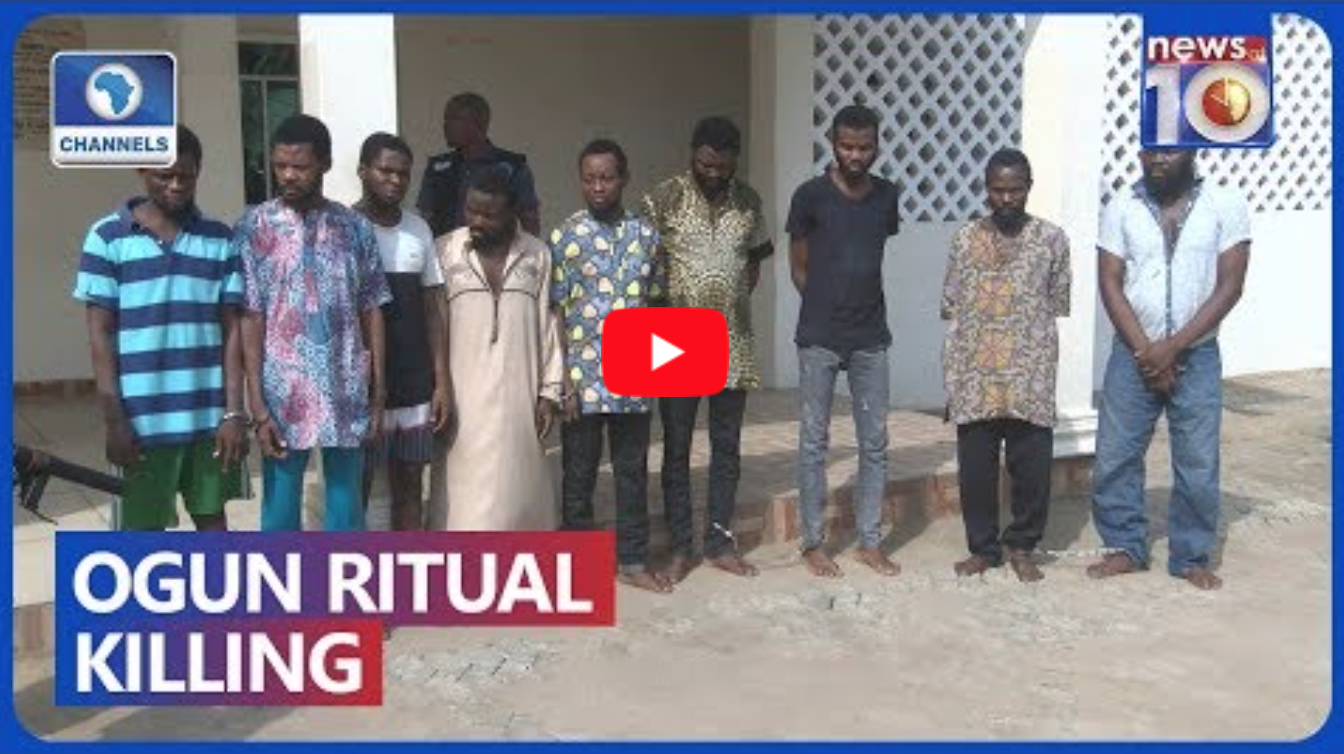
Ritualistic activities and murders have become so common in Nigeria that their occurrence is being announced on television, a strange combination of 20th century technology and medieval superstition and practices. Since protection of the privacy of suspects is unheard of in Nigeria, the nine suspects who were arrested in Ogun State were shown in full glory. The suspects allegedly admitted murdering a women for a ‘money ritual’, notably the leader of the gang, Segun Olaniyi, confessed his role in the crime.
Judge for yourself and watch the television broadcast, by clicking the link mentioned in the Source below (webmaster FVDK).
Police Arrest Ritualist Gang In Ogun State
Screenshot – to watch the broadcast, click the link below (‘Source’)
Published: March 9, 2020 By: Channels Television
Officers of the Inspector General of police intelligence response team in Ogun state have apprehended a gang of nine including herbalists and clerics who admitted to killing a woman for rituals.
Surprisingly, the leader of the gang, Segun Olaniyi who calls himself the ‘devil’, in confessing to the crime also pleads for mercy.
The police say the suspects will face the full wrath of law.
Recently, on March 2, I posted an article – dated February 26 – on the subject mentioned in the heading: ritual killers and kidnappers who have been found guilty may face the death penalty in Osun State. I added critical comments which I won’t repeat here. Readers are referred my March 2 posting.
Now it has become official. On Tuesday, March 10 the Osun State House of Assembly has passed into law a bill that makes kidnapping, banditry and ritual killing a crime which is punishable by death. Will the capital punishment act as a deterrent? Or will in practice it serve s a means to revenge the heinous crime committed, not more and no less? Only the future will tell. We will follow up on the upcoming events in Osun State (webmaster FVDK).
Osun Assembly okays death penalty for kidnappers
Speaker Timothy Owoeye
Published: March 11, 2020 By: The Nation – Toba Adedeji, Osogbo
Osun State House of Assembly has passed into law, a bill prohibiting kidnapping, banditry and ritual killing.
The bill, which was passed into law on Tuesday, was read for the third time, having passed through debates to correct identified grey areas by the committee of the whole of the House of Assembly.
Speaker Timothy Owoeye said that with the passage of the bill, Section 364 of the Criminal Code Cap 38 Law of Osun, which stipulated 10 years for kidnappers, stood repealed and replaced with the death penalty.
He said: “Where the life of the person kidnapped, restrained or seized is lost in the process, the kidnapper(s) is liable on conviction and will be sentenced to death.”
Owoeye said any person who kidnaps another person by any means or instilling fears or tricks or compels another to do anything against his will commits an offence.
Said he: “Where the life of the person kidnapped is lost in the process and the kidnapper is liable on conviction, he or she is to be sentenced to death.
“Not lost in the process, but he is released upon payment of a ransom or performance of a ransom act, the kidnapper is liable on conviction to repay the sum he/she received as ransom and to imprisonment for life and the ransom act shall be reversed.
“Any person who knowingly or willingly allows his premises, building or place belonging to or occupied by him or her and which he has control over to be used for purposes or keeping a kidnapped person, commits an offence and liable on conviction to imprisonment for 15 years and such building shall be forfeited to the government for public use.”
Owoeye said the passed bill will soon be transmitted to Governor Gboyega Oyetola for his assent as soon as administrative processes are completed.
Osun state assembly has passed the bill seeking to impose the death penalty for kidnappers, bandits and money ritualists
The move became necessary in order to tackle the insecurity concern in the southwest state
Explaining the mission of the bill, Osun speaker Timothy Owoeye said the kidnappers will be sentenced to death should the victims die
The war against kidnapping received a massive boost as Osun assembly completed the passing of a bill which will henceforth tackle abduction and ritual killing in the southwest state.
The assembly passed the bill on Tuesday, March 10, which will also hopefully tackle the cases of banditry in the state, The Nation reports.
Speaking at the assembly complex after the bill scaled through the legislative hurdle, Osun speaker Timothy Owoeye said any kidnapper found henceforth will be made to face the wrath of the law and be sentenced to death.
Osun assembly okays death penalty for kidnappers, ritualists
Published: March 11, 2020 By: Blueprint
The Osun state House of Assembly has passed into law a bill that makes kidnapping, banditry and ritual killing punishment by death sentance.
The bill, which was passed into law on Tuesday, was read for the third time, having passed through debates to correct identified grey areas by the committee of the whole of the House of Assembly.
Speaking after the passage, the Speaker of the House of Assembly, Timothy Owoeye, said with the passage of the bill, Section 364 of the Criminal Code Cap 38 law of Osun, which stipulated 10 years for kidnappers, stood repealed and replaced with the death penalty.
“Where the life of the person kidnapped, restrained or seized is lost in the process, the kidnapper(s) is liable on conviction and will be sentenced to death.”
“Where the life of the person kidnapped is lost in the process and the kidnapper is liable on conviction, he or she is to be sentenced to death.
“Not lost in the process, but he is released upon payment of a ransom or performance of a ransom act, the kidnapper is liable on conviction to repay the sum he/she received as ransom and to imprisonment for life and the ransom act shall be reversed.
“Any person who knowingly or willingly allows his premises, building or place belonging to or occupied by him or her and which he has control over to be used for purposes or keeping a kidnapped person, commits an offence and liable on conviction to imprisonment for 15 years and such building shall be forfeited to the government for public use.”
Owoeye said any person who kidnaps another person by any means or instilling fears or tricks or compels another to do anything against his will commits an offence.
Owoeye said the passed bill will soon be transmitted to Governor Gboyega Oyetola for his assent as soon as administrative processes are completed.
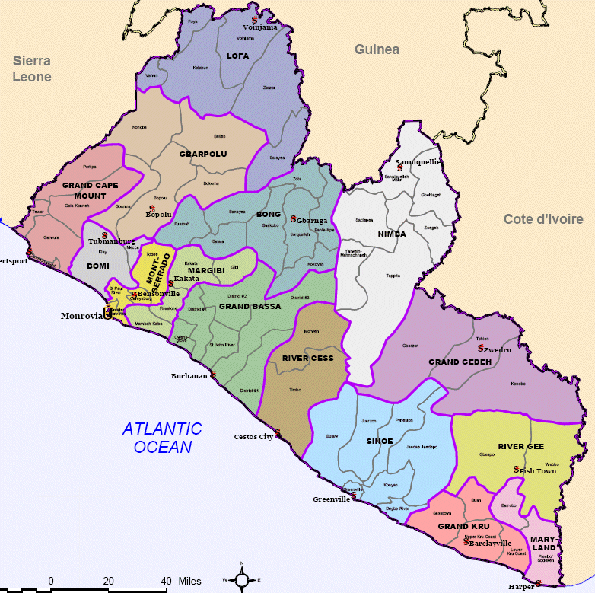
Much has already been written (and said) about the late Thomas G. Quiwonkpa, one of the main perpetrators of the bloody 1980 coup in Liberia – if not the most important – who savagely toppled the regime of President William Tolbert. Thomas Quiwonkpa was a Gio from Nimba County and at the time of the coup a corporal in the Liberian Army. The reason why he did not emerge as the leader of the coup was that his comrade Samuel Kanyon Doe, a Krahn from Grand Gedeh County, was a master-sergeant in the same army, hence one military grade higher than Quiwonkpa. Doe thus became leader of the PRC, the People’s Redemption Council. Quiwonkpa was promoted General and Commander-in-Chief of the armed forces.
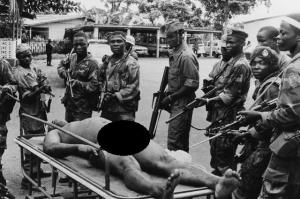
However, the two comrades later fell out and – to shorten a long story – in 1983 Quiwonkpa fled to the United States to escape an inevitable death by Doe loyalists. After fraudulent elections in 1985, Quiwonkpa returned with a group of armed men to install the real winner but the attempted coup against Samuel Doe failed. Quiwonkpa was captured by Doe’s forces, killed and partly cannibalized, his mutilated body publicly exhibited.
Using parts of Quiwonkpa’s body for ritualistic purposes and exposing his mutilated body publicly was meant to create juju and to enhance his killers’ power and prestige. Notably Samuel Doe and his Krahn soldiers who had captured the late General were to benefit from the thus created juju. (Source: Fred van der Kraaij, ‘Liberia: From the Love of Liberty to Paradise Lost’. African Studies Centre Leiden, 2015, p.52-56).
Liberia’s history is full of irony. When in 1990 President Samuel Doe was tortured to death by rebel commander Prince Johnson and his group he suffered the same fate. Doe’s mutilated body was publicly exposed in Monrovia (Source: Idem, p. 63) Warning – readers are warned that the picture of the late President Doe (below) might be found disturbing.
Thomas Quiwonkpa (left) and Samuel Doe (right) after the coup, April 1980.
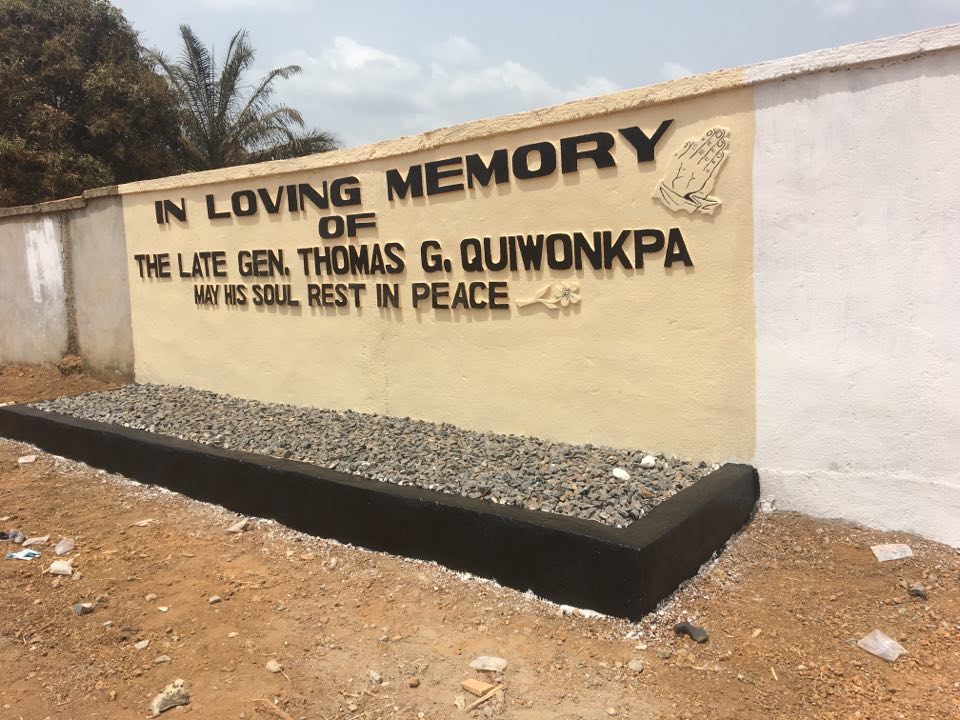
On March 10, 2020 an article appeared in the Daily Observer, one of Liberia’s leading newspapers, entitled ‘Memorial to Late Gen. Thomas G. Quiwonkpa Under Construction in Ganta, and for shortness sake it will be reproduced below.
Memorial to Late Gen. Thomas G. Quiwonkpa Under Construction in Ganta
Monument to Quiwonkpa: “Today, he is gone, but nothing is left of him as a memorial for someone to lay wreath or pay homage on Decoration Day or even the Armed Forces Day,” said Ebenezer Williams.
It appears to be one of the most unlikely places but, the Sanana Funeral Home in Ganta, along the road leading to Sanniquellie, Nimba County, has sealed on its wall the memorial of the late General Thomas G. Quiwonkpa. Quiwonkpa was killed in an aborted coup staged by him in 1985, and there is no trace of his grave as reports at the time noted that he was butchered with his heart extracted and testes placed in wine and drunk by his killers.
General Quiwonkpa, like some others including then Head-of-State Samuel Doe of the People’s Redemption Council (PRC), who seized power in 1980 following the assassination of President William R. Tolbert on April 12, do not have graves and therefore their surviving families and relatives are not able to memorialize them on Decoration Day on the second Wednesday in March of every year.
The proprietor of the Sanana funeral home, Ebenezer Williams, told the Daily Observer that the late Quiwonkpa was one of Liberia’s heroes, but nothing has been enshrined in any part of Liberia as a memorial. The memorial, still under construction, is expected to be covered in marble.
The late Gen. Thomas G. Quiwonkpa
“I saw him at the Du-Side Hospital when I was small at the time. He used to visit the hospital for an eye treatment, and was always sharing with us every time we visited him,” he said.
“Today, he is gone, but nothing is left of him as a memorial for someone to lay wreath or pay homage on Decoration Day or even the Armed Forces Day,” he said.
“This marble design in his honor will certainly make his memory not to be lost and will create an avenue for people for come to pay their respect,” he added.
The late General Thomas G. Quiwonkpa was born July 24, 1955 and was a member of the People’s Redemption Council, a governing military junta that overthrew President William Richard Tolbert on April 12, 1980, by assassination.
The late General Quiwonkpa defected from the PRC in 1983 after he was removed as Commanding General of the Armed Forces of Liberia and given the position of Secretary-General.
He later went into exile and returned in 1985 as head of a dissident group called the National Patriotic Front of Liberia, which staged an aborted coup and was killed.
Since the brutal death of the late Quewonkpa, there has been no memorialization of him, neither in his county nor the country. Similar fate befell President Samuel Doe, who was also captured on September 9, 1990 and killed by the rebel group, Independent National Patriotic Front (INPFL) of Prince Johnson who is now a Senator of Nimba County. Sen. Johnson’s testimonies during the Truth and Reconciliation Commission (TRC) hearings indicated that Doe’s body was buried, then exhumed following request for an assessment. By tradition, since he could not be buried twice, the late President’s body was cremated and the ashes scattered in the river in Caldwell, where the INPFL had its base.
Williams, proprietor of the Sanana Funeral Home, is not a native of Nimba; however, he believes the slain General Quiwonkpa was a good and honest man in the Armed Forces of Liberia who needs to be remembered.
“We want people to constantly pay homage to this place and lay a wreath, either on his birthday, Decoration Day, or even the Armed Forces Day,” he concluded.
The people of Grand Gedeh County are also contemplating on erecting a monument in memory of slain President Samuel Doe to memorialize him. Scores of PRC members including Vice Head-of-State Thomas Wey-sehn and Deputy Vice Head-of-State, J. Nicholas Podier, also seem to have no identifiable graves to decorate.
Recommended additional reading for those interested in Liberia’s politics and history:
Quote: “Quiwonkpa was captured and on November 15 was killed and mutilated by Krahn soldiers loyal to Doe . His killers then dismembered his body and reportedly ate parts of it. His body was publicly exhibited on the grounds of the Executive Mansion in Monrovia soon after his death.” Unquote Source: Thomas Quiwonkpa – click here
Warning: a shocking account with graphic contents (webmaster FVDK): General Quiwonkpa and Marconi: a connection of deadly proportions – click here
Warning: the follows contains graphic details (webmaster FVDK): The Rise And Fall Of Samuel Doe Of Liberia (graphic Pics & Video ) – click here
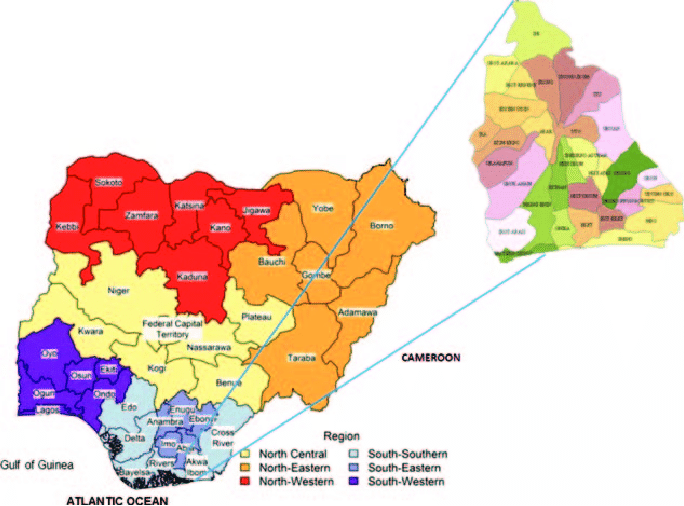
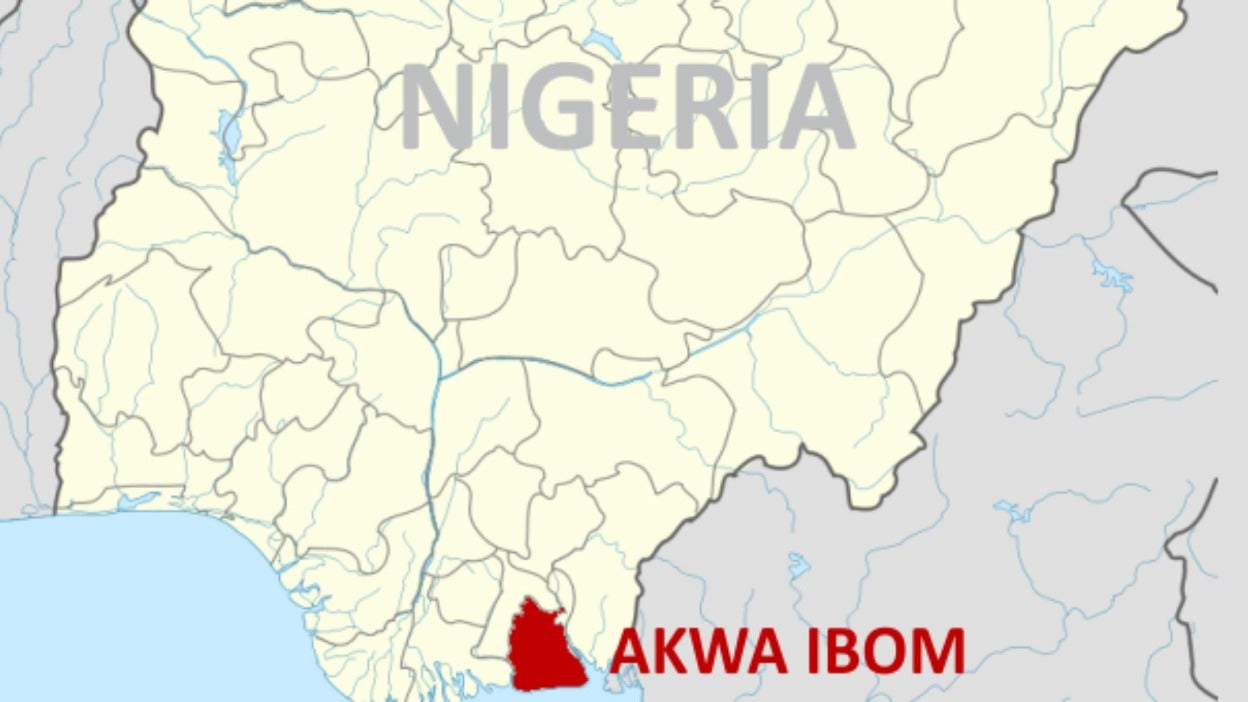
While working through old files of ritualistic murder cases I came across this article (below) reporting that – way back in 2016 – a 28-year-old man revealed to the Akwa Ibom State Police Command on how he was hired by a village council leader in Itu Local Government Area to kill a pregnant woman for ritual purposes.
For completeness sake (will I ever realize a complete overview of ritual murders in Nigeria? – I seriously doubt it), I am sharing it here, also to demonstrate that yesterday’s posting wasn’t about an isolated case. Akwa Ibom State, currently the highest oil- and gas-producing state in Nigeria, is a small but densely populated state, with a land area of 7081 km² and a population of over 5 million (webmaster FVDK).
28-yr-old man kills pregnant woman for N50,000
Published: January 14, 2016 By: Vanguard Nigeria – Tom Moses and Chioma Onuegbu
UYO—A 28-year-old man, Edet Stephen Asuquo, yesterday, made revealing statements to the Akwa Ibom State Police Command on how he was hired by a village council leader in Itu Local Government Area to kill a pregnant woman for ritual purposes.
Vanguard gathered that the suspect was arrested by the police on January 11 through the combined efforts of his brother and sister (names withheld) who reported the matter to the police, and the body was found by the police on a plantain farm.
Parading the suspect yesterday at the Akwa Ibom State Police Headquarters, Ikot-Akpanabia, Uyo, state Police Public Relations Officer, PPRO, Cordelia Nwawe, said the suspect who was the victim’s customer, lured her to the market to buy oysters, later took her home to buy more, then killed and hid her body, hoping to harvest the foetus for rituals.
Nwawe said the suspect’s sister, who witnessed the act, reported to her elder brother who later alerted the police.
Suspect’s story
The suspect, Asuquo, told newsmen: “What brought me to the police station is because of the job given to us by a village council chairman. “He paid five of us to kill a pregnant woman so her head and her unborn child would be used for charms. “He said after we have carried out the job, he will give us N50,000 each. He did not give us any advance payment. After we had done the job, my brother became angry. “He said that this is not the kind of job I should have gotten myself involved in. He called my other senior and reported the matter to him.”
The following report, see below, is a bit fuzzy but nevertheless I want to share it with you. The chief perpetrator of the heinous act, who was caught, may not have been fully responsible for his deed because of his (unstable) mental state (but this is up to the judges to rule) and not all details are clear or have been confirmed by the authorities, however, the youth who supported the police which led to the arrest of the suspects merits to be applauded. A good example of how it should be – no mob justice, but the rule of law! (webmaster FVDK).
Four nabbed in Akwa Ibom for beheading woman for ritual purpose
Published: March 8, 2020 By: Vanguard Nigeria – Harris Emanuel
Tragedy struck at the weekend at Oku Abak community in Abak Council Area of Akwa Ibom, as a woman simply identified as Eka Sammy was reportedly beheaded in her farm and the head dumped in front of her house.
Vanguard gathered that the woman fondly called Mma Iko Mbakara was ambushed in her farm while harvesting cassava by a young man, one Lucky Michael from Delta State, working hands in gloves with three others.
An eyewitness account averred that the suspect was caught by the irate youth of the community when he dumped the head of the woman in front of her house and immediately stripped himself naked before taking the youth to the farm where the lifeless body of the woman was found.
One Augustine Ekwere said, ‘’the youth of this village caught him and called on the police after their own assessment. The police then arrested his and his accomplices.
Continuing, Ekwere said the suspect confessed to the crime at Abak Police Station, saying that a prophetess contracted him for a fee of N15, 000 to bring human head for rituals.
According to him, although the suspect did not mention the name of the prophetess, he had already received the cash payment to carry out the dastard acts.
‘’At the Police station, the boy confessed to beheading the woman in the farm because he was paid a N150, 000 by a prophetess to do so. I fear that such crime is coming to my community, my stress and our house’’, he said.
Police Public Relations Officer, Fredrick Nnudam, Chief Superintendent of Police confirmed the incident and applauded the youth of the community for supporting the Police which led to the arrest of the suspect and his cohorts.
The PPRO who did not mention the number of suspects arrested hinted that the matter was being investigated at the Police Headquarters, Ikot Akpanabia, but source informed our reporter that about four suspects were nabbed by the police.
‘’I am in a picture. A woman was beheaded in the farm on Saturday while working there. Some youth joined the police to comb the bush and some suspects were arrested.
‘’I can’t give you the exact figures, but some persons were arrested especially the principal suspect’’, he said.
On whether the prophetess allegedly said to have masterminded the killing for ritual purpose has been arrested, he said, ‘’as at now information is still sketchy but investigation is ongoing, so, I can’t say if somebody like that is involved.’’
TRAGEDY struck last Saturday in Akwa Ibom state as suspected ritualists behead 82-year-old woman popularly known as Mma Iko Mbakara in Ibesit community in Oruk Anam local government area of the state.
It was gathered that the unsuspecting octogenarian was ambushed in her farm in Ibesit, Oruk Anam while she was harvesting cassava.
A reliable source in Abak local government area who spoke to Vanguard in confidence yesterday said the news of the sad incident filtered through the whole Abak town early Sunday morning.
“Actually the incident happened in Ibesit community in Oruk Anam local government area, but the principal suspect is from Oku Abak, in Abak local government area. I learned that the police have already arrested him and his accomplices. ”
I was told this morning (Sunday morning) that the principal suspect identified as Lucky Michael and his accomplices have been arrested by the police”, he simply added.
An eyewitness identified as Ekwere said Michael was caught by the youths of Oku Abak community who stripped him naked before asking him to take them to the farm where he committed the crime.
Ekwere added that the youths later called the police to arrest him and his accomplices, adding that it was at the Abak Police station that he (Michael) confessed that he was paid the sum of one hundred and fifty thousand naira ( N150,000.00) to bring a human head for ritual.
Contacted, the Police Public Relations Officer in the state, CSP, Frederick Nnudam confirmed the incident, noting that some suspects however have been arrested in connection with the crime.
The PPRO who did not mention the number of suspected arrested said, “The story is true. Some of the suspects have been arrested and the head of the woman was also recovered. “The principal suspect one Lucky Michael was in possession of the head of the 82-year-old woman. The matter is under investigation”
The following reproduced article is not about an entirely new incident of mob justice in Nigeria. It relates to the same jungle justice addressed in my February 27 posting and also yesterday’s Editorial. However, for completeness sake I want to include it here: readers who may have missed previous posts may find in the article reproduced below the necessary information to fully understand the editorial in the Nigerian newspaper The Nation (online) posted yesterday (webmaster FVDK).
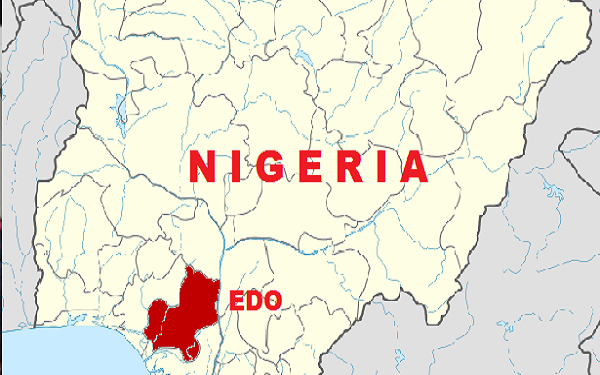
Four burnt to death after ritual killing in Edo
Edo State Commissioner of Police DanMallam Muhammed, addressing journalists in Benin City, Edo State capital, on Monday, October 14, 2019
Published: February 25, 2020 The Punch, Sola Shittu – Benin (city), Nigeria
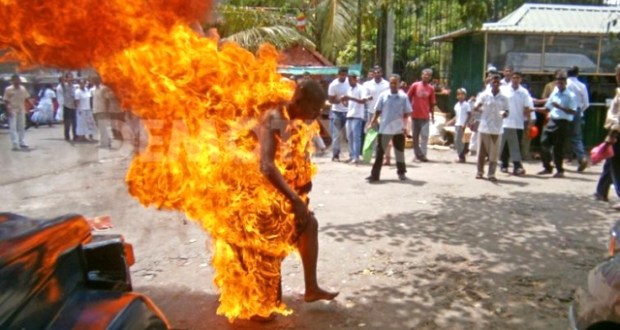
Three middle-aged men and a woman were on Monday set ablaze by a mob at Otuo community in the Owan East Local Government Area of Edo State.
The four were alleged to have been involved in the murder of a Senior Secondary School 3 pupil of Azama College, Otuo.
PUNCH Metro gathered that the pupil was allegedly killed and her head severed from her body for ritual purposes.
A source in the community said the murder was carried out at night by her neighbour who sent her on an errand to get sachet water in the evening.
While in his room to deliver the sachet water, she was allegedly murdered and decapitated.
Our source said when the girl’s parents could not find her, they raised the alarm.
The alleged culprits were said to have been caught while attempting to dump the victim’s body in the early hours of the following day.
They were said to have identified two other persons, including the woman who performed the rituals for them.
“The two men were burnt this morning (Monday) along with the woman, while her house was razed. They were all dragged to the popular Women Centre where the community police station is located. The third man was traced to his farm and apprehended,” he said.
Later in the day, our source confirmed that the third man had also been burnt by the mob.
The state Police Public Relations Officer, Mr Chidi Nwabuzor, while confirming the incident, said two suspects were lynched.
“The command is aware that a young girl’s head was cut off and the youth of the community arrested two suspects, brought them to the front of the station and set them ablaze,” he said.
A recent Editorial in one of Nigeria’s leading newspapers drew my attention and I would like to share it with you. It is a cry from the heart and corresponds with previous messages which I put on this site. Referring to a recent incident in Edo State, it is about the nonsense of mob justice, it’s illegal nature, and even the damage it causes to the country’s justice system. Read it for yourself. May it contribute to less jungle justice, but – of course and more important – we have to battle the phenomenon of money rituals with all our force and eradicate it from society! (webmaster FVDK).
Compounded barbarity
Picture from file, not related to described incident
Published: March 6, 2020 By: The Nation (online) – Nigeria (editorial)
Editorial
Suspected ritual killers turned victims of jungle justice is cold comfort. Both outrage jar with civilised 21st century conduct.
It really makes no difference which of the versions of the incident is accurate, whether four or two people were burned alive for allegedly beheading a teenage girl for ritual purposes. The picture of compounded barbarity is clear enough. The girl’s beastly murder attracted jungle justice, but neither of the two is good for society.
According to the Edo State police spokesman, Chidi Nwabuzor, “The command is aware that a young girl’s head was cut off and the youth of the community arrested two suspects, brought them to the front of the station and set them ablaze.” But media reports said a mob had set ablaze three men and a woman at Otuo community in the Owan East local government area of the state, on February 24, for their alleged involvement in the murder of a Senior Secondary School 3 pupil of Azama College, Otuo.
The girl’s neighbour was said to have sent her on an errand to get sachet water, and she was allegedly killed and beheaded when she returned with the sachet water. Two of her killers were said to have been caught while trying to dump her headless body somewhere the next day. They were said to have implicated two other collaborators, including a woman described as a native doctor.
By taking the law into their own hands, the mob demonstrated public anger over the increasing cases of ritual killing in the country. But their reaction was extreme. It is noteworthy that they had imposed their own punishment on the suspects, right in front of a police station, which suggested they had lost confidence in the police.
Their action was a recipe for anarchy. Mob justice not only reflects a negative public perception of the criminal justice system, it also undermines the institution charged with maintaining law and order. This is yet another instance that shows the low rating of the police by the public, and the need for the police to improve their image by performing professionally.
It is unfortunate that the suspected killers were burned alive, thus making it impossible for the police to investigate the allegation against them. The accusation that they killed the victim for ritual purposes could have been more clearly established through a proper trial.
Sadly, this incident further highlights the troubling issue of money-ritual killing prompted by a get-rich-quick mentality. The circumstances of the murder suggested it may well have had something to do with money rituals. Only the killers could have explained why they needed the girl’s head, but the beheading followed a familiar pattern of killing associated with money ritualists.
The money-ritual angle says something bad about our society. Frequent reports of suspected money-ritual killings in the country show a dark side of the society that needs to be urgently corrected. Murder is evil; it is worse when it is connected with a get-rich-quick motive. The love of money should never be taken to such extremes.
The question is: What drives such a desperate and unconscionable pursuit of riches? The inadequacies of the socio-economic environment must be a major factor, but these can’t justify a do-or-die approach to getting rich. Money rituals that involve murder signify not only material poverty but also spiritual poverty on the part of the perpetrators.
Improved socio-economic conditions can discourage such an approach to getting the good things of life. That is why the government, in pursuing the greatest good for the greatest number, must pay serious attention to the improvement of the socio-economic conditions. The goal should be to significantly reduce the number of the desperately poor as well as promote enlightenment that makes it unnecessary to seek wealth through money rituals