Children who are accused of witchcraft. Children who are abused. Children who are discriminated, punished, beaten, tortured, mutilated, killed. The following story is again one which makes you shiver, like yesterday’s article. I read the article reproduced below with growing disbelief and disgust.
As with ritualistic crimes, superstition lies at the base of this evil. It saddens to read that these children are not protected by their parents, their families, their communities, not even by the State. The protection of the weak and the poor is an obligation of the State. In the DRC the central and regional authorities fail miserably (webmaster FVDK).
Witchcraft horror sees teen attacked and accused of sorcery by own family
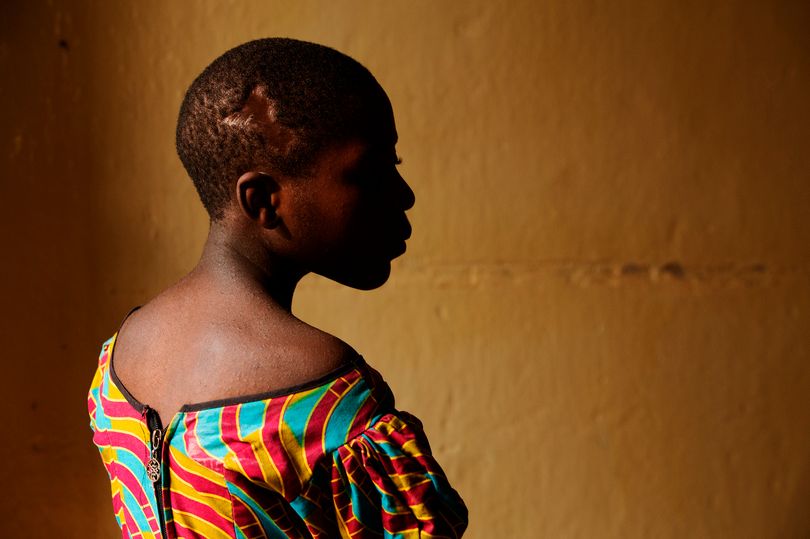
Gabrielle’s life was turned upside down when she found herself at the centre of a chilling witchcraft craze sweeping the Democratic Republic of Congo.
Gabrielle shows scares on her head after she was beaten and accused of being a witch (Image: simon murphy)
Published: February 23, 2020 By: Daily Record UK – Stephen Stewart
Gabrielle is like any other bright teenager. She loves learning new things, chatting with pals and watching TV.
But her life has been turned upside down after she was accused of being a child witch – by her own family.
She is one of thousands of young children and teenagers at the centre of a new, chilling witchcraft craze sweeping the Democratic Republic of Congo.
This epidemic – reminiscent of the infamous 16th century European witch hunts – has seen girls as young as four burned to death.
The Sunday Mail recently travelled to the Central African nation with Scottish charity SCIAF to see their work helping female victims of sexual violence.
As revealed in our sister paper The Daily Record, armed factions illegally mine a mineral called Coltan – used in phones and electronic devices – to finance their atrocities, including gang rape and sexual slavery.
These mind-numbing levels of violence have plunged much of the country into the Dark Ages with economic and educational catastrophe triggering a related rise in beliefs in superstition and witchcraft.
Gabrielle is just one of a skyrocketing number of kids facing accusations of sorcery.
The 15-year-old said: “I felt like a princess when I was at school. I was first in my class and I was very proud of that.
“Then things went bad. I remember sleeping and my uncle came home and he started beating me around the head with a piece of wood.
“He beat me and beat me and beat me and then he took me to the hospital because he felt bad about what he had done.
“He felt pity and they told him at the hospital not to beat me because I might die. I do not want to stay at home any more because they plan to kill me or leave me to the bandits.
“People go into churches and say I am a witch. They say that it is because of me that they have death and misery in their family. I don’t know why they say these evil things and abuse me.”
SCIAF is helping to fund various projects in the Bukavu archdiocese to help women victims of sexual violence.
These projects often deal with other vulnerable people such as Gabrielle and other children accused of witchcraft.
Belief in witchcraft is widespread in Africa, according to the UN, but until recently, violent allegations were not usually aimed at children.
There are now alarming numbers of killings of children accused of being “sorcerers” and a growing phenomenon of witchcraft accusations against children and adolescents.
The main power attributed to child witches is the ability to inflict harm from the invisible world to the visible.
This could consist of transmitting an illness to a relative who must be “sacrificed” with fellow witches.
Children are accused of causing diarrhoea, malaria, tuberculosis and HIV and AIDS, and the fatal consequences that may follow.
They are also often suspected of bringing about general misfortune, poverty, unemployment, failure and bereavement.
Gabrielle’s dad Vincens – who is blind and battles ill health – was even one of her accusers.
Victims are now trying to rebuild their lives through SCIAF and local partners at the Centre Olame Bukavu which seeks to defend the human rights of women and girls.
Sciaf launches the WEE BOX Big Change appeal this week, which will help vulnerable women and girls.
Gabrielle now often feeds her father, 55, and helps him get around. He said: “I know now these were very bad things. When she was forced out of the home, she had to sleep outside.
“I was living in ignorance and believing in ignorant things. As a Christian, I can only ask for forgiveness. My whole family have went to Gabrielle and said, ‘Please forgive us for these bad things we did and the awful superstitions we believed in’.
“I was sad when she went away and lived outside. As a father, there are things you do through ignorance but you then regret your weakness and ignorance. I felt pity and regret and wanted to find her.
“Through this centre, I have seen how I went wrong. Now, if neighbours or someone else say things about my daughter, I don’t accept it as I can’t allow these things.”
Lisette, 14, is another victim of the witchcraft craze. She said: “I don’t like staying with my family. I suffer a lot when I stay there. I don’t feel well at home because they hit me and say bad things about me.
“If I try to do the dishes, they hit me and say, ‘Don’t touch those things because you will kill us’. They make me isolated and force me to stay outside. I want to be a nun to stop these things and make people live better lives.”
Captain Innocent Rutema Baguna is a police officer who has seen the horrors of the epidemic.
Dad-of-10 Innocent, 54, who became a police officer in 1998, said: “I have witnessed horrible things. One of the worst was when I saw a girl who was four and was accused of being a witch.
“She was burned alive as people had accused her and then put her in a house and then set it on fire. I can never forget that. I do my best to protect the children.
“It can be a dangerous job as you have to go to places to interview people where the rebels are very active.
“My work is a matter of sacrifice but I am an orphan, my mother died when I was only six.
“So, now that I am a father, it is very important that I do my best to protect and help the children. Our future depends on it.”
SCIAF’s chief executive Alistair Dutton has just returned from DR Congo.
He said: “The lives of thousands of poor, vulnerable women and girls are being destroyed by sexual violence and exploitation.
“They need our help. SCIAF and our partners are on the ground providing medical care, counselling, legal aid and support so they can recover and rebuild their lives.
“But the need is great. I’d ask everyone to please give what they can so we can do more to help women and girls in need.”
As the Sunday Mail team left, Gabrielle shyly handed us a drawing she had been working on.
Her poignant message reads: “May peace reign around the world but especially in the Democratic Republic of Congo.”
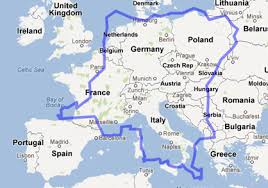
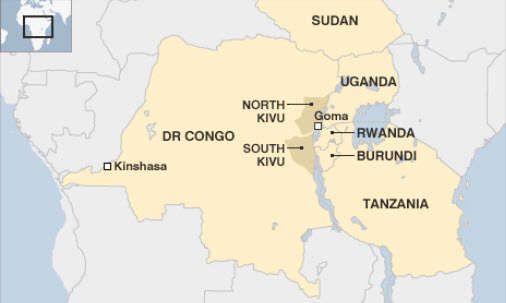
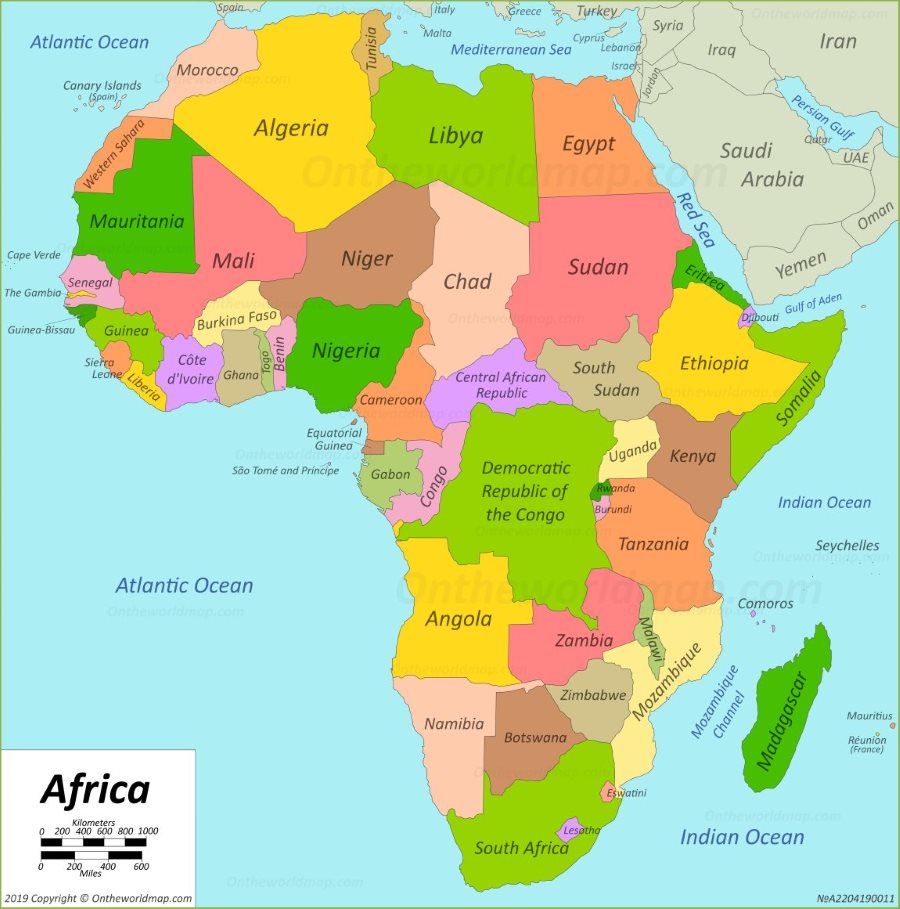
With 2.4 million square kilometers, at least 250 ethnic and language groups and a total population of nearly 100 million people, the Democratic Republic of Congo (DRC) is one of Africa’s giants. The following map illustrates the real size of the DRC.
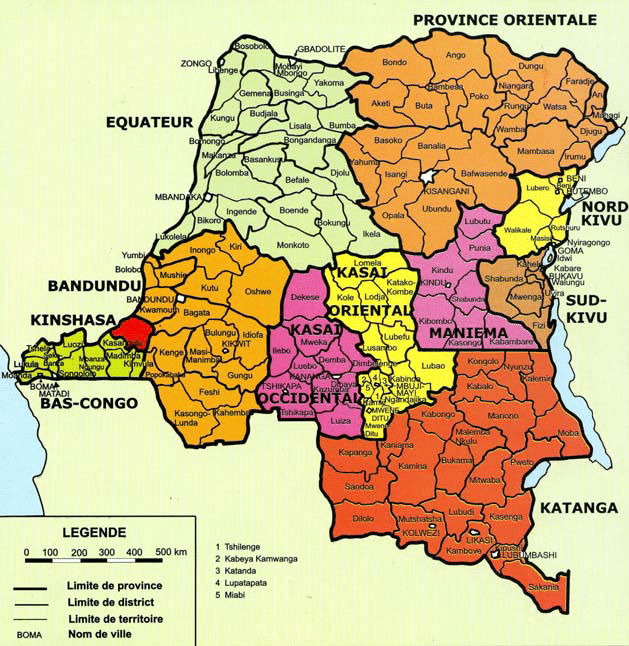
The number of people living with albinism in the DRC is unknown, but they are a vulnerable group, sometimes hunted down as animals, like in neighboring Central and Southern African countries. In the article below an albino woman, Lisa, narrates her story, how she escaped from being murdered. She was also sexually abused. Lisa lives in a remote area of South Kivu, an administrative region bordering Rwanda and Burundi. Much of the article focuses on sexual violence and unfortunately Lisa’s experiences are shared by many other women in the DRC.
People living with albinism are discriminated and enjoy even less protection from the State than other Congolese citizens. Superstition, witchcraft, lack of protection, human rights violations, ritual murder, sexual abuse. Read Lisa’s story and shiver. (webmaster FVDK).
Sex abuse survivor reveals kidnapper wanted to kill her and use her bones in witchcraft
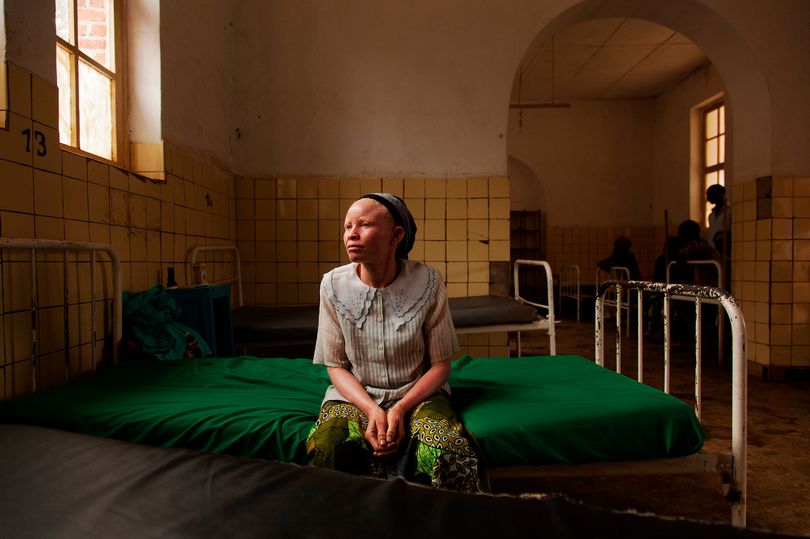
Lisa – an albino who lacks pigmentation in her hair, eyes and skin – tells the Record how a man lured her away from home in the Congo so he could murder her and perform magic rituals with her remains.
Survivor Lisa was abducted by a man who wanted to use her bones in witchcraft rituals (Image: simon murphy)
Published: February 24, 2020 By: Daily Record UK – Stephen Stewart
He wanted to butcher her and use her bones in magic ceremonies.
Sexual abuse survivor Lisa – an albino who lacks pigmentation in her hair, eyes and skin – is quietly telling how a man wooed her, expressing his undying love before luring her away from home to murder her and perform rituals with her remains.
Her delicate features remain impassive as she recounts her horrific ordeal. Her condition – which affects the production of melanin, the pigment that colours skin, hair and eyes – can be a gruesome death sentence in the Democratic Republic of Congo.
The Daily Record and Sunday Mail have run a series of hard-hitting stories this week after we travelled there to uncover the reality for women in the country once dubbed the “rape capital of the world”.
According to the Home Office, 40 per cent of women in the area we visited – South Kivu – have suffered sexual violence.
Before she was kidnapped, Lisa had already suffered. The 22-year-old has one child born of rape. She was attacked when she was 18 as she worked in the fields around her village.
Often, women like Lisa have to be treated in poorly-equipped hospitals where doctors have to perform gynaecological surgery using the light of their mobile phones thanks to the frequent power cuts.
She said: “I was in the field working when I was raped. A man came and forced himself on me and I got pregnant. I gave birth to a boy. At first, when he was born, he was unwell but now he is fine and I love him very much.”
In DRC, there are many mothers who became pregnant after being attacked.
In the eyes of the law, their children do not exist but, thanks to SCIAF, Scotland’s Catholic international aid agency, they can now get a birth certificate, which gives them access to healthcare and education.
Lisa, who lives in a remote area of South Kivu, added: “Albino people like me are often discriminated against here. There are people who say that albinos can work magic. People point at me in the village and say bad things.
“One day, a man came to my village and he was very nice to me. He said he had fallen in love with me and he talked me into going on the bus with him to the city of Bukavu. He took me to a house and left me there.
“Another man came and asked me if I knew the other man. I had to admit that I didn’t really know him that well. It was then that he told me the other man was bad and trafficked albino people.
“He wanted to kill me and use my bones in witchcraft. I left as soon as I could and went back to my own village. Things are better now. I did not go to school and I can’t read or write but I would like my boy to study and do great things.”
Lisa has been supported by the generosity of Scottish people through SCIAF, which supports local projects promoting women’s rights, gender equality and provides services to the survivors of sexual and gender-based violence.
Gran Sylvia, 41, is another woman who has survived sexual abuse and is now receiving support through SCIAF.
She was abducted by rebel gangs and had to leave behind her two-month-old baby.
She was forced to become the “wife” of a rebel commander and was abducted for four years. During this time, her baby and mother had died and her husband had remarried.
She was left traumatised and now receives counselling, seeds, tools and training in how to grow food to feed the family and sell any surplus.
Sylvia said: “They made me walk and they hit me on the back with the butt of their guns. I left everything. If you said you were tired, they would say, ‘OK, you want to rest?’ and they would shoot you.
“I saw two people shot like this. We were all afraid. Those who refused to have sex were killed and their bodies fed to the pigs. I saw so many people die.
“This life was the worst.”
Thanks to the support of Scots through SCIAF, things have turned around. She added: “The counselling helped very much. After this, I still felt hurt but not as badly as before.
“I say, show me the one who brought this programme here and I could kiss them. Whenever I hear SCIAF is visiting, I feel happy.”
SCIAF funds medical care and surgery for women who have suffered sexual violence.
The rape epidemic means that doctors at Katana hospital are now world experts in fistula surgery despite the basic conditions.
Dr Michael Chanikire, 38, said: “When I work with these women, I think they could be my mother, wife or sister. It hurts to see people hurt in these ways. They are often traumatised by their suffering.
“I have worked in Europe and one of the main medical issues there is cancer but here we see a lot of fistula problems caused by the trauma of rape and sexual violence. There are times when we have no electricity and we have to use the lights on our mobile phones to perform surgery.
“Women fear coming here as there are many rebels in the area and they will know she has come for treatment and they know she will be asked about what has happened to her.
“Sometimes, it feels like we doctors have come through hell dealing with the things we have to do. It is rewarding too, though. My mother sees me wearing my white coat and she feels so proud of me.
“She knows I am doing my best to help women and that makes her very happy.”
Is the capital punishment a justifiable sanction or a sufficient deterrent to ritualistic murders, money rituals, muti murders, or whatever one calls the heinous crimes which ruthless criminals commit to increase their wealth, prestige or power? In Osun State, Nigeria, legislators contemplate to prescribe the death penalty for kidnappers and ritual killers. See the article below.
The United Nations has voted in favor of a moratorium on the death penalty (though Nigeria was among those voting against the resolution). It is to be doubted seriously if the capital punishment serves as a deterrent to ritual killers. Wouldn’t it be more logical and useful to eradicate superstition – which lies at the base of the belief in juju – by providing the necessary education and to create more job opportunities? (webmaster FVDK).
Kidnappers to Face Death Penalty in Osun
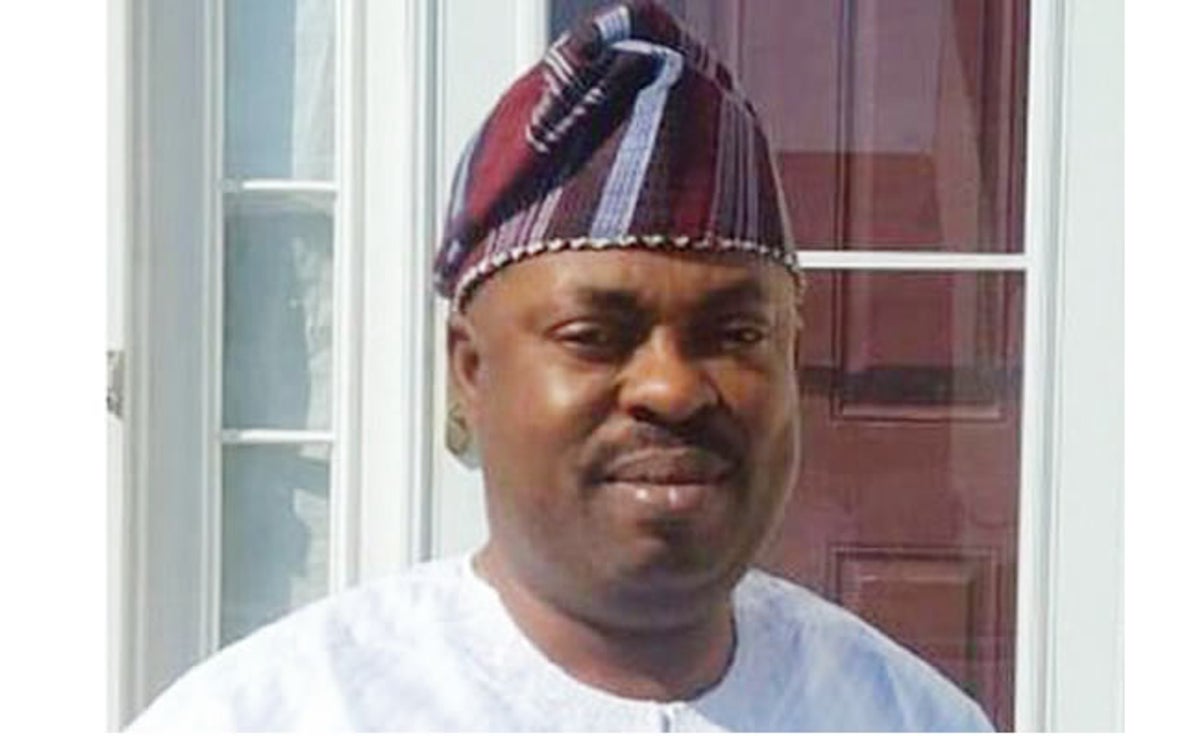
The Speaker of Osun State House of Assembly, Hon Timothy Owoeye
Published: February 26, 2020 By: This Day, Nigeria – Yinka Kolawole in Osogbo
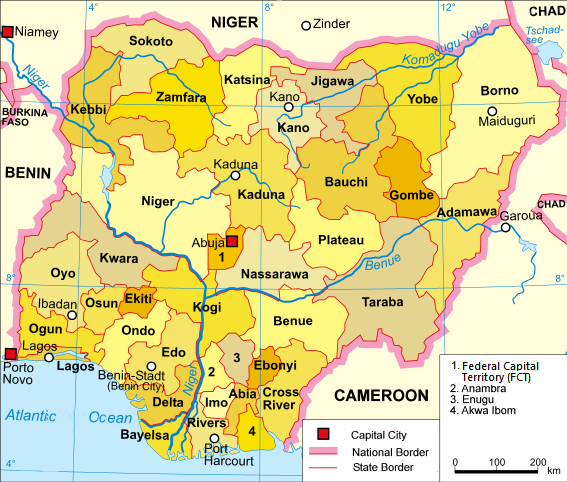
The Speaker of Osun State House of Assembly, Hon Timothy Owoeye, yesterday said the state kidnapping and other related crimes (prohibition) bill 2020 would prescribe death penalty for kidnappers and also compliment efforts of the Amotekun Corps when fully inaugurated.
The Speaker at the public hearing on Osun State kidnapping and other related crimes prohibition bill 2020 stated that it is imperative to have an enabling law to ensure quick and diligent prosecution of kidnappers.
Owoeye pointed out that ever since the issue of Amotekun Corps arose, there has been a downward trend in the cases of kidnapping in Osun and other South-western states.
He held that the seveth Assembly under his watch is reviewing the existing laws on kidnapping which recommended that 14 years would be reviewed to death penalty.
The Speaker added that should the bill scale through the needed stages, those caught with human parts and kidnappers whose victims dies in the process of abduction would face death sentence as against imprisonment obtainable before now.
Owoeye noted that with the way kidnapping is becoming lucrative, it is sacrosanct that laws with severe consequences be put in place to protect Nigerians from kidnappers.
According to him, “Ever since the issue of Amotekun came up, I have noticed downward cases of kidnapping in Osun and other South-western states; however I am more afraid of the surge in ritual related cases.
“The country was saddened at the gruesome murder and dismembering of a 23-year-old 400 level LASU student, Favour Oladele, for money ritual purposes. We the Osun people are sadder that the killing took place in Ikoyi town, in our own soil.
“As parents and community leaders, we must begin to re-orientate our young ones on this prevailing get-rich-quick syndrome. There is no shortcut to success, the only way is preparation, hard work, patience and perseverance.”
Also, the Chairman of Osun Civil Society Coalition, Waheed Lawal, has given reasons for government at all levels to re-double their efforts to create job for employable youths, stating that it would go a long way in reducing the crime rate in the country.
Police Community Relations Committee Chairman in the state, Amitolu Shittu, on his own, commended the seventh Assembly for championing the crusade to bring sanity to the society.
Mob justice or jungle justice is not only a widespread problem in Nigeria – see my February 27 posting – and other countries reported on this site. Als in e.g. in Zambia, mobs attack and kill people who are suspected of ritualistic killing. The local, regional and national authorities are often not trusted. This may have been caused by past experiences, but it still does not justify killing people who are ‘only’ suspected of being ritual killers and have not been tried by an official court. The prerogative of using violence lies only with the State, not with citizens (webmaster FVDK).
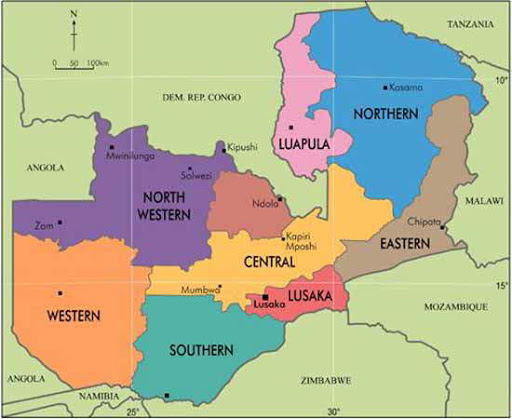
Police arrest 10 murder suspects linked to the hacking to death of three Power Tools workers in Luapula Province
Published: February 28, 2020 By: Mwebantu
POLICE in Chiengi have arrested ten suspects in connection with the gruesome murder of three Power Tools workers who were hacked to death by a mob on suspicion of being ritual killers.
Zambia Police spokesperson Esther Mwaata Katongo has told Mwebantu in the early hours of today, Friday, 28th February, 2020, Police in Chiengi of Luapula Province arrested ten (10) suspects in connection with the gruesome murder of three (3) Power Tools employees, who were murdered by a mob on 21st February, 2020, around 0300 hours at Kazembe Village in Chiengi District.
She said the suspects were apprehended in an operation conducted between 01 00 hours and 03 00 hours.
“They are all detained in police custody charged with murder. “She said.
Warning: the article reproduced below contains graphic details of the heinous crime committed (webmaster FVDK).
Successful surgery of boy rescued from ritual sacrifice
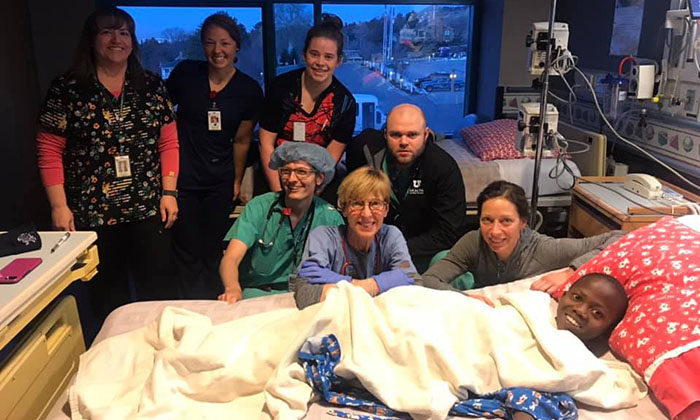
The victim, Robert Mukwaya – ‘Doctors are confident in helping him improve.’
Published: February 25, 2020 By: Uganda Christian News
Robert Mukwaya suffered severe spinal injuries in 2014, it was thought he would never walk again.
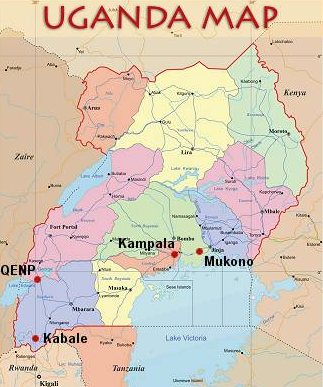
He had been resting in his grandmother’s kitchen in Mukono district when a witch doctor heartlessly dragged him out of the room and stabbed him in the neck, leaving him with a spinal damage and feet permanently facing down.
Robert was left paralysed, but the surgery he had on 20th February, 2020 at Shriners Hospitals for Children – Salt Lake City, USA might change his story.
Kyampisi Childcare Ministries, a Christian charity organisation founded by Pastor Peter Sewakiryanga issued a statement saying the young man’s surgery was “all success.”
He had a “big operation on his hip, foot and hands” among other areas.
“More prayers for healing,” the statement read. “He has done very well this brave and strong miracle gem! His post operation recovery is longer, but doctors are confident in helping him improve.”
Kyampisi Childcare Ministries helps child sacrifice survivors and their families rebuild their lives and overcome the trauma. The organization has helped over ten victims since its creation in 2009.
In an update shared online, Ms Anne Mitchell who interacted with Robert in USA before his Thursday surgery had this to say:
“Robert was unfortunately cut in his neck by a witch doctor. He was left with many issues especially in walking and using his arms. He was left a partial quadriplegic. Hopefully his surgery can allow him to walk and move much better. He will need considerable rehabilitation, but Robert is a wonderful resilient boy. Praying for the best outcome possible.”
Since 2014 Robert has undergone a series of operations, all aimed at seeing him walk again. In 2017, he has surgery performed at the John Hunter Hospital in Australia.
“On that day I left him alone at home and went to the church to pray, when I came back I found him laying on a mat in a pool of blood,” Robert’s grand mother, Yowani Nakiwala told Transterra Media earlier. “His neck was almost falling off, the doctors worked on him and dressed him with a collar around his neck.”
Pastor Peter Sewakiryanga told Transterra Media: “The condition we find them is quite sad, those that die, we find their bodies completely a part – they cut the head and drain the blood – They can cut the stomach and take the organs out of their bodies. They are shocking incidences, shocking pictures. Those that survive need huge medical attention.”
“Children are sacrifice because there is a growing belief that when you sacrifice a child, you get wealth, you get protection, you get healing and this belief which is a lie has spread all over the country and there has not been a tiger reaction from the Government or from people concerned to be able to educate masses that you don’t have to kill a child to get wealth or you don’t have to kill a child to get protection. Wealth comes from hard work, protection comes from God and because people are desperately poor and desperately in need of wealth issues, there is a witch-doctor in the community who claims to bring healing, to bring joy and happiness and blessings – the people go to that person and they are lied and they are sent for body parts of children,” Pastor Peter Sewakiryanga said.
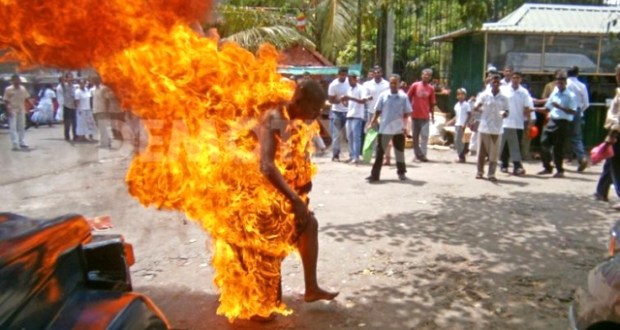
Mob justice is a serious problem in many if not all of Nigeria’s states. Early January of this year an angry mob set robbers ablaze in Calabar, the capital city of Cross River State. In early October last year an angry mob in Benue State set three suspected armed robbers ablaze over their alleged involvement in the robbery and serial killings witnessed in Gbaste community. I could cite many more examples of jungle justice in Nigeria, but this will do, for the moment. Recently, two – or four, accounts differ, see below – young men were set ablaze for alleged involvement in the killing of an SS3 Secondary Schoolgirl of Azama College, Otuo, Edo State.
The use of violence is a prerogative of State authorities. Moreover, every accused is considered innocent as long as he or she has not been found guilty by an independent and impartial judge during a public, transparent trial. Mob justice is a sign of a weak state authority and should not be tolerated. Mob justice resulting in the death of the victim is a crime; those responsible should be prosecuted and punished by law (webmaster FVDK).
Angry Mob Sets Four On Fire Over Ritual Killing In Edo State
Reports reaching Naija News at this time reveals that there was an uproar at a village in Owan East Local Government Area of Edo state on Monday, following the murder of a young girl who was reportedly beheaded for ritual purpose.
According to a source in the Otuo community in a chat with newsmen, some four young men were set ablaze for alleged involvement in the killing of an SS3 Secondary Schoolgirl of Azama College, Otuo.
The source whose identity was not given due to security purpose reveals that the child’s head was cut off at night hour by the culprits while she was on an errand by her neighbour who sent her to get him sachet water.
Naija News understands that she was murdered at the point of delivering the sachet water.
It was said that the girl’s parents cried out after they could not find their daughter, but that the culprits were nabbed while making moves to dump the victim’s body before the rising of the sun of the next day.
Further information revealed that two out of the four culprits were identified, including the woman who is to perform the rituals for them.
The source said, “The two men were burnt this morning (Monday) along with the woman, while her house was razed. They were all dragged to the popular Women Centre where the community police station is located. The third man was traced to his farm and apprehended,”
However, after the arrest of the culprits, furious residents set the young men on fire.
Meanwhile, a confirmation from the state Police Public Relations Officer, Mr Chidi Nwabuzor, mentioned that only two of the suspects were burnt alive.
“The command is aware that a young girl’s head was cut off and the youth of the community arrested two suspects, brought them to the front of the station and set them ablaze,” he said.
4 burnt to death for kidnapping SS III student for rituals in Edo
Published: February 24, 2020 By: Vanguard – Ozioruva Aliu
BENIN CITY— FOUR persons, including a lady, were, yesterday, set ablaze by a mob in Otuo, Owan East Local Government Area over allegation of kidnapping an SS III female student and killing her for ritual purpose.
It was gathered that the victim, a student of Azama College in Ikhuera quarters of the rustic town, was allegedly sent to buy sachet water by her neighbour Sunday night.
A source said while she was on her way from buying the water that her head was severed from her body apparently for ritual.
It was also gathered that when the young girl’s parents could not find her, they raised the alarm, but her whereabouts remained unknown.
The source said one of the culprits caught in the early hours of yesterday while attempting to dump the victim’s body confessed to the crime and those involved, including the woman, who allegedly performed the rituals for them.
“The two boys were burnt this morning (yesterday) along with the woman while her house was razed. They were all dragged to the popular ‘Women Centre’ where the community police station is located. The third boy was traced to his farm and apprehended,” he said.
Vanguard gathered that the third man apprehended in connection with the ritual killing was later burnt by a mob late yesterday.
One of the suspects, the gang leader, identified as Lukeman, was alleged to be a serial killer while two of the boys, who accompanied Lukeman, are of same parents and from Ikhueran quarter, Otuo.
He also said the woman, who performed the rituals was from Kogi State while Lukeman is said to be from Auchi in Etsako West Local Government Area of the state.
Spokesman for Edo Police Command, Mr Chidi Nwabuzor, while confirming the incident, said it was only two of those arrested that were burnt.
“The command is aware that a young girl’s head was cut off and the youths of the community arrested two suspects they took to the station where they were set ablaze,” he said.
The following case may not refer to a ritualistic murder though there are strong indications that a ritual murder has indeed been committed. Moreover, the article refers to previous ritual killings that have taken place as “There have been concerns over the high number of ritual killings in the province for years, particularly of women.”, see below (webmaster FVDK).
Polokwane police launch manhunt after discovery of mutilated body
Published: December 15, 2019 By: The South African – Thabo Baloyi
A passer-by made the gruesome discovery of a mutilated body near the Peter Mokaba Stadium.
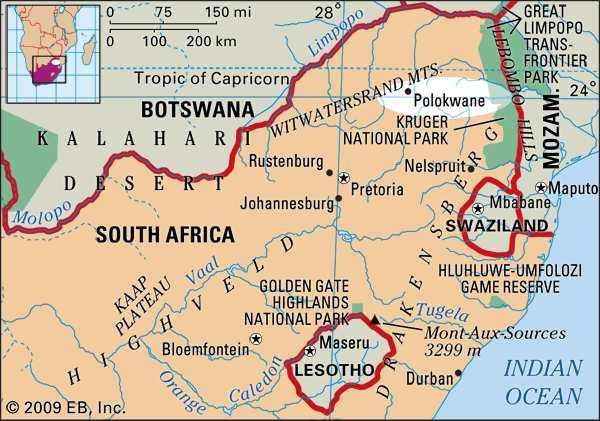
The South African Police Service (SAPS) in Limpopo are on the search for the perpetrators behind the horrific discovery of a badly mutilated body in Polokwane on Thursday 12 December 2019.
The body was found dumped in the bushes along the N1 bypass, near the Peter Mokaba Stadium. A passer-by, who came across the body, noticed some limbs were missing and called the police who then rushed to the scene.
“Upon arrival at the scene, the police were met by the gruesome scene of the badly mutilated body of a man who is estimated to be in his forties, wearing grey trousers, a blue T-shirt and black shoes”, police spokesperson Brigadier Motlafela Mojapelo said.
Provincial police commissioner Lieutenant-General Nneke Ledwaba strongly condemned the attack and called for those responsible to face the full might of the law
“The commissioner has noted the incident with shock, especially the brutality that characterised this murder and has ordered an intensive manhunt for the suspects,” the statement read.
Police are appealing to anyone with information that can assist in the arrest of the suspect(s) and who can assist in the identification of the deceased, to contact Crime Stop at 08600 10111 or the nearest police station.
Ritual murder not ruled out as motive
While Mojapelo did note that the motive was unknown at this stage, they were not ruling out the likelihood of a ritual killing and investigations into the murder are ongoing.
There have been concerns over the high number of ritual killings in the province for years, particularly of women.
Earlier in 2019, Giyani villagers discovered that the private parts of a 69-year-old Giyani man, who had been killed after being hit by a car, were missing. His family believes that he had actually been murdered as part of a ritual act.
In 2018, the headless body of a woman was found in Lulekani, outside Phalaborwa, insider her bedroom. In the same year, the Polokwane High Court sentenced two men to life in prison for the murder of a 17-year-old girl. They were reportedly arrested while trying to sell her head to a local businessman.
The dark practice of ritual murders, motivated by cultural beliefs, is usually carried out by traditional leaders and involves the removal of body parts, whether for self-enrichment or to appease ancestors.
Read this “chilling story of how a prison warden, moviemaker and con-herbalists abduct, butcher 30-year-old hunchback in Osun State, Nigeria, for money ritual.” The cold-blooded murder of an innocent man for money ritual occurred in September last year and the article was published in December.” Warning: the article contains graphic details of the heinous crime the accused allegedly committed (webmaster FVDK).
Reporters of the Saturday Sun were able to interview some of the suspects in police custody – which his amazing and raises several questions. Who authorized these interviews and why? Is this in conformity with the defendants’ rights, despite the horrible accusation against them and their alleged responsibility and guilt? What is the added value of interviewing people in detention who have not yet been tried by an impartial court?
The following article is a sad story. We sympathize with the victim and his dear ones. Once more, it is demonstrated that the belief in the power and juju obtained through ‘money ritual’ in Nigeria is widespread. We must fight against ignorance and superstition and compliment the Nigerian authorities for all efforts to help eradicating this evil from Nigerian society (webmaster FVDK).
Nigeria: Hunchback hunters
Published: December 21, 2019 By: The Sun, Voice of the Nation – Chioma Okezie-Okeh
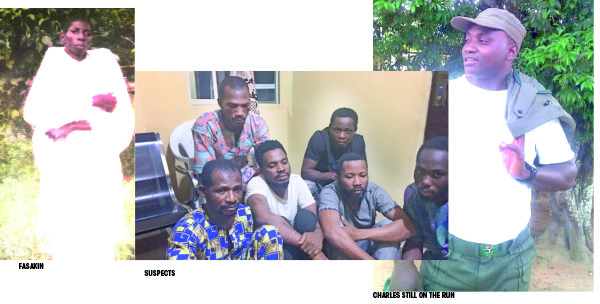
On September 15, 2019, a 30-year-old hunchback, Olusegun Fasakin, was abducted from his home at Igangan-Ijesa, Atakunmosa East Local Government Area of Osun State. All efforts by the police, his family and friends to locate him did not yield any result. His abductors never called to demand a ransom.
The truth of what became of him recently resurfaced. It was an accidental discovery by law enforcement agents tracking a suspect of a robbery case.
Since then, detectives have picked some of the suspects involved and interrogated them. The suspects sang like canaries, divulging the ghastly details. The suspects are a ragtag group of desperadoes, that include a prison warden (correctional officer) and a set of herbalists who are ex-convicts previously jailed for a similar offence.
Saturday Sun interviewed some of the suspects in police custody. Their stories add up to a macabre tale of the cold-blooded murder of an innocent man for money ritual.
Discovery by mistake
Acting on a petition by the victims of the armed robbery incident that took place in Ijesa, on October 10, 2019. Head of the Inspector General of Police, Intelligence Response Team (IRT), Deputy Commissioner of Police Abba Kyari, drafted operatives at its Osun annexe to investigate the case.
The IRT team, led by Chief Superintendent of Police Bisiriyu Akindele, tracked down one Akinyemi Oyebode who participated in the robbery. While on his trail, detectives intercepted a phone conversation between him and a prison warden. In the conversation, he was heard threatening to expose a prison warder if he fails to pay him some money.
He was grilled after his arrest, during which he made a clean breast that the incident he was talking about was the abduction and killing of Olusegun Fasakin, a 30-year-old hunchback.
Law enforcement agents consequently rounded up those allegedly involved in the crime. The suspects were identified as Akinyemi Oyebode, Jamiu Adeniyi, Isaac Ayandokun (a.k.a. Baba Niyi), Kehinde Oladokun (a.k.a. Alfa), Ojo Taiwo Olasukanmi (a.k.a. Ifa) and Mukaila Kolawole (a.k.a. Baba Beji) who all claimed to be herbalists, and Charles Adebusuiyi, a serving prison warder at the Ilesa Correction Centre.
Presently, all primary suspects, save for the prison warden, have been arrested
The search for a hunchback
Saturday Sun spoke with Akinyemi Oyebode, the suspect originally tracked by IRT operatives.
He alleged that several meetings were held inside the office of Charles Adebusuiyi at Ilesa Correctional Centre.
The 24-year-old, a native of Okemesi in Ekiti State, was a school dropout who trained as a vulcanizer, but has served time in prison, jailed in 2016 after he was found with wraps of Indian hemp during a raid by operatives of National Drug Law Enforcement Agency (NDLEA). He was released earlier this year after three years behind bar.
His family sought to straighten his life. They bought him a motorcycle so he could earn his daily bread as a commercial bike man. He soon made a lot of customers including the prison officer.
“He was one of my early customers and I normally pick and drop him in front of the prison. One thing led to another and I told him that I have spent about three years in prison. Gradually we became friends and sometimes he will invite me to come and have a drink with him,” he said.
Oyebode insisted they held several meetings in his office at the prison premises.
“This was how I got to know the likes of Alfa, Baba Beji and Ifa who are all herbalists,” he said. “One of the days that I took Charles to Sabo, I overheard them talking about doing rituals to make money. I needed money at that time so I was interested. As soon as Charles came out and we were heading back to town, I told him that I am also interested in what I overheard and he assured me that he will alert me when everything is set. I was so excited especially when he told me that he was going to pay me one million at the end of the deal.”
Oyebode admitted he knew they were going to abduct someone for money ritual only that he was not sure who the target was.
His story threw illumination on the dark deed that took place on the night of September 15.
He narrated: “Few days later Charles called me to come and pick him up that we have an important job. I took him to where his car was. Three other persons were already there. They were not the regular faces that I knew.
“When we got to Igangan Square around 10 pm, he asked us to wait, while he and the three young men went into the neighbourhood. In less than 20 minutes, they came back dragging one tall man with them. The man did not resist or shout; he was just following them like a fool. They put him in the car and drove off. Charles told me not to worry that he would handle everything.”
After waiting for some days and it was clear Charles had no intention to give him any money, Oyebode called up and threatened to tell the police what he was up to.
The warden pacified him with N18, 000. In the meantime, one of his friends invited him to join a robbery gang.
“We attacked a compound in August and raided the entire flats. I got a big phone which I sold for N16, 000,” he confessed.
That was to be his undoing, as IRT operatives who took charge of the case, tracked him down, for the robbery, and also routinely queried him about his telephone conversation with a “prison warden” he threatened.
With this background, the next logical question is, who commissioned the search for hunchback?
In their various depositions during interrogation, the suspects all claimed they were contracted by a shadowy figure, a medical doctor who promised them millions of naira in return for a real hunchback.
The answer could only come from Mukaila Kolawole, popularly known as Baba Beji. It was he who got the contract from a man whom he claims people know as a medical doctor.
The native of Iragbiji in Osun State earned a livelihood as a farmer. He was, however, jailed in the past for the killing of a hunchback. “I was framed,” he said.
He told Saturday Sun the details.
“In 2009, I was a member of Odua Peoples Congress (OPC). One of our members, known as Muritala, misbehaved and was suspended from the group. He got annoyed and formed his own local vigilante group. They were the ones who attacked a nearby village and abducted a woman with hunchback. We were at a meeting the night her mutilated corpse was found. The Muritala-led vigilante group raised alarm that we were the ones responsible for the murder. About ten of us were arrested that day and charged to court for murder. I was released last year after spending nine years.”
It was during those nine years he met Charles Akinbusuyi.
“He was our warden. He normally ‘dash’ us money. We became friends with him. He assured us that anytime names of those to be helped by government was compiled, he’d make sure my name was included.”
He was part of the inmates granted amnesty by the Chief Justice of Osun State in 2018.
Back to the business of September 15, he continued: “When I regained my freedom, I went back to farming but kept in touch with Charles. One day, he called me that he was tired of depending on monthly salary that he wanted a faster way of making money. He asked me if I knew anyone who is into money ritual and I said yes. I introduced him to some of my friends who were herbalists and they suggested to us different ways that we can make quick money. It was while we were at it that I received a call from my longtime customer and asked if I can help him abduct and kill a man or woman with a hunchback. He offered to pay us millions and I told Charles about it and he agreed to be part of it.”
It turned out that Baba Beji who claimed in the beginning of his confession that he knew nothing about hunchback killers, was the person who assembled the best hands to find a hunchback. “Millions were involved and I know that it is not a one-man thing,” he said. “I alerted my herbalist friends that I know and told them about the contract. Everyone started searching until Charles said that he knows of one in a village called Iwara where he normally goes to consult a native doctor.”
According to him, the prison warden planned the abduction. “Charles agreed to hire boys that will abduct the man,” he claimed. “He is a prison warden so he knows a lot of criminals.”
Kolawole took charge of the second part of the mission. “I assembled my fellow herbalists who would help in the killing and removal of the hump. All of us went to the area, and Charles and three other young men that I assumed are professionals, moved into the compound and asked us to wait. In less than 20 minutes, they came out with a man. The young men left and the rest of us entered the vehicle to an agreed place where we intended to slaughter him.”
Kolawole was the one who delivered the killing stroke. “When we got to a deserted area that night, I brought out my spanner, and because I knew what I came there to do, I quickly hit him on the head and he fell down. When I was sure he was dead, I used a knife to cut out the deformed part of his back.”
“We called Niyi, who is an expert in such things, to come and confirm if it was authentic.”
They received a big blow when the expert arrived and proclaimed the hump not useful because it was not a natural hump but a growth.
“We were disappointed. We had no choice but to discard the body and return to Osogbo.”
While he claimed that he had no idea what exactly the hump of a hunchback is used for, Kolawole admitted he knew native doctors use it to produce charm for wealth. “I heard that if you want good money from everywhere, that some people used their (hunchback’s) bones to make bathing soap. This is what I heard, maybe doctor [the one who commissioned the job] will explain better.”
Additional information came from Olasukunmi, popularly known as Ifa, who claimed that he was lured into the crime.
“I am a movie producer and I have successfully produced three movies as far back as 2010. During my spare time, I also do herbalist work which I learnt from my father. I am still working on one of my movies when police arrested me,” he stated.
His connection to the group was Akinbusuiyi, the prison warden.
“I knew Charles in prison when I was arrested by the police during a raid. I didn’t spend much time with them before I was released from prison,” he said.
He was present on the killing ground.
He explained his role: “On the day of the incident, I met them at the express. They asked me to help hold the torch because it was late at night, at about 11:30pm. I held the torch while Baba Beji cut him open. I was not the one who killed him.”
Ifa tried to distance himself from the murder, saying: “I am a herbalist and my stock-in-trade is assisting fraudsters to be successful.”
He explained he got entangled in the plot hunchback plot. “Baba Beji came to me and asked if I knew where we could get a man or woman with a hunchback. I told him to leave me alone as I was not into any money ritual. He called me one day to join him and I asked him what it was. He said that one of his friends who can pay very well wants to see me. I thought he was real till we got to the forest,” he narrated.
He tried desperately to justify his role: “I was scared, that was why I joined him. I know how these things work out ––if I don’t join them, they will kill me.”
Baba Niyi is the expert in the group, the man who could identify the hump of a natural hunchback.
He, too, once spent time in Ilesha prison. He was one of the vigilantes that were jailed alongside Baba Ibeji over the killing of a hunchback.
He, also, knew the man who commissioned the job. “I have known the doctor for many years. He normally asked for herbs. This was why he asked me to go and cross-check. I went there and discovered that it was not real,” he said.
Baba Niyi insisted on his innocence. “I did not follow them to kill anyone,” he submitted.
What became of the body?
They claimed the remains was dumped inside the bush along Osun-Ibadan expressway.
The fugitive prison warden
Charles Adebusuiyi, the prison warden, has since vanished into thin air. His office, Nigerian Correctional Services, confirmed no one has seen him at work since the case broke out. He has been declared wanted by the police.
From others’ confessions, it was he who allegedly contracted the services of the abductors –Emmanuel, Kazeem and another popularly known as MTN – to go to Igangan and abduct the victim. The three abductors, presently on the run, are suspected criminals who were once inmates at the Ilesa correction al center, where Adebusuiyi was a warden until he became a fugitive.
The victim’s family
Saturday Sun spoke with one of the relatives, Olatunji Fasakin, who was at the police station.
“I am his nephew and we live at Igangan-Ijesa, Osun State,” he introduced himself.
According to him, the family had given up hope of finding when they heard that IRT operatives had cracked the case.
He gave his side of the story thus: “On September 15, 2019, around 6 pm, I left to the forest to hunt. At about 8 pm, my wife called me that they have kidnapped my nephew and urged me to hurry back home. Upon my return, I met his mother and grandmother in tears. They told me four men took him away on a motorcycle. I took my motorcycle and drove towards the direction they were heading. When I got to Iwara junction, the persons that I met said that they have left and that some of the villagers who tried to stop them were beaten up. I returned to the village and reported the matter at Igangan police post.”
Although, some community members who heard of his abduction had rightly deduced that he was picked because of his hunched back, the family, nonetheless, had hoped his abductors would, in time, call to demand a ransom.
“But they never did,” he said, “When we couldn’t find him, everyone assumed that he was used for money ritual.”
He explained why his cousin was not a natural hunchback: “He had been sick right from birth, the constant ill-health affected his growth and he was no longer walking properly. Anyone that saw him would assume he had a hunchback. He wasn’t a hunchback.”
On how they got the news of the arrest of his abductors and killers, he said: “A family friend at Ayesan police post informed us that it was IRT Osun that arrested them.”
He said the family is still in mourning, stating, “but now we know what really happened to our brother.”
The family pleaded with the police to help them find his remains so that they can give him a befitting burial.
The following article, published by the Sunday Mail in Zimbabwe in late December 2019, is strictly speaking not about ritual killing or a specific ritualistic murder case. However, it has everything to do with the subject: superstition and the use of rituals using human body parts. It is a shocking account of a thriving market for human body parts. The interviews, and apparently also the investigations, have taken place in Zimbabwe, yet there is no reason not to believe that similar practices may be reported from other countries.
As the articles also concludes: ‘In Zimbabwe and other parts of the world, trading in human body parts is illegal.’ Hence, it is up to the government(s) to maintain the law (webmaster FVDK).
Inside the thriving human body parts market
Published: December 29, 2019 By: Sunday Mail, Zimbabwe – Emmanuel Kafe and Simbarashe Manhenda
Human body parts, according to sources and a pathologist, can also be harvested during post-mortems.
HUMAN body parts, mostly fingers, internal organs and private parts, are being sold by syndicates made up of mortuary attendants and security guards, investigations carried out by The Sunday Mail Society have revealed.
Information gathered revealed that the syndicates are conniving to harvest the body parts from mortuaries without the knowledge of the deceased’s families.
Investigations revealed that the body parts are much sought after and literally cost an arm and leg.
Water used to clean corpses, which is believed to be used in the preparation of juju used in housebreaking, is also in great demand.
As a result of the high demand, the water and body parts are only being sold in foreign currency.
The Sunday Mail Society’s investigations revealed that there is a ready and thriving market for the human body parts and water.
Among those that are acquiring the parts from the morgues are traditional healers, prophets, sex workers, criminals and businesspeople.
Apparently, acquiring human body parts can be as easy as ordering pizza.
A phone call and a little bargaining is all that it takes. After agreeing on a fee, the deal is sealed.
From the interactions with those involved in the illegal and unusual trade, it is clear that the syndicates are making a killing.
After getting a tip-off from a security guard who was once part of the human body parts’ cartel, The Sunday Mail Society crew went underground and pretended to be genuine buyers.
Following the tip-off, we approached one of the security guards manning the premises of a well-established funeral parlour in Harare.
Posing as traditional healers, we enquired from him how we could get certain human body parts.
We also asked about the prices.
The security guard, whom we were later told is paid a “commission” by the mortuary attendants for linking them with buyers, did not even attempt to exercise caution.
Without hesitation, the security guard gladly gave us the mortuary attendant’s contact details, saying his colleague would gladly help us.
After contacting the mortuary attendant, who was expecting our call, a meeting was promptly arranged.
The meeting took place at a local eatery.
From our deliberations with the mortuary attendant, we gathered that human private parts can be sold for as much as US$ 500.
Internal organs such as the heart were pegged at more than US$ 1 500.
The mortuary attendant, who remained composed and relaxed as if he was negotiating the sale of a heifer, explained how the body parts are harvested.
“The parts are mostly removed when the bodies are cleaned in preparation for burial,” he explained, adding that harvesting external body parts was often a challenge since relatives usually inspected the bodies of their departed loved ones.
“However, there is no risk in harvesting internal organs such as the heart and lungs since relatives of the deceased rarely inspect those parts of the body. Those ones are easier to get,” said our source.
In addition, he also said bones and teeth could be “easily obtained’”
But despite that, external organs such as the eyes, breasts and private parts were in great demand.
Also in demand is the water left after washing corpses.
Criminals, among them armed robbers and burglars, are believed to use the water as juju or to induce heavy sleep among house occupants.
According to sources, the water is mixed with juju to produce a concoction which criminals believe will protect them during their escapades
A 500ml bottle of the water was being sold for US$ 200.
It is widely believed that if the water is sprinkled on the door of a targeted house, the victim will fall into a deep slumber, resulting in the robbers ransacking their homes.
Mbuya Alice Nhemachena, a traditional healer, said the water was in great demand.
“The water can be used to make it easier for burglars to steal. Criminal elements can fork out a fortune to get hold of this water. It can also be used to make love potions,” Mbuya Nhemachena said.
Sekuru Friday Chisanyu, another traditional healer, said stealing and selling human body parts is a form witchcraft.
“Some traditional healers tell their clients to bring ‘a warm heart, freshly pulled out of a person’. People who engage such traditional healers want easy money and will end up engaging in ritual murders,” Sekuru Chisanyu said.
“But some people approach us saying they are now being tormented by avenging spirits after buying human body parts,” he said.
So who are the victims in this macabre scam?
According to sources, accident victims are the most common victims of human body parts’ theft.
For accident victims, relatives normally cannot tell whether missing body parts was lost during or after the accident.
Dr Edwin Muguti, a former Deputy Minister of Health and Child Care, said it was possible for one to steal human body parts during a post-mortem.
“It is possible for pathologists, mortuary attendants and security guards to illegally harvest body parts. Such laws as the Human Tissue Act and the Anatomy Act were enacted to deter such practices,” Dr Muguti said.
But Mr Talent Nharara, the operations manager at Foundation Funeral Services, said he was yet to come across such criminal cases.
“I have heard about such things, but I am yet to come across such cases. However, it might be possible for body parts to be harvested during embalming and when the corpse is being washed. The fact that people always talk about this means that such things might be happening,” Mr Nharara said.
The human body is usually washed, embalmed and dressed up in preparation for either burial or cremation.
But according to Mr Nharara, the water used in cleaning corpses is disposed of in a manner which makes it almost impossible for one to collect it for sale.
“The water is disposed of using special drainage pipes. Like I said before, I am yet to come across people who siphon such fluids, but that does not mean that the fluids are not being siphoned off,” added Mr Nharara.
He was, however, not at liberty to reveal exactly how the water is disposed of.
Mr Taka Svosve, Zimbabwe Association of Funeral Assurers’ (Zafa) general manager, said there was much speculation regarding the harvesting of human body parts. “From our investigations, nothing of that sort is happening. Some fraudsters might actually be selling ordinary water, which they claim to have come from mortuaries.”
“Our people are professionals and we make sure that such acts are detected. Just like any other professionals, those that work in morgues adhere to stipulated rules,” Mr Svosve said, adding that there was need for the public to be educated about the role of morticians and undertakers so that society can get to understand how they work.
Zimbabwe Republic Police national spokesperson Assistant Commissioner Paul Nyathi said no such reports hadbeen made to the police.
“I cannot comment on that one at the moment. There is need for investigations and verification,” Ass Comm Nyathi said.
In Zimbabwe and other parts of the world, trading in human body parts is illegal.
The recent disturbances in Zambia have given rise to many articles in local, regional and international newspapers. To cite them all would be an impossible task, I will not even attempt it here. Below I reproduce a kind of summary given by Home Affairs Minister Stephen Kampyongo. Of course, I realize that he is a high placed Zambian official (politician) who might be interested in the political correctness of his statement, or having – understandable – political objectives. However, his Ministerial Statement before Parliament provides us with enough elements to be relatively well informed about the recent incidents which occurred in many places and regions of his Southern African country. Besides, it is interesting to note the ‘definition’ of ritual murders which he gives us: ‘(….) I wish to state that the term ritual killing means slaying a human being to appease deity. In short, victims of ritual killing are found with certain body parts missing from them for suspicious ritual use. (…)’
The article is reproduced here for various reasons. First, it shows the willingness and determination of the Zambian authorities to maintain the law. Secondly, it gives insight in the fear of local people and the reason why mob justice occurs. Furthermore, it establishes – once more – the fact that ritual murders have not been eradicated from Zambian society and, finally, it shows the nowadays complex nature of this phenomenon with the mixture of traditional beliefs, superstition and outright criminal behavior which characterize ritualistic killings, in Zambia as well as other countries.(webmaster FVDK).
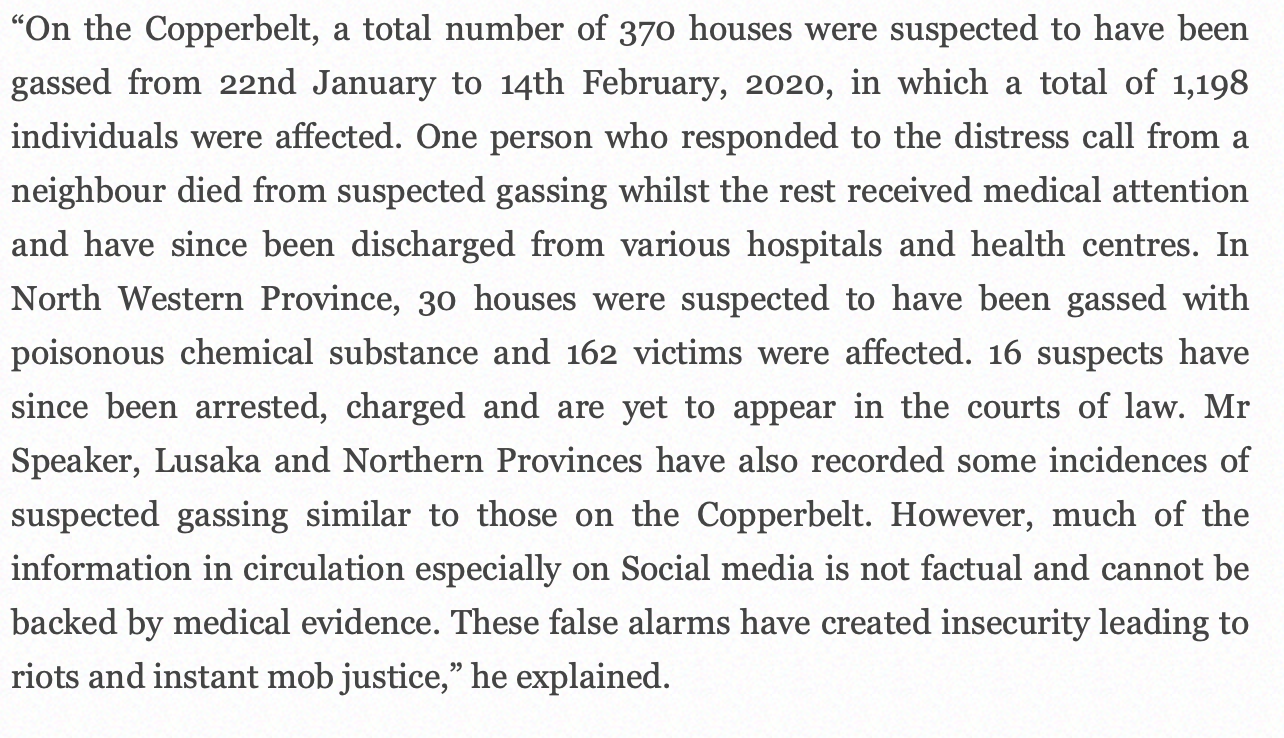
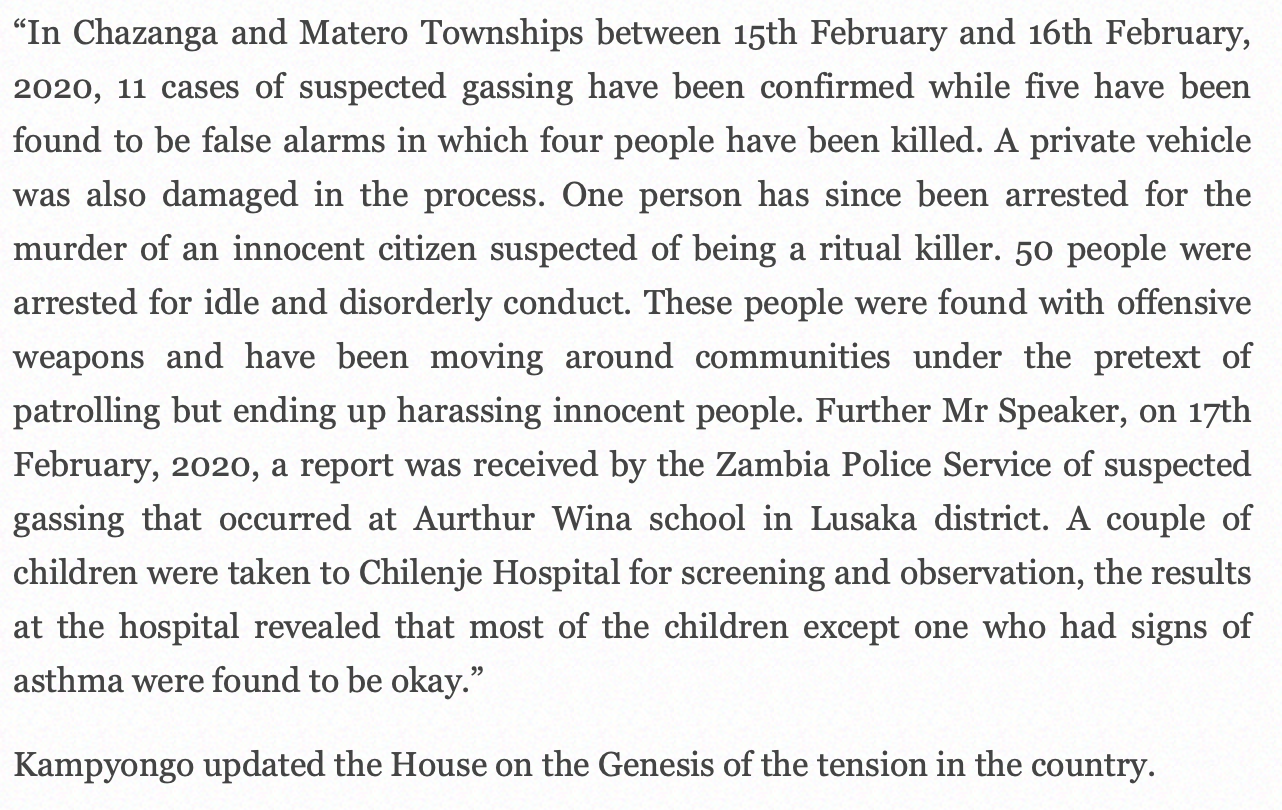
‘370 households, 1198 people affected by gassing so far’ – Home Affairs Minister Stephen Kampyongo