The article below is a follow-up to another article by the same reporter, Chris Phiri, in the same newspaper, Zambia Reports, which was earlier published on March 26, 2020 (my posting of March 29, 2020).
Though I haven’t included the comments of readers below, it’s worth reading what the readers think about this disgusting murder and the Zambian police authorities (see the original article – webmaster FVDK).
Body Of Murdered Albino Still Unclaimed
Picture not related to news story
Published: April 5, 2020 By: Chris Phiri – Zambia Reports
The Eastern Province police command has expressed concern over the delay by the relatives of an albino who was found dead without some body parts on March 24. The body was without a tongue, arms and eyes.
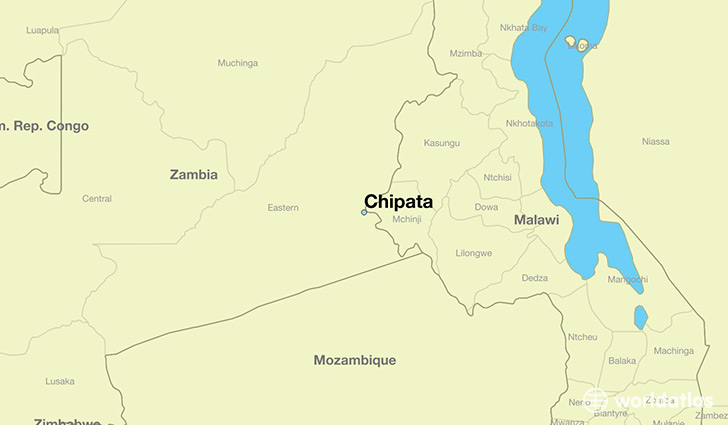
Provincial police Commissioner Luckson Sakala said the body had remained unclaimed and is currently at Chipata Central Hospital mortuary.
Mr. Sakala said police suspect that the deceased was taken from somewhere and was just dumped in Chipata. He is appealing to members of the public who could be missing a relative to come forward and identify the body.
The body of the deceased was found near Yamene Farms along the Chipata/Lundazi road.
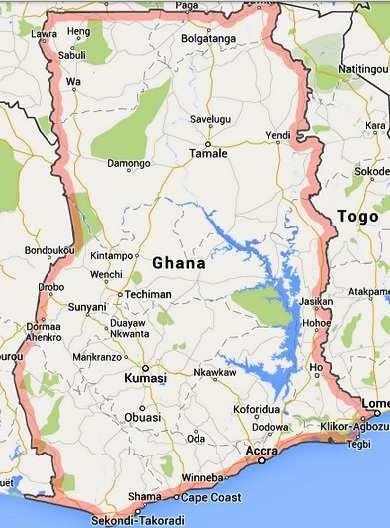
Ghana has a fairly good reputation, both on the African continent and beyond. This positive reputation mainly applies to the state of the economy and the country’s political affairs. (This has not always been the case. Notably in the 1970s Ghana offered a very different outlook. It is thanks to flight-lieutenant-turned-president Jerry J. Rawlings – and the two Bretton Woods Institutions (BWI), World Bank and the IMF – that Ghana nowadays is what it is). However, superstition is rampant in the country. I drew attention to it at earlier occasions. See my posting on the work of Anas Aremeyaw Anas and Seamus Mirodan, both fighting infanticide in Ghana as well as Burkina Faso, Benin and Nigeria (June 4, 2018), and the activities of Seth Kwame Boateng and Jospeh Asakibeem (June 23, 2018), also fighting ritual baby killing in this West African country.
The article below treats the fate of women who are accused of witchcraft, sometimes triggered by jealousy and criminal intentions, sometimes based on superstition and a belief in the supernatural powers which the victims of the repression and mob justice are supposed to possess. Fortunately, the women are being rescued by a group of benevolent nuns, but shouldn’t it be better if these age-old practices and belief in witchcraft cease to exist? (webmaster FVDK).
Women accused of witchcraft in Ghana find refuge in outpost run by sisters
Vivian Salamatu, outside her house, relates how she escaped death from angry villagers who had accused her of killing her brother-in-law. (Doreen Ajiambo)
Published: April 13, 2020 By: Global Sisters report – Doreen Ajiambo
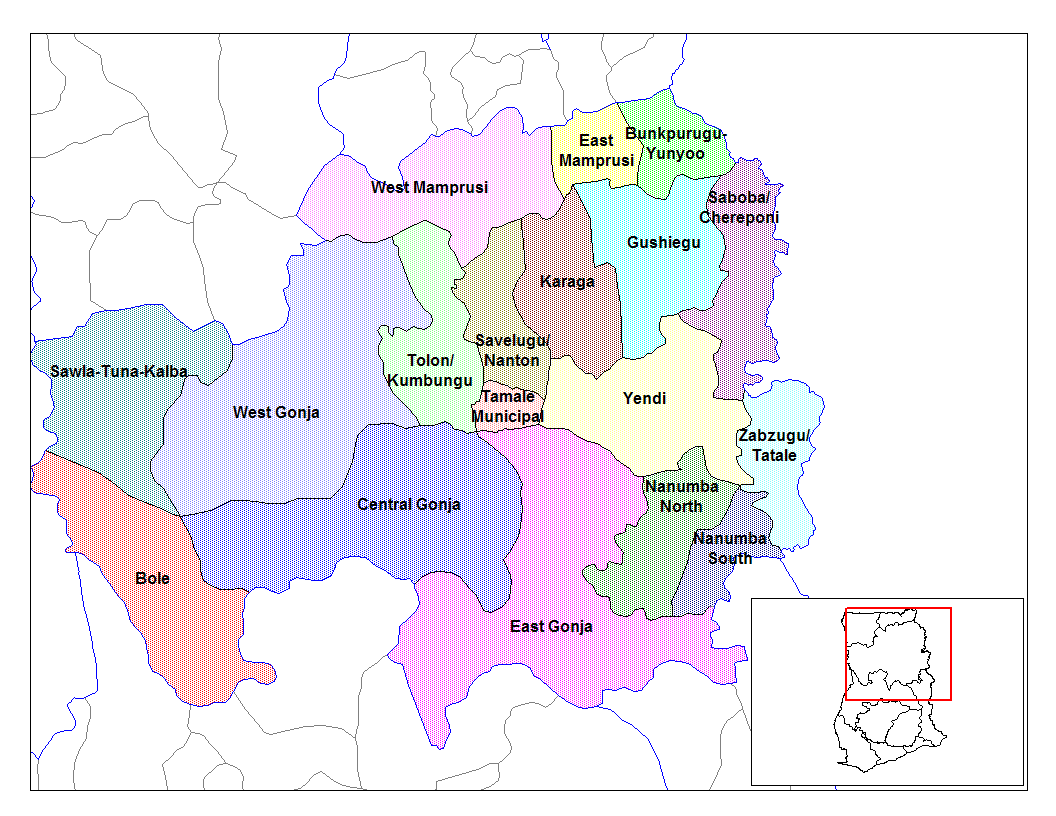
GUSHEGU, GHANA — Vivian Salamatu and 200 hundred other women here are bound together for life. They share each other’s misfortunes and all have a similar story. They were accused of witchcraft, beaten, cast out and sent to “witch camps” that serve as havens.
“When my nephew died after a short illness, everyone hated me,” Salamatu explains in Dagbani, her native language. “My brothers-in-law said I was responsible, they accused me of being a witch.”
Dozens of elders and villagers gathered at her home to determine her innocence or guilt. One of the elders participating in the ritual test grabbed a chicken, slit its throat and flung it overhead. After it finished struggling, the chicken fell head first and died face down.
It was clear by the village standard she was a witch.
“If the chicken had died face up, then I would have been declared innocent of witchcraft,” said Salamatu, 39, a mother of three. “That night, villagers led by my brothers-in-law attacked me with machetes and set fire to my house. They wanted to kill me with my children.”
Her attackers, who had tied her up with a rope, were intercepted by nuns and local authorities. She was rescued with her children and taken to Gushegu “witch camp,” located in the north of the country.
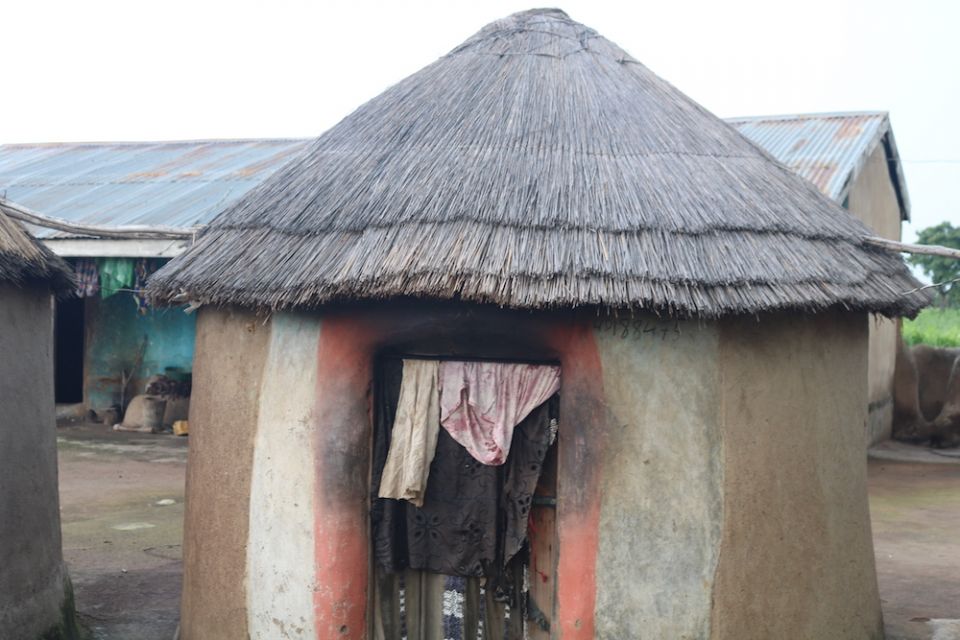
One of the mud huts where women accused of practicing witchcraft live in the Gushegu camp of northern Ghana (Doreen Ajiambo)
“I can’t believe I’m alive today,” she said, noting that the allegations came barely a year after losing her husband in a road accident. “I had no one to protect me from the angry villagers. But I want to thank God and the sisters who came and rescued me. It was a miracle!”
Salamatu is among hundreds of women who have been rescued by the Missionary Sisters of the Poorest of the Poor and taken to Gushegu. The refuge, which is run by Sr. Ruphina Anosike and other sisters, provides homes to women accused of witchcraft. Anosike also cares for the homeless by providing meals and other necessities such as medical care and education for their children.
The immense majority of these women are widows with children. They have been accused by relatives, or sometimes by a competing wife, neighbors or village elders, of witchcraft, mainly of killing their husbands or other family members, said Anosike.
“It’s heartbreaking to see that these women suspected to be witches are no longer needed in their families and communities,” she said, noting that her camp, which accommodates more than 200 women, has become a safe haven for widows accused of witchcraft. “They stay here because they have no place to go, no food to eat, and no one cares for them.”
The motive to call someone a witch
Anosike notes that the chief motive behind such acts is often greed, and labeling these women as witches becomes a means of taking away their husbands’ wealth. Camp residents also include mentally ill women and children who are considered outcasts in Ghana, she said.
Salamatu agreed there is a motive.
“My father-in-law wanted to take cows, land and some money that my husband had left, and I refused,” she said, adding that her husband’s relatives became hostile to her and toward her children. “They later accused me of practicing witchcraft so that I could be chased away and leave them everything. One of my neighbors told me they held a meeting to discuss how they could chase me away so that they would be able to take my properties.”
Thousands of women and their children in northern Ghana have been left homeless after being accused of witchcraft, according to a 2018 report by the U.S. State Department. The report indicates that there are more than six witch camps spread throughout the northern region, holding 2,000-2,500 adult women and 1,000-1,200 children.
There is a widespread belief in witchcraft in the West African nation, according to 2009 Gallupsurveys, despite 96% of the population declaring themselves to be active worshippers in one of several world religions. The belief in the phenomenon has devastating consequences. Elderly women believed to be witches are often persecuted, ousted from their homes or even murdered. Their children are also cursed and not allowed to go back home after they have grown.
Though both men and women can be accused of witchcraft, the vast majority are women. Men are considered to have a strong socio-political base and are therefore better able to successfully contest the accusations leveled against them, knowledgeable observers say.
The witch camps are unique to northern Ghana. However, the West African nation shares with other African countries an endemic belief in witchcraft, with drought, death, poor harvest, illness and other natural disasters blamed on black magic.
Screenshot of the GSR video of sisters and women at the Gushegu camp in northern Ghana (credit: Doreen Ajiambo). Click on the picture in the original article (see source below) to watch the video.
The situation has prompted religious sisters in this part of the country to provide residential shelter for the women and children shunned by relatives. Anosike depends on supporters to build homes at the camp and she pleads for food, clothing, bedding and other necessities from neighbors and passers-by.
“I actually go out every morning to beg for food for these women to ensure they have something to eat,” said Anosike. “The bishop also helps us very much, especially with food and money to run the camp. These women also survive by collecting firewood, selling little bags of peanuts or working in nearby farms.”
A superstition that sticks
Witchcraft is a stubborn phenomenon in African cultures, experts say. Witches and wizards are thought to possess intrinsic and supernatural powers that are used to create evil. Many seek out the services of witchdoctors and wizards to find solutions for their relationships, troubles and even for good health. However, the practice has for years also had its negative side. In worst-case scenarios, such beliefs lead to murder and destruction of the accused witches, they said.
“The belief in witchcraft is deeply entrenched in Africa culture and dictates people’s lives,” said Charles Nzioka, a professor of sociology at the University of Nairobi in Kenya. “Witchcraft is in people’s minds. If someone loses a job, Westerners assume that it’s due to economic conditions or poor performance. An African is likely to say that someone used witchcraft to make or confuse an employer to hate and sack the person concerned.”
Nzioka said that the belief in witchcraft in Africa is intended to keep order in society; any deviation in behavior may lead to an allegation. As in Ghana, women who do not want to conform to society’s expectations may fall victim to the accusations of witchcraft, he said.
“For instance, when a woman accumulates wealth and becomes independent, she deviates from local norms that recognize only men to own wealth, and as such she becomes a target,” said Nzioka. “Sometimes women are targeted by relatives of the husbands in order to inherit their son’s wealth.”
Nato Blenjuo, who has lived at Gushegu camp for the last two decades, explained how she escaped death by a whisker after villagers claimed she had used witchcraft to kill her ailing husband. A post-mortem was reportedly held, establishing that her husband died of malaria, she said. Malaria has continued to be the leading cause of death in the country, according to 2018 data of the Centers for Disease Control and Prevention.
“They really wanted to kill me,” said the 66-year-old widow who lives in one of the huts made of mud, sticks, grass, cow dung and cow’s urine. “My stepson led other irate villagers with machetes to attack me at night. They set my house on fire, but I was lucky to escape with my three children into a nearby bush and I made my way to this camp.”
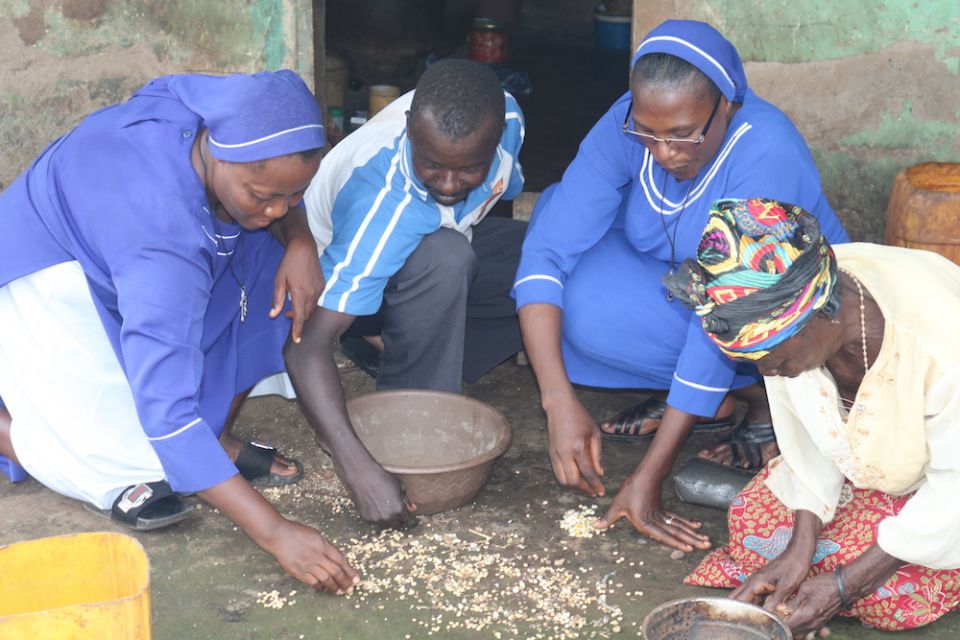
Srs. Ruphina Anosike, left, and Monica Yahaya, second from right, help sort out the grains that had been swept from the market by women accused of witchcraft in Ghana. These women survive by collecting firewood, selling little bags of peanuts or working in nearby farms. (Doreen Ajiambo)
Sr. Monica Yahaya said that women are seen as the most vulnerable members of the population and are therefore often labeled as witches because of their inability to contest the accusations. This explains why there are no men at the camps and women are predominantly the victims, she said.
“The problem here is that relatives cannot allow widows to inherit their husband’s possessions,” said Yahaya, who works with Anosike at Gushegu camp. “They will definitely look for a reason to accuse them and then send them away from their homes in order to take properties left by their dead husbands. Without a husband, these women really have no way to defend themselves after such an accusation.”
Osei Ekow, an elder, denies that greed is the impetus behind calling someone a witch. He says the villagers rely on the traditional slain chicken ritual to determine whether a woman is a witch.
“That’s our culture, and we must respect it,” said Ekow, 75, who says he has witnessed tens of thousands of widows being sent away from their homes. “There’s no way that ritual can be wrong. These women taking refuge at the camps are all witches because it was culturally confirmed.”
The government has on several occasions tried in vain to close down the camps in a bid to discourage attacks on women. Officials contend the very existence of witch camps encourages people to levy allegations of witchcraft knowing that the women they accuse will find refuge at the camps.
“People should stop accusing and harassing innocent women of witchcraft,” said Issah Mahmudu, a government official who oversees the Legal Aid Department in northern Ghana. “We want to encourage suspected witches and wizards who have been harassed to report to the police so that investigations begin. The law protects every citizen.”
Mahmudu said the incidents of witchcraft accusations have recently declined but encouraged local chiefs to dispel outdated cultural practices that are injurious to others.
“These women are vulnerable, that’s the reason they are attacked,” he said. “The chiefs should arrest any person committing offenses that are recognized under the law. The laws of this country condemn dehumanizing the fundamental human rights of all citizens.”
Anosike and other sisters are trying to shape the way people think about witchcraft. They conduct weekly seminars in various villages to campaign against ongoing violence on women, educate the public about the myths that surround witchcraft, rehabilitate and reintegrate women into their homes, and call for an end to the persecution of alleged witches and to superstition.
“Cases of women being chased away from their homes have of late been reduced as a result of the ongoing campaign, but more needs to be done,” she said. “We are going to continue educating people in the villages to ensure women live freely without fear of their rights being abused due to the belief in witchcraft.”
However, victims of the attacks call for more to be done.
“I have never been a witch, I don’t know how witchcraft works,” said Salamatu. “Men should treat us with dignity because we are all human beings created in the image of God.”
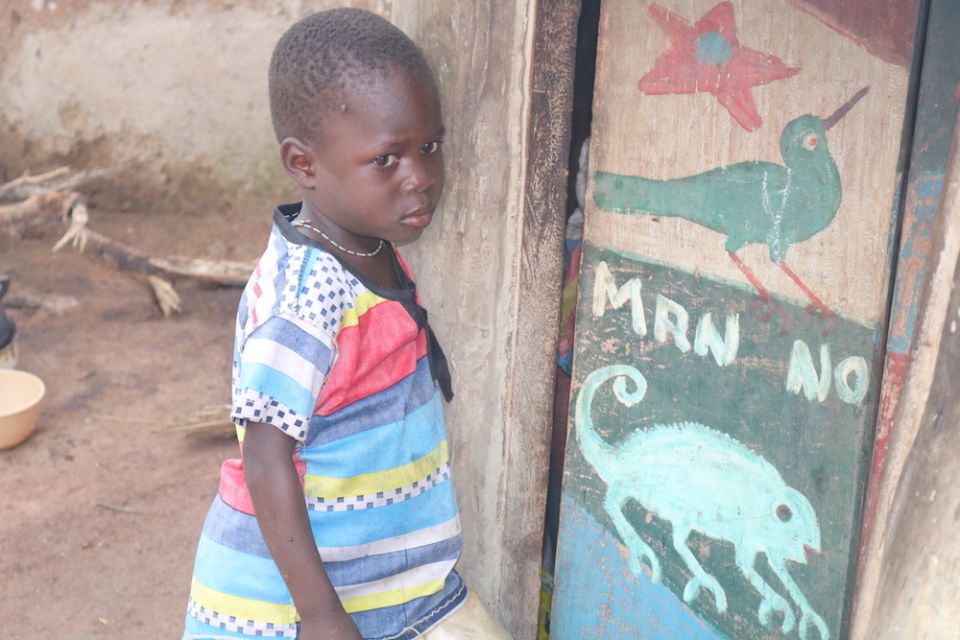
A child stands outside her mother’s hut house at Gushegu camp. Her mother was accused of killing her husband. (Doreen Ajiambo)
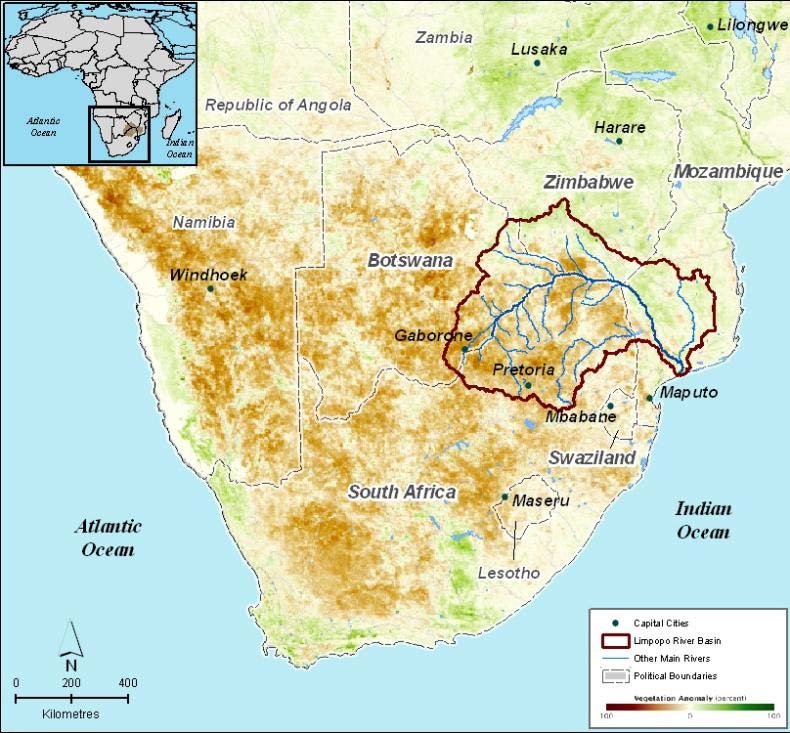
Beware, suspicion alone does not count! However, a dismembered body is an indication that a muti murder may have been committed. The truth is that muti murders do occur rather frequently in the region, notably Limpopo Province (webmaster FVDK).
Limpopo police arrest suspect wanted for serious crimes, including body dismemberment
Published: April 8, 2020 By: The Citizen (South Africa)
It is alleged that the man committed the crimes between 2015 and 2019.
A 32-year-old suspect wanted for a string of serious and violent crimes that include rape, burglary and the murder of a man whose body was dismembered, has been arrested.
The arrest was made in Sterkfontein, outside Groblersdal, Limpopo police said on Tuesday.
It is alleged that the man committed the crimes between 2015 and 2019.
In one of the incidents in Legolaneng on 28 September 2016, police were alerted to a murder.
Police spokesperson Brigadier Motlafela Mojapelo said: “On arrival at the scene, they found the body of a man with multiple injuries and some body parts missing. He was later identified as Thabitha Makola, then aged 62.”
The motive for the killing is unclear but police are investigating whether it was a ritual murder.
“The suspect was subsequently arrested through forensic investigations that followed and was further linked to other four cases of rape and three [of] burglary residence in the area,” Mojapelo added.
The suspect is expected to appear in the Nebo Magistrate’s Court on Thursday.
Allegedly, the eighth (such) killing since 2010. If true, it’s a crying shame. Will it ever stop? People living in fear. Perpetrators who go unpunished. The rule of impunity. And WHY??? (webmaster FVDK)
Girl, 13, found dead in Kisumu in suspected ritual killing
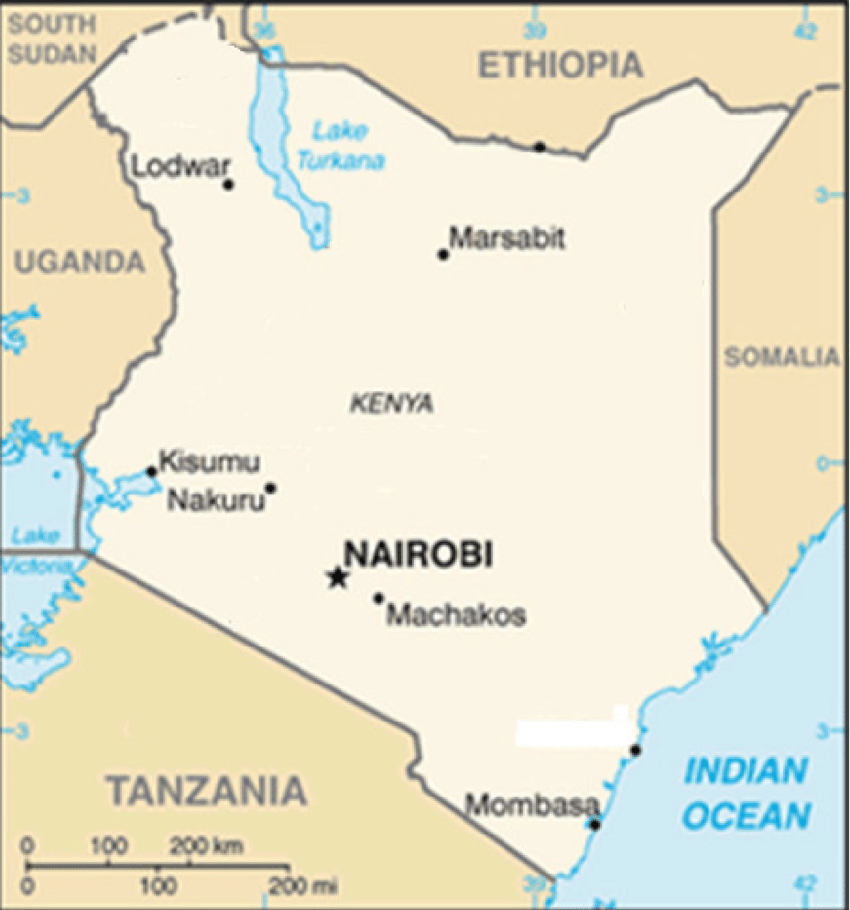
Residents at the scene where the body of a 13-year-old girl was on April 4, 2020 found dumped in Nyahera, Urudi village in Kisumu County. PHOTO | VICTOR RABALLA | NATION MEDIA GROUP
Published: April 5, 2020 By: Daily Nation – Victor Raballa
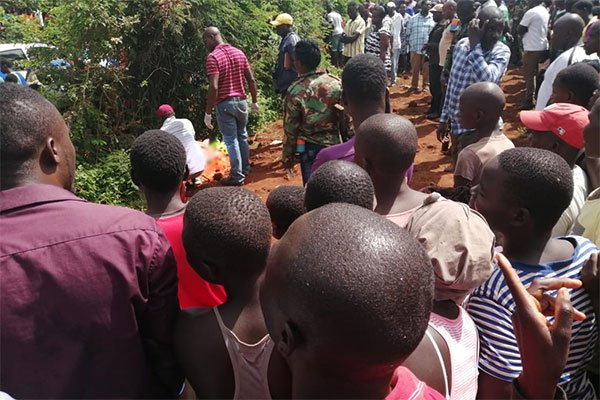
There was chaos on Saturday morning in Nyahera, Kisumu County after police lobbed tear gas canisters as they sought to carry away the body of a 13-year-old girl who was found brutally murdered in a suspected ritual killing.
Angry residents had protested and resisted an earlier attempt by the police to carry away the mutilated body of the Class Seven girl who is alleged to have disappeared at 1pm on Friday, shortly after delivering drinking water to her mother who was tilling her land a few meters from their home.
Residents suspected her murder is part of a ritual killing, citing seven other cases in which they claimed girls aged between eight and 14 years are targeted.
UNRESOLVED MURDERS
The angry residents had protested that police have not resolved past cases.
Ms Martha Auma, the girl’s mother, said she got alarmed at 6pm when she returned home only to find that her daughter, Tabitha Akinyi, had not returned.
“When I came back home, her siblings told me they had not seen her and thought she was helping me in the farm,” she said.
She immediately informed the chief who initiated a search around the village.
“I could not sleep at night and spent most of my time outside my house hoping she would come back,” said the tearful mother.
She woke up at 5.30am in the morning and went to check if Akinyi had decided to sleep at her friend’s home in the neighbouring village.
“However, on my way back, my heart sank when I heard some people wailing next to my home,” she said.
MUTILATED BODY
She dashed to the scene where she found the badly mutilated body of her second born child lying by the roadside, 200 meters from their house.
The body of Akinyi, a Standard Seven pupil at Ogada Primary School, was discovered by a passer-by who raised the alarm.
It is believed that the girl, who was strangled and had injuries on her face, was killed elsewhere and her body dumped at the scene where it was found.
For over six hours, hundreds of residents prevented the police from collecting the body as they complained over the rise similar incidents.
“This is now the eighth [such] killing since 2010,” said Mrs Grace Onyango who called on the police to urgently investigate the mysterious murders.
GIRLS TARGETED
“We have had enough of this and we will not allow our innocent children to be butchered like animals. There is no need for the police to carry the body since they have so many unresolved cases pending,” said Mr Charles Otieno.
He termed the killings as unusual as the perpetrators only target girls aged eight to 14 years.
“This is [probably] some kind of ritual which must be busted by law enforcement agencies before we take the matter into our own hands,” he said.
Police officers who arrived at the scene were forced to get backup to repulse the villagers who thronged the scene.
Kisumu County Police Commander Ranson Rolmodooni assured the residents that his officers will get to the bottom of the matter and ensure all those involved are arrested.
The body of girl was taken to Jaramogi Oginga Odinga Teaching and Referral Hospital mortuary to await post-mortem.
Incredible news comes to us from Uganda and – maybe even worse – it is not even NEW news. This has been going on for years. According to the 2013 Child Sacrifice and Mutilations report, one child is sacrificed every week. A human sacrifice!
Recently, we have noted a surge in the frequency of ritual murders in Uganda. Read the article below. One wonders why the Ugandan law enforcement authorities do not step up efforts to wage war on the traditional healers who are allegedly implicated in this repulsive practice which thrives where ignorance and superstition rule (webmaster FVDK).
Why Kayunga is an epicentre of human sacrifice, murders
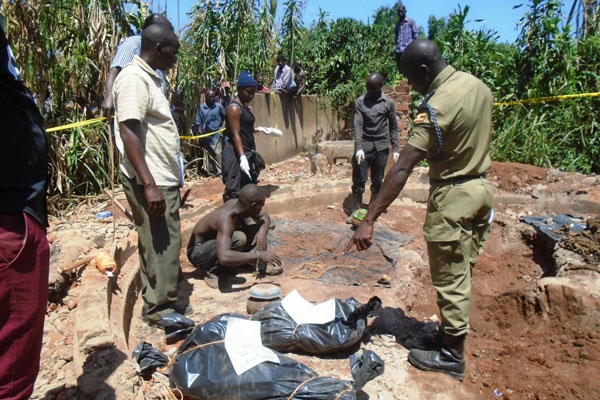
Police at the demolished shrine where bodies were recovered in Kisoga Village, Kayunga District in September 2018. PHOTO BY FRED MUZAALE
Published: March 26, 2020 By: Daily Monitor – Fred Muzaale
Residents of Kakoola Village, Kitimbwa Sub-County, Kayunga District are recovering from shock they suffered after one of their own was beheaded last week.
Tarsis Mutesasira, 60, was beheaded on March 17 and his head taken by unknown assailants.
Residents discovered Mutesasira’s torso lying in a pool of blood in the bedroom. A week later, police are still hunting his killers.
On the fateful day, neighbours say the deceased, who lived alone in his small house, spent the entire day in his garden tending to his crops.
Preliminary police investigations indicate that Mutesasira murder was an act of human sacrifice and two traditional healers have since been arrested to help police with investigations.
Both suspects practise their trade in Kitimbwa Sub-county.
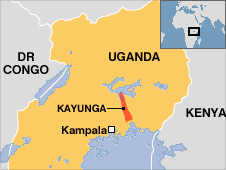
Mutesasira’s murder is one of the several acts of human sacrifice cases that have occurred in r Kayunga District about 60kms from Kampala city.
Mr Isaac Mugera, the officer in-charge of the criminal investigations in Kayunga District, says they do not know why Kayunga continues to register many cases of murders linked to human sacrifice.
He, however, says the big concentration of traditional healers in the district could be the cause of such increasing acts.
“There are more than 200 traditional healers in this district and our preliminary investigations revealed that many are fake, which could be the reason they engage in unlawful acts,” Mr Mugera says.
He adds: “We have tried to register all the native doctors in the district with a view of weeding out the fake ones but it seems we have not yet succeeded.”
Similar incident Mr Mugera cites a September 2018 incident when traditional healer Owen Ssebuyungo, 27, a resident of Kisoga Village in Nazigo Sub-county, Kayunga District was arrested on charges of human sacrifice.
Security operatives recovered five bodies from his shrine. The bodies were recovered from shallow graves each containing a Shs5,000 note.
The suspect is on remand at Luzira prison and hearing of the case at Mukono High Court is ongoing.
Mr Mugera adds that given the strategic location of the district, wrongdoers from Nakasongola, Kamuli, Luweero, Mukono and other neighbouring districts find it easy to hide in the area and commit such heinous acts.
“It is surprising that many people go to traditional healers when they fall sick, even when their ailments can be treated by medical personnel,” he says.
Mr Mugera reveals that since this year began, police have recorded a total of nine murder cases.
He, however, explains that two of these are suspected to have been acts of human sacrifice.
Last year, a total of 35 murder cases were registered in the area while 29 murder cases were recorded in 2018.
“As police, we have been successful in prosecuting the suspects in most of these cases because there is overwhelming evidence to pin them,” Mr Mugera notes.
Mr Tom Sserwanga, the Kayunga District chairperson, says acts of human sacrifice are rampant in the greater Mukono area that includes Buikwe, Mukono, and Buvuma districts.
“Many people in these districts believe in witchcraft and when they fall sick, they go to witch doctors for treatment,” Mr Sserwanga says.
According to the 2013 Child Sacrifice and Mutilations report, one child is sacrificed every week compared to the seven cases of child sacrifice reported to Uganda Police in 2011. The report adds that people carry out human sacrifice seeking wealth and fortune, among others.
The Kayunga District traditional healers’ association chairperson, Mr Badru Ssemisambwa, however, dismisses the claims that traditional healers are involving in acts of human sacrifice.
“No genuine traditional healer can kill a person. Those who murder people are fake and only masquerade as healers to make money,” Mr Ssemisambwa says.
He says they have in the past three years cooperated well with police to arrest and prosecute quack traditional healers but many others keep joining the trade.
“We are planning a fresh registration of all traditional healers and those without proper documents will be arrested and prosecuted,” Mr Ssemisambwa says.
Way forward The Kayunga Resident District Commissioner, Ms Kikomeko Mwanamoiza, says they are working with local leaders and security organs to wipe out the vice.
Ms Mwanamoiza expressed concern over the rampant acts of human sacrifice in the area, adding that there is need to sensitise residents.
“ It is a pity that a big number of people spend most of their time visiting shrines and some are forced to part with their hard-earned money in the name of pleasing their gods,” she says.
Background Call for regulation. The number of traditional healers who engage in criminal acts are increasing by the day, not only in Kayunga but in other districts too.
Several local leaders in many districts in central region have on several occasions urged Parliament to regulate activities of traditional healers, accusing many of duping their gullible clients.
Jailed. The High Court sitting in Mukono in 2018 handed a 40-year jail term to a man and his daughter-in-law after finding them guilty of human sacrifice.
In February last year, police in Luweero District with the help of residents stormed shrines belonging to a prominent traditional healer in Butiikwa Village, Kikyusa Sub-county in Luweero District and set nine of the ablaze, after he was accused of killing a resident in a suspected ritual murder.
When police confronted the traditional healer in a bid to search his shrines, he put up strong resistance but was overpowered.
Police found a mutilated human body and hundreds of human bones from eight shallow graves.
During interrogation at police , the suspect said his accomplices took a adult male to his shrine for ritual sacrifice.
In March 2018, police recovered a headless body dumped at Kalongo Miti Cell, Kizito Zone in Luweero Town Council.
Superstition is a curse. Its spread is like a virus… and it kills… How on earth can one believe that by murdering someone one increases wealth, power or prestige? ‘Money rituals’ in Nigeria cannot be compared to the traditional ritual killings which were performed for the sake of the wellbeing of the community – but which also don’t have a place in a modern society. Taking someone’s life is a crime. And should be punished.
Warning: the article below contains graphic details of the gruesome crime (webmaster FVDK)
Uncle kills seven-year-old twins for rituals in Delta, flees
Published: March 28, 2020 By: Punch Nigeria – Afeez Hanafi
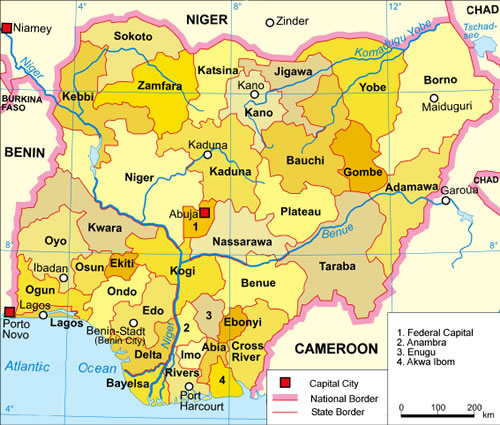
The joy heralding the birth of a child is usually indescribable let alone arrival of twins. That was the feeling seven years ago when Chiagozie and Chidalu Agwunobi, were welcomed to the Oliseh clan in Oko Ogbele Community, Oshimili South Local Government Area of Delta State. They were a bundle of joy to their parents as they grew up happily in months and years.
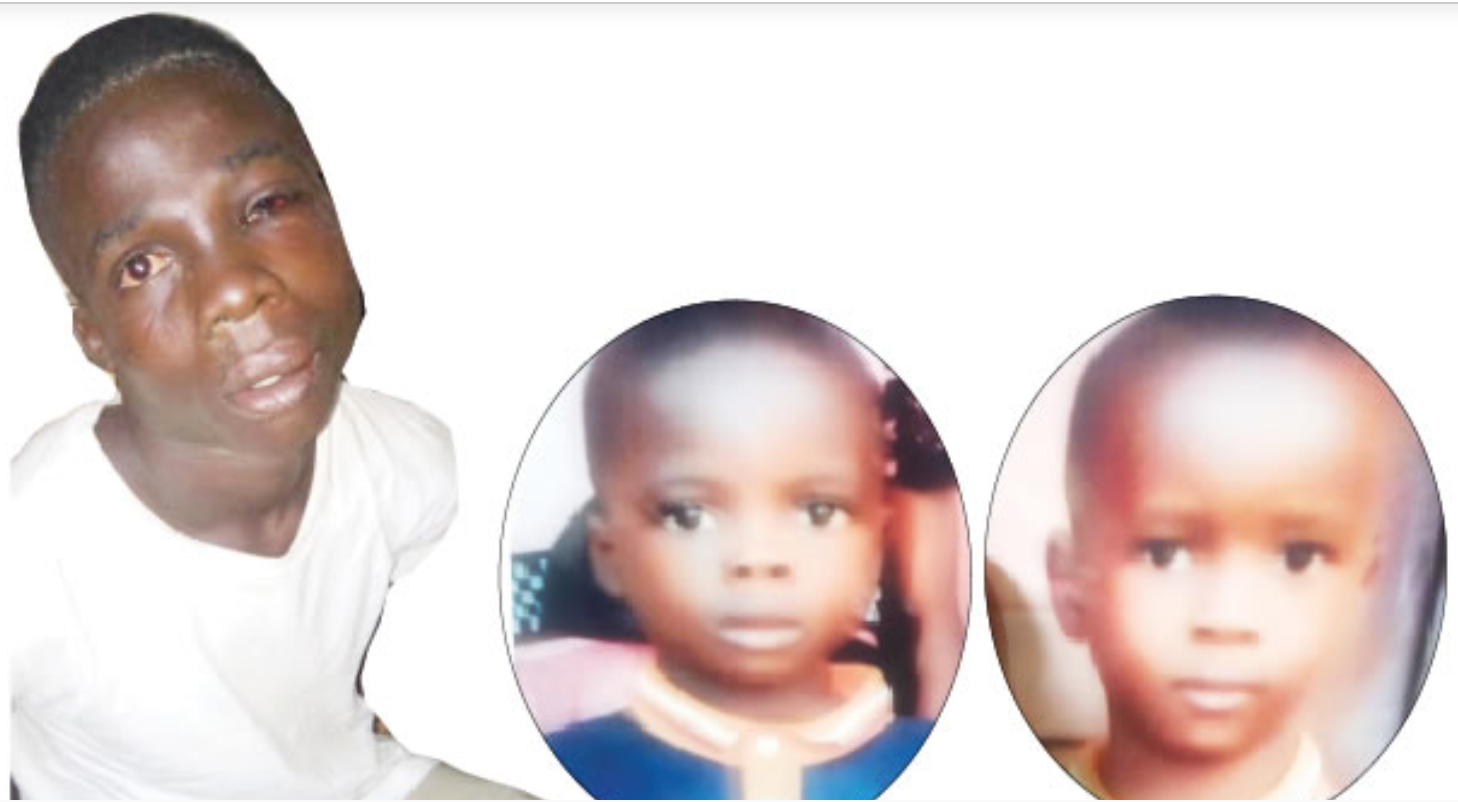
Few days ago, that joy was blown away like a candle in the wind when they went missing and their dismembered bodies later found in a bush. They were cruelly killed by their uncle, Onuwa Oliseh, who is still at large.
Onuwa reportedly lured the seven-year-old male twins to the bush within the neighbourhood on Friday, March 6, after they returned from school and butchered them. He was said to have removed some of their body parts for money rituals and dumped the remains.
Investigation by operatives of the Inspector-General of Police Intelligence Response Team in the state led to the arrest of Onuwa’s accomplice, Kelvin Uzor, who is also a relation of the twins.
“Police got information that on March 6, the twins were missing from their parents’ house. Their bodies were later found in the bush on March 8 with some parts of their bodies mutilated. Their eyes, hands and private parts were missing. Police began investigation and generated enough intelligence that led to the arrest of Uzor. He confessed that they were a three-man gang and wanted to do money ritual with the body parts,” a senior officer told Saturday PUNCH.
Our correspondent learnt that Onuwa’s younger brother, Iweka, who attended the same school with the twins, told the police that the suspect asked him to lure the deceased from the school.
“I am a primary four pupil of Ekeanya Primary School. On March 6, at about 6.30am, my elder brother Onuwa Ajei Oliseh, asked me if I would go to school and I told him yes. He asked if I can help him bring out the twins from the school before the school closes that day and I told him no because their teacher would not agree.
“That day when I came back from school, I saw my brother place a cutlass on the table where he was eating while I went to the backyard. It was later I heard that the twins were missing and their dead bodies were found in the bush,” he told detectives.
The twins’ father, Agwunobi Oliseh, stated that Onuwa visited his house that Friday in the morning and asked him if they (the twins) would go to school. He said he responded in affirmative, unknown that Onuwa was plotting to kill his beloved kids.
The 52-year-old farmer said when his children returned from school, Onuwa came back and asked them to follow him to the stream in the community.
He said, “I am a traditionalist and a farmer. I’m married with seven kids. My twins were seven years old. On March 6 in the early morning, Onuwa came to my house and inquired if my late children would go to school and I said yes. I later learnt he told his younger brother, Iweka, to help him take my children out of the school premises. He said he wanted to go somewhere with them.
“Later in the day, he went to their school and tried to take them out but he was chased away by their teacher. As soon as they came back, he came to my house and asked them to follow him to the stream. I think they were on their way when he brought out a cutlass and killed them.”
The distraught father, who noted that he and his wife were not around when Onuwa took the twins away, said he was told the suspect ran home with bloodstains.
“According to his brother, he ran back home with his hands stained with blood. He then asked the brother to pour water on his hands while he washed the machete with which he killed the twins. He left for Uzor’s house and both of them went to one Anam.
“It was when I came back later in the day with my wife that I realised the twins were missing. While I was running around, Iweka told me that it was Onuwa who took my children. Onuwa ran away but we were able to find Uzor who told us where their bodies were dumped. We went there and found their mutilated bodies. Their eyes, tongues and hands were removed,” he added.
Uzor, in his statement, admitted the twins were killed for rituals but denied partaking in their murder.
He said one of his friends, called Chukwudi, told him of a traditionalist in Anambra who could help them to perform money rituals with children not above age 12.
The 18-year-old primary school leaver stated that he informed Onuwa, who agreed to the plan.
He said, “I stopped schooling after my primary school education because my parents did not have money. I worked for a farmer called Egwiyo. I served him for many years and he promised to give me money this year. Chukwudi told me there was a place where we could do money rituals in Anambra and he asked if I was interested.
“We later told Onuwa who agreed to do it. I told them I was not interested but if they want to do it, they could go ahead. I told them I would be happy if they succeeded. I was sleeping when Onuwa called me and said he had killed the twins. He said he took their bodies to one native doctor in Delta but the man told him he wasn’t into money rituals.
“He later called me when the heat was much and told me where he dumped the bodies. Now, police said I was the one who killed the twins. Onuwa took the body parts to a herbalist in Aguleri, Anambra.’’
Uzor said immediately he learnt about the twin’s murder, he ran to Anambra where he was tracked down by the police. He added that he gave tacit support for the crime in the hope that he would be given money to buy a car and build a house if it worked out.
He said, “I wanted to become a young chief because most of the young men I know did not work as hard as I did and now they are millionaires. I am a farmer and hardworking but I was not making enough money. I have no savings. That was why I somehow agreed to be part of the plan.
“Onuwa convinced me it was the fastest way to make money and that most of our colleagues made money through that means. My greatest mistake was that I did not inform my family when Onuwa suggested that we should use the twins.
“I love the twins so much and their parents are nice. I cautioned him but I don’t know that he would still go ahead to kill them. They normally went to his house to play; so it was easy for him to take them out without anyone being suspicious. I was not in the bush when he killed them.”
Uzor revealed further that the initial plan was to use an elderly woman in the community for the money ritual but he prevailed on the gang to spare the woman because she was generous.
“Initially, they wanted to use one old woman known as Nne Amaka, but I pleaded with them to leave her because she is nice. If I passed by and begged her for water, she would give me water and even food.
“I feel bad because he betrayed me. I am appealing to young men that money ritual does not pay. I am a hard working man and well known. Even when my name was mentioned in the crime, a lot of people came out to defend me. I am sorry. I want the family to forgive me,” he added.
Saturday PUNCH learnt that the remains of the twins had been deposited at the General Hospital, Igbuzor while IRT detectives led by DCP Abba Kyari had launched a manhunt for the fleeing suspects.
A gruesome murder in Chipata, Eastern Province, Zambia.
It is not the first time that the Eastern Province is in the news with an attack on a person with albinism. Also last year, in 2019, the province made headlines with the murder of an albino. Often, Zambians point an accusing finger to neighboring Malawi when a mutilated body of an albino is found. However, just recently, in January of the current year, a prominent Zambian, MDD president Dr Nevers Mumba, alleged that ritual killings are common in Zambia and have always happened towards elections.
Body of albino found in Chipata with missing tongue, arms and eyes
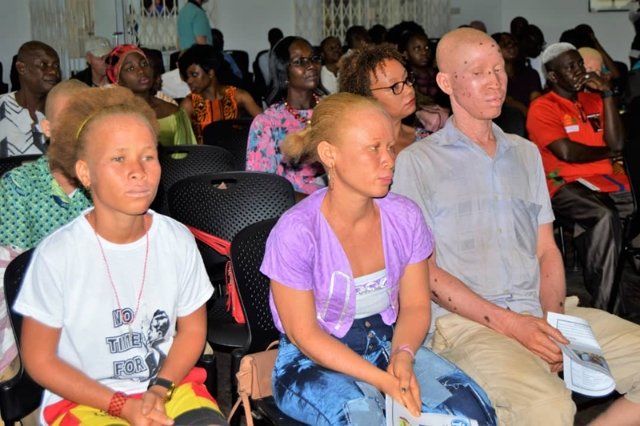
Picture not related to the murder in this news story.
Published: March 26, 2020 By: Zambia reports – Chris Phiri
POLICE in Chipata have picked up a dead body of an albino without a tongue, arms and eyes.
Eastern Province Police Commissioner Lackson Sakala said police recoverd the body at Yamene farms along the Chipata/Lundazi road yesterday.
Mr. Sakala said the incident occurred between 15 hours and 17 hours adding that the deceased was found in a maize field at a distance of about 60 metres from the Chipata/Lundazi Road.
He said when police officers visited the scene of the suspected murder they discovered that some body parts were missing.
“After inspecting the body they discovered that the following body parts were missing; there was no tongue in the mouth, the tongue was cut, both eyes were removed and both arms were also removed by way of amputation. The victim at the time he met his untimely death was wearing a jean trousers, red t-shirt and black shoes,” Mr Sakala said.
He said the body had since been deposited in Chipata Central Hospital Mortuary awaiting postmortem.
“May I appeal to those that may miss their relative, an albino to come through so that they identify this unknown albino who was murdered yesterday. As police we have actually instituted investigations into this gruesome murder,” Mr Sakala said.
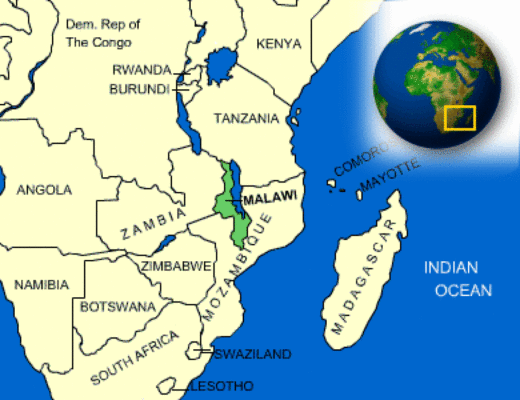
The Association of People with Albinism in Malawi (APAM) fears that this will increase the already fragile position of people living with albinism in Malawi. History teaches us that attacks on people with albinism increase during election campaigns. The Malawian government fails to react properly. Since 2014, 171 attacks against people with albinism were carried out of which 25 persons were killed and 13 were reported missing. Hence, the Association of People with Albinism in Malawi has launched an anti-killings campaign. (webmaster FVDK).
Malawi persons with albinism launch anti-killings campaign
The Association of People with Albinism in Malawi (APAM) has launched a campaign to condemn killings of people with albinism for rituals ahead of the fresh presidential polls in the country.
APAM President Ian Simbota, told local media Sunday after the launch that members of the Association fear for their lives as some study showed that persons with albinism are targeted for rituals during elections. Simbota told Xinhua Monday that as of March 23rd, 2020, APAM had recorded 171 cases of attacks against people with albinism of which 25 persons were killed and 13 were reported missing since 2014. (italics added by the webmaster FVDK)
“We received the February 3 judgement with mixed reactions because on one hand we were happy that we will be given back our ballot power but on the other hand looked at the threatening times that we always go through because of the same election exercise,” said Simbota.He said during the campaign the APAM members want to sensitize mostly political leaders to desist from beliefs that killing a person with albinism and getting their body parts for rituals can make them win an election.
“Those things don’t exist, it’s just some evil way of thinking. We are the voters and politicians should use us as such and not as rituals; it does not work,” said Simbota.”We are a population of 134,636 people and those are the votes that we are worth,” he added. In 2015 UN Human Rights Expert on Albinism Ikponwosa Ero, linked the killings of persons with albinism in Africa to elections, saying many political hopefuls believe that body parts of persons with albinism can be used as charms for one to win an election. (bold added by the webmaster FVDK)
If the news reported below is true, it is a horrific crime. I do not have the impression that ritualistic murders occur frequently in Ghana, although I may be wrong. Perpetrators may effectively hide all traces related to their heinous crimes – or the families and communities hit by these murders may prefer to remain silent about these age-old practices…. for fear, or for reasons of complicity… Let’s hope that the law enforcement officers act swiftly and will soon identify the murderer(s) and arrest him (her) / them (webmaster FVDK).
Girl Killed For Rituals
Published: March 24, 2020 By: Modern Ghana
A two-year-old girl has been found dead, raising suspicion of ritual purposes.
Her body was found in a big gully full of water at Apatrapa, a suburb of Kumasi, on Friday morning.
Eyewitnesses alleged that her tongue was cut away, but the police are yet to confirm their allegation.
Two different names — Ama Serwah and Maame Yaa — have so far surfaced as the girl’s name.
According to reports, some assailants broke into a house in the area and they took away the young girl on Thursday.
Barely 24 hours after the girl had been kidnapped, her body was found lying in a big gully in the area, sparking fear and panic.
DAILY GUIDE gathered that the young girl’s body had since been deposited in a morgue, awaiting autopsy.
Meanwhile, the police in Kumasi are said to have commenced investigations to help arrest the culprits and are doing everything possible to get to the bottom of the matter.
More details emerge with respect to the lifeless body of Tiyiselani Rikhotso, found at the Klein Letaba dam near Giyani, Limpopo, South Africa. The region is known for its ritual murders, as reported multiple times on this site. The local population calls the ritualistic murders muti (muthi) murders (webmaster FVDK).
Murdered Giyani girl (11) found in dam had missing body parts, family say
Tiyiselani Rikhotso when she was younger. The 11-year-old was killed and her body found in a dam near Giyani.
Published: March 20, 2020 By: Sowetan Live – Peter Ramothwala
The family of an 11-year-old girl whose dismembered body was found in a dam suspects she was murdered for ritual purposes.
Tiyiselani Rikhotso from Ndengeza village, about 40km west of Giyani in Limpopo, was reported missing on Sunday and her body was found on Tuesday in the Klein Letaba Dam.
Her discovery was preceded by a protest by the community, who went on a rampage, blockading roads.
Tiyiselani’s grandmother Christina Rikhotso, 59, said she suspected Tiyiselani was hacked with a panga as she had several open and deep wounds on her body.
“I saw those wounds on her body and they were very scary. Her right leg was chopped and still missing as we speak.
“I think she was killed elsewhere and thrown into the dam.
“If her murder is not for muthi, what will one do with a child’s leg?”
Rikhotso said Tiyiselani was found in the dam after some children tipped off community members that they saw her in the company of an unknown man.
“On our way to the dam, we found her doek and we became convinced she was thrown in there,” she said.
The grandmother said she was in church when Tiyiselani went missing on Sunday.
“I left her with her other siblings at home in the morning. Later in the day, I received a call that Tiyiselani was missing. I quickly called a few neighbours and we combed the local bushes and could not find her.
“In the afternoon, I went to the police to report a missing person. I even told them that we suspect her body was in the dam and they told me they would wait for a search and rescue team and sniffer dogs.”
Police spokesperson Brig Motlafela Mojapelo said a manhunt for the killer(s) had been launched.
“The discovery was made by community members who then called the police.
“On arrival at the scene, the police retrieved the body and discovered that some of her body parts were missing,” Mojapelo said.
Mojapelo said the motive for the murder was unknown at this stage but said that murder for body parts could not be ruled out.
Tiyiselani’s father Thulani Rikhotso said he was shocked and in disbelief about his daughter’s murder.
“I arrived on Wednesday from Gauteng to see for myself. My brother, I’m heartbroken. I want police to find her killers soon,” he said.
MEC for social development Nkakareng Rakgoale has also reacted with shock to the incident.
“Incidents such as this one are again putting in the spotlight the general safety of our children in communities.
“I cannot begin to imagine how a person can decide to take away an innocent soul just like that.
“We are once again appealing to parents and communities to always keep a close eye on children who are in their vicinity,” Rakgoale said.
Missing Giyani girl’s body found dismembered in Limpopo dam
Published: March 20, 2020 By: News 24 (South Africa) – Canny Maphanga
Tiyiselani Nokuthula Rikhotso. (Supplied, SAPS)
The body of Tiyiselani Nokuthula Rikhotso, a 11-year-old missing Giyani girl, was found dismembered and dumped in the local Klein Letaba Dam on Tuesday.
Rikhotso was reported missing on Monday.
“The discovery was made by community members, who called the police. On arrival at the scene, the police retrieved the body and discovered that some of her body parts were missing,” said Brigadier Motlafela Mojapelo in a statement on Tuesday.
The provincial commissioner of Limpopo, Lieutenant General Nneke Ledwaba, strongly condemned the brutal killing of an innocent child and instructed the police to hunt down the killers.
The police have subsequently launched a manhunt.
Authorities are calling on anyone with information to come forward.