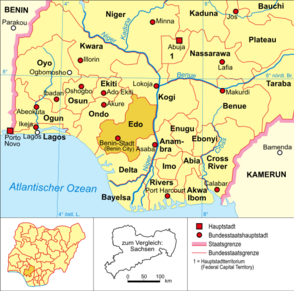
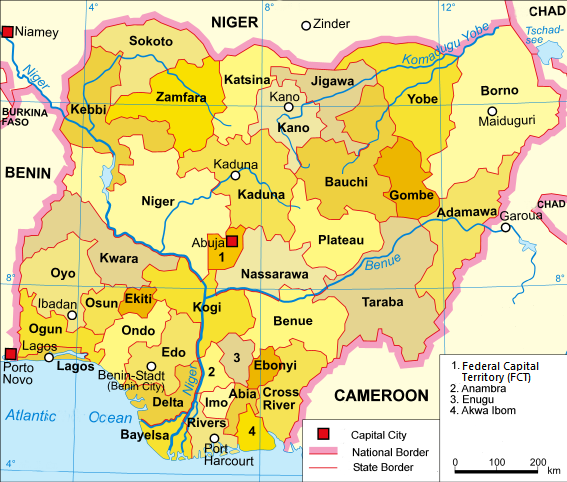
Recently, Edo State police did a horrific find when it discovered in Benin City a ritualist’s den with 20 mummified bodies: 15 dried male corpses, three female corpses and two children corpses. Benin City is the capital of Edo State. Click here for more information on the Edo or Benin people.
It is not known who the victims are and how long the corpses have been in the ritualist’s den.
In general, it’s a gruesome reality that many unidentified bodies of victims of ritual murders (‘money rituals’) in Nigeria may be linked to unexplained disappearances. Even worse, some people are not being reported as missing.
Hence the exact number of victims of ritualistic murders in Nigeria is unknown, but much higher than the number of reported cases. (webmaster FVDK)
Location of Edo state and Benin City in Nigeria
Edo Police Command uncovers ritualist’s den, 20 corpses in Benin
Published: August 19, 2022 By: The Guardian, Nigeria
Edo State Police Command has uncovered a ritualist’s den with 20 mummified bodies, along Ekehuan Road area of Benin City.
The State Commissioner of Police (CP), Abutu Yaro, said the Command unravelled the suspected ritual shrine on Wednesday, August 17 and arrested three suspected ritualists.
Yaro said the raid is in line with the Command’s operational mandate of curbing crime in the state.
He said: “Following credible information at the Command’s disposal that some corpses were discovered in a building along Asoro slope off Ekehuan Road, Uzebu Quarters, in Benin City, operatives of the Command immediately swung into action and mobilised to the scene.”
According to him, three suspects were arrested at the scene, namely: Chimaobi Okoewu ‘m’ and Oko Samuel ‘m’ both of Afikpo in Ebonyi and Gideon Sunday ‘m’ of Akwa-Ibom State, while other suspects fled.
Yaro said the police have launched an intensive manhunt to apprehend the fleeing suspects.
Among the corpses discovered at the scene of the crime, are 15 dried male corpses, three female corpses and two children corpses.
He noted that the Deputy Commissioner of Police in charge of the State Command Criminal Investigation and Intelligence Department (CIID) has been directed to carry out a discreet investigation to unravel the circumstances surrounding the discovered corpses.
The commissioner urged members of the general public to be calm as the Command will continue to ensure the safety of all law-abiding citizens and those residing in Edo State.
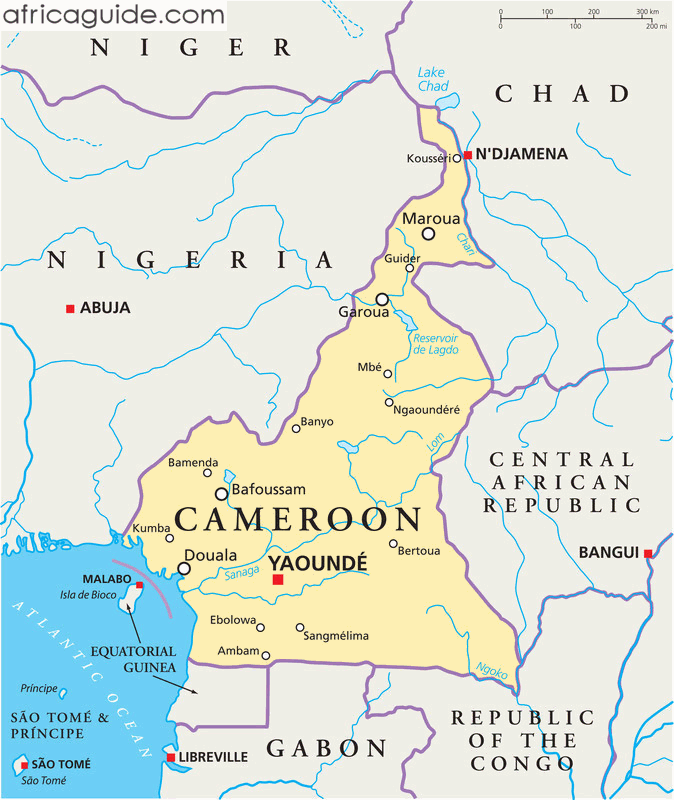
It is relatively rare that ritual murder cases are being reported from Cameroon though this does not mean that these atrocious practices do not occur in this Central African country. I’ve explained on previous occasions that my continuous search for ‘muti’ murders, ‘money rituals’, ritual killings and other superstitious practices suffers from a bias. As a result, more cases from anglophone countries than from francophone and lusophone countries are being brought to my attention.
Though both French and English are official languages in Cameroon, eight out of its ten regions are primarily francophone. Hence, francophone media dominate the news which may explain the underreporting of Cameroonian ritual murder cases on this site. (webmaster FVDK)
Cameroonian woman kills sister-in-law, chops body for ritual (Videos, Photos)
Marie France Mbea, a 57-year-old Cameroonian woman, has been arrested for allegedly killing her sister-in-law for suspected money ritual.
Naija News gathered that the culprit killed the woman and chopped her body in a hotel in Yaoundé’s Biyem Assi area.
Marie was intercepted on Monday, August 22, 2022, while leaving the hotel with the body parts stuffed in a suitcase.
According to Local Media, the suspect claimed she had a phone conversation with an unidentified man who directed her to murder her sister-in-law in exchange for money.
She checked into the hotel with the victim where she used a beer bottle to hit her on the head and slit her throat.
Marie fled the hotel on Sunday night after killing her sister-in-law, only to return on Monday carrying a machete and a travelling bag.
When the hotel administration saw that she was carrying something too heavy for her and refused offers of assistance, they became suspicious and called the police.
The suspect, during interrogation at Yaounde police headquarters, admitted that the body parts were intended to be transferred to a man in exchange for money.
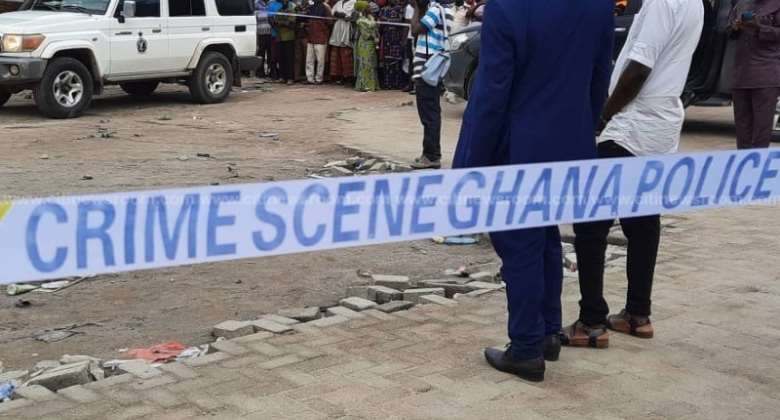
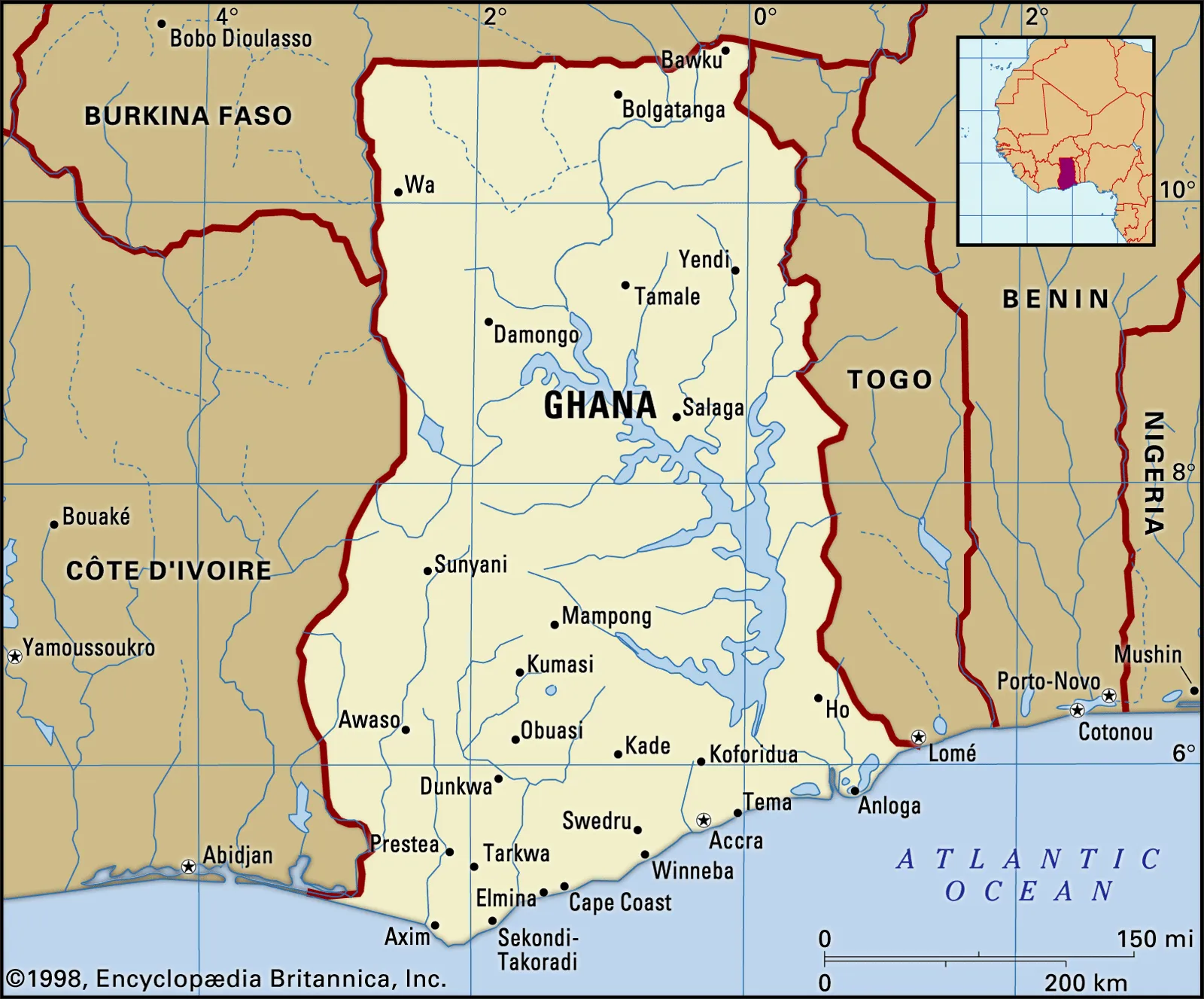
The article below pays attention to the first study of its kind (at least, as far as I know) that gives us reliable and in-depth information on the scale of ritual murders in a West African country as well as details pertaining to the ‘how and why’ of ritual killings in this country, Ghana. The author, Emmanuel Sarpong Owusu, is a law and criminology researcher at Aberystwyth University and a lecturer at Arden University (all in the United Kingdom). He recognizes that the reported ritual murder cases which were analyzed, and which were all reported in three local Ghanaian media outlets in the 2013-2020 period, may be only the tip of the iceberg due to a number of factors which he explains in the study.
The author studied and analyzed 96 ritual murder cases (reported in the 2013-2020 period) involving approximately 116 victims including 62 children. This means an average of 16 ritual murders including 9 child victims each year – in Ghana only, a country with a population of about 30 million. Significantly, the study shows that ritual murders form approximately 1.6% of all the murders chronicled in the country annually.
The study is entitled ‘The Superstition that Dismembers the African Child: An Exploration of the Scale and Features of Juju-Driven Paedicide in Ghana’. The 42-page study, in volume 60 issue 1 of the ‘International Annals of Criminology’ by Cambridge University Press, has been published in open access for which the publishers are to be commended. It is available in both HTML and PDF formats at: https://doi.org/10.1017/cri.2022.2 or click here. (webmaster FVDK)
Over 16 ritual murders occur in Ghana each year, a recent study shows
Published: August 23, 2022 By: Vincent Tutu Bawuah – Modern Ghana
Juju-driven homicide or ritual murder has been the subject of many media reports in contemporary Ghana. However, very little is known about the prevalence/magnitude and features of this crime in the country, as national data sets on the ritual murder phenomenon are presently non-existent.
To help address the problem relating to the paucity of information on ritual murder, Emmanuel Sarpong Owusu (also known as Black Power), a law and criminology researcher at Aberystwyth University and a lecturer at Arden University (all in the United Kingdom), has conducted a dynamic study on juju and ritual paedicides/pedicides (i.e. killing children for ritual or occult purposes) in Ghana, the first of its kind in a West African setting.
The study sought to establish the scale and identify the primary features, motivations, and socio-cultural, religious and economic contexts of ‘ritual paedicide’ (a phrase coined by the researcher himself) in contemporary Ghana. It also examines the criminal justice system’s responses to such murders.
To realize the defined aim, an in-depth analysis of ritual homicide cases/reports publicized in three local Ghanaian media outlets (the Daily Graphic, Ghanaian Times, and Daily Guide) between September 2013 and August 2020 was carried out. Semi-structured interviews involving 20 participants were then conducted to gain additional insights into key aspects of the results of the media content analysis.
The following are some of the key findings of the study:
A total of 96 reports/articles on ritual murder were extracted from the websites of the three media outlets perused, and this involved approximately 116 victims. Out of the 116 victims, 62 were children. This means that at least 16.5 ritual murders involving approximately 9 child victims occur in Ghana each year. The study also indicates that ritual paedicide forms approximately 1.6% of all the murders chronicled in the country annually. The researcher however admits that the number of ritual paedicide cases identified in the selected media outlets may be only the tip of the iceberg due to a number of limitations highlighted in the study.
Most ritual paedicide victims (over 79%) are children of low socio-economic backgrounds in rural and semi-rural communities. There is no significant difference in the number of boys and girls murdered. Blood, the head, the limbs, and the private parts are the most sought-after body parts. Several reasons have been suggested for this trend. Ritual paedicide cases were more prevalent in the western part of Ghana than in other areas of the country. A reason for this development has been suggested in the study.
Poor parental supervision is a significant risk factor for ritual paedicide. Over 70% of the victims were kidnapped while playing outside their homes unsupervised, going to school or fetching water from a stream unaccompanied, or running errands for their parents or other family members. Though letting children under 10 years roam about unsupervised appears to be a normal practice in most African communities, the study cautions against it.
Most ritual murders involve multiple perpetrators, and a number of factors have been offered to explain this trend. Most perpetrators and prime suspects are males, aged between 20 and 39 years, mostly unemployed or financially handicapped. However, the study does not rule out the involvement of rich and educated people who are highly likely to hire others (ideally, poor or unemployed youth) to commit the barbaric crime rather than doing it themselves.
Unlike other forms of homicide, perpetrators of ritual paedicide are strangers nearly as often as being family members and acquaintances. Fathers, stepfathers, and uncles are the dominant culprits in cases where victims and perpetrators are related.
The most dominant motivation for ritual murder in Ghana is pecuniary gain. Among the key factors that account for the prevalence and persistence of ritual murders in the country are widespread unemployment and concomitant economic privations, obsession with juju, the increasing popularity of ‘cyber-criminality’ and the so-called Sakawa Boys, exposure of Ghanaian youth to African movies that portray juju and juju rituals as an efficient wealth-guaranteeing religious practice, illiteracy, and the emergence of a new ‘consumerist ethos’ that has engrossed the Ghanaian society and which is marked by the unrestrained quest for material success and the flamboyant display of luxury.
The majority of perpetrators are not apprehended or even identified by law enforcement agencies. There is evidence of police laxity in investigating and prosecuting cases of ritual pedicide in Ghana.
The study, entitled ‘The Superstition that Dismembers the African Child: An Exploration of the Scale and Features of Juju-Driven Paedicide in Ghana’, makes a significant contribution to the body of knowledge. It is highly significant as it breaks new ground and provides a foundation for further informed engagement with the ritual paedicide phenomenon in Africa.
The full study (a 42-page article) has been published (open access) in volume 60 issue 1 of the ‘International Annals of Criminology’ by Cambridge University Press. It could be accessed in both HTML and PDF formats at: https://doi.org/10.1017/cri.2022.2
I’ve been doing research on ritual killings in African countries for many years. Yet, it still happens that I am surprised even flabbergasted by the new information I still find. One such experiences happened when reading the article presented below.
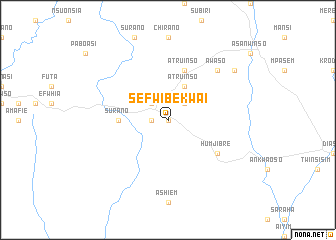
Reportedly, the Sefwi Bekwai area in Ghana is notorious for its ritual murders. The traditional leaders who recently spoke out against the rise in murders in their region notably the increase in ritual murders are to be commended for their public outcry. They referred to more than one ritual murder case in the past, one of these cases being the ritual murder of Kofi Kyinto by his uncle, Benjamin Affi, in the 1980s. The small boy was murdered by contract kiilers who had been instructed by Nana Akwasi Agyei of Akaasu.
I will soon provide more details about this notorious ritual murder case as well as others in the region. (webmaster FVDK)
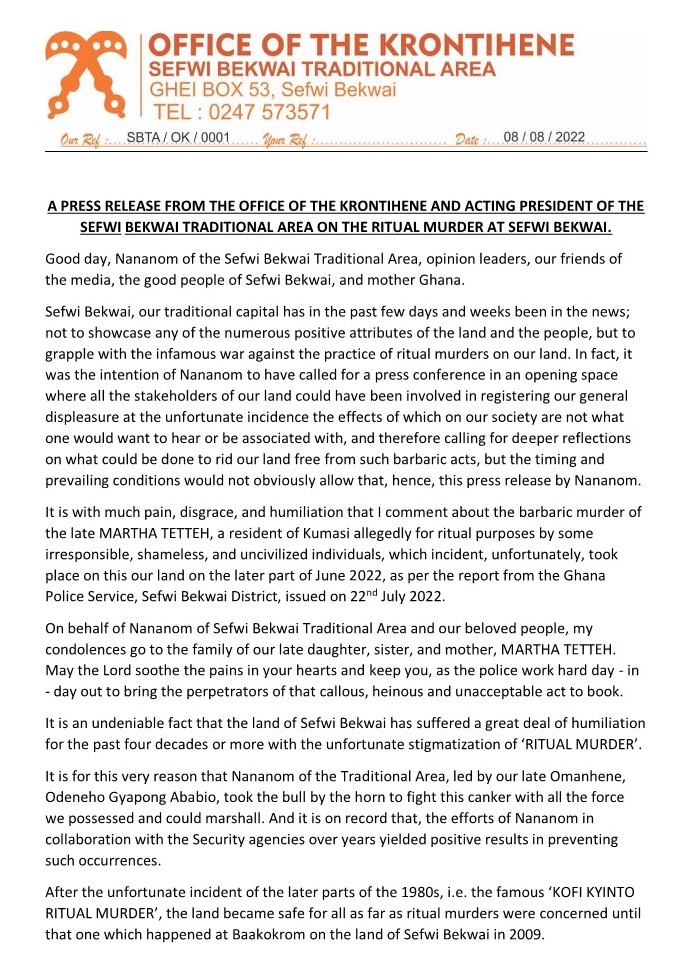
Screenshot. To listen to this article (13:34 minutes), please click hereKrontihene and Acting President of Sefwi Bekwai Traditional Council, Chief of Sefwi Humjibre, Nana Kwadwo Twum II
Chiefs at Sefwi Bekwai have condemned a recent rise in murder cases in the entire traditional area.
According to Nananom, the recent murder cases have brought shame to the people and rekindled the unfortunate and undesirable stigma of a ‘Ritual Murder’ community.
The chiefs’ worry comes on the heels of some recent incidents including the killing of a 27-year-old woman, Martha Tetteh, a Linguist who was shot dead at Sefwi Proso among other bizarre killings.
The Sefwi area unfortunately had infamously gained notoriety in the 1980s for consistently recording mysterious deaths led by the popular Kofi Kyinto ritual murder.
Krontihene and Acting President of Sefwi Bekwai Traditional Council, Chief of Sefwi Humjibre, Nana Kwadwo Twum II, in a statement said the traditional leaders do not want such tags to continue.
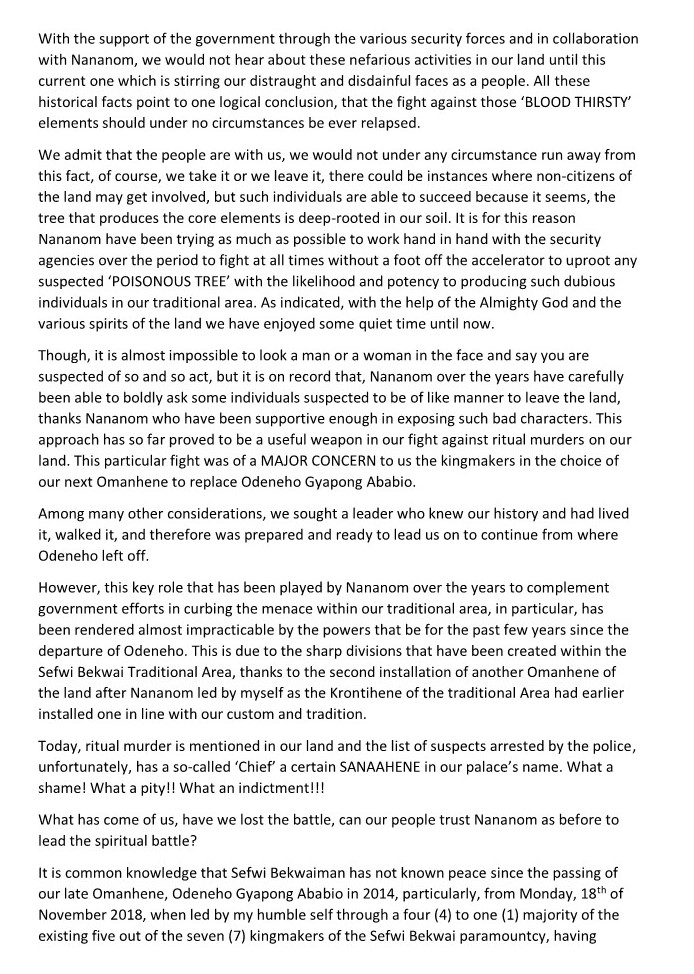
Below is the full statement:
Below is the full statement:
(RESEC ) under the leadership of then Honourable Kingsley Aboagye Gyedu as Regional Minister and Member of Parliament for our constituency, Bibiani Anhwiaso Bekwai and the Municipal Security Council (MUSEC) under the authority of Honourable Alfred Amoah (late) immediate past Municipal Chief Executive, and therefore they could make a BENKUMHENE in an Akan society such as ours install no mean a chief than OMANHENE, and still, we have people supporting this? We found nothing wrong with that abominable act, we sang their praises to the high places, and they did that with sheer bravado, we were told. Have we bothered to find out how they could formulate a litany of charges against me as the Acting president and without giving me any opportunity to defend myself, they came out with a captioned, ‘VOTE OF NO CONFIDENCE’, which was subsequently endorsed by all the bodies mentioned above as supporting them? They even said, by that, they had removed me from office as KRONTIHENE of the traditional area, these were not child’s play. All of these have gone on and one expects our just God and the spirits of the land to be happy? Only time and real-time will tell.
“The further a society drifts from the truth; the more it will hate those that speak it” George Orwell would put it. Of course, if people get blinded and are influenced by their personal interests as against a group interest, they end up seeing things the way they would otherwise want them to be, and not as they are supposed to be, the case of the chieftaincy dispute at Sefwi Bekwai. However, no one bribes nature not to let them face the repercussions of their wrongful acts.
One may look at it this way, assuming the installation on 18th November 2018, was faulty as they claimed, the best option available to Nananom if they cared for the peace and good of our land and people, was to have challenged it at the appropriate forum; and it was never the calling for National Security to come and impose a certain individual on us as Omanhene, I stand to be corrected, they might have stood on one of our numerous laws to do that untoward act, and since I’m not a lawyer, I may not know.
Worst of all, in order to get a majority of four (4) out of the seven (7) kingmakers as our custom requires, the Regional House of Chiefs without listening to our side would authorize Benkumhene to install both Adontenhene (though I had already done that in my capacity as Krontihene) and Akwamuhene within a month and would go behind the existing Kyidomhene to appoint a brother of his who is maimed in the hand (having some fingers chopped off) and therefore, not qualified to come to the palace in the first place as per custom, let alone stand in as Kyidomhene. To all those who care for the truth, this is how far those Nananom and their supporters who claim to love Sefwi Bekwai more than anybody else, could throw our Omanhene stool to the lowest ebb ever and to the swine in their unflinching burning desire and uncustomary quest to also install someone as Omanhene. If you could wickedly do this unacceptable thing to your stool, could the people trust you for anything good, should what we are hearing and experiencing be strange? Could the Almighty God and the Spirits be blamed?
Is it not strange if after all of these, they turn round to point accusing fingers at some of us, albeit, we do not love Sefwi Bekwai?
Today, the truth is gradually getting out of the bag, and in due course, all would know who loves Sefwi Bekwai the more!
When we came out to challenge their illegal and abortive installation, almost the individuals who were madly involved in that sacrilegious installation including bodies we suspected to have had their hand tainted in the matter, came out with the speed of thunder to deny their involvement, rather vehemently. Thank God, that the truth could not be covered forever. In recent circulating audio, an individual who claims to be a member of Nana Ahene Mmra’s (late) family indicates and confirms our position that the Regional House of Chiefs ordered MUSEC, to collaborate with the other side to select a candidate of their choice and get him installed with the backing of the RESEC and National Security – A Regional House mandating MUSEC to select a candidate as Omanhene. And people who claim to know everything are proud to be assigned with such installation? Only at SEFWI BEKWAI!
The names of the individuals and bodies and roles they played are loud and clear in the said audio. Yet they had denied only to be exposed in the audio. They treat us this bad way and would want to take and swallow that bitterness down our throats?
Another alarming side to this whole episode is the mention of a pastor and the instrumental role he played in getting the assistance of the National Security on board the illegal installation. If it was true, then, we are not safe! Dangerous precedence it is.
If pastors who claim they have been called by God to do His work could not see the need to meet with us and know our side of the story for peace’s sake, would work their way to get the authorities so easily swayed to let National Security do what they did, then, of course, we are not safe! As Christians, we are told in the Good book, the Holy Bible to make peace with all, especially, pastors, yet a pastor worth his sort could get the rules bent in his favour in support of a relative or a dear one, thinking less of the dire consequences that could lead to, then, where was that God who’s voice directs him? Did he hear the voice of God to do that? l hardly could find words enough to describe that.
We may not have to complain about getting a raw deal from the state apparatus. One may be quick to say that, the authorities only acted on the sieved information they received from the very sources whose information is what they are to act on but what was true was the fact that those sources had an interest in the matter, and therefore they could be said (authorities) to have been tricked or misinformed. The question however is, should we always listen to a side on a disputed matter like ours?
What about the numerous petitions we wrote in respect of the earlier installation to various places of authority?
What came of the secular from the Chieftaincy Ministry to let a three-member Committee look into our case before it and; that the second installation should not be allowed by both RESEC AND MUSEC? – With the orders being flouted with impunity and disdain by the two bodies because there had been some compromises up the hill? Honorable SAMUEL KOFI AHIAVE DZAMESI, former Minister for Chieftaincy and Cultural Affairs, may the Lord bless you wherever you are.
And what about we appearing before the National Security Minister, Honourable Albert Kan Dapaah, to tell him our side of the story some two or three days to the second installation, only for him to tell us in the face that the ORDERS had already been given and his office could do nothing about it. His only advice was, “Nananom, Onyame na osi ohene, se eye mo dea a, mo nsa beka”, to wit if God says it is our candidate who is to be on the stool, their subsequent installation could not stop that.
In the face of these abuses, provocations, and injustices, we have never resorted to any foul means to get justice, as the system keeps delaying us justice by not getting the Judicial Committee of the Western North Regional House of Chiefs ready to consider our cases filed before it against the second installation since July 2019 (the four kingmakers and the principal elders of Ekona Royal Family of Sukusuku).
One may be hated for speaking the truth, as Plato would say. It is the hard truth as this which needs to be told at all times. The Bible tells us in John 8: 32, that we will know the truth and the truth will set us free.
How beautiful it would be if together we protect our cultural heritage given to us by Nananom. Sefwi Bekwai has a unique culture and tradition to which our energies ought to be channeled to their development and promotion rather than allowing others who might not be well able to appreciate our culture, do as they presume, with all due respect.
Nananom, is it not our duty to ensure that the tenets of our culture are well organized so that we do not lose touch with it as trustees as we hand them over to the youth and generations yet unborn in due course and in their pure and natural states, not as adulterated as would undermine our integrity as traditional leaders as has been so done with the so-called second installation.
Was it not beautiful when in the process of the second installation, our Queen-mother, Nana Abena Aninwaah II sent drinks to me through a delegation, inviting me as Krontihene to undertake the said installation as our tradition provides?
I gave them a simple response that since I had already installed the Omanhene with the help of the other kingmakers, the second one could not be possible. But they would not accept nor respect that, because they had the support of National Security. They, therefore, went ahead to do the unimaginable, the effect of it we are facing today. This gives credence to the age-long saying that “You cannot eat your cake and have it”. If we decide to throw our tradition and culture to the dogs, we cannot turn around to get the support of the spirits for anything good. Nana Kwame Ampadu I of blessed memory would sum it up in one of his songs: “Ammanere yentoto n’ase, na yeso mu yie”. If we believe that our forebears gave what we have to us through various generations what they received from the creator, then of course we cannot disregard what God and the spirits have put down and has been sustained over the years by others for our good and that of those who come after us; and still expect their blessings and guidance in times such as these.
” Nea ese se yede to no, se yeamfa anto ho a, efiri to” It is time we got all the wrongs righted.
Again, irrespective of our current differences, we could still work in diverse ways in collaboration with the security agencies in ensuring that all those who played various roles in the ritual murder are made to face the full rigours of the law in a manner that will deter any such distasteful, preposterous and inhuman acts in the future. This is not beyond us.
It is also my humble prayer to the good people of Sefwi Bekwai to support authorities in this fight to get to the bottom of the matter by giving out any information whatsoever we may have in respect of the case to ensure that a lasting solution is found so that our security could be guaranteed. It may also go a long way in restoring our dented image as a people.
Finally, I will seize the opportunity to make a passionate appeal to His Excellency the President, Nana Addo Danquah Akufo – Addo to use his good offices to ensure that the chieftaincy dispute at Sefwi Bekwai is resolved by directing the appropriate bodies to get lawyers to the newly created Regional Houses of Chiefs, such as the Western North Region.
In 2017, the President gave assurance to Ghanaians that his government would not meddle in issues bothering chieftaincy. The President said this when the Bawku Baana Asigri Abugrago Azarka II and his chiefs called on him at the Jubilee House.
Again, somewhere in April this year, the President was on record to have expressed his unhappiness on the numerous chieftaincy disputes across the country. This he said exacts a heavy toll on the public purse and therefore must be avoided where necessary.
The President, His Excellency Nana Addo Danquah Akufo – Addo is noted for finding lasting solutions to protracted chieftaincy disputes – Yendi where he was conferred with the title, ” Naa Abudani I” and Ga states come to mind.
If those were possible, the case of Sefwi Bekwai is also possible, most especially, having promised the people of creating a District in honor of our late Omanhene, Odeneho Gyapong Ababio at his funeral at the Sefwi Bekwai Palace, back in 2016.
It is the humble prayer of Nananom that the President would not leave office without fulfilling that promise and also ensuring justice or reconciliation as far as our chieftaincy dispute is concerned. Counting on you, Mr. President.
Signed
Nana Kwadwo Twum II,
Krontihene and Acting President, Sefwi Bekwai Traditional Council; Chief of Sefwi HumjibreTel: 024- 7573571
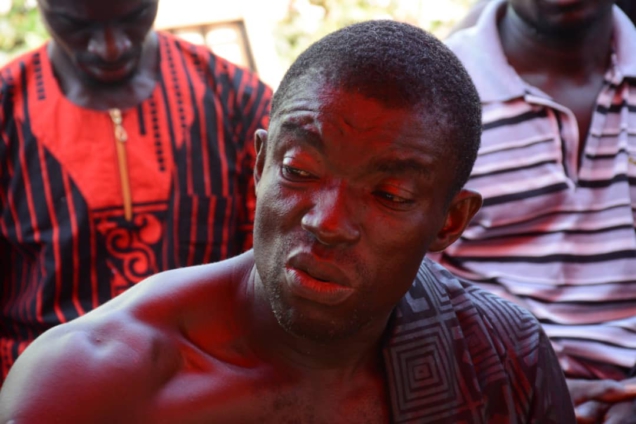
First of all, the suspect, Oppong Kyekyeku, is facing a charge of preparation to commit a crime. Allegedly, the accused when facing financial difficulties consulted a spiritualist and agreed to offer his 11- year old daughter for a ritual. What struck me beyond the assumed superstition and the gruesome murder inevitably linked to the ritual is the fact that the suspect has been living in the Netherlands for many years before he relocated to Ghana a year ago.
Seemingly ‘normal people’ are capable of committing gruesome murders. It’s a known fact, but when again confronted with this reality, I find it quite shocking. (webmaster FVDK)
Case of businessman in alleged ritual murder sent to Attorney General for advice
Published: July 19, 2022 By: Modern Ghana
The case of Evans Oppong Kyekyeku who is accused of attempting to use his daughter for ritual purposes has been sent to the Attorney General ‘s Office for advice.
When the matter was called today, Monday July 18, 2022, before Ms Ama Adomako Kwakye, Chief Inspector Lawrence Kofi Anane, who held a brief of Chief Inspector Richard Amoah, prayed for a date as a duplicate docket had been sent to the Attorney General.
Defence Counsel said he had followed up at the AG Office adding that the State was finding it difficult to advise on his client’s case as there was no evidence against him (Oppong Kyekyeku).
The Court, therefore, adjourned the matter to August 1 and remanded Oppong Kyekyeku into Police custody.
Oppong Kyekyeku is facing a charge of preparation to commit crime to wit, murder.
The accused’s plea has been preserved by the Court.
The fact of the prosecution is that Kyekyeku is the father of the victim aged 11 years and he has been living in Holland for many years but relocated to Ghana a year ago.
In the month of May this year, Oppong Kyekyeku allegedly told a friend known as Kwame that he was facing financial difficulty and consulted a spiritualist.
The accused allegedly agreed to present his daughter for the ritual.
He was, however, picked up after he had allegedly managed to send the daughter for the ritual at Oyibi Kom in Accra.
Everyday I see new reports of ritual killings in Nigeria – locally called ‘money rituals’ – and although I haven’t stopped presenting these articles here, on this site, I have been forced to limit reporting on these barbaric and cruel crimes due to their overwhelming number. Unfortunately, there are many more African countries where ambitious, unscrupulous and criminal people commit the same repulsive crimes and governments fail to act effectively, as is the case in Nigeria.
Nevertheless the foregoing, I wish to draw the readers’ attention to the article below, a Nigerian plea to address the escalating wave of ritual killings terrorizing Africa’s most populated country, divided in 36 states.
Let the article speak for itself. The reader may find useful background reading in my February 13 2022 posting whereas I also wish to remind the reader that on February 9 of this year, the House of Representatives asked the Federal Government to declare state of emergency on ritual killings, signaling the urgency and spread of the problem. (webmaster FVDK)
Addressing the escalating ritual killings challenge
Published: July 25, 2022 By: Business hallmark – Hallmark News
From all available indications, the killing of humans in Nigeria for ritual purposes is escalating. And it has to be severely addressed.
In some of the more confounding instances, the alleged perpetrators are most shockingly, young people.
An obvious trigger for the disreputable behaviour from many accounts is the parlous economic state of the nation. With inflation, unemployment and the exchange rate posting very dismal statistics, millions of Nigerians are at their wits end as to how to make ends meet. And some are being lulled into the false trap of ritual killings.
Compounding the extant challenges that the average Nigerian is faced with today are the atrocious governance failings countrywide, the unbridled rate of urbanisation and the collapse of both the traditional community structure and family values.
Some others would add factors like the parlous state of public education and very importantly, the untoward practices of several disreputable traditional and religious leaders who hardly inspire a better orientation for the embattled and impressionable in the society at a moment like this.
Indeed, given the reported close synergy between ritual killing practices and traditional and spiritual related observances and leaders, this is one critical area where the searchlight must be beamed as we seek a resolution of the menace. Traditional and spiritual leaders must be put on the spot.
This is more so when the entire ritual industry complex is predicated on traditional and religious factors. Within this framework, the thinking is that when the traditional ‘medicine man’ administers an appropriate mix of fitting incantations and sacrifices, the end result is that a mystical power transfer of sorts can then be effected in which the human sacrifice is then accepted by the superintending spiritual forces who then sign off on the efficacy and acceptability of the sacrifice and thereafter dispense the requested security, material or other similarly incredulous favours to the beneficiaries.
Alarmed by the rising incidence of the nefarious practice, the Federal House of Representatives had in February this year tasked the executive ‘to declare a state of emergency on the rising incidence.’ This was via a motion that was sponsored by its Deputy Minority Leader Toby Okechukwu.
In the same breath, the lawmakers requested Inspector General of Police, Usman Alkali Baba, to “take urgent steps to increase surveillance and intelligence gathering with a view to apprehending and prosecuting all perpetrators of ritual killings in Nigeria.”
And establishing a cultural nexus to the challenge, the lawmakers equally urged that the National Orientation Agency (NOA) “initiate a campaign towards changing the situation in the country.”
Five months after these resolutions were seemingly passed and carried, there is no let in the rate of incidence as regards the killing for rituals challenge.
Underscoring the depth of the challenge is the fact that pontificating political actors are not innocent of the practice. Indeed, some are minded to believe that they are indeed the prime enablers of the gory ring of shame.
Now and again, the airwaves are littered with news reports and revelations linking political players with acts of ritual. Whether in the Okija shrine incidents earlier in the current democratic disposition where a then serving governor openly confessed to having been taken to a shrine to swear an oath of allegiance to a godfather; or in the Otokoto saga that wracked the Imo State capital, Owerri; or even the Baddoo incidents in Ikorodu, Lagos State, political players have been implicated now and again.
Beyond the immediate precincts of politics is the fact that many of our supposed elite role models also get to be fingered from time to time as being somewhat involved in the ring. At the moment for example, a very notable and high profile tertiary education complex proprietor is being tried on account of the mysterious death of a lodger in his hotel premises.
With clearly both the high and mighty being implicated in the challenge and with many members of the public increasingly being led to believe that you really cannot make good progress in today’s Nigeria without getting involved with shady and nefarious underground groups that are associated with ritual killings and related vices, it is really a herculean task addressing the cankerworm.
An expanded part of the challenge is even more deeply historical. We refer to a time in the distant past when different communities were engaged in acts of war and where, it is believed that the prevalent spiritual environment back then tended to accommodate human ritual killings under certain communally defined conditions. While in the modern social environment this has since been formally outlawed, very clearly some rogue practitioners continue to find ways around its outlawing.
This situation has also not been helped by the continued prevalence of traditional and modernist cult groups that many a time have been widely believed to be associated with ritual killings. While one or more of such groups now and again comes out to the public domain to swear their non-involvement with ritual killings, the deeper fact remains that the tar on the entire sub-set remains. And then you have the yahoo yahoo plus segment of the irascible internet fraud ring.
In the view of the newspaper, what is needed is a firm will to act, to enforce the laws and vigorously drive a campaign to wean our people off the accursed path of ritual killing. And while we are at it, can our leaders all commit to simply going back to the basics and doing very simple things to raise the governance bar? Half of the crisis would be addressed in that way.
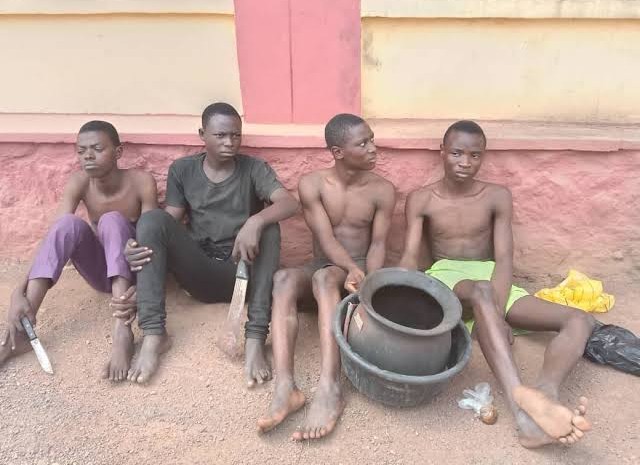
Teens arrested in Abeokuta, Ogun State over murder of a teenager girl – Click here for more postings on ritual murders in Ogun State
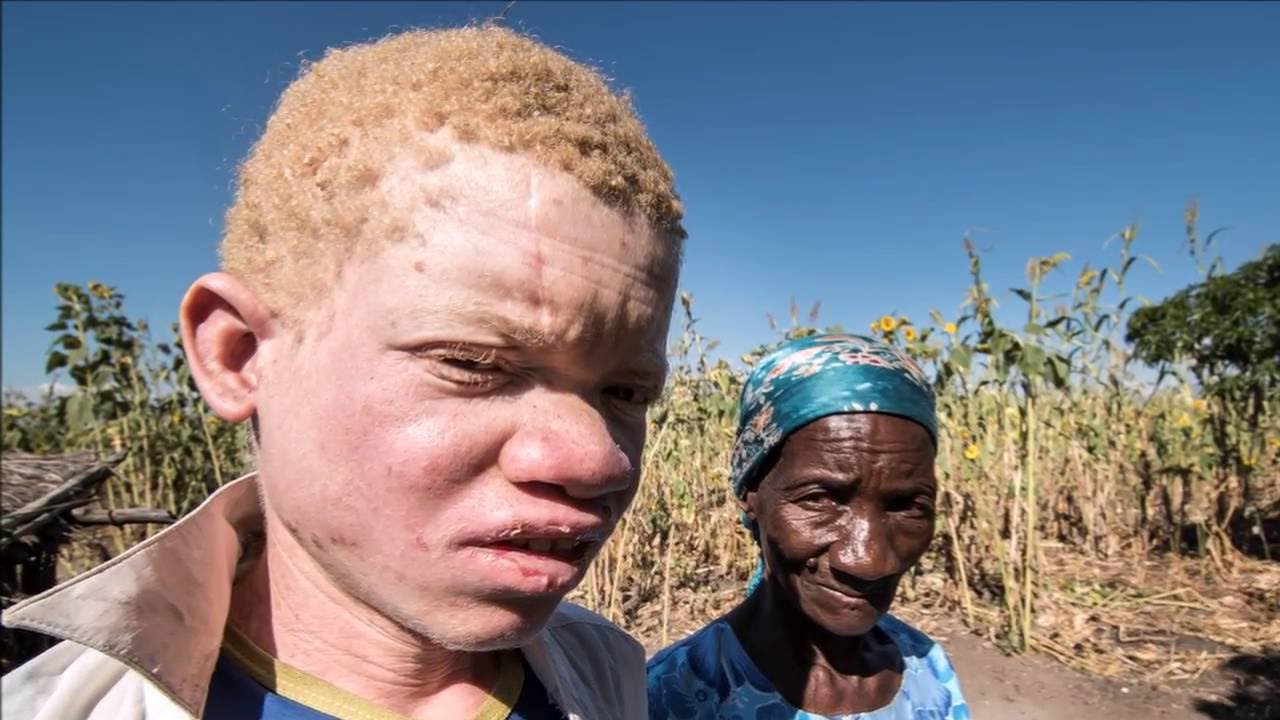
For completeness sake I am posting the following news about the death in detention of the Malawian priest who had been sentenced to 30 years in prison for killing a man with albinism – see my July 1 posting on the subject.
Attacks on people with albinism are not rare in Malawi: reportedly, in 2021 there were at least 170 such attacks since 2014, with 20 of them being murders. (webmaster FVDK)
Malawi priest jailed for killing man with albinism dies
Published: July 21, 2022 By: Frederick Nzwili, Catholic News Service
Father Thomas Muhosha, a Malawian priest serving a 30-year prison sentence for the murder of a man with albinism, died July 19 while undergoing treatment in a local hospital.
The 50-year-old priest was sentenced June 27 alongside five other suspects, who received life sentences, for the 2018 murder of Mcdonald Masambuka.
The Malawi bishops’ conference said it regretted announcing the death of the priest of the Diocese of Zomba while undergoing treatment at Zomba Central Hospital.
“Rev. Dr. Muhosha was not in full communion with the church. He was serving a prison sentence after being convicted in a case of albino killing. The Catholic Church in Malawi deeply regrets his death,” Father Henry Saindi, general secretary of the bishops’ conference, said in a statement.
The priest had been admitted to the hospital to undergo mental health treatment, according to local news reports.
Days after the priest’s sentencing, Archbishop George Desmond Tambala of Lilongwe, bishops’ conference president, told Catholic News Service that the church will let justice take its course.
“We as a church always preach about justice. We have always stood by the people who are victims. We will let justice take its course. We stand by the rule of the law,” he said June 29.
In the sentencing, the judge said Father Muhosha had planned to traffic and sell the body parts of Masambuka, who the killers had lured to death after lying to him that they had found him a wife.
The victim had gone missing from his home in a village in southern Malawi in February 2018. Nearly a month later, his burned limbless body was found buried in a shallow grave in the home of one of his killers.
Malawi has a recent history of violent attacks on people with albinism. In 2021, Amnesty International reported the occurrence of at least 170 such attacks since 2014, with 20 of them being murders.
Okay, the possession of a human head is no proof that a ritual murder has been committed or that the carrier of the head was somehow involved in a ritual murder. Even with blood oozing from the head… well, in that case, it certainly becomes more complicated to deny that an ugly crime has been committed.
Be that as it may, having a human head in its possession clearly indicates that the owner or carrier of the head has something to do with ‘juju’, superstition, and the blief that body parts can help in increasing one’s wealth, health or prestige.
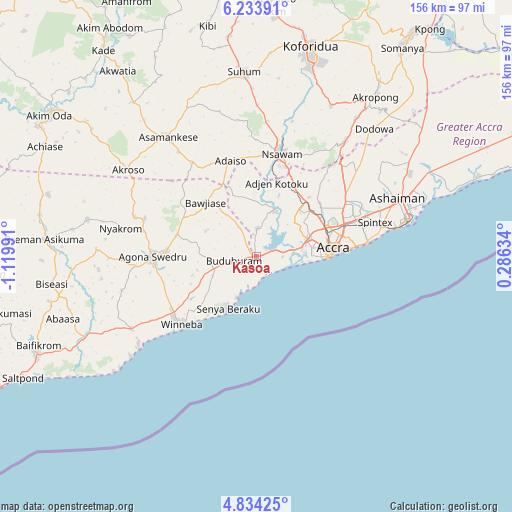
What’s going on in Kasoa, formerly known as Odupongkpehe, a peri-urban town in the Awutu Senya East Municipal District of the Central region of Ghana? I’d like to know more about it. (webmaster FVDK).
There is no doubt. Ritual murders are rampant in Zimbabwe. Significantly, still in May last year President Mnangagwa appealed to the general public, to traditional healers and to witch doctors to stop killing people for ritualistic purposes. See my posting Zimbabwe President Mnangagwa: ‘Stop ritual killings!’
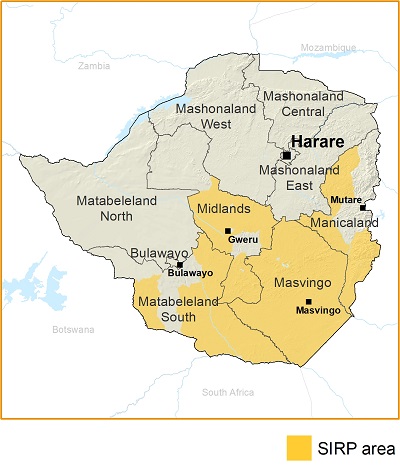
I’ve posted earlier reports on ritualistic activities and murders in Zimbabwe including Matabeleland. The article below focuses on Bulawayo, the country’s second largest city and the largest city in Matabeleland. Its population is estimated at about 1 million.
One may think that traditional beliefs including the superstitious belief in the supra-natural powers of ‘muti’ persist mainly in the rural areas. The article below indicates that migrants from rural regions who settle in urban centers bring with them their cultural values and religious beliefs including, unfortunately, traditional repulsive activities which violate the law. (webmaster FVDK)
Bulawayo Residents Live In Fear Of Ritual Murders
Published: June 30, 2022 By: Zimeye – Zimbabwe
Panic has gripped Bulawayo residents following a spike in suspected ritual murders in the city.
A number of mutilated bodies have been discovered in the city over the past few months, while some residents have been reportedly kidnapped and their blood drained by unknown culprits still at large.
Over the weekend, a yet to be identified woman was found dead with missing body parts at the 21km peg along the Bulawayo-Plumtree road.
Bulawayo Progressive Residents Association chairperson, Ambrose Sibindi told Southern Eye that there were several reports of such incidents happening in Bulawayo and other parts of Matabeleland.
He appealed to law enforcement agencies to devise ways to curb such cases.
“Inexplicable stories are now common, lawlessness has become the norm. People are now behaving like animals,” Sibindi said.
“I would like to urge residents to shun boarding private cars. If possible the law enforcement teams in plain clothes must be on alert at transport pick up points to effectively deal with these shady activities.”
Bulawayo United Residents Association chairperson, Winos Dube said: “We are disheartened and disappointed as residents to learn that these activities are taking place among our people. Ritualism is becoming a menace and people have to be very vigilant. They shouldn’t board unknown vehicles belonging to people they do not know.”
Dube advised the commuting public to use public transport to avoid such dangers.
Recently, the owner of a shop at Kelvin was kidnapped after boarding a Honda Fit vehicle with unidentified women. They took the victim to a secluded bushy area where she was injected with an unknown substance which made her unconscious.
The suspects, who are still at large, allegedly drained blood from her body for suspected ritual purposes. They then dumped her some 15km from Kensington.
National police spokesperson, Assistant Commissioner Paul Nyathi said all the incidents would be investigated.
“I cannot say it’s ritualism; we are conducting an investigation to find out what really transpired so that the truth comes out,” Nyathi said.
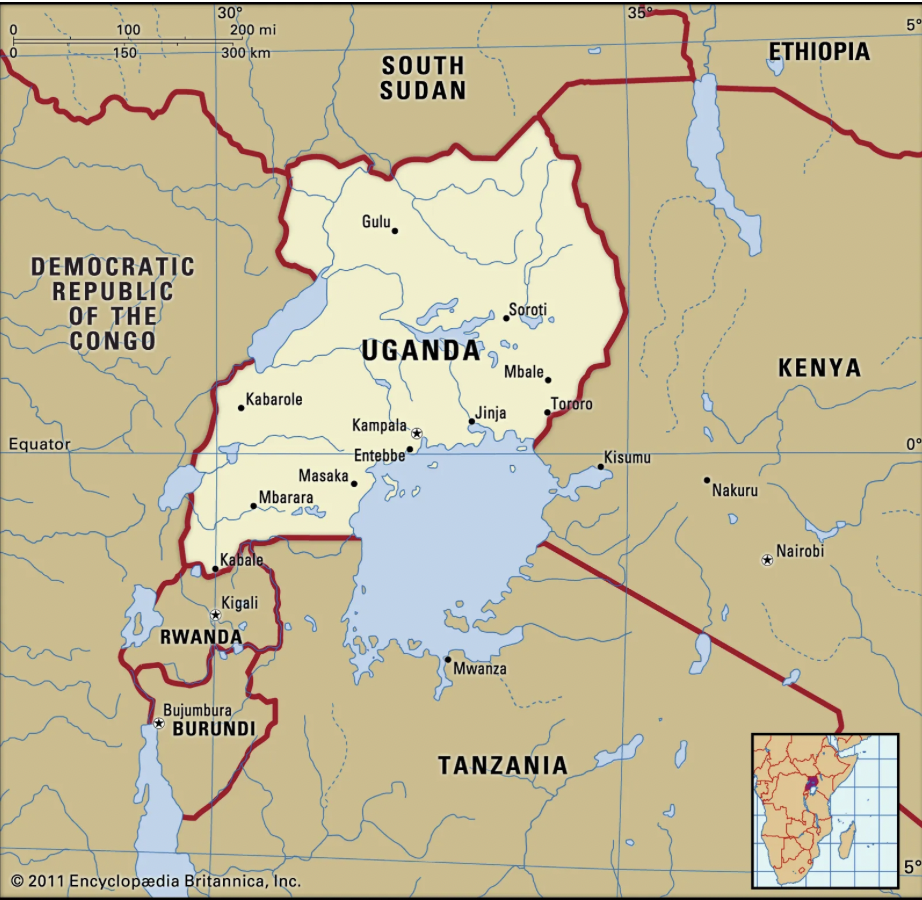
Below follows a shocking account from Uganda. It is not the first time on this site that human sacrifices, ritual murders and ritualistic activities are being reported from this East African country.
The reported steep increase in the number of (reported and/or discovered!) human sacrifices is indeed extremely worrisome, the more so that we may assume that the discovered or reported cases of ritual killing are only the tip of an iceberg.
It’s a horrifying reality that mainly children are victim of these crimes which are above all based on superstition and (partly) caused by poverty. Partly caused, because according to reports not only poor people resort to human sacrifices to increase their well-being. Also (rich) businessmen do, as the 2014 case of the business tycoon Kato Kajubi demonstrates (see my posting dated May 7, 2021).
Whereas in 2019 22 ritualistic murders were recorded, this number rose to 45 in 2020, and to 65 last year (2021), resulting in the sad total figure of 132 human sacrifices which have been recorded.
Ritual killings must stop! (webmaster FVDK)
‘A big problem’: Uganda sees spike in human sacrifice incidents
Most victims of the sacrifices are children, apparently because they are easier to abduct and seen as “pure” and so of “higher ritual value”. (AA Archive)
Published: July 3, 2022 By: TRT News
Authorities say human sacrifices take place at advice of ‘witch doctors’ in superstition-hit rural areas to bring good luck.
Human sacrifices continue unabated in the remote and rural areas of the landlocked East African country of Uganda despite authorities enacting tough laws and threatening death sentences.
According to officials, 132 incidents of human sacrifices have been recorded in the last three years. The numbers have spiked from 22 sacrifices in 2019, 45 in 2020 and 65 in 2021.
Most victims of such “ritual sacrifices” are children, apparently because they are easier to abduct and seen as “pure” and so of “higher ritual value”.
Anadolu Agency quoted authorities as saying on Sunday that the sacrifices are being carried out by witch doctors or local traditional healers, dotting rural areas.
Admitting that human sacrifice is a big problem, Lucas Oweyesigire, the police spokesman for the Kampala region, said most such practices take place in rural areas.
The so-called leader of traditional healing and witch doctors, Mama Fina, has also condemned human sacrifice and described those recommending the sacrifice of human beings as “fake”.
Taking advice from witch doctors
Police spokesman Fred Enanga said only last month they “arrested a man identified as Musilimu Mbwire on suspicion of killing his two sons in human sacrifice.”
According to preliminary investigations, a rich man had paid Mbwire money and convinced him to sacrifice his two sons at the instructions of a witch doctor.
Superstitions lead people in rural areas to seek help from witch doctors, who in turn offer weird prescriptions, including human sacrifices to turn around their luck.
A more worrisome part of the superstition is to undertake human sacrifice to put the body at the foundation of a building to bring good luck.
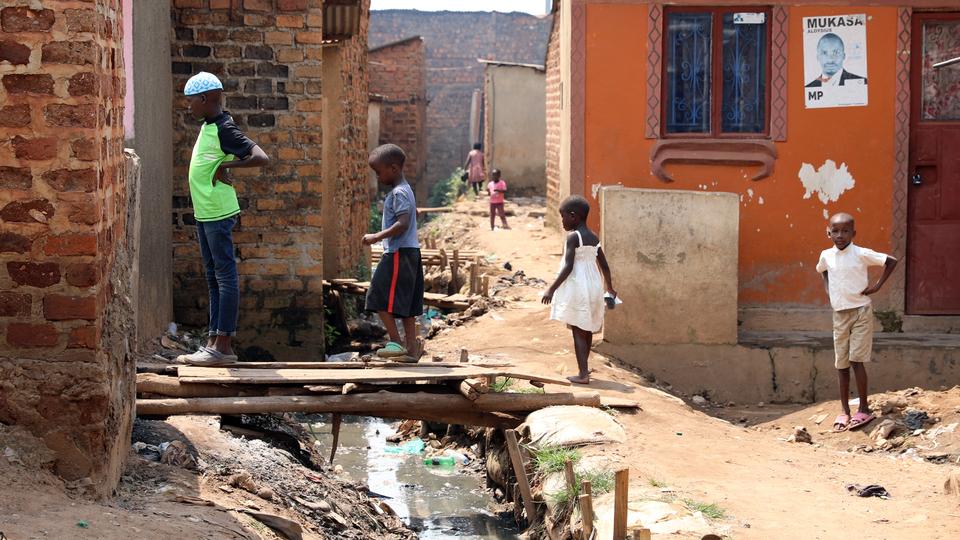
Timothy Mukasa, a local leader in Kampala’s suburb of Kireka, said many multi-storey buildings in the town have been built on a human body.
“The witch doctors tell owners to put a human body at the foundation of the construction of the buildings,” he said.
In 2014, authorities apprehended and later sentenced a tycoon Kato Kajubi for sacrificing a child and then putting his body in the foundation of a building that he was about to construct.
David Musenze, a journalist who studied psychology, said there are not many qualified counsellors to attend to psychological and mental issues of people, which makes them take advice from witch doctors.
“People go to witch doctors to help them get jobs, be promoted at jobs, or kill their enemies, along with many other problems,” he said.