Ritual murders in Zimbabwe – when will it stop?

Ritual murder – locally known as ‘muti murder’ – is not uncommon in Zimbabwe although it remains an exceptional crime that we must reject, combat and punish. The last time I posted on murder for ritualistic purposes in this Southern African country was on July 6 this year.

I take here a brief, superficial look at a number of reported and suspected or cases of ritual murder in Zimbabwe which have been reported in the current year, 2025, and in 2024 – with the important disclaimer that I do not claim to present an exhaustive list of reported muti murder cases, and underlining that many ritual murders go unnoticed.

In this post I do not include the original article(s), which is my usual procedure (for fear of losing the source in cyberspace). This time I take the risk… I apologize in advance for any inconvenience this may cause to the reader.

Before presenting you aforementioned list, I wish to share with you a succinct but very correct description of ‘ritual murder; thanking Lovemore Muzira of Pendula News, Zimbabwe for the quote:

‘Ritual killings are premeditated murders carried out on the belief that human body parts hold supernatural powers.’ Unquote.

Journalist Lovemore Muzira is a regular contributor to Pindula News with a background in Political Science and International Relations and has written most of the articles referred to below. He is to be commended for drawing our attention to this plague – murdering for ritualistic purposes, which are a serous human rights violation and cause fear and sadness.

The reader is reminded of the Makore ritual murder case: 7-year old Tapiwa Makore was murdered by his uncle and an accomplice for ritualistic purposes. His cruel death in 2020 shocked the nation and the high-profile muti murder of the young boy was leading headlines in newspapers for many years, 2020-2025. I also covered the tragic murder case and following trial on this site.
Unfortunately, ritual murderers learn little from the punishment imposed on the murderers: ultimately they were sentenced to life imprisonment.

Warning: some of the following articles contain graphic details which may disturb the reader.

On a recent suspected case of ritual murder, in Norton, Zimbabwe, Lovemore Muzira reported:

Body Of 40-Year-Old Found With Missing Body Parts In Norton
Published: August, 26 2025
By: Lovemore Muzira – Pendula News, Zimbabwe

Norton Gripped By Fear After Two Grisly Murders
Published: August 28, 2025
By: Lovemore Muzira – Pendula News, Zimbabwe

29-Year-Old Man Arrested Over Norton “Ritual” Murder
Published: August 28, 2025
By: Lovemore Muzira – Pendula News, Zimbabwe

Norton Man Accused Of Murder And Body Mutilation Granted US$100 Bail
Published: September 10, 2025
By: Lovemore Muzira – Pendula News, Zimbabwe

Norton is located about 40 km west of Harare, Zimbabwe’s capital, in the province of Mashonaland West.

Provices of Zimbabwe – Source: Wikipedia

Unfortunately, there are many more cases:

Zimbabwe: Brother Beheads Sister for Rituals, Goes Blind On Eve of Trial
Published: September 10, 2025
By: Mary Taruvinga – New Zimbabwe
Refers to a 2017 ‘muti murder’ case

Shurugwi Grandmother Kills, Eats Child’s Flesh For Ritual
Published: August 29, 2025
By: Lovemore Muzira – Pendula News, Zimbabwe

Self-Styled Prophet Arrested For Ritual Murder Of 12-Year-Old Boy
Published: July 9, 2025
By: Marlven Chinembiri – Pendula News, Zimbabwe

Assailant Cuts Off 8-Week-Old Baby’s Nose And Cheek In Filabusi
Published: May 27, 2025
By: Lovemore Muzira – Pendula News, Zimbabwe

Body Dumped In Bindura With Head, Both Hands And Feet Missing
Published: May 1, 2025
By: Lovemore Muzira – Pendula News, Zimbabwe

Decomposing Body Of Missing Chitungwiza Teacher Found In Gutu
Published: October 8, 2024
By: Lovemore Muzira – Pendula News, Zimbabwe
Parts of the decomposing body of Stella Mushangidze Chidzenga,
a Chitungwiza teacher were recently found in Gutu, Masvingo Province.

Body Found In Mazowe Dam With Missing Parts
Published: July 5, 2024
By: Lovemore Muzira – Pendula News, Zimbabwe

Man Jailed 4 Years For Attempted Ritual Murder Of Boy (7)
Published: March 11, 2024
By: Lovemore Muzira – Pendula News, Zimbabwe

Headlands Businessman Allegedly Hires Hitman To Kill Grade One Learner For Rituals
Published: March 8 2025
By: Lovemore Muzira – Pendula News, Zimbabwe

Burnt Body Of Baby Boy Found Hanging On A Tree – body parts missing  
Published: Febr 3 2024
By: Lovemore Muzira – Pendula News, Zimbabwe

“Ritual Murder” Victim (3) Body Found In Mavuradonha Mountain
Published: February 1, 2024
By: Lovemore Muzira – Pendula News, Zimbabwe

Zhombe Teacher Killed, Face Skinned, Eyes And Ears Cut Off
Published: January 21, 2024
By: Lovemore Muzira – Pendula News, Zimbabwe 

It’s a sad list.
(webmaster FVDK)

The business, science behind ritual killings

The murder of Thabelo Mazolo in Zimbabwe inspired Bruce Ndlovu, the author of the article reproduced below, to dwell on the phenomenon of ritualistic murders, muti or muthi murders as they are called in Southern Africa. The staggering details of recent murder cases in Botswana, South Africa and Zimbabwe are shocking. The author is to be commended for his frankness to expose and discuss these heinous crimes which have no place in the 21st century.  

Warning: the following article contains many graphic details as to how these murders are committed (webmaster FVDK). 

Murder economy: The business, science behind ritual killings

The suspected ritual killer, Tawana Ngwenya (right) and his disillusioned father, Buzwani Ngwenya (left).

Published: June 21, 2020
By: Nehanda Radio – Bruce Ndlovu

“You must cut yourself and spill your blood onto a mirror,” the message to Tawana Ngwenya reportedly read. “Gaze into the mirror and say out loud that you are selling your soul for riches. After that you must open the door for my boys to go out.”

The messages, from a South African sangoma, were allegedly part of a chain of instructions to Ngwenya, messages that allegedly led him to take the life of Tawana Mazolo at Matsheumhlophe, Bulawayo.

The messages were witchcraft delivered digitally, as the unknown sangoma, from his lair somewhere in one of South Africa’s nine provinces gave Ngwenya instructions on how to spill blood and in the aftermath, prepare for a life of riches.

The details of the alleged murder are gruesome. Half of Mazolo’s body, from the waist down, was missing while her breasts and palms were cut off. On the surface, the tragic killing of Mazolo already looks like a ritual murder. The grizzly details suggest that this indeed is the case.

After all, every once in a while, the pages of publications in Zimbabwe and neighbouring countries drip with the blood of innocents murdered at the altar of self-enrichment.

There was the case of Edmore Rundogo, whose dismembered remains were found in Maun, about 500km from Botswana’s second city of Francistown.

Rundogo had left his home in Lobengula West (Bulawayo) in search of a better life in Botswana. Instead of the proverbial greener pastures on the other side of the Plumtree border, he had found machete-wielding men who savagely murdered him, ripping his heart out.

The five killers also cut off his hands, feet, privates and took part of his brains. The killers, after being told by the traditional healer that had hired them that they had killed the wrong person, had then tried to burn his body.

South of the Limpopo, there was the case of 10-year-old Masego Kgomo, a schoolgirl who was still alive when Brian Mangwale ripped out her womb.

During the course of his trial for murder, Mangwale would change his story three times, a fact that the courts took as evidence that he had no remorse for his actions. In one of the three accounts he claimed that he and a group of friends had taken the young girl to a traditional healer in Soshanguve, who gave them a concoction to drink before he dragged the crying Masego into a room.

The girl was still crying when the traditional healer returned with her 10 minutes later and started sprinkling something on her body.

Mangwale claimed the medicine man had then returned with a knife and a clay pot and ordered Masego to lie down on a bed.

When she refused, she was forcibly held down while the traditional healer stabbed her in the stomach, put his hand inside her body and removed something that looked like a ball, which he put into the clay pot. He also removed her left breast.

Mangwale told the magistrate he heard the others had wrapped the child’s body in plastic and drank muthi before dumping her body in the veld on the instructions of the traditional healer.

While his testimony kept changing, the courts were convinced that Kgomo had died after meeting the nasty end of Mangwale’s knife. A life in prison sentence was handed to the killer.

Body parts are big business in Africa, but particularly in South Africa where trade in human body parts is lucrative. In the race to get rich in places like the City of Gold, Johannesburg, some believe that the key to getting their hand on all that glitters is taking a shortcut.

Many Zimbabweans, like Mazolo, can trace their gruesome ritual death to powerful sangomas south of the Limpopo. While Ngwenya was the one allegedly wielding the instrument of death when Mazolo took her last painful breath, this is not always the case.

Middle men, like in the case of Mangwale, are usually the ones that handle the dirty work. According to South African scholar Louise Vincent, certain gangs specialise in killing people for the harvesting of body parts only.

“It is believed that certain murder gangs specialise in muthi killings. Unlike human sacrifice where death is the express purpose of the act, in muthi-related killings, death is an anticipated and accepted by-product of the garnering of human organs but it is not the main aim.

Indeed, it is often preferred that the victim remain alive during the process. When body parts, including internal organs, are removed while the victim is still alive it is believed that the power of the resultant medicine will be greatly enhanced. Depending on the wants of potential customers, the instructions that the sangomas give specifics.

“Sangomas seldom do the killing themselves. The order will include not only specifications as to which particular body part or parts are required — testicles for virility purposes, fat from the breasts or abdomen for luck, tongues to smooth the path to a lover’s heart — but the very specific manner in which they are to be collected.

“The use of human body parts for medicinal purposes is based in the belief that it is possible to appropriate the life force of one person through its literal consumption by another. For this reason, a victim is often carefully chosen — not just any person’s penis as a cure for male infertility, for instance, but that of a man with several healthy children.”

Those who grew up in Zimbabwe urban areas will recall how the shadow of ritual murder has never been far off the horizon. Some, no doubt, know of the stories of businessmen who are said to have suddenly turned rich after they lost a spouse or a child. That child, or any other loved one, is assumed to be the blood sacrifice that was necessary for their businesses to turn a sudden corner.

Such perceptions of course, may be nothing but jealous rumour, but they are not helped by actual cases like that of Robert Tazvireva, a bottle store and general dealership owner in Magunje who allegedly instructed Samuel Mushonga in 2017 to murder his own sister so he could enhance his business.

After Mushonga had allegedly fatally stabbed his sister and hacked off her head, he delivered it to Tazvireva who told him to hide it in a nearby bush. Such instances, have helped convince many that businesspeople profit from the spilling of blood.

“‘If the business is not doing well, get a boy or a girl’s head — someone who has a future — and your business will have a future too,” said Dr Gordon Chavunduka time president of the Zimbabwean Traditional Healers Association, once said.

Those who grew up in Bulawayo in the late 90s will remember the myth of men who reportedly drove around the city with a blood sucking frog, looking for unsuspecting victims to profit from.

While such urban legends have never been confirmed, they are an entertaining reminder that people live on the constant lookout for people trying to profit off their ritual sacrifice.

“I recall vividly growing up in one township in Zimbabwe. This was just when public transport in the form of the Toyota Hiace taxi had just been introduced in the country,” says Fanuel Hadzidzi of Gender Links.

“At that tender age, we were scared to death by the stories doing the rounds in the township of the disappearance of children. We were told how kids were being lured by strangers who promised them some sweets.

“The next thing, their bodies would be found in the bushes with some body parts missing. Rumours were that businesspeople were taking the children’s heads for instance to Durban in South Africa and were trading them off for the taxis. Weren’t we all scared!”

With claims of human body parts sold by vendors on the streets of South Africa and other countries, it may be a long time before ritual killings lose their lustre to those trying to make a quick dollar.

Source: Murder economy: The business, science behind ritual killings

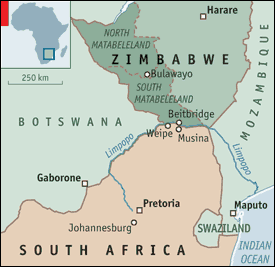
The Limpopo River Basin (Botswana, Mozambique, South Africa, Zimbabwe). Source map: The Economist