Killing for ritualistic purposes is rampant in Nigeria. In most states, ‘money ritual’ is a well-known phenomenon. I have already reported many cases on this site. In many states ritual murders are being committed. Reporting on these cases is erratic. Not always there is a follow-up, informing the public of any arrest made, or – in case suspects are arrested – whether they are put on trial, and what the outcome is.
Unfortunately, ritualistic murders or murders for ritualistic purposes are not rare in Ogun State, in Nigeria’s southwest. This year alone I already reported various cases, my most recent postings were on April 27 and March 15.
Below I’ve listed four cases which happened during the past few months. Mind you, these are cases which have been reported. How many cases go unreported? To be correct, the fourth case, a seven-year old boy who was murdered for ritualistic proposes by his mum and step-father was already reported on April 27, from a different source. It does not make it less serious. I’m afraid ritualistic killings in Ogun State will continue, as they will in other states. How to end this barbaric practice? (webmaster FVDK).
Notorious cultist arrested in Ogun State, confesses to killing three
Published: June 3, 2020 By: The Eagle Online, Nigeria
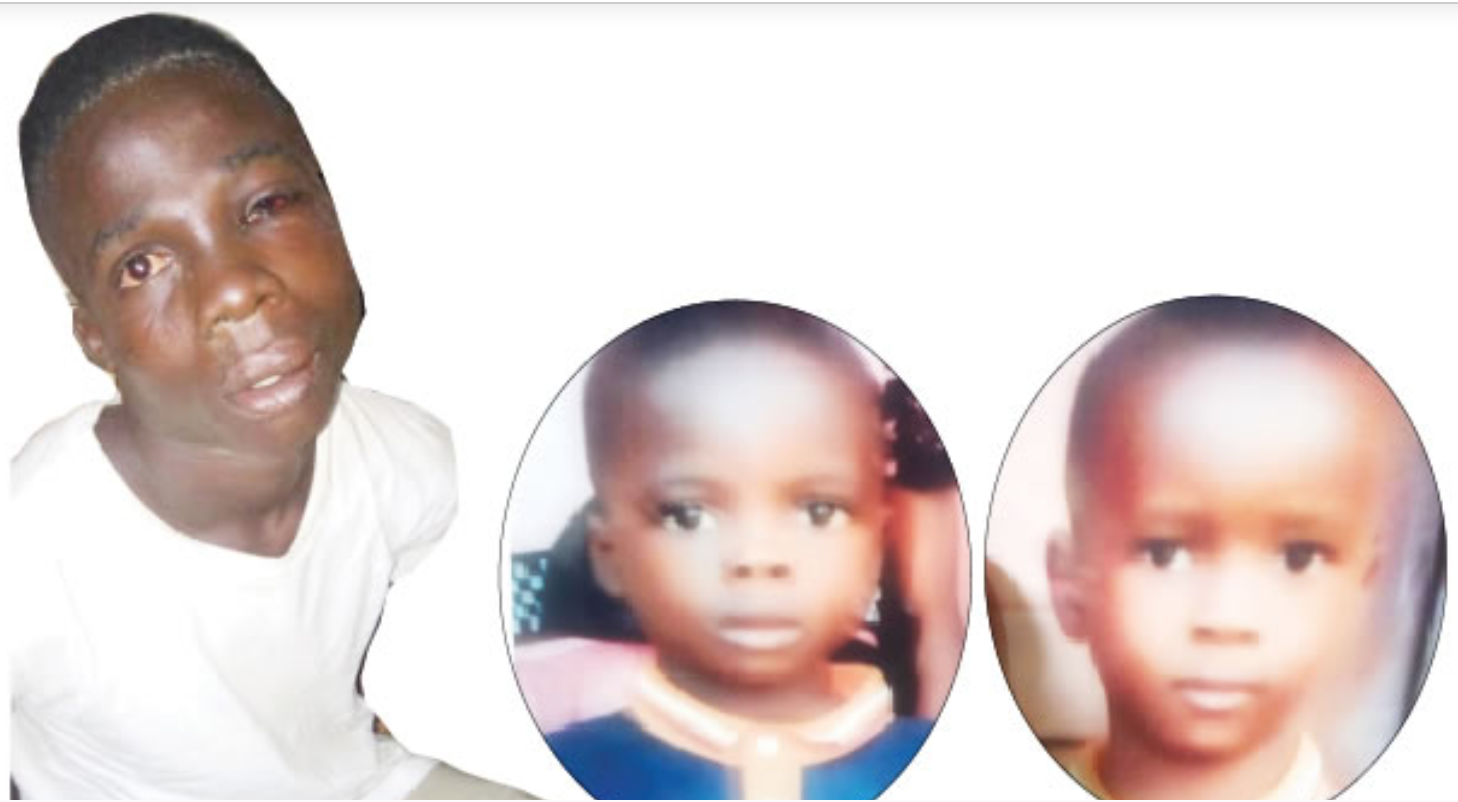
A notorious cultist, Adewale Adeoye, popularly known as 16, has confessed to killing no fewer than three persons since joining the Eiye cult.
Adeoye made the confession on Tuesday when he was paraded alongside 30 others by the Ogun State Police Command for different crimes.
The Commissioner, Ogun State Police Command, Kenneth Ebrimson, who paraded the suspects at the command headquarters in Eleweran, Abeokuta, accused them of involvement in cultism, armed robbery, murder and illegal possession of firearms.
Ebrimson said Adeoye, who has been on the wanted list of the police in connection with cult-related killings in Ijebu-Ode and its environs, added that he was arrested alongside five others at their hideout in Ijebu-Ode.
He said two locally-made single-barrelled pistols, one double-barrelled pistol, 11 live cartridges, assorted charms and Indian hemp were recovered from them.
Adeoye told newsmen that two of his victims were the killers of the leader of the Eiye confraternity in Ijebu-Ode, identifying them as Vandan, Koledowo and Abas.
He said he had been arraigned twice for similar crimes between 2012 and 2017.
He said: “I have been arraigned twice.
“I was first arraigned in 2012 and regained my freedom in 2015 because the complainant did not show up in court and they could not find anything incriminating against me.
“A few days after, the police came for my arrest again and kept me in custody for another two years before I regained my freedom again in 2017.”
Adeoye said he was the fourth in command in the confraternity in 2017 and later became the second in command a year later.
When asked if he renounced his membership of the cult after his arrest, he said: “I have not renounced my membership.
“They didn’t give me the chance because they told me that they would kill me if I renounced my membership.”
Ogun State: Pastor seeking ‘power’ to grow congregation killed by native doctor for ritual
Published: May 27, 2020 By: The Eagle Online, Nigeria
A Pastor, Kalejaiye Ezekiel, who went to seek traditional power, has been killed by the same native doctor from whom he sought help.
According to available information, the pastor said he needed the power to draw worshippers to his church.
The Ogun State Command has since last month arrested the native doctor, Isiaka Ogunkoya, for the murder of the pastor.
The 48-year-old native doctor has also confessed to killing Ezekiel.
Ogunkoya told policemen mid last month: “The Pastor came to me for power so that his church would grow.
“I used the opportunity to use him for my personal job.
“I mixed some sleeping solution for the pastor to drink and he slept off moments afterward.
“As he dozed off, I picked a knife and slaughtered him.
“I am a native doctor and I have helped so many people, including pastors who want their congregation to grow, in the area.
“This particular incident happened because I personally needed human parts for a particular concoction that I wanted to prepare for one of my clients in Isoyin.
“When the Pastor came, saying that he wanted power so that his congregation could grow, I used the opportunity to kill him and used the needed parts for the concoction.
“I gave him some solution to drink and he fell deeply asleep and that afforded me the time to slaughter him and cut out the parts I needed for my concoction.
“I know I have done wrong, but I want forgiveness because if you go around and ask about me, people will tell you that I am a good person.
“This one just happened the way it did.”
The spokesperson of the Ogun State Police Command, Abimbola Oyeyemi, said the native doctor was arrested by policemen on routine stop and search duty along Isoyin Road.
Oyeyemi, a Deputy superintendent of Police, said Ogunkoya would be profiled to know how many people he may have killed in the same manner.
He said the native doctor would be charged for murder at the end of investigation.
Ogun State: Human parts dealers go violent after customers fail to pay N1m for ‘fresh hand’
Published: May 21, 2020 By: The Eagle Online, Nigeria
Alleged human parts dealers in Ogun State last week went violent following the failure of three of their customers to come up with the N1 million agreed for the supply of a “fresh human hand”.
According to available information, after the customers failed to pay for the human hand, the human parts dealers lured them to a bush, where they had them beaten thoroughly for a couple of days before releasing them on May 17, 2019.
According to the spokesman of the Ogun State Police Command, Deputy Superintendent of Police Abimbola Oyeyemi, the development led to the arrest of four persons involved in the deal.
Oyeyemi, in a statement on Wednesday, said the operation, carried out in conjunction with the Ogun State Security Outfit, So-Safe Corps, also led to the recovery of the fresh human hand.
The Command’s spokesman, who identified the buyers of the fresh human hand as Matthew Idosu, John Feyisetan and Samuel Adegbola, said they were arrested alongside a 40-year-old herbalist, Michael Itomu, by operatives of the Police and So-Safe Corps at Idi-Iroko in Ipokia Local Government Area of the state for being in possession of a fresh human hand.
He said the suspects, through Idosu, had contracted someone in Abeokuta, the state capital, who promised to get the human hand for them for N1 million for money rituals.
Oyeyemi said in the statement: “On delivering the hand, the dealers demanded the agreed N1 million, but the money was not readily available; this led to a serious scuffle between them and they angrily took away the duo of Samuel Adegbola and John Feyisetan into a bush, where they thoroughly beat them before they were released on May 17, 2020.
“It was the action of those, who supplied the hand, that made the whole secret to leak out and which eventually led to their arrest.”
He said following a tip-off, the Idi-Iroko Divisional Police Officer, CSP Sunday Opebiyi, detailed his detectives in collaboration with men of the So-Safe Corps to ambush the suspects, leading to the arrest of three of them in Owode-Yewa, adding: “Their arrest led to the arrest of the herbalist in the early hours of Tuesday, May 19, 2020.”
Oyeyemi said the fresh human hand had been taken to the Idi-Iroko General Hospital for preservation, adding that the Commissioner of Police in the state, Kenneth Ebrimson, had ordered the transfer of the case to the State Criminal Investigation and Intelligence Department for further investigation.
He said: “He also directed that other members of the syndicate, who provided the hand, should be hunted and brought to justice.”
Ogun State: Mum, stepdad kill boy for ritual, bury him in upright position with parts missing
Published: April 26, 2020 By: The Eagle Online, Nigeria
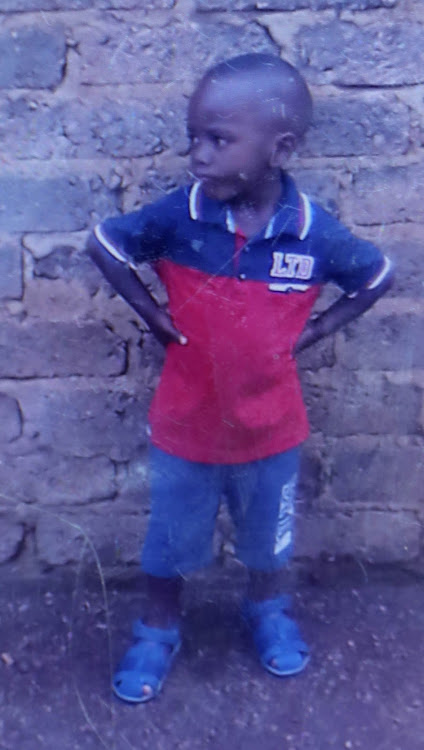
Operatives of the Ogun State Command have arrested three persons, including the mum and stepdad, of a seven-year-old boy in the state, Pelumi Apalaya, for allegedly killing him for ritual.
The spokesman of the Command, Abimbola Oyeyemi, revealed this in a statement on Saturday.
According to the police, those arrested were the boy’s mum, Adetutu Apalaya; her husband, who is the boy’s stepdad and a herbalist, Lajuwon Ogunleye; and his friend, Fatai Sefiu.
Oyeyemi said in the statement that the boy, who lived with his mum and stepdad until he died in Abigi area of Ogun State, reportedly slumped and died on the spot without being ill.
This was said to have aroused the suspicion of some neighbours who trailed Apalaya, Ogunleye and Sefiu to a bush, where the corpse of the boy was reportedly buried in a mysterious way.
The incident was then reported at Abigi Police Station, with the Divisional Police Officer, SP Tarkighir Joseph, leading a crack team to track down the suspects in Iwopin area of Ijebu Waterside, Ogun State on Wednesday.
The three suspects led the policemen to where Pelumi was buried.
There, it was discovered that the victim was buried in an upright position with some of his parts removed.
Oyeyemi said: “On interrogation, the second suspect, Fatai Sefiu, told the detectives that the boy was actually used for ritual by the stepfather (Ogunleye) in connivance with the deceased boy’s mother.
“He stated further that the couple had reached a conclusion before he was co-opted into the business.”
He stated that Apalaya initially denied knowledge of her husband’s plan to use Pelumi for ritual, but later admitted to the crime, adding: “She was dumbfounded when asked whether or not she followed them to the bush where her son was buried and the mode of burial of the boy.
“Meanwhile, the Commissioner of Police, CP Kenneth Ebrimson, has ordered the immediate transfer of the case to the homicide section of the State Criminal Investigation and Intelligence Department for further investigation and prosecution.”
The story below is a weird story, about a series of ritualistic murders which took place in and around a shebeen in Luanshya’s Twashuka, popularly known as Walale, in the 1980s (a shebeen is an illegal drinking place, a place where alcohol is being sold and served without a license).
The article is brief. More can be read after registering as a subscriber. It is unknown whether additional information can easily be found on the internet. If that’s the case, I will keep you informed. It’s an intriguing story (webmaster FVDK).
Changing times reform Walale
Published: May 29, 2020 By: Zambia Daily Mail Limited – Nkole Mulambia
WALALE, Luanshya’s little-known township, once gained recognition during the UNIP era for its notorious murders by a family that was allegedly killing people and burying them at their house.
In the early1980s, the story of the ritual killings in Walale spread far and wide and attracted the attention of the then President, Kenneth Kaunda, who visited the township. In an interview, Twashuka councillor Mulenga Chakulya says the family in question was running a shebeen, and under the cover of darkness and loud music, they would waylay intoxicated patrons and strangle them.
As alcohol was being served at the shebeen under the ambience of traditional music by live drummers, some patrons would disappear and not be seen again by their relatives. Mr Chakulya says it was believed that the family in question was killing their clients for juju purposes.
“They were arrested, tried in court and jailed. I am not sure just how long they were jailed,” Mr Chakulya narrates.
Walale, christened as Twashuka, is now a peaceful and generally crime-free township, located 15km from the Luanshya central business district.
To read more, you can access the original article after clicking on the link below (webmaster FVDK).
Warning: the article below contains graphic details which may shock the reader (webmaster FVDK).
Rivers Ritual Killing: University Undergraduate, Accomplice to Die by Hanging
Published: May 14, 2020 By: This Day (Nigeria)
Justice Adolphus Enebeli of the Rivers State High Court sitting in Port Harcourt, has sentenced one Ifeanyi Maxwell Dike to death by hanging for the killing of an eight-year-old Victory Chikamso, a female for ritual purposes in 2017.
Also sentenced to death alongside Dike is one Ugochukwu Nwamairo, his accomplice who reportedly requested for the supply of the human body parts for money ritual.
Also, an ex-police sergeant who allegedly aided Dike’s escape from prison at night after his detention, Johnbosco Okoronze got one year imprisonment, for aiding and abating escape of the murderer.
Dike, a 200-level Physics student of the University of Port Harcourt, (UNIPORT), on August 18, 2017 allegedly strangled his victim who was also his niece and primary two pupil of a private school in Port Harcourt.
Dike perpetrated the act in his (Dike’s) room at Eliozu community, in Obio/Akpor Local Government of the state, where he also removed the vital parts of her body.
Chikamso’s body parts such as, breast, private part, fingers, ear, heart, eyelid, among others, were discovered missing when the remains were found with Dike.
He was on his way to the community central crash bin at midnight to dispose of what was left of the body of the child when he was apprehended by men of the community vigilante and was handed over to the police.
The duo, Dike and Nwamiro were found guilty of the two-count charge of conspiracy and murder levelled against them.
Sentencing them, Justice Enebeli pronounced that Dike should be hanged on his neck until he dies, while Nwamiro should be hanged on his leg until he dies (upside down).
The court explained that it decided to sentence the ex-police sergeant to just one year jail term because he has already served two years in prison from the time he was arrested, adding also that he has been dismissed from police force, since the case began.
He noted that Nwamairo’s conviction and sentence was based on Dike’s evidence-in-chief and voluntary confession/ statement on four different occasions that, the second defendant (Nwamairo), had requested the body parts of a little girl, including the heart for financial independence.
The court ruled that the prosecution proved his case beyond reasonable doubts, insisting that counsel to Dike, Lezina Amegwa “in his written address did not deny the fact that his client committed the murder but said he was not in his right frame of mind when he committed the act, meaning that he was mentally deranged and insane.”
The court verdict caused panic and serious outburst among Nwamairo’s family members who were present when the judgment was delivered.
His wife collapsed and was carried away by other members of the family present while one of the brothers, was noticed shouting on top of his voice, insisting that the brother was innocent of the crime, adding that the judgment was wrong and would be appealed as they cried profusely.
Speaking to journalists shortly, the prosecution counsel, Mr. Chidi Eke, described the judgment as landmark, adding that “it has brought about justice for the state, the family of late Victory Chikamso and the soul of the departed.”
However, counsel to Nwamiro, Mr. John Ndah expressed displeasure over the judgment and assured that it would be appealed.
As for Dike and his lawyer, Amegwa, it is all over with the case.
“We may not appeal the matter because of the circumstances in the judgment,” they concluded.
It would be recalled that Dike escaped from police custody, using the darkness of the night to run away from the cell of the State criminal investigation Department, the night he was arrested and was re-arrested in Jos, Plateau state, two weeks after. Source: Undergraduate, accomplice to die by hanging in Rivers (The Nation, May 13, 2020)
Warning: some of the articles below contain graphic details of the crime (webmaster FVDK).
Child murder accused described as ‘quiet and reserved’
Amanda Zitho, L, the mother of Mzwandile Zitho, 05, who was killed in Orange Farm about 2 weeks ago. PHOTO : ANTONIO MUCHAVE/SOWETAN
Published: April 29, 2020 By: The Sowetan – Tankiso Makhetha
The woman accused of killing a five-year-old boy whose body was found in a local tavern has been described as a quiet and reserved person.
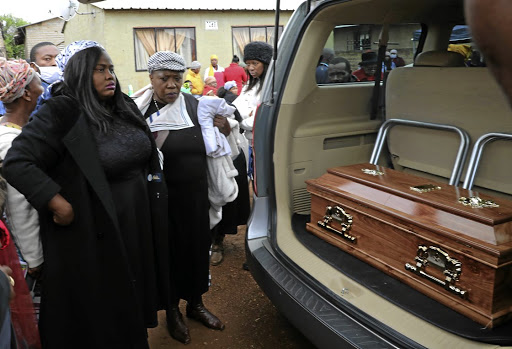
This was a sentiment shared by community members at Mzwandile Zitho’s funeral yesterday in Orange Farm, south of Johannesburg.
Mzwandile was allegedly murdered by Pontso Mohlanka who appeared in the Vereeniging magistrate’s court yesterday where she is facing a charge of murder.
Her matter was postponed until May 15 when her bail application is expected to be heard. The matter was also postponed to allow the state to verify Mohlanka’s nationality with the department of home affairs.
She was initially arrested with her partner and tavern owner, who was not formally charged due to insufficient evidence.
“We are still dumbstruck by what happened. It’s hard to make sense of the whole thing because she is the last person who we thought would be charged for Wandi’s murder,” said Petunia Nkwanyane, a resident in the area.
She spoke to Sowetan at Mzwandile’s Orange Farm home, moments after his burial. The deceased’s home is just across the street from the tavern where the body was discovered on April 15.
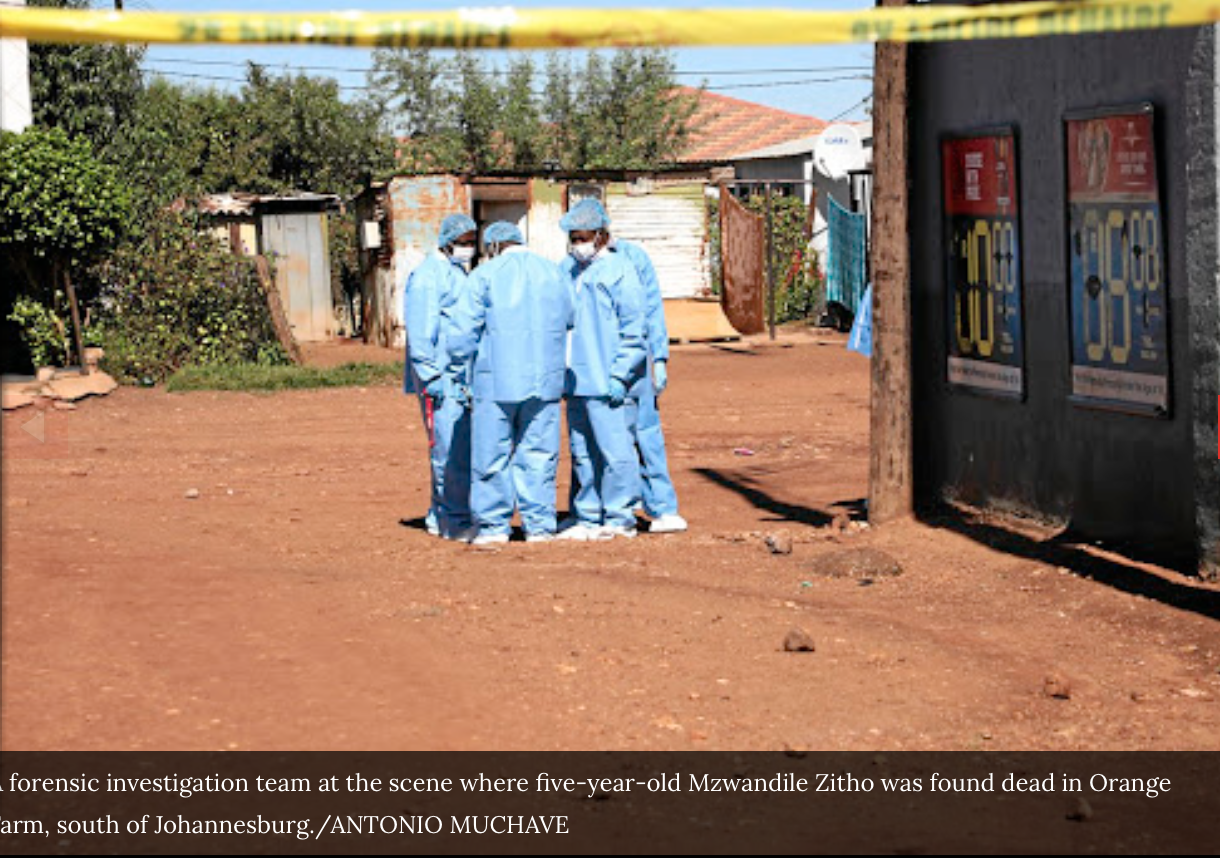
The tavern house, now a crime scene, is sealed off with police tape.
Mzwandile’s body was found in an upright position in a fridge, with his hands and feet tied.
According to residents, he also had a red rope around his neck which had small packets containing a powdery substance.
“The only time we saw anyone there was when the tavern owner’s sister came to fetch something while the couple was in jail. We know that the owner was released from jail but we don’t know where he is,” Nkwanyane said.
Another neighbour, Phindi Majola, said Mzwandile’s mysterious death had enraged the community which wanted to burn down the tavern.
“Everyone was upset because of the way Mzwandile was killed. People wanted to burn the house when the police were done with their work because they suspected that Mzwandile was killed in a muthi ritual,” Majola said.
She said she was familiar with Mohlanka, with whom she interacted while peeling vegetables at homes preparing for funerals in the area.
“She is so quiet and shy. I am familiar with her; we talk a lot when we peel vegetables for funerals here,” she said.
Mzwandile was buried at De Deur Memorial Park near Vereeniging. His distraught father, Simphiwe Mosala, said: “I just want to know why he was killed. He was an innocent boy who had so much potential. We want justice; we are also grateful to everyone who has shown us support.”
Woman charged after senseless killing of five-year-old boy
Five-year old Mzwandile Zitho was reported missing by his grandmother on Wednesday. Image: Supplied
Published: April 20, 2020 By: The Sowetan – Tankiso Makhetha
A woman has been charged with the murder of a five-year-old boy who was found killed in a tavern in Orange Farm last week.
Pontso Mohlanka appeared in the Vereeniging regional court on Monday where she was charged with Mzwandile Zitho’s murder.
Phindi Mjonondwane, the National Prosecuting Authority’s spokesperson said the matter was postponed until Wednesday for further investigations.
“The matter was also postponed to set a date for the bail application hearing,” Mjonondwane said.
The woman was arrested along with her husband at the tavern, which is located less than 30 metres from Zitho’s home.
“Charges against the man were not placed on the roll as there is currently no prima facie case against him,” she said.
Zitho was found in an upright position with his legs tied and a red rope around his neck in what his family believes was a muthi killling.
Zitho’s grandmother Nompumelelo Zitho previously told Sowetan how she frantically searched for her grandson last Wednesday with the tavern owner allegedly telling her not to worry when she asked him if he had seen Mzwandile.
“I was worried sick because I didn’t know where he was. I started searching for him and asked the owner of the tavern if he had seen Wandi and he said no. He said Wandi was a smart boy and would return home,” she recalled Wednesday’s events.
Zitho said the tavern owner assisted them to search for Mzwandile and went as far as sending one of his employees into a neighbouring township.
“He was telling me not to go to the police station and that we would find Wandi by the end of the day. He was so reassuring, but I was concerned and wanted to find my grandson,” she said.
Zitho said after several hours of searching, she then went to the police station to report Mzwandile missing.”Four hours after our conversations, I was shocked when I arrived at the police station to report Wandi missing, only to find him [tavern owner] there.
“He told us that he had found Wandi’s body in his tavern and did not know how it got there,” Zitho said.
“I feel betrayed because he was one of the first people to start a search party for Wandi when I told him he was missing.
“He didn’t tell me that my grandson was in his tavern the whole time we were looking for him. He said he also didn’t know that Wandi was there.”
Zitho said she was heartbroken because she raised Mzwandile since he was five months old. She recalled the condition in which they found Mzwandile’s body.
“He was standing upright, there was a red rope with small papers containing powdery substances attached to it. His legs were also tied with a handkerchief with a small bottle containing white muthi attached to it.
“It is as if he was a sacrifice.”He was an active child and full of energy. He would say to me that he wanted to be a priest because he was tired of seeing me take a taxi to church. He said he would take me to church with his own car.”
Nompumelelo Zitho , the grandmother of 5 year old child, Mwzandile Zitho, killed in Orange Farm, Johannesburg . PHOTO: ANTONIO MUCHAVE/SOWETAN
Published: April 20, 2020 By: The Sowetan Live, South Africa – Tankiso Makhetha
The tavern owner who helped the family of a five-year-old boy to search for him after he went missing last week has been arrested for the child’s murder.
Mzwandile Zitho’s grandmother Nompumelelo Zitho recalled how she frantically searched for her grandson in Orange Farm, south of Johannesburg, on Wednesday with the tavern owner allegedly telling her not to worry when she asked him if he had seen Mzwandile.
“I was worried sick because I didn’t know where he was. I started searching for him and asked the owner of the tavern if he had seen Wandi and he said no. He said Wandi was a smart boy and would return home,” she recalled Wednesday’s events.
Zitho said the tavern owner assisted them to search for Mzwandile and went as far as sending one of his employees into a neighbouring township.
“He was telling me not to go to the police station and that we would find Wandi by the end of the day. He was so reassuring, but I was concerned and wanted to find my grandson,” she said.
Zitho said after hours of searching, she then went to the police station to report Mzwandile missing.
“Four hours after our conversations, I was shocked when I arrived at the police station to report Wandi missing, only to find him [tavern owner] there. He told us that he had found Wandi’s body in his tavern and did not know how it got there,” Zitho said.
Mzwandile was found in an upright position with his legs tied and a red rope around his neck in what his family believes was a muthi killling.
Provincial police spokesperson Capt Kay Makhubele said the tavern owner’ and his wife were arrested on Friday and are expected to appear in the Vereeniging magistrate’s court today on charges of kidnapping and murder.
“I feel betrayed because he was one of the first people to start a search party for Wandi when I told him he was missing.
“He didn’t tell me that my grandson was in his tavern the whole time we were looking for him.
“He said he also didn’t know that Wandi was there.”
Zitho said she was heartbroken because she raised Mzwandile since he was five months old.
She recalled the condition in which they found Mzwandile’s body.
Published: April 17, 2020 By: The Sowetan Live, South Africa – Tankiso Makhetha
A five-year-old boy was found dead in a tavern in Orange Farm, south of Johannesburg, on Wednesday, in what his family and community suspect was a muti-related murder.
Mzwandile Zitho was reported missing by his grandmother on the same day.
Residents said they were shocked by the gruesome discovery of his body in a fridge.
Anna Makhubu, who was one of the first people to enter the tavern where Mzwandile’s body was found, said: “His grandmother said she grew worried when she could not find him around the yard at 10am. She said he was still in his pyjamas when he went missing.
“She asked the tavern owner, who lives across from them, if he had seen Mzwandile. He said no. But she was shocked to find him at the police station as well.”
According to Makhubu, the tavern owner told the police he did not know how the boy’s body ended up on his property.
“He said he doesn’t know how the body got there and wanted to help. When we got there we found Mzwandile naked, standing in an upright position. His hands and feet were bound. There was muthi bottles and a handkerchief that had small ropes in it.”
Makhubu said she was heartbroken as she raised Mzwandile since he was five months old.
“He was an active child and full of energy. He would say to me that he wanted to be a priest because he was tired of seeing me take a taxi to church. He said he would take me to church in his own car.”
ANC branch chairperson in the area, Macy Monageng, said: “We are hurt because we are in a lockdown and then this happens. We thought children and women abuse would end in this situation but clearly not. The law needs to take its course.”
Police spokesperson Capt Kay Makhubele said they were investigating a case of murder and that no arrests have been made.
Five-year old Mzwandile Zitho was reported missing by his grandmother on Wednesday.
Published: April 16, 2020 By: The Sowetan Live – Tankiso Makhetha
A five-year-old boy was found dead in a tavern in Orange Farm, south of Johannesburg on Wednesday in what the community suspects was a muthi-related murder.
Mzwandile Zitho was reported missing by his grandmother on the same day. Community members said they were shocked by the gruesome discovery.
Anna Makhubu, who was one of the first people to enter the tavern where Zitho’s body was found, said: “His grandmother said she grew worried when she could not find him around the yard at 10am”.
She said he was still in his pyjamas when he went missing. Makhubu added: “She asked the tavern owner, who lives across from them, if he had seen Mzwandile. He said no. But she was shocked to find him at the police station as well.”
According to Makhubu, the tavern owner told the police he did not know how the boy’s body ended up on his property.
“He said he doesn’t know how the body got there and wanted to help. When we got there we found Mzwandile naked, standing in an upright position. His hands and feet were bound. There was muthi bottles and a handkerchief that had small ropes in it,” she said.
Macy Monageng, ANC branch chairperson in the area, said: “We are hurt because we in a lockdown and then this happens… a naked boy in a fridge? We thought child and woman abuse would end in this situation but clearly not. The law needs to take its course.”Police spokesperson Captain Kay Makhubele said they were investigating a case of murder.
On Tuesday, March 10 the Osun State House of Assembly passed into law a bill that made kidnapping, banditry and ritual killing a crime punishable by death. See my March 13, 2020 posting.
Therefore, the following is not surprise. Recently, on Thursday, April 2, an Osun State High Court in Ikirun has sentenced two men to death by hanging for murdering Rofiat Adebisi for money ritual purposes. Rofiat Adebesi was a a student of the Osun State University when she met her untimely death. The following article provides more details though it is not known when the hanging will take place (webmaster FVDK).
2 Men Sentenced To Death For Using Uniosun Final Year Student For Money Ritual (Photos)
Published: April 3, 2020 By: Sundiata Post (Ebere)
An Osun State High Court sitting in Ikirun has sentenced two men to death by hanging for killing one Rofiat Adebisi, who at the time of her death was a student of the Osun State University, Osogbo.
Giving his judgment on Thursday in the trial that lasted almost two and half years, Justice Oyejide Falola, said 25-year-old Elijah Oyebode and Jelili Raji, aka Ifa, 35, should be hanged after he found them guilty of murdering the undergraduate.
The convicts were first arraigned on November 14, 2017, alongside one Yusuf Ajibade on three counts bordering on conspiracy to commit murder and murder contrary to sections 324 and 316, and punishable under sections 319 and 322 of the Criminal Code, Cap.3, Laws of Osun State, 2002.
The prosecution team called five witnesses and tendered exhibits before the court, while the accused testified for themselves.
Giving the facts of the matter, the lead prosecution counsel, Kareem Adekilekun, who appeared with Kemi Oyolola for the Ministry of Justice, said on December 22, 2016, Rofiat, a 400-level student of UniOsun, Ipetu-Ijesa campus, boarded a car driven by Oyebode and went missing.
However, a day after, Rofiat’s dead body was found by the Egbeda/Iragbiji Road.
Following investigation by the police, Ajibade was arrested for selling the deceased’s iPhone to one Kolapo Quadri on the instructions of Oyebode.
When apprehended, Oyebode claimed that Raji hired him to get a lady with the aid of a charm he gave him, which would make the victim to obey all instructions given to her.
Oyebode said Raji paid him N10,000 to bring the victim to his shrine, adding that he hit Rofiat with the charm, while she was putting her luggage in the car.
Giving evidence, a police officer from the Homicide Section of State Criminal Investigation Department, Adeyeye Simon, told the court that Oyebode, a commercial driver plying the Akure-Owena Road, took Rofiat to Raji house’s after he had sex with her.
He also claimed that Rofiat died at Raji’s house, while Oyebode assisted him to dump her remains on the road.
Another witness, Olatomiwa Alade, from the Department of the State Services, said the deceased’s phone was traced to Quadri, who claimed that he bought it from Ajibade.
The counsel for the accused, Suleiman Bello, urged the court to be merciful on his clients.
In his judgment, Justice Falola found Oyebode and Raji guilty of murder and conspiracy, and sentenced them to death by hanging.
The court, however, discharged and acquitted Ajibade on the counts of murder and conspiracy, but sentenced him to two years in prison for receiving stolen property.
Related article: Two to Die by Hanging in Osun for Killing Final Year Student
Published: April 2, 2020 By: Sundiata Post
Abuja – Justice Jide Falola of Osun High Court sitting in Ikirun has sentenced two men to death by hanging for murder.
Falola, in his judgement on Thursday, said the prosecution counsel proved his case against the convicts – Elijah Oyebode, 25, Yusuf Ajibade, 28, and Jelili Raji, 35 – beyond reasonable doubt.
He, however, acquited the second convict, Ajibade, of two-count charge of murder and conspiracy but convicted him on the third count charge of receiving stolen property.
The judge sentenced him to two years imprisonment, while Oyebode and Raji were sentenced to death by hanging.
He also said that the shrine where the deceased was murdered be forfeited to the state government.
The convicts, who were first arraigned on Nov. 14, 2017, pleaded not guilty to three-count-charge of conspiracy to commit murder, murder and stealing preferred against them.
The State Counsel, Mr Kareem Adekilekun, had earlier told the court that the defendants murdered one Miss Rofiat Adebisi, a 400-level student of Osun University, Ipetu-Ijesha, on Dec. 22 2016.
Adekilekun said the offences were contrary to Sections 324 and 316, and punishable under Sections 319 and 322 of the Criminal Code Cap.3 Law of Osun, 2002, respectively.
The prosecution counsel told the court that on that fateful day, the deceased boarded a golf car with Lagos number plate FKJ 636 DL, driven by the first convict, Oyebode.
Adekilekun further told the court that on Dec. 23, 2016, the lifeless body of the deceased was found by the road side along Egbeda road in the state.
He said the convicts were arrested with help of the police through the iPhone 5 of the deceased, which was sold to Ajibade.
Adekilekun said Oyebode, in his confessional statement, said that Raji asked him to supply him a maid.
According to the prosecution counsel, a charm was given to Oyebode by Raji to charm any lady that he will bring and that such lady will be unconscious.
He also explained that in Oyebode confessional statement, he said the charm was used against the deceased.
He said Oyebode thereafter handed the deceased to Raji in his shrine and paid him N10,000.
He also told the court that the confessional statements of the three convicted persons were corroborated by the police, whose report showed that Oyebode had sex with deceased before taking her to Raji’s shrine.
Counsel to convicts, Mr Suleiman Bello, pleaded with the court to temper justice with mercy.(NAN)
Superstition is a curse. Its spread is like a virus… and it kills… How on earth can one believe that by murdering someone one increases wealth, power or prestige? ‘Money rituals’ in Nigeria cannot be compared to the traditional ritual killings which were performed for the sake of the wellbeing of the community – but which also don’t have a place in a modern society. Taking someone’s life is a crime. And should be punished.
Warning: the article below contains graphic details of the gruesome crime (webmaster FVDK)
Uncle kills seven-year-old twins for rituals in Delta, flees
Published: March 28, 2020 By: Punch Nigeria – Afeez Hanafi
The joy heralding the birth of a child is usually indescribable let alone arrival of twins. That was the feeling seven years ago when Chiagozie and Chidalu Agwunobi, were welcomed to the Oliseh clan in Oko Ogbele Community, Oshimili South Local Government Area of Delta State. They were a bundle of joy to their parents as they grew up happily in months and years.
Few days ago, that joy was blown away like a candle in the wind when they went missing and their dismembered bodies later found in a bush. They were cruelly killed by their uncle, Onuwa Oliseh, who is still at large.
Onuwa reportedly lured the seven-year-old male twins to the bush within the neighbourhood on Friday, March 6, after they returned from school and butchered them. He was said to have removed some of their body parts for money rituals and dumped the remains.
Investigation by operatives of the Inspector-General of Police Intelligence Response Team in the state led to the arrest of Onuwa’s accomplice, Kelvin Uzor, who is also a relation of the twins.
“Police got information that on March 6, the twins were missing from their parents’ house. Their bodies were later found in the bush on March 8 with some parts of their bodies mutilated. Their eyes, hands and private parts were missing. Police began investigation and generated enough intelligence that led to the arrest of Uzor. He confessed that they were a three-man gang and wanted to do money ritual with the body parts,” a senior officer told Saturday PUNCH.
Our correspondent learnt that Onuwa’s younger brother, Iweka, who attended the same school with the twins, told the police that the suspect asked him to lure the deceased from the school.
“I am a primary four pupil of Ekeanya Primary School. On March 6, at about 6.30am, my elder brother Onuwa Ajei Oliseh, asked me if I would go to school and I told him yes. He asked if I can help him bring out the twins from the school before the school closes that day and I told him no because their teacher would not agree.
“That day when I came back from school, I saw my brother place a cutlass on the table where he was eating while I went to the backyard. It was later I heard that the twins were missing and their dead bodies were found in the bush,” he told detectives.
The twins’ father, Agwunobi Oliseh, stated that Onuwa visited his house that Friday in the morning and asked him if they (the twins) would go to school. He said he responded in affirmative, unknown that Onuwa was plotting to kill his beloved kids.
The 52-year-old farmer said when his children returned from school, Onuwa came back and asked them to follow him to the stream in the community.
He said, “I am a traditionalist and a farmer. I’m married with seven kids. My twins were seven years old. On March 6 in the early morning, Onuwa came to my house and inquired if my late children would go to school and I said yes. I later learnt he told his younger brother, Iweka, to help him take my children out of the school premises. He said he wanted to go somewhere with them.
“Later in the day, he went to their school and tried to take them out but he was chased away by their teacher. As soon as they came back, he came to my house and asked them to follow him to the stream. I think they were on their way when he brought out a cutlass and killed them.”
The distraught father, who noted that he and his wife were not around when Onuwa took the twins away, said he was told the suspect ran home with bloodstains.
“According to his brother, he ran back home with his hands stained with blood. He then asked the brother to pour water on his hands while he washed the machete with which he killed the twins. He left for Uzor’s house and both of them went to one Anam.
“It was when I came back later in the day with my wife that I realised the twins were missing. While I was running around, Iweka told me that it was Onuwa who took my children. Onuwa ran away but we were able to find Uzor who told us where their bodies were dumped. We went there and found their mutilated bodies. Their eyes, tongues and hands were removed,” he added.
Uzor, in his statement, admitted the twins were killed for rituals but denied partaking in their murder.
He said one of his friends, called Chukwudi, told him of a traditionalist in Anambra who could help them to perform money rituals with children not above age 12.
The 18-year-old primary school leaver stated that he informed Onuwa, who agreed to the plan.
He said, “I stopped schooling after my primary school education because my parents did not have money. I worked for a farmer called Egwiyo. I served him for many years and he promised to give me money this year. Chukwudi told me there was a place where we could do money rituals in Anambra and he asked if I was interested.
“We later told Onuwa who agreed to do it. I told them I was not interested but if they want to do it, they could go ahead. I told them I would be happy if they succeeded. I was sleeping when Onuwa called me and said he had killed the twins. He said he took their bodies to one native doctor in Delta but the man told him he wasn’t into money rituals.
“He later called me when the heat was much and told me where he dumped the bodies. Now, police said I was the one who killed the twins. Onuwa took the body parts to a herbalist in Aguleri, Anambra.’’
Uzor said immediately he learnt about the twin’s murder, he ran to Anambra where he was tracked down by the police. He added that he gave tacit support for the crime in the hope that he would be given money to buy a car and build a house if it worked out.
He said, “I wanted to become a young chief because most of the young men I know did not work as hard as I did and now they are millionaires. I am a farmer and hardworking but I was not making enough money. I have no savings. That was why I somehow agreed to be part of the plan.
“Onuwa convinced me it was the fastest way to make money and that most of our colleagues made money through that means. My greatest mistake was that I did not inform my family when Onuwa suggested that we should use the twins.
“I love the twins so much and their parents are nice. I cautioned him but I don’t know that he would still go ahead to kill them. They normally went to his house to play; so it was easy for him to take them out without anyone being suspicious. I was not in the bush when he killed them.”
Uzor revealed further that the initial plan was to use an elderly woman in the community for the money ritual but he prevailed on the gang to spare the woman because she was generous.
“Initially, they wanted to use one old woman known as Nne Amaka, but I pleaded with them to leave her because she is nice. If I passed by and begged her for water, she would give me water and even food.
“I feel bad because he betrayed me. I am appealing to young men that money ritual does not pay. I am a hard working man and well known. Even when my name was mentioned in the crime, a lot of people came out to defend me. I am sorry. I want the family to forgive me,” he added.
Saturday PUNCH learnt that the remains of the twins had been deposited at the General Hospital, Igbuzor while IRT detectives led by DCP Abba Kyari had launched a manhunt for the fleeing suspects.
Bad news from Kenya where a couple has been arrested. They are accused of murdering their child in a ritualistic act. But also good news: swift action of the law enforcement officers. Hence, the rule of law. In many countries ritual killers get away with their heinous crimes. The two arrested in Kenya wil have to account for their deeds and, if found guilty, they will have to pay the prize accordingly, after an impartial, transparent trial (webmaster FVDK).
Man and wife held over ritualistic murder of their son, 4
Published: March 21, 2020 By: Nairobi News NN, KNA
Police in Bungoma are holding a couple for questioning after it emerged that the duo allegedly conspired to murder then secretly dumped the body of their four-year-old son at a nearby road.
Residents of Misikhu location, Webuye West constituency in Bungoma County were shocked after they encountered the lifeless body of the baby abandoned on a feeder road.
Preliminary investigations into the incident indicated that the couple had domestic squabbles and may have sacrificed the child in a ritual.
A neighbour who sought anonymity said the couple had frequent quarrels where the husband always accused the woman of infidelity.
The two suspects were apprehended at Makhese village after the mother confessed to killing their son. Police had to fire into the air to save them from an angry mob.
Webuye West sub-county commander Christopher Limo confirmed the arrests adding that the body of the deceased had been moved to the Webuye referral hospital mortuary while the parents were currently being held at Webuye police station for further questioning.
The area police boss further warned parents against infringing on the rights of children saying that his office would prosecute those found to be breaching these rights.
“Children have rights too and anyone who violates the children’s rights will be severely punished,” he charged.
The ritualistic infanticide practiced by the Kara, Banna and Hamar tribes of southern Ethiopia is as old as their cultures. The Kara, Banna and Hamar are not the only ethnic groups in Sub-Saharan Africa (SSA) that kill ‘cursed’ or ‘mingi’ infants. Also in e.g. Ghana, Burkina Faso, Benin and Nigeria tribal elders decide that the well-being of their clan or ethnic group is best served by the killing of young, innocent and often defenseless life – and I am certain that infanticide is practiced in more SSA countries.
As with other ritualistic killings (murders!), superstition ‘is the root of all evil’. Ignorance, superstition, AND the lack of law enforcement keeps this ugly practice alive. Let’s all work hard to eradicate these practices from society. Today is 2020. We’re living in the 3rd millennium!
I highly recommend the article below. CNN is to be commended for its publication! (webmaster FVDK)
Is the tide turning against the killing of ‘cursed’ infants in Ethiopia?
Published: November 5, 2011 By: CNN – Matthew D. LaPlante
His top teeth came in before his bottom teeth. That is how elders of the Kara tribe determined that a healthy baby boy needed to be killed.
The child was “mingi” — cursed, according to their ancient superstitions. With every breath, they believed, the boy was beckoning an evil spirit into their village.
Murderous though it was, the decision to kill the boy was the easy part. It was the sacrifice of one infant for the good of the entire tribe — a rite that some of the elders had witnessed hundreds of times throughout their lives in Ethiopia’s remote Omo River Valley.
The tribe’s leaders were less certain of what they should do about the boy’s twin brother, who had died of sickness shortly after birth. After some debate, including a pensive examination of a goat’s intestines, they decided the dead child must have been mingi, too.
So they dug up the corpse, bound it to the living boy, paddled a canoe into the center of the Omo River and threw them both into the murky brown water.
That was five years ago — a time before many outside of this isolated basin had ever heard of mingi.
Today, nudged out of acquiescence by a slow-growing global condemnation of the ritualistic infanticide practiced by the Kara, Banna and Hamar tribes of southern Ethiopia, regional government officials have begun to take action — threatening prison for those complicit in mingi killings.
Meanwhile, a small band of Banna Christians has taken it upon itself to give sanctuary to the mingi children of their tribe; an enlightenment among some young and educated tribesmen of the Kara has spawned an orphanage for the condemned; and global Samaritans, drawn by the plights of these defenseless children, have offered money and adoptive homes.
The combined efforts have saved scores of children.
But none of the interventions has brought an end to the deep fear that stokes the slaughter. And so it is estimated by some government officials, rescue workers and village elders that hundreds of children are still being killed each year, by drowning, suffocation and deliberate starvation.
‘All the people’ Bona Shapo steers a dugout canoe through crocodile-infested waters, guiding the craft ashore where the Omo River bends at the bottom of a crumbling precipice near the tiny stick-and-thatch village of Korcho.
The sun is setting into the ravine. Across the river, a troop of colobus monkeys whoops and howls, stirring a flock of gangly marabou storks from their perches on a stand of flat-topped acacia trees.
“This is where they do it,” says Bona, who stood upon these same muddy banks on the day the twin boys were thrown into the river. “Sometimes they take the babies out in a boat. Other times, they just take them to the edge of the water and throw them in.”
The mingi rites of the Kara are slightly different from those of the Banna, which are, in turn, different from the Hamar. But common among all is a profound fear of what might happen if the killings were to stop.
There has been little academic scholarship on the subject, but some observers have speculated that it might have started many generations ago as a way to purge people who are more likely to become a burden or who cannot contribute to the propagation of their people. That might explain why children who break a tooth or injure their genitals are among those singled out for death. Others are killed because they are born out of wedlock or to married parents who have not completed a ceremony announcing their intention to have children — a brutal enforcement, perhaps, of the deep-rooted duty that members have to the tribe first, their family second.
As far as the Kara elders are concerned, these rules are as old and unyielding as the Omo River — and every bit as crucial to their survival. Allowing a mingi child to live among the Kara, they believe, could cause the rains to stop falling and the sun to grow hotter.
“If they have the mingi, there will be no water, no food, no cattle,” Bona says. “But when they throw the baby away, everything is good again.”
Elders bitterly recall times in which their sympathy for mingi children prevailed over their fear. They believe that heedlessness cost the tribe most of its cattle and many of its members. Today, Kara leaders say, a more respectful adherence to the brutal obligations of their beliefs has allowed their tribe to thrive.
“So yes, it is sad, but we are thinking about the village, the family, all the people,” Bona says. “We tell the parents, ‘don’t cry for your baby, because you will save everyone. You can always make another baby.’ ”
‘No other option’ She wasn’t permitted to nurse him, hold him or even see him. But Erma Ayeli still clings to an image of the baby she lost — fantasy though it may be.
“I think he must have been a beautiful boy,” Erma says as she rests on a pile of sticks, surrounded by a playful mob of younger children. “I wanted to keep him.”
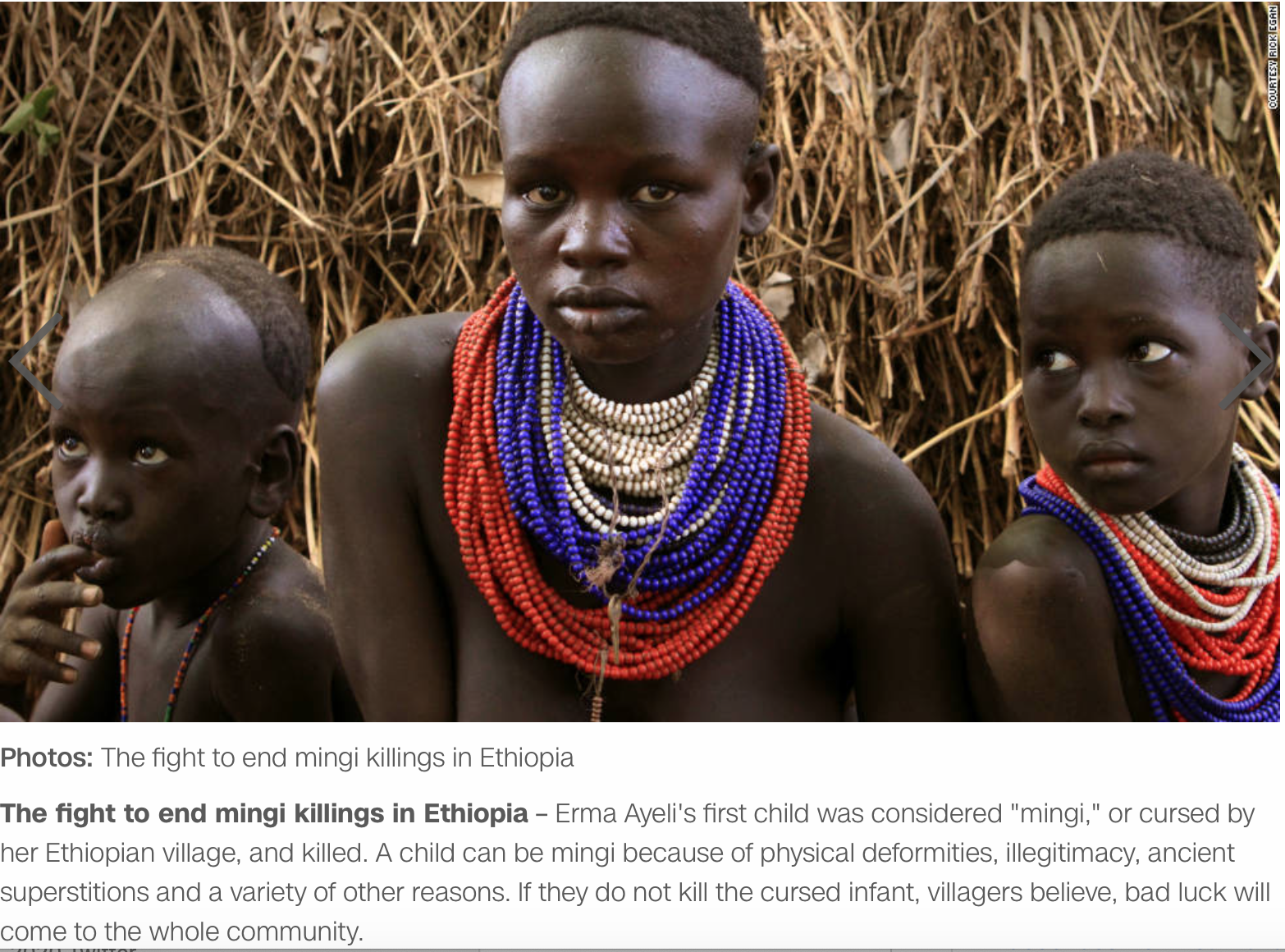
Her chin sinks into the tornado of colorful beads draped around her neck.
Apparently sensing her sorrow, a young boy rests his half-shorn head playfully on her lap. Erma tugs at his ear, smiles and reclaims her composure.
She still mourns. But she does not question why her son was killed. “There was no other option,” she says.
Sex outside of the confines of marriage is acceptable among the Kara.
But if a woman becomes pregnant before participating in a marriage ceremony, her child is considered “kumbaso,” a mingi curse that occurs when parents fail to perform the appropriate series of rites before conceiving. Erma cannot marry, though, until her older sister has first been wed. Her hands fall to her swollen stomach; she is pregnant once again.
“It was an accident,” she laments as she rubs her bare waist. “I don’t want to lose this baby, too.”
There is a potion she can take; the village medicine man can mix a concoction of roots and herbs that will make her sick and might cause her body to reject her pregnancy, taking her baby’s life before others can take it from her.
Many women choose this path. Erma won’t. Because this time, at least, she has some reason to hope that her child might be spared a violent death. Far away from her village, she has heard, there is an orphanage for mingi babies. She has pleaded with village leaders to let her child go there.
Either way, though, she won’t be allowed to see her baby. Once again, she’ll be left to dream about what her child might look like. “This time, I think, I might have a girl,” Erma says. Again, her head hangs low. Again, the boy next to her drops his own head into her lap, glancing up with a wry smile.
This time, though, Erma doesn’t smile back. She gently strokes his smooth brown cheek.
‘This was our culture’ They have taken her tribal clothes. Her beads, her animal skins and her jewelry have been replaced by a tattered shirt and loose-fitting skirt. In that and most other visible regards, Mashi Lamo is indistinguishable from the other inmates at the Jinka Prison Institute.
Yet everyone in this ragtag penitentiary knows who she is. “The mingi mother,” says one guard, a woman whose crisply pressed khaki uniform seems to stand out in defiance of this dirty, dilapidated jail, cut into a hillside in the South Omo region’s administrative capital. “Yes, we all know what happened to her. It is very sad.”
It is not typical for Kara mothers to be asked to kill their own mingi children — and none are known to have done it of their own volition. In any case, fellow Kara say Mashi could not have killed her baby; she was far too weak after the birth to have done such a thing. It was other women who took the child away, they say.
But when police arrived, Mashi took the blame. Within days, she had been sentenced to three years in prison. She had no attorney, and there was no trial.
She may be a prisoner today, but her past and future are inexorably Kara. Mashi can speak and understand only her native language. She’s never been to school. When she is finally released, there will be only one place to go.
And so, under the watchful eyes of several other Kara prisoners, Mashi stands by her story.
“What they say is false,” she says of those in her tribe who have proclaimed her innocence. “I did it all myself.”
But asked if she deserves to be in prison, the teenager sinks her face into her hands. “I hate it here,” she says.
“I wanted to keep my baby, but that was not allowed. This was our culture.”
A few feet away, another young prisoner — girlish in figure and demeanor — hides behind a corrugated metal wall and listens in. Prison guards say she is the only other person serving time here for a mingi killing, and they say she shares Mashi’s plight.
But she cannot bring herself to speak of what happened. “This one prefers to forget” the shipshape guard says.
Unevenly executed as it might be, the government’s effort to crack down on mingi killings has had an effect on the Kara. Combined with other interventions, the fear of prison might be helping to save some children.
But not all of them.
“Before, they did it in the open,” says Solomon Ayko, a gangly young Kara man who has witnessed several mingi killings. “Now, it just happens in secret.”
‘They are human’ The Kara don’t count the passing years as outsiders do, but by Ari Lale’s recollection, it happened about 15 years ago, when he was a young man, eager to prove himself to the rest of his tribe.
A kumbaso baby had been born. Leaders asked Ari to supervise the child’s execution.
“The baby was crying,” Ari says, “so we put sand in its mouth and he was still trying to cry but couldn’t anymore.”
Soon, the child was dead, and Ari escorted a group of women away from the village to throw the tiny boy’s body into the bush.
What became of the child’s remains? “The hyenas or other animals took it away,” Ari says with a shrug.
Today, Ari is the leader of Korcho village, and he counts his participation in the boy’s death as one of his proudest memories.
“All the families would thank me for throwing away that baby,” he says.
“If I had not done it, they would have been angry.” It is extremely uncommon for police officers to make the arduous trip from Jinka to any of the Kara villages, but Ari says he and other leaders are nonetheless wary of the threat of prison. At some point, he says, the government will want to make an example out of someone of his stature.
But Ari, who wears his hair taut under a hard, red clay bun in the way of his tribe’s warriors, has not stopped believing in the dark magic of mingi. And so he and others have found a different way to carry out the killings.
They will not drown or suffocate the children, as they once did.
But they have forbade anyone from the village to have contact with a cursed baby.
“If a mother was to give the baby her breast, she would also become mingi,” he says. “After the baby is born, we keep it alone in the house and we do not give it water or milk.”
Without nourishment, the infants quickly die, and there is little that can be done to prove that a baby wasn’t simply stillborn.
Ari appears to be pleased about this solution. Yet he balances his pride with a lament for the dead.
“They are human,” he says of the mingi children.
For all of the praise he got for carrying out that first killing, Ari says, he would have much preferred to let the child live, if only there had been another way.
For some, now there is.
‘A sickness in our culture’ Kara children die all the time.
Many succumb to disease. Others are killed by wild animals. And some are sacrificed in the name of mingi.
For Shoma Dore, that was simply part of life.
“This is something that came down from generation to generation,” Shoma says. “If a baby comes with the top teeth before the bottom teeth, it must be killed. If it comes without the ceremony, it must be thrown away. … I didn’t realize there was anything wrong with it.”
Not, that is, until Shoma left the tribe to attend school in his early teens. In Jinka, he says, he realized for the first time the evil that was being done by his tribe. And when he returned, two years later, he found that others among the Kara’s more educated youths had come to the same realization.
“There are many important and good parts of our culture — there is also a sickness in our culture, and we have to change ourselves,” says Aryo Dora, who decided a few years ago to go with Shoma and about 30 other young Kara to plead with tribal elders to stop the killings.
Their plan, developed with the assistance of a team of Westerners, was simple: If mingi children could be sent far away from the village, they would pose no risk to the tribe.
“Once we explained the plan, they agreed quite easily,” Shoma recalls.
And that is how the orphanage began.
It wasn’t long before Webshet Ababaw was drawn into the fight. The professional tour guide and driver was in Jinka when he received a call from the orphanage. Leaders there had received word that a kumbaso girl was about to be born in the Kara village of Labuk. They needed someone with a four-wheel-drive vehicle who wasn’t afraid to race across the axle-breaking savannah to get to the village in time to save her.
No one seemed inclined to help find the child when Webshet and an official from the orphanage arrived in the village, but they finally found the infant lying on the ground behind a stick hut. Her mouth was filled with dirt and sand, but she was alive and seemed to be in relatively good health, Webshet says.
Piecing together a newborn first-aid regimen from what he’d seen in the movies and in a high school health class, Webshet unstrung a lace from his shoe and tied it around the baby’s broken umbilical chord. When no one in the village would give him a blanket, he wrapped the shivering child in his jacket. And when no one would give him milk, he found a goat, crouched beside it, and took a small amount for the girl.
None of the Kara had helped him on that day, but as he raced back to Jinka, Webshet looked at the small bundle in the passenger seat beside him and smiled.
There she was, improbably cooing as he bumped along the rugged dirt road.”
At least someone decided to contact us,” he says. “That is the only reason why she was alive.”
Orphanage officials later named the baby Edalwit, which means “she is lucky.
“Today, more than 30 mingi children live together in a small single-story home in a quiet Jinka neighborhood. Aryo, who is co-director of the orphanage, won’t grant permission for outsiders to check on the children — a rule intended to protect the orphans from potential exploitation, he explains. But, he says, they are loved, cared for and schooled with the hope that one day, they will be allowed to return to their families.
“These children are the future leaders of their tribes,” Aryo says. “They are going to grow up big and strong. They are the ones who will end mingi.”
‘We did our best’ It is a bright May morning in Korcho. In the communal spaces between the round, grass-topped huts, dozens of women are on their knees, vigorously thrusting their body weight into stone hand mills, grinding sorghum into flour.
Zelle Tarbe, though, is working inside. It has been just six days since she gave birth to her baby boy. Her breasts are still swollen — full of milk that will not nourish her child. The shock of losing him is still plastered across her face.
Zelle, who is unmarried, knew she would have to give up the child, but it was harder than she expected. “I wanted to keep him with me,” she says.
But she is nonetheless feeling very fortunate, “because my son is alive.”
Zelle was able to spend a few short moments with her baby before orphanage officials spirited him away.
“He was so sweet and beautiful,” she says from the shadows of the hut as a friend butchers a goat and hangs its carcass on the wall beside her. “But I did not give him a name because he was mingi and could not stay with me.”
Already, though, she is dreaming of a day in which she might make the journey to see her boy.
“Someday, I hope, I can visit him in Jinka,” she says.
No one, least of all Zelle, would argue that the rescue mission isn’t preferable to death for mingi children. But the orphanage has nonetheless been a controversial solution. A Christian group that supported the effort for two years withdrew its backing this spring after accusing the orphanage’s director of stealing money donated by American benefactors.
Orphanage officials counter-accused the Americans — who had helped arrange the adoptions of four mingi babies — of stealing the children from their families. The adoptions were, in fact, all legal under Ethiopian law, which treats mingi children as abandoned. But the orphanage leaders have argued that the biological parents surrendered their babies under cultural duress and should have the right to reclaim those children if their situation were to change.
Either way, adoptions and orphanages don’t address the root causes of mingi. And even when it had the support of a determined and resourceful team of Westerners, the rescue and shelter system was able to save only a fraction of the endangered children.
“At one point, there were six women we knew about who were pregnant with mingi children,” recalls Jessie Benkert, one of the Americans who supported the rescue effort. “We only got one.”
Geography is as much an obstacle as tradition. The Kara tribe is separated into three main villages, and the only telephone able to reach the outside world is in the main village of Dus, an hours-long hike from the other communities. Hundreds of other Kara live deep within the bush and, tribe members say, are more likely to carry out mingi killings there without notice.
Getting from Jinka to any of the Kara villages in a four-wheel-drive vehicle is, in the best of situations, a half-day’s trip across soft savannah sands and muddy river beds. A light rain can delay the trip by days. And during the rainy season, which lasts for up to eight months each year, the route can be washed away entirely.
Tribal leaders in Korcho say about 20 mingi children have been born into their small village since the orphanage opened. Orphanage workers have arrived in time to save only about half of them, they say.
Last year, rescue mission leaders learned that a Kara woman had given birth to a mingi boy whom tribal elders had promptly attempted to kill by ripping out his umbilical cord. The wounds had quickly gone septic, and there was no time to send a car to retrieve the child. Evacuation by air was the only solution; chartering the aircraft cost $3,500.
“That was the sum of all the money we had,” said Levi Benkert, Jessie’s husband. “And we couldn’t be certain that, even if we did it, he was going to live.
“They did it anyway — and saved the boy. An online fundraising effort quickly recouped the costs of the evacuation, but rescue mission officials knew they couldn’t sustain those sorts of expenses. And, in any case, they’ve since been pushed out of the Omo River Valley by local government officials who have sided with the orphanage’s Ethiopian director.
“We did our best,” Levi Benkert says. “We saved as many children as we could. And we continue to pray for them every day.”
‘Out of fear’ The people of the Omo River Valley love their children.
That is what Andreas Kosubek has come to believe over six years of organizing medical mission trips into the Kara heartland.
“These people are really good people,” says the German missionary, who recently gained permission from tribal elders to build a home on Kara lands. “They are not doing this because they are evil, wild, dumb monsters. They’re doing it out of fear. They fear for the lives of others in the tribe.”
From Kosubek’s point of view, the fear will end only if the Kara come to believe in something stronger than mingi. In his way of thinking, that means introducing them to Christianity.
“But we cannot do that,” the 29-year-old evangelist says, “unless we approach them with humility and a dedication to service.”
And Kosubek says he has often failed in that regard.
Not long ago, a Kara man brought his sick daughter to Kosubek, who was on tribal lands to work on his home and not accompanied by anyone with medical training.
The toddler was breathing rapidly and not responding to her father’s words or touch.
“She was the same age as my daughter and, you know, if my daughter had been sick like that, there is nothing I wouldn’t have done to save her,” Kosubek says, noting that he would have immediately evacuated his own daughter to a hospital. “But so many things crossed my mind: It’s difficult, it’s expensive.”
The girl later died, probably of simple pneumonia.
“I could have helped her,” Kosubek says. “And I am ashamed.”
Kosubek recognizes the need to end mingi killings, but he doesn’t feel entitled to condemn those deaths.”
Far more children are dying in other ways,” he says. “These are ways that we can address and prevent immediately if we just cared enough. Before we judge, we have to ask ourselves what we have done to help these children.
“In that question, he believes, is a model for truly bringing an end to the slaughter — through genuine selflessness and compassion.He’s seen it, firsthand, among the people of the nearby Banna tribe.
‘My children are also mingi’ In a smoke-filled mud hut in the village of Alduba, Kaiso Dobiar dips a ladle into a tar-black pot of coffee, filling her home with the aroma of the brew as she stirs the simmering liquid.
Kaiso is proud to be Banna, and she follows many of her tribe’s customs and beliefs. But she is also Christian and, wary of false idolatry, she and her husband refused to perform the rites mandated by tribal leaders before they conceived.
“So my children are also mingi, in that way of thinking,” says Kaiso, who is fostering two additional mingi children in her home.
A tiny girl crawls onto Kaiso’s lap, reaching over to help stir the pot. “This is Tarika,” Kaiso says. “She is 2 years old, and she is mingi.”
The girl was born without the appropriate Banna ceremonies, but her birth mother hid the child for six months. “Then the rains stopped for a short time,” Kaiso says. “The people rose up and said, ‘You must get rid of her. Throw her into the bush.’ But I said, ‘do not throw your child into the bush, give her to me.’ ”
Also sharing this small hut with Kaiso’s family is Tegist, another mingi child who guesses her age at 7 or 8 years. Kaiso says her foster daughters cannot play with other Banna children and must remain in her family’s small compound.
“They will have to stay here until they are older,” Kaiso says. “After that? God, he knows.”
Missionaries first came to the Banna decades ago, and the Christian church here is larger than any other among the tribes of this region. Still, their numbers are small; Banna’s Christians make up just 1 or 2 percent of the tribe’s population.
But their collective efforts have been enough to almost eliminate mingi killings within their tribe. With little money or other means of support, Banna’s Christians have accepted responsibility for nearly all of the tribe’s mingi children. Many, like Kaiso, are already caring for one or more mingi boys and girls. One family has taken in 17 foster children.
They do so at great potential risk to their own families. As she steps outside her home, the precariousness of Kaiso’s situation becomes clear.
“Kaiso, why are you protecting those children?” an angry neighbor screams from beyond a stick fence. “Tell us why!”
The Banna have not faced drought or a significant bout with deadly disease for many years. That, local Christians say, has kept much of their neighbors’ anger at bay.
But if the tribe’s fortunes were to change, its leaders would be swift to identify a culprit, Banna tribesman Andualem Turga says.
“What you need to understand is that, to these people, these babies are like an influenza,” he says. “If it is not stopped, it can kill many people. That is what they believe. … And when things go badly, the people believe this more than ever.”
Another foster mother, Uri Betu, tries not to think about such things. Her faith, she says, is clear on her responsibilities to the two mingi children who live in her home — and any others that need her care.
“For now, we do not worry,” Uri says as she watches her pair of 2-year-old foster daughters, Tariqua and Waiso, play in her yard.
ver time, Uri prays, the Banna will see that the presence of mingi children in their midst is unrelated to the patterns of rain and sun that sometimes cause their crops to fail.
Still, she laments, “there is a long way to go to change the beliefs we have had for so long.”
Recently, on March 2, I posted an article – dated February 26 – on the subject mentioned in the heading: ritual killers and kidnappers who have been found guilty may face the death penalty in Osun State. I added critical comments which I won’t repeat here. Readers are referred my March 2 posting.
Now it has become official. On Tuesday, March 10 the Osun State House of Assembly has passed into law a bill that makes kidnapping, banditry and ritual killing a crime which is punishable by death. Will the capital punishment act as a deterrent? Or will in practice it serve s a means to revenge the heinous crime committed, not more and no less? Only the future will tell. We will follow up on the upcoming events in Osun State (webmaster FVDK).
Osun Assembly okays death penalty for kidnappers
Speaker Timothy Owoeye
Published: March 11, 2020 By: The Nation – Toba Adedeji, Osogbo
Osun State House of Assembly has passed into law, a bill prohibiting kidnapping, banditry and ritual killing.
The bill, which was passed into law on Tuesday, was read for the third time, having passed through debates to correct identified grey areas by the committee of the whole of the House of Assembly.
Speaker Timothy Owoeye said that with the passage of the bill, Section 364 of the Criminal Code Cap 38 Law of Osun, which stipulated 10 years for kidnappers, stood repealed and replaced with the death penalty.
He said: “Where the life of the person kidnapped, restrained or seized is lost in the process, the kidnapper(s) is liable on conviction and will be sentenced to death.”
Owoeye said any person who kidnaps another person by any means or instilling fears or tricks or compels another to do anything against his will commits an offence.
Said he: “Where the life of the person kidnapped is lost in the process and the kidnapper is liable on conviction, he or she is to be sentenced to death.
“Not lost in the process, but he is released upon payment of a ransom or performance of a ransom act, the kidnapper is liable on conviction to repay the sum he/she received as ransom and to imprisonment for life and the ransom act shall be reversed.
“Any person who knowingly or willingly allows his premises, building or place belonging to or occupied by him or her and which he has control over to be used for purposes or keeping a kidnapped person, commits an offence and liable on conviction to imprisonment for 15 years and such building shall be forfeited to the government for public use.”
Owoeye said the passed bill will soon be transmitted to Governor Gboyega Oyetola for his assent as soon as administrative processes are completed.
Osun state assembly has passed the bill seeking to impose the death penalty for kidnappers, bandits and money ritualists
The move became necessary in order to tackle the insecurity concern in the southwest state
Explaining the mission of the bill, Osun speaker Timothy Owoeye said the kidnappers will be sentenced to death should the victims die
The war against kidnapping received a massive boost as Osun assembly completed the passing of a bill which will henceforth tackle abduction and ritual killing in the southwest state.
The assembly passed the bill on Tuesday, March 10, which will also hopefully tackle the cases of banditry in the state, The Nation reports.
Speaking at the assembly complex after the bill scaled through the legislative hurdle, Osun speaker Timothy Owoeye said any kidnapper found henceforth will be made to face the wrath of the law and be sentenced to death.
Osun assembly okays death penalty for kidnappers, ritualists
Published: March 11, 2020 By: Blueprint
The Osun state House of Assembly has passed into law a bill that makes kidnapping, banditry and ritual killing punishment by death sentance.
The bill, which was passed into law on Tuesday, was read for the third time, having passed through debates to correct identified grey areas by the committee of the whole of the House of Assembly.
Speaking after the passage, the Speaker of the House of Assembly, Timothy Owoeye, said with the passage of the bill, Section 364 of the Criminal Code Cap 38 law of Osun, which stipulated 10 years for kidnappers, stood repealed and replaced with the death penalty.
“Where the life of the person kidnapped, restrained or seized is lost in the process, the kidnapper(s) is liable on conviction and will be sentenced to death.”
“Where the life of the person kidnapped is lost in the process and the kidnapper is liable on conviction, he or she is to be sentenced to death.
“Not lost in the process, but he is released upon payment of a ransom or performance of a ransom act, the kidnapper is liable on conviction to repay the sum he/she received as ransom and to imprisonment for life and the ransom act shall be reversed.
“Any person who knowingly or willingly allows his premises, building or place belonging to or occupied by him or her and which he has control over to be used for purposes or keeping a kidnapped person, commits an offence and liable on conviction to imprisonment for 15 years and such building shall be forfeited to the government for public use.”
Owoeye said any person who kidnaps another person by any means or instilling fears or tricks or compels another to do anything against his will commits an offence.
Owoeye said the passed bill will soon be transmitted to Governor Gboyega Oyetola for his assent as soon as administrative processes are completed.
The following report, see below, is a bit fuzzy but nevertheless I want to share it with you. The chief perpetrator of the heinous act, who was caught, may not have been fully responsible for his deed because of his (unstable) mental state (but this is up to the judges to rule) and not all details are clear or have been confirmed by the authorities, however, the youth who supported the police which led to the arrest of the suspects merits to be applauded. A good example of how it should be – no mob justice, but the rule of law! (webmaster FVDK).
Four nabbed in Akwa Ibom for beheading woman for ritual purpose
Published: March 8, 2020 By: Vanguard Nigeria – Harris Emanuel
Tragedy struck at the weekend at Oku Abak community in Abak Council Area of Akwa Ibom, as a woman simply identified as Eka Sammy was reportedly beheaded in her farm and the head dumped in front of her house.
Vanguard gathered that the woman fondly called Mma Iko Mbakara was ambushed in her farm while harvesting cassava by a young man, one Lucky Michael from Delta State, working hands in gloves with three others.
An eyewitness account averred that the suspect was caught by the irate youth of the community when he dumped the head of the woman in front of her house and immediately stripped himself naked before taking the youth to the farm where the lifeless body of the woman was found.
One Augustine Ekwere said, ‘’the youth of this village caught him and called on the police after their own assessment. The police then arrested his and his accomplices.
Continuing, Ekwere said the suspect confessed to the crime at Abak Police Station, saying that a prophetess contracted him for a fee of N15, 000 to bring human head for rituals.
According to him, although the suspect did not mention the name of the prophetess, he had already received the cash payment to carry out the dastard acts.
‘’At the Police station, the boy confessed to beheading the woman in the farm because he was paid a N150, 000 by a prophetess to do so. I fear that such crime is coming to my community, my stress and our house’’, he said.
Police Public Relations Officer, Fredrick Nnudam, Chief Superintendent of Police confirmed the incident and applauded the youth of the community for supporting the Police which led to the arrest of the suspect and his cohorts.
The PPRO who did not mention the number of suspects arrested hinted that the matter was being investigated at the Police Headquarters, Ikot Akpanabia, but source informed our reporter that about four suspects were nabbed by the police.
‘’I am in a picture. A woman was beheaded in the farm on Saturday while working there. Some youth joined the police to comb the bush and some suspects were arrested.
‘’I can’t give you the exact figures, but some persons were arrested especially the principal suspect’’, he said.
On whether the prophetess allegedly said to have masterminded the killing for ritual purpose has been arrested, he said, ‘’as at now information is still sketchy but investigation is ongoing, so, I can’t say if somebody like that is involved.’’
TRAGEDY struck last Saturday in Akwa Ibom state as suspected ritualists behead 82-year-old woman popularly known as Mma Iko Mbakara in Ibesit community in Oruk Anam local government area of the state.
It was gathered that the unsuspecting octogenarian was ambushed in her farm in Ibesit, Oruk Anam while she was harvesting cassava.
A reliable source in Abak local government area who spoke to Vanguard in confidence yesterday said the news of the sad incident filtered through the whole Abak town early Sunday morning.
“Actually the incident happened in Ibesit community in Oruk Anam local government area, but the principal suspect is from Oku Abak, in Abak local government area. I learned that the police have already arrested him and his accomplices. ”
I was told this morning (Sunday morning) that the principal suspect identified as Lucky Michael and his accomplices have been arrested by the police”, he simply added.
An eyewitness identified as Ekwere said Michael was caught by the youths of Oku Abak community who stripped him naked before asking him to take them to the farm where he committed the crime.
Ekwere added that the youths later called the police to arrest him and his accomplices, adding that it was at the Abak Police station that he (Michael) confessed that he was paid the sum of one hundred and fifty thousand naira ( N150,000.00) to bring a human head for ritual.
Contacted, the Police Public Relations Officer in the state, CSP, Frederick Nnudam confirmed the incident, noting that some suspects however have been arrested in connection with the crime.
The PPRO who did not mention the number of suspected arrested said, “The story is true. Some of the suspects have been arrested and the head of the woman was also recovered. “The principal suspect one Lucky Michael was in possession of the head of the 82-year-old woman. The matter is under investigation”