eSwatini: Security fears keep 250 pupils away from school (Swaziland)

Swaziland King Mswati III, Africa’s last absolute monarch, has renamed his country ‘the Kingdom of eSwatini’.

On April 18, 2018 King Mswati III of Swaziland announced that he was renaming the country ‘the Kingdom of eSwatini’. The new name, eSwatini, means ‘land of the Swazis’.

King Mswati III is Africa’s last absolute monarch. He is being criticized by human rights organizations and activists for not allowing political parties and discriminating against women. See e.g. Richard Rooney’s blog.

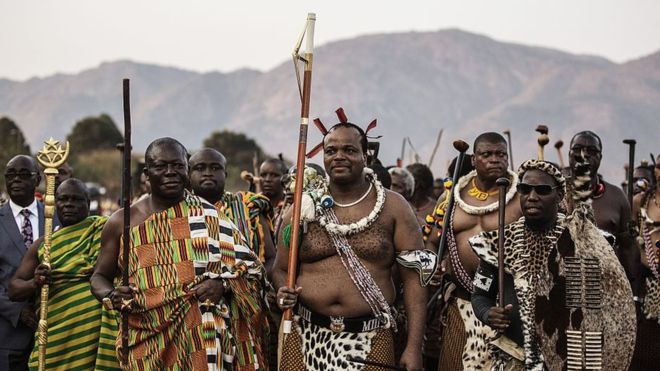
King Mswati is known for his many wives, 15 – though this is much less than the number of wives his father, King Sobhuza II, had: 125 – and for his adherence to traditional dress (see picture below).

Ritual murder especially of children is a common experience in the Kingdom of eSwatini, formerly known as Swaziland. The number of ritual murders increases at election time. As reported earlier (see my June 19 posting), in 2003, King Mswati III urged Swaziland’s politicians not to engage in ritual killings to boost their chances. Five years later, Prime Minister Absalom Themba Dlamini issued a similar warning (2008).

We’re now in 2018 and apparently nothing has changed. The Swaziland Action Group Against Abuse (SWAGAA) has issued a statement recently, saying it is “(…) deeply alarmed and distressed by recent media reports of abductions and kidnappings resulting in mutilations and killings. Children, both girls and boys, are especially targeted (…). The fact that there are widespread speculations on whether or not these abductions are for ritual purposes linked to the upcoming Parliamentary elections in Eswatini cannot be ignored.”

So far, about 45 people have been abducted, killed and mutilated in countrywide attacks that are believed to be associated with ritual activities ahead of parliamentary elections later this year (read article below).

(webmaster FVDK)

King Mswati III, centre, has ruled the country for more than 30 years (since 1986).

eSwatini: Security fears keep 250 pupils away from school

Published: June 18, 2018
APA News, Journal du Cameroun.com

Some 250 pupils from one community in eSwatini have abandoned school over fears linked to the recent spate of ritual kidnappings and murders.

Residents of Mafutseni, about 50km from Manzini, decided to withdraw their children from schools following incidents of attempted murder in the space of two weeks.

“At least residents pulled their children out of school and did not take the law into their own hands by hunting and killing the murder suspects,” said community headman, Mamilela Maphosa.

The first incident occurred two weeks ago when a 15-year-old boy was captured by three men and his throat slot in an attempted murder apparently over ritual purposes.

The boy escaped and is currently admitted to a hospital.

The other case involved a community policeman who fled from an attack by three men whom he believed wanted to abduct him last week.

The two incidents forced parents of pupils at a nearby primary school to keep their children at home until they were assured of their safety.

On Tuesday residents held a march around the area carrying placards that condemned such acts.

So far, about 45 people have been abducted, killed and mutilated in countrywide attacks that are believed to be associated with ritual activities ahead of parliamentary elections later this year.

Source: eSwatini: Security fears keep 250 pupils away from school
JournalDuCameroun, June 28, 2018.

Also read my June 18 (2018) posting.

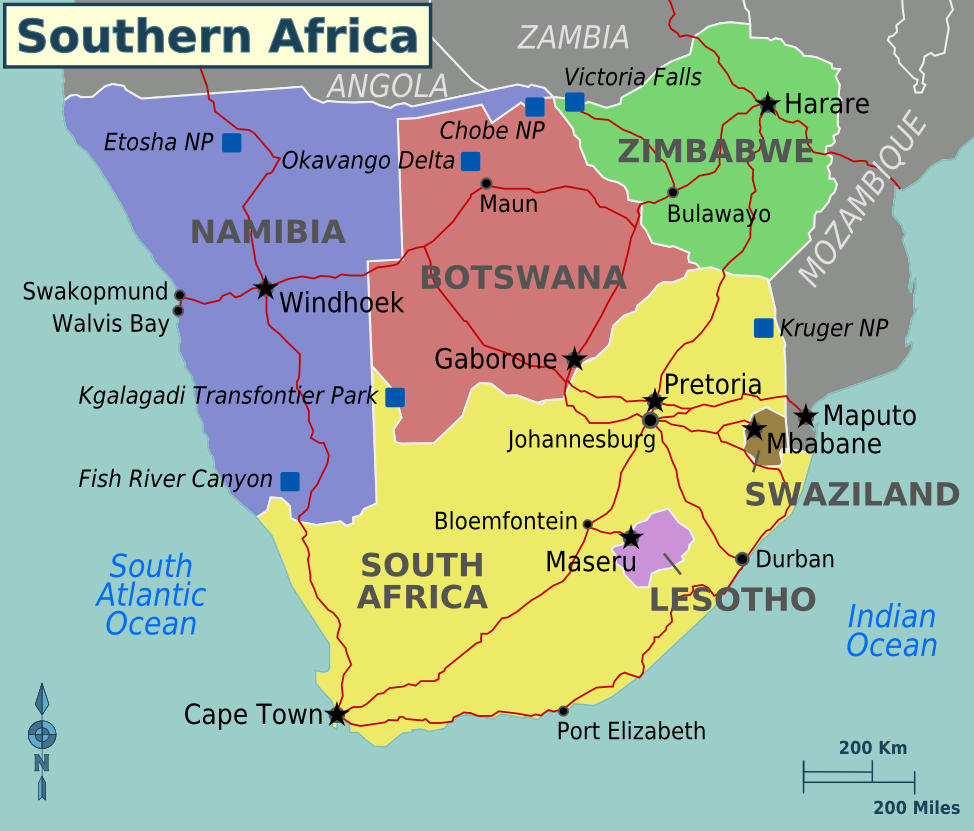
Swaziland, or ‘the kingdom of eSwatini’ as the country is being named since April 2018, is a landlocked country and smaller than the US state of New Jersey.

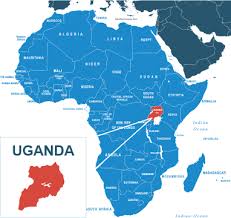
Uganda – Government must study, check causes of ritual killings

I was completely flabbergasted reading this editorial article of a leading Ugandan newspaper. There’s hardly anything I can add, without risking to repeat its shocking observations and conclusions.

Read it yourself!
(webmaster FVDK)

“In the 2008 Annual Police Crime Report, 25 cases of ritual murders were reported. This increased to 29 cases the following year and it has not dropped.”

Published: June 28, 2018|
By Daily Monitor (Editor)

In Summary:
The issue: Ritual murders
Our view : Why does government allow such agents to trade witchcraft? They should be tasked to prove the efficacy of their claims to bring wealth or good fortune.

A local artiste in northern Uganda has been arrested on charges of killing his wife in ritual sacrifice. The reason for the killing was to gain fame and get rich. Several of his co-accused associates have also been arrested for their role in the crime. Whereas at this stage of the investigations the suspects are presumed innocent under our legal system, what is undisputed is that a woman was killed in ritual sacrifice, a primitive criminal practice that has been happening in the country for decades.

Every year, there is increasing incidence of the crime and there seems to be no effective measure to check it. In the 2008 Annual Police Crime Report, 25 cases of ritual murders were reported. This increased to 29 cases the following year and it has not dropped. Behind all these killings lies a single cause: Wealth. The belief in ritual wealth cuts across every social class ranging from the poorest, who live in slums and rural areas, to the rich and wealthy in towns.

These misguided and misinformed individuals believe that using witchcraft will bring them wealth/money and fame. They frequent witchdoctors’ shrines where they are manipulated or misguided to believe that witchcraft brings wealth if human beings are sacrificed and their blood and body parts poured at the altar of Satan.
This evil practice is thriving and growing because government departments, including Parliament and the law enforcement agencies, are sleeping on their job. For example, the Ugandan law does not allow practice of witchcraft.

However, everyday unscrupulous people claiming to possess witchcraft or supernatural powers, are advertising their services in the media purporting to cure all sorts of ailments and problems. The media is awash with their claims of power to make people rich, take away curses, bring fortune, cure evil spirits, etc. Government should task these witchdoctors to prove the efficacy of their claims, failure of which they should be checked or even arrested to account for their deception.
Why does government allow such agents to trade witchcraft? They should be tasked to prove the efficacy of their claims to bring wealth or good fortune. The government must check free spread of harmful falsehoods and evil propaganda.

These are some of the causes that perpetuate witchcraft and breed ritual killings. It appears their activities are justified in as long as they do not antagonise or threaten the existence of the State.
If they talked ill of government, they would not operate the following day. But they are now freely misguiding people with witchcraft and ritual killings in the futile search for evil wealth. Government must wake up or shut up on this evil.

Source: Government must study, check causes of ritual killings
Daily Monitor, June 28, 2018

Kenya: Evil spirits? Villagers stone to death suspected ritual killer in Meru

Ritual killing is wrong. Suspected cases of ritual killing must be taken serious. But mob justice is absolutely not the right answer to react to a suspected case – or a real case – of ritual murder. Let the police do its work. Let the courts do their work. The judiciary system must deal with confessed or alleged murderers. The rule of law must be applied.

People have a right to live without fear – hence my exposure of ritual killings in Africa, hoping it will contribute to more awareness of this horrible phenomenon. I also plead for the rule of law: murderers must be prosecuted and they have a right to defend themselves, aided by a professional lawyer. Therefore, there is no place for mob justice.
(webmaster FVDK)

Kenya: Evil spirits? Villagers stone to death suspected ritual killer in Meru

Published on February 21, 2018
By

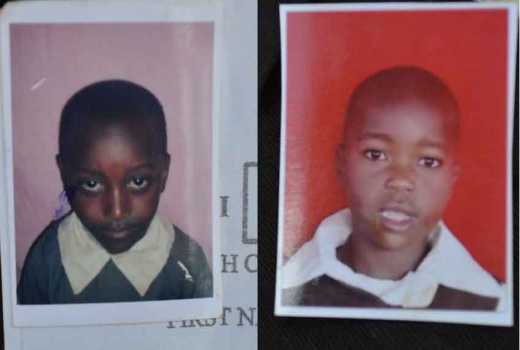
Sheila Makena (6) and Justin Mwenda (7) were found dead. Villagers lynched the suspected ritual killer of the two pupils.
[Photo: Courtesy]

Residents of Mweru location in Meru County yesterday lynched a man suspected to be behind the killing of two children.

The bodies of Sheila Makena, six, and Justin Mwenda, seven, both Standard One pupils at Machegene Primary School, were found last week.
Makena’s body was found on Thursday and Mwenda’s on Sunday. The bodies were discovered 30 metres apart.

Angry residents yesterday confronted the suspect, who allegedly confessed that he had killed the two children in search of blood.

Raised alarm

Makena’s parents raised the alarm when their daughter failed to return home on the evening of February 15. Her body was discovered on the school farm by a watchman.

“The pupil was missing at about 1pm. When the class teacher checked the attendance register, she was not in class. Her class mates said she had gone to get mangoes from the school farm,” said Lucy Karani, deputy head teacher of the school.

The child’s neck was slit and her mutilated body lay in a pool of blood under a mango tree. According to Mwiru Location Chief Purity Mugambi, the body had parts missing.
“Her eyes were gouged out and her body was severely mutilated,” said Ms Mugambi.

Mwenda, the second victim, had been sent by his mother to fetch water from a nearby stream when he was stabbed to death. His mother, Varsity Karimi, said her three other children who were at the river with Mwenda, narrowly escaped death when they fled from the suspect.

The three later named the suspect, who was their cousin, leading to his lynching.

“My second born narrated to me how they almost died with their younger brother,” said Ms Karimi.

The children said the suspect threatened to stab them after appearing at the river where they were fetching water. As the three fled, he was left behind with Mwenda before the boy was found dead.

The family said they had been hosting the suspect after he fled from his home in nearby Gikurune. He is said to have fled after attacking his brother and torching his house.

“We knew he had a criminal record because he had attacked and injured his brother earlier. When he came here about three weeks ago, we accommodated him because he is the son of my late sister. We did not imagine he could murder his cousin, who seemed to be his favourite,” said the boy’s father, James Kimathi.

Villagers later accosted the suspect, who claimed he had been instructed to kill seven people and drink their blood.

Evil spirits

Villagers said the suspect was possessed by evil spirits or belonged to a cult. His family and those who knew him said he always carried a bag with knives and documents containing literature no one understood. Other blamed drugs for his erratic behaviour and the killings.

Reports indicate that the suspect tried to attack pursuing villagers before he was stoned to death and his body set ablaze.

Igoji East MCA John Kireria said insecurity was to blame for the killings. He said the suspect had been roaming freely in the area despite being linked to multiple crimes. “It is unfortunate that he fled from the neighbouring village after committing arson and causing grievous harm. We have a police post but it is unoccupied because no officers have been posted there because the camp was funded by the Constituency Development Fund,” he said.

Source: SDE Entertainment News – Kenya, February 21, 2018
Related link covering the same news:
Villagers lynch suspected ritual killer of two pupils – February 21, 2018
Published: February 21, 2018 at 07:31, Updated February 21, 2018 at 07:35 GMT +3

Meru County, Wikipedia

Meru County – Kenya

Gambia – President Barrow denies killing his son for ritual purposes to become president

The big news of this article is NOT what its heading suggests. I have no doubt, president Barrow is speaking the truth. However, the real meaning of this article – and that’s why I include it here – is that it underscores one of my firm beliefs: “Ritual killings are a – daily – reality in many African countries”. If ritual killings would never occur in the Gambia, this rumor would not have existed. The fact alone that the president of the Gambia finds it necessary to publicly deny any involvement in the ritual killing of his son, says a lot about what’s in peoples’ mind in the Gambia. Also, apparently, the (supposed) link between presidential elections and ritual killing is a logical one, also in the Gambia.

Ritualistic killings, superstition and rumors thrive where there is lack of education and proper information. Hence the key to a better future lies in a better education, accessible to all.

President Barrow denies killing his son for ritual purposes to become president

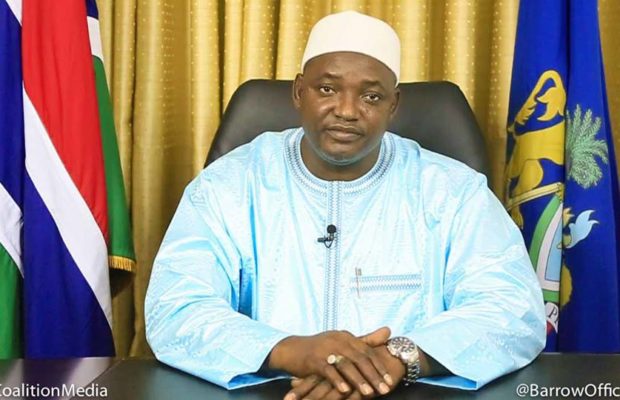
Adama Barrow won the 2016 presidential election, defeating eccentric dictator Yahya Jammeh (1994 – 2017). Jammeh refused to recognize his defeat and Barrow fled to Senegal. After a diplomatic ECOWAS intervention Jammeh was forced to go into exile. Barrow returned to the Gambia on January 26, 2017 and was installed as Gambia’s third president since independence in 1965.

Published: June 27, 2018
By Pa Nderry M’Bai
Freedom Newspaper 

President Adama Barrow has denied reports attributed to him that he allegedly killed his son for ritual purposes so that he can be elected into office as Gambia’s President. The president made the denial through his Press Director Amie Bojang Sissoho, who addressed a news conference on Wednesday at the President’s office in Banjul. This followed, a statement made by President Barrow, during a recent visit to Faraba Banta, where he was quoted as having said that he (Barrow) had to sacrifice his own son, wealth, and life in order for The Gambia to be freed from Jammeh’s twenty-two years dictatorship. Barrow was in Faraba last week to sympathize with the bereaved families, whose loved ones were killed by Gambia’s police intervention unit— the (PIU).

“ When he lost his son, is because he left the Gambia, as president elect. When his son died, he had to leave the children behind. If he was not the president, he would not have done that at that point in time; he wouldn’t have left his family behind. That is what he was trying to explain; that even he has lost his family, but he had to move on because he has taken a responsibility of serving the country,” State House Press Director Amie Bojang Sissoho clarified.

Mr. Barrow’s statement attracted a huge reaction on social media. Many Gambians were taken aback by Barrow’s statement, in which he allegedly made the appearance that he sacrificed his son for ritual purposes to become the country’s President. But the State House was quick to dismiss such reports saying that the President’s statement was being blown out of proportion. It also says Barrow’s statement was being interpreted out of context.

“We have to understand things into context. And remember that when people are in a difficult situation; we have to understand how, and what was the context in which things happened. And this was what simply he was trying to explain. And that is simply what he was trying to explain. That in a process, anything could happen. This is what happened; these lives were loss because of a cause; to show that even he himself lost his child because of a cause. His child died,” Mrs. Bojang Sissoho further clarified.

Mr. Barrow’s son was bitten by a stray dog, and he died in the process. Barrow and his two wives were in Dakar, Senegal, at the time of the incident. His son was buried in his absence.

Mr. Barrow left the Gambia for Mali, to attend a regional Summit over Gambia’s political impasse. He later resettled in Dakar, Senegal, in the wake of the country’s month long political impasse. Former Gambian dictator Yahya Jammeh had refused to concede defeat during Gambia’s December 2016 Presidential elections, which had thrown the impoverished West African country into a state of turmoil.

“And it was difficult time. We all know that..; when his son died, he was president elect; he was not sworn in; he left the country, but that did not stop him to move on. It is not that he did not feel it; what he was trying to say is that we have our difficult times, but we have to move on as a country,” Mrs Bojang Sissoho told journalists.

“I think people have to calm down on receiving information. What the president was emphasizing was that; we all have lost somebody for the sake of the Gambia; We have been either directly or indirectly affected,” she added.

Source: Freedom Newspaper, June 27, 2018

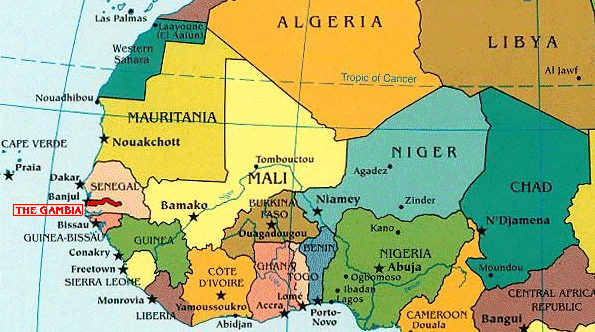
With a territory of 10,689 square kilometres (4,127 sq mi) the Gambia is the smallest country within mainland Africa.

Albinism in Tanzania: slow progress in combatting violence and discrimination

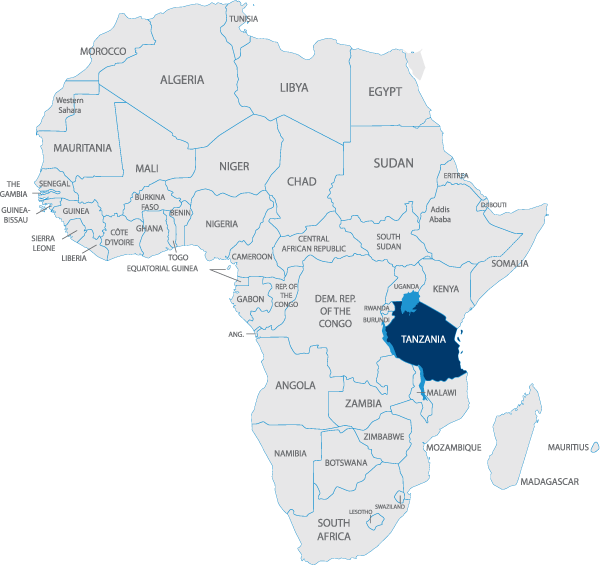
In 2008 a wave of murders of albinos in eastern and central Africa attracted worldwide attention and condemnation even though it wasn’t the first time albinos were targeted in countries like Tanzania, Burundi and Malawi.

In June 2008, a New York Times online edition aired a news brief on albino killings in Tanzania, which caused a sensation. In July 2008, a BBC journalist, Vicky Ntetema, posed as a businesswoman who wanted to get rich quick and consulted 10 witchdoctors in Tanzania. Several witchdoctors promised to get her a magic concoction mixed with ground albino organs. The starting price was $2,000 for the vital organs. Later she had to go in hiding after receiving death threats because of her undercover work. A BBC video on the horrifying spate of killings of albinos in Tanzania, broadcast in August of the same year, was later taken off the air. Also in July Al Jazeera presented a video on the fate of albinos in Tanzania (Part 1 and Part 2). The European Union condemned the ritual murdering of albinos (September, 2008), followed by UNICEF (December, 2008). By then, according to the Tanzania Albino Society (TAS), more than 35 albinos had been killed in 2008 alone, with many other such cases unreported. For more cases, covering the 2003 – 2010 period, you’re welcome to visit my archives. Unfortunately, many links have expired. (For this reason I copy all articles and publish them on the present site while acknowledging their origin).
It’s important to mention that ‘Under The Same Sun’ founder Peter Ash estimates the total number of deadly victims to be twice the official figure in a December 3, 2008 interview. Viewers are warned that the interview can be shocking because of the graphic nature of the story.

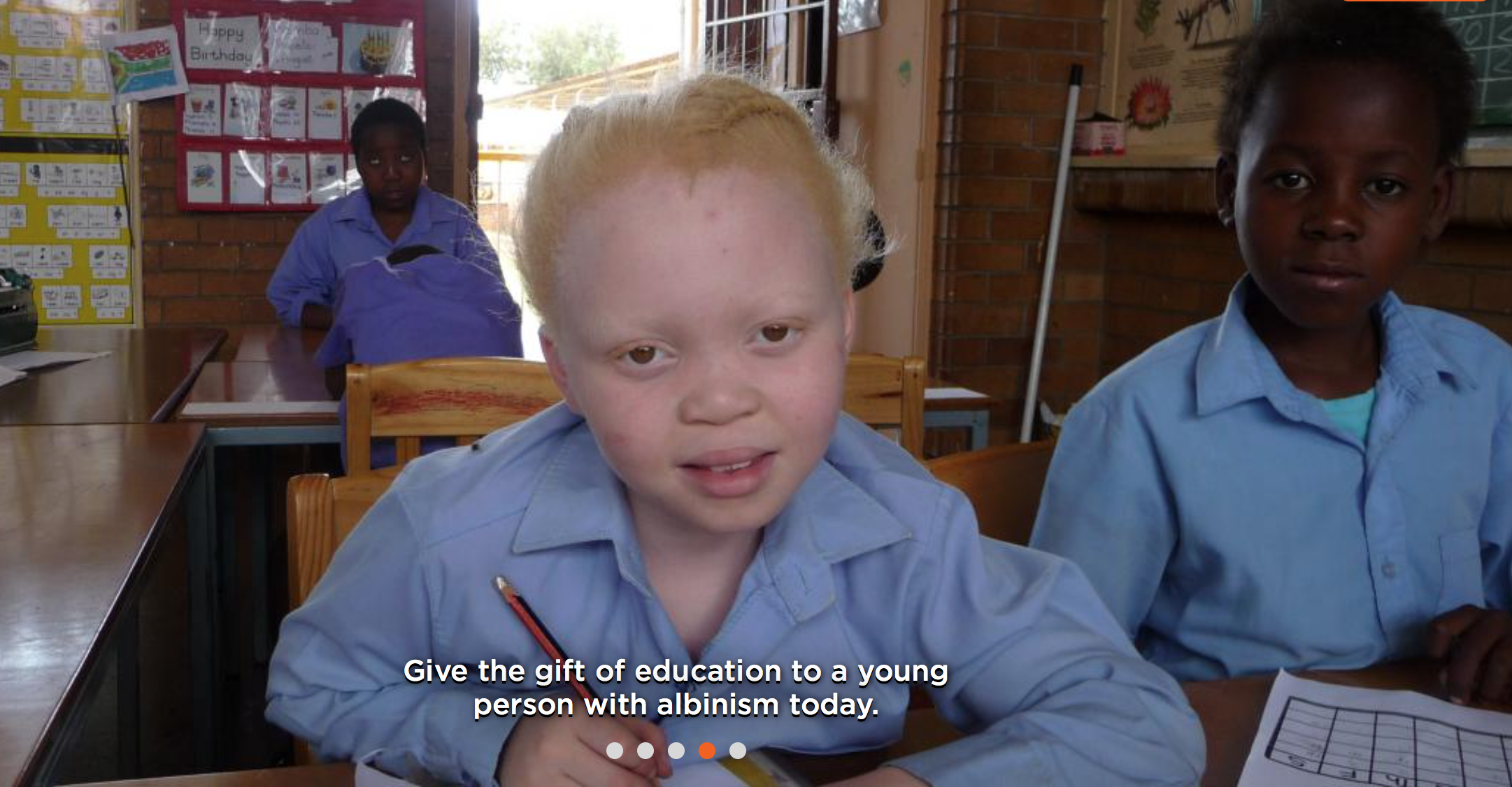
The NGO Under The Same Sun helps people with albinism overcome often deadly discrimination through education and advocacy. UTSS was started by Peter Ash, a former pastor and Canadian businessman with albinism, and Vicky Ntetema, mentioned earlier, Tanzania’s BBC bureau chief whose report in July 2008 broke the story to the world of the gruesome murders of persons with albinism in Tanzania. UTSS was founded in 2008. Visit the impressive site of Under The Same Sun, a comprehensive site about Persons with Albinism in Tanzania.

Under The Same Sun helps people with albinism overcome often deadly discrimination through education and advocacy

The following article dates from 2015 but as forthcoming posts will also demonstrate, the fight against discrimination of people with albinism is far from over, and therefor I want to congratulate Under The Same Sun, the Tanzania Albinism Society, and other organizations supporting the same cause for their valuable work and wish them success in the future. May their work soon be no longer needed! (webmaster FVDK)

Published on May 13, 2015
By Daniel Wesangula
The Guardian

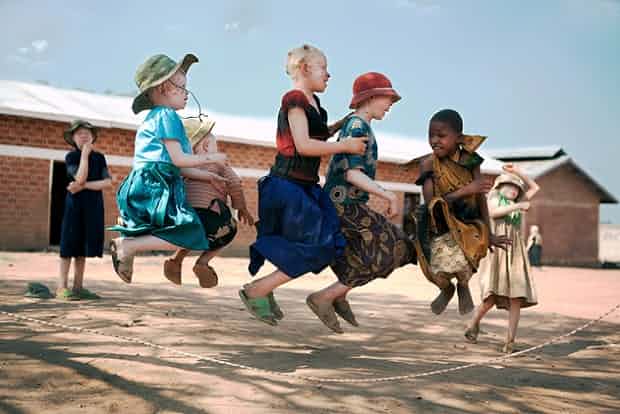
Around 30,000 people with albinism are thought to be living in Tanzania. Photograph: Ana Palacios

Albinos live with the risk of being killed, their body parts fetching high prices for witchcraft – but NGOs hope that change is coming.

“This is possibly the worst time to be a person living with albinism in Tanzania,” says Amir Manento.

In October, citizens will go to the polls to vote in presidential and parliamentary elections. “Every election period brings with it a new cycle of killings. In between we have other smaller elections translating to more abductions, more killings.” Manento, a retired judge and human rights activist, has been at the forefront of campaigning for the rights of people living with albinism for decades. “We see an increase of witchcraft and the use of human body parts, particularly albino body parts, in the run-up to the general elections.” Albino body parts are associated with good luck, and as the country gears up for the elections, the demand for good luck charms goes up. Sacrifices during this time are thought by some to be a sure way of guaranteeing victory in the polls.

“Albino hunting came into the limelight around 10 years ago, particularly within the fishing and mining communities,” says Dr Benson Bana, a political science and public administration lecturer at the University of Dar es Salaam. Bana believes that some of the roots of the problem lie in the financial downturn in the area around Lake Victoria, one of the regions where there have been the most killings and abductions.

“A certain poverty touched our people after the privatisation of fishing activities in Lake Victoria,” says Bana. “Everything was being controlled, from where one could fish to the size of the holes in his fishing net. The result was diminished harvests. Every above-average catch by the little guys was then attributed to superstition. This is when witchdoctors started peddling the belief that people living with albinism or their body parts, most of whom coincidentally live in these regions, could be used as good luck charms.”

Bana believes that this devastating association was then passed on to neighbouring mining communities. “Eventually it caught wind and was looked upon as a legitimate way of acquiring riches and power by some individuals. Hence the association with politicians.”

Tanzania is thought to have one of the world’s largest populations of people living with albinism, a congenital disorder that robs skin, eyes and hair of their pigment. But for years this population of about 30,000 people has existed under the threat of abductions and ritual killings, and in recent years the situation appears to have worsened.

According to a report by the International Federation of Red Cross and Red Crescent Societies, a complete set of Albino body parts – including all four limbs, genitals, ears, tongue and nose – can fetch up to $75,000 (pdf).

The Tanzania Albinism Society says it is almost impossible to know the numbers of those abducted or killed since the beginning of the year. What they are sure of, though, is that the number of victims will be higher than the two cases that made it into police records in 2013.

“Even last year the numbers might have been higher because these crimes are very intimate. Mostly a close family member, even a father, is involved in the killings and abductions. In such cases silence wins; his wife will probably be an accomplice in the crime. Nothing will be said of the matter again and the police will have no chance of prosecuting anyone,” says Severin Edward, programme coordinator for the Tanzanian Albinism Society.

A total of 155 cases of violation of albino rights have been reported to Tanzanian authorities since 2009, according to a study (pdf) released in March by Under The Same Sun, an NGO working to combat discrimination against people with albinism.

“Of these cases, 75 were deaths. We have also received 18 reports of grave violations,” said Don Sawatzky, director of operations for UTSS. The study, which gathered together data from 25 different countries in Africa, found reports of 145 albino killings, in addition to 226 violations that include mutilations, other forms of violence, and kidnappings.

UTSS has been actively pushing the United Nations for four key resolutions aimed at ending all forms of discrimination of people living with albinism.

A total of 155 cases of violation of albino rights have been reported to Tanzanian authorities since 2009.
Photograph: Ana Palacios

However, Sawatzky argues that to describe the killings as a phenomenon propelled by recent economic hardship would be “to accept the easy answer”.
“Nobody really knows the origin of the killings, since documentation in Africa is not common other than through oral tradition. All we know for sure is that albinism has been ‘mythologised’ since time beyond memory. Muti murders, or ‘medicine’ killings, have a deep, longstanding history, and are a familiar concept to most Africans,” he says. In Kenya’s capital, Nairobi, the nation’s first albino member of parliament, Isaac Mwaura, says it is time measures are put in place to end these killings and abductions, and that existing laws need to be adhered to by all affected countries.

“Kenya has strict trafficking laws, the same as Tanzania. What makes it possible for criminals to take our children, mothers, fathers or brothers across borders and sell them off like commodities to witch doctors? Enforcement of laws is one of the weakest links in this war. We have become the hunted. Neither we nor our children are safe. Fathers are betraying their children’s trust and selling them off like unwanted baggage. Mothers are conspiring to traffic their own flesh and blood to senseless deaths.”

In Tanzania the government has been working with NGOs and civil society, and results are now being seen. “Never before have we seen so much effort from the government and the general public. At least we are now getting convictions, primarily because investigations are more thorough and new laws are being set up,” says Manento. “Although no executions have taken place, a total of 17 individuals have received the death sentence, some of them as recently as March, when four individuals, including the husband of the murdered victim, were convicted,” he said.

To win this war, NGOs at the forefront believe collusion within the community must come to an end. “We must educate families to understand that having such a child is not a gateway to quick riches. We then encourage the rest of the community to speak up,” says Edward. “The society needs to be more empowered and supported to co-operate. For instance, when family members are involved in killings or abductions it is quite difficult to get witnesses, because even they are not assured of their security.”

Sawatzky also believes that the war will be won, just not in the near future. “Like all forms of discrimination, it will take several generations to achieve. I will not see the war won in my lifetime. The youth and future generations are the best answer to this war,” he said.

More community sensitisation needs to be achieved, says Justus Kamugisha, regional police chief in Shinyanga, in the north of the country. “We need to make our people understand that there are no shortcuts to prosperity. Only hard, honest work pays. Taking the life of someone else, regardless of his condition, is simply murder, for which you will be charged.”

Source: The Guardian, May 13, 2015

More:

Albinism in Tanzania: safe havens in schools and support centers – in pictures
Photographs by Ana Palacios – May 13, 2015

Tanzania bans witchdoctors in attempt to end albino killings,
The Guardian, January 14, 2015

Tanzania albino murders: ‘More than 200 witchdoctors’ arrested
BBC, March 12, 2015

Witchcraft and the law in Tanzania
The Guardian, September 26, 2008

Mozambique police warn bald men after ritual attack

Superstition, ignorance, lack of education, they’re all part of the explanation for the bizarre ritual killings that shook Mozambique last year. Bald men were targeted!
(webmaster FVDK)

Published on June 7, 2017
Published by BBC

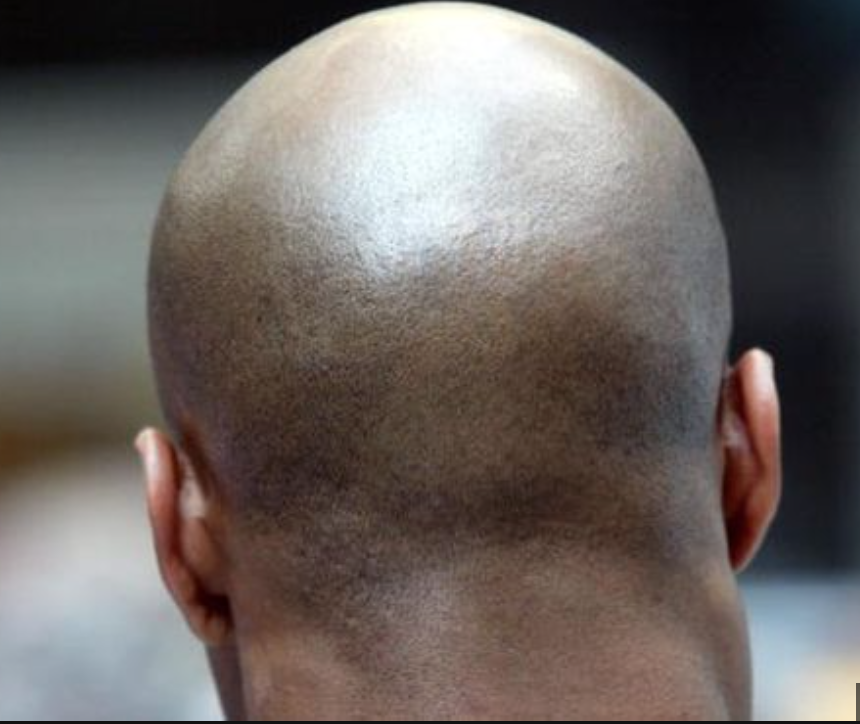
Superstition: some people believe that the heads of bald men contain gold.

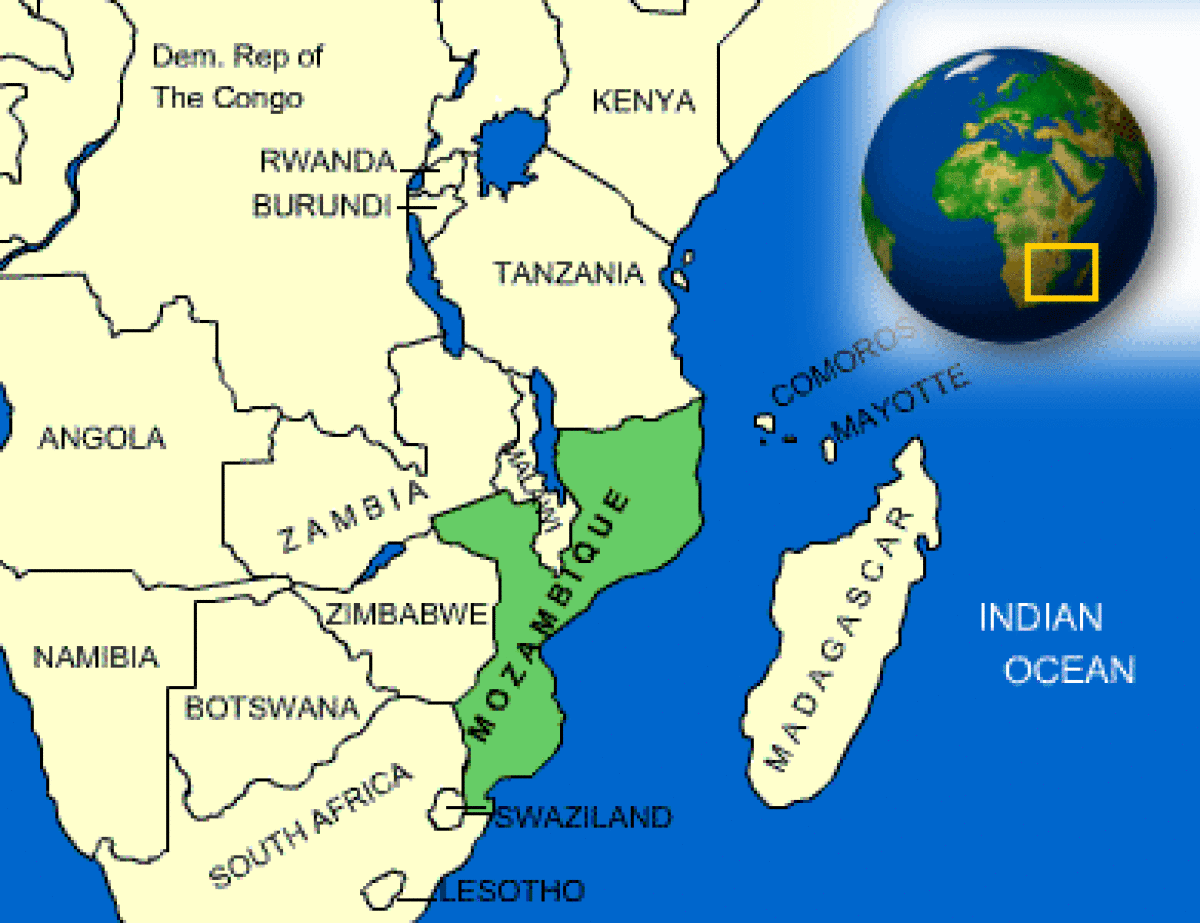
Bald men in Mozambique could be targets of ritual attacks, police have warned, after the recent killing of five men for their body parts.

Two suspects have been arrested in the central district of Milange, where the killings occurred.

“The belief is that the head of a bald man contains gold,” said Afonso Dias, a police commander in Mozambique’s central Zambezia province.

Albino people have also been killed in the region for ritual purposes.

Three men have been killed in the past week alone.

The BBC’s Jose Tembe in the capital, Maputo, says police think the notion of a bald head containing gold is a ruse by witchdoctors to get clients to take a person’s head to them.

“Their motive comes from superstition and culture – the local community thinks bald individuals are rich,” Commander Dias is reported as having told a press conference in Maputo.

The suspects are two young Mozambicans aged around 20, the AFP news agency reports.

A regional security spokesman, Miguel Caetano, told AFP that one of the victims had his head cut off and his organs removed.

The organs were to be used in rituals to advance the wealth of clients in Tanzania and Malawi, Mr Caetano said, citing the suspects.

There has been a spate of killings of people with albinism in East Africa in recent years, with their body parts used to make charms and potions by witchdoctors.

Source: BBC, June 7, 2017

AfriKids: Ghana’s haven for ‘spirit’ children marked for murder

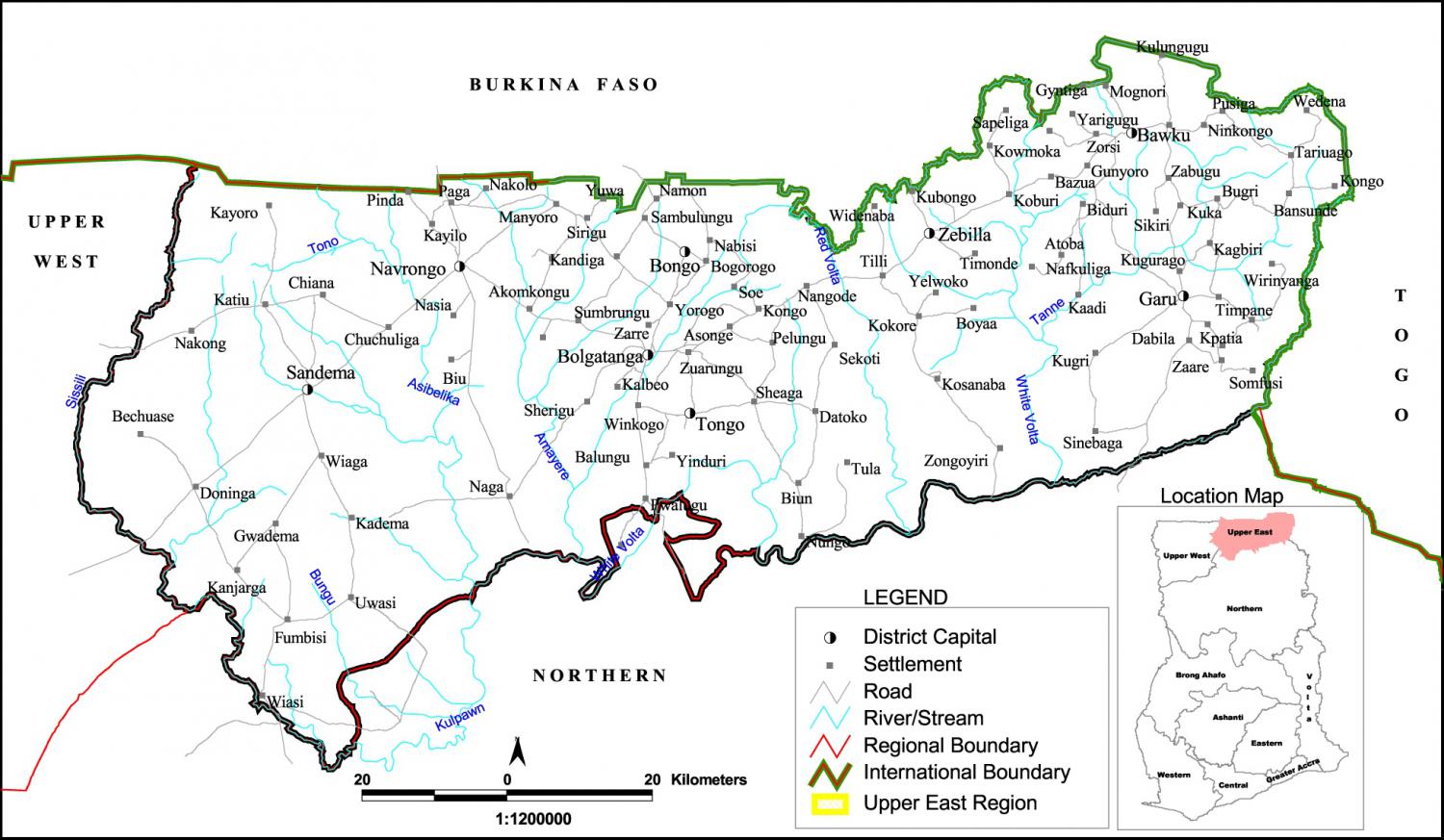
Further to my previous post – on Seth Kwame Boateng’s breathtaking account of a journey to an orphanage in Sirigu, in Ghana’s Upper East Region, in 2011, I find it heart-warming to read about the valuable work which is being realized by the non-governmental organization AfriKids. In Northern Ghana, AfriKids runs a centre in the village of Sirigu and another in nearby Bongo district. Though I am not sure, it looks as if Afrikid’s Sirigu center for disabled children and pregnant women is the same as the Mother of Mercy Babies Home visited by Seth Kwame Boateng in 2011. Joseph Asakibeem is AfriKids project manager in the Upper East Region. He and his team are doing a great job. Read about their work below (‘AfriKids: Ghana’s haven for ‘spirit’ children marked for murder’).

Joseph Asakibeem hails from the Kassena Nankana district (in the Upper East Region) where the superstition in the power of spirit children is most widespread. AfriKids and OrphanAidAfrica have been fighting against infanticide for many years.

In 2013 the two non-governmental organizations were joined by Anas Aremeyaw Anas, an investigative journalist and filmmaker. Anas’ film Spirit Child ‘promised’ to become a U-turn in the fight against infanticide. In the aftermath of his investigation, local leaders in the Kassena Nankana region banned the ritual killing of ‘spirit children‘. However…., a recent follow-up to Anas’ 2013 investigative report – see my post dated June 4, 2018 – shows that the practice of infanticide still exists in the region. (webmaster FVDK)

AfriKids: Ghana’s haven for ‘spirit’ children marked for murder

Published on February 27, 2018, at 11:50 am
By MIldred Europa Taylor

Ghana, Upper East region – This Catholic Sister has dedicated her life to protecting babies and children and plays a precious role in the fight against infanticide in the region — Afrikids

The act of killing babies who were born with disabilities was until recently widely practised in some parts of northern Ghana. These children were labelled as “spirit children” with the belief that they brought bad luck. They were killed to “save the lives of their parents and family”.

These children were basically taken to medicine men who would give them a poisonous potion and lock them in a room. The belief is that if you die from the potion, it means you are indeed a spirit. The children are then buried in an isolated place far away from the village.

This traditional belief was highly practised in some parts of the Kassena-Nankana West District in the Upper East region but thanks to AfriKids, a child rights Non-governmental organization (NGO), the practice has declined even though it is believed to be still ongoing in some parts of northern Ghana. The NGO has so far been able to save a number of children perceived to be “spirit children” in some parts of the Upper East Region.

Joseph Asakibeem is the project manager at AfriKids. The 41-year-old was recently awarded the Bond Humanitarian Award 2018 for his work in saving many disabled children who would have been killed due to the traditional practice.

Growing up in the Kassena Nanakana district where the belief in spirit children was deeply entrenched, Asakibeem told Reuters that he and his team at AfriKids started talking to chiefs, parents, opinion leaders and medicine men about the need to change the perception they have about children born with disabilities.

Asakibeem explained to them that there were medical reasons for these disabilities – poor nutrition and health care during pregnancy, and the inability to get access to medical help during labour resulting in complications.

AfriKids has a centre in the village, Sirigu, and another in nearby Bongo district, where they provide help for disabled children and antenatal care for pregnant women. Mothers, through Afrikids, have also been able to acquire small loans to grow their businesses.

The main challenge for the child rights NGO has been trying to change the mindset of concoction men and other community members about “spirit children”, but interestingly, many of them have now joined the fight against the practice.

For 10 years, no child has been killed for being deformed in Kassena Nankana, but Asakibeem said the act is still being practised in other areas. Babies whose mothers die in childbirth, or who are born after the family has been hit with an unfortunate incident, have the risk of being labelled spirit children.

As AfriKids continues to expand its activities to the whole of northern Ghana, Asakibeem is hopeful that the practice would be effectively abolished in 15 years.

In 2013, Ghanaian investigative journalist Anas Aremeyaw Anas published “Spirit Child”, an undercover investigation film on the ritual killings of deformed children. Two concoction men were charged with attempted murder and another three men charged with conspiracy to commit murder. 

Source: Face2FaceAfrica, February 27, 2018

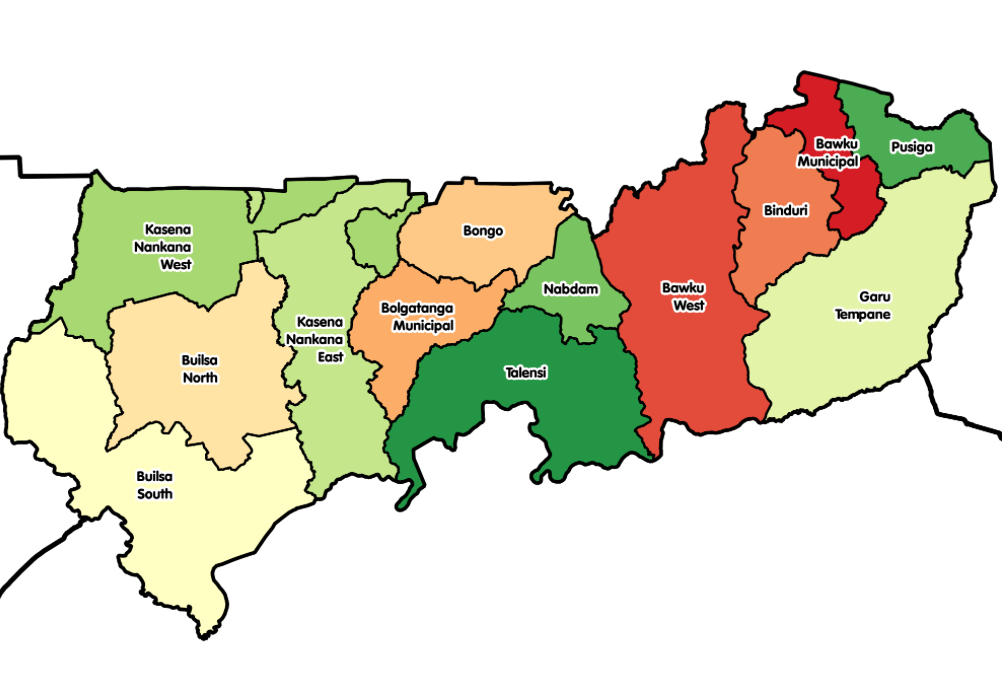
Ghana – Upper East Region

Shocking!…Ritual baby killing in Northern Ghana

On June 4, this year, I drew attention to Spirit Child, a film on infanticide in West Africa, made by Anas Aremeyaw Anas and Seamus Mirodan, and I reproduced a related article, published by Al Jazeera. The article, on infanticide in Ghana – and Burkina Faso, Benin and Nigeria – was a follow-up to a 2013 investigative report of the same journalist and filmmaker, Anas Aremeyaw Anas. The latter and his colleague, Seamus Mirodan, are to be commended for their fight against infanticide.

Fortunately, they are not the only ones who raise there voices against these age-old practices which have no reason to exist in the 21st century. While mentioning the names of others it is not my intention to belittle the activities and achievements of others, who work with them. Recently, I read an article on AfriKids, a non-governmental organization running an orphanage in northern Ghana, in the Upper East Region, in a village called Sirigu, to be more specific. Project manager at AfriKids is Joseph Asakibeem, who was recently awarded the Bond Humanitarian Award 2018 for his work in saving many children who would have been killed due to the gruesome traditional practice of killing disabled children and so-called ‘spirit childs’. More on Afrikids and its work in my next post.

When reading about the village of Sirigu I remembered an article, written by another outstanding Ghanaian journalist, Seth Kwame Boateng. In 2011 he visited Sirigu and made a breath-taking documentary for Ghana’s Joy 99.7 FM’s Hotline. Below the transcript.
Seth Kwame Boateng was named ‘journalist of the month‘ in July 2017 and can boast of an impressive list of awards and documentaries. Read here what he wrote in 2011 on infanticide in Northern Ghana. (webmaster FVDK)

SHOCKING!…Ritual baby killing in Northern Ghana

Originally published on April 1, 2011
by Seth Kwame Boateng

Joy FM reporter Seth Kwame Boateng visits an orphanage in the Upper East Region of Ghana called “Sirigu” to uncover the chilling practice of cultural murder; the killing of babies who are born with deformities, or whose birth coincide with a tragic incident in the family, such as the loss of a parent.

Such babies are called spirit children or siri sirigu, and are thought to be bad omen for the community.

Below is a transcription of his documentary for Joy 99.7 FM’s Hotline.
I have come to the Upper East Region on an assignment, a very different assignment. The job has tight time frames. I’m rushing to meet deadlines.

I hear a stranger chatting with a friend on the streets of Bolgatanga. He mentions a Babies’ Home in the area.

The conversation reminds me of a story somebody once told me about this town and a very strange kind of orphanage.

Most children who end up in an orphanage have lost their parents. But in the Sirigu facility in Bolga, the children’s fate is much more tragic. If the child is born with deformities, the child is killed.

The first time I heard this story, I could hardly believe it. I’ve always lived in a community where great merry-making accompanies childbirth, no matter the condition of the baby or the mother.

So at first I didn’t pay too much attention to the story.

{They put the child on the hill and put plenty rocks on the child.}

Since coming to Bolgatanga I feel this story is following me. I see goose pimples all over my body and my eyes are heavy with tears when people tell me the details.

I have a very busy schedule. I tell myself I won’t have time to go to this place of horror. As I reach for my pillow one night to sleep, I can’t help myself. I make a firm resolution to travel to Sirigu the next morning no matter the consequences. It’s as if I have been possessed, I feel so uncomfortable.

I reach a friend at dawn the next day who agrees to take me on his motor bike to Sirigu. It takes about 45 minutes to drive from Bolgatanga to Sirigu and it’s not easy. The road is barely passable.
We have done only 10 minutes of the journey, and I have already regretted embarking on this trip. I don’t have a helmet. In the side mirror, I see my hair color has turned brown as if I’ve applied a dye.
I don’t have any protective cloth, so I’m shivering as if I’ve been beaten by heavy rain as I sit behind my friend on his bike.
But the story of those babies and a drive to understand the dark side of cultural practice keeps me going.

After 45 minutes of a bone-shaking journey, we finally reach Sirigu.

{Some come healthy, some come sick, some almost dying.}

At the Mother of Mercy Babies Home in Sirigu a Catholic Sister, a caretaker and a community leader are in front of the fading, brown iron gate of the home to welcome us. I look at the children and wonder what stories they would tell if they could find the words and exchange it with me. There are 16 babies in this 26-year-old home and the youngest is only two months old.

In an orphanage in Sirigu, in Ghana’s Upper East region. This Catholic Sister has dedicated her life to protecting babies and children. Now in 2018 the orphanage is being run by Afrikids.

The caretakers tell me the babies in the home are not considered ‘real’ human beings by their families. They have been cast out as evil spirits… either because they were born physically deformed or their mothers died during childbirth. And, according to an ancient cultural practice that survives in this area the babies must die to save the families from evil.

In some situations there were strange events at the time of their birth. All of the children except one, are motherless.

The caretaker, Sister Innocentia Depor tells me how some of the children are rescued and arrive on their doorstep.

{Because of the education, family members of the babies bring them themselves. The moment they get to know that the child can be termed a spirit child, they rush them here. So come very hefty, sick and weak.}

I decide to go to the nearby town to delve deeper into this story. Perhaps I will find some fathers or family members.

I meet the assemblyman for the area, Azokulgu Azotipelba, and he makes a shocking admission.

{it happened within our house, our family and within our community so I have witnessed it several times. And when that type of child dies, they don’t use a proper thing to carry him for the burial, they will take a rough mat and put the child there and hold it just like anything and go and throw it away. They normally don’t take the baby to the hill alive. They will use something like a stone, stick, or a cutlass to hit the child and kill him}

Once again, my entire body is shaking. My mouth is wide open and I’m close to tears as I visualize the events the Assemblyman is describing.

Trying to understand innocent blood being shed in the name of culture, I talk with an elder in the town, John Ayamaga. He takes time as he explains.

{when you give birth and the mother dies instantly, the myth is that it is the baby that has killed the mother so the child must also go so when there is no intervention, the baby is sent to the hill there for that rituals. If the child is born with some deformities either with some teeth or some of the hair being white, that child is termed a spirit child and that baby is not accepted in that community. We have a very big hill; they take them there and put a stone on that spirit child so that it will not get up again. The family will not fail to do that because they think if that baby has killed the mother, it can kill the rest of the family.}

I listen carefully to the stories of the people who have seen this horror first hand. I try to put myself in their shoes, to understand the fear and ignorance that leads to the slaughter of innocent children.

As I watch the kids of the Sirigu orphanage playing, I think of those who didn’t make here… Lying in shallow graves under a pile of stones on the hills in the distance.

Then a breeze blows through the window and this place of safety feels vulnerable. What if frightened family members hunted down these kids who have found refuge here. The assemblyman Azokulgu Azotipelba says this frightening possibility exists.

{At times the children will grow up to 10 or 15 years and they will still manage and go and kill that particular child. If a baby like this escape, the whole family and the entire community will come out and go and search and kill that baby. Because it is a culture for that community and the whole community believes that whatever the soothsayer says is for all so they have no reason to defy it.}

But despite these dangers the children will be discharged when they are three years old, according to the caretaker, sister Innocentia.

And, the local community has started taking advantage of the facility, bringing children who are not endangered but merely because they cannot afford to raise them.

{It was before that they don’t want the children that they always want to kill. But now with the education, they want their children but how to take care of them, very tiny, they prefer to bring the children here so that after three years when they can eat anything then they come for their child. When they bring the babies we always tell them not to come and throw the babies here like that. They should always visit them. And when they are bringing the babies, here, each child with a caretaker so that when the baby is discharged, he will have somebody he is familiar with. He will not feel like a stranger in somebody’s house.}

Poor people from the surrounding villages, outside Sirigu, have heard about the home and now bring their babies here because they are struggling to make ends meet. One child was recently brought from Bongo, a town in the Upper East Region. Little Marilyn as they’ve named her is only a month old but motherless. She is fortunate to have been spotted and saved by Hajia Mary Issaka, a midwife in-charge of the Anafubisi health center.

{Last week Friday we went to a community to run a clinic then we saw a pregnant woman holding this baby at the outreach point then we ask of the mother and she said the mother died at Bolga hospital. We ask what they were given and they told us that some people came to the funeral and donated some money and bought some lactogen and they are giving to the baby. So when we saw her, we knew that they cannot take care of the baby in the house so I sent this nurse to go the house and meet the community members and speak to the people about this orphanage. If they agree, we will arrange and bring the baby to Sirigu and they agreed.}

But little Marilyn is one of the more fortunate.

Everywhere I go in this town people have stories about baby killing that make my blood run cold.

{there are certain things they don’t even want to mention it. There was a community like that when a woman died after delivery and they gave the baby to another woman who died when there was an outbreak of CSM. And they are saying that it is the baby that has killed both the mother and the caretaker so they brought the baby out and knock the child on the tree and it died. So some of these things they are silent}.

The services of the Sirigu home is made possible by donations from foreign NGO’s like Friends of African Babies (FAB), based in the region.

Mary Kaglan is from Ireland and a member of the NGO. She tells me what motivated her organisation help the home.

{I think it was to see these sisters working so hard looking after so many babies thus the least we could do as we live in the area and that any help we could give them would be a bonus. The sisters of course take very good care of the babies so it is not that the case that the babies are looking after. But I think it is that people would be aware there is a home in Sirigu so people can visit and assist with the little they have}

But even with the assistance of the FAB NGO, sister Innocentia Apor and the staff here struggle to raise these children.

{The NHIS does not cover all the sickness so when you have a child that sickness surpasses the national insurance, it is difficult and to take a child like this, you would have to start the child with artificial food and all these are very costly. They are all the challenges. Right now we have one who has hydrocephalus and if it had not been FAB, it would have been difficult for us to take care of him. So medical wise it is a challenge}

The world is full of orphanages. And, I’ve done my fair share of stories about pain and suffering.

But the faces of the children of this place and the silent cries of the ones buried on the hill will remain with me for a long time to come.

Seth Kwame Boateng; for hotline in Sirigu.

Source: Modern Ghana, April 1, 2011
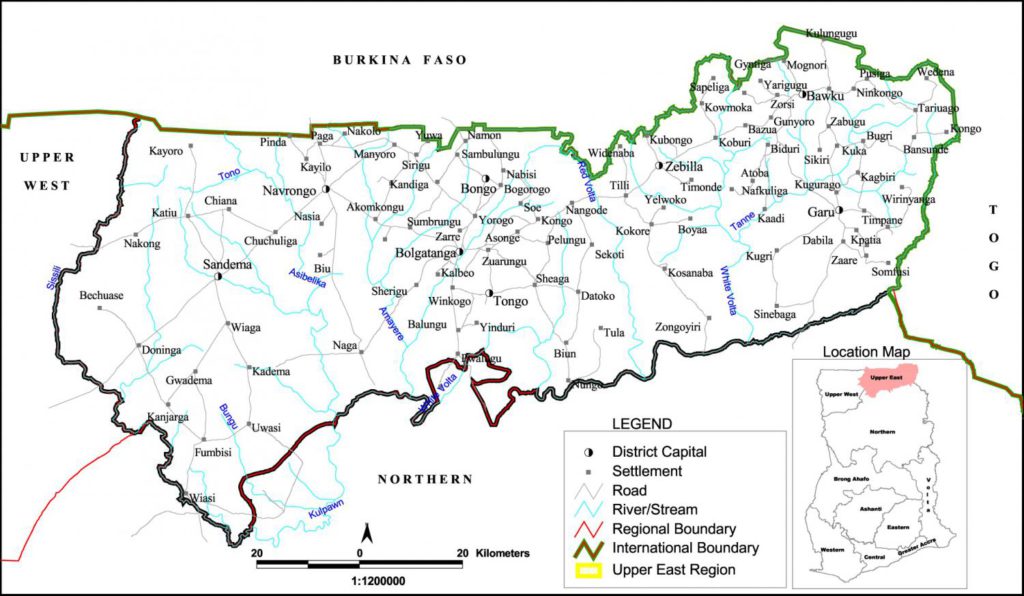
Upper East Region – Ghana

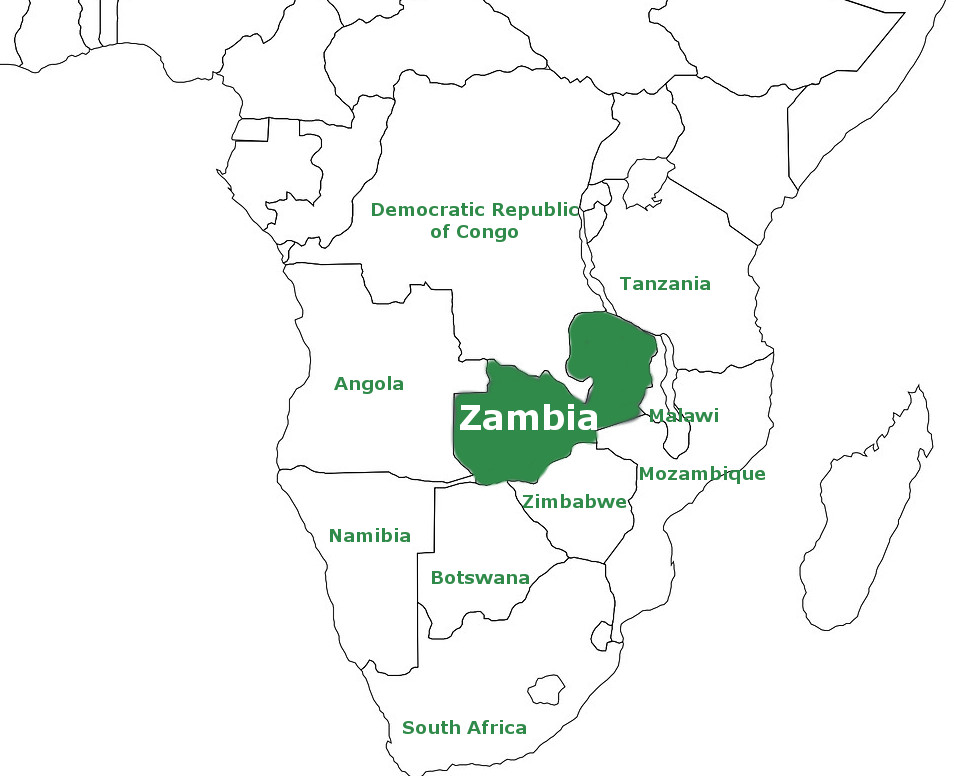
Zambia: Cannibals in Matero? Suspected ritual killer arrested in Lusaka

Unfortunately, Zambia is no exception. Ritual killing of human beings – children, adults – takes place in Zambia too. I’ve been following events in Zambia since quite some time. Many suspected cases of ritual killings as well as real cases have been reported over the years. Without a shadow of a doubt the tip of the iceberg – as in many other countries. Many ritual murders are not discovered, or not reported as such. One of the cases in my archives dates back to 1996. An excerpt: “(…) Early this year, another spate of mob justice hit the country, especially Lusaka and the tourist capital Livingstone, after children started disappearing. Some of the children were later found, horribly mutilated. These murders were believed to be ritual killings. Angry mobs again took their justice, beating to death some suspects who the police say were innocent. This ended only when the police arrested and had several men convicted.(…)”

More in the near future. Read here (below) one of the more recent cases. Matero lies a few miles west of Lusaka, Zambia’s capital.
Readers are warned, the details are gruesome.

Ritual killings, superstition, mob justice, absence of rule of law, ignorance, they’re all interrelated. Let’s hope that the Zambian government continues on the good road taken, as shown by the appearance in Parliament and the frank statements of Home Affairs Minister Stephen Kampyongo.
(webmaster FVDK)

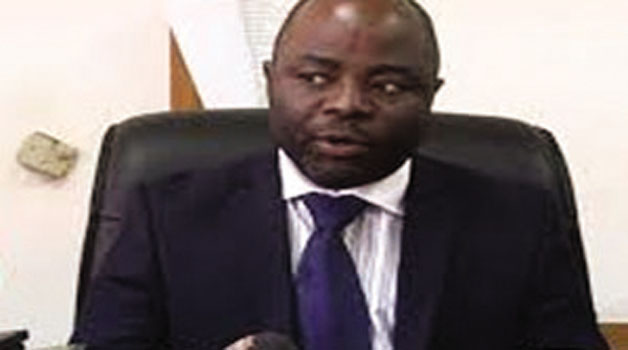
Home Affairs Minister Stephen Kampyongo: “Between October 21, last year, and February 24, this year, seven suspected ritual killings were reported to Police (…)”

CANNIBALS IN MATERO?…POLICE RECOVER COOKED HUMAN HEART, LIVER AFTER ARRESTING A SUSPECTED RITUAL KILLER IN LUSAKA

Published on March 2, 2018
By CHILA NAMAIKO and JANE MWANSA
Times of Zambia

A COOKED human heart and liver have been recovered by police in Lusaka after arresting a suspected mastermind in the spate of suspected ritualistic killings of seven people in Matero, Parliament heard yesterday.

Home Affairs Minister Stephen Kampyongo said some of the cooked body parts were eaten by the suspect, who also shared with his unsuspecting neighbours.
Mr Kampyongo informed the House that the suspect also led the officers to the recovery of ears and several private parts, which had now been submitted to the forensic laboratory for examination. Updating the House in a ministerial statement on recent suspected ritual killings, he said all the victims of the murders were found with their chests ripped open and internal parts missing.
He said the security situation in Matero was generally stable until October, 21, last year, when the first suspected ritual killing was reported.
Between that date and February 24, this year, seven suspected ritual killings were reported to Police, with the victims in all the incidences had been males aged between 25 and 40 years. “By 24th February 2018, the Zambia Police Service investigation unit had with the help of the suspect recovered suspected cooked human heart and liver, “he said.

Mr Kampyongo said police visited and processed the crime scene, and preliminary findings suggested that the people behind the gruesome murders used the same method of killing.
For instance, at every crime scene, a concrete block was found. The officers believe the same block was one of the weapons used.
“The ripping open of the chest, cutting off of the ears and the private parts also appear to have been conducted in a similar manner. The preliminary findings suggest that these murders have been carried out by the same group,” he said.
Mr Kampyongo warned that false beliefs of human body parts helping one to accumulate wealth had no place in Zambia, and the law would catch up with the perpetrators.

To bring the perpetrators of such barbaric crimes, the House heard that police had instituted investigations, which had so far resulted in the arrest of one suspect.
He said the suspect, believed to be the master-mind, was assisting the officers with further investigations and would appear in court soon.
Police had taken a number of measures to enhance security in Matero such as foot patrol and motorised patrols, increased presence in high-density townships, and sensitisation to members of the community on personal security. He assured the public of police protection.

Meanwhile, residents of Kitwe woke up to a rude shock yesterday after a human head was found along the banks of the Kafue River.
When contacted for a comment, Copperbelt Commissioner of Police Charity Katanga said police were waiting for the family of the deceased to come and identify the head. And scores of residents living near the river thronged the scene to have a glimpse of the bizarre finding, which was later picked up by police.

Source: Times of Zambia, March 2, 2018

Ritual killings linked to elections – Swaziland

Unfortunately, also in Swaziland the number of ritual murders increases at election time. I remember a BBC article of June 2, 2003, reporting that King Mswati III had urged Swaziland’s politicians not to engage in ritual killings to boost their chances in the general elections later that year.

Five years later Prime Minister Absalom Themba Dlamini issued a warning to aspiring members of parliament against committing ritual murders to win the vote. When speaking during the Ascension prayer service held at Embangweni Royal Residence on May 4, 2008, the PM said it was very disturbing that, already, there were reported incidents of people disappearing under a cloud of controversy as the elections dates draw closer. He said King Mswati III issued a similar warning.

We’re now in 2018 and apparently nothing has changed. The Swaziland Action Group Against Abuse (SWAGAA) has issued a statement recently, saying it is “(…) deeply alarmed and distressed by recent media reports of abductions and kidnappings resulting in mutilations and killings. Children, both girls and boys, are especially targeted (…). The fact that there are widespread speculations on whether or not these abductions are for ritual purposes linked to the upcoming Parliamentary elections in Eswatini cannot be ignored.”
(webmaster FVDK)

Swaziland Action Group Against Abuse (SWAGAA) is a non-governmental organization which has been working for over 20 years to eradicate Gender-Based Violence (GBV) and Human Trafficking in Swaziland.

‘Ritual murder has long been part of Swazi life.’, as Richard Rooney said.

More in the following article written by Richard Rooney.

Published: Thursday, 31 May 218

BY RICHARD ROONEY Y
SWAZI MEDIA COMMENTARY – INFORMATION AND COMMENTARY ON HUMAN RIGHTS IN SWAZILAND

There are ‘widespread speculations’ across Swaziland that a number of recent abductions resulting in mutilations and killings might be related to the ongoing national election in the kingdom, the Swaziland Action Group Against Abuse (SWAGAA) said.

SWAGAA said, ‘Children, both girls and boys, are especially targeted; however, this does not mean adults cannot be a target in future. For this reason, all people should remain on high alert.’

It said in a statement, ‘The fact that there are widespread speculations on whether or not these abductions are for ritual purposes linked to the upcoming Parliamentary elections in Eswatini [Swaziland] cannot be ignored.

Swaziland has a history of abductions and ritual killings in the run-up to national elections that are held every five years. Voter registration is currently taking place and ends on 17 June 2018. The date for the actual election has yet to be announced.

In June 2017, during a voter-education workshop, Swaziland’s Elections and Boundaries Commission (EBC) called for an end to ritual killings around voting time. It was concerned about reports of people mysteriously disappearing across the kingdom.

At KaLanga in the Lugongolweni constituency EBC educator Cynthia Dlamini said ritual murder reports increased during election time. The Swazi Observer reported at the time, ‘Dlamini said this was one belief driven by lunacy which tarnishes the image of the country in the process. She said the commission condemns such beliefs and called for intensive investigations against those who would be suspected of ritual killings.’

At the last election in 2013, The Swaziland Epilepsy Association warned that cases of the abduction of epileptic people always increased during elections. Mbuso Mahlalela from the association told the Swazi Observer at the time it was common for the vulnerable to be targeted and abducted. He spoke after a report that a 13-year-old epileptic boy might have been abducted for ritual purposes.

Before the election in 2008 a march by civil society groups to draw attention to ritual killings was banned by the government amid fears that it would bring bad publicity to Swaziland and might embarrass King Mswati III, the kingdom’s absolute monarch, who had spoken out against the practice.

The Times of Swaziland reported at the time the march had been motivated by the mystery disappearances and murders of women. Some of these had been found mutilated fuelling speculating that they were related to rituals.

Some Swazi people believe body parts can be used as ‘muti’ which is used to bring good fortune to candidates at the election and help them to win seats in parliament.

In 2008, it was strongly rumoured in Swaziland that the reason why members of the government wanted to ban discussion on the ritual murders was that some of them had themselves used ‘muti’ to get elected.

In March 2018, a campaign called ‘Don’t kill us, we are human beings too’ was launched to raise awareness about people with albinism, a group at particular risk at election time. The Stukie Motsa Foundation is using social media to dispel the false belief that people with albinism cleanse bad luck and bring fortune to people.

There have been concerns in Swaziland for years that people with albinism have been targeted and murdered. Witchdoctors use the body parts to make spells that they claim bring people good luck.  Sport teams have also been known to use spells to bring them good fortune during matches. Witchdoctors’ services are especially sought after by candidates contesting parliamentary and local elections.

In January 2017, the Director of Public Prosecution’s office in Swaziland told witchdoctors in the kingdom to stop murdering people for body parts. The witchdoctors, also known as tinyanga, were advised to go to the Ministry of Health for body parts, such as bones.

During the national elections in Swaziland in 2013, people with albinism lived in fear that their body parts would be harvested by candidates seeking good luck.

Independent Newspapers in South Africa reported at the time, ‘In the past [people with albinism], who lack the skin pigment melanin, as well as epileptics have been specifically targeted, prompting the police to set up registries.

‘In 2010, the killing and mutilation of [people with albinism], including in one instance the decapitation of two children in Nhlangano, prompted panic.’

In August 2013, Independent Newspapers quoted an academic at the University of Swaziland, who did not want to be named, saying, ‘Ritual killings to achieve elected office are a natural outgrowth of a government based not on rationality or democratic principles but on superstitious beliefs.

‘The Swazi king claims power through an annual Incwala festival where a bull is brutally sacrificed and mysterious rituals occur, and this sets the tone. No one knows how office-holders are appointed in Swaziland. It’s all done in secret, without recourse to merit or any rhyme or reason, so this fuels irrational beliefs.

‘Ritual murder has long been part of Swazi life.’

Source: Ritual killings linked to elections, May 31, 2018