The following plea speaks for itself. (webmaster FVDK)
Ritual Killings: Imperative For Urgent Legislative Reform
Published: January 18, 2025 By: Charles Ude – The Whistler, Nigeria
Charles Ude, Esq, is an Abuja Based Legal practitioner
Ritual killings in Nigeria are a grave concern that transcends mere criminality, reflecting a deep-seated cultural malady that requires immediate legislative action. The recent brutal murder of a young woman in Kogi State serves as a timely reminder of the urgency for a decisive and multifaceted approach to combat this abhorrent practice. As the nation mourns the victims and stands in solidarity with their families, it is imperative to recognize that an effective legal framework, bolstered by education and cultural intervention, is crucial in the fight against ritual killing.
The Socio-Cultural Context
The persistence of ritual killings in Nigeria is intricately linked to widespread beliefs in the supernatural, which infiltrate various socio-economic strata irrespective of educational background. These beliefs often manifest in attempts to harness spiritual powers for personal gain, including financial prosperity or social advancement. Such practices are often cloaked in traditional rituals, rendering them difficult to combat solely through legal measures. Addressing the root causes—misplaced belief systems and ignorance—is as crucial as enforcing legal prohibitions against these crimes.
Recent Cases and Judicial Precedents
While it is vital to acknowledge the role of the judiciary in addressing ritual killings, recent court cases such as Federal Republic of Nigeria v. Igbokwe (2022) and Nwankwo v. State (2023) illustrates both the commitment and the limitations of the current legal framework. These cases have underscored the severity of ritual killings and the necessity for stronger penalties. However, the infrequency of successful prosecution and the perceived leniency of existing sentences highlight the urgent need for reforms. The judiciary must be empowered to impose harsher consequences for such heinous crimes to act as a deterrent.
Numerous high-profile cases illustrate the alarming implications of ritual killings, offering a grim snapshot of the societal dangers at play. The Sofiat Kehinde case, where four teenagers were arrested for a murder intended for a money-making ritual, starkly demonstrates the youthful exploitation rife in these crimes. Similarly, the Otokoto killings of 1996 sparked national outrage due to the abduction and murder of children for their body parts. The Osun Osogbo and Ibadan cases further reveal a troubling pattern of ritualistic violence, emphasizing the urgent need for preventive measures and robust legislation.
Implications for Law and Order
The impact of ritual killings on Nigeria’s legal and social fabric is profound, posing significant challenges to law enforcement and community safety. To effectively combat this menace, we advocate for the following legislative reforms:
Uniform and Tougher Legislation: It is imperative to enact comprehensive laws that explicitly define ritual killings as grave offenses. Such legislation should be accompanied by stringent penalties that reflect the severity of the crime, serving both as punishment and deterrent.
Education and Awareness: Integrating educational initiatives into community awareness programs is essential. These initiatives should aim to debunk myths surrounding ritualistic practices and promote understanding of the laws against them. Community engagement can play a critical role in changing attitudes and reducing the incidence of such practices over time.
In conclusion, the urgent nature of ritual killings in Nigeria cannot be overstated. The recent tragic events illustrate an inescapable need for decisive legislative reform. Enhancing legal frameworks and fostering community awareness are both critical steps in eradicating this menace. It is time for all stakeholders—government officials, the judiciary, civil society, and communities—to unite in a concerted effort to dismantle the socio-cultural foundations that support ritual killings, ensuring the safety and dignity of all citizens.
Disclaimer: This article is entirely the opinion of the writer and does not represent the views of The Whistler.
Early December 2024 there was a tsunami of articles focusing on the nexus prostitution – missing girls – ritual killings. The facts are horrifying. Young women between the age of 20 and 32 are most likely to be the victim of ritualistic killers.
The Public Relations Officer of the Ogun State Command, Omolola Odutola, even mentioned a number of ten young women disappearing daily in the southwestern state, one of Nigeria’s 36 states. She blamed the ‘hookup culture’ of facilitating the disappearances and ‘money rituals’, as murders for ritualistic purposes are being labeled in Nigeria. (webmaster FVDK)
Ogun State Police link missing girls, ritual killings to hook-ups
Published: December 4, 2024 By: Vanguard, Nigeria
The Nigeria Police Force has linked many cases of missing young women to ritual practices, with a growing connection to the rising hook-up culture in the country.
The Public Relations Officer of the Ogun State Command, Omolola Odutola, revealed this, yesterday, when she was featured on Channels Television’s Morning Brief.
During the discussion on “Hookup Culture: Impact on Youth Values and Relationships,” Odutola revealed that young women aged 20 to 32 were the most affected.
She added that many young people, especially males, believe that ritual killings was a way to become wealthy.
“This particular menace is very serious and I will like a lot of young people to understand the danger in the hookup culture. Today, we have lots of reports of missing persons. By the time we start an investigation, not less than 10 young girls and ladies go missing daily.
“In-depth investigations also reveal that those cases are not by accidents. Most of them are connected to hookup channels and apps. They fall victim to strangers who causally invite them to unknown places, and eventually fall victim to being used for ritual purposes.
“Most cases of missing girls and ritual killings occurring in Ogun State of recent, I will like to say that it is not new. But as much as possible, the Ogun State Commissioner of Police has been able to tame these ugly incidents.
“It stems from the ugly perspective of young persons who believe that ritual killing could enrich them. We have some of these unscrupulous elements who deceive young people to get human skulls or human body parts, which they use for some kind of concoction to get them rich.”
“That is why we are having advocacy and sensitization, to enlighten young persons to make them understand that engaging in ritual killings does not in any way make them rich,” she said.
She stated that the police command was collaborating closely with the state Women Affairs Commission to tackle and curb the menace.
She stated, “The Ogun State government, particularly the Women Affairs Commission works in tandem with the police command by providing counselling sessions.
“Apart from that, whenever we have cases such as this if per adventure the girls escape the rituals, we also have a proper way of helping them go through the distress of mental health and anxiety they might have felt during the incident.
“The hookup culture is prevalent among young girls between the ages of 20 to about 32 years. The reason they get involved in this menace is because they feel they don’t get enough from their parents, and then the get-rich syndrome.”
Hookup culture refers to casual sexual relationships, like one-night stands, that often don’t involve emotional attachment or long-term commitment. While this trend has existed since the 1920s, it has become more common and accepted in recent years.
Some argue that hookup culture is a step forward for women’s freedom and empowerment, but others believe it harms the development of healthy and meaningful relationships.
Police Link Missing Girls Cases, Ritual Killings To Hookups
Published: December 4, 2024 By: Samuel – Tori, Nigeria
The Public Relations Officer of the Ogun State Command, Omolola Odutola, revealed this on Wednesday when she was featured on Channels Television’s Morning Brief.
The Nigerian Police Force has linked many cases of missing young women to ritual practices, with a growing connection to the rising hookup culture in the country.
The Public Relations Officer of the Ogun State Command, Omolola Odutola, revealed this on Wednesday when she was featured on Channels Television’s Morning Brief.
During the discussion on “Hookup Culture: Impact on Youth Values and Relationships,” Odutola revealed that young women aged 20 to 32 are the most affected.
She added that many young people, especially males, believe that ritual killings are a way to become wealthy. “This particular menace is very serious and I would like a lot of young people to understand the danger in the hookup culture. Today, we have lots of reports of missing persons. By the time we start an investigation, not less than 10 young girls and ladies go missing daily.
“In-depth investigations also reveal that those cases are not by accidents. Most of them are connected to hookup channels and apps. They fall victim to strangers who causally invite them to unknown places, and eventually fall victim to being used for ritual purposes,” she said.
“Most cases of missing girls and ritual killings occurring in Ogun State of recent, I would like to say that it is not new. But as much as possible, the Ogun State Commissioner of Police has been able to tame these ugly incidents.”
The police boss added, “It stems from the ugly perspective of young persons who believe that ritual killing could enrich them. We have some of these unscrupulous elements who deceive young people to get human skulls or human body parts, which they use for some kind of concoction to get them rich.
“That is why we are having advocacy and sensitization, to enlighten young persons to make them understand that engaging in ritual killings does not in any way make them rich,” she said.
She stated that the police command is collaborating closely with the State Women Affairs Commission to tackle and curb the menace.
She stated, “The Ogun State government, particularly the Women Affairs Commission works in tandem with the police command by providing counselling sessions.
“Apart from that, whenever we have cases such as this if per adventure the girls escape the rituals, we also have a proper way of helping them go through the distress of mental health and anxiety they might have felt during the incident.
“The hookup culture is prevalent among young girls between the ages of 20 to about 32 years. The reason they get involved in this menace is because they feel they don’t get enough from their parents, and then the get-rich syndrome.”
Hookup culture refers to casual sexual relationships, like one-night stands, that often don’t involve emotional attachment or long-term commitment. While this trend has existed since the 1920s, it has become more common and accepted in recent years.
Some argue that hookup culture is a step forward for women’s freedom and empowerment, but others believe it harms the development of healthy and meaningful relationships.
This culture also reflects a double standard, with women often judged more harshly than men for engaging in casual encounters. For instance, women who hook up frequently or go too far in a single encounter may face derogatory labels like “hoe,” while men in similar situations are often praised.
Ogun police blame ‘hookup’ for high rate of missing girls
Published: December 4, 2024 By: The Citizen, Nigeria
The Public Relations Officer for the Ogun State Police Command, Omolola Odutola, has blamed the high rate of missing girls and ritual killings involving females in the state on “hookups”.
The Ogun PPRO made this statement on Channels Television’s Morning Brief on Wednesday, where she was invited as a special guest to speak on the topic ‘Hookup Culture: Impact on Youth Values and Relationships’.
Hookup is a slang used to describe brief, casual sexual relations between individuals. Odutola described the hookup culture as a menace prevalent among young girls and attributed this to the surge in cases of missing girls and female victims of ritual killings in the state.
“Today, we have lots of reports of missing persons. By the time we start an investigation, not less than 10 young girls and ladies go missing daily.
“In-depth investigations also reveal that those cases are not by accidents. Most of them are connected to hookup channels and apps. They fall victim to strangers who causally invite them to unknown places, and eventually fall victim to being used for ritual purposes,” said Odutola.
The PPRO noted that Ogun State has an ugly history with the cases of missing girls and ritual killings.
In October, the Ogun Police Command declared Testimony John, an 18-year-old girl, missing. The 18-year-old was sent on an errand to Saabo Market in Sagamu and did not return home.
A month before then, in September, the police launched a manhunt for the killers of Habibat Akinsanya, a 17-year-old secondary school student who was abducted and murdered in the state.
Police Uncover 1 Reason for High Cases of Missing Girls, Ritual Killings In Nigeria, Details Emerge
Police link h0okup activities to missing girls and ritual activities Photo credit: @PoliceNG/Pius Utomi Ekpei Source: UGC
Published: December 5, 2024 By: Ezra Ukanwa – Legit, Nigeria
Police reveal the dark side of hookup culture Odutola emphasized that the hookup culture, characterized by casual sexual encounters without commitment, has fueled a surge in cases involving young girls who fall prey to ritual killings, Channels Television reported.
“Today, we have lots of reports of missing persons. By the time we start an investigation, not less than 10 young girls and ladies go missing daily. “Most of these cases are linked to hookup channels and apps,” she explained. The police noted that many young men are motivated by the belief that ritual killings can lead to wealth, The Punch reported. “Most cases of missing girls and ritual killings in Ogun State have their roots in this misguided idea. “We have some unscrupulous elements who deceive people into providing human body parts for rituals,” she stated.
To combat this, according to her, the Ogun State Police Command, in collaboration with the Women Affairs Commission, has been actively raising awareness and providing counselling to victims and their families.
UNIPORT student found dead in boyfriend’s apartment
In another development, Legit.ng reported that a 300-level Biological Chemistry student of the University of Port Harcourt (UNIPORT), Otuene Justina Nkang, has been found dead in her boyfriend’s apartment in the River State capital. Nkang has been declared missing four days after leaving her place of work, where she was doing her industrial training at a private hospital in Port Harcourt.
Hookups to blame for most cases of missing girls, ritual killings in Nigeria – Police
Published: December 4, 2024 By: Nurudeen Shotayo – The Pulse, Nigeria
The hookup culture encourages casual sexual encounters in some cases between two strangers who could engage in one-night stands without necessarily involving any emotional bonding or long-term commitment.
The Nigeria Police have attributed the increasing cases of missing young ladies and girls being used for ritual purposes in the country to the prevalent hookup culture pervading society.
This is according to Omolola Odutola, the Public Relations Officer, Ogun State Police Command, who spoke on Channels Television‘s Morning Brief on Wednesday, December 4, 2024.
Odutola, who contributed to the topic, ‘Hookup Culture: Impact on Youth Values and Relationships,’ observed that young girls and ladies within the age range of 20 and 32 fall victim to the menace.
The hookup culture encourages casual sexual encounters in some cases between two strangers who could engage in one-night stands without necessarily involving any emotional bonding or long-term commitment.
This is hardly a new concept given that non-romantic sexual encounters, especially prostitution have been around since almost the beginning of time.
“This particular menace is very serious and I would like a lot of young people to understand the danger in the hookup culture.
“Today, we have lots of reports of missing persons. By the time we start an investigation, not less than 10 young girls and ladies go missing daily.
“In-depth investigations also reveal that those cases are not by accidents. Most of them are connected to hookup channels and apps. They fall victim to strangers who casually invite them to unknown places, and eventually fall victim to being used for ritual purposes,” she said.
Odutola says young people believe in ritual wealth
The police spokesperson added that most young Nigerians, especially males believe that ritual killings can make them rich.
“Most cases of missing girls and ritual killings occurring in Ogun state of recent, I would like to say that it is not new. But as much as possible, the Ogun state commissioner of police has been able to tame these ugly incidents.
“It stems from the ugly perspective of young persons who believe that ritual killing could enrich them. We have some of these unscrupulous elements who deceive young people to get human skulls or human body parts, which they use for some kind of concoction to get them rich.
“That is why we are having advocacy and sensitization, to enlighten young persons to make them understand that engaging in ritual killings does not in any way make them rich,” she said.
Police link missing girls cases, ritual killings to hookups
Published: December 4, 2024 By: Adetutu Sobowale – Punch, Nigeria
The Nigerian Police Force has linked many cases of missing young women to ritual practices, with a growing connection to the rising hookup culture in the country.
The Public Relations Officer of the Ogun State Command, Omolola Odutola, revealed this on Wednesday when she was featured on Channels Television’s Morning Brief.
During the discussion on “Hookup Culture: Impact on Youth Values and Relationships,” Odutola revealed that young women aged 20 to 32 are the most affected.
She added that many young people, especially males, believe that ritual killings are a way to become wealthy.
“This particular menace is very serious and I would like a lot of young people to understand the danger in the hookup culture. Today, we have lots of reports of missing persons. By the time we start an investigation, not less than 10 young girls and ladies go missing daily.
“In-depth investigations also reveal that those cases are not by accidents. Most of them are connected to hookup channels and apps. They fall victim to strangers who causally invite them to unknown places, and eventually fall victim to being used for ritual purposes,” she said.
“Most cases of missing girls and ritual killings occurring in Ogun State of recent, I would like to say that it is not new. But as much as possible, the Ogun State Commissioner of Police has been able to tame these ugly incidents.”
The police boss added, “It stems from the ugly perspective of young persons who believe that ritual killing could enrich them. We have some of these unscrupulous elements who deceive young people to get human skulls or human body parts, which they use for some kind of concoction to get them rich.
“That is why we are having advocacy and sensitization, to enlighten young persons to make them understand that engaging in ritual killings does not in any way make them rich,” she said.
She stated that the police command is collaborating closely with the State Women Affairs Commission to tackle and curb the menace.
She stated, “The Ogun State government, particularly the Women Affairs Commission works in tandem with the police command by providing counselling sessions.
“Apart from that, whenever we have cases such as this if per adventure the girls escape the rituals, we also have a proper way of helping them go through the distress of mental health and anxiety they might have felt during the incident.
“The hookup culture is prevalent among young girls between the ages of 20 to about 32 years. The reason they get involved in this menace is because they feel they don’t get enough from their parents, and then the get-rich syndrome.”
Hookup culture refers to casual sexual relationships, like one-night stands, that often don’t involve emotional attachment or long-term commitment. While this trend has existed since the 1920s, it has become more common and accepted in recent years.
Some argue that hookup culture is a step forward for women’s freedom and empowerment, but others believe it harms the development of healthy and meaningful relationships.
This culture also reflects a double standard, with women often judged more harshly than men for engaging in casual encounters. For instance, women who hook up frequently or go too far in a single encounter may face derogatory labels like “hoe,” while men in similar situations are often praised.
Police raise the alarm over rising missing persons cases in Ogun
Published: January 8, 2025 By: Punch, Nigeria
The Ogun State Police Command has raised concerns over an increase in reports of missing persons in the state.
The command’s spokesperson, Omolola Odutola disclosed this in a statement in Abeokuta, the state capital, on Tuesday.
She explained that the command had noticed an unprecedented rise in the number of missing persons across all age groups.
Odutola noted that only a small fraction of the individuals had been found, with many regrettably not returning home.
The police spokesperson urged residents to remain vigilant and more security-conscious while prioritising their safety.
She added that, as a proactive and community-oriented force, the command was committed to raising public awareness about this concerning trend.
“We encourage everyone to prioritise their safety by maintaining a heightened sense of security to avoid becoming a victim.
“The Commissioner of Police, Lanre Ogunlowo, has outlined essential measures and guidelines to keep residents informed about the most pressing issues.
“Based on insights from individuals who were rescued, the Commissioner advises parents not to allow their children to use commercial transportation services with strangers.
“Additionally, he encourages restless youth to activate the digital communication and sharing features on their mobile devices, especially when travelling or in moments of distress,” Odutola said.
Odutola further emphasised that the public could contact the police control room at 09164859299 and the Police Public Relations Department at 09159578888 for assistance.
Most Missing Girls Cases, Ritual Killings In Nigeria Connected With Hookups — Police
The Hookup culture encourages and accepts casual sexual encounters, such as one-night stands, without necessarily involving emotional bonding or long-term commitment.
Published: December 4, 2024 By: Channels Television
The Nigerian Police Force has identified most cases of missing young ladies and girls being used for ritual purposes in Nigeria connected to the prevalent hookup culture sweeping across the country.
The Public Relations Officer, Ogun State Command, Omolola Odutola who was a special guest on Channels Television’s Morning Brief on Wednesday, to discuss the topic ‘Hookup Culture: Impact on Youth Values and Relationships’, said young girls and ladies within the age range of 20 and 32 fall victim of the menace.
The Hookup culture encourages and accepts casual sexual encounters, such as one-night stands, without necessarily involving emotional bonding or long-term commitment.
The idea of casual, non-romantic sexual encounters has been around since the 1920s.
Some social critics argue that hooking up is a feminist achievement, while others worry that it is a step backwards for healthy, intimate relationships.
The hookup culture can also be gendered, with women being judged by a different standard than men. For example, women who hook up with too many people or go too far in the first hook-up are often judged by terms like “hoe”.
“This particular menace is very serious and I would like a lot of young people to understand the danger in the hookup culture.
“Today, we have lots of reports of missing persons. By the time we start an investigation, not less than 10 young girls and ladies go missing daily.
“In-depth investigations also reveal that those cases are not by accidents. Most of them are connected to hookup channels and apps. They fall victim to strangers who casually invite them to unknown places, and eventually fall victim to being used for ritual purposes,” she said.
She added that most young persons, especially males believe that ritual killings can make them get rich.
‘Most cases of missing girls and ritual killings occurring in Ogun state of recent, I would like to say that it is not new. But as much as possible, the Ogun state commissioner of police has been able to tame these ugly incidents.
“It stems from the ugly perspective of young persons who believe that ritual killing could enrich them. We have some of these unscrupulous elements who deceive young people to get human skulls or human body parts, which they use for some kind of concoction to get them rich.
“That is why we are having advocacy and sensitization, to enlighten young persons to make them understand that engaging in ritual killings does not in any way make them rich,” she said.
According to her, the police command is working closely with the Women Affairs Commission of the state to stem the menace in the tide.
“The Ogun State government, particularly the Women Affairs Commission works in tandem with the police command by providing counselling sessions.
“Apart from that, whenever we have cases such as this if per adventure the girls escape the rituals, we also have a proper way of helping them go through the distress of mental health and anxiety they might have felt during the incident.
“The hookup culture is prevalent among young girls between the ages of 20 to about 32 years. The reason they get involved in this menace is because they feel they don’t get enough from their parents, and then the get-rich syndrome,” she said.
A Development expert, Dorothy Njemanze who also joined the conversation from Abuja, urged the Nigerian Police to provide full security and encourage the reporting culture to deal with the crime.
Development expert Dorothy Njemanze
“A lot of the predatory trends that we see have existed in the society all along. But instead of tackling them headlong, we make excuses and try to guilt-trip people. If you stay in your house, harm can happen to you. You go out, harm can happen to you. A lot of healthy marriages in Nigeria happen through hookups. We are expected to meet people irrespective of how it happened, especially when we are adults.
“But my concern is that the predation system extends to children. A lot of children are being lured through the predation system. Every state needs to have a mandatory reporting system so that when suspicious movements are seen, such activities can be reported. And then for law enforcement, when people report things to you, and you are lax and expect people to write petitions and ply certain routes before you can take action, then there is a problem.
“The proactiveness of law enforcement agencies is what we bank on.
“Bad people plan very well, to gain the trust of who they want to harm to minimise chances of their victims raising alarm for them to be caught.
“I heard the policewoman talking about people going to parties. And I also read about a lady killed by her pastor in the church. So it could be anybody.
“Whatever the dimension that bad people choose to operate, the law enforcement should be able to ready to swoop in and ensure that there is minimal to no damage done, and then the mandatory reporting culture of the society is one thing that can help to minimise these things.
“As long as we can’t control what adults do among each other, we can minimize such occurrences because the hookup culture affects both men and women, but more among the women. There is more pressure on men to have resources that can make them look like big men. But make sure as much as possible whenever you are going out, somebody knows where you are going,” she said.
Screenshot – to access the video please open the link included in the Source (below)
Ogun police blame hookup for high rate of missing girls
Published: December 4, 2024 By: Olayide Soaga – The Guardian, Nigeria
Omolola Odutola, the Public Relations Officer for the Ogun State Police Command, has blamed the high rate of missing girls and ritual killings involving females in the state on “hookups”.
The Ogun PPRO made this statement on Channels Television’s Morning Brief on Wednesday, where she was invited as a special guest to speak on the topic ‘Hookup Culture: Impact on Youth Values and Relationships’.
Hookup is a slang used to describe brief, casual sexual relations between individuals. Odutola described the hookup culture as a menace prevalent among young girls and attributed this to the surge in cases of missing girls and female victims of ritual killings in the state.
“Today, we have lots of reports of missing persons. By the time we start an investigation, not less than 10 young girls and ladies go missing daily.
“In-depth investigations also reveal that those cases are not by accidents. Most of them are connected to hookup channels and apps. They fall victim to strangers who causally invite them to unknown places, and eventually fall victim to being used for ritual purposes,” said Odutola.
The PPRO noted that Ogun State has an ugly history with the cases of missing girls and ritual killings.
In October, the Ogun Police Command declared Testimony John, an 18-year-old girl, missing. The 18-year-old was sent on an errand to Saabo Market in Sagamu and did not return home.
A month before then, in September, the police launched a manhunt for the killers of Habibat Akinsanya, a 17-year-old secondary school student who was abducted and murdered in the state.
Published: December 4, 2024 By: Titilope Adamo – The Osun Defender, Nigeria Titilope Adako is a talented and intrepid journalist, dedicated to shedding light on the untold stories of Osun State and Nigeria. Through incisive reporting, she tackles a broad spectrum of topics, from politics and social justice to culture and entertainment, with a commitment to accuracy, empathy, and inspiring positive change.
The Nigerian Police Force has attributed a significant number of cases involving missing young women to ritual practices closely tied to the rising hookup culture in Nigeria.
Omolola Odutola, the Public Relations Officer for the Ogun State Command, discussed this issue on Wednesday during an appearance on Channels Television’s Morning Brief programme.
Highlighting the impact of hookup culture on youth values, she noted that women aged 20 to 32 are the most vulnerable.
“This particular menace is very serious and I would like a lot of young people to understand the danger in the hookup culture. Today, we have lots of reports of missing persons. By the time we start an investigation, not less than 10 young girls and ladies go missing daily.
She further explained, “It stems from the ugly perspective of young persons who believe that ritual killing could enrich them. We have some of these unscrupulous elements who deceive young people to get human skulls or human body parts, which they use for some kind of concoction to get them rich.
“That is why we are having advocacy and sensitization, to enlighten young persons to make them understand that engaging in ritual killings does not in any way make them rich,” she said.
She also stated that the police command is collaborating closely with the State Women Affairs Commission to tackle and curb the menace.
She added, “The Ogun State government, particularly the Women Affairs Commission works in tandem with the police command by providing counselling sessions.
“Apart from that, whenever we have cases such as this if per adventure the girls escape the rituals, we also have a proper way of helping them go through the distress of mental health and anxiety they might have felt during the incident.
“The hookup culture is prevalent among young girls between the ages of 20 to about 32 years. The reason they get involved in this menace is because they feel they don’t get enough from their parents, and then the get-rich syndrome.”
Hookup culture, which refers to casual sexual relationships like one-night stands, has been debated for its effects on youth.
While some argue it empowers individuals, others criticize its impact on relationships and societal values.
This culture often highlights double standards, with women judged more harshly than men for casual encounters, facing derogatory labels such as “hoe,” while men are often praised.
THE Nigerian Police Force has linked many cases of missing young women and girls to the rising hookup culture in Nigeria, which is believed to be contributing to their exploitation for ritual purposes.
The Public Relations Officer of the Ogun State Command, Omolola Odutola, highlighted during an interview today that young women aged 20 to 32 are particularly vulnerable to this issue.
The hookup culture promotes casual sexual encounters, such as one-night stands, without emotional attachment or long-term commitment.
The idea of casual, non-romantic sexual encounters has been around since the 1920s.
While some social critics view hooking up as a feminist achievement, others express concern that it undermines healthy intimate relationships.
The culture can also be gender-biased, with women facing harsher judgments than men, often labeled derogatorily if they engage with multiple partners or go too far on a first encounter.
Odutola emphasized the seriousness of this issue, stating, “I want young people to understand the dangers of the hookup culture. We receive numerous reports of missing persons, with at least 10 young women disappearing each day. Investigations indicate that these cases are often not accidental; many are linked to hookup platforms and apps, where victims are lured by strangers to unknown locations and subsequently exploited for ritual purposes.”
She noted that many young individuals, particularly males, believe that ritual killings can lead to wealth.
“The recent cases of missing girls and ritual killings in Ogun State are not new, but the Ogun State Commissioner of Police has been working to address these disturbing incidents. The belief that ritual killings can bring wealth is prevalent among some young people, who are often deceived into providing human remains for various rituals.”
To combat this issue, advocacy and awareness campaigns are being conducted to educate young people about the dangers of ritual killings.
The Ogun State Police Command is collaborating with the Women Affairs Commission to tackle the problem effectively.
“The Ogun State government, particularly the Women Affairs Commission, is working alongside the police to provide counseling sessions. In cases where girls escape from rituals, we have established support systems to help them cope with the mental health challenges and anxiety they may experience,” she explained.
Odutola pointed out that the hookup culture is particularly common among young women aged 20 to 32, who may feel financially unsupported by their families and are drawn to the allure of quick wealth.
Development expert Dorothy Njemanze, who joined the discussion from Abuja, urged the Nigerian Police to enhance security measures and promote a culture of reporting suspicious activities to address these crimes.
Njemanze said, “Many predatory behaviors have long existed in society, yet we often make excuses instead of confronting them. Harm can occur whether one stays at home or goes out. While hookups can lead to healthy relationships, my concern is that children are being lured into dangerous situations. Every state should implement a mandatory reporting system for suspicious activities.”
She emphasized the need for law enforcement to act proactively.
“Criminals often plan meticulously to gain their victims’ trust, minimizing the chances of being caught. The police should be prepared to intervene swiftly to prevent harm.
“Regardless of the circumstances, whether at parties or other venues, it is crucial to ensure that someone knows your whereabouts when going out,” she added, highlighting the importance of awareness and caution in navigating the hookup culture, which disproportionately affects women.
Most cases of missing persons, related to hookup – Police
Published: December 4, 2024 By: Nkiruka Gloria – Gistreel, Nigeria
The Nigerian Police Force (NPF), has disclosed that most cases of people who have been reported to be missing, is linked to ‘hookup‘.
This was disclosed by the Public Relations Officer of the Ogun State Command, Omolola Odutola, while speaking on Channels Television’s Morning Brief, on Wednesday.
She noted that the rising hookup culture in the country, has a growing connection to the many cases of missing young women to ritual practices.
She added that this stems from the ugly perspective of young persons who believe that ritual killing could enrich them.
Odutola stated that young women aged 20 to 32 are the most affected.
She said, “This particular menace is very serious and I would like a lot of young people to understand the danger in the hookup culture. Today, we have lots of reports of missing persons. By the time we start an investigation, not less than 10 young girls and ladies go missing daily.
“In-depth investigations also reveal that those cases are not by accidents. Most of them are connected to hookup channels and apps. They fall victim to strangers who causally invite them to unknown places, and eventually fall victim to being used for ritual purposes.
“Most cases of missing girls and ritual killings occurring in Ogun State of recent, I would like to say that it is not new. But as much as possible, the Ogun State Commissioner of Police has been able to tame these ugly incidents.”
Nigeria Police Link Missing Girls Cases, Ritual Killings to Hookups
Published: December 4, 2024 by: Naijapals Base – Gist Mania, Nigeria
The Nigerian Police Force has raised concerns about the alarming trend of missing young women and girls, many of whom have reportedly fallen victim to money ritual killings. According to SP Omolola Odutola, the spokesperson of the Ogun State Police Command, a significant number of these cases are linked to the growing “hookup culture” in the country.
Odutola shared these insights during a live appearance on Channels Television’s Morning Brief program on Wednesday, December 4, 2024, where the discussion focused on the topic: “Hookup Culture: Impact on Youth Values and Relationships.”
She highlighted that young women aged 20 to 32 are particularly vulnerable, often lured into dangerous situations under the guise of casual relationships or financial arrangements.
She added that many young people, especially males, believe that ritual k!llings are a way to become wealthy.
“This particular menace is very serious and I would like a lot of young people to understand the danger in the hookup culture. Today, we have lots of reports of missing persons. By the time we start an investigation, not less than 10 young girls and ladies go missing daily,” the PPRO stated.
“In-depth investigations also reveal that those cases are not by accidents. Most of them are connected to hookup channels and apps. They fall victim to strangers who causally invite them to unknown places, and eventually fall victim to being used for ritual purposes
“Most cases of missing girls and ritual killings occurring in Ogun State of recent, I would like to say that it is not new. But as much as possible, the Ogun State Commissioner of Police has been able to tame these ugly incidents.
“It stems from the ugly perspective of young persons who believe that ritual killing could enrich them. We have some of these unscrupulous elements who deceive young people to get human skulls or human body parts, which they use for some kind of concoction to get them rich
“That is why we are having advocacy and sensitization, to enlighten young persons to make them understand that engaging in ritual killings does not in any way make them rich,” she said.
She stated that the police command is collaborating closely with the State Women Affairs Commission to tackle and curb the menace.
“The Ogun State government, particularly the Women Affairs Commission works in tandem with the police command by providing counselling session.
Published: December 5, 2024 By: Abimbola Abatta – Foundation for Investigative Journalism, Nigeria
How did she know the killer? Girls, stop doing hookup, but you won’t listen.
FIJ has observed a trend where Nigerians engage in victim blaming whenever women are reported missing. It is worse when they wind up dead and their deaths are linked to ritual killings or intimate partner violence.
Victim blaming essentially implies that a victim deserved the violent crime committed against them, and it comes in various forms.
Sometimes veiled as words of caution, victim blaming springs out in comments such as, “What was she looking for?” “What was she wearing?” “How did she know the killer?” “Stop doing hook up; women no dey hear” “No justice for anybody o,” “Stop dating Yahoo boys,” “Girls will never learn,” “She will think twice in her next life.”
FIJ came across similar comments on X, captured more screenshots and uploaded them to this folder.
One of the comments
What makes this more alarming is how the Nigeria Police Force (NPF) reinforces the culture of victim blaming through careless statements. In 2019, when a suspected serial killer was on a killing spree, having killed the 10th victim, the Rivers State Police Command told young women to shun prostitution.
Chuks Enwonwu, the Deputy Commissioner of Police in charge of administration at the time, said, “In as much as societal values are disintegrating, we must go back to try to educate them (women) and discourage them from going into prostitution because that is how they fall victim to these crimes.”
A similar sentiment from law enforcement played out on Wednesday when Omolola Odutola, the police public relations officer in Ogun State, linked missing women and ritual killings to the hookup culture. This culture encourages casual sex encounters, often paid, without emotional commitment.
According to a publication by the Canadian Resource Centre for Victims of Crime, victim blaming occurs when the victim of a crime or an accident is held responsible, whether in whole or in part, for the crimes that have been committed against them.
This blame can be in the form of negative social responses from legal, medical and mental health professionals, as well as from the media, immediate family members and other acquaintances. Some types of crimes victims get blamed for are intimate partner violence, sexual assault, homicide and sex trade.
Odutola was featured on Channels Television’s Morning Brief when she said the hookup culture gives men, who believe ritual killings could enrich them, the platform to lure women to their deaths.
“Most girls who find themselves in hookup acts get missing and slaughtered for ritual purposes,” she said.
Although she noted that the police had been sensitising young persons to make them understand that ritual killings do not in any way make them rich, she stressed the need for women to beware of the hookup culture.
That was not the first time Ogun Police would be warning women about their lifestyle rather than condemning their attackers.
While detailing the arrest of three ritual killers in a post on February 29, the security agency stated, “The Command is using this avenue to advise our young ladies at this umpteenth time to desist from untoward movements. They are advised to use social media and attendant technology positively. It is through the social media platform that all these victims were surreptitiously lured to their untimely death.”
The warning for ladies. Source: Ogun State Police Command’s X page.
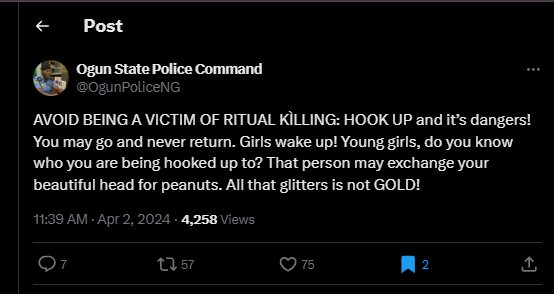
Also, in April, the Ogun police wrote on X: “Avoid being a victim of ritual killing: hook up, and its dangers. You may go and never return. Girls, wake up! Young girls, do you know who you are being hooked up to? That person may exchange your beautiful head for peanuts. All that glitters is not gold!”
Meanwhile, Dorothy Njemanze, a communication strategist and development expert who was featured on the television programme along with the Ogun police spokesperson, opined that law enforcement agencies and the government have key roles to play in tackling the underlying issues.
“Instead of tackling them (the issue) head-on, we guilt trip people. Bad people plan very well. They gain the trust of people, but regardless of the dimension that bad people choose to operate, the law enforcement should sweep in and ensure that the impact is reduced,” she said.
Njemanze differed from the police PRO’s argument that the hookup culture was to blame for the prevalent cases of missing women and ritual killings.
She explained that, as someone working in a survivor centre, she encountered cases of children who had been lured through predatory systems. Njemanze pointed out that such cases cannot be classified as hookups.
“The biggest currency that is exploited is trust. The government needs to step in into the get-rich-quick syndrome and empower people who are under the pressure of wanting to break the jinx of poverty,” Njemanze added.
Roseline Adewuyi, a gender and social advocate, told FIJ that the culture of blaming victims is a deep social issue that calls for genuine concern.
“We have had cases of women in Nigeria who are killed for ritual purposes or who have been sexually assaulted and the society goes on to subtly or expressly blame these victims,” Adewuyi stated.
She also said that factors such as existing cultural norms, social conditioning and lack of concrete understanding of the root causes of heinous crimes influence victim-blamers.
For her, the complex root cause of violence against women cannot be understood without first challenging social conditioning and reshaping the ingrained beliefs about gender and victims. Rather than make comments that imply that victims are partly culpable, the responsibility for crimes should be placed squarely on the shoulders of the perpetrators.
“It is when the responsibility of the crime has been rightly placed that we can find out the root cause and motivation of that violence. Commenting about the movements or actions of women in this context distracts the society from the real causes of the problem of gender-based violence,” Adewuyi explained.
To address the victim-blaming biases, Adewuyi said, focus must be on critical stakeholders like the police, who are the first responders in cases of violence against women. She also said that there should be sensitisation programmes on gender issues against the reinforcement of stereotypes, and the police must prioritise the safety of everyone, no matter their gender.
“NGOs, media organisations, communities, schools and others must also be targeted to replace the culture of victim blaming and silence with the culture of respect, consent and gender equality,” the social advocate told FIJ.
Abimbola Abatta is a reporter with FIJ, writing reports in partnership with Report for the World which matches local newsrooms with talented emerging journalists to report on under-covered issues around the globe.
Hook-ups reason for missing girls, ritual killings – Police
Published: December 4, 2024 By: Matthew Atungwu – Daily Post, Nigeria
The Nigeria Police said many cases of missing young women to ritual practices are caused by the surge of hook-up culture in the country.
The Public Relations Officer of the Ogun State Command, Omolola Odutola, made this revelation on Wednesday when she was featured on Channels Television’s Morning Brief.
According to her, young women aged 20 to 32 were the most affected.
She added that many young people, especially males, believe that ritual killings were a way to become wealthy.
“This particular menace is very serious and I will like a lot of young people to understand the danger in the hookup culture. Today, we have lots of reports of missing persons. By the time we start an investigation, not less than 10 young girls and ladies go missing daily.
“In-depth investigations also reveal that those cases are not by accidents. Most of them are connected to hookup channels and apps. They fall victim to strangers who causally invite them to unknown places and eventually fall victim to being used for ritual purposes.
“Most cases of missing girls and ritual killings occurring in Ogun State of recent, I will like to say that it is not new. But as much as possible, the Ogun State Commissioner of Police has been able to tame these ugly incidents,” she said.
She further said that the Ogun State Police Command was collaborating closely with the state Women Affairs Commission to tackle and curb the menace.
DAILY POST reports that hookup culture refers to casual sexual relationships, like one-night stands, that often don’t involve emotional attachment or long-term commitment.
Actress Kate Henshaw reacts to police blaming ritual killings on hookup culture
Published: December 7, 2024 By: Jessica Gistlover – Nigeria
Nigerian actress Kate Henshaw has reacted to police reports blaming hookup culture for ritual killings after facing backlash on social media for her statement about Yahoo boys using girls for rituals.
On December 4, 2024, Omolola Odutola, the PRO of the Ogun state command, highlighted the dangers of the hookup culture on Channels Television’s Morning Brief.
Nigerian actress Kate Henshaw has responded to police reports attributing ritual killings to hookup culture, following significant criticism on social media in November 2024 regarding her comments about Yahoo boys exploiting women for rituals.
During an appearance on Channels Television’s Morning Brief on December 4, 2024, Omolola Odutola, the Public Relations Officer of the Ogun State Command, emphasized the risks associated with hookup culture.
She said, “Today, we have numerous reports of missing persons. By the time we start an investigation, not less than 10 young girls and ladies go missing daily. These cases are not accidental. Most are tied to hookup arrangements where young women are invited by strangers to unknown places, ultimately leading to their harm or use in ritual killings.”
This report garnered significant media attention and elicited various reactions on social media. A user on X recalled the time when Kate Henshaw faced accusations of promoting femicide for expressing a similar viewpoint.
The post read, “There was a time not too long ago @HenshawKate made a statement as regards this and some people came for her. Alas!!! She has been vindicated.”In response to the post, Kate Henshaw wrote, “Let the role model females who spouted I was promoting femicide show naa.. Alas, their mouths are shut!!”
It is worth noting that on October 31, 2024, Henshaw commented on a viral video featuring a young girl who expressed her intention to date a Yahoo boy, a known fraudster. At that time, Henshaw warned that the young girl was at risk of being exploited for rituals due to her choice.
She wrote, “Na so dem go take pieces you for ritual…Yeye mindset.”
Henshaw’s remarks were met with backlash from many social media users, who accused her of insensitivity and of endorsing femicide.
An X user asked her, “This is so wrong to say. How is murder justifiable?”
The actress responded, “That’s the value she placed on herself with her words and actions. That’s how she reduced herself to be used by all and sundry. That’s the green light she has put on but that’s OK with you.”
Leo Igwe is a famous Nigerian, human rights activist, an indefatigable fighter against superstition, witchcraft and ritualistic murders. In 2020 he started Advocacy for Alleged Witches. On numerous occasions I have praised him on this site for his valuable work fighting superstition, witchcraft and ritualistic violence and helping and supporting the victims of witchcraft and superstition.
The year 2025 is only a few days old, yet Leo Igwe is again at the forefront of the fight against ritualistic attacks and murders, ‘money rituals’, notably in his home country with the following chilling account of an attempt to kidnap a young lady, a university student, who narrowly escaped a violent death.
I have repeatedly stated on this site that Nigeria may be the African country with the highest incidence of ritualistic crimes. Africa’s largest country needs more people like Leo Igwe to help eradicate superstition, witchcraft and violent ritualistic behavior.
There is no place for these outdated practices which violate the human rights of the Nigerian people and make a mockery of the rule of law in Nigeria. (webmaster FVDK)
Ritualists on Rampage in Delta State capital Asaba
Published: January 4, 2025 By: Leo Igwe – New Times, Nigeria
The following plea for stiffer punishment for convicted ritual murderers contains a staggering fact: according to research conducted by an NGO, the West African Network for Peace Building, Nigeria recorded 185 ritual-related deaths between January 2021 and January 2022. Among the victims were 43 women, and 30 children in 80 cases across 20 states.
Please note that we talk here about recorded cases. The total number of missing persons who have fallen prey to ritual murderers is unknown, but estimated to be very high. (webmaster FVDK)
Nigeria: The wave of ritual killings – a plea for stiffer punishment to deter the murderers
Published: December 11, 2024 By: Press Reader – Nigeria News
Leo Igwe is a famous human rights activist, an indefatigable fighter against superstition, witchcraft and ritualistic murders. In 2020 he started Advocacy for Alleged Witches. In this blog he regularly publishes on the lives of those affected by superstition and his organization’s efforts to save and/or to improve their lives.
The list of his achievements is too long to cite here, for shortness sake readers are referred to the internet where he is widely present.
In a recent article published in Ghana Leo Igwe gives his views on witchcraft and the need to effectively fight superstition, not only in this West African country, but in all African countries. He does not hide his views and feelings, as will be clear when reading the following essay.
No need to elaborate further on his message. Let me invite you to start reading while praising Leo Igwe and the valuable work he’s doing! (webmaster FVDK)
Witchcraft accusations and critical thinking: combating harmful effects of dogma and superstitions in Africa
Published: October 28, 2024 By: Leo Igwe – GhanaWeb
Leo Igwe works and campaigns to foster critical thinking skills in schools
Ritual murders are not a recent phenomenon in Kogi State, Nigeria. See my previous posts (using the dropdown menu – under ‘African countries’ – in the heading of this site will give access to all posts on Nigeria).
Austin Okai, a former Peoples Democratic Party, PDP, House of Representatives candidate for Dekina/Bassa Federal Constituency of Kogi State, has spoken urging law enforcement agencies and traditional rulers in Igala land to address the rising tide of ritual killings and human trafficking in the area. Recently a spike in ritual killings has been reported, creating an alarming situation in particular in Dekina LGA (local government area) of the state.
Some information on Kogi State where it all happens..
Kofi State is located in the North Central geopolitical zone of the Federal Republic of Nigeria. The Federal Republic of Nigeria is divided into six geopolitical zones commonly called zones.
Kogi State’s population consists of various ethnic groups, including the Igala, Ebira, Gbagyi, and subgroups of the Nupe in the state’s center; the Igala (most dominant in the east), Agate, Basa-Komo and Idiom in the east, and various Yoruba subgroups in the west and central part of the state. (source: Wikipedia).
It is interesting to note that Austin Okai openly linked the so-called ‘Yahoo Yahoo Boys’ to the criminal acts of ritual murders and trade in human parts. ‘Yahoo Yahoo boys’ refers to Nigerians engaged in internet fraud. (webmaster FVDK).
Ritual Killings, Human Parts Business Have Taken Over Igala Land – Okai Says
Published: October 12, 2024 By: Samuel – Tori news, Nigeria
Recent reports indicate a rise in cases of ritual killings in the area, with dead bodies exhumed from burial grounds and women brutally murdered and their body parts removed for sinister purposes.
On Saturday, Austin Okai, a former Peoples Democratic Party, PDP, House of Representatives candidate for Dekina/Bassa Federal Constituency of Kogi State, urged law enforcement agencies and traditional rulers in Igala land to address the rising tide of ritual killings and human trafficking in the area.
Recent reports indicate a rise in cases of ritual killings in the area, with dead bodies exhumed from burial grounds and women brutally murdered and their body parts removed for sinister purposes.
Okai said the alarming situation, which is particularly prevalent in Dekina LGA of the state, raises urgent concerns about the safety and security of Igala communities.
In a statement he signed, Okai said the emergence of human parts trading has become a horrifying reality in Kogi East, with the notorious activities of ‘Yahoo Yahoo’ boys— individuals engaged in internet fraud — escalating into something far more sinister.
He said: “What was once viewed as a mere criminal enterprise has morphed into a grave threat to life and dignity, as these individuals increasingly resort to ritualistic practices to enhance their illicit gains.
“The abominable acts now dominating Igala land demand immediate attention and action from all stakeholders.
“It is imperative to recognize that the government holds the enforcement power necessary to address this crisis. Law enforcement agencies must be mobilized to investigate these heinous crimes, apprehend the perpetrators, and restore a sense of safety within our communities.
“The government must prioritize the establishment of a robust security framework that not only deters these criminal activities but also fosters trust and cooperation between law enforcement and the communities they serve.
“However, government action alone is insufficient. Parents and guardians must awaken to the reality that the allure of quick wealth is leading many young people down a perilous path.
“The romanticization of internet fraud and the pursuit of easy money have dire consequences, as they draw our youth into a world where human life is devalued.
“It is crucial for families to engage in open conversations about the dangers of such lifestyles, promoting values of hard work, integrity, and respect for human life.”
Okai said community leaders, traditional rulers and religious institutions also have a vital role to play in combating the menace.
He said they must come together to condemn these practices and educate the public about the dangers of ritual killings and human trafficking, and provide support for victims and their families.
Okai added: “Creating awareness about the psychological and social impacts of these crimes can help foster a community that stands united against such atrocities.
“The time for action is now. We must not allow fear to paralyze us or silence our voices. It is our collective responsibility to protect our communities and ensure that the sanctity of life is upheld. By working together—government, families, community leaders, and citizens—we can combat the rising tide of ritual killings and human trafficking in Igala land.
“Let us reclaim our communities from the clutches of these abominable acts and foster a safer, more secure environment for all. The future of our children and the integrity of our land depend on it.”
Alnother Nigeria newspaper, Gist Mania, reported the same news, with an identical text:
Former Kogi PDP Candidate Calls For Urgent Action Against Ritual Killings & Human Trafficking
Published: October 12, 2024 By: Mister Jay Wonder – Gist Mania, Nigeria
Austin Okai, a former candidate for the House of Representatives from the Peoples Democratic Party (PDP) in Kogi State, has called on law enforcement agencies and traditional leaders in Igala land to tackle the alarming rise in ritual killings and human trafficking in the region.
Speaking on Saturday, Okai highlighted the disturbing trend of ritual murders, citing recent reports of exhumed bodies and the brutal killing of women for their body parts. He expressed grave concerns for the safety and security of communities within Dekina Local Government Area, where these incidents are particularly prevalent.
In a statement he released, Okai described the emergence of a grisly trade in human parts as a horrifying reality in Kogi East. He noted that the notorious activities of individuals involved in internet fraud, popularly known as “Yahoo Yahoo boys,” have escalated into something far more sinister.
“What was once considered a mere criminal enterprise has evolved into a serious threat to life and dignity, as these individuals are increasingly engaging in ritualistic practices to boost their illicit profits,” Okai said. He urged immediate action from all stakeholders, emphasizing that the government has the power to combat this crisis.
He called for law enforcement to investigate these heinous crimes, apprehend those responsible, and restore safety to the communities. Okai stressed that a robust security framework is essential for deterring criminal activities while fostering trust between law enforcement and the public.
However, he warned that government action alone is not enough. Parents and guardians must recognize the dangers of the allure of quick wealth, which he said is leading many young people into perilous lifestyles. “The romanticization of internet fraud and the pursuit of easy money can have dire consequences, devaluing human life,” he cautioned.
Okai also urged community leaders, traditional rulers, and religious institutions to unite against these practices. He emphasized the importance of condemning ritual killings and human trafficking, educating the public about their dangers, and providing support for victims and their families.
“The time for action is now,” Okai stated. “We cannot allow fear to silence us. It is our collective responsibility to protect our communities and uphold the sanctity of life. By working together—government, families, community leaders, and citizens—we can combat the rising tide of ritual killings and human trafficking in Igala land.”
Okai concluded by calling for a unified effort to reclaim communities from these atrocities and to create a safer environment for future generations. “The future of our children and the integrity of our land depend on it.”
WARNING: The following post and articles contain graphic contents which may upset readers(webmaster FVDK)
The horrifying murder of a 4-year old by a 16-year old teenager in Lagos, Nigeria, has been in the news all over the African continent and elsewhere. I won’t dwell on it right now. Below I will provide a few links to articles covering the heartbreaking news.
Leo Igwe is a renown human activists who has denounced witchcraft practices and ritual related violence including murders on many occasions and I have on more than occasion drawn attention to his commendable activities. See my October 25, 2021 post.
For now I will stop. This case makes me too sad to continue. Since the crime is so repulsive I have decided not to publish the photo which accompanies the article below in its original publication and which has been included in many articles covering the same news. The following screenshot of a tweet captures the main story.
Below the reaction of Dr. Leo Igwe. (webmaster FVDK)
Ritual Killing By 16-Year-Old Indicates Moral and Educational Failures – By Leo Igwe
Dr. Leo Igwe directs the Advocacy for Alleged Witches.
The Advocacy for Alleged Witches warns the public to be vigilant at this time and to resist any temptation to indulge in money-making rituals, or to go in search of human body parts. It is a fact, as this case shows, that people attack and murder others for ritual purposes. It is a fact that people procure human body parts for rituals. It is a fact that people indulge in some money ritual sacrifice of human body parts. However, there is no evidence that these sacrifices yield money or wealth as popularly believed and often portrayed in movies such as Nollywood films or African magic.
Published: September 17, 2024 By: Leo Igwe – Opinion Nigeria
The attention of the Advocacy for Alleged Witches has been drawn to a horrifying case of ritual attack and murder in Lagos, Nigeria. This incident involves a 16-year-old teenager, Azeez Tajudeen, who lives in the Ijanikin area in Lagos. Tajudeen lured a 4-year-old child, named Ibrahim to a nearby primary school and murdered him. He stabbed and strangled the child to death. He removed the intestines, kidneys, and private organs. Tajudeen said that a man named Osho asked him to get him some human parts and promised to pay him fifty thousand naira(thirty dollars) for the service.
The Advocacy for Alleged Witches is outraged over the gruesome killing of this child and other instances of ritual attacks and bloodletting in the country. AfAW is aware of another case of ritual murder of a girl by the supposed boyfriend in another part of the country. These cases of ritual attack and killing are a clear demonstration of moral and educational failures. Skeptically oriented Nigerians must rise to the challenge of reorienting the public and promoting reason and scientific thinking.
At a time when Nigeria is going through an unprecedented economic crisis that has led to multidimensional poverty, stress and distress, despair, hunger, and uncertainties, one expects an increase in cases of ritual attacks. Many people are vulnerable; they could easily be lured to engage in ritual sacrifice and to explore purported ritual means of making money. More people are likely to embrace ritual money-making narratives or consult ritualists for some help. Ritualists and other self-acclaimed occultists will tell seekers of ritual money to go in search of human body parts.
As in this case, those who cannot get the human parts would commission others to do so on their behalf. Some people are inclined to accept such assignments and undertake to attack and murder others in the quest to make some income.
The Advocacy for Alleged Witches warns the public to be vigilant at this time and to resist any temptation to indulge in money-making rituals, or to go in search of human body parts. It is a fact, as this case shows, that people attack and murder others for ritual purposes. It is a fact that people procure human body parts for rituals. It is a fact that people indulge in some money ritual sacrifice of human body parts. However, there is no evidence that these sacrifices yield money or wealth as popularly believed and often portrayed in movies such as Nollywood films or African magic.
Ritual money or wealth is fiction and has no basis in reason, science or reality. As this case has illustrated, there is an urgent need to reeducate and reorient children and youths in the country. Superstition is destroying the moral fiber of the society. And it is the responsibility of this generation of Nigerians and Africans to end ritual attacks and sacrifice. Young people are often the victims and the perpetrators because they are socialized to believe that ritual money is real. Unfortunately, it is not. At home and in schools, children and youths are taught and told about the ritual processes of achieving success. They are made to think that ritual wealth is a fact. Hence, some youths are motivated to indulge in vicious attacks and murder other human beings, including their parents and relatives. Nigerian authorities need to encourage critical thinking in schools and society. They should get students to question and examine ritual money narratives and associated superstitions. Nigeria needs to execute an intense public education and enlightenment campaign and get the public to abandon ritual money beliefs and embrace critical thinking and science-based means of making money and acquiring wealth.
Below I present a cry for justice and an urgent appeal voiced by the Editorial Board of the Nigerian Tribune, a leading Nigerian newspaper, to stop the nefarious trade in human parts, related organ harvesting and inhumane criminal activities commonly referred to as ‘money rituals’ in Africa’s most populous country. The authors of the Editorial call for immediate government action to stop these heinous practices and to apprehend and punish the culprits.
Previous posts on the present site related to the widespread occurrence of ‘money rituals’ in Nigeria underscore the importance of this cry for justice and urgent appeal to the highest Nigerian authorities to take immediate action. (FVDK).
That human skulls merchant
Published: June 19, 2024 By: Editorial – The Nigerian Tribune
IT seems that the criminals who trade in human flesh are intent on continuing their ruinous trade even in the face of social disapproval, and will never mend. That is why they must always be subjected to the wrath of the law. Hardly does a month go by without some story about ritual killing or related activities in the country. Just last week, one Yusuf Adinoyi, a suspected ritualist, was arrested with eight human skulls by security agents at Isua Akoko, in the Akoko South-East LGA of Ondo State. Adenoyin, 37, was arrested at one of the checkpoints between the Isua and Epinmi in a Nissan car en route Akure to Osogbo. He was in a vehicle with four other passengers when the personnel attached to the Police Safer Highway Patrol intercepted them on the road.
The Ondo State Commissioner of Police, Abayomi Oladipo, confirmed the suspect’s arrest in a statement. According to him: “Upon interrogation, Adinoyi, 37, confessed to being the owner of the skulls and explained that he was delivering them to a herbalist named Opeifa in the Oke-Onitea area of Osogbo. He equally mentioned other customers he usually supplies human skulls to include one Almonso, who lives at Oke-Onitea, Osogbo, Alfaa Agba who lives at Oke Onitea, and also Oshoyemi who resides around the Oja Oba area. The suspect further confessed that the human skulls were usually handed over to him by one Imaila living at Oboroke in Okene, and that each head is sold for between N30,000 and N35,000.” The police chief added that the suspect would be transferred to the State Criminal Investigation Department (SCID) unit in Akure with his case file for further investigations.
It is a shame that some people not only violate the dead, other people’s treasured bodies and memories, but also kill people to harvest their organs for sale, treating them like cattle. In most cases, these dead bodies are used in demonic money-making rituals, but the absurdity of the trade and practice is underlined by the fact that to date, no one has come out to tell the Nigerian public that he is a ritualist, as the traders in human flesh are called. The government must deploy every asset at its disposal, including public enlightenment campaigns, against this pernicious trade which casts the country and its people in extremely bad light. This nonsense must stop. As we have said it many times, no ritualist is on Forbes’ list of billionaires. The wealthiest people in this world have legitimate businesses; they saw a need, keyed into it, and provided services to meet that need, reaping bountiful rewards from their investment in social research. The idea that dead human flesh could somehow conjure certain spirits that will bring wealth to those subscribed to such dark practices is not only absurd but patently illogical. Are the spirits alleged to be behind such practices supposed to replace government mints, printing money from their mystical spaces and modelling them after the national currency, or do they steal other people’s money from the vault of banks, perhaps even the Central Bank of Nigeria (CBN), then bring such monies to those who have summoned them? Even if such a practice was real, which is vehemently denied, how does it square with the ancient, timeless wisdom that hard work—legitimate, socially sanctioned labour— is the route to wealth?
It is no coincidence that the apprehended ritualists easily show themselves to be extremely selfish, nihilistic and narcissistic. For instance, the suspect in the current story was reported to have claimed that he sold skulls in order to cater to his mother’s health. But this is a lame excuse if it even qualifies as one. Just how do you divest other people of their body parts in order to make your own mother keep hers in good shape? If every Nigerian whose mother took ill decided on his own course of action, how would the society look? Was engaging in crime the only route to addressing his mother’s health challenge? How about engaging in honest, decent labour? And now that he is in the clutches of the law, how will he ensure his mother’s wellbeing?
Yusuf’s arrest confirms, yet again, the prevalence of ritualistic engagements across the country as the platform for wealth enhancement as if killing people had ever resulted in real riches. The society has a lot of work to do to dissuade people from this unfortunate and ridiculous mindset that could only have resulted from the perversions attributable to poverty in the land. Wealth, we reiterate, ordinarily comes from productive engagements, hardwork and commitment and not the infantile engagement with occult manipulations. Given that this unfortunate engagement with rituals often comes with the sadistic killing of other human beings, there is a crucial need to strengthen the capacity of the government to apprehend those involved for necessary and appropriate punishment. In the present instance, that would include conducting thorough investigations to expose all those associated with Adinoyi in the nefarious business and ensuring that they are all adequately punished in accordance with the laws of the land.
I thought it interesting and useful to add another post on the federal government’s ban om smoking and ritual killing in Nollywood movies.
Filmmaker and co-founder of Yabatech Film Academy, Abay Esho, publicly supported the ban emphasizing that “Nollywood is a major contributor to the epidemic ‘money ritual’ in present Nigeria.“
Need I say more? (FVDK)
Filmmaker Supports Ban On Smoking, Ritual Killing Scenes
Abay Esho, Nigerian filmmaker
Published: June 1, 2024 By: Samuel Abulude – Leadership, Nigeria
Filmmaker and co-founder of Yabatech Film Academy, Abay Esho, has offered his opinion in support of the federal government’s recent ban on smoking, ritual killing and glamourisation of crime in Nigerian films.
Esho who believes the media to be an important tool for social engineering of any society, said a society cannot separated from whatever it’s been fed over a long period of time.
Nollywood, he said ought to drive change by deliberately producing movies that set agenda, change behaviour and its viewers perception and way of thinking.
The director’s statement is in response to the chief executive officer (CEO) of National Film and Videos Censors Board (NFVCB), Shuaibu Husseini, announcement of federal government’s approval of a ban on glamourisation in Nollywood films, last week, at the National Stakeholders Engagement on Smoke-free Nollywood in Enugu.
The ban, has triggered mixed reactions amongst Nigerian movie stakeholders who were vocal about their stance.
Esho whose views aligns with Husseini’s on ‘money ritual’ factor in Nollywood films, stressed that Nollywood is a major contributor to the epidemic ‘money ritual’ in present Nigeria, but the distrust of Nigerians in Africa owing to “what we portray in our films, especially the ones with money ritual theme.”
He, however, expressed reservations with the NFVCB’s CEO on banning of smoking in movies noting it’s be near impossible to do so. “It will be difficult to place a ban on smoking because if the story has a smoking character, how else do you expect (filmmakers) to portray that?”
“Nigerian movies have generally tended to present false narratives, (….). They have glamorized voodoo, conveying the impression that it is the only source of wealth, and thus misleading the country’s army of impressionable, often jobless youths who have, by their own admission, not only learnt bad habits from the movies but put them into practice, sometimes landing in the clutches of the law and lamenting their poor choices. “
Moreover, the Tribune Editorial places the ban in a historic perspective and appeals to film makers to take their responsibility in a modernizing society such as Nigeria’s. It concludes:
“(…) movie culture should be dynamic. (…) the content of Nigerian films should be in tandem with the paradigm shift in the society. The idea, however, is not just about issuing a ban, but more about the state of enlightenment and development of those involved in the industry. Their production naturally would not just portray their creative predilections, but also their level of consciousness, which makes it important to raise the consciousness of movie producers and practitioners, such that they would key into the idea of using their films to portray the limitations of rituals and not seek to glamorize them. Indeed, with the right kind of consciousness, films and movies are some of the best ways to help change society and correct anomalies. (…)”
Well said! (FVDK)
The ban on money ritual, other vices in movies
Published: May 31, 2024 By: Tribune Editorial Board
WORRIED by the accustomed negative trends in Nigerian movies, the Federal Government recently placed a ban on the promotion of money rituals and vices in Nigerian films.
Disclosing this during a National Stakeholders Engagement on Smoke-Free Nollywood held in Enugu, Enugu State, an event organised by the National Film and Video Censors Board (NFVCB) and the Corporate Accountability and Public Participation Africa (CAPPA), the Executive Director/CEO of the NFVCB, Dr Shaibu Husseini, said that the country was currently confronted with an industry emergency requiring bold and ambitious actions from all parents, guardians and stakeholders.
He said: “I am delighted to announce to you that the Minister of Arts, Culture and the Creative Economy, Hannatu Musawa, pursuant to Section 65 of the NFVCB Act 2004, has approved the regulation. The minister has approved the Prohibition of Money Ritual, Ritual Killing, Tobacco, Tobacco Products, Nicotine Product Promotion and Glamorization Display in Movies, Musical Videos and Skits Regulations 2024. We have also forwarded the approved copy to the Federal Ministry of Justice for Gazette.”
According to him, besides the health implications, glamorizing smoking in films has a negative influence on teens and young adults, the largest segment of Nigerian movie viewers. His words: “The film industry occupies a central position in the entertainment and creative sector, and it is imperative that we continue to place the highest premium on the progress of the film industry. The NFVCB supports smoke-free movies and supports smoke-free Nollywood, and we therefore seek your collaboration to develop creative content that discourages smoking and promotes positive health messages. After series of engagements, the NFVCB in collaboration with the CAPPA decided to do a subsidiary regulation to address smoking in movies since this aspect was not expressly spelt out in the extant law. The NFVCB is well prepared to take leadership in this regard and has planned and begun implementing innovative ways to achieve its mandate.”
For decades, while there have admittedly been some positives in terms of the exponential growth of the movie industry and the expansion of the audience and income base, together with growth in terms of the technical aspects of movie making, including the use of special effects, Nigerian movies have generally tended to present false narratives, shirked the social responsibility of advocating societal change, and assisted the feckless political establishment in confining the vast majority of Nigerians to the morass of poverty, despondency and despair.
They have glamorized voodoo, conveying the impression that it is the only source of wealth, and thus misleading the country’s army of impressionable, often jobless youths who have, by their own admission, not only learnt bad habits from the movies but put them into practice, sometimes landing in the clutches of the law and lamenting their poor choices.
It is a fact that even at this very moment, most Nigerian movies continue to portray Nigerians as a people very badly; that is, as avid subscribers to dark and demonic practices, fraud, prostitution and drug abuse, to mention but a few. They show a society still living in the stone age, which is why the late erudite scholar, Professor Ayo Banjo, once panned them for consistently portraying a bygone age and for being pernicious in their messages. In most cases, the movies portray Nigerians as a people still stuck in superstition, whereas culture is dynamic and any aspect of it that is repugnant should be discarded. Nigerian movies, if they are to assist in the development and modernisation effort, ought to project positive images and ideas. They ought to enable and give a fillip to science and technology.
Nothing in life is static: movie culture should be dynamic. There was a time twin babies had to be killed in many communities in this country, but magnifying such today is evidently anachronistic. Sticking to the osu caste system, the suppression of widows and genital mutilation is barbaric: the content of Nigerian films should be in tandem with the paradigm shift in the society. The idea, however, is not just about issuing a ban, but more about the state of enlightenment and development of those involved in the industry. Their production naturally would not just portray their creative predilections, but also their level of consciousness, which makes it important to raise the consciousness of movie producers and practitioners, such that they would key into the idea of using their films to portray the limitations of rituals and not seek to glamorize them. Indeed, with the right kind of consciousness, films and movies are some of the best ways to help change society and correct anomalies. The idea should be to conscientize movie practitioners about the need to observe the limits and negatives of rituals and use their craft to help dissuade society from them. The government should take up this advocacy in earnest.