The criminal nature of ritualistic killings goes without saying. Ritual killings are a crime and ritual killers are liable to prosecution. People who kill other people for ritual purposes usually do it for specific reasons related to their personal situation: to gain (more) power, prestige or wealth. The ‘engine’ of their criminal behavior is a combination of greed and superstition.
However, there are also criminals who use this combination of greed and superstition of other people as an income-generating model. They specialize in murdering innocent people for the sole purpose of harvesting their organs which then are sold for ritual purposes. A gruesome crime.
This what happened in Rivers state. The police in Rivers State, a state in the Niger Delta region of southern Nigeria, tracked a criminal syndicate that has been specializing in murdering e-hailing cab-drivers and harvesting their organs which were subsequently sold to unscrupulous individuals who wanted these organs and body parts for ritual purposes (‘money rituals’).
Unfortunately, the phenomenon of ‘money rituals’ is widespread in Africa’s most populated country, Nigeria. This is also the reason why the Federal Government recently imposeda ban on ritual killings in Nollywood movies in an attempt to curb the popularity of this phenomenon which is basically a crime based on superstition.
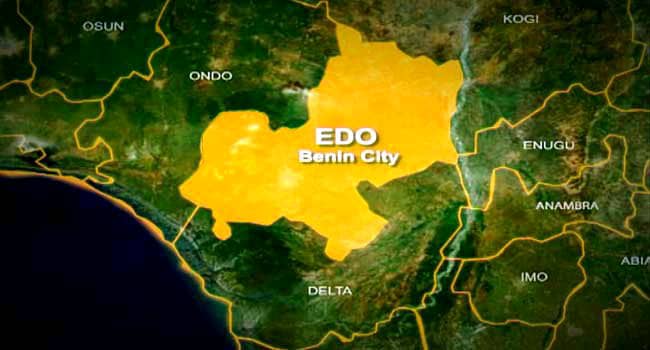
Rivers State, also known as Rivers, is located in the South-South geopolitical zone of Nigeria. The Federal Republic of Nigeria is divided into six geopolitical zones commonly called zones.
Police Burst Organ Harvesting Syndicate In Rivers, Trail Fleeing Members
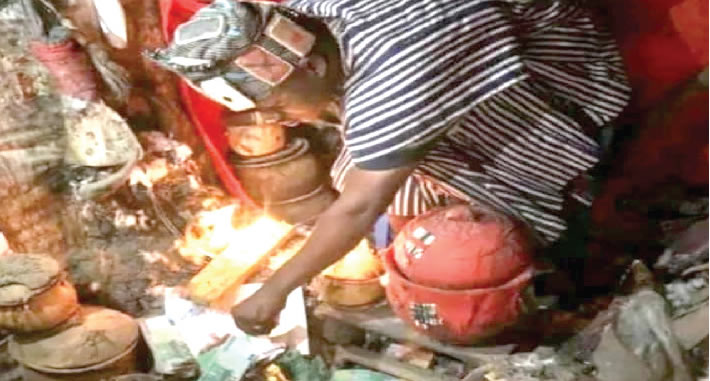
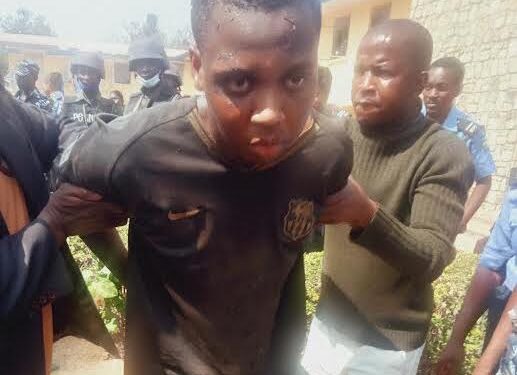
Organ harvesting suspect
Published: June 2, 2024 By: Itode Akari – Independent, Nigerią
PORT HARCOURT – The Police in Rivers State have arrested a member criminal syndicate, that specialises in murdering e-hailing cab drivers and harvesting their organs for ritual purposes in the state.
The arrested suspect, a 35-year-old graduate of political science from the Ignatius Ajuru University of Education, identified as Anthony Chima, confessed to have recently lured an innocent cab driver into his gang’s ambush, where the driver was waylaid before he was murdered in cold blood by the gang.
A statement signed by the Public Relations Officer for the Rivers State Police Command, SP Grace Iringe-Koko on Sunday, stated that the suspect was arrested following an investigation into the mysterious disappearance of one e-hailing cab driver on January 10, 2024, identified as Oghenevwarhe Barry Akpobome.
According to the police, a member of the syndicate confessed to have posed as a passenger to lure the unsuspecting driver to a remote area in Aminigboko community, Abia/Odual Local Government Area of the state, where other armed gang members laid an ambush and pounced on the driver, bound him both arms and legs, gagging his mouth and eventually killing him for the purpose of harvesting his organs.
The statement reads, “In a shocking turn of events, the Rivers State Police have uncovered a disturbing criminal enterprise that has been targeting Uber drivers in the region. The investigation was sparked by the disappearance of one such driver, Oghenevwarhe Barry Akpobome, leading to the arrest and confession of 35-year-old Anthony Chima, a political science graduate from the Ignatius Ajuru University of Education.
“According to Chima’s testimony, he was recruited into a gang that specialized in luring cab drivers into ambushes, stealing their vehicles, and ultimately murdering them for ritualistic purposes and organ harvesting.
“Chima revealed that he was brought into the fold by a friend, Amfoh Abu, who introduced him to the gang’s armourer, a man known as “Reason,” and the notorious ringleader, “General Effizy,” a prominent figure in the Greenland cult and a seasoned kidnapper.
“The chilling details of Akpobome’s demise emerged as Chima recounted the events of January 10, 2024. On that fateful day, he was summoned to Reason’s residence and instructed to call a driver whose number he had previously collected. Posing as a passenger, Chima then lured the unsuspecting Uber driver to a remote area in Aminigboko, where he and Reason were met by General Effizy and four armed gang members.
“The driver was forcibly removed from the vehicle and taken to Effizy’s shrine, where he was bound, gagged, and ultimately murdered. Chima’s involvement in the gruesome act was confirmed when the police, following his confession, recovered the victim’s skull and a locally fabricated Beretta pistol from Effizy’s residence.”
Iringe-Koko quoted the state Commissioner of Police, CP Olatunji Disu to have advised citizens of the state and drivers to be circumspect while boarding passengers to remote areas in the state.
She noted that while the police continues to trail fleeing members of the syndicate, emphasising that the case serves as a stark reminder of the dangers that lurk in the shadows, and the importance of vigilance and cooperation between law enforcement and the public in maintaining the safety of all citizens.
“This disturbing revelation has sent shockwaves through the community, prompting the Rivers State Police Commissioner, Cp Tunji Disu, to advise both citizens and Uber drivers. He urged them to exercise caution when boarding or transporting passengers, especially to remote or potentially dangerous areas.
“The investigation is ongoing, with the authorities still searching for the fleeing suspects involved in this chilling criminal enterprise. The case serves as a stark reminder of the dangers that lurk in the shadows, and the importance of vigilance and cooperation between law enforcement and the public in maintaining the safety of all citizens. Meanwhile, the suspect would be charged to court immediately.”
I thought it interesting and useful to add another post on the federal government’s ban om smoking and ritual killing in Nollywood movies.
Filmmaker and co-founder of Yabatech Film Academy, Abay Esho, publicly supported the ban emphasizing that “Nollywood is a major contributor to the epidemic ‘money ritual’ in present Nigeria.“
Need I say more? (FVDK)
Filmmaker Supports Ban On Smoking, Ritual Killing Scenes
Abay Esho, Nigerian filmmaker
Published: June 1, 2024 By: Samuel Abulude – Leadership, Nigeria
Filmmaker and co-founder of Yabatech Film Academy, Abay Esho, has offered his opinion in support of the federal government’s recent ban on smoking, ritual killing and glamourisation of crime in Nigerian films.
Esho who believes the media to be an important tool for social engineering of any society, said a society cannot separated from whatever it’s been fed over a long period of time.
Nollywood, he said ought to drive change by deliberately producing movies that set agenda, change behaviour and its viewers perception and way of thinking.
The director’s statement is in response to the chief executive officer (CEO) of National Film and Videos Censors Board (NFVCB), Shuaibu Husseini, announcement of federal government’s approval of a ban on glamourisation in Nollywood films, last week, at the National Stakeholders Engagement on Smoke-free Nollywood in Enugu.
The ban, has triggered mixed reactions amongst Nigerian movie stakeholders who were vocal about their stance.
Esho whose views aligns with Husseini’s on ‘money ritual’ factor in Nollywood films, stressed that Nollywood is a major contributor to the epidemic ‘money ritual’ in present Nigeria, but the distrust of Nigerians in Africa owing to “what we portray in our films, especially the ones with money ritual theme.”
He, however, expressed reservations with the NFVCB’s CEO on banning of smoking in movies noting it’s be near impossible to do so. “It will be difficult to place a ban on smoking because if the story has a smoking character, how else do you expect (filmmakers) to portray that?”
“Nigerian movies have generally tended to present false narratives, (….). They have glamorized voodoo, conveying the impression that it is the only source of wealth, and thus misleading the country’s army of impressionable, often jobless youths who have, by their own admission, not only learnt bad habits from the movies but put them into practice, sometimes landing in the clutches of the law and lamenting their poor choices. “
Moreover, the Tribune Editorial places the ban in a historic perspective and appeals to film makers to take their responsibility in a modernizing society such as Nigeria’s. It concludes:
“(…) movie culture should be dynamic. (…) the content of Nigerian films should be in tandem with the paradigm shift in the society. The idea, however, is not just about issuing a ban, but more about the state of enlightenment and development of those involved in the industry. Their production naturally would not just portray their creative predilections, but also their level of consciousness, which makes it important to raise the consciousness of movie producers and practitioners, such that they would key into the idea of using their films to portray the limitations of rituals and not seek to glamorize them. Indeed, with the right kind of consciousness, films and movies are some of the best ways to help change society and correct anomalies. (…)”
Well said! (FVDK)
The ban on money ritual, other vices in movies
Published: May 31, 2024 By: Tribune Editorial Board
WORRIED by the accustomed negative trends in Nigerian movies, the Federal Government recently placed a ban on the promotion of money rituals and vices in Nigerian films.
Disclosing this during a National Stakeholders Engagement on Smoke-Free Nollywood held in Enugu, Enugu State, an event organised by the National Film and Video Censors Board (NFVCB) and the Corporate Accountability and Public Participation Africa (CAPPA), the Executive Director/CEO of the NFVCB, Dr Shaibu Husseini, said that the country was currently confronted with an industry emergency requiring bold and ambitious actions from all parents, guardians and stakeholders.
He said: “I am delighted to announce to you that the Minister of Arts, Culture and the Creative Economy, Hannatu Musawa, pursuant to Section 65 of the NFVCB Act 2004, has approved the regulation. The minister has approved the Prohibition of Money Ritual, Ritual Killing, Tobacco, Tobacco Products, Nicotine Product Promotion and Glamorization Display in Movies, Musical Videos and Skits Regulations 2024. We have also forwarded the approved copy to the Federal Ministry of Justice for Gazette.”
According to him, besides the health implications, glamorizing smoking in films has a negative influence on teens and young adults, the largest segment of Nigerian movie viewers. His words: “The film industry occupies a central position in the entertainment and creative sector, and it is imperative that we continue to place the highest premium on the progress of the film industry. The NFVCB supports smoke-free movies and supports smoke-free Nollywood, and we therefore seek your collaboration to develop creative content that discourages smoking and promotes positive health messages. After series of engagements, the NFVCB in collaboration with the CAPPA decided to do a subsidiary regulation to address smoking in movies since this aspect was not expressly spelt out in the extant law. The NFVCB is well prepared to take leadership in this regard and has planned and begun implementing innovative ways to achieve its mandate.”
For decades, while there have admittedly been some positives in terms of the exponential growth of the movie industry and the expansion of the audience and income base, together with growth in terms of the technical aspects of movie making, including the use of special effects, Nigerian movies have generally tended to present false narratives, shirked the social responsibility of advocating societal change, and assisted the feckless political establishment in confining the vast majority of Nigerians to the morass of poverty, despondency and despair.
They have glamorized voodoo, conveying the impression that it is the only source of wealth, and thus misleading the country’s army of impressionable, often jobless youths who have, by their own admission, not only learnt bad habits from the movies but put them into practice, sometimes landing in the clutches of the law and lamenting their poor choices.
It is a fact that even at this very moment, most Nigerian movies continue to portray Nigerians as a people very badly; that is, as avid subscribers to dark and demonic practices, fraud, prostitution and drug abuse, to mention but a few. They show a society still living in the stone age, which is why the late erudite scholar, Professor Ayo Banjo, once panned them for consistently portraying a bygone age and for being pernicious in their messages. In most cases, the movies portray Nigerians as a people still stuck in superstition, whereas culture is dynamic and any aspect of it that is repugnant should be discarded. Nigerian movies, if they are to assist in the development and modernisation effort, ought to project positive images and ideas. They ought to enable and give a fillip to science and technology.
Nothing in life is static: movie culture should be dynamic. There was a time twin babies had to be killed in many communities in this country, but magnifying such today is evidently anachronistic. Sticking to the osu caste system, the suppression of widows and genital mutilation is barbaric: the content of Nigerian films should be in tandem with the paradigm shift in the society. The idea, however, is not just about issuing a ban, but more about the state of enlightenment and development of those involved in the industry. Their production naturally would not just portray their creative predilections, but also their level of consciousness, which makes it important to raise the consciousness of movie producers and practitioners, such that they would key into the idea of using their films to portray the limitations of rituals and not seek to glamorize them. Indeed, with the right kind of consciousness, films and movies are some of the best ways to help change society and correct anomalies. The idea should be to conscientize movie practitioners about the need to observe the limits and negatives of rituals and use their craft to help dissuade society from them. The government should take up this advocacy in earnest.
I have a special reason for including the recent ‘noise’ in Nigerian newspapers and other news media about the Federal Government’s decision to ban smoking, ritual killings (‘money rituals’) and other harmful, indecent and/or criminal habits and practices in movies and music videos – and the subsequent denial of such a measure as well as the rationale of a ban. The at times contradictory articles are very confusing but I leave it to the reader to appreciate what really happened.
The reason for including these articles here is that it clearly shows how ‘normal’ it is to talk about ritual killings in Nigeria. It clearly demonstrates how much ‘money rituals’ are part of daily life in Nigeria. In fact, the occurrence of ritual murders in movies reflect the occurrence of ritualistic murders in daily life. A sad reality.
There was no reason to include these articles on the FG’s ban on ritual killings in movies to prove that these outdated, criminal and repulsive practices and crimes still occur in one of Africa’s most modern countries. As stated before, it is impossible to include here all reports of discovered bodies with organs or other body parts missing, and all reported cases of ‘money rituals’ in this West African country. I estimate that every day at least one ritual murder is committed in Nigeria. After all, Nigeria also is Africa’s most populated country with a population exceeding 225 million people. (webmaster FVDK)
Nigerian govt bans smoking, ritual killings in movies, music videos, skits – Published May 24, 2024 – Screenshot – To access the YouTube video, please click here
JUST IN: Tinubu Bans Money Ritual, Smoking Scenes in Nollywood Films, Gives Reason
Published: May 23, 2024 By: Esther Odili – Legit, Nigeria Legit.ng journalist Esther Odili has over two years of experience covering political parties and movements.
The federal government led by Bola Tinubu has announced the ban on money ritual, ritual killing and other vices in Nollywood movies.
Shaibu Husseini, the executive director of the National Film and Video Censors Board, confirmed the development at a national stakeholders’ engagement in Enugu on Wednesday.
Dr Husseini explained that the move became imperative to urgently address the ugly trend.
President Bola Ahmed Tinubu’s led federal government has approved the prohibition of money rituals and the glamorising of vices in Nigerian films.
Tinubu’s government confirmed the ban on smoking, rituals, and other negative vices in Nollywood films. Photo credit: Asiwaju Bola Ahmed Tinubu Source: Facebook
“To sanitise the film industry”, FG says As reported by The Punch, Shaibu Husseini, the executive director and CEO of the National Film and Video Censors Board (NFVCB), disclosed this at a National Stakeholders Engagement on Smoke-Free Nollywood held in Enugu on Wednesday, May 22.
Husseini lamented that the present day movie industry is facing an “industry emergency” requiring bold and ambitious actions from all parents, guardians and stakeholders, Vanguard reported. He added that the regulation to ban smoking and other crimes has been approved by Hannatu Musawa, the minister of arts, culture and the creative economy, The Cable reported.
“As you all know, the film industry occupies a central position in the entertainment and creative sector and it is imperative that we continue to place the highest premium on the progress of the film industry,” he said.
“When my predecessor approached the former Minister of Information, Alhaji Lai Muhammed on the need to make a subsidiary legislation to curtail the display of smoking in Nigerian movies, he saw the need to include money rituals.
“Others included in the regulation are ritual killings and glamorising other crimes to further sanitise the film industry.”
Movie producers, directors and actors drawn from different parts of the country, as well as leaders of various guilds and associations in the Nigerian film industry were present at the event.
Kano government bans movies promoting cross-dressing In a similar development, Legit.ng reported that the Kano state government banned all movies and cinematic productions promoting thuggery and cross-dressing in the state.
This was announced in a press statement issued by the media officer of the state’s censorship board, Abdullah Sani Sulaiman. “It is high time we put a stop to this sort of films that corrupt the morals of the Kano people,” the board stated.
Kanayo O Kanayo Attacks FG Over Plans to Ban Rituals Scenes, Others in Movies: “Arrant Nonsense”
Published: May 24, 2024 By: Chinasa Afigbo – Legit, Nigeria
Nigerian actor Kanayo O. Kanayo is enraged over the latest regulations by the government to ban ritual scenes and more in Nollywood movies.
The veteran known for portraying such continuous roles dropped a message for the minster and his cohorts.
The new restriction claimed that such movie interpretations had a negative impact on teens and young adults.
Prominent Nigerian actor Kanayo O. Kanayo, aka Nnayi Sacrifice, is displeased over the government’s new laws to scrap rituals and other likely portrayals from films, music videos, and skit content.
The Executive Director/CEO of National Film and Video Censors Board (NFVCB), Shaibu Husseini, stated days ago that the Federal Government has approved the prohibition of money rituals and glamourising of vices in Nigerian films.
Husseini disclosed this while speaking at a National Stakeholders Engagement on Smoke-Free Nollywood in Enugu on Wednesday, May 22. The NFVCB boss said in part:
“When my predecessor approached the former Minister of Information, Alhaji Lai Muhammed, about the need to make a subsidiary legislation to curtail the display of smoking in Nigerian movies, he saw the need to include money rituals. Others included in the regulation are ritual killings and glamourising other crimes to further sanitise the film industry.”
According to Husseini, in addition to the health concerns, glamorising smoking in films has a negative impact on teens and young adults, who make up the majority of Nigeria’s moviegoers. He stated that the board planned to implement extensive enlightenment campaigns in secondary schools, tertiary institutions, local communities, faith organisations, and other institutions.
Kanayo O Kanayo reacts Kanayo criticised the policy and classified it as “arrant nonsense”. He questioned Barrister Hannatu Musa Musawa’s justification for imposing such restrictions on filmmakers and mocked his tenure.
“Arrant NONSENSE. This Minister has no work, just like Liar Mohammed.”
I Didn’t Pronounce Ban on Smoking and Ritual Scenes in Movies – Shaibu Husseini
Published: May 24, 2024 By: Thandiubani – tori.ng
The event was organised by the NFVCB and Corporate Accountability and Public Participation Africa (CAPPA).
Executive director of the National Film and Video Censors Board (NFVCB) Shaibu Husseini has denied reports that the Federal Government has placed a ban on money rituals and smoking in Nigerian films and skits.
Clarifying the report, Husseini while speaking at a national stakeholders engagement on smoke-free Nollywood in Enugu on Wednesday, debunked the viral report.
The event was organised by the NFVCB and Corporate Accountability and Public Participation Africa (CAPPA).
Movie producers, directors and actors drawn from different parts of the country, as well as leaders of various guilds and associations in the Nigerian film industry were present at the event.
However, in a statement on Thursday released on social media, Husseini said in part:
“I did NOT announce a ban on ‘smoking, or smoking, and ritual scenes in movies’ at the (southeast zone) stakeholders engagement on a healthy screen and the campaign to have a smoke free Nollywood which held in Enugu in collaboration with @CAPPAfrica. No, I did NOT.
“What I mentioned in a speech that I have shared here is the existence of a regulation (NFVCB Regulations 2024) that in line with global best practices prohibits the PROMOTION and GLAMOURISATION of Money Ritual, Ritual Killing, Tobacco, Tobacco product, Nicotine products in movies, musical videos and skits. The regulation aims at discouraging the ‘unnecessary’ depiction, promotion, advertisement, or glamourisation of tobacco or nicotine products in movies, musical videos, and skits.”
Husseini assured that the NFVCB would not implement any policy that will muzzle creativity. He added:
“Any movie, skit, or musical video that displays or depicts tobacco or nicotine products, brands, or use that is necessary to the realization of a narrative shall be given the appropriate classification (rating) and shall not be shown to persons below the age of 18.”
The following article is highly recommended reading, excellent work by Victor Ayeni!
In Nigeria, nearly every day ‘money rituals’ are reported, maybe not surprising in view of the country’s large population of well over 200 million people – Africa’s largest – even though just one ritual murder is already one too much. However, on the other hand, it could well be that the cases known and reported are only the tip of an iceberg.
But what do we know about ‘money rituals’, as ritual murders are being called in this part of the African continent? Most articles reporting on these crimes, which are driven by greed – for power, prestige or wealth – and based on superstition, are superficial. It is hard to find an article which treats this phenomenon in depth and in a serious way. The Nigerian journalist Victor Ayeni has done a great job and he’s to be commended for this achievement.
The traditional history of ritualistic killings and human sacrifices point to protection of the community’s interest by sacrificing one of its members. Cruel as this might be in our eyes nowadays, in the 21st century, back then relatives of the victim may have been proud of their family member’s contribution to the community. We see nowadays in many parts of the African continent that the ritualistic act which demands the death of the victim is for the (pretended, aimed) benefit of one person only who thus wants to increase his or her power, wealth or health. Moreover, the victim is often picked at random. Involuntary, the victim is attacked and tortured, what results is a gruesome, a wicked crime. Sometimes, specific groups are targeted, e.g. people with albinism, hunchbacks or bald people.
In some countries ambitious politicians tend to resort to these practices in the hope of increasing their political chances and success, resulting an increase in ritual murders during election campaigns. It’s a shocking reality – even though we don’t known the full scale of it.
‘Money rituals’ in Nigeria show another characteristic: some people consider it a business model, which enables them to ‘earn’ money from superstitious people who believe that by using another man’s organs or other body parts, ‘juju’ will be created, to their personal benefit.
Victor Ayeni explains well how this works in Nigeria. A very informative article which ends with the question ‘Are money rituals real or a fiction?’
The reader may answer this question for him- or herself after reading Ayeni’s valuable article. (webmaster FVDK)
Money ritual seekers’ dark walk into deceit, misery
Published: March 18, 2023 By: Victor Ayeni, Punch – Nigeria
VICTOR AYENI explores the subject of money ritual in popular culture, religious houses, and Nollywood movies, why the purveyors of the belief succeed in deceiving youths, and its implications on the public
The apprehension in the air was so thick that one could cut through it with a knife as Olajide (surname withheld) narrated his journey through a maze of confusion.
The 27-year-old graduate was helping a friend manage a pig farm in Osogbo, Osun State, when another friend introduced him to Internet scam, which in Nigerian lingo is called Yahoo Yahoo.
But his experience shocked the wits out of him.
“I was being paid N10,000 per month at the farm, but the money couldn’t meet my needs as time went on, so a friend of mine bought me an iPhone and from there, I was introduced to Yahoo Yahoo.
“I started off on a neutral ground and I was getting little money from my clients (victims), but after like three months into it, things became so tough that I couldn’t fend for myself again. I explained my situation to a friend and he took me to an Alfa (cleric),” Olajide recalls, shaking his head in disbelief.
This Alfa was known in Yahoo boys’ circles to be adept in the art of money magic – an occult economy that involves the performance of rituals to supernaturally conjure money.
Abode of fear
When Olajide described his financial difficulties to the Alfa, he was given two options.
“Alfa said he would help me out with small osole. I asked what he meant by that and he explained that osole (spiritual assistance) is different from oso (human body parts).
“Alfa told me oso required the use of human parts for material wealth with repercussions such as untimely death or insanity, whereas osole required the use of plants and animals for the same purpose but with lesser repercussions like being poor. I opted for osole,” he added.
Olajide was instructed to pay a sum of N12,000 into the cleric’s bank account for the materials and return in four days.
Five days later, when Olajide put a call through to the Alfa, he was asked to return for the materials.
He said, “When I got there, he gave me a small black soap and told me to find small palm oil and go to a flowing river to bathe that I had to cleanse myself first before I would use the materials.
“He explained to me that the soap was made with pepper mixed with some herbs and directed me to rub the palm oil on my body first before bathing with the soap. He warned that if I didn’t use the palm oil first, I was going to disappear and I would not be seen again. So, I did as I was told.”
Olajide said he complied with all the instructions.
“When I went back to him, he gave me three different materials: a soap to bath with every morning by 4am, a potion which I must swallow daily after taking my bath, and a powdery mixture to be licked every night before I go to bed.
“He said the herbal concoction was made from animals like crow, chameleon, cat, pigeon, and some leaves. He also told me that I would experience more hardship during the first two or three months of using the ritual materials, but I should endure it because after that, the tide will turn and money will be flowing in from my clients,” he added.
The idea of recipients conjuring money through magic is a familiar theme in many Nigerian films and religious houses.
Whether through animal sacrifices or trafficking in human parts, it is erroneously believed that these rites bring stupendous wealth to those who practice them.
When our correspondent inquired from Olajide if the magic worked, and in what specific ways the money came to him, he was silent.
When he spoke, he recalled faithfully following all the instructions given to him, but for the next two months, as the cleric predicted, he experienced serious financial hardship.
At this point, he said his friend introduced him to a client (victim), who had been defrauded several times.
Olajide then began to siphon money from the victim.
The inexplicable ease with which his ‘client’ gave him money implied that he (client) had been hypnotised.
“I ended up getting plenty money from this client. The cleric had assured me of having lots of money from osole, but he advised me to return to him for an upgrade of the ritual by paying N450,000, saying I would be making millions of naira after using the alleged ‘upgraded’ soap.
“But I didn’t go back because I asked my friend who took me there about what the new upgrade entails since that was what he did, and he warned me sternly against it because of the repercussions behind it.
“He said once I bathe with the ‘upgraded’ soap the cleric would prescribe, I could only wear the clothes and shoes I had and I must not change them for the next two years,” he added.
Four months after he dabbled in osole, Olajide realised that his fortunes began to dwindle as reality pulled the plug on his gravy train.
He said, “Things suddenly turned sour after four months. The client I was getting money from was arrested and ended up in jail and I no longer had any financial link. I ended up becoming more broke than before.
“My friend found me another client but I ended up wasting money rather than gaining some. Then, I was taken to another voodoo practitioner. This one said he would perform a ritual for me but one of its conditions was that I must never have sex with more than one girlfriend for the next three years and if I did otherwise, I would run mad.
“It was then I decided to withdraw from this stuff and went back into teaching for some time. Later on, I was introduced to the crypto business that I now do.”
The poverty factor
The belief in gaining wealth through mystical practices has gained much appeal over the decades in Nigeria with the exponential rise in poverty and lack of equal economic opportunities, especially for young people.
According to the 2022 Multidimensional Poverty Index Survey released by the National Bureau of Statistics, 63 per cent of Nigerians, which account for 133 million citizens, are multi-dimensionally poor due to a lack of access to health, education, living standards, employment, and security.
The unemployment rate in Nigeria has not only increased constantly in the past years, the Nigerian Economic Summit Group has also projected that the country’s unemployment rate will hit 37 per cent in 2023.
However, investigations by Saturday PUNCH showed that many Nigerians fervently believe that they can make a lot of money regardless of the dire economic situations in the country through a supernatural supply of money.
Ritual killings
In Nigeria, there are various tales around wealth creation that foster the concept of one becoming rich through the manipulation of metaphysical forces in nature.
Among the Yoruba, South-West Nigeria, there is the aworo phenomenon that is believed to draw large patronage to a trader in a marketplace.
There is also awure (wealth booster) which can be prepared as a traditional soap or concoction.
Research shows that many Nigerians plank their belief in money rituals on mostly unverified reports.
This has drawn many into desperate measures, including taking the lives of close family members and friends.
In December 2021, a suspected Internet fraudster from Edo State, identified only as Osas, allegedly murdered his girlfriend, Elohor Oniorosa, for ritual purposes.
In November 2022, another Yahoo boy, alongside his herbalist, one Ike, aka Ogenesu, was arrested after policemen recovered suspected human parts at the herbalist’s place in Obiaruku, in the Ukwuani Local Government Area of Delta State.
But Ogun State appeared to have the highest number of reported incidents of such killings.
For instance, the state recorded at least 15 cases of ritual killings between January 2022 and 2023.
In January, the Ogun State Police Command arrested a 36-year-old herbalist, Taiwo Ajalorun, who reportedly confessed to the gruesome killing of a 26-year-old mother of two and two others in the Ijebu Ode area of the state.
On December 28, 2022, in the Ijebu-Ode area of the state, a gang reportedly killed three women, including a girlfriend of one of them, after sleeping with her.
In February 2022, two suspected criminals who were alleged to be ritualists were set ablaze by an angry mob for being in possession of human parts in Oja-Odan in the Yewa-North Local Government Area of the state.
Also, in October 2022, two suspected Internet fraudsters allegedly killed a 40-year-old man, Abdullahi Azeez, in Owode-Egba.
But probably the most pathetic was that of some teenagers who were caught burning the head of a female, Sofia, whom they killed for money ritual in the Oke Aregba area of Abeokuta.
One of the teenagers, Soliu Majekodunmi, who was Sofia’s boyfriend, said in January 2022 that he learnt the practice through Facebook.
Majekodunmi said he typed, ‘How to make money ritual’ on Facebook and got the details, adding that the link instructed him to behead and burn a female skull in a local pot.
Shaman or sham man?
Our correspondent found many Facebook accounts and groups created for seekers of money rituals.
Most of the social media pages had photographs of new naira notes placed in African traditional pots, calabashes, and cowrie-strewn bags, and some showed animal blood splattered on the ground around them.
Posing as a school teacher, our correspondent reached out to one of the acclaimed shamans, Babatunde (surname withheld), who resided in Ijebu Igbo, Ogun State.
In his response, he introduced his shrine as the ‘Arab Money Family’ and sent his phone number to our correspondent.
In a rather confident tone, Babatunde said, “If you are ready, even if it is this night, you will pay me and I will get the materials ready to start the ritual work for you. Most of my ritual work is done overnight and by tomorrow, it will be completed and your money will come out.
“You will send me your bank account, photograph, and full name, and you will be receiving money in your account. You will be receiving cash thrice every two weeks.”
When our correspondent inquired whether it is spirits that would be sending the money, he interjected in a mildly exasperated tone, “Listen, I will prepare the money here in my shrine and the money will be entering your account.”
He sent his ritual material price list and asked our correspondent to select the amount of money he wishes to receive in his bank account.
The list says, “N15,500 for N200,000; N20,000 for N300,000; N30,500 for N500,000; N50,000 for N1million; N75,000 for N5million; N90,000 for N20million; and N120,000 for N50 million.”
When our correspondent selected “N20,000 for N300,000,” he reiterated that his brand of ‘money magic’ utilises native materials instead of human blood.
“I make money without human blood and I only make use of native materials. I only make use of materials called ‘Cash of Hope’ and the ‘Money Drawer Oil.’
“Mind you, my work does not require any side effects or human being blood for sacrifice or repercussions, okay? Never say never to the high spirit.
“You don’t need to travel down for the ritual; I will just send them to you and you will get your money, but you must come down to my shrine with a token of appreciation for my work, any amount your heart chooses,” Babatunde added.
When the reporter complained about being unable to afford the cost of the ritual material, the magician urged him to find the money by any means possible and contact him when ready.
Babatunde was also observed to regularly post videos on his Facebook and WhatsApp statuses featuring ‘clients’ who claim to have acquired money through his rituals but the veracity of their claims could not be confirmed.
The second acclaimed money magician, who resides in Ogbomoso, Oyo State, goes by the Facebook name, Iya Ifa Bomi.
In this case, our correspondent posed as a greenhorn ‘Yahoo boy’ and asked her for spiritual assistance in order to obtain money from his ‘clients.’
She said, “You mean you are talking to your clients and they are not giving you money? I can perform a ritual for you and it will involve the use of big Titus fish, pepper, and some fresh leaves, but it will cost you N25,000.
“When you have the money, you can come to Ogbomoso and pick up the materials. I will prepare them for you. I have done this for many Yahoo boys like you and they all come back to testify that their clients are cooperating although some of them are ingrates. We also have some of us who do this work who are scammers and have made people not trust our works.”
Another cleric contacted by our correspondent, Alfa Abdulmumeen Aremu, advertised himself as a practitioner of “money rituals for engineers, contractors, business owners and ‘Yahooboys.’”
He first demanded a sum of N2,000 and told our correspondent to send his full name and his mother’s name for spiritual consultation before he could recommend osole to him.
In a voice note, he explained, “There are different types of osole and I perform them for people like you, so don’t worry, I am adept in this work. Send me those things first and I will do some consultations to know your destiny in five minutes and I will revert to you.”
Our correspondent sent him a pseudonym along with the name of his late grandmother.
After some minutes, Aremu sent a voice note saying, “I can see you have a very bright destiny but you have some enemies. They are divided into two: some from your family and others from your workplace.
“You will cook ritual meals like rice and semo with tasty stew and give them to the children in your community. They will eat it with relish, and some of them will go to sleep. After you do that, you will be spiritually clean and we can proceed to the next stage.”
Divergent beliefs
A student of Business Administration, Kazeem Akinpelu, says money rituals are real.
“If they have not been working, people will no longer be practicing them. I grew up in Ibadan, Oyo State, and I know of a market where they sell human parts at night.
“The people selling in this particular market practice voodoo and they are patronised by those who perform money rituals. There was also one time the body parts of a lynched motorcyclist here in Ibadan were used by ritualists,” he added.
However, a civil servant, Nnamdi Okeke, dismissed money rituals as a fantasy that existed only in the realm of make-believe.
“Well, I have not come across any money rituals and I haven’t thought of doing such either. I don’t believe there is anything like ‘blood money.’
“Someone can watch a film and tell you the story, but no cult will tell you what to bring if you have not passed through their ranks, and that is if such things exist, because I don’t believe in them. The question is, the person who wants to make you rich, why is he poor and even why are their children not rich?” he asked.
Similarly, a medical scientist, Mike Okechukwu, said the whole concept of ritual killing boiled down to superstition.
“People would believe what they want to believe to obtain money. Desperate people will employ desperate measures. For me though, I don’t think ritual killings are effective; I have not seen any proof to make me believe so. It all boils down to superstition,” he stated.
But a sales representative, who gave her name as Judith for security reasons, said she once dated a man whom she believed was involved in such rituals.
She said, “I was dating this Yahoo-Yahoo guy and one day, I visited him unannounced and found that he didn’t want me to go inside his room. He was just acting weird that day.
“But while I stood at the door, he didn’t know I saw a native pot placed on the floor. From that day on, I began to suspect him and that was what made me leave him eventually because I don’t want anybody to use me for money rituals.”
Money ritual mirage
Commenting on popular beliefs about money rituals, a Professor of Philosophy of Religion at the Lagos State University, Danoye Oguntola-Laguda, said herbalists appeal to Internet scammers for pecuniary gain.
He said, “My experience is that there is nothing called money rituals. What many people mistake for money rituals is the prayer for getting rich. That could definitely involve some sacrifices of animals or birds or cooking for the whole community (saara) which brings the blessing of feeding multitudes and people may not be able to determine how you become rich.
“I don’t want to say that those who believe in osole or perform oso are wrong because there are a lot of myths that point in that direction, but if you ask many of them to tell you or show you the real thing, you will see that they have nothing to show.
“I want to say that most of these traditionalists do not even know that those who consult them are ‘Yahoo boys.’ They just see them as people seeking a way to be rich and they do a ritual, pray for them and tell them to go and kill one goat. The babalawos are also human beings who have families to feed so when they see a victim with such a proposal, they grab it with both hands.”
Oguntola-Laguda also explained the difference between religious practice and occultism.
“Religion is experiential; it is about your experience. If I tell you that prayer doesn’t work, it’s because I tried it and it didn’t work and if I tell you that it works, it’s because I tried it and it worked for me.
“There is a need to separate occultism from religious practices. Occultism is the appropriation of spiritual agents, who in most cases are negative, and it’s not limited to African traditional religion; it is something that cuts across the board.
“Many religious people appropriate these negative spiritual agents for these money rituals and power to be able to do things that are extraordinary, like the power to be able to tell the sun to go down or to tell the rain to stop.
“So, it is occult people that will tell you that they will make you rich and invite a spiritual agent to do that for you but they always come with a price and that is what many people have come to call oso or osole.
“In the past, in Yoruba traditional society, the wizard who is called oso doesn’t mean he is rich but has power appropriated through spiritual agents that he deploys for good or evil of society,” he added.
Nollywood magical realism
The scenarios of materially wealthy people enmeshed in sinister rituals and pacts with spirits, is a recurring theme in Nollywood plots.
Findings by Saturday PUNCH revealed that whether in the predominantly Muslim North or the largely Christian South, many religious Nigerians believe in the reality of an unseen world, and the fictive representations from Nollywood plots have heavily shaped their perceptions of reality.
A Nollywood screenwriter, Mr Abiola Omolokun, argued that the depictions of money rituals in films are a true representation of Yoruba culture.
He said, “First, I don’t write such stories, but they are true representations of reality. Money rituals are real and are reflected in our cultural beliefs; they are not fiction.
“We tell a story just to teach morals and make people see things differently. Our stories make them know that for every action, there are consequences.
“Through our movies, we teach that patience is a virtue that youths need to walk on the right path, and in due time, with hard work and perseverance, everything will lead to success.”
However, a researcher in African Studies, Akin Faleye, contended that such stories lack historical precedent and are fraudulent.
“As a student of global history, I will say that there is no evidence that the Yoruba practised money rituals in the pre-colonial time. All these stories of money rituals are fraudulent and emanated from psychopaths rather than people with some actual spiritual knowledge of how to make money,” he stated.
Money rituals in other cultures
In some other cultures, what could be termed as money rituals are often symbolic acts or dramas that appeal to psychological and cosmic powers through an application of symbolic structures.
In Ireland, there is a tradition of taking a piece of straw from the nativity scene/crib in the church at Christmas and keeping it in your purse or wallet, which is believed to bring financial prosperity throughout the year.
An Indian author, Suresh Padmanabhan, in his work, I Love Money, devoted a chapter to ‘Money rituals’ and wrote, “Take a currency note in your hand and wish it ‘Good morning.’ “Express gratitude to your wallet, accounts book, cash box, bank passbook, or any other tools connected directly to money. Smile at yourself in the mirror and pat yourself when you perform a task well.”
Some practitioners in western traditions also perform what they define as money spells/rites, which involve the invocation of spirits and archangels, drawing ritual circles, erecting a temple and an altar, and presenting offerings to ancient deities.
However, these rituals are often believed and practiced by religious groups on the fringes and are based on cultural paradigms that only allow clearly defined routes of financial access through hard work, lucrative business, and clever exploitation of market gaps.
Lamenting the lack of profitable skills available to Nigerian youths, a United Kingdom-based personal development coach, Mr Toyyib Adelodun, highlighted the need for popular magical ideas about money to be refuted.
“Nigerian youths need to understand that money is a unit of account to measure, therefore the more value you produce for the community, the richer you are supposed to be. So, the first thing a young person should seek is education and skills to earn money.
“Money is always circulating in an economy. It is the Central Bank of Nigeria that prints money, it doesn’t come from anywhere else. We saw a practical example of this recently when the CBN embarked on the naira redesign and there wasn’t enough money in circulation. So, there is no magic that is going to bring money from anywhere unless you offer your skills as a person of value.
“I have been to several countries in the world and I can see that money only comes from value creation. Unfortunately, Nigerian youths are not equipped with the relevant skills; we just go to religious houses to pray and sit back at home and don’t market skills or deliver an excellent service in order to generate wealth. We don’t have to resort to crimes,” he said.
Clerics urge re-orientation
A Senior Pastor at Christ Life Church, Ibadan, Prof. Wale Coker, told Saturday PUNCH the youth need a re-orientation that would see them embrace a new value system other than the present mad rush to become wealthy overnight.
“The scriptures state that ‘wealth gotten by vanity shall be diminished, but he that gathers by labour shall increase’. Youths should be encouraged to walk in the fear of God which is the beginning of wisdom,” he added.
The National Missioner of the Ansar-ud-Deen Society of Nigeria, Shiekh, Abdur-Rahman Ahmad, stated, “All those who claim to be Muslims and Alfas that are involved in money rituals know within their hearts that they are doing something wrong and deceiving people.
“The reality is that there is no money ritual. It is not only against the letter and spirit of the laws of Islam but also against human conscience. Islam recognises only three sources of legitimate wealth: direct labour or hard work, inheritance, and a legitimate gift and this doesn’t mean a Greek gift or bribe or something induced.”
On her part, a traditionalist, Omitonade Ifawemimo, said, “There is no shortcut in Isese (traditional spirituality). If you don’t work, you won’t be wealthy. Nollywood and the fantasy it creates bears responsibility for the concept of money rituals.
“Human sacrifice for money rituals does not exist in Isese. It is fake, madness, and a scam! It’s tragic that Yoruba movies have messed up people’s thinking into believing all these lies.”
“It is time we put an end to these barbaric practices.”
What can I add to this cry for the rule of law, to respect human life, and to act. Governments can no longer ignore these barbaric practices based on superstition, poverty and ignorance, and fed by greed. The numerous examples of ritual murders given in this Op-Ed are frightening: all over the country though I’ve pointed at the widespread occurrence of ritual murders in Nigeria in previous postings (webmaster FVDK).
The Illusion of money-making rituals in Nigeria – Editorial
Published: February 20, 2023 By: Editorial – This Day, Nigeria
Ritual killing remains largely a crime driven by ignorance and poverty
The recent arrest of two teenagers by operatives of the Edo State Security Vigilante Network has once again brought into sharp focus the bizarre practice of money rituals. The young men were apprehended following a tipoff by the female herbalist from whom they sought help in their desperate bid for wealth through diabolical means. But they are not alone. Just recently, some young men were reported to have stormed a health centre in Ado-Ekiti, Ekiti state capital, asking for day-old babies. The unanswered question remains: What do they want to do with day-old babies? We can hazard a guess. They must belong to the growing group of desperadoes murdering innocent people, particularly women, children and sometimes the physically challenged, for ritual purposes.
These murderers, sometimes called headhunters, can go to any extent in the search of body parts for money-making rituals. And they are all over the country. Not long ago, there was a shocking discovery of three human heads inside a hotel room in the commercial city of Onitsha, Anambra State. The three heads said to have been kept inside polythene bags were reportedly discovered by police officers following a raid on the hotel. Eleven persons suspected to be kidnappers or ritualists were arrested but typically, nothing was ever heard again about the case. At about the same time, the police in Kagura in Rafi Local government area of Niger State arrested four people in connection with the alleged murder of a 13-year-old son of an Islamic scholar. They reportedly lured the young boy to a secluded area where they removed his intestines and other vital organs after he had been murdered.
So rampant is this crime that in cosmopolitan cities like Lagos, Ibadan, Benin City and Kano, cases of ritual murders have now become commonplace. Indeed, incidence of ritual killings is said to account for many missing people in the country. But illiteracy is also a great factor in this crime. Even though the belief lacks common sense, many people indulge in these bestial acts for the purpose of making “instant wealth”, what some have aptly dubbed “blood money”. Yet, it is difficult to prove that these sacrifices, done at the instruction of some crafty traditional medicine practitioners and witch doctors, can catapult people from penury into instant wealth. At least, for now, there is no single person that can be named to have become rich because of human sacrifices, except the characters in some Nollywood movies. So, to that extent, ritual killing remains largely a crime driven by ignorance and poverty.
Meanwhile, the old image of the country as a citadel of humanitarianism, peacefulness, fraternity, cultural and moral renaissance seems blurred. There is disorderliness and chaos everywhere. Amid the moral confusion, it is difficult for many young Nigerians to understand that work comes before wealth. The estrangement from pristine values now finds dramatic expression in crass materialism, inordinate ambition to get rich quick at all costs. But on the prevalence of money rituals, this is also a law-and-order failure. Indeed, the increasing cases of abduction and killing of many innocent men, women and children is a poignant reminder that the police and the other security agencies have not sent a forceful message on what awaits the perpetrators of such a most heinous crime. The largely indifferent treatment of those caught has encouraged the commitment of more crime.
This is an issue that the relevant authorities must deal with and very quickly. There is also an urgent need for enlightenment campaigns to put a lie to the erroneous belief that money can grow out of the body parts of murdered people. It is time we put an end to these barbaric practices.
As far as I know it is unprecedented in the history of Nigeria: lawmakers have urged the government of president Buhari to declare a state of emergency on ritual killings in the country. Even continent-wise, it is a novelty, to my knowledge. It is symptomatic for the widespread occurrence of ‘money rituals’ in the country, as I have repeatedly stated here.
No need to elaborate now on the details of the various (read: many) cases of ritualistic murders which motivated the House of Representatives of Africa’s most populated country to take this bold step. The news had a nation-wide coverage as is amply demonstrated by the nearly 30 newspaper articles cited (and partly reproduced) below – far from all publications on this historic decision.
Warning: some readers may find (some of) the following articles disturbing because of the graphic description of ritualistic activities. (FVDK)
Declare state of emergency on ritual killings —Reps to FG
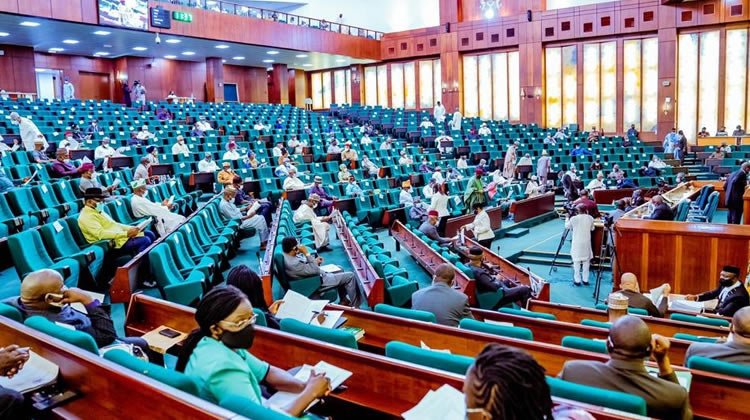
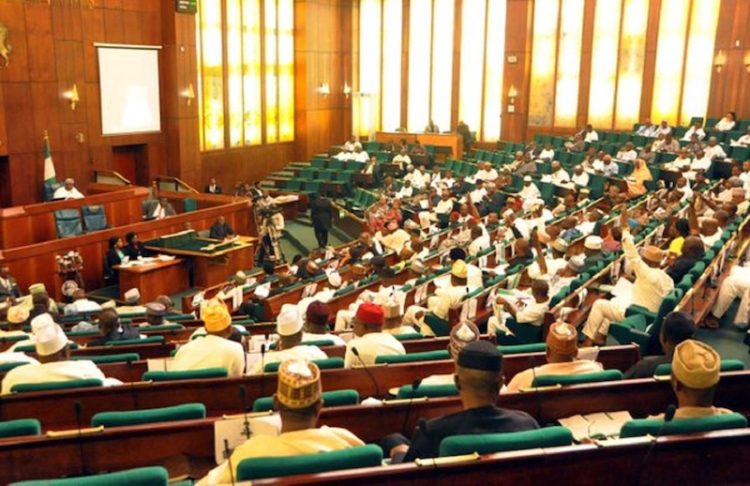
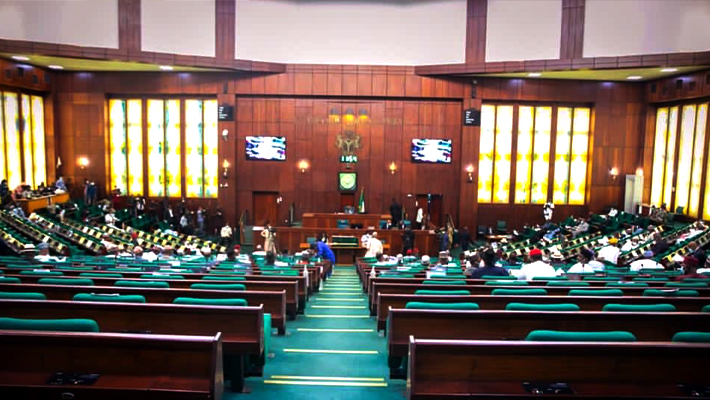
Members of the House of Representatives during plenary
Published: February 9, 2022 By: Segun Adewole – Punch, Nigeria
The House of Representatives on Wednesday said a state of emergency on ritual killings in the country should be declared by the Federal Government.
The lawmakers also called for a campaign against the menace, saying the effort of parents, schools, religious leaders and the media is needed.
This is following a motion sponsored by Deputy Minority Leader of the House, Toby Okechukwu, who lamented that ritual killings have taken a new dimension in recent times.
He said, “There’s an upsurge of reported ritual killings with increasing cases of abductions and missing persons in different parts of the country, which in most cases, the culprits also rape, maim, kill and obtain sensitive body parts of unsuspecting victims for rituals.
“Merchants of such wicked acts often use social media as a ready tool to advertise their evil behaviour. Ritual killing has become a predominant theme in most homemade movies which if not checked, our younger generation may begin to view as an acceptable norm.
“There are several reports where law enforcement agents arrested and paraded suspects of ritual killings with gory pictures of human skulls and dismembered bodies.
“Fake clerics, imams, herbalists and native doctors are often complicit in the heinous practices. Although our communities are getting more religious with the proliferation of churches and mosques, the ugly trend of ritual killing is on the rise as the quest for wealth at all costs pervades our society.
“Youths in other climes are embracing science and technology as a way of maintaining pace with our dynamic world while some of our youths seem stuck in the mistaken belief that sacrificing human blood is the surest route to wealth, safety and protection.
“Such cruel and barbaric acts should no longer be promoted in our society given the demands of today’s world.”
The motion was unanimously adopted by the House which called on the Inspector-General of Police, Usman Alkali Baba to “take urgent steps to increase surveillance and intelligence gathering with a view to apprehend and prosecute all perpetrators of ritual killings in Nigeria”.
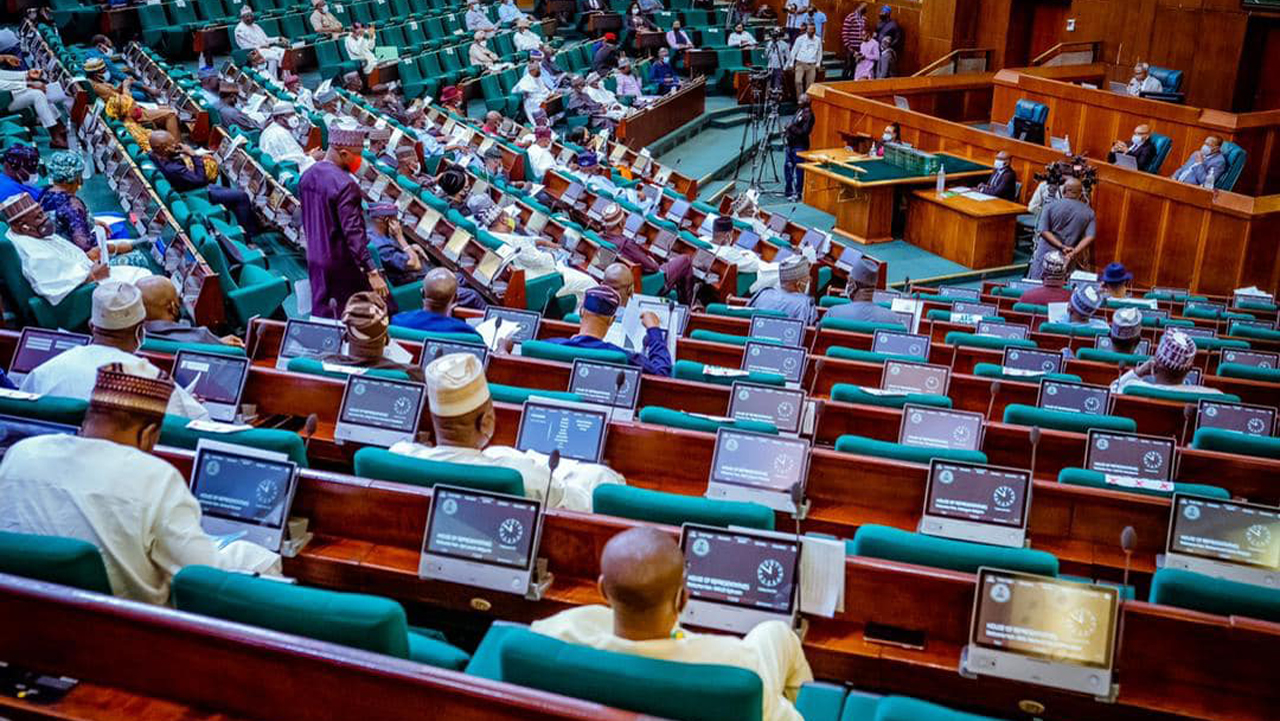
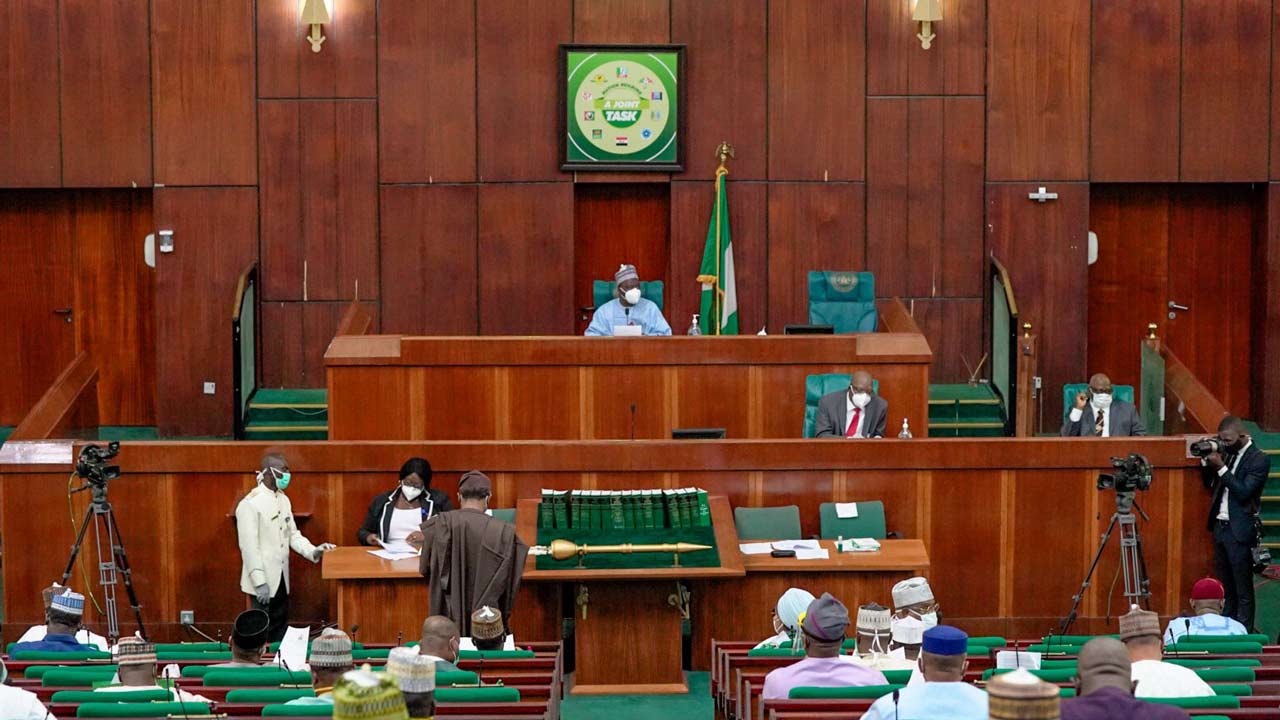
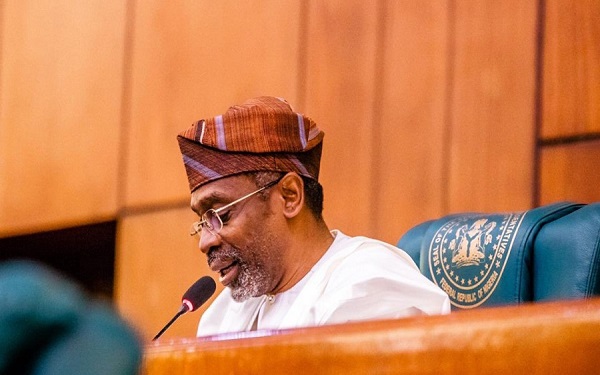
The House of Representatives – Photo Facebook / Speaker Gbaja
Published: February 9, 2022 By: NAN – The Guardian, Nigeria
The House of Representatives has charged the Inspector General of Police (I-G) to take urgent steps towards tacking ritual killings in the country.
This followed the adoption of a motion of urgent public importance by Rep Toby Okechukwu, the Deputy Minority Leader, at the plenary on Wednesday in Abuja.
Presenting the motion, Okechukwu said that incidents of ritual killings had assumed an alarming rate in Nigeria while decrying the upsurge of reported ritual killings with increasing cases of abductions and missing persons in different parts of the country.
He added that in most cases, the culprits also rape, maim, kill and cut out sensitive body parts of unsuspecting victims for rituals.
He said that the Red Cross Society in 2017 reported that it received 10,480 reports of missing persons in Nigeria. “On Jan. 22, three teenage suspects and a 21-year-old reportedly killed one Sofiat Kehinde and severed her head and burnt in a local pot in Abeokuta, Ogun.
”The police command in Ogun on Feb. 7, reported that one of the suspects confessed that he learned the act of ritual killing from a video he watched on Facebook,” he stated.
He said that the death of Sofiat attracted national outrage and condemnation considering the age of the suspected killers.
The lawmaker said that merchants of such wicked acts often use the social media as a tool to advertise their evil acts.
He also mentioned the grievous killing of Iniobong Umoren, a young woman in her 20s; who was lured to a particular location in Uyo, Akwa Ibom for a job interview, as widely reported in the national dailies.
He also cited the gruesome killings and heinous activities of Badoo Boys in Lagos State, which was also reported in the national dailies.
“Ritual killing had become a predominant theme in most homemade movies which if not checked, our younger generation may begin to view it as an acceptable norm,” he said.
The House thereafter declared a national emergency on ritual killings and urged National Orientation Agency (NOA), stakeholders and the media to initiate a campaign towards changing the situation in the country.
The House tasked the Executive Director, National Film and Video Censors Board to rise to the mandate of the agency as the clearinghouse for all movies produced in the country.
Reps Ask FG To Declare National Emergency On Ritual Killings
Screenshot – click on image in original to watch the video
Published: February 9, 2022 By: Terry Ikumi – Channels TV, Nigeria
The House of Representatives has called for the declaration of a national emergency on ritual killings across the country.
This formed part of the resolutions reached by the lawmakers on a motion of urgent public importance entitled ‘Need to Curb the Rising Trend of Ritual Killings in Nigeria’.
Mr Toby Okechukwu, the Minority Leader of the House, moved the motion during Wednesday’s plenary at the lower chamber of the National Assembly in Abuja.
The motion comes amid the incessant killing of innocent Nigerians for ritual purposes, with one of the latest being the murder of Sofiat Okeowo in Ogun State.
Worried about the trend, the lawmakers called on the National Orientation Agency (NOA), as well as parents, heads of schools, religious leaders, and the media to undertake a campaign to change the negative narrative bedevilling the society.
They resolved to call on the Executive Director of the National Film and Video Censors Board to rise to the mandate of the agency, as the clearinghouse for all movies produced in the country.
While moving the motion, Okechukwu called the attention of the House to the recent incidents of ritual killings which he said have assumed an alarming rate.
He condemned the upsurge of reported ritual killings with increasing cases of abductions and missing persons in different parts of the country, saying the culprits in most cases rape, maim, kill and obtain sensitive body parts of unsuspecting victims for rituals.
The Red Cross Society, according to him, reported that it received 10,480 reports of missing persons in Nigeria in 2017, and three teenage suspects and a 20-year-old were accused of killing Sofiat.
The lawmaker told his colleagues that the Ogun State Police Command later reported on Monday that one of the suspects confessed that he learned the act of ritual killing from a video he watched on Facebook.
He also condemned the killing of Iniobong Umoren, a woman in her 20s, after being lured to a location in Uyo, Akwa Ibom State for a job interview.
Okechukwu stressed the need to be mindful of the role of the Nigerian movie industry in moulding the behavioural patterns in the society, as well as the mandate of NFVCB and others.
The lawmakers mandated the House Committee on Information, National Orientation, Ethics, and Values to report back to the House within four weeks.
According to them, the Inspector General of Police should take urgent steps to increase surveillance and intelligence gathering, with a view to apprehend and prosecute all perpetrators of ritual killings in Nigeria.
Similarly, the House Committee on Police Affairs was mandated to report back to the lawmakers within four weeks.
Reps ask FG to declare state of emergency on ritual killings
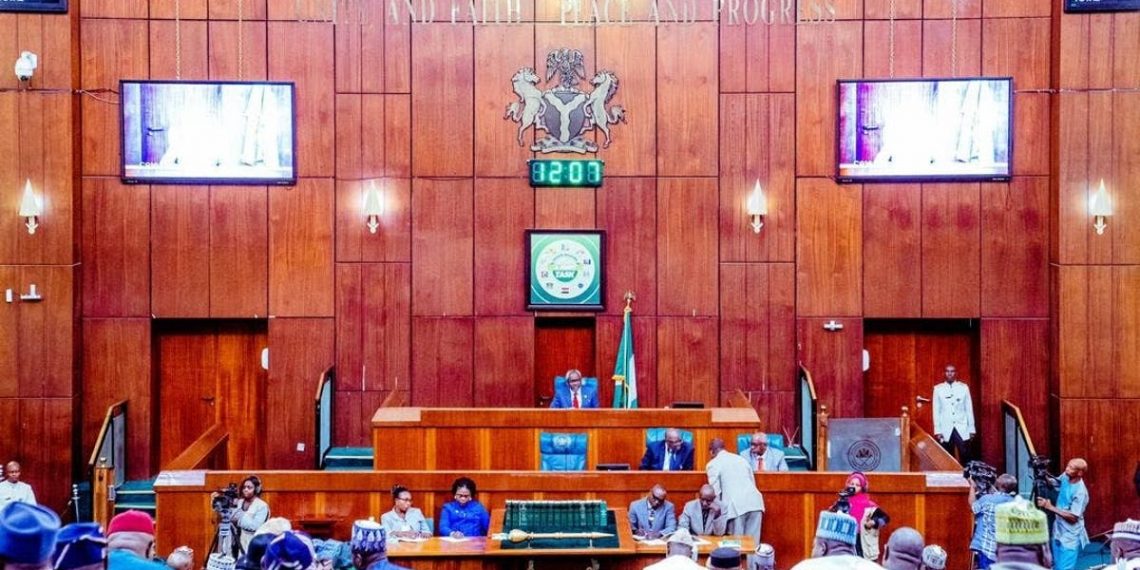
Nigeria’s House of Representatives in session. Photo used for illustrative purposes.
Published: February 9, 2022 By: Vincent Ufuoma – ICIR, International Centre for Investigative Reporting
THE House of Representatives has asked the Federal Government to declare a state of emergency on ritual killings in the country.
This followed a motion moved by the House Deputy Minority Leader Toby Okechukwu during Wednesday’s plenary.
Okechukwu, who noted that ritual killings have assumed an alarming rate in Nigeria in recent times, lamented the increasing cases of abductions and missing persons in different parts of the country.
He said in most cases, the culprits also rape, maim, kill and obtain sensitive body parts of unsuspecting victims for rituals.
The lawmaker also decried the roles of various social groups, especially the entertainment industry, in reinforcing ritual killings among young people.
Okechukwu said, “Ritual killing has become a predominant theme in most home made movies which if not checked, our younger generation may begin to view it as an acceptable norm.
“There are several reports where law enforcement agents arrested and paraded suspects of ritual killings with gory pictures of human skulls and dismembered bodies.
“Fake clerics, imams, herbalists and native doctors are often complicit in the heinous practices.
“Although our communities are getting more religious with the proliferation of churches and mosques, the ugly trend of ritual killing is on the rise as the quest for wealth at all cost pervades our society.”
The lawmaker expressed worry that while youths in other climes were embracing science and technology as a way of maintaining pace with the world, some Nigerian youths were enmeshed in the belief that human sacrifice would bring them wealth, protection and security.
Adopting the motion, the House of Representatives asked the Inspector General of Police (IGP) Usman Baba Alkali to take urgent steps to increase surveillance and intelligence gathering with a view to fishing out, arresting and prosecuting the perpetrators of the ritual killings.
The House called on the National Orientation Agency (NOA), parents, heads of schools, religious leaders and the media to undertake a campaign to change the negative narrative that is bedeviling the society.
Subsequently, the House mandated its Committee on Information, National Orientation, Ethics and Values to ensure compliance of the resolution and report back within weeks.
Last month, a 20-year-old lady, Sofiat Kehinde was gruesomely murdered in Abeokuta, Ogun State capital by four teenage boys aged 17, 18, 19 and 20.
Sofiat’s head was severed by the boys and they were burning it in a pot for money ritual before they were apprehended.
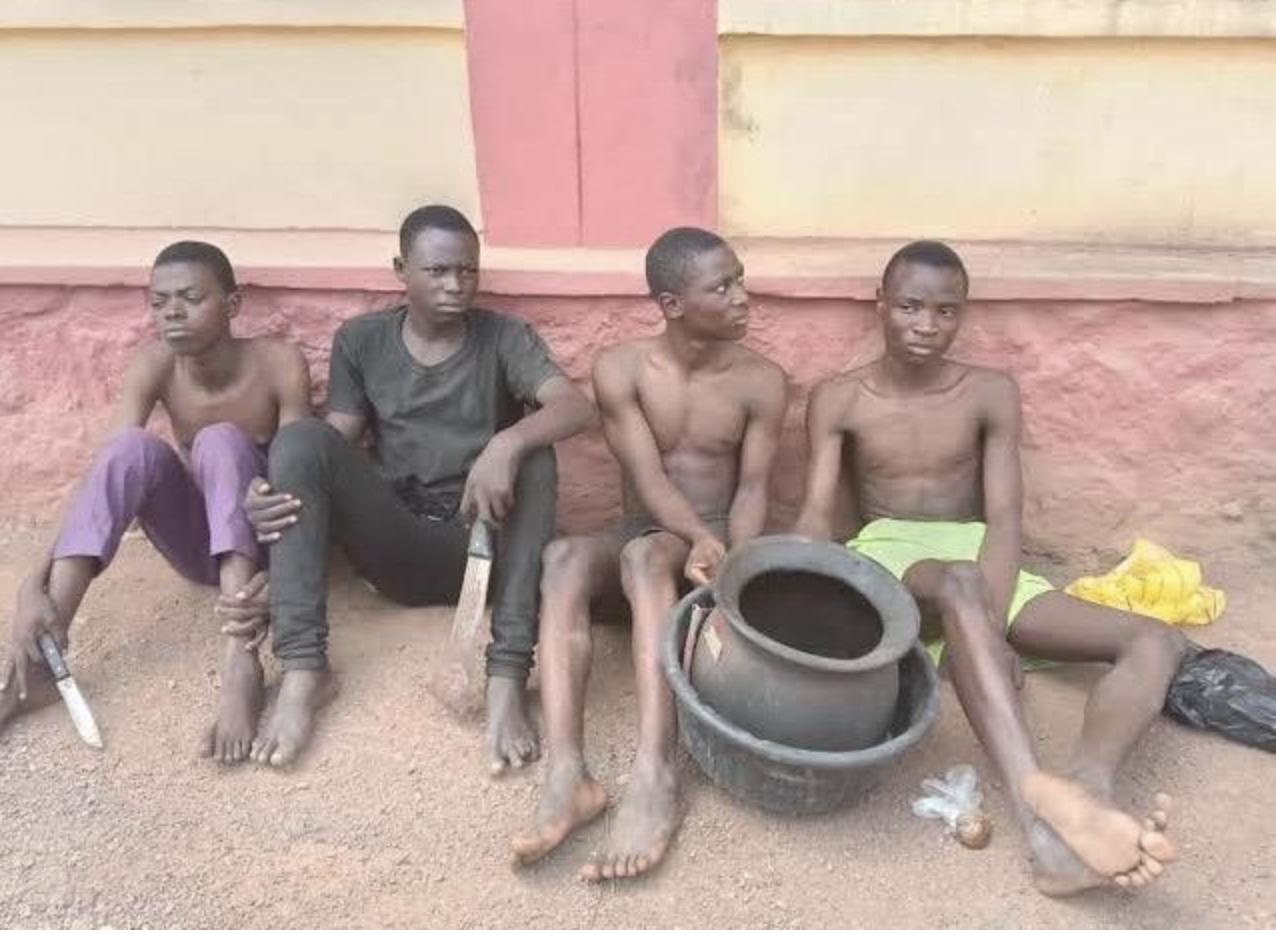
The four teenage suspects arrested by the police are Soliu Majekodunmi, Wariz Oladehinde, Abdulgafar Lukman, and Balogun Mustaqeem.
They confessed to have conspired to kill Sofiat and played different roles in her murder.
One of the suspects, Mustaqeem, confessed that he was motivated by a post he saw on Facebook to murder Kehinde for money ritual.
He said, “I saw a post on Facebook that explained how to get rich quickly. I downloaded the video because I had interest in getting wealthy at an early stage. I wanted to get rich and lead a luxurious life.
“The video was what prompted me to tell Soliu about getting rich quickly at our early age. He was interested after I showed him the video on my phone and asked where we would get the materials we needed.”
Jolted by the reports of incessant ritual killings across the country, the House of Representatives, Wednesday, asked the federal government to declare a national emergency on the social vice.
The House also asked the Inspector General of Police, IGP, Usman Baba Alkali to take urgent steps to increase surveillance and intelligence gathering with a view to fishing out, arresting and prosecuting the perpetrators of the killings.
The parliament also called on the National Orientation Agency, parents, heads of schools, religious leaders and the media to undertake a campaign to change the negative narrative that bedeviling the society.
The resolutions of the House came after it considered a motion titled “Need to Curb the Rising Trend of Ritual Killings in Nigeria”, presented at the plenary by the deputy minority leader, Hon. Toby Okechukwu under matters of urgent public importance.
Presenting the motion, Okechukwu noted that the incidents of ritual killings have assumed an alarming rate in Nigeria in recent times.
He said there was an upsurge of reported ritual killings with increasing cases of abductions and missing persons in different parts of the country, which in most cases, the culprits also rape, maim, kill and obtain sensitive body parts of unsuspecting victims for rituals.
He said: “The Red Cross Society in 2017 reported that it received 10,480 reports of missing persons in Nigeria.
“On January 22, 2022, three teenage suspects and a twenty year old reportedly killed one Sofiat Kehinde and had her head severed and burnt in a local pot in Abeokuta, Ogun State.
“Ogun State Police Command on Monday, February 7, 2022 reported that one of the suspects confessed that he learned the act of ritual killing from a video he watched on Facebook.”
The lawmaker recalled that the death of Sofiat has attracted national outrage and condemnation considering the ages of her killers.
“Merchants of such wicked acts often use the social media as a ready tool to advertise their evil behaviours.
“The grievous killing of Iniobong Umoren, a young woman in her 20s; after being lured to a particular location in Uyo, Akwa Ibom State for a job interview, as widely reported in the national dailies.
“The gruesome killings and heinous activities of Badoo Boys in Lagos State, which was also reported in the national dailies.
“Ritual killing has become a predominant theme in most home made movies which if not checked, our younger generation may begin to view it as an acceptable norm.
“Several reports where law enforcement agents arrested and paraded suspects of ritual killings with gory pictures of human skulls and dismembered bodies.
“Fake clerics, imams, herbalists and native doctors are often complicit in the heinous practices.
“Although our communities are getting more religious with the proliferation of churches and mosques, the ugly trend of ritual killing is on the rise as the quest for wealth at all cost pervades our society.”
Okechukwu expressed worry that while youths in other climes are embracing science and technology as a way of maintaining pace with our dynamic world, some of our youths seem stuck in the mistaken belief that sacrificing human blood is the surest route to wealth, safety and protection.
“Such cruel and barbaric acts should no longer be promoted in our society given the demands of today’s world.
“The growing rate of unemployment in the country.
“The moral decadence in our society, a trend that has promoted the get-rich-quick syndrome among our youths.
“The role of the Nigerian movie industry in moulding behavioral patterns in our society vis-a-vis the mandate of the National Film and Video Censors Board as a clearing house for movies produced in the country.
“A lot needs to be done by the Police and other law enforcement agencies to checkmate this ugly trend.
“The roles of parents, schools, religious leaders, and the urgent need to curb the increasing rate of ritual killings and other related vices.
“The House is mindful of the role of media as a tool to change this wrong narrative among our youths”, he said.
Adopting the motion, the House called on the Executive Director, National Film and Video Censors Board to rise to the mandate of the agency as the clearing house for all movies produced in the country.
It therefore mandated its Committee on Information, National Orientation, Ethics and Values ensure compliance of the resolution and report back to the House within weeks.
Lawmakers blame Nigerian movies for surge in ritual killings, declare national emergency
Teens arrested in Abeokuta, Ogun State over murder of a teenager girl
Published: February 9, 2022 By: Business Hallmark News, Nigeria
Nigeria’s House of Representatives on Wednesday declared a national emergency amid rise in cases of ritual killings across the country.
The lawmakers also urged the National Orientation Agency (NOA), stakeholders, and the media to initiate a campaign towards changing the situation in the country.
This followed the adoption of a motion of urgent public importance by Toby Okechukwu, the deputy minority leader, at the plenary in Abuja, NAN reported.
Presenting the motion, Mr Okechukwu said that incidents of ritual killings had assumed an alarming rate in Nigeria while decrying the upsurge of reported ritual killings, and abductions in different parts of the country.
He blamed the increase on Nollywood, the country’s movie industry, arguing that younger generations may see ritual killing as a norm.
“Ritual killing had become a predominant theme in most homemade movies which if not checked, our younger generation may begin to view it as an acceptable norm,” he said.
Mr Okechukwu added that in most cases, the culprits also rape, maim, kill and cut out sensitive body parts of unsuspecting victims for rituals.
Citing the killing of Iniobong Umoren in Akwa Ibom and the recent incident of 21-year-old Sofiat Kehinde who was killed and had her head burnt in a local pot in Abeokuta, Ogun, the lawmaker said the news triggered condemnation considering the age of the suspected killers.
The House thereafter charged the Inspector General of Police to take urgent steps towards tacking ritual killings in the country.
The lawmakers also tasked the Executive Director, National Film and Video Censors Board to rise to the mandate of the agency as the clearing house for all movies produced in the country.
Reps ask Buhari to declare national emergency over ritual killings
Published: February 9, 2022 By: Ochogwu Sunday – Daily Post, Nigeria
The House of Representatives on Wednesday called on the Federal Government to declare a national emergency on ritual killings across the country.
The development followed the adoption of a motion of urgent public importance by Toby Okechukwu, the Deputy Minority Leader, at the plenary on Wednesday in Abuja.
Presenting the motion, Okechukwu said incidents of ritual killings had assumed an alarming rate in Nigeria while decrying the upsurge of reported ritual killings with increasing cases of abductions and missing persons in different parts of the country.
He added that in most cases, the culprits also rape, maim, kill and cut out sensitive body parts of unsuspecting victims for rituals.
He said the Red Cross Society in 2017 said it received 10,480 reports of missing persons in Nigeria.
“On January 22, three teenage suspects and a 21-year-old reportedly killed one Sofiat Kehinde, severed her head and burnt it in a local pot in Abeokuta, Ogun.
”The police command in Ogun on Feb. 7, reported that one of the suspects confessed that he learned the act of ritual killing from a video he watched on Facebook,” he stated.
He said the death of Sofiat attracted national outrage and condemnation considering the age of the suspected killers.
The lawmaker said merchants of such wicked acts often use social media as a tool to advertise their evil acts.
He also mentioned the grievous killing of Iniobong Umoren, a young woman in her 20s, who was lured to a particular location in Uyo, Akwa Ibom for a job interview, as widely reported in the national dailies.
He also cited the gruesome killings and heinous activities of Badoo Boys in Lagos State, which was also reported in the national dailies.
“Ritual killing had become a predominant theme in most homemade movies which if not checked, our younger generation may begin to view it as an acceptable norm,” he said.
The House thereafter declared a national emergency on ritual killings and urged the National Orientation Agency (NOA), stakeholders and the media to initiate a campaign towards changing the situation in the country.
The House tasked the Executive Director, National Film and Video Censors Board to rise to the mandate of the agency as the clearinghouse for all movies produced in the country.
DAILY POST reports that ritual killing has recently become a trend across the country as videos clips of such activities involving adults and even teenagers continue to emerge online.
Declare emergency on ritual killings, Reps tell FG
Published: February 10, 2022 By: Ndubuisi Orji, Abuja – The Sun, Nigeria
House of Representatives, yesterday, called on the Inspector General of Police (IGP), Usman Baba Aikali, to step up intelligence, with a view to arrest and prosecute ritual killers across the country.
The House, which also called on the government to declare a national emergency on ritual killings, urged the National Orientation Agency, parents, heads of schools, religious leaders and the media to undertake a campaign against the menace.
Similarly, the Green Chamber charged the National Film and Video Censors Board to rise to its mandate as the clearing house for all movies produced in the country.
This followed the adoption of a motion by the Deputy Minority Leader, Toby Okechukwu, on the “need to curb the rising trend of ritual killings in the country.”
Okechukwu, while leading debate on the motion, said ritual killings have assumed an alarming rate in recent times. He said there have been an upsurge of reported cases of ritual killings with increasing cases of abductions and missing persons in different parts of the country.
According to him, in most cases, the culprits rape, maim, kill and obtain sensitive body parts of unsuspecting victims for rituals.
“The Red Cross Society in 2017 reported that it received 10,480 reports of missing persons in Nigeria. On January 22, 2022, three teenage suspects and a 20-year-old reportedly killed one Sofiat Kehinde, severed her head and burnt the head in a local pot in Abeokuta, Ogun State.
“Ogun State Police Command on Monday, February 7, reported that one of the suspects confessed he learned the act of ritual killing from a video he watched on Facebook.
“Sofiat’s death has attracted national outrage and condemnation considering the ages of her killers,” he said.
He said it is worrisome that while youths in other climes are embracing science and technology, Nigerian youths “seem stuck in the mistaken belief that sacrificing human blood is the surest route to wealth, safety and protection.”
Okechukwu expressed dismay that ritual killings have “become a predominant theme in most home made movies,” and warned that if it is not checked, the younger generation may begin to see it as an acceptable norm.
He said a lot needs to be done by the police, other law enforcement agencies, as well as parents, religious institutions and schools to check the ugly development.
The House noted that while citizens of other countries are embracing science and technology, Nigerian youths are turning to ritual killings.
The House of Representatives has resolved to declare a national emergency on ritual killings in Nigeria.
It asked the National Orientation Agency (NOA), stakeholders and the media to initiate a campaign towards changing the situation in the country.
It also asked the Inspector-General of Police, Usman Alkali, to take urgent steps towards tackling ritual killings in the country.
This followed a motion by the Deputy Minority Leader of the House of Representatives, Toby Okechukwu (Enugu, PDP), who raised alarm over the surge in ritual related killings across the country.
Mr Okechukwu, in the motion of urgent public importance he moved on Wednesday, blamed Nigerian movies, popularly known as Nollywood, for the rising cases of ritual killings.
According to Mr Okechuckwu, while citizens of other countries are embracing science and technology, Nigerian youths are turning to ritual killings.
“While youths in other climes are embracing science and technology as a way of maintaining pace with our dynamic world, some of our youths seem stuck in the mistaken belief that sacrificing human blood is the surest route to wealth, safety and protection,” he said
Mr Okechukwu added that “ritual killing has become a predominant theme in most homemade movies which if not checked, our younger generation may begin to view it as an acceptable norm.
The killing of Sofia Kehinde
He drew the attention of the House to the gruesome killing of me Sofiat Kehinde in Ogun State by some three teenagers in January for ritual related act sparked conversation on ritual.
Mr Okechukwu also condemned the use of social media “as a ready tool to advertise their evil behaviours.”
He also accused fake clerics, imams, herbalists and native doctors of being involved in promoting the get-rich-quick syndrome.
Following the presentation of the motion, the House resolved to declare a national emergency on ritual killings in Nigeria and called on National Orientation Agency, parents, heads of schools, religious leaders and the media to undertake a campaign to change the negative narrative that is bedevilling the society.
Also, it called on the Executive Director, National Film and Video Censors Board to rise to the mandate of the agency as the clearing house for all movies produced in the country.
It, therefore, mandated the House Committee on Information, National Orientation, Ethics and Values to ensure the agency complies with the directive and report back to the House within four weeks.
Furthermore, the House called on the Inspector-General of Police, Usman Akali, to take urgent steps to increase surveillance and intelligence gathering with a view to apprehending and prosecuting all perpetrators of ritual killings in Nigeria.
It asked the House Committee on Police Affairs to ensure the compliance of the force and report back to the House within four weeks.
The Nigerian lower legislative chamber attributed the increase in ritual killings to home videos depicting the gruesome acts in their productions.
The House of Representatives on Wednesday declared a national emergency following the rise in cases of ritual killings across Nigeria.
It also urged the National Orientation Agency (NOA), stakeholders, and the media to initiate a campaign towards changing the situation in the country.
This followed the adoption of a motion of urgent public importance by Toby Okechukwu, the deputy minority leader, at the plenary in Abuja.
Presenting the motion, Mr Okechukwu said that incidents of ritual killings had assumed an alarming rate in Nigeria while decrying the upsurge of reported ritual killings, and abductions in different parts of the country.
He also attributed the increase in ritual killings to home videos in Nigeria, arguing that younger generations may see ritual killing as a norm.
“Ritual killing had become a predominant theme in most homemade movies which if not checked, our younger generation may begin to view it as an acceptable norm,” he said.
Mr Okechukwu added that in most cases, the culprits also rape, maim, kill and cut out sensitive body parts of unsuspecting victims for rituals.
Citing the killing of Iniobong Umoren in Akwa Ibom and the recent incident of 21-year-old Sofiat Kehinde who was killed and had her head burnt in a local pot in Abeokuta, Ogun, the lawmaker said the news triggered condemnation considering the age of the suspected killers.
The House thereafter charged the Inspector General of Police to take urgent steps towards tacking ritual killings in the country.
The lower chamber also tasked the Executive Director, National Film and Video Censors Board to rise to the mandate of the agency as the clearing house for all movies produced in the country.
In my posting of January 29 reference was made to the perceived negative impact which Nigerian movies have on the country’s youth. Filmmaker Sam Nnabuike raises his voice against this unjustified blaming of Nollywood. Instead, he points an accusing finger at the parents of the derailed youth. (FVDK)
Stop blaming Nollywood for rise in ritual killings: filmmaker Sam Nnabuike
Nollywood filmmaker, Sam Nnabuike has urged the public to stop blaming actors for the increased spate of money ritual killings in the country.
According to him, Nollywood has shed a light on the issue and should not be blamed for the casualties.
He wrote on Instagram, “Nollywood have in no way influenced the radical increase in money ritual killings. Rather Nollywood has exposed and educated people about the murderous and insane quest for fast unexplainable wealth.
“Stop pointing accusing fingers at filmmakers (no be we do una). Reasons why parents should pay attention to their wards. It starts with you as a parent.
“A failed home produces children who are easily influenced to commit heinous crimes such as ritual killings, militancy, squandering and covetousness, which translates to a failed society. A failed society then ultimately produce bad leaders.
“So blame your fathers and mothers, they brought us where we are now as a nation.”
In his address via Instagram story, Sam Nnabuike opposed the claim saying that Nollywood movies have in no way influenced the radical increase in money ritual killings, but rather, Nollywood movies have exposed and educated people about the murderous and insane quest for fast unexplainable wealth.
He espoused that this is why parents should pay close attention to their wards because it stars with you as a parent.
According to the script-interpreter, a failed home produces children who are easily influenced to commit heinous crimes such as ritual killing, militancy, squandering and covetousness, which translates to a failed society.
Sam Nnabuike added that a failed society then ultimately produces bad leaders so blame your fathers and mothers, they brought us where we are now as a nation.
The cases of ritualistic activities, attacks and murders in Nigeria are too many to include here on a daily basis. I have stated this more than once. The article below not only confirms this. Some of the ritual murder cases referred to in the article have been previously reported on this site, some not. More importantly, the author of the article, Otuya Daniel, explains the reasons for this, seemingly, surge in what is popularly called ‘money rituals’. One of the contributing factors, he argues, is the example set by Nollywood movies idealizing the importance of a social status based on material wealth and the way one can ‘get rich quickly’: through a ‘money ritual’ which implies the use of someone’s organs and other body parts in a ‘juju’ ritual performed by local ‘herbalists’ who often are nothing else but criminals conniving in the act of murder.
For the interested readers: the article also explains the difference between Yahoo boys (internet fraudsters) and Yahoo Plus boys (ritual killers).
Warning: certain descriptions of ritual murders contain shocking, graphic details (FVDK).
The prevalence of ritual killings amongst Nigerian youths
Published: January 28, 2022 By: Otuya Daniel – The Street Journal, Nigeria
Never before have the quest to get riches by all means been so magnified among Nigerian youths than as it is now.
To satisfy the need for getting money, youths today have fully invested their time in learning and practising internet fraud popularly called Yahoo Yahoo.
They have created various ingenious ways to rip unsuspecting victims of hard-earned income.
As if that is not enough, the new wave amongst these fraudsters is to add killing of human beings for money rituals or as it is popularly called, Yahoo Plus.
While families and friends came together to celebrate this past Yuletide, it was not the case for two families who were thrown into grief as in two separate incidents, young girls were killed by their boyfriends in suspected cases of money rituals.
In one of the incidents, it was reported that a Yahoo boy simply identified as Osas who had recently returned to Nigeria from Ghana killed his girlfriend, Elohor Oniorosa for ritual purposes.
It was reported that the deceased and the suspect had gone out only for the young girl to be found dead with her throat slit and the fraudster went on the run.
A few days on, A 300-level student of the University of Jos (UNIJOS), identified as Jennifer Anthony, was found dead in a hotel room with her body mutilated and some body parts missing.
Jennifer was reportedly lured to the hotel by her 20-year-old boyfriend, Moses Okoh who drugged, killed her and proceeded to pluck off her eyes and other body organs before running off.
Such stories are not really new. In fact, in 2018, there was a public outcry in reaction to the gruesome way a student of Delta State University, Abraka, Elozino Ogege was murdered by some group of ritualists and internet fraudsters.
Not only was the poor girl killed, her organs were reportedly harvested while she was still alive.
The frequency of how these incidents has got many wondering, how did moral decadence in the Nigerian society get to the point where someone will unilaterally decide to kill, butcher and harvest another’s organs just for the sake of making quick riches.
Nigerian youths now consider the amount of money they have as the only accepted measure of success as such, they are ready to do any and all things possible to get it.
The ‘glorification’ of internet fraud in Nigeria is the root cause of this trend of ritual killings.
As a matter of fact, that it is called ‘Yahoo Plus’ depicts that many of these youths consider these killings as a necessity in the advancement of their ‘fraud business.’
Some days back, one of such fraudsters was arrested and his confession shocked many.
The 32-year-old, Afeez Olalere who was arrested by operatives of the Lagos State Police Command narrated how his mother encouraged him to kill his younger brother for money rituals.
His words, “My mother took me to a herbalist who told me if I want to be successful in the yahoo business, I will have to sacrifice one life and that person must be a sibling to me.”
Shockingly, the mother and son proceeded to kill a younger sibling for the stipulated rituals and were about to dump the body before they were apprehended.
It is not just parents of fraudsters who ‘support’ them, young girls are also now encouraged by their parents to date these Yahoo boys despite the attendant risks just for the financial ‘gains’.
A lady in Edo State recently said “In Benin city, at least 90% of parents are aware that their daughters are dating Yahoo/ G- boys and they are 100% in support of it.”
She also revealed that parents will gladly give out in marriage their daughters to such Yahoo boys and will even shout the catchphrase “them get money?” when these fraudsters shower them with money.
Worse still, social media has been vehemently used to convey the misleading message of ‘get rich or die trying’ to the youths.
Pictures and videos of flamboyant lifestyles displayed over Facebook, Instagram, TikTok etc deceive these youths and sometimes serve as motivation or the final push to some who were having doubts about going into such business.
Celebrities and/or social media personalities who should know better are not even helping matters. Sometimes even, they themselves display these luxuries lifestyles.
Nollywood actress, Tonto Dikeh recently revealed the extent some of these social media personalities go to display fake lifestyles when she said some people would rent money from bureau de change operators just to show off.
Although many of these displays are fake and only done for social media engagements, it does not register as such to the gullible youths.
Earlier in the month, two 15-year-old boys were caught in the act trying to use a 14-year-old for money rituals in Bayelsa.
According to reports, they lured the girl with charms, cut off her finger and had already begun the ritual process when a passerby saw them, raised alarm and the boys were arrested. It begs the question, where do these kids learn such?
Nigeria music producer, Samklef has said that Nollywood movies are a contributing factor to the rising cases of ritual killings among young people.
The musician argued that by constantly promoting fetish-themed content, Nollywood movies have influenced a lot of young Nigerians negatively.
His words, “Igbo Nollywood, English and Yoruba movie are the reason why a lot of young boys are doing rituals. They keep promoting fetish stuff in all their movies.”
Considered, there is some element of truism in the words of Samklef. For a long time, making money through rituals has been the predominant theme of Nigerian movies.
In fact, just by seeing the cast of a movie gives away the plot as some actors it may seem are only cast to play such ritual roles.
The plot of the movies have always revolved around a struggling young man, who meets a rich friend who introduces the poor man to a group of ritualists and after someone is sacrificed, the poor man instantly becomes extremely rich.
Having been fed with this content for a long time, it comes across to youths that a sure way out of poverty is money rituals and so, it is a route a desperate youth is willing to take.
Peer pressure and the company of friends a youth keep are also contributing factors.
As the saying goes, birds of a feather, flock together. Constant exposure and association with fraudsters will actually have a knock-off effect on many youths considering the fact that at this stage of their life, they make many outlandish decisions.
James McCue of Edith Cowan University, Australia advocates for parents to help guild their teenagers as “A teen’s developing brain places them at greater risk of being reactive in their decision-making, and less able to consider the consequences of their choices.”
In the same vein, Nollywood actor, Ime Bishop Umoh, popularly known as Okon Lagos has said that boy child needs urgent attention to stem the tide of ritual killings.
His words, “Let’s fix the boy child and do it ASAP. It’s a shorter route to decriminalising and putting an end to most societal vices in our fast decaying society.
“Let’s put a central and foundational end to all these killings of young girls by these Benz driving wannabe boys.”
Generally, society has to step up and the paradigm should shift towards appreciating good and honest labour than just money or riches.
Just as a commentator said we need to digress and abandon the mindset that making money by any means establishes fulfilment in life and until we get this right, this generation of youths and the ones to come will continue to do things that are inhumane without any remorse.
More (the following murder case has been referred to in the preceding article):
Police arrest suspected killer of 300L UNIJOS student
Published: January 12, 2022 By: Otuya Daniel – The street Journal, Nigeria
The Police in Plateau State have arrested and paraded Moses Oko, a 20-year-old suspected Yahoo boy who allegedly killed his girlfriend, Jennifer Anthony.
Jennifer, a 300L UNIJOS Student was found on January, 1st, 2022 with her eyes plucked out and other parts of her body mutilated.
According to Vanguard, the suspect was paraded alongside personal effects of the deceased and exhibits from the crime scene which included a blood-soaked bedsheet and a blood-stained fork allegedly used to pluck the deceased’s eyes
The State Commissioner of Police, CP Bartholomew Onyeka who paraded Moses Oko, stated Oko was arrested on Tuesday, January 11 in Benue State.
The CP said, “The Command through my leadership has put together a lot of strategies to prevent crimes in Plateau State. But whenever crime occurs, we put in all efforts to arrest the perpetrators for them to face the consequences of their criminal actions.
“Sequel to the gruesome murder of Miss Jennifer Anthony, a 300 level student of the University of Jos whose lifeless body was found mutilated on 01/01/2022 at Domus Pacis Guest House, Jos by a man named Moses Oko ‘m’, aged 20 years, suspected to be her boyfriend who fled after committing the crime, the Command in a bid to arrest the perpetrator launched an aggressive manhunt on the suspect and tactically trailed him to Benue State where he was arrested by hawked-eye police operatives of the Command.
“The suspect will be arraigned in court as soon as investigation is completed.”
Suspected yahoo boy kills girlfriend for rituals in Edo
Published: December 27, 2021 By: Otyua Daniel – The Street Journal, Nigeria
A suspected internet fraudster popular called Yahoo boy who was simply identified as Osa has allegedly killed his girlfriend identified as Elohor Oniorosa, for ritual purposes.
It was reported that the incident happened in the Egor Local Government Area of Edo State near Benin on December 24, 2021.
It was gathered that the suspect, who recently returned to Nigeria from Ghana, allegedly killed the girl for ritual.
According to the report by Daily Trust, the deceased went out with the suspect but was found dead with her throat slit with a knife even as the suspect absconded.
The details of how it happened are however still sketchy at the moment.
Meanwhile, the Edo State Police Command’s Public Relations Officer, Kongtons Bello, who confirmed the incident, said the suspect is on the run.
He said that the father of the deceased, William Oniorosa, reported the case to the police and investigation is on to arrest the suspect.
The PPRO said, “The suspect’s name is Osas and his surname is unknown, who is a boyfriend of Elohor Oniorosa, daughter of one William Oniorosa, who also reported the incident to the police.
“Investigation is on while the suspect is on the run. The Incident happened on the 24th of December 2021,” the PPRO added.The Street Journal earlier reported how a sex worker developed a strange sickness and started vomiting blood after an encounter with clients suspected to be yahoo boys in Ondo.
To better understand the following reports I will first provide some background information on the phenomenon of ‘Ngozi’, or avenging spirits, in the Shona community.
“In Shona cosmology, once “ngozi” is committed, it has to be recompensed in order for restorative justice to occur between individuals, families, and the community in general. However, failure to appease “ngozi” results in inexplicable misfortunes such as sicknesses or eventual death or deaths of the person or persons who would have committed the “ngozi.”
Also, Timothy Myambo is the author of an interesting book on Ngozi, entitled ‘A Biblical Evaluation of the Avenging Spirits (Ngozi): A case of the Shona people of Zimbabwe‘ (2010) which is also useful for better understanding the phenomenon. This is what he says about ‘Ngozi’, the avenging spirits:
The main reason for posting here a case of ‘ngozi’ forces – the first article below, entitled ‘Castration the ultimate price for ngozi‘ – is because it relates to a ritual murder committed nearly 30 years ago. Subsequently, in order to demonstrate that this case is not an isolated case of ‘avenging spirits’, I have added a second, recent case, however, not related to a murder for ritual purposes. Ngozi forces are not limited to avenge a ritual murder. A third case, presented here, again refers to ngozi seeking to avenge a ritual murder, committed some 45 years ago (in 2013, when the case was reported).
A fourth case, ‘Ngozi Haunts Marange Family‘ (dated March 6, 2021), allegedly refers to a ritual murder too. Unfortunately, the page is not accessible for technical reasons. As soon as it will be restored I will include the corresponding link here.
To conclude here a final remark: I do not pretend to know more about ‘ngozi’ than the average reader. Therefor, I have no opinion or judgement on this phenomenon. The focus of this site is on ritualistic activities based on superstition and motivated by an unstoppable greed for power or wealth and which are a violation of people’s human rights.That’s why I am presenting these reports.
Warning: the following articles contain graphic details which may disturb the readers.(webmaster FVDK).
Castration the ultimate price for ngozi
Published: February 26, 2021 By: The Manica Post – Tendai Gukutikwa, Post Correspondent
Four Marange families are at the mercy of an avenging spirit that is allegedly castrating its victims and killing them soon afterwards.
The avenging spirit is now demanding 50 beasts as compensation from the five families.
The Manica Post understands that male members from the Mukanjari, Denga, Ndova and Mauchaza families who have fallen victim to the avenging spirit woke up with blisters all over their bodies.
Suddenly their private parts fell off, leading to their instant deaths.
The spirit of Ruwizhi Makondo Mashato, who was allegedly murdered 29 years ago, is claiming that this is how he was killed by members of the aforementioned families.
Through manifestations on various members of the families, Mashato claims that his private organs were chopped off by his five neighbours before his head was cut off for ritual purposes.
His body was later dumped in a well.
Two of the alleged murderers – Dunmore Mukanjari and Dorcus Ndova – are still alive; while the rest – Manzinde Denga, Godfrey Denga and Agnes Mauchaza are now dead.
Mauchaza committed suicide a few years ago after being tormented by Mashato’s spirit.
The matter has since spilled into Chief Marange’s court and Mukanjari has confessed that he did take part in Mashato’s murder.
Ndova, however, insists that she had nothing to do with the murder. She says she only witnessed the crime.
However, the avenging spirit claims that Ndova held the dish that collected his blood as the gruesome murder was being committed in 1992.
Speaking to The Manica Post, Dorcas Ndova’s nephew Takesure Chadambuka said his family is going through hell due to Mashato’s avenging spirit.
“We need her (Ndova) to address this issue as a matter of urgency before we perish like the Denga family. The Denga homestead has been turned into a grave yard.
“Manzinde Denga and his son Godfrey were part of the gang that murdered Mashato. It is so scary because we do not know who is next. My brother died last year in December because of this avenging spirit,” said Chadambuka.
Following Mukanjari’s confession, Chief Marange said the matter needs to be handed over to the police.
“In matters like these, both the traditional and criminal courts should be involved. The perpetrators need to appease the avenging spirit and serve jail terms upon their conviction,” said the traditional leader.
Veresy Mutungwazi, who married into the Mukanjari family, said she has lost five children to the avenging spirit.
She said her late sons all woke up feeling weak and with blisters all over their bodies.
Their private organs fell off before their sudden deaths.
“I am only left with two children and I fear for their lives if nothing is done. I pray that someone will knock some sense into my father-in-law’s head so that he appeases this spirit. It is not fair to lose my children because of someone’s evil deeds.
“After my first child’s death, we all thought he had succumbed to a rare disease. But eyebrows were raised when the next child died in the same manner a few months later. After the death of my second child, Mashato’s spirit began manifesting and revealing all these details. The spirit has threatened to wipe off the entire Mukanjari family unless it is appeased,” said Mutungwazi.
Mercy Nyaude, who also married into the Mukanjari family, said two of her children have also died in the same manner.
“Some of the family members died after bleeding from their private organs. Their private organs were mysteriously chopped off, and then they died.
“Mashato’s spirit says he suffered excruciating pain when his private organ were cut off by his murderers, hence all the victims should go through the same ordeal.
“The avenging spirit is also targeting our livestock and most of our cattle and goats are now blind. Some of the livestock’s sexual reproductive organs also mysteriously disappeared,” said Nyaude.
Chief Marange said some of Mashato’s remains was recovered from the well it had been dumped for proper burial.
However, Mashato’s son, Harrison, claims his family never received their late father’s remains for re-burial.
“I do not know where the remains were put when they were retrieved as I was very young then. We never buried my father’s remains. In fact, he is also manifesting in our family asking for closure on the case through a proper burial,” said Harrison.
The chief is also unaware of how the remains were handled as he was not yet in office when they were retrieved from the well.
“I hear it took them three days to find some of my father’s remains. These men and women were our neighbours and we never suspected that they had a hand in our father’s disappearance,” said Harrison.
Related article (based on the previous article in The Manica Post):
Horror As Marange Avenging Spirit Castrates Killers’ Family Members
Distressed man (File photo)
Published: March 1, 2021 By: iHarare, Zimbabwe – Tim E. Ndoro
In what reads like the script from a Nollywood ‘African Movie,’ an angry avenging spirit, Ngozi in local parlance, is reported to be castrating and killing family members of the alleged killers.
iHarare has learned from the Manica Post that the avenging spirit is haunting four families from the Marange area in Manicaland. According to reports, the Ngozi is affecting the male members of the Mukanjari, Denga, Ndova and Mauchaza families. Those who are unfortunate to be attacked, are reported to have developed blisters all over their bodies. Once the blisters break out, their private parts mysteriously fall off and they die.
According to the families of those affected, the avenging spirit belongs to Ruwizhi Makondo Mashato who was allegedly murdered by members of the four families for ritual purposes in 1992. Mashato’s private parts were allegedly chopped off first before his head was decapitated by five of his neighbours.
Those who have been privy to the mysterious events claim that the avenging spirit said that Mashato felt excruciating pain when his privates were cut off. Because of this, all the victims of the avenging spirit must also feel the pain of losing their privates before they die.
Mashato’s avenging spirit is demanding 50 beasts as compensation from the four families.
The neighbours who are alleged to have killed Mashato 29 years ago are Manzinde Denga and his son Godfrey Denga, Agnes Mauchaza, Dunmore Mukanjari and Dorcus Ndova. Only the last two, Mukanjari and Ndova are still alive. Mauchaza is said to have committed suicide after being tormented by the Ngozi.
Mukanjari already confessed to the murder when he appeared before traditional leader Chief Marange. Ndova on the other hand disputed taking part in the murder. She is claiming that she only witnessed the event but did not participate. The avenging spirit, on the other hand, is saying Ndova is the one who held the dish that was used to collect his blood during the horrific murder.
One of Dorcas Ndova’s relatives Takesure Chadambuka is begging his aunt to come clean on the matter. Chadambuka told the Manica Post:
“We need her (Ndova) to address this issue as a matter of urgency before we perish like the Denga family. The Denga homestead has been turned into a graveyard.
“Manzinde Denga and his son Godfrey were part of the gang that murdered Mashato. It is so scary because we do not know who is next. My brother died last year in December because of this avenging spirit,”
Veresy Mutungwazi, who married into the Mukanjari family told the publication that she has already lost 5 children to the avenging spirit.
“I am only left with two children and I fear for their lives if nothing is done. I pray that someone will knock some sense into my father-in-law’s head so that he appeases this spirit. It is not fair to lose my children because of someone’s evil deeds.
“After my first child’s death, we all thought he had succumbed to a rare disease. But eyebrows were raised when the next child died, in the same manner, a few months later. After the death of my second child, Mashato’s spirit began manifesting and revealing all these details. The spirit has threatened to wipe off the entire Mukanjari family unless it is appeased,” said Mutungwazi.
Following Mukanjari’s confession, Chief Marange said that the police need to be involved as well.
“In matters like these, both the traditional and criminal courts should be involved. The perpetrators need to appease the avenging spirit and serve jail terms upon their conviction,” said the traditional leader.
Mashato’s son, Harrison commented on the matter saying,
“I hear it took them three days to find some of my father’s remains. These men and women were our neighbours and we never suspected that they had a hand in our father’s disappearance,”
Drama As Avenging Spirit Demands 5 Virgins, 75 Cattle…36 Years After Businessman Was Murdered
Avenging Spirit Demands 5 Virgins, 75 Cattle…36 Years Later
The late businessman, Costa Kafikira (Image Credit: The Manica Post/ The Weekender/ Zimpapers Digital)
Published: December 12, 2020 By: iHarare, Zimbabwe – Vincent Masikati
The biblical phrase, “the sins of the fathers shall be visited upon the sons” has become a dark reality for five families from Nyanga as an avenging spirit is demanding compensation for a murder that was committed 36 years ago. The avenging spirit (Ngozi) is demanding 75 head of cattle as well as 5 virgins.
iHarare has learned from the Manica Post that the avenging spirit of the late businessman Costa Kafikira is seeking justice from the families of the 5 men who allegedly murdered him. Kafikira is alleged to have been killed by his then neighbours, Willard Sakupwanya, Charles Fombe, Tsakadzai Mautsi and Tambuzwa Matseketsa in 1984. The fifth neighbour has been identified only as Benyu.
The five are alleged to have conspired to murder Kafikira by poisoning his alcohol. They then robbed him of his valuables and dumped his body near the Gairezi River. All of the alleged perpetrators are now late except for Charles Fombe.
Kafikira’s spirit is now manifesting on Tambudzwa Matseketsa’s daughter-in-law, Riona. Riona is reported to be now dressing and speaking like the late Kafikira.
Riona Matseketsa dressed like the late businessman Costa Kafikira who is reported to be manifesting on her
Kafikira’s nephew Paul Dzinduwa narrated how his uncle had been brutally murdered.
“When my uncle left home the day he was last seen, he was dressed in the clothes Riona came wearing.
“We searched for him for years and could not find him. What hurts most is that the killers were part of the search team back then. They would mislead us knowing very well where they had dumped my uncle’s remains.”
On the issue of compensation, Dzinduwa said that his family would abide by the laws of the land and not accept the 5 virgins as the giving of a virgin girl for purposes of ‘kuripa Ngozi’ is a criminal offence in Zimbabwe. Dzinduwa, however, said, that the family is quite happy to accept the 75 head of cattle.
“The spirit is demanding a virgin and 15 beasts from each of the perpetrators’ families, thereby making it five girls and 75 beasts. We, however, stand guided by the laws of the land when it comes to compensation or appeasement of avenging spirits. We know that the appeasement of avenging spirits with girls, women or any human being was outlawed. All we pray for is justice to prevail so that our uncle rests in peace. We need justice.”
The Matseketsa family said that the matter needed to be dealt with urgently because their family members are dying in mysterious circumstances while others are battling for their lives. The late Matseketsa’s son, only identified as Matseketsa reinforced the point saying,
“We need to appease the avenging spirit and be at peace with the Kafikiras”
The other four families are yet to approach the Kafikira family.
The previous article was based on an article in The Manica Post, dated December 11, 2020:
Ngozi demands 5 virgins, 75 cattle
Nicholas Kafikira, the late businessman’s eldest son
Published: December 11, 2020 By: The Manica Post – Tendai Gukutikwa, Post Correspondent
In a case that has left a Nyanga family at sixes and sevens, it is alleged that the avenging spirit of a businessman who was robbed and murdered by his five neighbours 36 years ago is demanding five virgins and 75 beasts as appeasement.
lt is said Costa Kafikira’s spirit is accusing his then neighbours in Tombo Village under Chief Saunyama — Willard Sakupwanya, Charles Fombe, Tsakadzai Mautsi, Tambuzwa Matseketsa and a Benyu of poisoning his alcohol, robbing and murdering him before dumping his body near Gairezi River.
Four of the alleged murderers are now late, save for Fombe.
Kafikira’s family says they stand guided by the laws of the land and will not accept human beings as appeasement for his loss of life.
They, however, will accept the 75 beasts.
The late businessman, Costa Kafikira
Said Kafikira’s nephew, Paul Dzinduwa, in an interview with The Weekender: “The spirit is demanding a virgin and 15 beasts from each of the perpetrators’ families, thereby making it five girls and 75 beasts. We, however, stand guided by the laws of the land when it comes to compensation or appeasement of avenging spirits. We know that the appeasement of avenging spirits with girls, women or any human being was outlawed. All we pray for is justice to prevail so that our uncle rests in peace. We need justice.”
It is said the avenging spirit is manifesting on Matseketsa’s daughter-in-law — Riona — who now dresses and speaks like the late Kafikira.
All this was revealed when the Matseketsa family recently approached the Kafikiras to chart the way forward.
Riona was clad in a pair or grey trousers, a red shirt and a tie. Kafikira’s relatives said the outfit resembles the clothes that Kafikira was last seen wearing.
Riona Matseketsa
“When my uncle left home the day he was last seen, he was dressed in the clothes Riona came wearing,” said Dzinduwa.
Kafikira was murdered in 1984 and his remains were discovered by herd boys three years later near Gairezi River.
His family identified him by his metal identity card and the family heirloom belt that was found near his skeleton.
“We searched for him for years and could not find him. What hurts most is that the killers were part of the search team back then. They would mislead us knowing very well where they had dumped my uncle’s remains,” said Dzinduwa.
The Matseketsas claimed that their family members are dying in unclear circumstances, while some are battling for their lives.
A Nyanga traditional healer, Sekuru Shingirai Mukotsanjera, advised them to appease Kafikira’s avenging spirit.
“Four family members have already died and the avenging spirit keeps telling us that more woes will befall the family. It is said my late father was one of Kafikira’s assailants and we cannot deny or accept the claim since he is now late. But if it is true, we are wallowing in poverty because of my father’s transgression.
“We need to appease the avenging spirit and be at peace with the Kafikiras,” narrated the late Matseketsa’s son, only identified as Matseketsa.
Kafirika’s eldest son, Nicholas Kafikira, said he was deprived of his father’s love and care by the killers as his father was murdered while he was still in his youth.
The matter is yet to be brought before Chief Saunyama’s court.
Kafikira said his family will take the matter to the chief’s court when the remaining four families approach them.
Published by The Manica Post on March 1, 2013, as reported by Ray Bande on Facebook
AFTER being murdered for ritual purposes by her husband almost 45 years ago, a Nyanga woman is now demanding reparations from her husband’s Mandikonza family in Nyanga.
The Mandikonza and Mavhunga families were left stunned at Chief Saunyama’s court in Nyatate area of Nyanga North last Friday when a female teenager possessed with the spirit of the late Tanganza Mavhunga demanded reparations and threatened to ruthlessly deal with the Mandikonzas.
The late Tanganza, who was married to the late Jack Mandikonza, manifested herself through a female teenager as she chronicled how she was cold-bloodedly murdered by her husband.
All hell broke loose recently when the possessed teenager walked for more than 10km from her home and went straight to sit in the ruins of the homestead where the deceased Jack Mandikonza used to stay with his late wife, Tanganza.
As she narrated Tanganza’s ordeal at the hands of her husband during the court session last Friday, the possessed teenager pledged to show the Mavhunga and Manikonza families the shallow grave where her remains were buried by her late husband.
“My relatives, you ought to know what happened. One day I packed my clothes and went away from Jack Mandikonza’s homestead. “As I was walking, about a few metres from the homestead, Jack followed me. He grabbed my hand and demanded that we should go back home. I refused. Since it was dark, he instantly took a knife and cut the lower parts of my breasts and went on to cut off my private parts.
“My relatives, I beg you not to touch anything that belongs to the Mandikonzas. My husband’s brothers Cosmas, Webster, Lazarus and Oliver bought cars and livestock after they used my body parts for rituals. “I will wreck havoc very soon in the Mandikonza family and I plead with you my relatives not to touch anything that belongs to the Mandikonza family.“
When you are ready, I can guide you to the place where Jack buried me near Nyanga Downs between two big rocks. That is where I have been lying since Jack murdered me. They made a fortune out of my blood, but I will deal with them,” fumed the possessed teenager.
The deceased woman’s aunt, who also attended the court session last Friday, said Jack Mandikonza was the one who later approached the Mavhunga family saying his wife Tanganza had disappeared.
“We were made to believe that Tanganza disappeared. In fact, it was Jack, the husband, who came to our elders in the Mavhunga family, saying his wife was nowhere to be seen. However, our fathers did not accept it and have always suspected foul play.“
For years, we were made to believe that Tanganza eloped to a Malawian lover and never came back. However, it seems as if chickens are coming home to roost because several unexplainable things have been happening in our family. She (Tanganza) appeared in my dreams recently bitterly complaining about our (Mavhunga family)’s silence over her disappearance,” she said.
In his ruling, Chief Saunyama adjourned the matter to next Friday after summoning the Mandikonza family representatives.