Making Witch Hunting History: Dr. Leo Igwe’s Fight for Justice

Nigerian human rights activist and lawyer Dr. Leo Igwo needs no introduction on these pages.

Dr. Leo Igwe and I have more in common than a birthday (26 July); we both abhor human rights violations, mob justice, superstition, ritual murders, impunity and other forms of injustice.

I would like to take this opportunity to congratulate Dr. Leo Igwe on his relentless fight against superstition, witch hunting and ritual murders, and encourage him to continue to do so.
(webmaster FVDK)

Dr. Leo Igwe

Nigeria – Making Witch Hunting History: Dr. Leo Igwe’s Fight for Justice

Published: September 26, 2025
By: Scott Douglas Jacobsen – The Good Men Project

How can Nigeria’s legal system be strengthened to effectively prosecute witchcraft-related abuses?

Dr. Leo Igwe is a Nigerian human rights advocate, scholar, and founder of the Advocacy for Alleged Witches (AfAW). With decades of activism, Igwe has dedicated his career to defending those falsely accused of witchcraft, combating superstition, and advancing secular human rights. He has partnered with international and national organizations to confront harmful practices rooted in fear and cultural beliefs, particularly targeting women, children, and people with disabilities. A vocal critic of religious extremism and media sensationalism, Igwe promotes critical thinking, education, and legal reform. His work stands at the intersection of grassroots advocacy, public enlightenment, and global humanism.

In this interview with Scott Douglas Jacobsen, Igwe intensified campaigns across Nigeria in 2025 to defend victims of witchcraft accusations. Through unprecedented collaborations with organizations such as the International Federation of Women Lawyers, the National Human Rights Commission, and disability rights groups, AfAW has expanded its outreach to over 15 states. Initiatives include memorial events, legal interventions, media engagement, and direct support for victims. Despite cultural and religious resistance, Igwe emphasizes that witchcraft is a myth, urging communities to shift from fear-driven persecution to rights-based advocacy. His work highlights growing momentum, though challenges remain entrenched.

Scott Douglas Jacobsen: Today, we are here with the prolific activist, Dr. Leo Igwe of Nigeria, founder of the Advocacy for Alleged Witches (AfAW). Our primary focus is advocacy for people accused of witchcraft. A lot has happened this year, and we can dive into some specific events because I have notes. In your view, what have been the most significant achievements so far?

Dr. Leo Igwe: One of the most significant developments this year is that we have organized more meetings and awareness programs than in any previous year since 2020. Even as I speak with you, I am in Port Harcourt, in Rivers State, where we are organizing an awareness event—an event to remember victims of witch hunts and ritual attacks. It is the first of its kind in the country and in the history of our campaign: victims are being remembered rather than demonized.

These victims are not being pre-judged as guilty or condemned. There has also been considerable interest from groups wanting to partner with us. We have seen unprecedented requests and welcoming gestures from different organizations and civil society groups. For instance, the International Federation of Women Lawyers (FIDA)—several state chapters—has reached out to co-organize events. Historically, their focus has been on women and children, and accusations of witchcraft were not central; that is changing as AfAW’s work gains traction.

We have also engaged with the National Human Rights Commission of Nigeria (NHRC). Nigeria has 36 states and the Federal Capital Territory (Abuja), and some NHRC state offices are reaching out to co-organize events like the one we are holding on Saturday. They are ready to collaborate to highlight these abuses.

The Down Syndrome Foundation Nigeria has also contacted us to partner. They work on disability issues. Unfortunately, people with disabilities are often stigmatized or labelled as “possessed,” which leads to ostracism and harmful so-called “spiritual” interventions.

A recent example that drew national attention was a reported case in Calabar in February 2025, where a pastor allegedly killed his daughter, a child with Down syndrome, claiming she could transform into a snake. Cases like this show how superstition and stigma can turn deadly, and we are working with disability advocates to confront these beliefs and protect vulnerable families.

In terms of people who are accused, demonized, or stigmatized—whether because of disability or because of problems within the community—this has been a significant focus this year. We have now organized or collaborated in organizing events in over 15 states across Nigeria. By next week, we are planning an event in Niger State, in the north of the country. That will be the first event we have organized there, and we hope to use the opportunity to strengthen our partnerships with local groups and build a more robust mechanism for defending the accused.

That said, these collaborations do not come without challenges. For instance, in Niger State, we are partnering with women’s rights and children’s rights groups. They told us they would prefer not to have accused persons present, because their presence might trigger confrontation with accusers or with those who suspect them of being witches. This has been difficult, but we see it as a step toward educating people that everyone should stand as an advocate for the accused.

Many people still hold on to those beliefs and fears, even while showing some sympathy for the accused. However, sympathy is not enough. The accused are innocent. The law is on their side. So we want to find ways to reduce fear and anxiety and encourage communities to join us in openly and categorically supporting those accused of witchcraft.

Our meetings are not always characterized by unanimous support for advocacy on behalf of alleged witches. Sometimes, participants insist that witchcraft oppression is real. For example, at a recent meeting in Owerri, a pastor argued that witchcraft affliction must be addressed.

This is the contradiction we face. People say they oppose torture, killing, and persecution, but at the same time, they continue to insist witches exist. For us at AfAW, this is contradictory. If anyone claims people really are witches, then the burden is on them to prove it—to vindicate or exonerate those accused, rather than subject them to persecution.

Religion and culture also reinforce these challenges. Christianity, Islam, and Nollywood movies all perpetuate the belief that witchcraft and demonic possession are real. These institutions and cultural products continue to fuel the mindset that sustains witchcraft accusations.

In the churches and in the mosques, these harmful ideas are still being promoted. We are working to weaken the grip of these narratives on people’s minds and to chip away at what I call “witchcraft evangelism.” It does enormous damage and undermines our work. We also want people to recognize that Nollywood films and African movies are fiction, not fact.

The filmmakers reflect the myths and beliefs of society, but they are still telling stories, not recording reality. We want to help reorient society so that these movies are understood as cultural fiction. These are some of our successes, but also some of our challenges. Still, we see steady progress as more people begin to realize that something does not add up when it comes to witchcraft accusations. More groups are welcoming us and reaching out to cooperate, so that together we can address and dispel this phenomenon.

Jacobsen: Now, about specifics, in Owerri, Imo State, on September 2–3, we observed the International Day Against Witch Hunts. That was an event reaffirming material and psychosocial support. What was the big takeaway from that event this year?

Igwe: A lot. In Owerri, for the first time, we marched through the streets of the city, sharing flyers and speaking with people about the problem. We also visited the palace of the traditional ruler, Eze Clinton, who received us warmly and pledged his support to our campaign. That was an important milestone.

Another highlight was a presentation by our legal counsel, Mr. Okorie, on witchcraft accusations and the law. In Nigeria, accusing someone of witchcraft is a criminal offence. It is a form of criminal defamation, but most Nigerians are unaware of this—or if they are, they do not take it seriously, because their beliefs often outweigh what is written in the law. Mr. Okorie made it clear that even calling someone a witch can lead to prosecution. If this is done in a church or public gathering, the entire act is criminal.

He gave the example of a crusade organized in Imo State shortly after our event. The theme was “That Witch Must Die.” We reported it to the police, who summoned the pastor, but unfortunately did not prosecute him. Mr. Okorie explained to our participants that such gatherings are legally actionable, and anyone who participates in them could also be held liable. His legal perspective shocked many people, as they were unaware that the law was so clear on this matter.

We also had some victims from different communities share their experiences, which reinforced the urgency of our campaign.

We also heard from victims who recounted their stories and experiences. One woman in particular, Mrs. Regina, told us that after some people in her family died, she was forced to undergo a ritual. They bathed the corpse, washed the body, and gave her the water to drink as an “exoneration” ritual. She is one of the people we are supporting now, trying to provide her with all the necessary help to get back on her feet.

Another experience I had was visiting a street named after a victim of ritual killing, Ikechukwu Okoroho, who was murdered about 30 years ago. A street was named in his memory. I went to that street and to the scene where he was killed, according to reports. These are some of the key takeaways from the Owerri, Imo State event.

Jacobsen: There was also a case intervention in Ebonyi State on August 20, involving the banishment of Joseph Agwu from Unwuhu community. The case called on the state to prosecute the attackers, compensate the victim, and end the practice of banishment. Could you elaborate on that specific case?

Igwe: Yes, Joseph’s case is one of several in Ebonyi. He was accused of witchcraft and banished from his community. His property was destroyed, and he was forced to leave. We reached out to him, and he recounted his ordeal. We are appealing to the state authorities to step in and protect people like him.

Another successful intervention we made was in the case of Mr. Kingsley, who had also been accused. He was paraded through the streets, humiliated, and substances were poured over his body. When we got the information, we immediately contacted the police.

Thanks to that intervention, Kingsley is now back in his community. I met him recently, and he told me how happy and relieved he was. People now look at him with respect rather than the scorn he used to face. This was a real success story.

Of course, not all cases succeed. Sometimes incidents happen in rural communities where it is difficult for us to intervene. Accessing those areas can be dangerous—there are threats of beatings, mob attacks, or even killings. People in those communities often suspect that anyone investigating is there to help the police prosecute them. So yes, we have had some successes, but the challenges remain significant.

Jacobsen: There were also several roundtables. For example, in Ekiti State from August 19 to 21, there was a stakeholder roundtable aligned with the World Day Against Witch Hunts. There were also NHRC partnerships in Kano, Okoro, Ondo, and Yola, Adamawa. Across the year, there were several such meetings—on January 21, March 6, July 21, and August 19–21. What is the role of these roundtables, and what were the key takeaways from each?

Igwe: For the one we held in Yola early in the year, the big takeaway was that too often, when these cases are reported, nothing is done. They appear in the news and then disappear. Victims receive no help or support.

Since 2020, AfAW has been a game-changer. We step in on the side of the accused to support and empower them. In Yola, our message was clear: there is now an organization that stands for the accused. We introduced ourselves, explained what we do, and intervened in a specific case where a parent and his partner tortured a girl to death. The mother had been accused of witchcraft, and the children were said to have “inherited” it from her. The girl was tortured and died. We have been working hard to support the mother and her three surviving children, and to push for justice.

That was our first meeting in Yola, and like with many of these events, participants told us nobody else was doing what we are doing. We know why—few people have the conviction and understanding that we at AfAW bring. However, we made it clear there is now a place where the accused can seek support, and an organization keeping watch on these cases. That was our takeaway from Yola.

In Ondo, we also held an event and combined it with a radio program. A woman named Olaemi Ijogun attended after hearing us on the radio. She told us how she had been accused as a child and beaten. Her case was heartbreaking. She said that both she and her sister had been accused of being initiated into a coven when they were very young.

In Olaemi’s case, the accusations came from a relative who claimed to have seen her and her sister in a dream. The parents were told the girls were going to covens at night. As a result, they were not allowed to sleep. They were forced to kneel and raise their hands through the night because the parents believed that if they slept, they would travel spiritually to the coven. The girls were denied sleep for several nights.

The stigma followed Olaemi to school, where it negatively impacted her social life. She still breaks down when recounting the trauma, which she did at our event. She called on people to stop making accusations because they leave an indelible mark on the minds and psyches of children. Since then, she has been working with us to advocate against witchcraft accusations.

For instance, she joined us in Ekiti State during the World Day Against Witch Hunts event. There, we encountered a case where a 10-year-old girl accused her grandmother of initiating her into a coven and of spiritually murdering people. This accusation was made on the radio after a station invited the family to speak. As a result, the grandmother’s business collapsed, and she was ostracized; the community avoided her. We intervened to reassure her that she had no hand in such things.

The background is that the family’s youngest child, about two years old, had been sick since birth. The grandmother was blamed for the illness. When I interviewed the mother of the 10-year-old, she even told me that the grandmother had “taken away the intelligence” of the children, causing them to do poorly in school, and was also responsible for the family’s financial struggles. In other words, they blamed the grandmother for virtually every problem.

To address this, we provided the family with money to conduct a medical test on the child, so we can determine the real medical problem and treat it appropriately. This shows that we are not only holding events, but also taking practical steps to intervene. We extend solidarity by combining advocacy with direct support. We are helping the grandmother, the victim of the accusation, while also ensuring that the sick child receives medical treatment. These are some of the key outcomes from the Ekiti State event.

Jacobsen: How did the World Day Against Witch Hunts itself go?

Igwe: It was observed on August 10. That year it fell on a Sunday. In Nigeria, the best thing you can do on a Sunday is either go to church or stay at home. Suppose you organize anything else on that day. In that case, it is not likely to attract much participation—except for the few atheists and humanists in the country.

On August 10, the World Day Against Witch Hunts, I attended a church where the pastor regularly preaches against witch hunting. In our work, we identify religious leaders who speak out against these practices. It is not easy, of course, but we make every effort to find such churches. I was told about this one, contacted the pastor, and he confirmed that he preaches against witch hunting. So I went there to listen to his sermon. We also recorded it so that we could use it later to show other churches that this kind of preaching is possible and necessary.

It was a small church, with maybe 50 participants—tiny compared to the massive congregations you see in Nigeria, where tens or even hundreds of thousands gather. That probably explains why this church holds what you might call a minority position in the religious landscape. Still, that was where I spent the day.

Before and after August 10, we have continued organizing events in various states to remember victims of witch hunts and ritual attacks. It has gone well. People are coming out and saying, “At last, there is a space where we can feel vindicated, where we can share our stories in front of an audience that supports us, rather than seeing us as guilty.” That has been the spirit of these gatherings. In fact, we could not accommodate all the events in August, which is why some of them were pushed into September. For us at AfAW, the World Day Against Witch Hunts has not really ended. Our event this Saturday will conclude this year’s cycle of activities tied to that observance.

Jacobsen: Let us turn to the media side of things—ongoing public education, advocacy, op-eds, and briefings. Which news and opinion publications have been most effective in disseminating information about this campaign, the organization, and the harm caused by these superstitions?

Igwe: We have had coverage of our activities in several online and mainstream media outlets. Some journalists have even drawn our attention to cases in which we later intervened. Among Nigerian media organizations, I must mention Sahara Reporters, ThisDay, and The Eagle Online, which have been supportive.

We have also had coverage in other outlets, such as the Nigerian Tribune, Punch, and The Sun. Some of these online and print organizations have tried to highlight the work we are doing.

However, let me be clear—before now, media agencies have overwhelmingly been part of the problem. Their reporting on witchcraft accusations often reinforces the very narratives we are trying to dismantle. This is something I consistently point out to them during media interactions.

Many journalists still report accusations in sensational ways. They tell me the more spectacular, the better—for clicks and traffic. They call it “clickbait.” So, you see headlines like “Witch Crash-Lands” or “Bird-Woman Found in Village.” It is absolute nonsense, but it generates attention. Moreover, in their pursuit of attention, they misinform the public, mislead communities, and do real harm.

These reports are unprofessional and unethical. Journalism should be about reporting facts, and it should be balanced. Instead, in their quest for traffic, media houses end up endangering lives. For example, there was a radio program where a child accused her grandmother of initiating her into witchcraft. We intervened, and when we left, the station manager admitted to me, “Leo, it was this radio program that caused the problem.” He realized it had put an innocent woman in danger and destroyed her socially.

So yes, the media have been part of the problem. However, with the kind of engagement we are doing at the Advocacy for Alleged Witches (AfAW), some outlets are beginning to rethink. Some are realigning and realizing just how unprofessional and unethical their reporting has been. They are slowly starting to highlight our perspective. However, we still have a long way to go. Nigerian media organizations still thrive on sensationalism.

The media still thrives on sensational headlines—stories designed to attract attention and appeal to primitive superstitions that people find exciting. Slowly and steadily, some outlets are beginning to support what we are doing. However, there is still a tremendous amount of work ahead.

Another challenge is this: while media agencies are quick to publish sensational, false, and misleading reports about witchcraft—often for free—when we want to put forward our perspective, they demand large sums of money. Both online and broadcast outlets do this.

For example, if we want to appear on television, they charge between $500 and $1,000 just for the appearance. Additionally, you may need to travel, pay for flights, and cover accommodation costs. This makes enlightenment and advocacy extremely expensive, even though it is precisely what the country needs to counter these harmful narratives.

Jacobsen: Do you have any final points on that last topic?

Igwe: Yes, while a few media organizations are beginning to report witchcraft accusations more responsibly—rather than treating witchcraft itself as a fact or as a “certified” part of African culture—the progress is limited. Some outlets are starting to understand AfAW’s position and provide more balance. However, we are still far from the cultural shift we need. That kind of change will not happen through one report or even one event. It requires intensive public education and sustained enlightenment.

Unfortunately, in this area, many media stations have not been supportive. They are quick to publish sensational stories, like “an elderly woman turned into a bird” or “a witch crash-landed on her way to a meeting,” as was recently reported in Delta State. These kinds of stories get free publicity.

However, when AfAW attempts to purchase airtime to educate the public, we encounter significant costs. Media outlets charge us considerable amounts of money, making enlightenment campaigns very expensive. The imbalance is stark: free space for superstition, but costly barriers for rational education.

Meanwhile, churches and religious organizations that actively promote witchcraft narratives are given abundant airtime. They advertise events with themes like “That Witch Must Die” or “Exposing the Mysteries of Witchcraft.” These programs receive free promotion, which reinforces harmful beliefs.

By contrast, when we present our position—saying plainly that witchcraft is a myth—we are given little space, asked to pay heavily, and sometimes even put under pressure during media interviews. The pressure is on us to “prove” that something imaginary does not exist, instead of challenging those who claim it does.

The media landscape is still heavily skewed toward reinforcing witchcraft beliefs. We have not yet reached the paradigm shift where media establishments themselves start questioning and dismantling these narratives. That remains the challenge before us.

The cultural shift we need will only come when the media itself transforms. Until then, they will not welcome our programs in the way they should. Even when we pay for airtime, they often schedule us in the middle of the day, when people are busy at work. They refuse to give us prime slots in the evening or late at night—times when churches preach about witchcraft to audiences at home around the dinner table.

Without media on our side, we cannot fully succeed in making witch-hunting history in this region. That is why this work is so critical.

Jacobsen: There was a memorial action on August 29, connected to victims of ritual killings. You visited a hotel site linked to one of those incidents, to connect memory with today’s anti–witch hunt work. Could you explain what happened at that hotel, and how many victims are we talking about?

Igwe: I visited because of the incident that happened there in September 1996, almost 29 years ago. What happened then is still happening today. For example, earlier this year, in February 2025, in Lagos, a young man murdered his girlfriend, used an axe to break her head, and drained her blood into a calabash, supposedly for rituals. That case mirrors what happened at the Otokoto Hotel in 1996.

At Otokoto, the victim was an 11-year-old boy who sold peanuts on the streets. A hotel gardener lured him inside, gave him a drugged drink, and when the boy became unconscious, he cut off his head. The man was apprehended while attempting to deliver the head to someone who had ordered it for ritual purposes.

The news caused a massive uproar. There were riots in the city, and people began burning the houses of those suspected of being involved.

The people labelled as “ritualists,” in other words, those involved in ritual syndicates or racketeering, were the focus of that uproar. My visit to the Otokoto Hotel aimed to remind the people of Imo State that this practice has been ongoing for far too long and must come to an end.

The government seized the hotel property, and today it is used by the police. Not far from the police station, there is a street named after the young boy who was murdered. Those responsible were eventually arrested, and some received life imprisonment while others were sentenced to death.

I visited that property to show that the same problem we saw nearly three decades ago is still with us today—only in new forms. Now, people kill their girlfriends, relatives, or acquaintances for what they call organ harvesting. They believe specific organs can be used in rituals to produce wealth, success, or power.

The narratives of religion, miracles, magic, and supernatural intervention fuel these beliefs. All of them reinforce the idea that ritual killings can deliver prosperity. What we are confronting is a Herculean task—a complex, many-headed monster of superstition and fear. Only the flame of reason, compassion, critical thinking, and skeptical inquiry can provide hope for society and for the victims.

Jacobsen: Thank you for the opportunity and your time, Leo. 

Source: Making Witch Hunting History: Dr. Leo Igwe’s Fight for Justice

Mystery of boy’s torso found in Thames after ‘voodoo ritual’ remains decades later

The story of ‘Adam’, as the African child was named after his headless body was found floating in the river Thames in the UK.

It’s good that this horrific crime is getting attention again. Kudos to the journalism!

Already in 2019 I posted a detailed account of this outrageous ritualistic murder on this site, see my posts:
March 25, Part I: The unsolved case of the torso in the Thames (2001) March 2019 article March 27, Part II: The unsolved case of the torso in the Thames (2001) 2002-2003 articles March 28, Part II: The unsolved case of the torso in the Thames (2001) 2004-2005 articles

It’s impressive how the police uncovered everything, but it never led to a rial. The perpetrators went unpunished. A painful thought.
(webmaster FVDK)

The photo Joyce Osagiede claimed to be Adam (Image: PA)

Mystery of boy’s torso found in Thames after ‘voodoo ritual’ remains decades later

Published: September 7, 2025
By: Saskia Rowlands – The Mirror, UK

More than two decades since little Adam’s torso was discovered in the river Thames, police are no closer to finding the boy’s killer after he was slaughtered in a horrific “voodoo ritual”

The child’s torso was dressed in orange shorts (Image: PA)

The torso of a little boy from Africa was found in London’s river Thames over two decades ago – but his killer is still on the loose.

An investigation found the youngster, aged between four and seven, was smuggled into Britain and slaughtered as part of a horrific voodoo ritual. Tests proved he had been plied with a powerful potion of gold dust and quartz, drugged into paralysis with a type of African bean and had his throat slit.

But despite several arrests and forensic breakthroughs over the years, nobody has been brought to justice for the horrific crime. As the 24th anniversary of the horror approaches, we take a fresh look at the evidence and how the story unfolded.

Officers recovered the body upstream (Image: SWNS)

The discovery

On September 21 2001, IT consultant Aidan Minter was walking across London’s Tower Bridge when he caught sight of something floating in the water. It was just 10 days after the 9/11 attacks in the US and the city was still strangely quiet.

At first, Aidan thought it was a shop mannequin with a red cloth attached to it. But as the object passed under the bridge and out the other side, he realised he was in fact staring at a headless child.

It’s a memory Aidan lives with to this day. He said during an interview in 2020: “I do think about him – I’ll never forget it for as long as I live.” Police pulled the body from the water upstream, close to the Globe Theatre, later that day. They named him Adam.

Aidan Minter spotted the torso in the river (Image: BBC NEWS)

The first week

Early investigations suggested Adam’s body may have been in the water for as long as 10 days. Police conclude he died from having his throat slit. His arms, legs and head had all been expertly amputated. The body parts have never been found.

There were no signs of physical or sexual abuse, and he had been well fed. He was wearing nothing but a pair of orange shorts – something which later gave officers their first breakthrough. The label indicated they were made by firm Kids & Company and the size and colour could only be found in a small number of shops in Germany.

Detective sergeant Nick Chalmers was one of the police officers assigned to the case and says it was the strangest and most complex of his career. He added: “You definitely have a tie to a case, and there’s this drive to find answers. The one thing that has lingered is the frustration that we didn’t find all the answers.”

Retired detective Nick Chalmers worked on the investigation (Image: BBC NEWS)

African connection

Tests showed Adam had lived in Africa until shortly before his death. Because his body had been precisely butchered, experts decided it had been a ritualistic murder.

Some thought it was a rare so-called “muti” killing found in southern Africa – when a victim’s body parts are removed and used by witchdoctors. Others said it was more likely a human sacrifice linked to a twisted version of Yoruban belief systems from Nigeria.

Nelson Mandela later made an impassioned plea to the African public for help, saying: “The boy comes from somewhere in Africa, so if anywhere, even in the remotest village of our continent, there is a family missing a son of that age who might have disappeared around that time please contact the police.”

Nelson Mandela made an impassioned plea (Image: Mirrorpix)

Breakthrough

In July 2002, social workers in Glasgow became concerned for the safety of two girls living with their mum, an African woman named Joyce Osagiede. Council workers found bizarre, ritualistic objects in her home. And at a court hearing to take the children into care, Joyce told an alarming story of cults, killings and sacrifices.

Joyce Osagiede was considered a key witness (Image: BBC NEWS)

DS Nick Chalmers searched her home and found clothes with the same Kids & Company label and in the same sizes as Adam’s orange shorts. Joyce is arrested.

Officers were convinced Joyce was an important part of the story, but she was confused and kept changing her account. She denied knowing Adam, but was unable to explain the extraordinary coincidence about the shorts. Officers lacked enough evidence to charge Joyce. She remained in Glasgow awaiting an asylum decision.

The shorts were from a brand called Kids and Company (Image: SWNS)

September – November 2002

Forensic work narrowed down Adam’s birthplace to land near Benin City in Nigeria, which is Joyce’s home city. Pollen samples in his gut showed he had been living in the south-east of England for a few days or weeks before his death. Also in his stomach was an unusual substance made of African river clay – including vegetation, ground bone and traces of gold and quartz. The presence of ash showed the mixture had been burned before Adam ate it.

In November, Joyce was deported after the Home Office rejected her asylum application. She vanishes after landing in Lagos. Afterwards, German police say she lived in Hamburg until late 2001, which is the city where Adam’s shorts were purchased.

July – October 2003

A man named Kingsley Ojo is arrested as part of several human trafficking raids in London. Police discovered he was one of two contacts on Joyce’s phone. And during a search of his house, officers find an animal skull pierced with a nail, liquid potions, packets of sand and a videotape labelled ‘rituals’ which showed an adult being beheaded.

Kingsley Ojo was jailed with four charges of people smuggling and using fake documents (Image: PA)

Meanwhile, botanists at London’s Kew Gardens analysed samples of a plant found in Adam’s gut and discovered he was fed small amounts of Calabar bean, sometimes known as the Doomsday, and used in witchcraft ceremonies in West Africa. The dosage found would have paralysed Adam but not prevented any pain. Ground up seeds from the Datura plant, which acts as a sedative and causes hallucinations, were also found.

Traces of so-called Doomesday seeds were found in Adam’s stomach
(Image: Universal Images Group via Getty Images)

July – December 2004

Kingsley Ojo was jailed with four charges of people smuggling and using fake documents to obtain a passport and driving licence. He was said to have performed ‘juju’ ceremonies for other inmates behind bars.

An inquest into Adam’s death recorded a verdict of unlawful killing, hearing that he died from neck wounds suffered while he was still alive.

Adam was laid to rest in an unmarked grave( Image: BBC NEWS)

2005 – 2008

Kingsley Ojo offered to help the team investigating Adam’s death and claims he has secret recordings of Joyce. While awaiting deportation, he convinced officers he could help and spent two years feeding them information.

In December 2006, Adam’s body was laid to rest in an unmarked grave in a London cemetery. And two years later, Ojo is deported back to Nigeria after detectives decide they can’t rely on him.

In Nigeria, Joyce Osagiede finally admits she looked after Adam when she had lived in Hamburg in northern Germany and bought the orange shorts found on his body. A social worker assessing benefit claims later says she met Joyce on several occasions when she was in Hamburg and remembers seeing her with a small boy who she believes was Adam.

March 2011 – 2012

Joyce Osagiede claimed a photo found among her belongings in Germany was of Adam. She said his real name was Ikpomwosa and that she had looked after the boy, but gave him to a man called Bawa.

The following year, Joyce’s brother Victor said the boy in the photo was not Adam, claiming it was a misunderstanding. The BBC later met with Victor and Joyce who said the boy in the image was actually called Danny – who was later tracked down in Hamburg.

Joyce then suggests Adam was called Patrick Erhabor. She later identifies the man Bawa as trafficker Kingsley Ojo. Ojo continues to deny links to Adam’s killing and no evidence of his involvement is found.

The photo Joyce claimed to be Adam(Image: PA)

September 2021 – present

The Met Police launch a fresh appeal to find Adam’s killer to mark the 20 year anniversary of his body being found. The previous year, Joyce’s brother Victor revealed Joyce had died.

Aidan Minter, who spotted the body in the river, was diagnosed with acute post-traumatic stress disorder. He says he felt utterly helpless, knowing his discovery was somebody’s son.

For retired detective Nick Chalmers, the lack of answers is deeply frustrating. He said: “This was an innocent young child. There are people responsible for his death who haven’t been brought to justice. Twenty years on, I wish we knew the identity of Adam – and his parents. In reality, he is a missing child from a family, who probably don’t know he’s buried here in London.”

Source: Mystery of boy’s torso found in Thames after ‘voodoo ritual’ remains decades later

Nigeria: daughter accuses Adamawa traditional ruler of attempted ritual murder, bribing Police Commissioner (2017 article)

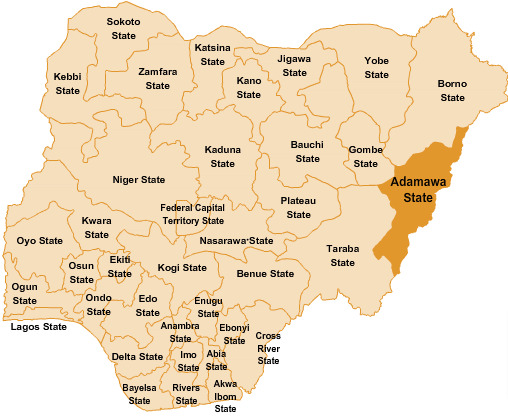
Abamawa State in Nigeria was in the spotlight during my recents postings. For this reasons I consider it appropriate to post the following article, though dating from 2017.

Presenting the article – which was originally published by Sahara Reporters – here does not imply that I accept its contents without criticism or reticence. It’s no small thing, the accusation leveled at her father by the daughter of the traditional ruler is very serious. It is worth noting though that Sahara Reporters is a credible source of information. For that reason I have no hesitation presenting the article below. Hence read it and judge for yourself.

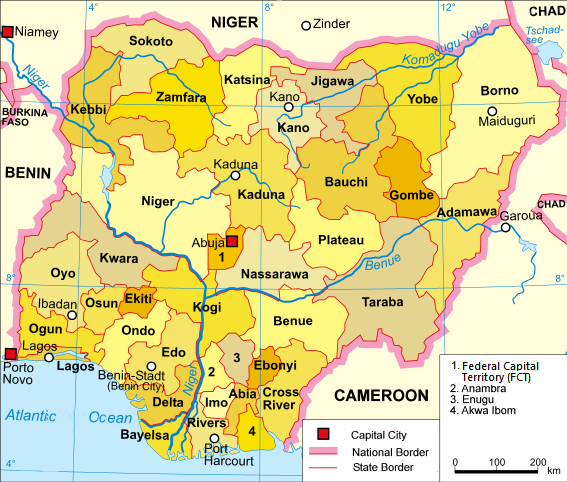
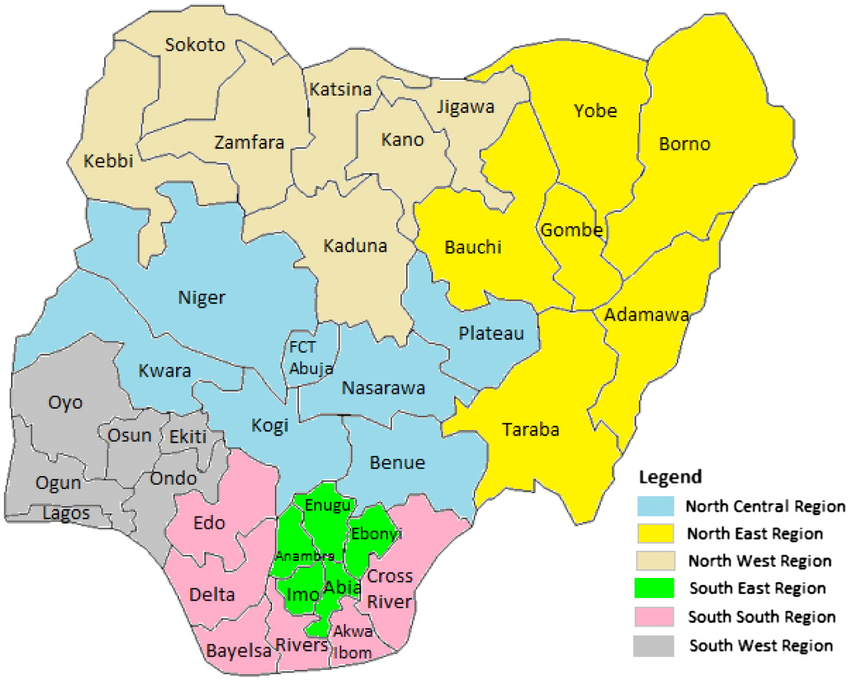
Adamawa State is located in the North East geopolitical zone of the Federal Republic of Nigeria and one of Nigeria’s largest states, it is the eight largest in land mass ( with a total land mass of 36,917 km2. It is Nigeria thirteenth or fourteenth least populous state with an estimated population of 6 – 7 million people. Adamawa State is mainly inhabited by Fulani people. Other ethnic groups in Adamawa State are the Mumuye, Higi, Kapsiki, Chamba, Margi (Marghi), Hausa, Kilba, Gude, Wurkum, Jukun, and Bata peoples. An estimated 100 indigenous ethnic groups live in this northeastern state which borders Cameroon.

Adamawa State shares its eastern border with Cameroon

Adamawa State is also religiously very diverse. About 50% of the population is Muslim and 40% is Christian while the remaining 10% are adherents of traditional ethnic religions. 
(Source: Wikipedia.)
(FVDK)

Daughter Accuses Adamawa Traditional Ruler Of Attempted Ritual Murder, Bribing Police Commissioner

Published: March 26, 2017
By: Sahara Reporters, New York

Ms. Umar claimed that her siblings – Murtala, Aisha, Abubakar and Aliyu – were hired by her father to carry out the murder.

Fadimatu Umar, daughter of the district head of Umar Ardo in Yola, Adamawa State, has claimed that her father bribed the Police Commissioner in charge of Force Criminal Investigations Department (FCID) in Abuja to cover up a case of an attempt to kill her.

She alleged that her father planned to use her corpse for a ritual. Ms. Umar claimed that her siblings – Murtala, Aisha, Abubakar and Aliyu – were hired by her father to carry out the murder.

Her siblings, she told SaharaReporters, attacked her in front of the National Identity Card Management Office in Yola, leaving her with a badly damaged arm, which may have to be amputated, according to doctors treating her.

The victim, 28, disclosed that less than a year ago, her stepmother, Bintu, died under mysterious circumstances, which she alleged was the handiwork of her father. The woman’s death, Ms. Umar added, convinced her that she would be the next target.

After hearing noises coming from the front gate of her home, Ms. Umar jumped through her window in fear of her life. She alleged that she was pursued by her siblings, who were armed until they caught up with her in front of the National Identity Card Management Office.

Ms. Umar said she reported the attack to the police, who subsequently arrested Aisha and Abubakar. But Aliyu Umar Ardo, an Air Force officer, and Muitala, who works with Intels Services, escaped arrest by fleeing.                   

The Air Force officer, she said, later emerged from hiding and wanted to shoot her with a pistol, a fate she escaped through the intervention of family friends. She maintained that Aliyu and Murtala have continued with their plot to kill her in an effort to end the case of attempted ritual killing she reported to the police.

Ms. Umar then fled Yola and petitioned the FCID in Abuja. The petition led to the arrest of Murtala in Calabar.  

Their father, along with influential people in Adamawa State, used their connections to free Murtala, who proceeded to bribe Mr. Jonah Mava, Police Commissioner in charge of the FCID, to dump the case.    

“They asked us to come back the next day by 10:00 a.m. But when I got there at 10:00 a.m., they didn’t allow me to go inside to see the Commissioner. But when I saw the Investigative Police Officer (IPO) in charge of the matter, he told me that Murtala had been around and that I should go in to see the commissioner,” she said.

Having received encouragement from the IPO, Ms. Umar barged into the Commissioner’s office, where she saw Murtala handing an envelope to the Commissioner of Police.       

“The Police Commissioner quickly stuffed it in his drawer and said we should come back at noon,” she said.                      

Ms. Umar said she suspected that the envelope contained a bribe from her father. Her suspicion became stronger when, a few days later, the Police Commissioner told her to forget the matter because it was a family affair.                               

“My mind is not at peace because they are still after my life and I cannot step into Adamawa State,” she told SaharaReporters.  

She also disclosed that her case with the family would be brought to court in Adamawa State on April 6, but she has been warned not to appear in court because she would be abducted.    

“I have been given privileged information that my father has also paid some men of the Directorate of State Security and the Police to look out for me and arrest me either at the airport or anywhere near te court.”, Ms. Umar revealed.

Source: Daughter Accuses Adamawa Traditional Ruler Of Attempted Ritual Murder, Bribing Police Commissioner

Some of the deadliest human sacrifices in history

The article below is not specifically describing the actual situation in one or more African countries. The article is brief and superficial. The reason why I decided to post it here is that it illustrates the fact that ritualistic killings, human sacrifices, and the belief that sacrificing a human being in a ritual with the objective to please the gods or the ancestors are as old as mankind and have occurred or are still occurring all over the world.

It goes without saying that although these age-old practices occur world-wide, they have no place in the 3rd millennium of mankind.
(webmaster FVDK)

SOME OF THE DEADLIEST HUMAN SACRIFICES IN HISTORY

Published: December 12, 2022
By: Oluwatomiwa Ogunniyi – Guardian, Nigeria  

In the past, human sacrifices were prevalent all over the world.  The manner in which they were carried out was dreadful and not for the faint-hearted. We have compiled a list of some of the deadliest human sacrifices in history; you wouldn’t believe some of them!

  1. Persecution of People with albinism

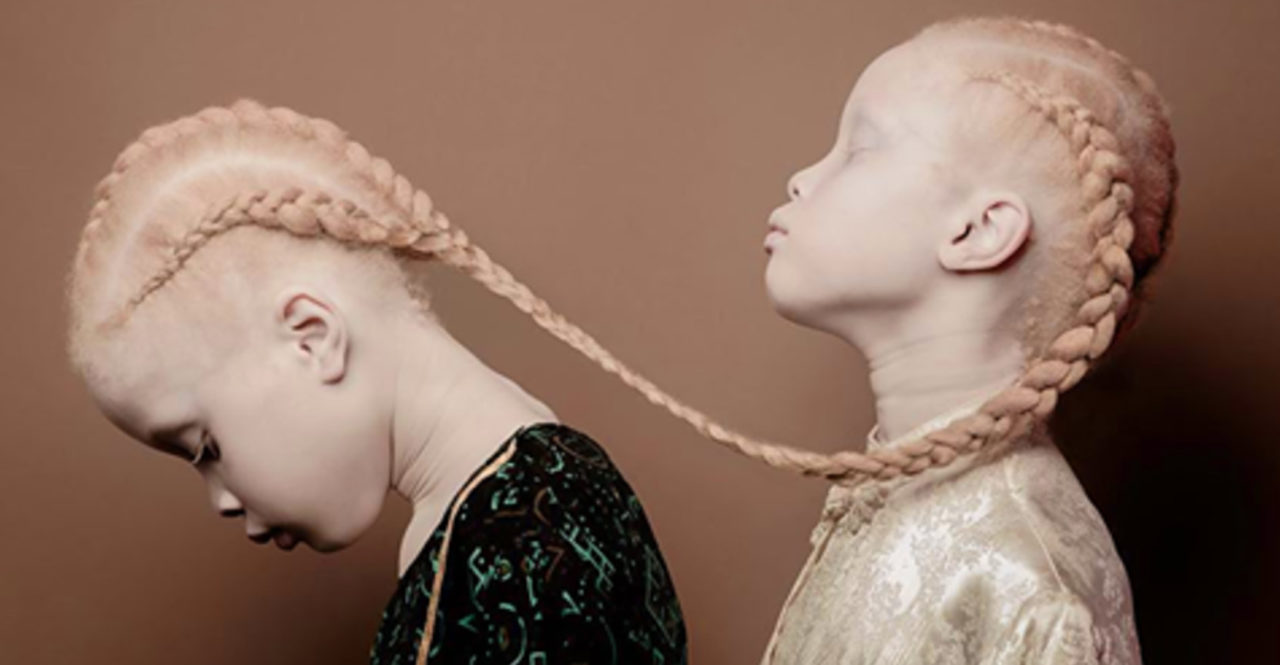
Albinism is a genetically inherited condition that is very rare and it affects approximately one in every 20,000 people worldwide. Though rare in the western world, albinism is fairly common in sub-Saharan Africa, most likely, as a result of consanguineous alliances. Even though albinism occurs in both males and females and is not specific to any race or ethnic group, many still believe that it is a punishment from God or a result of hard luck.

Some Africans still believe that certain parts of an albino’s body have magical powers. This belief has led to many witch doctors and those seeking ingredients for their rituals to kill them. As a result, thousands of people with albinism have been killed and dismembered, and their graves of dug up and desecrated. The scary thing is that this practice is still common in Africa today. 

  • The Lafkenches Tribe Sacrifice

In the year 1960, the strongest earthquake and tsunami ever recorded on the moment magnitude scale hit Chile, thereby, killing thousands of people and destroying many homes and properties in the process. This earthquake became known as the great Chilean earthquake and it led to widespread fear of the possible cause. The people came to the conclusion that the god of the sea was angry with them and so they decided to offer a sacrifice.

They chose a five-year-old child and sacrificed him in a horrifying manner: he had his legs and arms and was stuck into the sand of the beach like a stake and the beach carried him away so that the waters would be calmed. The culprits were arrested and charged but they were released after two years.

  • The Mayan Sinkhole Sacrifices  

During the pre-Columbian era, the Mayans are known to have carried out all manner of ritual sacrifices, as they believed that human sacrifice was the ritual offering of nourishment to the gods. And one manner of sacrifice practised was the sinkhole, where they deposited valuables and human bodies into the cenote as a form of sacrifice to the rain god Chaac.

They also believed that the sinkholes and cenotes were portals to the underworld and they would appease dead spirits by offering human sacrifices to them. Explorers have discovered many sinkholes including the Sacred Cenote, a water-filled sinkhole at the pre-Columbian Maya archaeological site on Peninsula. Archaeological investigations have removed thousands of objects from the bottom of the cenote, including artefacts made from gold, jadeite, copal, wood, rubber and cloth, as well as thousands of human skeletons.

  • The Child Sacrifice in Carthage

Child sacrifices were very common in ancient cultures maybe because they believed that children possessed innocent souls and therefore were acceptable as forms of sacrifices to gods.

The Carthaginians would have a sacrificial fire pit where children would be thrown into by their parents. The practice became very repulsive to the Carthaginian parents who became tired of killing their own children. In response, they decided to buy children from neighbouring poor tribes, or care for their servant’s children who would then be offered as sacrifices. And during calamities like war, drought or famine, the priests demanded that even the youth be offered as a sacrifice. The sacrifices were carried out on a moonlit night, the children would be killed generously and their bodies would be tossed into the fiery pit amidst singing and dancing.

  • The Killing of Twins in Nigeria

This is another form of child sacrifice as the killing of twins was a cultural practice among some ethnic groups in Nigeria. Back then, multiple births were seen as an abomination against the earth deity and giving birth to twins was considered a bad omen that could bring devastation or calamity upon society. Twin babies were believed not to be humans but evil.

In 1876, Mary Slessor, a Scottish missionary assigned to Calabar, gradually worked towards changing the cultural belief that twins were evil. However, by 1915, following intervention by the British government, twins and their mothers were fully integrated into their communities. 

Source: Some of the deadliest human sacrifices in history

Ritual Killing in Nigeria: Let The Carnage Stop

Not a word too much. This Op-Ed of the Nigerian newspaper ‘For God and Country LEADERSHIP’ echoes my firmest belief, my most ardent wish. I wholeheartedly share the editors’ cry for an end to ritual killings, for justice and the rule of law in Africa’s most populated country, Nigeria. Repeatedly I have drawn here attention to the fact that ritual murders are rampant in the country and I have reported numerous examples on this website. When will the Nigerian authorities, both on the federal as the state level, act accordingly? 
(webmaster FVDK)

Ritual Killing: Let The Carnage Stop

Published: March 5, 2021
By: Leadership, Nigeria – Editorial

Last week, the internet was awash, yet again, with another case of suspected mass kidnapping and ritual killings. In the suburb of Onitsha, Anambra State, a woman and her children were found, in a bizarre collaboration, with several toddlers and kids whom she randomly selected to pound in a mortar into mash and then deliver the blood-cuddling product to her clients. The self-acclaimed prophetess has since been arrested.

Such a gory tale spiced with the worst dose of cruelty and man’s inhumanity to man brings to the fore the pervasive wickedness and deceit of the human mind.Still suspected, alleged and proven cases of ritual killings, grave robbery and dealing in human parts are replete across the land. From Calabar to Maiduguri and Lagos to Sokoto such cases, reported and unreported, fill the news space and rumour mills drawing attention to tendencies towards the grotesque.

Sadly, this development is becoming scarier by the day as the young, the old, male and female share in this ugly trend, engaging in a macabre competition with kidnapping and terrorism, all of which make the land more insecure. It gores the heart that even with the alarm raised by well-meaning individuals, institutions and organisations, the situation rather than abate, persists.

In the opinion of this newspaper, it is somewhat confounding that a nation whose citizens pride themselves as the most religious and happiest on earth could descend so low into debauchery, sheer cold-blooded murder and cannibalism in the name of ritual killings. To which god(s) do the perpetrators of these evil acts offer their fellow human beings as sacrifice and for what purpose?

As unacceptable as it is, the ailing economy may present itself as a lousy excuse for those who risk such practices. Yet, it is utterly inconceivable that some do sink this abysmally low to the point of patronising all shades of nocturnal, diabolical and dubious characters including kidnappers just to get the raw materials to feed their yawning bestial desire.

In our considered opinion, it is a shame if not utterly reprehensible that motherless homes, orphanages and health institutions euphemistically referred to as baby factories have been reported to be part of the huge source which feeds the furnace of this raging conflagration of ritual killings.

We recall that, consistently, well-meaning Nigerians, religious leaders, other leaders of thought and culture enthusiasts among them have, at various times, spoken out in open condemnation of this drift towards nihilism. We urge them to do more. As a matter of urgency, they should step up the campaigns against ritual killing, an act that is not only despicable to mortals but also offensive to the Supreme Being.

It is pertinent to stress that it is time all the relevant government agencies and non-state actors took the war against ritual killing to the perpetrators. There is an urgent need to save the country from being stigmatised by this ugly stamp added to those of insecurity and corruption which are already an albatross on the neck of Nigeria. The case of baby Adam (a victim of ritual killing) confirmed to have been killed in faraway United Kingdom but whose origin was traced to Nigeria is still fresh in the mind.

Behind this ugly trend is cultism indulged in by some members of society who yield to the negative in their mindless quest for power and the penchant to be dreaded and feared. These are people who nurture the self- delusion of being in charge and in control. Their co-travellers in this trip to nothingness, in our view, are the get rich quick maniacs who go to any length to acquire wealth for the sake of it. And when they soon realise that it is all vanity, they go to their religious leaders to confess their blood oaths. The police have a right to know whose blood was used in those unwholesome rituals. The religious leaders owe it a duty to humanity to report such confessions.

While we salute the courage and gallantry of the security personnel who often put their own lives on the line trying to secure the land, it is also important to let them know that the battle will not be won until the last vestige of anti-social behaviour is extirpated from decent society.

Furthermore, we implore law-making bodies, across all the tiers of government, to enact laws (where not in existence), strengthen the hands of the law enforcement operatives, with stringent penalties and other wherewithal necessary to bring these evil elements to justice.

Source: Ritual Killing: Let The Carnage Stop

Why killings for rituals are on the increase in Nigeria (2017 article)

During the past three days I have posted three articles related to the alarming rate of ritual killings in Nigeria, in 2014. The article below contains a similar cry for attention, but now in a 2017 article. In other words, there is no interruption in the occurrence of ritual murders in Nigeria, locally called ‘money rituals’. Moreover, also in November and December 2018 and February 2020 newspapers reported that ritual killing was rampant in Nigeria. In other words, nothing has changed over the years.

This means that ritual murders are a structural problem in the Nigerian society and that both the federal government and the government of the individual states repeatedly and continuously fail to protect their citizens, which is a ****** shame. Governments have an obligation to protect the population, notably the most vulnerable, and to arrest, try and punish perpetrators of heinous crimes.

Warning: the following contains a graphic description of ritualistic acts and murders (webmaster FVDK).

NB This article was posted before, on May 24, 2018.

Why killings for rituals are on the increase in Nigeria

Published: September 2, 2017
By: Vanguard, Nigeria – Evelyn Usman

…‘Human parts for sale’

The spate of killings for ritual purposes is gradually assuming an alarming rate in Nigeria with little or no effort by concerned government agencies to checkmate the trend.

One would have expected such pseudoscience acts to be a thing of the past going by increase in religious activities and in civilization. But murdering people to appease the deities appears to be on the increase.

Ritual den

These dastardly acts are carried out in a 21 st century, when other countries of the world are experimenting and advancing in technology.

It is also shocking to know that some acclaimed high and mighty indulge in ritual killings. For instance, some politicians and government officials have been accused by arrested suspects and herbalists who allege that they use human beings for rituals in order   to sustain their affluence as well as remain in positions of power.

Investigations revealed that cases of ritual killings and disappearance of persons are usually high whenever elections are around the corner.

Just last week, this barbaric act assumed a cannibalistic dimension following the arrest of a suspected kidnapper alleged to have killed one of his victims and used his intestines to prepare pepper soup.

The suspect, Roland Peter,  according to the Rivers State Commissioner of Police , Zaki Ahmed,  abducted his victim  from his house on August 2017, adding that the suspect was at the verge of eating pepper soup and yam porridge when the police swooped on him and some accomplices.

These vampires hide under different covers to get their victims. For some, they kidnap their victims from various points , while others who pretend to be commercial bus drivers, pick unsuspecting commuters at bus-stop only to take them to their slaughter slabs to carry out what they know how to do best.

Killings for money rituals

On August 17, 2017 , the lifeless body of the four-year-old girl was found  close to a shrine at 28 Ogbe Close in Iwaya area of Lagos, with her throat slit. In her case , the toddler who strayed from her siblings’ watch, on their way from the mosque, was suspected to have been used for sacrifice on the Ogun shrine which ironically is built in the same compound with her parents . Till date perpetrators of the dastardly act are yet to be fished out.

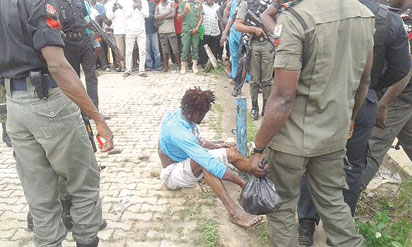
A suspected ritualist

A week earlier, precisely August 20, another lifeless body of an eight-year-old girl, Chikamso Victory , was found in the apartment of one Ifeanyi Chukwu Dike (23) at Messiah street , Eliozu area of Port Harcourt. Helpless and defenseless Victory was not only abducted by Dike, she was raped before she was killed. As at the time her body was recovered, some parts had been removed. They included her vagina, eyes, tongue and breasts which the suspect kept in a polythene bag awaiting the appropriate time to take them to his contacts. He was however, arrested by members of a local vigilante group while going to dispose of the body. But the incident assumed a laughable dimension following report by the Police that the suspect had disappeared from custody.

Elsewhere in Oyo state, on March 30, 2017 , a suspected ritualist,  Tunde Jimoh, who was arrested by the Police, gave a chilling description of how he and other members of his gang abducted their victim, Akintoye Oyeyemi, took him into a deep forest and murdered him in cold blood. Thereafter, they took the body to a Muslim cleric to prepare concoction for money rituals for him. At the end of the day, the wrists, heart and legs were cut off. Luck ran out on the suspect while on his way to dump the body in the bush.

Not too long ago, reports had it that an evil forest used as ritualists’ den was uncovered in Enugu state with the recovery of fresh and decomposing human parts. The nation’s Federal Capital Territory is not speared from the rising trend of killing for rituals. Late last year, a dismembered body of an unidentified lady was recovered at the  Lower Usuma Dam junction, along Dutse-Bwari Road. One of her breasts was cut off, while the rest of the body was cut into two from the abdomen, an indication that the killing was for ritual.

Badoo ritual killing

In Lagos state, the commercial hub of the country, different methods are devised by ritualists. One of such was the surge in the killing of residents by members of a dreaded cult group identified as Badoo Boys in Ikorodu area of Lagos. So far, over 50 persons have had their lives snuffed out of them by the perpetrators who were initially thought to be invisible, until they were decimated by the Police , under the watch of the new Commissioner of Police, Lagos State Command, Mr Edgar Imohimi, while he was the Deputy Commissioner of Police in charge of operations.

Ritualist den

Before the raid and subsequent arrest of over 200 suspected members of the cult group by the Police with the support of the Oodua peoples Congress, OPC local vigilante and the Neighborhood Watch Corps, Badoo Boys had been  unleashing an orgy of killings, during which they used heavy stones to crush the skulls of their victims.

Their modus operandi included storming victims’ residences while they are asleep. It is suspected that they usually hypnotize their victims, as none of them had ever been conscious of their presence. They would, thereafter, smash heads of their victims with a grinding stone and after which they use a handkerchief to clean the blood and brain before leaving the scene.

During interrogation, one of the suspects confirmed that each handkerchief stained with blood was sold for N500,000 . He further revealed that they were mere errand boys for rich politicians within and outside Lagos state.

But in their case , the blood and semen stained handkerchief were used to prepare spiritual defence for well to do Nigerians.

Mad people in disguise

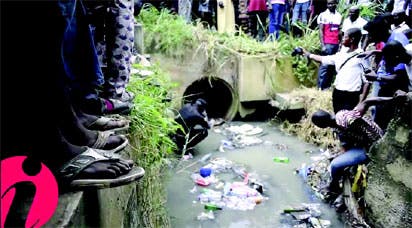
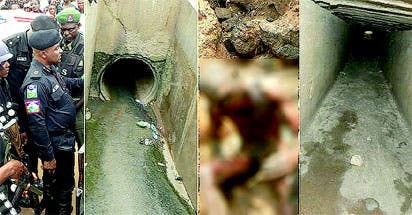
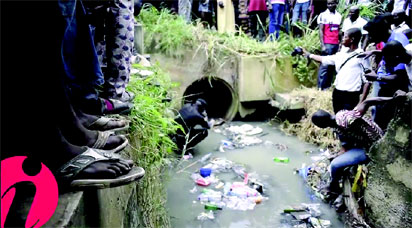
The latest method devised is the feigning of madness by these criminal elements. Recently in Lagos, some persons who disguised as lunatics were discovered to be using tunnels as dens for their activities. Two instances of note were along Lagos-Abeokuta road and Ile Zik, along Agege Motor road.

The latest was an uncovered ritualits’ den Wednesday , at Challege bus-stop , Mushin, where some suspected members who posed as lunatics were found with sophisticated phones, four ATM cards and over 100 syringes with blood stains.

One of the suspects was lynched by a mob while two others were rescued by policemen from Area ‘D’ command, Mushin.

Not too long  Nigerians received with shock, news of a den in Soka village, Oluyole Local Government area of Oyo state, where about 20 corpses, majority of which were   earlier declared missing   by their relatives, were found while 18 victims were rescued. From all indications, it was obvious that the den had been existing for long before it was uncovered, following a heap of victims’ clothes.

One of the rescued victims was reported to have said he was kidnapped in Ogun while attending an interview. The most celebrated ritual killing appeared to be the notorious Otokoto saga in Owerri, Imo State where a businessman belonging to a cult was alleged to have used his apprentice for ritual. The boy’s corpse was later exhumed at the premises of Otokoto Hotel. It exposed many other bizarre acts in hotels.

Religious leaders also involved

One would have expected such primitive acts to be going down, going by the increasing religious groups in the country. Regrettably,  some leaders of religious have been caught in the act. But investigations have shown that many evil men only use religion as a cover up. They are never true religious leaders.

One of the ready cases that comes to mind was that of the arrest of a Pastor who allegedly killed a seven-year-old boy and buried his head where the church’s alter was mounted. This action was to ensure the influx of members into the church located at  Odokekere/ Odogunyan in Ikorodu area of Lagos state .

Elsewhere in Edo state and Ogun states, some pastors were also arrested over similar acts.

Few months ago, an unidentified woman who left her abode in Sango Otta area of Ogun in search of spiritual cleansing at the place of a Muslim cleric popularly called Alfa , in Badagry area of Lagos, ended up being victim of ritual killing.

A 61-year-old landlord,  Toafeek Hassan, who confessed to have slaughtered the woman, was found with her fresh human head and other body parts which were to be used to prepare concoction by the  alfa

Investigation shows that female parts are more in demand than their male counterparts.  This is because of   what was described as the potency of some parts like the breasts and lower private parts in money rituals and other purposes by herbalists and occult groups.

Ritual used to elongate life —suspect

One of the herbalists who spoke with Vanguard at the State Criminal Investigation and Intelligence Department, SCIID , Oseni Bello, admitted to be preparing concoction with human body parts but said he was not involved in the killings. Oseni disclosed that some of the rituals were done to elongate lives . He added that the heart was used to prepare concoction for boldness and fear.

He stated further that virgins   and   babies on the other hand , were used by some politicians and government officials   for ritual purposes as their blood is said to be used to elongate the user’s life span as well as fortify them against spiritual attacks. These are some of the reasons, he said, killings for rituals are on the increase.

A particular case in mind was that of a South-West politician alleged to have been caught by his driver with a dissected day-old baby whose blood he was drinking. The incident as reported two years ago, occurred inside a bush, while the driver was taking his boss (names withheld) to a function. Half way into the journey, the politician was said to have ordered his driver to pull over.

He thereafter, alighted and headed for a bush with a promise to be back. Having waited   without any sight of his boss, the ignorant and curious   driver reportedly went in search for him,only to meet   him stark naked and pouring the blood of a dissected baby into his mouth. Barely two weeks later, the driver reportedly   died under mysterious circumstance.

The event that occurred   before his death was related by a Pastor friend whom the deceased   confided in before his demise. The lust for money and power drives these people into ritual killings.

While some kill to achieve this unfathomable dream, others   resort to digging graves   and removing needed human parts for ritual purpose.   Saturday Vanguard scooped that most guards at cemeteries connive with agents to sell human parts. It was learnt that  if a fresh human head is needed, an agent will contact some   cemetery workers ahead.

In this case, the cemetery official will be on the look out for fresh dead bodies, preferably those of Muslims   who are usually buried within 24 hours after death. Immediately the body is interred, they exhume the body at night, cut off the needed parts and place the body back in the grave.

Human parts for sale

Those who patronize cemetery officials are usually herbalists, herbal traders and even prominent Nigerians who usually use middle men. Surprisingly, human parts   are sold in some markets in Nigeria. We gathered that a fresh human head could go for N60,000 and above, while a skull is sold for N20,000. Fresh legs are sold for N30,000 each while a decomposed leg is sold for N20,000. A fresh finger is sold for N5,000 each while the decomposed is sold for 3,000. Fresh intestines are sold for N20,000 while dry ones are sold for N5000. Pieces of fresh bones are sold for N2,000 and above.

Public react

Reacting to the upsurge , the president,  Association of Industrial Security and Safety Operators of Nigeria , AISSON Dr. Ona. Ekhomu called on the Nigeria Police to set up Special Ritual Murder Squads in various State Commands to focus on the investigation, detection, arrest and prosecution of ritual killers. He said that the high incidence of serial ritual killings demands an urgent action at the level of the police high command.

According to the first chartered security professional in West Africa, citizens were rapidly losing faith in the ability of the police agency to detect and punish ritual killers.   This, he said was responsible for the increase in lynching of suspects as members of the public resort to jungle justice to get redress for the heinous murders.

Said he: “The conscience of Nigerians should be troubled by reports of recent ritual murders including that of   one-year-old Success lme in Calabar whose heart was ripped out from her small body for ritual purposes and was discovered in a Church along with other items for occult rituals. There is also the case of Pastor Samuel Okpara in Ahoada East LGA of Imo State who was kidnapped, killed and cannibalized by ritualists.   The pastor was reportedly beheaded and his liver and intestines used for pepper soup and plantain porridge. What a horrific occurrence?”

He also decried the excesses of the Baddoo murder cult in Ikorodu Lagos State , saying it was a direct challenge to the Police.

Economic recession in the land is not a license to commit ritual murder.   Impunity encourages ritualists to commit murders because they believe they will not be apprehended or punished.

I advise Nigerians against late night outings because if a vehicular breaks down one could fall victim of kidnap by ritualists.   Commuters should always write down the identification markings of public conveyance vehicles which they enter and make phone calls to loved ones to pass on the information. Because ritual murderers always wish to be unidentified.   They want to kill people, but don’t wish to be apprehended. Once information about them has been passed on to someone else, it becomes difficult for them to do evil”.

Nigerians should also assess public transport vehicles before boarding in order not to board the “wrong bus. Likewise, women are advised to carry whistles on them in order to raise an alarm if there is an attempt to abduct them”.

On his part, the national Coordinator,  Network on Police Reform in Nigeria , NOPRIN  Mr Okechukwu Nwanguma, attributted the rise in  cases of killing for ritual   to collapse in moral values “ 

It is also caused by , ignorance and superstition,   the inordinate quest and pursuit of quick wealth and lack of effective punishment system.In a way,   poverty and unemployment may also be a risk factor. If Nigerians have equal opportunities to   earn income in legitimate ways ,   there will definitely be reduction in such abominable crimes   like humans killing fellow humans for ritual.”

Also baring his opinion on the matter,  Treasurer of the Action Democratic Party , Cross River State Chapter, Offiong Okon, in a recent interview, advised that:  “Before a church is established, government should carry out investigation before license is granted because many of the church leaders and founders are ritualists, acting in the capacity of being Pastors.”

“Government should investigate the Pastors and checkmate their activities because what they do under the cover of being a religious leader.”

Source: Why killings for rituals are on the increase in Nigeria

Nigeria: Angry mob sets four on fire over ritual killing in Edo State

Mob justice is a serious problem in many if not all of Nigeria’s states. Early January of this year an angry mob set robbers ablaze in Calabar, the capital city of Cross River State. In early October last year an angry mob in Benue State set three suspected armed robbers ablaze over their alleged involvement in the robbery and serial killings witnessed in Gbaste community. I could cite many more examples of jungle justice in Nigeria, but this will do, for the moment. Recently, two – or four, accounts differ, see below – young men were set ablaze for alleged involvement in the killing of an SS3 Secondary Schoolgirl of Azama College, Otuo, Edo State.

The use of violence is a prerogative of State authorities. Moreover, every accused is considered innocent as long as he or she has not been found guilty by an independent and impartial judge during a public, transparent trial.
Mob justice is a sign of a weak state authority and should not be tolerated. Mob justice resulting in the death of the victim is a crime; those responsible should be prosecuted and punished by law (webmaster FVDK). 

Angry Mob Sets Four On Fire Over Ritual Killing In Edo State

Source: File photo. 

Published: February 25, 2020
By: Naija News – Richard Ogunsile

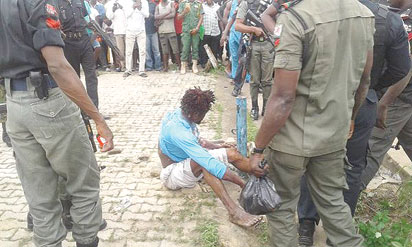
Reports reaching Naija News at this time reveals that there was an uproar at a village in Owan East Local Government Area of Edo state on Monday, following the murder of a young girl who was reportedly beheaded for ritual purpose.

According to a source in the Otuo community in a chat with newsmen, some four young men were set ablaze for alleged involvement in the killing of an SS3 Secondary Schoolgirl of Azama College, Otuo.

The source whose identity was not given due to security purpose reveals that the child’s head was cut off at night hour by the culprits while she was on an errand by her neighbour who sent her to get him sachet water.

Naija News understands that she was murdered at the point of delivering the sachet water.

It was said that the girl’s parents cried out after they could not find their daughter, but that the culprits were nabbed while making moves to dump the victim’s body before the rising of the sun of the next day.

Further information revealed that two out of the four culprits were identified, including the woman who is to perform the rituals for them.

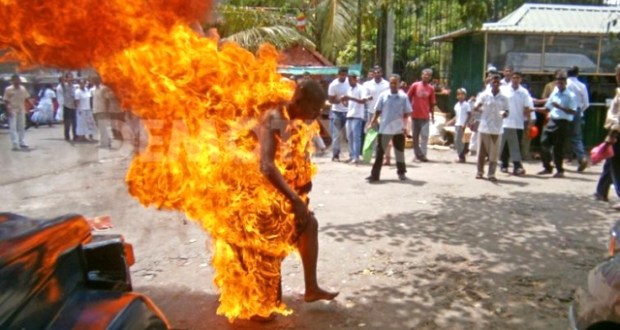
The source said, “The two men were burnt this morning (Monday) along with the woman, while her house was razed. They were all dragged to the popular Women Centre where the community police station is located. The third man was traced to his farm and apprehended,”

However, after the arrest of the culprits, furious residents set the young men on fire.

Meanwhile, a confirmation from the state Police Public Relations Officer, Mr Chidi Nwabuzor, mentioned that only two of the suspects were burnt alive.

“The command is aware that a young girl’s head was cut off and the youth of the community arrested two suspects, brought them to the front of the station and set them ablaze,” he said.

Source: Angry Mob Sets Four On Fire Over Ritual Killing In Edo

Related article: 

4 burnt to death for kidnapping SS III student for rituals in Edo

Published: February 24, 2020
By: Vanguard – Ozioruva Aliu

BENIN CITY— FOUR persons, including a lady, were, yesterday, set ablaze by a mob in Otuo, Owan East Local Government Area over allegation of kidnapping an SS III female student and killing her for ritual purpose.

It was gathered that the victim, a student of Azama College in Ikhuera quarters of the rustic town, was allegedly sent to buy sachet water by her neighbour Sunday night.

A source said while she was on her way from buying the water that her head was severed from her body apparently for ritual.

It was also gathered that when the young girl’s parents could not find her, they raised the alarm, but her whereabouts remained unknown.

The source said one of the culprits caught in the early hours of yesterday while attempting to dump the victim’s body confessed to the crime and those involved, including the woman, who allegedly performed the rituals for them.

“The two boys were burnt this morning (yesterday) along with the woman while her house was razed. They were all dragged to the popular ‘Women Centre’ where the community police station is located. The third boy was traced to his farm and apprehended,” he said.

Vanguard gathered that the third man apprehended in connection with the ritual killing was later burnt by a mob late yesterday.

One of the suspects, the gang leader, identified as Lukeman, was alleged to be a serial killer while two of the boys, who accompanied Lukeman, are of same parents and from Ikhueran quarter, Otuo.

He also said the woman, who performed the rituals was from Kogi State while Lukeman is said to be from Auchi in Etsako West Local Government Area of the state.

Spokesman for Edo Police Command, Mr Chidi Nwabuzor, while confirming the incident, said it was only two of those arrested that were burnt.

“The command is aware that a young girl’s head was cut off and the youths of the community arrested two suspects they took to the station where they were set ablaze,” he said.

Source: 4 burnt to death for kidnapping SS III student for rituals in Edo

Why ritualistic killings are on the increase in Nigeria

Ritualistic killings in Nigeria are rampant. Nigerians call these appalling crimes ‘money rituals’. I have been studying ritualistic killings in Africa since the mid-1970s and have come to the conclusion that Nigeria ranks among the Top-Five of African countries where ritual killings are most widespread. Even if we take into account that Nigeria is Africa’s most populated country, with close to 200 million people in 2017. The following article illustrates this conclusion. (webmaster FVDK)

Why killings for rituals are on the increase in Nigeria

By Evelyn Usman
Vanguard Nigeria
Date published: September 2, 2017, 8:27 AM

The spate of killings for ritual purposes is gradually assuming an alarming rate in Nigeria with little or no effort by concerned government agencies to checkmate the trend. One would have expected such pseudoscience acts to be a thing of the past going by increase in religious activities and in civilization. But murdering people to appease the deities appears to be on the increase.

Suspected ritualist arrested – Nigeria

These dastardly acts are carried out in a 21 st century, when other countries of the world are experimenting and advancing in technology. It is also shocking to know that some acclaimed high and mighty indulge in ritual killings. For instance, some politicians and government officials have been accused by arrested suspects and herbalists who allege that they use human beings for rituals in order to sustain their affluence as well as remain in positions of power.

Investigations revealed that cases of ritual killings and disappearance of persons are usually high whenever elections are around the corner. Just last week, this barbaric act assumed a cannibalistic dimension following the arrest of a suspected kidnapper alleged to have killed one of his victims and used his intestines to prepare pepper soup. The suspect, Roland Peter,  according to the Rivers State Commissioner of Police, Zaki Ahmed, abducted his victim  from his house on August 2017, adding that the suspect was at the verge of eating pepper soup and yam porridge when the police swooped on him and some accomplices.

These vampires hide under different covers to get their victims. For some, they kidnap their victims from various points, while others who pretend to be commercial bus drivers, pick unsuspecting commuters at bus-stop only to take them to their slaughter slabs to carry out what they know how to do best.

Killings for money rituals

On August 17, 2017, the lifeless body of the four-year-old girl was found  close to a shrine at 28 Ogbe Close in Iwaya area of Lagos, with her throat slit. In her case, the toddler who strayed from her siblings’ watch, on their way from the mosque, was suspected to have been used for sacrifice on the Ogun shrine which ironically is built in the same compound with her parents. Till date perpetrators of the dastardly act are yet to be fished out.

A week earlier, precisely August 20, another lifeless body of an eight-year-old girl, Chikamso Victory, was found in the apartment of one Ifeanyi Chukwu Dike (23) at Messiah street, Eliozu area of Port Harcourt. Helpless and defenseless Victory was not only abducted by Dike, she was raped before she was killed. As at the time her body was recovered, some parts had been removed. They included her vagina, eyes, tongue and breasts which the suspect kept in a polythene bag awaiting the appropriate time to take them to his contacts. He was however, arrested by members of a local vigilante group while going to dispose of the body. But the incident assumed a laughable dimension following report by the Police that the suspect had disappeared from custody.

Elsewhere in Oyo state, on March 30, 2017, a suspected ritualist,  Tunde Jimoh, who was arrested by the Police, gave a chilling description of how he and other members of his gang abducted their victim, Akintoye Oyeyemi, took him into a deep forest and murdered him in cold blood. Thereafter, they took the body to a Muslim cleric to prepare concoction for money rituals for him. At the end of the day, the wrists, heart and legs were cut off. Luck ran out on the suspect while on his way to dump the body in the bush.

Not too long ago, reports had it that an evil forest used as ritualists’ den was uncovered in Enugu state with the recovery of fresh and decomposing human parts .

The nation’s Federal Capital Territory is not speared from the rising trend of killing for rituals. Late last year, a dismembered body of an unidentified lady was recovered at the  Lower Usuma Dam junction, along Dutse-Bwari Road. One of her breasts was cut off, while the rest of the body was cut into two from the abdomen, an indication that the killing was for ritual.

Badoo ritual killing

In Lagos state, the commercial hub of the country, different methods are devised by ritualists. One of such was the surge in the killing of residents by members of a dreaded cult group identified as Badoo Boys in Ikorodu area of Lagos. So far, over 50 persons have had their lives snuffed out of them by the perpetrators who were initially thought to be invisible, until they were decimated by the Police, under the watch of the new Commissioner of Police, Lagos State Command, Mr Edgar Imohimi, while he was the Deputy Commissioner of Police in charge of operations.

Before the raid and subsequent arrest of over 200 suspected members of the cult group by the Police with the support of the Oodua Peoples Congress, OPC local vigilante and the Neighborhood Watch Corps, Badoo Boys had been  unleashing an orgy of killings, during which they used heavy stones to crush the skulls of their victims. Their modus operandi included storming victims’ residences while they are asleep. It is suspected that they usually hypnotize their victims, as none of them had ever been conscious of their presence. They would, thereafter, smash heads of their victims with a grinding stone and after which they use a handkerchief to clean the blood and brain before leaving the scene.

During interrogation, one of the suspects confirmed that each handkerchief stained with blood was sold for N500,000 . He further revealed that they were mere errand boys for rich politicians within and outside Lagos state. But in their case , the blood and semen stained handkerchief were used to prepare spiritual defence for well to do Nigerians.

Mad people in disguise

The latest method devised is the feigning of madness by these criminal elements. Recently in Lagos, some persons who disguised as lunatics were discovered to be using tunnels as dens for their activities.

Ritual den – Nigeria

Two instances of note were along Lagos-Abeokuta road and Ile Zik, along Agege Motor road. The latest was an uncovered ritualits’ den Wednesday , at Challege bus-stop, Mushin, where some suspected members who posed as lunatics were found with sophisticated phones, four ATM cards and over 100 syringes with blood stains. One of the suspects was lynched by a mob while two others were rescued by policemen from Area ‘D’ command, Mushin.

Not too long  Nigerians received with shock, news of a den in Soka village, Oluyole Local Government area of Oyo state, where about 20 corpses, majority of which were earlier declared missing by their relatives, were found while 18 victims were rescued. From all indications, it was obvious that the den had been existing for long before it was uncovered, following a heap of victims’ clothes. One of the rescued victims was reported to have said he was kidnapped in Ogun while attending an interview.

The most celebrated ritual killing appeared to be the notorious Otokoto saga in Owerri, Imo State where a businessman belonging to a cult was alleged to have used his apprentice for ritual. The boy’s corpse was later exhumed at the premises of Otokoto Hotel. It exposed many other bizarre acts in hotels.

Religious leaders also involved

One would have expected such primitive acts to be going down, going by the increasing religious groups in the country. Regrettably,  some leaders of religious have been caught in the act. But investigations have shown that many evil men only use religion as a cover up. They are never true religious leaders.

One of the ready cases that comes to mind was that of the arrest of a Pastor who allegedly killed a seven-year-old boy and buried his head where the church’s alter was mounted. This action was to ensure the influx of members into the church located at  Odokekere/ Odogunyan in Ikorodu area of Lagos state.

Elsewhere in Edo state and Ogun states, some pastors were also arrested over similar acts. Few months ago, an unidentified woman who left her abode in Sango Otta area of Ogun in search of spiritual cleansing at the place of a Muslim cleric popularly called Alfa, in Badagry area of Lagos, ended up being victim of ritual killing. A 61-year-old landlord, Toafeek Hassan, who confessed to have slaughtered the woman, was found with her fresh human head and other body parts which were to be used to prepare concoction by the  alfa.

Investigation shows that female parts are more in demand than their male counterparts.  This is because of  what was described as the potency of some parts like the breasts and lower private parts in money rituals and other purposes by herbalists and occult groups.

Ritual used to elongate life 

One of the herbalists who spoke with Vanguard at the State Criminal Investigation and Intelligence Department, SCIID, Oseni Bello, admitted to be preparing concoction with human body parts but said he was not involved in the killings. Oseni disclosed that some of the rituals were done to elongate lives. He added that the heart was used to prepare concoction for boldness and fear. He stated further that virgins and babies on the other hand, were used by some politicians and government officials for ritual purposes as their blood is said to be used to elongate the user’s life span as well as fortify them against spiritual attacks. These are some of the reasons, he said, killings for rituals are on the increase.

A particular case in mind was that of a South-West politician alleged to have been caught by his driver with a dissected day-old baby whose blood he was drinking. The incident as reported two years ago, occurred inside a bush, while the driver was taking his boss (names withheld) to a function. Half way into the journey, the politician was said to have ordered his driver to pull over. He thereafter, alighted and headed for a bush with a promise to be back. Having waited without any sight of his boss, the ignorant and curious driver reportedly went in search for him, only to meet him stark naked and pouring the blood of a dissected baby into his mouth. Barely two weeks later, the driver reportedly   died under mysterious circumstance.

The event that occurred before his death was related by a Pastor friend whom the deceased   confided in before his demise. The lust for money and power drives these people into ritual killings.

While some kill to achieve this unfathomable dream, others resort to digging graves and removing needed human parts for ritual purpose. Saturday Vanguard scooped that most guards at cemeteries connive with agents to sell human parts. It was learnt that  if a fresh human head is needed, an agent will contact some cemetery workers ahead. In this case, the cemetery official will be on the look out for fresh dead bodies, preferably those of Muslims who are usually buried within 24 hours after death. Immediately the body is interred, they exhume the body at night, cut off the needed parts and place the body back in the grave.

Human parts for sale

Those who patronize cemetery officials are usually herbalists, herbal traders and even prominent Nigerians who usually use middle men. Surprisingly, human parts are sold in some markets in Nigeria. We gathered that a fresh human head could go for N60,000 and above, while a skull is sold for N20,000. Fresh legs are sold for N30,000 each while a decomposed leg is sold for N20,000. A fresh finger is sold for N5,000 each while the decomposed is sold for 3,000. Fresh intestines are sold for N20,000 while dry ones are sold for N5000. Pieces of fresh bones are sold for N2,000 and above.

Public react

Reacting to the upsurge, the president, Association of Industrial Security and Safety Operators of Nigeria, AISSON Dr. Ona. Ekhomu called on the Nigeria Police to set up Special Ritual Murder Squads in various State Commands to focus on the investigation, detection, arrest and prosecution of ritual killers.

He said that the high incidence of serial ritual killings demands an urgent action at the level of the police high command.

According to the first chartered security professional in West Africa, citizens were rapidly losing faith in the ability of the police agency to detect and punish ritual killers. This, he said was responsible for the increase in lynching of suspects as members of the public resort to jungle justice to get redress for the heinous murders.

Said he: “The conscience of Nigerians should be troubled by reports of recent ritual murders including that of one-year-old Success lme in Calabar whose heart was ripped out from her small body for ritual purposes and was discovered in a Church along with other items for occult rituals.
There is also the case of Pastor Samuel Okpara in Ahoada East LGA of Imo State who was kidnapped, killed and cannibalized by ritualists. The pastor was reportedly beheaded and his liver and intestines used for pepper soup and plantain porridge. What a horrific occurrence?”

He also decried the excesses of the Baddoo murder cult in Ikorodu Lagos State, saying it was a direct challenge to the Police.

Economic recession in the land is not a license to commit ritual murder.   Impunity encourages ritualists to commit murders because they believe they will not be apprehended or punished.

I advise Nigerians against late night outings because if a vehicular breaks down one could fall victim of kidnap by ritualists. Commuters should always write down the identification markings of public conveyance vehicles which they enter and make phone calls to loved ones to pass on the information. Because ritual murderers always wish to be unidentified. They want to kill people, but don’t wish to be apprehended. Once information about them has been passed on to someone else, it becomes difficult for them to do evil”.

Nigerians should also assess public transport vehicles before boarding in order not to board the “wrong bus. Likewise, women are advised to carry whistles on them in order to raise an alarm if there is an attempt to abduct them”.

On his part, the national Coordinator,  Network on Police Reform in Nigeria , NOPRIN  Mr Okechukwu Nwanguma, attributted the rise in  cases of killing for ritual   to collapse in moral values “

It is also caused by ignorance and superstition, the inordinate quest and pursuit of quick wealth and lack of effective punishment system. In a way, poverty and unemployment may also be a risk factor. If Nigerians have equal opportunities to earn income in legitimate ways, there will definitely be reduction in such abominable crimes like humans killing fellow humans for ritual.”

Also baring his opinion on the matter, Treasurer of the Action Democratic Party, Cross River State Chapter, Offiong Okon, in a recent interview, advised that:  “Before a church is established, government should carry out investigation before license is granted because many of the church leaders and founders are ritualists, acting in the capacity of being Pastors.”

“Government should investigate the Pastors and checkmate their activities because what they do under the cover of being a religious leader.”

Source: The Vanguard Nigeria, dated September 2, 2017

Related articles:

How “Badoo killings” sent shock waves across Lagos State in 2017
Vanguard Nigeria, dated January 2, 2017

Assembly to legislate against ritual killings in Kwara
Vanguard Nigeria, dated December 6, 2017

Map of Nigeria showing the 36 states