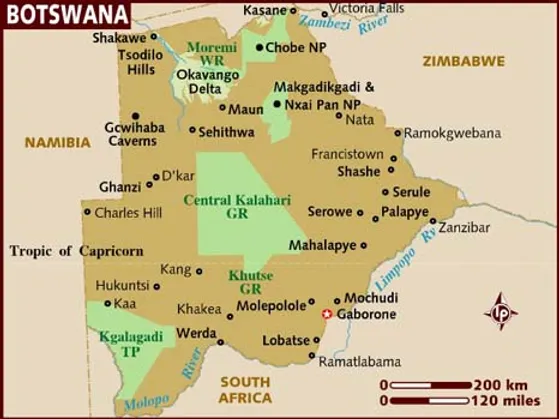
Malawi’s renewed attacks on persons with albinism raise alarm

Warning: the following post contains graphic details of abductions, mutilations and other criminal acts including murder which may upset readers.

Unfortunately, the abduction, mutilation and killing of persons with albinism for ritualistic purposes have never disappeared in the Southern African country of Malawi. I have devoted considerable attention to this in the past.

Without pretending to be exhaustive I refer to the following posts: 2015, 2016, 2018, 2019, 2020, 2021, 2022, 2024. Interested readers may use the dropdown menu (under ‘African countries’) for all posts on Malawi. For last year, 2025, I may refer to an article published by The Guardian, A friend killed, and inquiries shelved: life fighting the stigma of albinism in Malawi (not covered on the present ste). It draws attention to the increasing fear among people with albinism in light of the scheduled elections.

As has been reported before, there exists a link between an increase of reported ritualistic killings and elections (see my March 18 post) – and Malawi does not seem to be an exception – whereas the Association of Persons with Albinism in Malawi (APAM) has drawn attention to the connivance of certain politicians who obstruct fair investigations into reported attacks on people with albinism and ritual murder cases or sweep them under the rug, see my 2021 post on the subject.

5 facts about albinism in Malawi – Amnesty International (2016)

The Malawi-based journalist and media professional Benson Kunchezera has a strong focus on development reporting, particularly in areas such as agriculture, digital innovation, public health, and environmental sustainability. Besides the just mentioned areas of interest and competence he is also interested in human rights issues in particular the position of persons with albinism and their plight in some countries notably Malawi. I commend him for drawing international attention to the precarious position of people with albinism in Malawi and highly recommended reading his recently published article on this topic.

Malawi’s renewed attacks on persons with albinism raise alarm

Published: March 18, 2026
By: Benson Kunchezera – Fair Planet, Malawi

Attacks, abductions, and grave tampering targeting persons with albinism have resurfaced across Malawi in 2026, reigniting fears that the country’s progress on protecting this vulnerable community is unravelling. Civil society is fighting back — but without a renewed national action plan, advocates warn the worst may be yet to come.

The story of Flora Saidi remains one of the most painful reminders of the violence faced by people with albinism in Malawi. According to accounts documented by advocacy organisations supporting persons with albinism in the country.
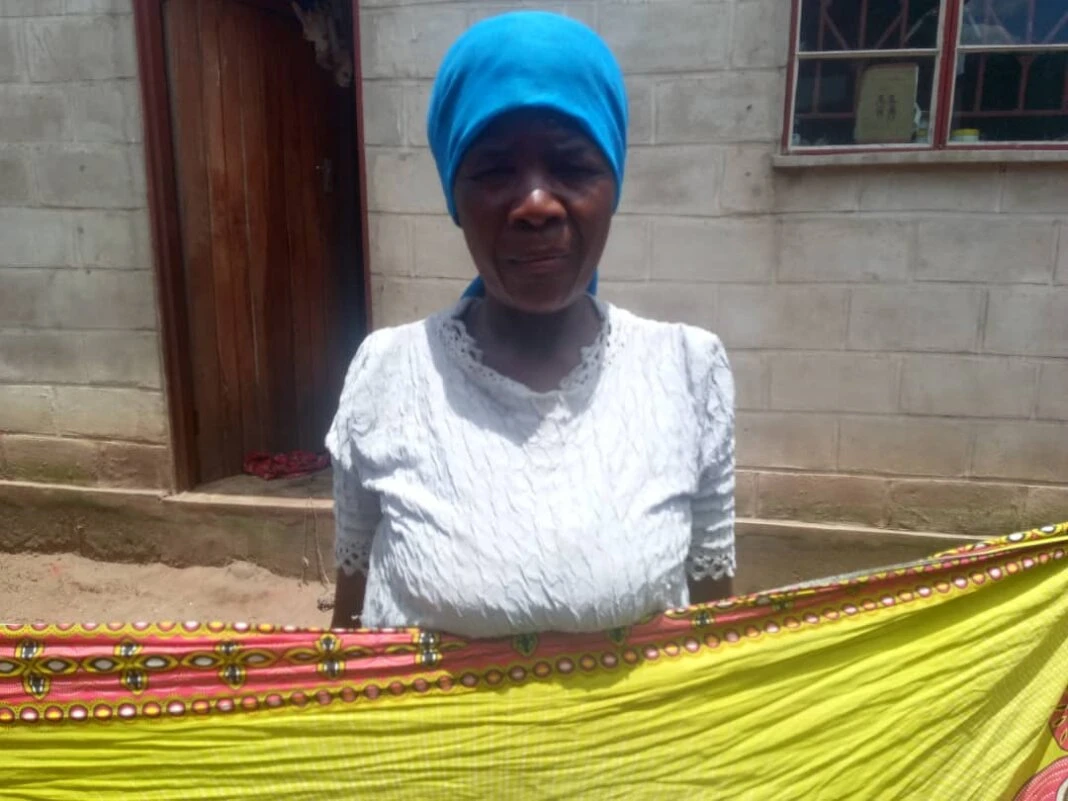
Flora Saidi

It was a Monday morning in 2003 when Flora Saidi left her home in Kadewere village under Traditional Authority Chowe in Mangochi, hoping to find piecework to feed her family. She left behind her 19-year-old son, Saidi Daitoni, a young man with albinism.

When she returned home empty-handed later that afternoon, her son had managed to earn a small amount of money. They agreed to share it with his girlfriend, who was visiting. Saidi left with her to look for change so they could divide the money properly. He never returned.

The following morning, Flora began searching for him. By then, he had disappeared. Police were informed, and after a search, his body was discovered near a residence he had visited the previous evening. Some of his body parts had been removed. The perpetrator was later sentenced to 155 years in prison with hard labour.

PERSISTENT THREATS IN RURAL MALAWI

Malawi has 134,636 persons with albinism, with over 117,000 living in rural areas. It is in these rural communities where poverty, limited law-enforcement presence, and entrenched myths combine to create dangerous conditions.

For years, people with albinism have faced abductions, killings, and grave tampering, fuelled by beliefs that their body parts can bring wealth and good fortune through ritual practices. 

Persons with Albinism, especially in the southern African regions face persecutions, because their body parts are believed to bring lack of wealth after being mixed with some concoctions by a witch doctor. 

Others believe that when they have unprotected sexual intercourse with a person with albinism they can get cured of HIV/ AIDS.

The Association of Persons with Albinism in Malawi (APAM) has documented fresh cases in districts including Mulanje, Kasungu, and Dowa. Grave tampering and disappearances have reignited fear among families who had begun to feel cautiously safe.

According to United Nations Statistics, in 2014 alone police recorded 160-170 reported cases of attacks and abductions of Persons with Albinism.

In February 2018, Amnesty International published a joint report by the Ministry of Justice and Constitutional Affairs and the Malawi Police Force with 148 cases reported in Malawi’s four districts.

Recently, in 2026, more than  4 cases of persons with Albinism have been recorded by the Malawi Police Service ranging from attacks, abductions and tampering of graves in some parts of the country.

“We thought we were coming to an end of these attacks,” Maynard Zacharia, APAM’s National Coordinator, told FairPlanet. “Now we are seeing signs that the underlying issues were never fully resolved.”
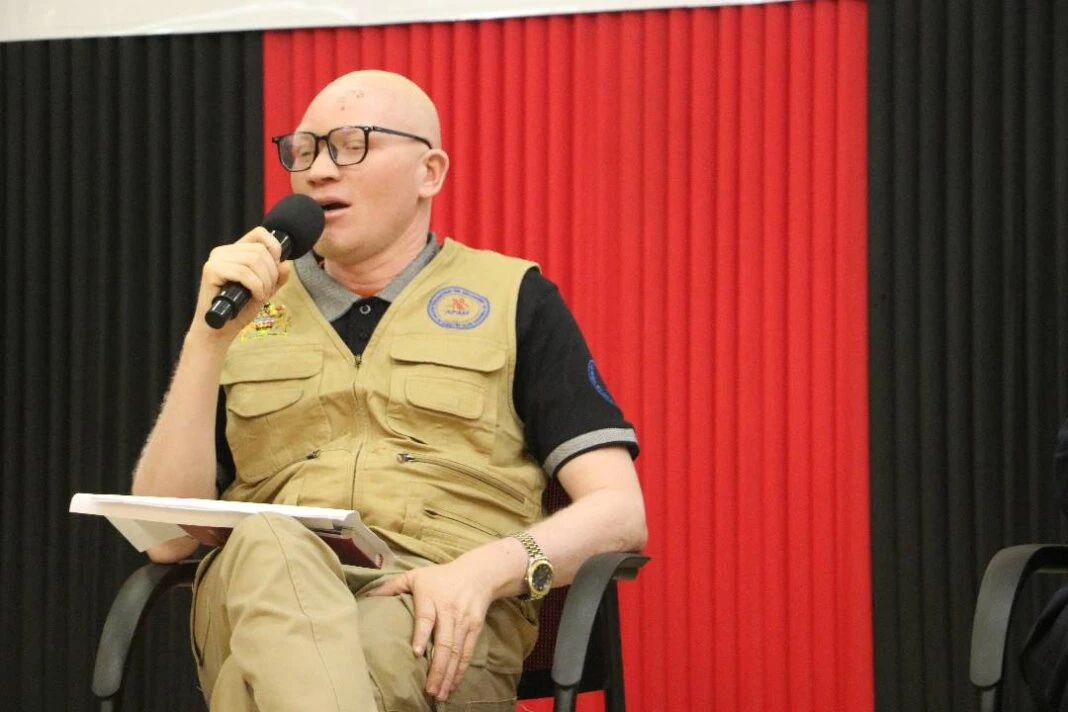
Maynard Zacharia

COMMUNITY PROTECTION IN ACTION

In response, APAM has intensified its on-the-ground efforts. The organisation is not only condemning attacks publicly but also mobilising communities in  hotspot districts such as Machinga.

One strategy involves relocating children with albinism from high-risk areas to safer homes. In some cases, this means placing them in boarding facilities or with vetted guardians where security is stronger. At the same time, APAM is lobbying authorities and partners to invest in secure-housing projects with reinforced doors, burglar bars, and community-based surveillance systems.

Beyond physical protection, APAM is conducting awareness campaigns aimed at dismantling the myths that drive violence. Working with chiefs, faith leaders, and local youth groups, activists hold community dialogues that confront harmful beliefs directly. In village meetings, survivors and families share testimonies, reframing albinism as a genetic condition rather than a mystical anomaly.

“These conversations are not easy,” Zacharia told FairPlanet. “But we have seen that when traditional leaders publicly reject the myths, attitudes begin to shift.”

The organisation is also pressing for the conclusion of more than 28 long-pending court cases involving murder and abduction. By monitoring proceedings and engaging legal-aid partners, APAM hopes to prevent cases from stalling indefinitely — a pattern that  erodes public trust.
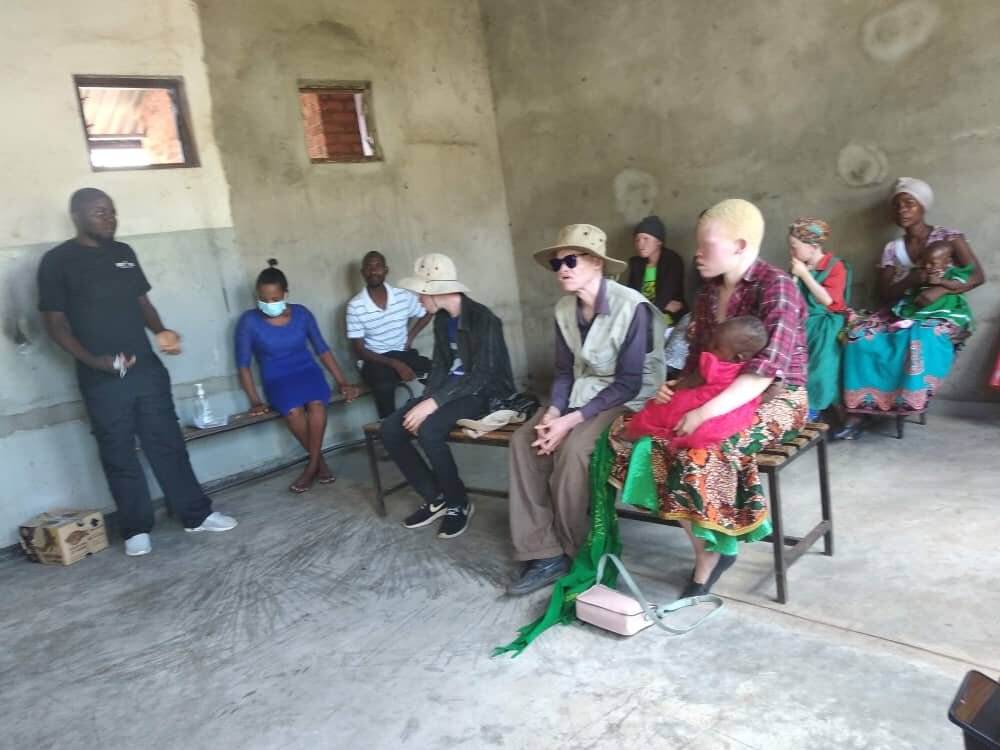
APAM Outreach Programme

DEMANDING ACCOUNTABILITY

Civil society actors argue that justice delayed is justice denied. The Centre for Human Rights and Rehabilitation (CHRR), led by Executive Director Michael Kaiyatsa, has been vocal about the need for stronger political will.

Kaiyatsa told FairPlanet that fear remains a major barrier to reporting threats. In rural areas, families often hesitate to approach police due to mistrust in the justice system and fear of retaliation.

According to him, the situation was further complicated by the controversial pardon of police officers previously convicted in connection with an albinism-related killing. For rights groups, the decision sent a damaging signal.

“To victims’ families, it suggested that justice can be undone,” Kaiyatsa told FairPlanet. “To would-be offenders, it reinforced the perception that accountability is not guaranteed.”
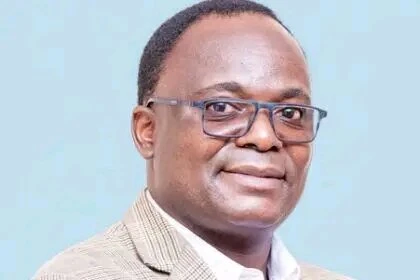
Michael Kaiyatsa

In response, CHRR and other organisations have stepped up advocacy for witness-protection mechanisms and independent monitoring of investigations. They are pushing Parliament and relevant ministries to allocate dedicated funding for protection programmes and to ensure that cases are prioritised within the judiciary.

REVIVING NATIONAL COMMITMENTS

Malawi once drew international praise for adopting a National Action Plan on the Protection of Persons with Albinism. However, the plan expired in 2022 and has yet to be renewed, leaving what activists describe as a dangerous coordination gap.

For activists, national-level commitment must translate into practical measures: timely investigations, functioning hotlines, trained police officers, and community-based protection committees.

“Commitments on paper are not enough,” Zacharia says. “We need implementation that reaches the village level.”

REBUILDING TRUST FROM THE GROUND UP

On the ground, solutions are increasingly community-driven. In some districts, local committees made up of chiefs, police representatives, teachers, and activists meet regularly to assess risks and share information. Informal early-warning systems — such as community WhatsApp groups with coordinated night patrols-have been introduced in certain high-risk areas.

Civil society organisations are advocating for long-term assistance for affected families, including counselling, educational support for orphaned children, and income-generating projects for households that have lost breadwinners.

These initiatives aim not only to respond to attacks but to address their ripple-effects — school dropouts, psychological trauma, and deepening poverty.

A FRAGILE BUT DETERMINED PROGRESS

Organisations such as the Scotland Malawi Partnership insist that regression is not inevitable. They point to the increasing visibility of persons with albinism in advocacy spaces, media platforms, and leadership roles.

Flora Saidi, though still grieving, has participated in community meetings where she shares her story. Her testimony serves both as a warning and a call to action.

For Malawi, the struggle to protect persons with albinism is about more than ending ritual killings. It is about strengthening rural policing, restoring faith in the justice system, and dismantling centuries-old myths. 

For people like Flora Saidi, safety is still uncertain, but hope lies in the quiet work happening in villages and communities across Malawi.

Their efforts may not end the attacks overnight. But for families living in fear, each community meeting, each court case and each safe home built is a step toward something simple with the chance to live an ordinary life without fear.

Source: Malawi’s renewed attacks on persons with albinism raise alarm

2027 elections: Nigerian Bishop Wale Oke warns politicians against ritual killings

On February 16, 2027 Presidential and National Assembly elections will be held in Nigeria, as announced by the country’s Independent National Elections Commission (INEC).

Unfortunately, Nigeria is not the only African country where persistent rumours and even hard evidence point to ambitious politicians who have resorted to ritual practices, including ritual murder, in order to achieve their goal of being elected. I have highlighted this on this site on several occasions referring to countries in West, Central and Southern Africa. See e.g. the following posts with respect to Eswatini (ex-Swaziland), Gabon, Liberia, Sierra Leone, Zambia.

In this light the warning of te President of the Pentecostal Fellowship of Nigeria, Bischop Wale One, must be understood. I wish to underline that his warning is not to be misunderstood: not every politician, elected or not yet elected, ambitious or not, in Nigeria or another African country believes in supernatural powers. Certainly, the majority doesn’t. But we also have to face a grim realty and that is the importance of bishop Oke’s statement. We cannot bury our heads in the sand regarding what is actually happening. It is precisely the involvement of certain politicians that stands in the way of a robust and effective crackdown on the phenomenon of ritual killings in a number of African countries.
(webmaster FVDK)

2027: PFN President Bishop Wale Oke warns politicians against ritual killings

The President of the Pentecostal Fellowship of Nigeria, Bishop Wale Oke

Published: March 18, 2026
By: Wale Akinselure – Punch, Nigeria

The President of the Pentecostal Fellowship of Nigeria, Bishop Wale Oke, has warned that God’s judgment awaits politicians who resort to ritual killings and other violent means to gain power ahead of the 2027 general elections.

Oke, who is also the Prelate of the Calvary Grace International College of Bishops, spoke on Tuesday in Lagos while delivering a state-of-the-nation address to herald a special ministers’ empowerment conference organised by the college.

The cleric condemned what he described as “blood politics,” cautioning politicians against violence, killings, and fetish practices in their quest for power.

He said, “There is no position that you’re going for that is worthy of the blood of any Nigerian.

“There should be no politics of murder and killing. Present your case to the Nigerian populace, argue your case, promise whatever you want to promise, but don’t promise lies.”

He warned that any politician engaging in ritual practices or killings to win elections would face divine consequences.

“The age of going for fetish rituals is gone. We are praying for Nigeria that God will judge any politician that will resort to fetish things, ritual killings and murder to come to power,” Oke said.

Addressing voters, the cleric urged Nigerians, particularly youths, not to sell their votes during elections.

“Don’t sell your vote; your vote represents your political power and your future security. If you sell your vote, you are selling your future,” he said, adding that vote-buying would end if voters refused to participate in it.

Oke also called on the Independent National Electoral Commission to conduct free and fair elections without interference.

“Let INEC do its job as provided in the constitution. Let all parties go to the polls to test their popularity, and whoever emerges should be accepted,” he said.

The cleric further advocated a review of Nigeria’s constitution, describing it as flawed and not reflective of the country’s diversity.

“The Constitution was imposed on us and is unfair. It does not represent all Nigerians. If religion must be included, then all religions should be represented equally. Otherwise, let religion be a private matter,” he said.

Oke also alleged that killings in parts of the country had religious undertones and called for urgent action to address insecurity.

“If there is no Christian genocide, what is happening in Benue, Taraba, Borno and Plateau states?” he queried.

He urged Christians to actively participate in politics rather than remain on the sidelines.

“If we keep saying politics is dirty and refuse to get involved, then we are allowing it to remain dirty. Let us get involved from the grassroots and change the narrative,” he said.

He urged the Federal Government to cooperate with the United States to decisively deal with terrorists.

Recognising poverty as a problem, Oke urged the federal and state governments to heavily invest in education and the creation of jobs for the huge population of youths.

Rather than doling out bags of rice as empowerment, Oke urged the Federal Government to create jobs through the establishment of cottage industries in each of the 774 local government areas and the engagement of 1,000 people  each.

He also called for support for youth entrepreneurs and farmers, while calling for massive investment in agriculture to ensure food security.

“We should no longer import a lot of things; we should be producing what we need. The economy should drive innovation as the distribution of rice is not a permanent solution to poverty,” Oke said.

Source: 2027: PFN President warns politicians against ritual killings

South Africa: EFF leader Julius Malema condemns ritual killings ahead of local government elections

The controversial South African politician Julius Malema is the founder and leader of the Economic Freedom Fighters (EFF), a black nationalist political party that adheres to communist principles and goals. The EFF is the fourth-largest party in the National Assembly. Julius Malema hails from Limpopo Province, where he was born in 1981. After the passing of his mother, a single parent, he was raised by his grandmother.

On Tuesday, February 24, during a joint session of the National Assembly and the National Council of Provinces, he made a number of attention-grabbing statements which can’t surprise since coming from the mouth of an – orally gifted – opposition politician. While Malema didn’t spend many words on ‘muti murders’, he was clear in his condemnation of them. The connection he made with local government elections is no coincidence, even though we must realize that he was primarily speaking as an opposition politician. South Africa isn’t the first or only SSA country where political elections are accompanied by an increase in ritual killings. Sadly, the existence of a link between politics and ritual murder is a reality in a number of African countries.

For the sake of clarity, I want to emphasize here that this last comment should not be interpreted as an accusation against all politicians and political candidates. I’ve said before on this site that we must be careful not to generalize.

But we cannot deny reality either.
(webmaster FVDK)

South Africa: opposition politician and EFF leader Julius Malema condemns ritual killings ahead of local government elections

EFF leader Julius Malema warned President Cyril Ramaphosa, condemning ritual killings (image: EFF)

Published: around February 24, 2026
By: Simon Majadibodu – The Mercury, South Africa

Economic Freedom Fighters (EFF) leader Julius Malema has sent a stern warning to President Cyril Ramaphosa, saying that as long as the red berets remain in Parliament, the Phala Phala scandal “will never die.”

Malema made the remarks during a joint sitting of the National Assembly and the National Council of Provinces on Tuesday afternoon, as MPs debated Ramaphosa’s recent State of the Nation Address (SONA).

The debate will continue on Wednesday at 2pm, with the president expected to reply on Thursday at 2pm.

“Mr President, we warned you eight years ago that the Oppenheimers and the Rupperts would neutralise you, and your legacy would be that you auctioned our country and its strategic assets to the highest bidder. You did not heed our warning,” Malema said.

“You have auctioned our sovereignty to asset management companies such as BlackRock, which is why you have praised the growth of the Johannesburg Stock Exchange (JSE).”

Malema accused Ramaphosa of selling state infrastructure, including ports, railways, and energy generation capacity, to the private sector, and warned that water could be next.

He said the president had failed to take responsibility for creating jobs.

“You do not take responsibility for fighting crime. You do not take responsibility for infrastructure development, and you do not take responsibility for growing our economy,” he said.

“There is no sign of any infrastructure for a bullet train, no design plans for a smart city, and not even a curriculum for the institution of higher learning in Ekurhuleni, as you promised.”

Malema said, “You asked us to send you Thumamina, and we made a mistake. And as your term of office comes to an end, you have nothing to show for it.”

He criticised Ramaphosa’s handling of crime, saying that deployment of the South African National Defence Force (SANDF) to Gauteng and the Western Cape is a last resort.

“You are admitting that you have failed to fight crime. The people of Gauteng have been terrorised for too long by the so-called Zama-Zamas, and on the deployment of the army, we have no choice but to support you, because you have destroyed law enforcement capacity.”

Malema questioned whether the military, weakened by austerity measures and humiliated abroad, could tackle crime domestically.

“Our concern is, how do you deploy a military which has been crippled by austerity measures to fight crime? Because we know that our military is under-strained and under-resourced, and has been humiliated in war zones abroad. How do you intend to ensure they can fight crime domestically?”

He noted that the army is trained for combat, not civilian law enforcement.

“The scale of crime in our country cannot be dealt with by the army alone, because crime is a national crisis and a social crisis. If we do not resolve the challenges of unemployment, alcohol and substance abuse, and the high drop-out rates of youth from schools, then crime will be a permanent feature in our society.”

“Crime in South Africa is organised through drug syndicates, protection fee rings, sex trafficking rings, and gangs. It has infiltrated all forms of government, and putting guns in the streets alone will not resolve this crisis,” Malema said.

He added that the root of the problem in the criminal justice system begins with Ramaphosa’s own political party.

“The biggest syndicate is the political party you are leading, Mr President… Mr President, subjectively, this government has done nothing to grow this economy or to strengthen our courage.”

Malema said it was important to remind Ramaphosa of his own commitments.

“Last year, on this same platform, you committed to grow the economy by 3% through infrastructure investment, structural reforms, and inclusive growth and employment.”

“You no longer speak of this figure, and the National Treasury itself predicts economic growth at 1.5%, and will most likely revise this projection downward as the year progresses, because that is their tradition.”

He said Ramaphosa presents a budget surplus as a positive economic indicator, but this reflects austerity rather than progress.

“Why would you be proud of a budget surplus in a country with massive unemployment, collapsing municipal infrastructure, and poverty which is leading to the death of children in the Eastern Cape?

”Your pride when it comes to EPWP jobs is something you should be ashamed of and not mention at this level of governance. Those are temporary jobs which are used to secure income for volunteers of your political party.”

Malema criticised the insecurity of Expanded Public Works Programme (EPWP) jobs.

“It enslaves jobs with no security because it cannot secure a car or a home with an EPWP job.”

He said the electricity crisis in South Africa is far from over.

“The mistake you are making in declaring an end to the electricity crisis is the same mistake you have made with the water crisis for decades in this country.”

“Now that the people of Sandhurst no longer experience an electricity outage, you no longer view it as a crisis, forgetting the people of Soweto, Mdantsane, Seychelles, and Ditsobotla.”

He claimed Ramaphosa had given load shedding a new name: “load reduction.”

“On top of that, you have lost control of the pricing regime of electricity, and Nersa is announcing an increase in the cost of electricity every few months.

“Your municipalities do not have an idea of the infrastructure they are seized with governing. It does not matter how many billions of rands you give them to revive water infrastructure.”

Malema said ministers and mayors lacked knowledge of town planning and water infrastructure.

“The fact of the matter is your minister and your mayors do not know the town planning of where water infrastructure begins and where it ends. This is why they respond to burst pipes and leakages as they happen and run after one pipe to the other.”

He praised EFF MMC for water in Ekurhuleni, Thembi Msane, who has been declared a “water champion.”

“When your minister (Pemmy Majodina) was running around complaining about water, our MMC of water in Ekurhuleni was given an award the same week and declared a water champion.”

“Instead of benchmarking from the DA, which struggles to provide clean water to people in the city, go and benchmark from the EFF department in Ekurhuleni on how to fix the water crisis.”

Malema said municipalities will not be fixed unless the equitable share model is revised.

“The idea that all municipalities can be self-reliant on revenue generation when you preside over a country that is massively de-industrialising and suffering massive unemployment is misguided.”

He called for stronger municipal capacity and recovery of revenue from major industries, offering incentives to industries for investing in municipal infrastructure.

Malema said the EFF supports Ramaphosa’s posture on international relations, including support for Palestine, Western Sahara, South Sudan, and Cuba.

“We agree with you that Africa must begin to negotiate its trade relations as a bloc and with unity, and that no nation must ever think it has the right to bully us and impose on us who our friends must be and who our enemies must be.”

He condemned xenophobic violence and ritual killings ahead of local government elections. (italics and bold letter-type added by the webmaster FVDK).

“They must ask their friends who came here with the name of killing foreigners. They did not win elections. Xenophobia will never win elections, and some of them are found in your cabinet.”

Malema urged Ramaphosa to take concrete action against Israel.

“You must exhibit your courage by closing the Israeli embassy, which is a resolution of this nationalism. You have declared their representative persona non grata, and the skies did not fall. Close their embassy and cut relations with this genocidal nation.”

He criticised the US diplomat, calling the appointment “rampant racism” and asserting the country has the right to refuse cooperation.

Malema said the Phalaphala scandal had rendered Ramaphosa ineffective in dealing with corruption and incompetence.

“When Dr Zweli Mkhize was found to be involved in a digital pipe scandal, you did not have the courage to remove him. He resigned. Today, Zweli Mkhize is chairperson of the Portfolio Committee on Cooperative Governance and Traditional Affairs.

“While David Masondo was identified as being a key part of corruption in the State Security Agency by the Zondo Commission, you did not remove him. Today he is Deputy Minister of Water and Sanitation.”

He also criticised the handling of suspended Police Minister Senzo Mchunu and minister of Water and Sanitation Pemmy Majodina, accusing Ramaphosa of creating task teams instead of exercising consequence management.

“If you have the courage to remove her, remove her now so that you demonstrate that you’ve got the courage.”

Malema slammed Gauteng Premier Panyaza Lesufi for suggesting citizens shower at hotels during water outages.

However, Lesufi later apologised.

“When you assumed office, you claimed it would be a transparent presidency, then proceeded to sell CR17 documents of your campaign and block investigations on Phalaphala. Where’s the transparency?”

“Let me reassure you, Mr President: as long as the EFF is alive and in Parliament, Phalaphala will never die.”

The EFF has long called for the Constitutional Court to release its delayed judgment on the Phalaphala matter, accusing the judiciary of undermining constitutional supremacy.

The party centres on the 2020 theft of an estimated R10 million from Ramaphosa’s farm and the alleged unlawful cover-up, arguing that delays in the impeachment-related case heard in November 2024 have eroded public confidence in the judiciary.

simon.majadibodu@iol.co.za 

IOL Politics 

Source: Malema warns Ramaphosa Phala Phala scandal ‘will never die’

Kenya: The ‘torch ritual’: House Speaker Wetang’ula ‘haunted’ as DCI probes Jirongo death mystery

Kenya is not often in the news when it comes to witchcraft and superstition, but this does not mean that these phenomena are unknown there. The following report bears witness to this.
(webmaster FVDK)

The Torch Ritual: Wetang’ula “Haunted” as DCI Probes Jirongo Death Mystery

Speaker Moses Wetang’ula records a statement with the DCI regarding the death of Cyrus Jirongo, as rumors of a traditional “torch ritual” to expose his killers grip Western Kenya.

Published: January 21, 2026
By: Stamline – Kenya

National Assembly Speaker Moses Wetang’ula has found himself at the center of a macabre political storm, recording a statement with the DCI as rumors of a traditional “torch ritual” swirl around the sudden death of veteran politician Cyrus Jirongo.

Jirongo, a former cabinet minister and one-time kingmaker, died in a grisly road accident on the Nairobi-Nakuru highway in December 2025. While police maintain it was a tragic crash, whispers of assassination have refused to die, fueled by leaders from the Western region who are demanding answers.

The “Lit Torch” Ultimatum

The saga took a supernatural turn when elders from Jirongo’s Tiriki community threatened to bury him with a “lit torch”—a traditional curse believed to hunt down killers. “If the torch goes out, the killer dies,” warned Saboti MP Caleb Amisi. Now, social media is abuzz with claims that the “torch is working,” casting a shadow over the Speaker.

  • The Last Meeting: Wetang’ula revealed he was one of the last people to see Jirongo alive. They met for an hour on Jamhuri Day evening, a meeting the Speaker described as “ordinary” but which detectives are now scrutinizing for clues.
  • The Probe: Wetang’ula is among 28 individuals questioned by the DCI. Detectives are reconstructing Jirongo’s final 24 hours to rule out foul play.
  • The Politicization: The Speaker has warned against politicizing the death, pleading with leaders to respect the family. “I don’t want to be cheered or jeered. This death touches me personally,” he told mourners.

A Region on Edge

The death has reopened old wounds in Western Kenya politics, with factions trading accusations. The DCI’s investigation is now a race against time to provide a scientific explanation before the narrative of “witchcraft and assassination” takes permanent root.

For Wetang’ula, the third most powerful man in the country, the ghost of his longtime friend—and the glowing embers of the Tiriki torch—pose a unique and unsettling challenge.

Source: The Torch Ritual: Wetang’ula “Haunted” as DCI Probes Jirongo Death Mystery

Ritual killings: Experts call for urgent action over rising cases in Northern Nigeria

Warning: the following post contains graphic details which may upset readers (webmaster FVDK)..

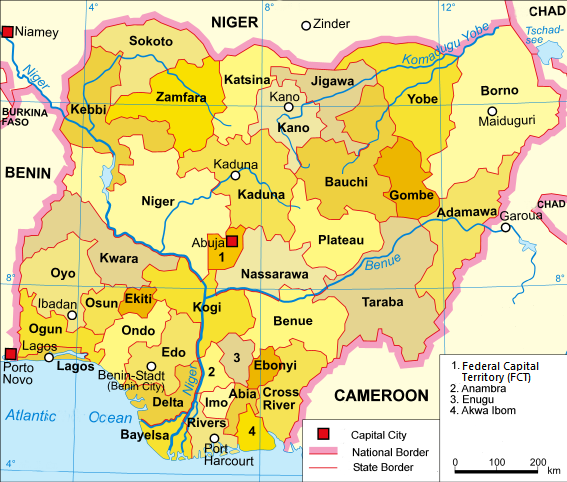
Nigeria is a federal republic comprising 36 states and the Federal Capital Territory (FCT) of Abuja. The 36 states are divided into six geopolitical zones commonly called zones.

Nigeria’s six geopolitical zones

The North West (NW), North East (NE) and North Central (NC) zones constitute Northern Nigeria. Politically, historically and culturally we may distinguish Northern and Southern Nigeria, but these broad categories don’t do justice to the great differences that exist within these areas. When I first went to Nigeria, in 1999, I asked a friend who knows the country very well what to expect. ‘Nigeria is a nice set of countries‘, she said.

This short statement says it all. It’s hard to speak of one country, although it has one constitution and one flag and is a member of many international organizations.

The Northern region consists of 19 states and the Federal Capital territory (FCT) of Abuja, the Southern region houses 17 states.

Map of Nigeria showing states in the northern and southern regions.

In the past I have on many occasions paid attention to the scourge of ritualistic murders in Nigeria and related practices such as abductions and torture. Let me suffice to refer to my recent post dated March 15, The horror of ritual killings in Nigeria, which also includes ritual murder cases in Northern Nigeria.

The article below provides several examples of reported ritual murders both in Northern and Southern Nigeria. The author, Hadiza Musa, pleading for more attention to the surge in ritual killing in northern states, reports that ‘Between January and April 2025 alone, at least 10 cases have been reported across Kwara, Nasarawa, Jigawa, Benue, Abuja and Bauchi states.’ Not surprisingly, residents of northern states (Kaduna, Kano, Katsina) came into the public eye calling for the death penalty for ritual killers and cannibals.

Moreover, it is necessary to emphasize that the number mentioned above refers only to reported ritual killings, and thus in all likelihood is only the tip of the iceberg.

On more than one occasion I’ve stated here that most likely Nigeria holds a dismal continental record of being the country with the highest number of ritual murders – only partly explained by being Africa’s most populous country. Hadiza Musa refers to research by an NGO, the West African Network for Peace Building, revealing that Nigeria recorded 185 ritual-related deaths between January 2021 and January 2022.

In addition, the National Bureau of Statistics (NBS) reported that over 150 ritual killing cases often linked to young people seeking quick wealth, were recorded in Nigeria in the past six months.
(FVDK)

Ritual killings: Experts call for urgent action over rising cases in Northern Nigeria

Published: April 8, 2025
By: Hadiza Musa – Daily Post, Nigeria

“Ritual Killing” a term referring to the intentional murder of individuals for spiritual, economic, or supernatural purposes, often involving body mutilation or organ harvesting were often associated with Southern Nigeria where they were linked to wealth-seeking practices, political power struggles, and deep-rooted traditional beliefs.

Over the years, several high-profile cases have reinforced this perception.

One of the most infamous cases was the 2004 Okija Shrine discovery in Anambra State, where the police uncovered dozens of human skulls and decomposing bodies allegedly used for sacrifices by politicians and businessmen.

Similarly, in 2014, the Ibadan ‘Forest of Horror’ was exposed, revealing a den of ritualists who had abducted, killed, and harvested body parts from their victims.

In recent years, however, there has been a notable shift, with cases of ritual killings increasingly reported in Northern states such as Kwara, Nasarawa, Jigawa, and Bauchi.

While ritual killings were once largely associated with Southern Nigeria, the rising economic challenges and the erosion of moral values have played a significant role in their spread to the North.

Between January and April 2025 alone, at least 10 cases have been reported across Kwara, Nasarawa, Jigawa, Benue, Abuja and Bauchi states.

In January and in Nasarawa State, Timileyin Ajayi, described as a gospel singer, allegedly murdered a lady, 24-year-old Salome Adaidu, and dismembered her body.

He was caught carrying the severed head of his victim in a bag, which alarmed onlookers, leading to his apprehension.

When he was arrested by the police, other dismembered parts of the deceased’s body were recovered from his home.

The deceased, Salome Adaidu was identified as a member of the National Youth Service Corps who was serving in Abuja.

Also, in Kwara, a final-year student, Hafsoh Lawal, was lured and killed by Abdulrahman Bello, a self-proclaimed cleric and her boyfriend whom she met on Facebook.

According to the Kwara State Police Command, the 29-year-old suspect killed Lawal and dismembered her for alleged ritual purposes at a location in the Olunlade area of Ilorin on Tuesday, February 11, 2025.

The headless corpse of the pupil was discovered by the roadside in Jikas-Dabaja village, Gwaram Local Government Area, Jigawa on March 12 (Wednesday).

The body was mutilated, with the private parts removed, prompting the police to launch an investigation into the circumstances surrounding the gruesome act.

On Sunday, March 16, the Police Command in Jigawa State announced the arrest of a 45-year-old suspect in connection with the crime.

The suspect, a teacher of the deceased, was apprehended and detained following a tip-off.

Experts call for urgent action as ritual killings surge in Northern Nigeria

The incidents and many others highlighted the urgent need for comprehensive measures to address ritual killings in the region with stakeholders, attributing the trend to economic struggles, poverty, and lack of education.

Comrade Umar Hamisu Kofar Naisa, Executive Director of the Society for Educational Development and Socio-Democratic Activities (SEDSAC), linked the surge in ritual killings to poverty and the worsening economic conditions in the region.

He told DAILY POST that illiteracy and lack of education play a significant role in fueling such heinous acts.

According to him, ritual killings violate human rights, instill fear, and create insecurity in communities.

“If we examine the situation closely, ritual killings not only violate human rights but also instill fear and insecurity in communities. The psychological trauma experienced by victims’ families and survivors is immeasurable,” he stated in an interview with DAILY POST.

On legal responses, he urged the government to strengthen policies that protect human rights and enact specific legislation to prosecute perpetrators of ritual killings.

He also stressed the need for collaboration among various stakeholders to curb the menace.

Hamisu called on NGOs to intensify awareness campaigns on the dangers of ritual killings, provide support to victims’ families, and advocate for policy reforms.

“We must ensure that policies are created and enforced to put an end to ritual killings in Nigeria,” he added.

He further advocated for grassroots strategies and community engagement, emphasizing the role of traditional and religious leaders in tackling the issue.

“What was once seen as a problem in the South is now happening here. We must work together to stop it,” he urged.

Suleiman Hamza, a student in Ibrahimul Ahmadul Qadhi Islamiyya, highlighted the strong stance of both Islam and Christianity against killings.

He referenced Islamic teachings, noting that taking a life unjustly is akin to killing all of humanity.

“In Islam, the sanctity of human life is paramount. Even in cases of accidental killing, compensation is required, which today can amount to as much as ₦344.8 million,” he explained in an interview with DAILY POST.

Hamza described ritual killings as a new and disturbing phenomenon in the North, stating that in some cases, perpetrators even resort to exhuming corpses from graves for ritualistic purposes.

According to him, there have been more sermons in both churches and mosques, as well as intersectoral conferences and seminars, emphasizing the need to address ritual killings and their root causes.

He called on religious leaders to intensify sermons against such practices and educate the public on the severe consequences of engaging in ritual killings.

Nigeria accounts for a significant number of ritual killings

According to research by an NGO, the West African Network for Peace Building, Nigeria recorded 185 ritual-related deaths between January 2021 and January 2022.

The National Bureau of Statistics (NBS) revealed that over 150 ritual killing cases often linked to young people seeking quick wealth, were recorded in Nigeria in the past six months.

The experts argued that the surge in ritual killings in Northern Nigeria signals a disturbing shift that demands urgent intervention and unless decisive action is taken by policymakers, security agencies, and societal leaders, ritual killings could become an even greater threat to public safety and human rights in the region.

Source: Ritual killings: Experts call for urgent action over rising cases in Northern Nigeria

Tanzania: Police crackdown on rising ritual killings in Singida Region

It’s unclear whether the rising numbers of missing persons, abductions and suspected and confirmed cases of ritualistic killings are related to internal Tanzanian politics. However, what is clear is that there is is increasing level of insecurity in certain parts of this East African country notably in the Singida region whereas the role played by certain witchdoctors seems undeniable.

The Tanzanian police arrested seven people. Will this stop the abductions and killings? It all depends on the follow-up of these arrests – and may be more to come? – that is to say it all depends on the authorities to show seriousness and perseverance to restore security and the rule of law in the country thereby restoring confidence in their government of local residents.
(webmaster FVDK)

Tanzania: Police crackdown on rising ritual killings in Singida

The Tanzania Police Force spokesperson David Misime. PHOTO | COURTESY

Published: August 26, 2024
By: The Citizen, Tanzania

Source: Police crackdown on rising ritual killings in Singida

More:

Tanzania police arrest seven in connection with gruesome murders


Police spokesperson David Misime

Published: August 26, 2024
By: Sharon Sauwa – The Citizen, Tanzania
Sharon Sauwa is the The Citizen reporter based in Dodoma.

Source: Tanzania police arrest seven in connection with gruesome murders

And also:

Tanzania Police unveils shocking incidents of homicides, ritual killings

Police spokesperson David Misime

Published: August 24, 2024
By: The Citizen, Tanzania

Source: Tanzania Police unveils shocking incidents of homicides

And:

Opposition party Chadema demands judicial inquiry into abductions, ritual killings

Chadema national chairman Freeman Mbowe speaks during press conference in Dar es Salaam on August 22, 2024. PHOTO | SUNDAY GEORGE

Published: August 23, 2024
By: The Citizen, Tanzania

Source: Chadema demands judicial inquiry into abductions, killings

Map of Tanzania showing location of Singida region

Imo State, Nigeria: ritualists killed pregnant woman, dumped corpse in the bush 

A few days ago I posted a message on the daily occurrence of ritualistic murders in Nigeria, with an estimated population of 225 million people Africa’s most populated country. Below I present a recent case from Imo State.

It is not he first time people in Imo State are confronted with these heinous crimes. In January 2023 villagers in Arondizuogu took to the streets following a number of unexplained murders, presumably linked to politics, hence suspected to be carried out for ritual purposes.

Imo State is located in the South-East geopolitical zone of Nigeria, bordering Anambra State in the north, Rivers State to the west and south, and Abia State to the east.  The Federal Republic of Nigeria is divided into six geopolitical zones commonly called zones.

Imo State is Nigeria’s 16th most populous state with an estimated population of over 6 million (2024). With a surface area of 5,530 km2 it is  the third smallest state. The state capital is Owerri. 
(FVDK)

Ritualists killed pregnant woman, dumped corpse in the bush 

Published: May 29, 2024
By: Stories from Everest Ezihe,  Owerri/Imo State

Exhibiting serious act of wickedness, residents around the  Amaraku-Umudim road in Isiala  Mbano local Government Area, Imo State were startled as they woke up on Tuesday with the ugly sight of a decomposing body of a yet-to-be-identified woman found in the bush within the area.

The deceased was allegedly seen to be victim of ritual killing.

An eyewitness (names withheld) told The AUTHORITY that the persistent barking of a dog within the vicinity prompted some residents to enter the bush and made the eye sour discovery.

The commotion that followed the discovery triggered an upsurge of sympathizers  who also noticed  that the deceased was pregnant and and had her breasts and private parts chopped-off.

This prompted the sympathisers to rush to the Amaraku Police Station and reported the incident.

Thee Police Division consequently removes the corpse to nearby government hospital for autopsy and identification.

When contacted, the Imo State Police Command’s Spokesman, ASP Henry Okoye, said he had yet to be briefed on the matter.

Source: Ritualists killed pregnant woman, dumped corpse in the bush 

Botswana: President Masisi condemns ritual killings and mob justice

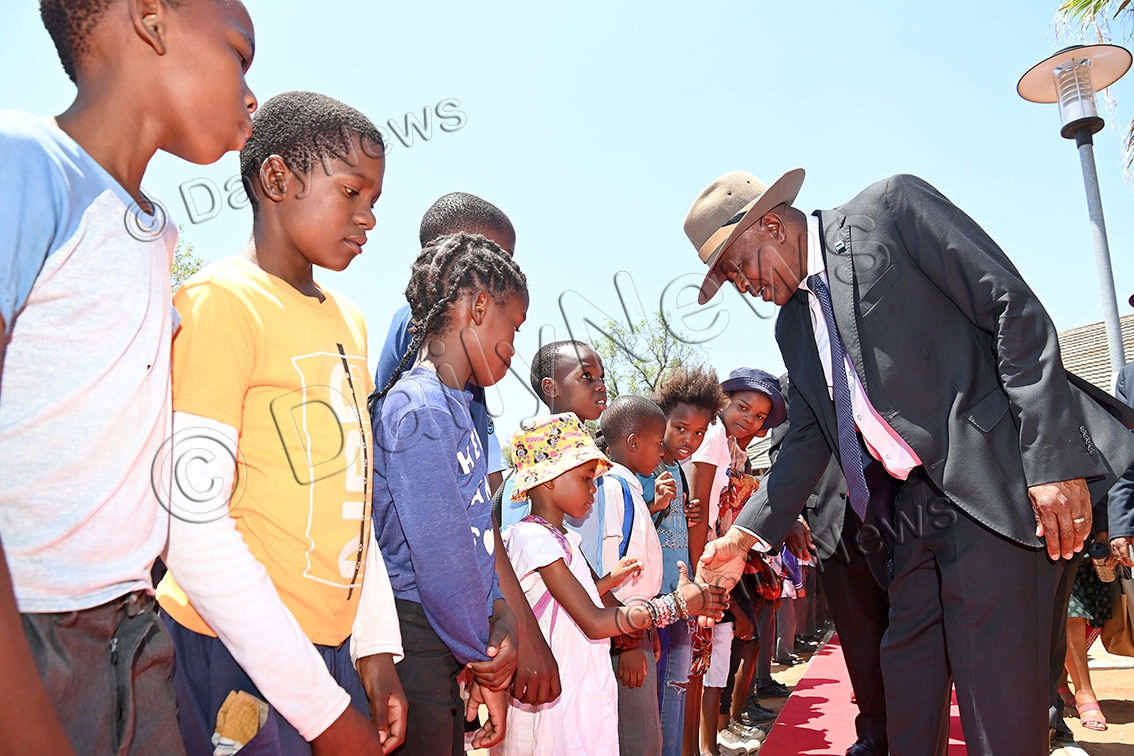
The relations between modern politics and politicians on the one hand and tribal chieftainship (bogosi) and tribal leaders (dikgosi, plural of kgosi) on the other constitute an interactive world and are not undisputed, Botswana President Dr Mokgweetsi Masisi was told at a kgotla meeting in Lerala on November 27. President Masisi urged politicians to desist from interfering in bogosi issues and urged dikgosi not to get involved in politics.
At the same occasion President Masisi warned against ‘jungle justice’, as had happened in Molepolole where citizens went on the rampage following the discovery of the body of a victim of a suspected ritual murder. He plainly condemned the recent suspected ritual killing incidents and arson that occurred in Molepolole. Read the full article below for the details.
(webmaster FVDK)

President Mokgweetsi Masisi condemns ritual killings and mob justice

Published: November 28, 2023
By: Portia Rapitsenyane – Botswana Daily News

President Dr Mokgweetsi Masisi has condemned the recent suspected ritual killing incidents and arson that occurred in Molepolole.

Addressing a kgotla meeting in Lerala yesterday, he said incidents of suspected ritual killings and burning of properties disrupted peace and stability in the country. He said these unfortunate occasions must stop and cautioned the community against taking the law into their own hands when they heard about such incidents.

In Molepolole, some residents torched houses, a shelter at the village kgotla and barricaded roads with tyres following the suspected ritual murder of a taxi driver, Phenyo Jakoba, whose body was discovered decomposed.

President Masisi said perpetrators of the arson were not different from ritual murderers. 

He pleaded with the public to always allow police to investigate cases and let the law take its course. President Masisi advised the public to be patient as investigations followed certain procedures that could take time to be completed. 

The public, he said should assist the police in their investigations instead of committing crimes.

The President also spoke against those who used social media to organise themselves to carry out attacks, warning  that action would be taken against them.

Responding to Kgosi Sello Moroka of Lerala, who had in his welcome remarks raised concern about politicians who got involved in bogosi issues, President Masisi urged politicians to avoid interfering in bogosi issues and also advised dikgosi against involvement in political matters.

On the request to consult and propose an establishment of buffer zones between Tuli Block farms and the border line between Botswana and South Africa, which was raised by the Village Development Committee chairperson Mr Leruo Matala, President Masisi said consultations on the subject were on going. 

Source: MASISI CONDEMNS KILLINGS

Nigeria: on the rising incidents of ritual killings

I’ve repeatedly drawn attention to the many ritual murders, or killings for ritual purposes, in Nigeria, Africa’s most populated country with a population exceeding 200 million souls. These ritualistic crimes are locally known as ‘money rituals‘. (Warning: the preceding link leads to a video with graphic details of ritual killings).

The following post is about the published worries of an individual, Safiyanu Ladan. He was so emotional about the spate of ritual murders in his country that when the new year 2023 was approaching he decided to write an open article which was first published by a leading Nigerian newspaper, the Daily Trust.

Safiyanu Ladan writes from Zaria, Kaduna State, and openly associates ritualistic murders to prominent businessmen and politicians. In the article he dwells on a ritual murder committed by a prominent businessman in Gusau, the capital of Zamfara State, in the north of the country.

It’s a well-known fact that in Nigeria and other countries ritual murders and elections are linked, with the number of alleged and confirmed cases of ritual murder increasing during election campaigns. Nigeria faces national elections in February this year (next month) when the people of Nigeria go to the polls to elect a new president and National Assembly.
(webmaster FVDK).

On The Rising Incidents Of Ritual Killings

Published: January 3, 2023
By: Safiyanu Ladan – Daily Trust, Nigeria

I feel compelled to register my concern on the rising spate of killings across the country supposedly by ritualists as the 2023 elections draw closer. Some politicians who are desperate to win the election have always resorted to these uncanny acts in a bid to attain power at all costs. Unfortunately, the perpetrators of these […]

The post On the rising incidents of ritual killings
appeared first on Daily Trust

I feel compelled to register my concern on the rising spate of killings across the country supposedly by ritualists as the 2023 elections draw closer. Some politicians who are desperate to win the election have always resorted to these uncanny acts in a bid to attain power at all costs.

Unfortunately, the perpetrators of these devilish acts have always gone free. It’s only on rare occasions that some arrests are made and after the suspects are ceremoniously paraded by the police one will never hear about the case again.

In January last year, Aminu Baba, a prominent businessman selling vehicles at Aminchi Motors, Gusau Zamfara State, after his arrest by the police, confessed to have eaten and sold human parts to some unknown persons.

In a video footage, the visibly unapologetic Aminu’s accomplice who was arrested alongside him had admitted the gruesome killing of a 9-year-old boy whose body parts were removed and sold to Aminu for N500,000.

It has been one year since such an unfortunate incident occurred, and the suspects and the police have promised to take them to court at the end of their investigation. The outcome of the court’s judgment on this heinous act is not yet available in the public domain.

Incidents such as this are being reported by the media and after initial reactions, the matter will just die off.

The unrelenting act of ritualists inflicting harm on unsuspecting members of society is of great concern, hence the need for security agencies to double their efforts in order to restore people’s confidence.

It is pertinent to note that the life of a human being is sacred, and as such, nobody should feel threatened that their life might be taken away in whatever form except according to laid down processes.

Safiyanu Ladan wrote from Zaria via uncledoctor24@gmail.com

The post On the rising incidents of ritual killings appeared first on Daily Trust

Source: On The Rising Incidents Of Ritual Killings

A surge in kidnapping, extrajudicial killings, ritual killings, and banditry in Nigeria’s South-East. 

Ritualistic activities and ritual murders are based on superstition, but the occurrence of ritual killings also has everything to do with the lack of rule of law. Countries with a weak rule of law tend to show a higher prevalence of ritual murders, be it a causal relationship or a correlation.

One such a country where a weak rule of law results in a high level of insecurity is Nigeria – as repeatedly stated on this site. Very likely, not all regions of Africa’s most populated country show a similar scale of insecurity. The article below focuses on Nigeria’s South-East.

The main theme of the article concerns the prevailing lack of security in the South-East. Ritual murders contribute to this high level of insecurity, as mentioned in the article – enough reason to include the article here (webmaster FVDK).

Nigeria’s South-East is plagued by a surge in cybercrime, armed robbery, kidnapping, domestic crime, extrajudicial killings, ritual killings, and banditry. 

Published: December 17, 2022
By: Garbxtpen (self media writer) – Opera News, Nigeria

Insecurity has been one of the major threats Nigerians are facing nowadays. Even though the Buhari-led administration has been putting everything in place to make sure that normalcy returns to every region of the country, some bad people in Nigeria are still causing havocs in some region of the country.

The South-East is plagued by a surge in cybercrime, armed robbery, kidnapping, domestic crime, extrajudicial killings, ritual killings, and banditry. However, while some people are so unfortunate to scrape through these insecurities, some Nigerians were so fortunate to escape from the dens of these perpetrators.

On Friday, Christopher Eleghu, the candidate of the Labour Party (LP) for Onuimo constituency, Imo state house of assembly in 2023 general election was reportedly killed by some unknown gunmen who stormed his house in the early hours of the day, the Punch reports.

An eyewitness who claimed anonymity disclosed that the gunmen who stormed the area operated for over two hours before they left the deceased’s house to also attack some other top politicians in the community.

While the eyewitness was further speaking to newsmen, he noted that when the villagers gathered at Eleghu’s house this morning, they all saw his dead body been inflicted with matchet cuts after the unknown gunmen killed him.

The eyewitness said, “They have killed Christopher Elehu, popularly known as Wasco. Until his death he was the Labour Party candidate in Onuimo Local Government Area. They invaded his house when everybody had gone to sleep and shot for over two hours. They killed the man and burnt his house. They also destroyed his property. His corpse was laying on the floor with matchet cuts when villagers gathered in the morning.”

Nevertheless, the Commissioner of Police in Imo State, Mohammad Ahmed Barde has vowed the the perpetrators of this crime would soon be arrested and charged to court for taking the life of this innocent LP chieftain.

Source: We Saw Eleghu’s Corpse Laying On The Floor With Matchet Cuts After The Gunmen Killed Him -Eyewitness