Nigeria: 166 ritual and cult related killings in the South West in 2023

Nigeria has an immense security problem. Boko Haram and other terrorists, armed criminal groups, bandits, kidnappers, communal clashes, political killings and – last but not least – ritual and cult-related murders terrorize the population of this West African country.

When President Bola Tinubu assumed office on May 29 last year he promised to end or reduce the insecurity in Africa’s most populated country (an estimated 225 million people in 2023). One year later we have a quick look at some data. The result is frightening.

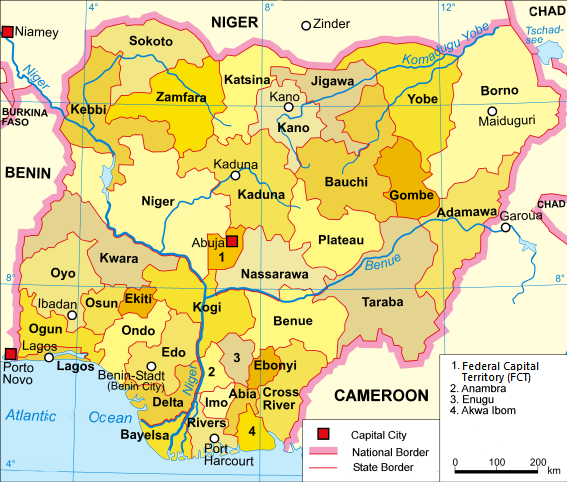
On this site I focus on murders for ritual purposes, therefor I will skip the other atrocities here (though mentioned in the article below). In 2023 there were reportedly 166 people murdered in ritual and cult-related killings in the South West. Presumably the author of the article, Jeph Ajobaju, refers here to the South West geopolitical zone.

The Federal Republic of Nigeria is divided into six geopolitical zones commonly called zones.

The six geopolitical zones of Nigeria

The South West geopolitical zone consists of  of Ekiti, Lagos, Ogun, Ondo, Osun, and Oyo States (6 out of Nigeria’s 36 states) with an estimated combined population of about 50 million people (2023).

Based on Ajobaju’s information that in the South West in 2023 166 persons died as a result of ritual and cult related killings, I estimate that in Nigeria at least one person a day dies as a result of ‘money rituals’, murder for ritual purposes. And this is a conservative estimate.
(FVDK)

Insecurity rubbishes Tinubu’s inaugural speech to spew mass atrocities

Bola Tinubu, president of the Federal Republic of Nigeria (May 29, 2023 – present)

Published: June 3, 2024
By: Jeph Ajobaju – The Niche, Nigeria

Bola Tinubu marked one year in office on May 29 as President against the backdrop of major concerns over insecurity he promised to end or reduce during the hustings last year.

Historical data plus new reports of abductions, kidnappings, and attacks show terrorists’ invasions persist despite more money being poured into security architecture.

Abuja in 2020 deployed technology to track and close the bank accounts of peaceful EndSars protesters who did not commit a fraction of the atrocities terrorists have inflicted on citizens, but it fails to also use the same apparatus to track and prosecute kidnappers.

Tinubu promised in his inaugural speech that “security shall be the top priority of our administration because neither prosperity nor justice can prevail amidst insecurity and violence.”

However, data from various tracking institutions shows an upsurge in mass killings by criminals as well as other forms of criminal conduct.

All demographics – old, young rich, and poor – live in fear of non-state actors who perpetrate violence on a large scale.

Fatalities

Daily Post writes that verified media reports and confirmation from security agencies show up to 500 people and counting have been kidnapped in mass abductions in the North so far in 2024.

February 2024

Up to 200 women and children were kidnapped from an Internally Displaced Persons (IDPs) camp in Gamboru Ngala in Borno.

March 2024

287 schoolchildren were snatched by bandits in Chikun in Kaduna.

Some 15 children were taken from a Tsangaya school in Sokoto.

61 people were kidnapped by gunmen in Kajuru in Kaduna.

November 2023

Coordinated attacks by armed groups saw the kidnapping of 150 people from four villages in Zamfara.

December 2023

At least 190 people were killed and over 300 injured between 23 and 25 December in attacks on at least 20 communities in remote parts of Plateau.

North West

Armed Conflict Location & Events Data (ACLED) also found between 2019 and 2023, the North West witnessed 662 kidnapping-related incidents.

South East

The South East recorded 533 insecurity-related incidents in 2023, according to ACLED, with over 224 people killed by gunmen between January and May 2023.

South West

Media reports show 166 people were murdered in ritual and cult-related killings in the South West

Global Rights through its on-site tracking, recorded more than 6,945 mass atrocities across the country in the first 11 months of Tinubu’s tenure.

May 2023-April 2024

Between 29 May 2023 and 23 April 2024, Global Rights found 3,707 killings and 3,238 abductions.

A minimum 4,416 innocent civilians were killed along with 262 security personnel.

Zamfara led the numbers – mainly abductions – at 636 in 2023, followed by Plateau with 627 killings.

Figures compiled by Global Rights

A recent report by Global Rights said in 2023 alone

  • 1,781 people were killed by bandits
  • 637 by ISWAP or Boko Haram
  • 524 died in communal clashes
  • 475 died in herdsmen attacks
  • 118 were murdered through political killings

Figures collated by Nigeria Mourns

  • 2,423 killings between 29 May 2023 and 26 January 2024
  • 1,872 abductions in the same period

‘‘Global Right’s data is what we call the minimum. If you look at the various data from SBM Intelligence, from Data 5, from Nestia, and others, you will see similarities,” explained Global Rights Programme Manager Edosa Oviawe, 

“It just shows that even though we are all doing it independently, we are reporting the same issues. We have backup documents for all of these.

“We are not just putting out numbers, we have the locations, we have the names of victims.”

Oviawe warned the efforts of the government may never be appreciated until it tackles insecurity.

“Doing other things, the economy and the rest are good, but security is paramount.

”If the people are dying and are being killed, every other thing you are doing makes no sense for Nigerians.

“If a man cannot live in safety, if he doesn’t have that assurance that as he steps out of his house, he is not going to become one of the numbers we are counting, then every other thing you are putting together as a government makes no meaning.’’

Souce: Insecurity rubbishes Tinubu’s inaugural speech to spew mass atrocities

Nigeria: Police burst organ harvesting syndicate in Rivers State

The criminal nature of ritualistic killings goes without saying. Ritual killings are a crime and ritual killers are liable to prosecution. People who kill other people for ritual purposes usually do it for specific reasons related to their personal situation: to gain (more) power, prestige or wealth. The ‘engine’ of their criminal behavior is a combination of greed and superstition.

However, there are also criminals who use this combination of greed and superstition of other people as an income-generating model. They specialize in murdering innocent people for the sole purpose of harvesting their organs which then are sold for ritual purposes. A gruesome crime.

This what happened in Rivers state. The police in Rivers State, a state in the Niger Delta region of southern Nigeria, tracked a criminal syndicate that has been specializing in murdering e-hailing cab-drivers and harvesting their organs which were subsequently sold to unscrupulous individuals who wanted these organs and body parts for ritual purposes (‘money rituals’).

Unfortunately, the phenomenon of ‘money rituals’ is widespread in Africa’s most populated country, Nigeria. This is also the reason why the Federal Government recently imposed a ban on ritual killings in Nollywood movies in an attempt to curb the popularity of this phenomenon which is basically a crime based on superstition.

Rivers State, also known as Rivers, is located in the South-South geopolitical zone of Nigeria. The Federal Republic of Nigeria is divided into six geopolitical zones commonly called zones.

The six geopolitical zones of Nigeria

Rivers State is Nigeria’s 8th most populous state with an estimated population of over 7 million (2024). About half the population lives in Port Harcourt, the fast growing state capital and centre of the booming oil industry. Rivers is characterized by its many ethnic groups and its linguistic diversity. With a surface area of 11,077 km2 it ranks 26th (out of 36) on the list of Nigerian states by area.  

Police Burst Organ Harvesting Syndicate In Rivers, Trail Fleeing Members

Organ harvesting suspect

Published: June 2, 2024
By: Itode Akari – Independent, Nigerią

PORT HARCOURT – The Police in Rivers State have arrested a member criminal syndicate, that specialises in murdering e-hailing cab drivers and harvesting their organs for ritual purposes in the state.

The arrested suspect, a 35-year-old graduate of political science from the Ignatius Ajuru University of Education, identified as Anthony Chima, confessed to have recently lured an innocent cab driver into his gang’s ambush, where the driver was waylaid before he was murdered in cold blood by the gang.

A statement signed by the Public Relations Officer for the Rivers State Police Command, SP Grace Iringe-Koko on Sunday, stated that the suspect was arrested following an investigation into the mysterious disappearance of one e-hailing cab driver on January 10, 2024, identified as Oghenevwarhe Barry Akpobome.

According to the police, a member of the syndicate confessed to have posed as a passenger to lure the unsuspecting driver to a remote area in Aminigboko community, Abia/Odual Local Government Area of the state, where other armed gang members laid an ambush and pounced on the driver, bound him both arms and legs, gagging his mouth and eventually killing him for the purpose of harvesting his organs.

The statement reads, “In a shocking turn of events, the Rivers State Police have uncovered a disturbing criminal enterprise that has been targeting Uber drivers in the region. The investigation was sparked by the disappearance of one such driver, Oghenevwarhe Barry Akpobome, leading to the arrest and confession of 35-year-old Anthony Chima, a political science graduate from the Ignatius Ajuru University of Education.

“According to Chima’s testimony, he was recruited into a gang that specialized in luring cab drivers into ambushes, stealing their vehicles, and ultimately murdering them for ritualistic purposes and organ harvesting.

“Chima revealed that he was brought into the fold by a friend, Amfoh Abu, who introduced him to the gang’s armourer, a man known as “Reason,” and the notorious ringleader, “General Effizy,” a prominent figure in the Greenland cult and a seasoned kidnapper.

“The chilling details of Akpobome’s demise emerged as Chima recounted the events of January 10, 2024. On that fateful day, he was summoned to Reason’s residence and instructed to call a driver whose number he had previously collected. Posing as a passenger, Chima then lured the unsuspecting Uber driver to a remote area in Aminigboko, where he and Reason were met by General Effizy and four armed gang members.

“The driver was forcibly removed from the vehicle and taken to Effizy’s shrine, where he was bound, gagged, and ultimately murdered. Chima’s involvement in the gruesome act was confirmed when the police, following his confession, recovered the victim’s skull and a locally fabricated Beretta pistol from Effizy’s residence.”

Iringe-Koko quoted the state Commissioner of Police, CP Olatunji Disu to have advised citizens of the state and drivers to be circumspect while boarding passengers to remote areas in the state.

She noted that while the police continues to trail fleeing members of the syndicate, emphasising that the case serves as a stark reminder of the dangers that lurk in the shadows, and the importance of vigilance and cooperation between law enforcement and the public in maintaining the safety of all citizens.

“This disturbing revelation has sent shockwaves through the community, prompting the Rivers State Police Commissioner, Cp Tunji Disu, to advise both citizens and Uber drivers. He urged them to exercise caution when boarding or transporting passengers, especially to remote or potentially dangerous areas.

“The investigation is ongoing, with the authorities still searching for the fleeing suspects involved in this chilling criminal enterprise. The case serves as a stark reminder of the dangers that lurk in the shadows, and the importance of vigilance and cooperation between law enforcement and the public in maintaining the safety of all citizens. Meanwhile, the suspect would be charged to court immediately.”

Source: Police Burst Organ Harvesting Syndicate In Rivers, Trail Fleeing Members

More:

Police arrest gang known for killing cab drivers, harvesting body parts for rituals

The arrest of one gang member exposed the sinister activities of the gang in the state.

Published: June 4, 2024
By: News Agency of Nigeria – Pulse, Nigeria

And:

Police nab Rivers’ syndicate targeting ride-hailing drivers for ritual purposes

“The driver was forcefully removed from the vehicle and taken to Effizy’s shrine, where he was tied up, gagged and gruesomely murdered.”

Published: June 4, 2024
By: News Agency of Nigeria – Peoples Gazette, Nigeria

And:

Police Uncover Gang Targeting, Killing Car-Hire Drivers In Rivers

The Rivers State Police Command has arrested some members of a criminal gang suspected to be murdering car-hire drivers and stealing their vehicles. 

Published: June 5, 2024
By: Daily Trust, Nigeria

Nigeria: FG ban on smoking, ritual killings scenes in Nollywood movies revisited: Filmmaker supports ban

I thought it interesting and useful to add another post on the federal government’s ban om smoking and ritual killing in Nollywood movies.

Filmmaker and co-founder of Yabatech Film Academy, Abay Esho, publicly supported the ban emphasizing that “Nollywood is a major contributor to the epidemic ‘money ritual’ in present Nigeria.“

Need I say more?
(FVDK)

Filmmaker Supports Ban On Smoking, Ritual Killing Scenes

Abay Esho, Nigerian filmmaker

Published: June 1, 2024
By: Samuel Abulude – Leadership, Nigeria

Filmmaker and co-founder of Yabatech Film Academy, Abay Esho, has offered his opinion in support of the federal government’s recent ban on smoking, ritual killing and glamourisation of crime in Nigerian films.

Esho who believes the media to be an important tool for social engineering of any society, said a society cannot separated from whatever it’s been fed over a long period of time. 

Nollywood, he said ought to drive change by deliberately producing movies that set agenda, change behaviour and its viewers perception and way of thinking. 

The director’s statement is in response to the chief executive officer (CEO) of National Film and Videos Censors Board (NFVCB), Shuaibu Husseini, announcement of federal government’s approval of a ban on glamourisation in Nollywood films, last week, at the National Stakeholders Engagement on Smoke-free Nollywood in Enugu.

The ban, has triggered mixed reactions amongst Nigerian movie stakeholders who were vocal about their stance.

Esho whose views aligns with Husseini’s on ‘money ritual’ factor in Nollywood films, stressed that Nollywood is a major contributor to the epidemic ‘money ritual’ in present Nigeria, but the distrust of Nigerians in Africa owing to “what we portray in our films, especially the ones with money ritual theme.”

He, however, expressed reservations with the NFVCB’s CEO on banning of smoking in movies noting it’s be near impossible to do so. “It will be difficult to place a ban on smoking because if the story has a smoking character, how else do you expect (filmmakers) to portray that?” 

Source: Filmmaker Supports Ban On Smoking, Ritual Killing Scenes

Nigeria: again on the ban on money ritual and other vices in Nollywood movies

On May 25, I posted the news that the Nigerian federal government had announced a ban on money ritual, ritual killing and other vices in Nollywood movies. This morning I read a very interesting editorial comment on this decision in a Nigerian newspaper which I like sharing with you. The editorial provides us with more insight in the background of the federal government’s ban, in particular I cite:

“Nigerian movies have generally tended to present false narratives, (….). They have glamorized voodoo, conveying the impression that it is the only source of wealth, and thus misleading the country’s army of impressionable, often jobless youths who have, by their own admission, not only learnt bad habits from the movies but put them into practice, sometimes landing in the clutches of the law and lamenting their poor choices. “

Moreover, the Tribune Editorial places the ban in a historic perspective and appeals to film makers to take their responsibility in a modernizing society such as Nigeria’s. It concludes:

“(…) movie culture should be dynamic. (…) the content of Nigerian films should be in tandem with the paradigm shift in the society. The idea, however, is not just about issuing a ban, but more about the state of enlightenment and development of those involved in the industry.
Their production naturally would not just portray their creative predilections, but also their level of consciousness, which makes it important to raise the consciousness of movie producers and practitioners, such that they would key into the idea of using their films to portray the limitations of rituals and not seek to glamorize them. Indeed, with the right kind of consciousness, films and movies are some of the best ways to help change society and correct anomalies. (…)”

Well said!
(FVDK)

The ban on money ritual, other vices in movies

Published: May 31, 2024
By: Tribune Editorial Board

WORRIED by the accustomed negative trends in Nigerian movies, the Federal Government recently placed a ban on the promotion of money rituals and vices in Nigerian films.

Disclosing this during a National Stakeholders Engagement on Smoke-Free Nollywood held in Enugu, Enugu State,  an event organised by the National Film and Video Censors Board (NFVCB) and the Corporate Accountability and Public Participation Africa (CAPPA), the Executive Director/CEO  of  the NFVCB, Dr Shaibu Husseini, said that the country was currently confronted with an industry emergency requiring bold and ambitious actions from all parents, guardians and stakeholders.

He said: “I am delighted to announce to you that the  Minister of Arts, Culture and the Creative Economy, Hannatu Musawa, pursuant to Section 65 of the NFVCB Act 2004, has approved  the regulation. The minister has approved the Prohibition of Money Ritual, Ritual Killing, Tobacco, Tobacco Products, Nicotine Product Promotion and Glamorization Display in Movies, Musical Videos and Skits Regulations 2024. We have also forwarded the approved copy to the Federal Ministry of Justice for Gazette.”

According to him, besides the health implications,  glamorizing  smoking in films has a negative influence on  teens and young adults, the largest segment of Nigerian movie viewers. His words: “The film industry occupies a central position in the entertainment and creative sector, and it is imperative that we continue to place the highest premium on the progress of the film industry. The NFVCB supports smoke-free movies and supports smoke-free Nollywood, and we therefore seek your collaboration to develop creative content that discourages smoking and promotes positive health messages. After series of engagements, the NFVCB in collaboration with the CAPPA decided to do a subsidiary regulation to address smoking in movies since this aspect was not expressly spelt out in the extant law. The NFVCB is well prepared to take leadership in this regard and has planned and begun implementing innovative ways to achieve its mandate.”

For decades, while there have admittedly been some positives in terms of the exponential growth of the movie industry and the expansion of the audience and income base, together with growth in terms of the technical aspects of movie making, including the use of special effects, Nigerian movies have generally tended to present false narratives, shirked the social responsibility of advocating societal change,  and assisted the feckless political establishment in confining the vast majority of Nigerians to the morass of poverty, despondency and despair.

They have glamorized voodoo, conveying the impression that it is the only source of wealth, and thus misleading the country’s army of impressionable, often jobless youths who have, by their own admission, not only learnt bad habits from the movies but put them into practice, sometimes landing in the clutches of the law and lamenting their poor choices.

It is a fact that even at this very moment, most Nigerian movies continue to portray Nigerians as a people very badly; that is, as avid subscribers to dark and demonic practices, fraud, prostitution and drug abuse, to mention but a few. They show a society still living in the stone age, which is why the late erudite scholar, Professor Ayo Banjo, once panned them for consistently portraying a bygone age and for being pernicious in their messages. In most cases, the movies portray Nigerians as a people still stuck in superstition, whereas culture is dynamic and any aspect of it that is repugnant should be discarded. Nigerian movies, if they are to assist in the development and  modernisation effort, ought to project positive images and ideas. They ought to enable and give a fillip to science and technology.

Nothing in life is static: movie culture should be dynamic.  There was a time twin babies had to be killed in many communities in this country, but magnifying such today is evidently anachronistic. Sticking to the osu caste system, the suppression of widows and genital mutilation is barbaric: the content of Nigerian films should be in tandem with the paradigm shift in the society. The idea, however, is not just about issuing a ban, but more about the state of enlightenment and development of those involved in the industry. Their production naturally would not just portray their creative predilections, but also their level of consciousness, which makes it important to raise the consciousness of movie producers and practitioners, such that they would key into the idea of using their films to portray the limitations of rituals and not seek to glamorize them. Indeed, with the right kind of consciousness, films and movies are some of the best ways to help change society and correct anomalies. The idea should be to conscientize movie practitioners about the need to observe the limits and negatives of rituals and use their craft to help dissuade society from them. The government should take up this advocacy in earnest.

Source: The ban on money ritual, other vices in movies

Imo State, Nigeria: ritualists killed pregnant woman, dumped corpse in the bush 

A few days ago I posted a message on the daily occurrence of ritualistic murders in Nigeria, with an estimated population of 225 million people Africa’s most populated country. Below I present a recent case from Imo State.

It is not he first time people in Imo State are confronted with these heinous crimes. In January 2023 villagers in Arondizuogu took to the streets following a number of unexplained murders, presumably linked to politics, hence suspected to be carried out for ritual purposes.

Imo State is located in the South-East geopolitical zone of Nigeria, bordering Anambra State in the north, Rivers State to the west and south, and Abia State to the east.  The Federal Republic of Nigeria is divided into six geopolitical zones commonly called zones.

Imo State is Nigeria’s 16th most populous state with an estimated population of over 6 million (2024). With a surface area of 5,530 km2 it is  the third smallest state. The state capital is Owerri. 
(FVDK)

Ritualists killed pregnant woman, dumped corpse in the bush 

Published: May 29, 2024
By: Stories from Everest Ezihe,  Owerri/Imo State

Exhibiting serious act of wickedness, residents around the  Amaraku-Umudim road in Isiala  Mbano local Government Area, Imo State were startled as they woke up on Tuesday with the ugly sight of a decomposing body of a yet-to-be-identified woman found in the bush within the area.

The deceased was allegedly seen to be victim of ritual killing.

An eyewitness (names withheld) told The AUTHORITY that the persistent barking of a dog within the vicinity prompted some residents to enter the bush and made the eye sour discovery.

The commotion that followed the discovery triggered an upsurge of sympathizers  who also noticed  that the deceased was pregnant and and had her breasts and private parts chopped-off.

This prompted the sympathisers to rush to the Amaraku Police Station and reported the incident.

Thee Police Division consequently removes the corpse to nearby government hospital for autopsy and identification.

When contacted, the Imo State Police Command’s Spokesman, ASP Henry Okoye, said he had yet to be briefed on the matter.

Source: Ritualists killed pregnant woman, dumped corpse in the bush 

Nigerian government bans ritual killings in movies 

I have a special reason for including the recent ‘noise’ in Nigerian newspapers and other news media about the Federal Government’s decision to ban smoking, ritual killings (‘money rituals’) and other harmful, indecent and/or criminal habits and practices in movies and music videos – and the subsequent denial of such a measure as well as the rationale of a ban. The at times contradictory articles are very confusing but I leave it to the reader to appreciate what really happened.

The reason for including these articles here is that it clearly shows how ‘normal’ it is to talk about ritual killings in Nigeria. It clearly demonstrates how much ‘money rituals’ are part of daily life in Nigeria. In fact, the occurrence of ritual murders in movies reflect the occurrence of ritualistic murders in daily life. A sad reality.

There was no reason to include these articles on the FG’s ban on ritual killings in movies to prove that these outdated, criminal and repulsive practices and crimes still occur in one of Africa’s most modern countries. As stated before, it is impossible to include here all reports of discovered bodies with organs or other body parts missing, and all reported cases of ‘money rituals’ in this West African country. I estimate that every day at least one ritual murder is committed in Nigeria. After all, Nigeria also is Africa’s most populated country with a population exceeding 225 million people.
(webmaster FVDK)

Nigerian govt bans smoking, ritual killings in movies, music videos, skits – Published May 24, 2024 – Screenshot – To access the YouTube video, please click here

JUST IN:
Tinubu Bans Money Ritual, Smoking Scenes in Nollywood Films, Gives Reason

Published: May 23, 2024
By: Esther Odili – Legit, Nigeria
Legit.ng journalist Esther Odili has over two years of experience covering political parties and movements.

  • The federal government led by Bola Tinubu has announced the ban on money ritual, ritual killing and other vices in Nollywood movies.
  • Shaibu Husseini, the executive director of the National Film and Video Censors Board, confirmed the development at a national stakeholders’ engagement in Enugu on Wednesday.
  • Dr Husseini explained that the move became imperative to urgently address the ugly trend.

President Bola Ahmed Tinubu’s led federal government has approved the prohibition of money rituals and the glamorising of vices in Nigerian films.

Tinubu’s government confirmed the ban on smoking, rituals, and other negative vices in Nollywood films. Photo credit: Asiwaju Bola Ahmed Tinubu Source: Facebook

“To sanitise the film industry”, FG says
As reported by The Punch, Shaibu Husseini, the executive director and CEO of the National Film and Video Censors Board (NFVCB), disclosed this at a National Stakeholders Engagement on Smoke-Free Nollywood held in Enugu on Wednesday, May 22.

Husseini lamented that the present day movie industry is facing an “industry emergency” requiring bold and ambitious actions from all parents, guardians and stakeholders, Vanguard reported. He added that the regulation to ban smoking and other crimes has been approved by Hannatu Musawa, the minister of arts, culture and the creative economy, The Cable reported.

“As you all know, the film industry occupies a central position in the entertainment and creative sector and it is imperative that we continue to place the highest premium on the progress of the film industry,” he said.

“When my predecessor approached the former Minister of Information, Alhaji Lai Muhammed on the need to make a subsidiary legislation to curtail the display of smoking in Nigerian movies, he saw the need to include money rituals.

“Others included in the regulation are ritual killings and glamorising other crimes to further sanitise the film industry.”

Movie producers, directors and actors drawn from different parts of the country, as well as leaders of various guilds and associations in the Nigerian film industry were present at the event.

Kano government bans movies promoting cross-dressing
In a similar development, Legit.ng reported that the Kano state government banned all movies and cinematic productions promoting thuggery and cross-dressing in the state.

This was announced in a press statement issued by the media officer of the state’s censorship board, Abdullah Sani Sulaiman. “It is high time we put a stop to this sort of films that corrupt the morals of the Kano people,” the board stated.

Source: Legit.ng

Source: JUST IN: Tinubu Bans Money Ritual, Smoking Scenes in Nollywood Films, Gives Reason

Read also:

Kanayo O Kanayo Attacks FG Over Plans to Ban Rituals Scenes, Others in Movies: “Arrant Nonsense”

Published: May 24, 2024
By: Chinasa Afigbo – Legit, Nigeria

  • Nigerian actor Kanayo O. Kanayo is enraged over the latest regulations by the government to ban ritual scenes and more in Nollywood movies.
  • The veteran known for portraying such continuous roles dropped a message for the minster and his cohorts. 
  • The new restriction claimed that such movie interpretations had a negative impact on teens and young adults.

Prominent Nigerian actor Kanayo O. Kanayo, aka Nnayi Sacrifice, is displeased over the government’s new laws to scrap rituals and other likely portrayals from films, music videos, and skit content.

The Executive Director/CEO of National Film and Video Censors Board (NFVCB), Shaibu Husseini, stated days ago that the Federal Government has approved the prohibition of money rituals and glamourising of vices in Nigerian films.

Husseini disclosed this while speaking at a National Stakeholders Engagement on Smoke-Free Nollywood in Enugu on Wednesday, May 22. The NFVCB boss said in part:

“When my predecessor approached the former Minister of Information, Alhaji Lai Muhammed, about the need to make a subsidiary legislation to curtail the display of smoking in Nigerian movies, he saw the need to include money rituals. Others included in the regulation are ritual killings and glamourising other crimes to further sanitise the film industry.”

According to Husseini, in addition to the health concerns, glamorising smoking in films has a negative impact on teens and young adults, who make up the majority of Nigeria’s moviegoers. He stated that the board planned to implement extensive enlightenment campaigns in secondary schools, tertiary institutions, local communities, faith organisations, and other institutions.

Kanayo O Kanayo reacts 
Kanayo criticised the policy and classified it as “arrant nonsense”. He questioned Barrister Hannatu Musa Musawa’s justification for imposing such restrictions on filmmakers and mocked his tenure.

“Arrant NONSENSE. This Minister has no work, just like Liar Mohammed.”

See his remark here:

Source: Kanayo O Kanayo Attacks FG Over Plans to Ban Rituals Scenes, Others in Movies: “Arrant Nonsense”

And:

I Didn’t Pronounce Ban on Smoking and Ritual Scenes in Movies – Shaibu Husseini

Published: May 24, 2024
By: Thandiubani – tori.ng

The event was organised by the NFVCB and Corporate Accountability and Public Participation Africa (CAPPA). 

Executive director of the National Film and Video Censors Board (NFVCB) Shaibu Husseini has denied reports that the Federal Government has placed a ban on money rituals and smoking in Nigerian films and skits.

Clarifying the report, Husseini while speaking at a national stakeholders engagement on smoke-free Nollywood in Enugu on Wednesday, debunked the viral report.

The event was organised by the NFVCB and Corporate Accountability and Public Participation Africa (CAPPA).

Movie producers, directors and actors drawn from different parts of the country, as well as leaders of various guilds and associations in the Nigerian film industry were present at the event.

However, in a statement on Thursday released on social media, Husseini said in part:

“I did NOT announce a ban on ‘smoking, or smoking, and ritual scenes in movies’ at the (southeast zone) stakeholders engagement on a healthy screen and the campaign to have a smoke free Nollywood which held in Enugu in collaboration with @CAPPAfrica. No, I did NOT.

“What I mentioned in a speech that I have shared here is the existence of a regulation (NFVCB Regulations 2024) that in line with global best practices prohibits the PROMOTION and GLAMOURISATION of Money Ritual, Ritual Killing, Tobacco, Tobacco product, Nicotine products in movies, musical videos and skits. The regulation aims at discouraging the ‘unnecessary’ depiction, promotion, advertisement, or glamourisation of tobacco or nicotine products in movies, musical videos, and skits.”

Husseini assured that the NFVCB would not implement any policy that will muzzle creativity. He added:

“Any movie, skit, or musical video that displays or depicts tobacco or nicotine products, brands, or use that is necessary to the realization of a narrative shall be given the appropriate classification (rating) and shall not be shown to persons below the age of 18.”

Source: I Didn’t Pronounce Ban on Smoking and Ritual Scenes in Movies – Shaibu Husseini

More links:

Ban On Smoking And Ritual In Nollywood: Kanayo .O. Kanayo and Mike Okori Berate Action
May 23, 2024

NFVCB clarifies ban on ritual, smoking scenes in Nollywood
May 24, 2024

Nigeria Bans Money Rituals And Smoking In Movies
May 24, 2024

Kanayo O. Kanayo Fumes as FG Bans ‘Money Rituals’ in Nollywood
May 24, 2024

‘Nnayi sacrifice’ Kanayo O. Kanayo Rages as FG Bans ‘Money Rituals’ in Nollywood
May 24, 2024

NFVCB Didn’t Announce Ban On Smoking, Rituals — DG, Husseini Shaibu
May 25, 2024

FG denies placing ban on smoking, rituals in films
May 25, 2024

FG clarifies placing ban on smoking, rituals in films
May 25, 2024

NFVCB clarifies ban on ritual, smoking scenes in Nollywood
May 25, 2024

NFVCB: Why FG Banned Rituals, Smoking In Movies
May 25, 2024

Rid Nollywood Of Money Rituals – FG Tells Filmmakers
May 25, 2024

Political map of Nigeria showing the 36 states and the seat of the Federal Government (FG), Abuja

Namibia, gender-based violence and ritualistic killings

Sometimes information on the occurrence of ritual likings or specific ritualistic murders is hidden in articles and/or books. One has to read between the lines to discover a reference to these age-old, cruel, outdated and criminal practices.

Such was the case when I recently read an article written by Martha Mukaiwa, a writer and journalist based in Windhoek, Namibia. She is also a writer in residence at the International Writer Program.

Martha Mukaiwa recently gave us her view on Namibia as a peaceful country. In fact, she provides many examples to the contrary.

In an article published by The Namibian, she presents a picture of Namibia which is different from what we expect. The at times gruesome facts she presents are shocking and convincing. Besides, it is my honest view that one always has to listen to what people who know a country well have to say about their native country.

Martha Mukaiwa provides us with an insight in this southwestern African country which is not known in detail to the outside world. In particular she focuses on gender-based violence and the plight of LGBTQI+ people in Namibia. I fully share and support her plea for a more peaceful Namibia.

Therefor I wish to recommend her article. Moreover, Namibia does not often strike headlines with respect to ritualistic killings. Hence another reason why Martha Mukaiwa’s article deserves reading. For that reason I’ve included it below.
(webmaster FVDK)

Peace in Namibia?

Published: May 18, 2024
By: Martha Mukaiwa – The Namibian

The tale many of us like to tell is that Namibia is a peaceful country.

It’s a mantra we repeat, as if saying it incessantly will make it entirely true, as if to be at peace is simply to not be at literal war.

When struggles for independence near their end, most nations begin the work of penning promises and predicting the future.

They compose constitutions. They write about themselves in golden, glowing terms, assuring things like freedom, prosperity and peace.

But just because a nation is not at war does not mean it’s not beset with a spirit of violence.

The same beating, bloody compulsion that shouts from daily newspapers as they speak of countless murdered women, six slain LGBTQI+ citizens in the last nine months and myriad of unnamed rape victims violated on their way to work, on their way to school, on their way to anywhere.

So where, pray tell, is this peace?

This peace of mind, freedom from violence, from murder and from vanishing?

Is it in Kavango East, where a string of murders, many victims missing body parts, remain unsolved as locals whisper of ritual killings? (italics added by the webmaster FVDK)

Is it in the traumatised soul of the eight-year-old boy at Okalale village who, in less than a decade on this earth, has learnt that the punishment for stealing food is to be beaten with an electrical cable before being doused in boiling water?

I don’t dare look for peace in the life of a Windhoek woman who seemed to foresee her own fate.

“Gender-based violence has always been there. It has become a norm to some men. When the beating stops, they resort to killing, mind you, this should not be called passion killing ’cause there’s nothing passionate about it,” she wrote on Facebook in 2019.

“As a country we have turned a blind eye to the growing issue, this needs to be curbed before it escalates beyond return.”

And return she shall not.

Helen Onesmus was murdered in February this year.

Reports about her death allege she was killed by her husband and that they were in the process of divorcing.

Perhaps Onesmus’ peace was on the other side of such a separation, but no one and, most tragically, she will never know.

Onesmus joins a growing list of women murdered by local men this year.

Sixty-four-year-old Helena Wemmert was reportedly robbed, raped and murdered at her home at Rehoboth in January, when the suspect was out on bail regarding another murder case.

Reports say Lizelda Xoagus’ husband murdered her with a kitchen knife at their home at Grootfontein, stabbing her multiple times before pouring acid on her body in April.

Later that month, Delia Weimers-Maasdorp’s body was found wrapped in a blanket at her home in Klein Windhoek. A male suspect has been arrested for her murder.

Peace?

Pekakurua Sylvia Kaimu, mother of nine-year-old Avihe Cheryl Ujaha, says Avihe’s death will haunt her forever.

Avihe’s raped, mutilated and partially dismembered body was found dumped in a riverbed in 2018 and the case remains cold. (italics added by the webmaster FVDK)

Unlike Avihe, two teen girls raped in a riverbed at Rehoboth survived to tell their tale of returning from a prayer session only to be violated at knifepoint in January.

Ask the women, children and LGBTQI+ people of this country about peace and you’ll find there is, in fact, little to be had.

There is no peace when you fear rape and murder in your own home or in your community.

There is no peace in cold cases, in perpetrators roaming among us or when your country has zero functional safe houses for adult victims of gender-based violence.

There is even less when you worry your child won’t come home after going out to play.

There is certainly no peace when six members of your community have been brutally murdered in the last nine months and calls to criminalise your LGBTQI+ identities blare in the hate speech stoked by political and religious leaders in online comment sections, in malicious WhatsApp groups and in the street.

Namibia is a peaceful country, we say, as if many of its people, most often men, are not regularly, brutally and, at times, fatally violent.

Once, maybe, this brave and undeniably beautiful land may have been every bit of its post-independence ideals.

Perhaps, it was even the epitome of peaceful.

But years pass, promises fade and we must eventually see our current selves for who we truly are.

The first step in recovery is admitting we have a problem.

– martha@namibian.com.na; Martha Mukaiwa on Twitter and Instagram; marthamukaiwa.com

Source: Peace?

Kavango East is Namibia’s most northeastern Region – for the Kavango East Regional Council, click here

Zimbabwe: public hearing for Death Penalty Abolition Bill

Reportedly, there are 62 murderers on the death row in Zimbabwe. If the Death Abolition Bill will be passed, their death penalty will be commuted to life in prison.

Among those who will benefit from the proposed abolishment of the death penalty are the two convicted killers of a 7-year old boy, Tapiwa Makore, who was murdered for ritualistic purposes in 2020, a ritual murder which upset the entire nation. The boy was murdered by one of his uncles, Tapiwa Makore (60), and an accomplice, Tafadzwa Shamba (4), who were found guilty of the brutal murder and sentenced to death in 2023.

Last month Zimbabwe’s President Emmerson Mnangagwa’s declared an amnesty by announcing his decision to commute the death sentences of prisoners at Zimbabwe’s maximum prisons to life imprisonment.

The last time that the death penalty was executed in Zimbabwe was in 2005.
(FVDK)

Public hearing dates set for Death Penalty Abolition Bill, week after Mnangagwa “saves” prisoners on roll

Published: May 3, 2024
By: Leopold Muntende

ZIMBABWEANS will, between May 6 and 10, be given an opportunity to share their views on the Death Penalty Abolition Bill in public hearings to be held across the country’s ten provinces.

Although independent of his decision, the hearings follow President Emmerson Mnangagwa’s recent decision to commute the death sentences of prisoners at Zimbabwe’s maximum prisons to life imprisonment in an amnesty announced last month.

According to the government, 62 people were on death row.

In February, Cabinet approved the principles to the Death Penalty Abolition Bill that seek to abolish capital punishment.

Committee on Human Rights have jointly announced a series of public hearings to discuss the death penalty,” said Parliament.

“These hearings aim to engage stakeholders, gather perspectives and guide potential legal reforms regarding three Bills currently before Parliament.”

Although Zimbabwe’s last execution was in 2005, the death sentence has, however, continued to be passed.

The Zimbabwean constitution allows for imposition of the death penalty in cases involving murder committed under aggravating circumstances and only on men between 21 and 70 years of age.

Cabinet’s decision to approve the principles of the Bill provoked discussions online with some arguing capital punishment must be maintained while citing cases such as that of Tapiwa Makore (7) whose head was hacked off by his uncle (Tapiwa Makore Snr) in a ritual killing that shocked the country in 2020.

Human rights organisations such as Amnesty International however declared the move progressive: “Zimbabwe has taken the right step towards ending this abhorrent and inhuman form of punishment that has no place in our world.”

The public hearings will also discuss the Criminal Law Amendment (Protection of Children and Young Persons) Bill “which aims to bring the law on sexual offences against minors into line with the Constitution” and the Administration of Estates Amendment Bill, “which seeks to restructure the office of the Master of the High Court.”

The schedule is copied below;

Team A:

  • Dates: From May 6 to May 10, 2024
  • Locations:

May 6, 2024: Kadoma Rimuka Hall

May 7, 2024: Gweru Mkoba Hall

May 8, 2024: Bulawayo Selborne Hotel

May 9, 2024: Lupane Community Hall

May 10, 2024: Filabusi Avoka

Team B:

  • Locations:

May 6, 2924: Tendai Hall, Bindura

May 7, 2024: Stodart Hall, Mbare

May 8, 2024: Mbuya Nehanda Hall, Marondera

May 9, 2024: Dangamvura Beit Hall

May 10, 2024: Masvingo Civic Center Hall, Masvingo

  • Time: All meetings start at 10:00 AM

Source: Public hearing dates set for Death Penalty Abolition Bill, week after Mnangagwa “saves” prisoners on roll

The plight of people with albinism in Zambia – a cry for protection and assistance

Zambia’s Eastern Province is notoriously known for its ritualistic murders. Allegedly, the country’s Eastern Province records the highest number of ritualistic murder cases.

I’ve posted earlier on the plight of people with albinism in Zambia and the attacks on and murder of innocent people in this remote province of Zambia. In 2019, within a short period of time, two murder cases were reported. In March the following year, another gruesome murder was committed in the Eastern Province. In Chipata, the mutilated body of the albino victim was discovered with tongue, eyes and arms missing. The Executive Director of the National Albinism Initiative Network of Zambia, Ruth Zulu, deplored the stigmatization, discrimination and murder of people and published a plea for a legal framework to address this nationwide problem. In vain. The murders continued as the article below painfully demonstrates.

Katerina Mildnerova, a Czech social and cultural anthropologist, and Antonio Costa, an independent photojournalist originally from Mozambique, are to be commended for their initiative.
Read more about their cry for help and protection of people living with albinism in Zambia below.
(FVDK)

The plight of people with albinism in Zambia – a cry for protection and assistance

Published: May 10, 2024
By: Znesnáze – Olomouc / Organizer: Nadační fond pomoci

In the middle of the night, there was a pounding on the door. “Open up, Zambian police!” I see four masked men. They broke into the house where I was sleeping with my children. They pointed guns at me and threatened me, “If you scream, we’ll kill you.” Two of them dragged me behind the house and held a gun to my head. Then I heard a terrible scream. “Mommy, mommy, they chopped my sister’s arm!” My son sobbed with tears. At that moment, those two men threw me to the ground and started to run away. I came into the room and saw my daughter in a pool of blood…” 

The brutal attack on little Jemimah took place in June 2021 in the Northern Province of Zambia. The two-year-old girl lost her right arm, which was chopped off by unknown attackers with a machete. This case has not yet been investigated by the Zambian police and none of the attackers have been persecuted and sentenced. Jamimah lives with other children with albinism in an orphanage in the capital Lusaka. In the same year two other nine-year-old boys were ritually attacked and mutilated. One lost his right arm, the other his fingers. 

These stories are just some of the many we encountered during our research in 2023. 

Since 2015, Zambia has faced an increasing number of abductions, mutilations and ritual killings of people with albinism, in most cases defenceless children. Their body parts are used for making magical objects that are supposed to provide their owners with wealth, power or prestige. While these murders are most often committed by family members of the victims while still in Zambia, body parts are smuggled through organised crime networks into neighbouring countries – Malawi, Tanzania and Mozambique. The largest number of ritual killings of albinos occur in the Eastern Province, the poorest region of Zambia. The victims of the attacks, if they manage to escape, continue to live in permanent fear for their lives, as the perpetrators are not prosecuted in the vast majority of cases. After an attack, children are placed in state orphanages, where they receive temporary protection, they are removed from their natural family environment and have to cut off contact with their parents and siblings. 

In addition to the threat to their safety, people with albinism face enormous health risks due to the lack of medication and protective equipment. Skin and eye cancer is the most common cause of their premature deaths. Albinos in Zambia live to an average age of only 40 years, 22 years less than the national average.

Most affected families live at or below the extreme poverty line. They cannot afford to provide education for their children because safety and health care must understandably take priority. Families lack the means to afford school supplies, school uniforms or even just the dioptric glasses necessary for reading and writing at school. Yet education is the ticket to a better future, without the daily fear for one’s survival. In Zambia, there is a belief that a child with albinism is the result of infidelity and the source of a family curse, which unfortunately often leads to the mother and child being abandoned by the father and the wider family. A single mother‘s status is inevitably linked to a life of poverty and it is very difficult for her to break this vicious cycle.

FUNDRAISING

Fundraising is ongoing via the crowdfunding platform Znesnaze21 from May to September 2024. It is aimed at purchasing direct material assistance for the most vulnerable families living below the extreme poverty line in the Eastern Province of Zambia (single mothers, children, victims of ritual attacks). The purchase and transportation of the material aid will be arranged by the organizer of the fundraiser in collaboration with the Butterfly Foundation of Zambia – a non-profit organization that has assisted the most adversely affected families with albinism in the Eastern Province of Zambia since 2017.

Our assistance targets three main areas: 

Security. Ensuring the protection of homes – security locks on doors, window bars and fencing 

Health. Prevention of skin cancer – sunscreen factor 50+, sunglasses, hats

Education. Basic school supplies – notebooks, stationery, uniforms and dioptric glasses

ABOUT THE BORN DIFFERENT PROJECT

Born Different is a project by the Czech anthropologist Katerina Mildnerova and the Mozambican photojournalist Antonio Cossa under the auspices of Palacky University in Olomouc. It is based on the creative linking of art and science, cultural anthropology and photography and draws on a series of team fieldworks in Zambia and Benin (2023-2024). It includes a travelling photographic exhibition, lectures and forthcoming popular science book.

Our primary aim is to raise public awareness about injustice, discrimination and human rights violations against people with albinism in Africa, particularly in Zambia. We want to stimulate a discussion about protecting the lives and rights of people with albinism in order to stop the violence and ritual killings that happen every day and which do not receive adequate attention. We are also endeavouring to help to improve their extremely difficult living conditions through public charitable fundraising efforts.

For more information, visit our website at www.borndifferent.upol.cz

(available from 17. 5. 2024)

ABOUT THE ORGANIZER

Katerina Mildnerova is Czech social and cultural anthropologist specializing in sub-Saharan Africa. She holds a PhD in ethnology from the University of West Bohemia in Pilsen. Since 2015 she has been working as a researcher and assistant professor at the Department of Sociology, Andragogy and Cultural Anthropology at Palacky University Olomouc. Since 2019 she is the president of the Czech Association of African Studies. She has conducted dozens of field researches in Zambia, Benin and Namibia and has lectured at several universities in Africa and Europe. She specializes in religious anthropology and medical anthropology. She is the author of dozens of academic articles and book chapters and five monographs of her own. She is co-author of the documentary film Black Czechs (2022) and founder of non-governmental organization Association for Support of Namibian Czechs. She is currently working on the project Born different with Antonio Cossa.

ANTONIO COSSA

An independent photojournalist originally from Mozambique, based in Prague. He has worked as a documentary photographer since 2004, collaborating with institutions such as the British Council and UNICEF. He has had a rich professional career focusing on war, refugee crisis and social issues. His work specializes in war conflicts in the Middle East and Africa, the refugee crisis on the Greek-Turkish border, documenting the situation of the Rohingya in Bangladesh and the pro-democracy protests in Hong Kong. Since the beginning of the war in Ukraine, he has been officially accredited by the Ukrainian Ministry of Defence as a war photojournalist. In recent years he has also photographed climate refugees in Mozambique after Cyclone Idai. His latest project focuses on albino survivors of ritual attacks in Zambia. He is also a portrait photographer and has photographed many of the world’s most famous people, including Nelson Mandela, the Dalai Lama, Vaclav Havel, 

His portfolio includes dozens of exhibitions around the world, lectures and workshops for students and the general public. Antonio Cossa is also a founder of the non-governmental organization Frontline Care whose main objective is to support victims of climate change and war refugees.

Source: ASSISTANCE TO PEOPLE WITH ALBINISM IN ZAMBIA!

Uganda: can increase in ritual murders be stopped by harsher punishment for murderers?

“Perhaps it is time to debate whether there are situations that require the death penalty” – says Miriam Wangadya, chairperson Human Rights Commission Uganda.

The chairperson of the Human Rights Commission Uganda, Miriam Wangadya, is devastated and despairing. The gruesome ritualistic killing of innocent victims often young children is heartbreaking, she says. The mutilated bodies found are disgusting witnesses of a violent death.

She cites a number of well-known recent ritual murder cases including the ritual murder of a four-year old girl in Jinja district in 2021 and the ritualistic murder of two young girls, sisters, by their mother, also in Jinja district in 2023. Statistics release by Uganda National Police indicate that ritualistic sacrifices are on a steady increase from 22 cases in 2019, to 45 in 2020, to 46 in 2021 and 72 in 2022.

The chair of the Human Rights Commission Uganda makes a plea for harsher punishment.

Since Uganda observes a moratorium on the death penalty she suggests to have a national debate whether indeed there are situations which require the death penalty. The law must take its full force, she argues, and murderers who kill innocent and helpless children deserve the capital punishment. Punishment should match the crime. A stern message is to be sent out that murder in al its forms is totally unacceptable and is met with the strongest deterrent, she insists.

But will the capital punishment, ‘an eye for an eye’, really act as a deterrent for the greedy and ruthless criminals who are willing to sacrifice the life of a human being for more money, power, or prestige?
(FVDK)

Murderers of innocent children deserve harsher punishment

Published: April 9, 2024
By: New Vision, Uganda

Source: Murderers of innocent children deserve harsher punishment