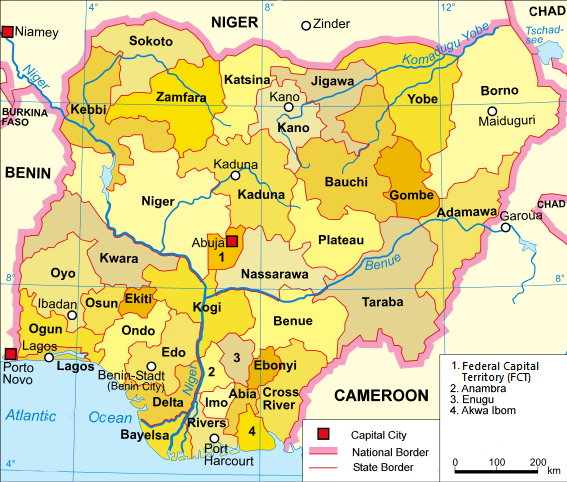
Nigeria: Kaduna, Kano, Katsina residents seek death sentence for ritualists, cannibals

In previous posts I’ve reported on death sentences pronounced in Nigerian states. In Delta State (2024), Niger State (2024), Rivers State (2020), Osun State (2020), Ondo State (2019), to be more specific. Shortly, more states may follow, as the following article implies. The increase in ritualistic murders has led the population in Kaduna, Kano and Katsina states to press their governments to allow for the death penalty for ritualists and those found selling or eating human parts, according to the article cited below.

As mentioned before on this site, Nigeria is a signatory to the Universal Declaration of Human Rights, adopted by the UN in 1948. National and international organizations emphasize that the death penalty breaches human rights including the right to life and the right to live free from torture or cruel, inhuman or degrading treatment or punishment. Both rights are protected under the 1948 Universal Declaration of Human Rights,

The surge in criminal killings for ritualistic purposes, human sacrifices, child trafficking, and various sorts of witchcraft activities in a number of SSA countries have resulted in an increasing number of countries adopting laws allowing for the death penalty for convicted criminals. In Nigeria a number of states have adopted legislation allowing the sentencing to death of convicted ritual murderers which does not always mean that they are actually executed. 

Though I strongly support the prosecution of suspected ritual murderers and the rule of law, I have my doubt about the effectiveness of the capital punishment as a deterrent. The phenomenons of ritualistic murders and witchcraft are too complicated to eradicate by only harsh punishments. I can cite many examples, in various countries – to name one: Liberia.

I witnessed the public execution by hanging of seven convicted ritualistic murderers, in Harper, Maryland County, almost fifty years ago, in 1979.

Did this eradicate ritual murders in Liberia? No.
Did this eradicate the belief in witchcraft in Liberia: No.
Did this eradicate superstition in Liberia? No.

Hanging of the Harper Seven, Liberia, February 16, 1979. Source: F. van der Kraaij Collection Wikimedia.

In my opinion only education will bring the desired result, in combination with the strict rule of law, not allowing any exception, political interference of ‘big shots’: political, religious or traditional leaders, resulting in a shameful impunity. All what is needed is the political will to end these cruel outdated and criminal practices and atrocities. They have no place in the 21st century.
(webmaster FVDK)

Kaduna, Kano, Katsina residents seek death sentence for ritualists, cannibals

Published: March 3, 2025
By: Agency Report – Daily Nigerian

There have been growing concerns about the obnoxious increasing trend of of ritual killings across Nigeria.

The News Agency of Nigeria reports that the heightened situation of ritual killings is driven by the quest for quick wealth, poverty, unemployment, and lack of effective legislation.

There have also been sustained calls for stronger laws against ritual killings to effectively stem the tide of the menace.

There have also been appeals for plausible economic empowerment programmes and public awareness campaigns to deal with the dastardly phenomenon.

Analysts have posited that the government, civil society, and individuals must work together to address the underlying factors and put an end to these heinous crimes.

In Katsina State, the residents of have urged the government to provide a death sentence against ritualists and those found selling or eating human parts.

They made the call in an interview with the News Agency of Nigeria (NAN)in Katsina.

The residents said the call has become imperative in view of the increasing cases of ritual killings, particularly in some parts of the country.

Ayuba Inusa, a resident of Katsina, said that was the only way to prevent the people from joining the ritual and cult groups.

He said: “Since the perpetrators have no mercy, they deserve to be treated with no mercy, to serve as a deterrent to those willing to join the groups.”

Inusa further stressed the need for the traditional and religious leaders to intensify efforts in preaching against the ugly act.

On his part, Kabir Tukur, advised the people against the desire to accumulate worldly materials using such inhumane and ugly methods.

He said,”That is because most of the victims were those who want to accumulate material things easily and anyhow.”

Tukur further urged parents to be monitoring their sons and daughters and discourage them against such bad habits to prevent them from becoming victims of such circumstances.

He also urged girls and women to be wary of friendship in the social media, saying, “because, most of the victims were easily caught up through that platform.”

Another correspondent, Grace Jacob, also urged girls to desist from going to the persons they met through the social media to avoid becoming victims.

She further urged the government to provide stiffer punishments against perpetrators of those barbaric acts.
In Kaduna State, the Police Command said it has recorded zero ritual killing in the state.

The command’s Public Relations Officer, DSP Mansir Hassan, confirmed to the News Agency of Nigeria (NAN) in Kaduna.

He said, “This remarkable achievement is a testament to the state’s unwavering commitment to combating this heinous crime.

He said the command has not received a single complaint of ritual killing in the past three years.

According to him, the ways to curb this incident include stopping hard drugs’ abuse, public enlightenment, and addressing youth motivations.

“The command’s proactive approach to preventing ritual killings has included increased patrols, intelligence gathering, and community engagement,”Hassan said.

He advised that the youths should be engaged with the local communities to raise awareness about the dangers of ritual killings.

Hassan said, “Religious leaders have a role to play in educating the public about the importance of upholding human life and the sanctity of human dignity.”

He said the youths should be engaged on education and job creation programmes, as well as counseling services to address anxiety and other mental health issues.

“We will continue to prioritise the safety and security of citizens,” Hassan said.

In Kano State, some experts have called on community leaders to collaborate in efforts to combat ritual killings, urging action to address the underlying factors driving the crime.

Some of the residents, who spoke to the News Agency of Nigeria (NAN) urged the government at all levels to address the crime.

One of them, Musa Abubakar, a lecturer at the Kano State Polytechnic, attributed the increasing frequency of ritual killings to economic hardship and widespread poverty.

According to Abubakar, these challenges have driven many, especially young people, to seek alternative, albeit criminal, means of wealth acquisition.

He said that the high unemployment rate has led to increased desperation, with some individuals believing that ritual sacrifices may offer a shortcut to financial success.

Abubakar said: “Moral decay is on the rise. If this decay is not addressed, it could lead to an increase in other forms of criminality.

“They include human trafficking, organ harvesting, and cult-related violence, further destabilising the nation.$
A public affairs commentator, Isa Muhammad, stressed the importance of collaboration between the security agencies and community leaders to curb these crimes.

“Community policing initiatives should be expanded to encourage local participation in crime detection and reporting.

” Vigilance groups should also be involved in monitoring suspicious activities,” he said.

Isa further emphasised that traditional and religious leaders must take a strong stance against immoral practices, while educational institutions should enforce ethics that all.the students must adhere to.

Similarly , Abdulrazak Abdullahi, a Lawyer, expressed concern over the growing incidents of ritual killings, highlighting a shift in values where human life was no longer sacred.

“The increasing prevalence of ritual killings suggests a dangerous shift in societal values, with people willing to engage in barbaric acts for personal gains,” Abdullahi said,

He urged the law enforcement agencies to act proactively rather than only responding after crimes have been committed.

Abubakar then called for closer cooperation between the Police, judiciary, intelligence agencies, and community leaders to dismantle criminal syndicates behind these killings.

“The government should strengthen legal frameworks, improve law enforcement, and ensure the swift prosecution of offenders,” he added.

An activist, Amina Ali, also called for the intensification it public awareness campaigns and the enactment of stricter laws to create a safer and more secure society.

She stated that the high unemployment had fueled desperation, with some resorting to ritual sacrifices as a shortcut to wealth.

Ali warned, “If the growing moral decay is not addressed, it could lead to increased criminal activities, including human trafficking, organ harvesting, and cult-related violence, further destabilising the nation.” (NAN)

Source: Kaduna, Kano, Katsina residents seek death sentence for ritualists, cannibals

And:

Ritual Killings: Why I Advocate Death Penalty For Perpetrators –Campaigner

Published: March 3, 2025
By: New Telegraph-Admin – New Telegraph, Nigeria

A campaigner against ritual killing, Mr Sunday Oyinloye, has advocated death penalty for perpetrators of the act. He told the News Agency of Nigeria (NAN) yesterday in Abuja that the increasing cases of ritual killings had become a source of worry.

Oyinloye, who blamed the development on the decay in family values, laziness and desire to get rich at all cost, said death penalty would be a great deterent.

The campaigner said society, schools, families, religious bodies and government were not doing enough to address the vice.

Oyinloye called for more engagements on ritual killings in the country, adding that the seeming nonchalance about the menace over time was part of the reasons for its increased rate.

He said: “As it is now, there is no conversation about ritual killings and we keep having cases on daily basis.

“Relevant stakeholders must rise up against this menace and speak out against this ugly trend where women and young girls are often the victims.”

Source: Ritual Killings: Why I Advocate Death Penalty For Perpetrators –Campaigner

Nigeria: shocking ritual murder in Ogun: man sells friend for ₦5,000:

On January 25 I posted a similar case showing the criminalization of ritual murder – notably in Africa’s most populated country, Nigeria. I refer to my post ‘Nigeria, Delta State: man who stole baby for ritual narrates how ‘Yahoo boys’ refused to pay him N200k after the deal‘

Yet another case which I present to prevent the idea that aforementioned case in Delta State is extraordinary and an exemption. Far from it. Kidnapping and killing on demand, selling humans organs and other body parts, just for greed, for money, is a rising business in Nigeria and may be in more countries.

The basic drive, apart from greed, lust for money, for wealth, for power and prestige, is superstition. Not only must authorities act swiftly and uphold the rule of law, thereby protecting the human rights of its citizens, but they must also embark an a campaign of prevention by investing in education. Colliding interests, of politicians and other ‘big shots’ in society involved in these barbaric practices, must be dealt with mercilessly.
(webmaster) FVDK)

Shocking Ritual Murder in Ogun: Man Sells Friend for ₦5,000

Published: January 29, 2025
By: Nigerian Bulletin

A man in Ogun State has been arrested for selling his best friend to a ritualist for ₦5,000, leading to the victim’s gruesome murder. The victim’s head was sold for ₦20,000. This shocking incident was exposed through a viral video, highlighting the prevalence of ritual killings in Nigeria.

A shocking incident unfolded in Ogun State, where a man reportedly sold his best friend to a ritualist for ₦5,000. The victim was lured under the pretense of a farm job offer. Upon arrival, the friend was killed, and his head was later sold for ₦20,000. This horrifying act was revealed after a viral video surfaced on X (formerly Twitter), showing the police parading multiple suspects.

The arrested man confessed that he had arranged the deal with a herbalist, who carried out the gruesome murder. The video also featured the ritualist admitting to his role in the crime. The tragic event highlights the growing concern of ritual killings in the country. The victim’s head, after being severed, was reportedly sold for a mere ₦20,000, further underscoring the brutal nature of the act.

This incident has raised alarm in the community, with many calling for greater awareness and stronger enforcement against ritualistic crimes. Authorities have promised to investigate further and hold all parties responsible accountable, as the video continues to circulate, increasing public outrage over the horrific crime.

Screenshot

Source: Shocking Ritual Murder in Ogun: Man Sells Friend for ₦5,000

‘Let’s work to end witch hunts in Adamawa State’ – Nigerian human rights activist Leo Igwe

Leo Igwe is a renown Nigerian human rights activist, founder and president of Advocacy for Alleged Witches (AfAW)

African countries face many problems. Most of these problems are the result of external causes. However, the problem attacked below by Leo Igwe, a renown Nigerian human rights activist, founder and leader of Advocacy for Alleged Witches, has a cause which lies within African societies and is within reach of local political and community leaders to solve.

The answer to the challenge which constitutes the definite eradication of superstition – hence the belief in witchcraft and witches – is (among other interventions) education, education and education! AfAW and Leo Igwe also emphasize this approach.

When looking at the budgets for education in African countries we cannot escape a feeling of dispair. Only a few African countries realize the education objectives agreed upon during international conferences, in international organizations or in national development plans.

African governments can rightly point to the failing support or sometimes undermining actions of governments of non-African countries and international corporations, but here is a problem in which they themselves have a hand in solving. What are they waiting for?
(webmaster FVDK)

Published: January 20, 2025
By: Leo Igwe – Sahara reporters

Greetings and salutations from the Advocacy for Alleged Witches and from all advocates against witch hunts in Nigeria and beyond on the occasion of this roundtable discussion on witch hunts and human rights violations in Adamawa state. I thank the National Human Rights Commission for the opportunity to collaborate and synergize against this superstition-based abuse. Witch hunting is a form of gender-based violence and we commend the commission for its commitment to addressing sexual and gender-based violence in Nigeria.  We hope that this event marks the beginning of our partnership. We hope it would be the first of so many to be held and organized in rallying against witchcraft accusations, witch persecution, and killing in the state. We are all delighted that the event is holding after years of planning, and postponement. And that advocates in this state have the opportunity to meet, discuss, interact, and exchange ideas on how to end human rights violations linked to beliefs in witchcraft and ritual attacks. Adamawa is one of the states where witch-hunting is pervasive. And let’s face it, this is not good news at all. Yes, it is not. Witch hunting in Adamawa is a cause for concern and needs to be treated with the urgency it deserves. We must join hands and end these violations now, not later, today, not tomorrow, this year, not next.

There have been growing cases of witchcraft accusations and killings in Adamawa. Incidentally, only a few are reported. Many more are not because they happen in rural areas and remote communities. Witch persecution happens mainly to people who cannot report the violations; those who do not know where and how to report. Victims of witch hunts are usually those who do not know that witch hunters are criminals who should be brought to justice. Many cannot report because they fear retribution, more abuse, and violation. But the situation is changing.

We have a recent case here in Adamawa where a couple suffocated a girl child to death for witchcraft. We understand that the case is in court. Local informants and advocates helped the police to intervene. We are also monitoring two other cases that involved the murder of the accused. Alleged witches are beaten to death, set ablaze, and murdered in cold blood. The people of Adamawa, how many deaths will it take till we know that too many people have been accused of witchcraft and subsequently killed? How many deaths will it take till we know that too many alleged witches have died? Know this the people of Adamawa: the world is watching and waiting for you to rise to the challenge and take all necessary measures to end witch hunts. Will you? 

We are aware that witch hunts would not stop when the police and courts are failing in their duties and when the authorities are doing little or nothing to address this miscarriage of justice. Witchcraft accusations are against the law. Jungle justice and trial by ordeal are against the law. But witch hunts continue despite existing legislations. Accusations are perpetrated with impunity. The police in Adamawa must rise to the occasion and enforce the law. They should make sure that perpetrators are arrested and brought to justice.

In many cases of witch hunts, the police do not intervene. And when they do so, the intervention comes too little too late. Many suspects are not arrested or charged in court. Sometimes, police arrest and detain suspects and later release them after paying a bribe. But the police cannot address this problem alone. Other state agencies need to fulfill their statutory duties.

Effective courts, diligent judges, and magistrates are needed. We need court officials who correctly interpret the law and ensure justice for the accused. Unfortunately, what we have here in Adamawa, and in other parts of Nigeria and the continent, is a case of justice delayed and eventually denied. The accused and their families suffer double victimization. The court processes are slow, too slow for comfort and justice. Court processes take many years to issue judgments. They make accused persons incur additional costs. Many alleged witches and families have been forced to abandon their cases and resign to their fate. We have it on authority regarding an ongoing case here in Adamawa, that the family of the victim is being pressured to leave the case so that perpetrators could go scot-free. 

Look,  the people and government of Adamawa, if the family of the victim in question is forced to abandon the case, there will be consequences. That will not reflect positively on you and your efforts to combat witch hunts. Know this: the world is watching.

You may recall that in 2021, there was an unfortunate development in the state. A chief magistrate misinterpreted the law. He invited a native doctor to help in the trial of an alleged witch in a court. That incident was a judicial scandal, a local and international embarrassment. It was a misapplication of the law and a misconception of national jurisprudence. That incident indicated how Adamawa was out of step in addressing the problem of witch hunts. AfAW raised concerns and petitioned the chief judge. We hope lessons have been learned, and that there will be no repeat of this charade in Adamawa in the future. We understand that witch believers would like to conduct witch trials in courts. But our laws are unambiguous on the issue of witchcraft accusations. Our laws do not recognize witchcraft. The law criminalizes witchcraft accusations and witch-hunting. Our courts are places to prosecute accusers, not the accused. As a state, Nigeria advocates against witchcraft accusations and witch persecution. Nigeria constitutionally protects and defends alleged witches. Let’s work together and uphold the law, not our beliefs.

AfAW exists to end witchcraft accusations, witch persecution, and killing in Nigeria, and, by extension, Africa. We work to change the mindset of the people, combat misinformation and disinformation, and other drivers of this menace. We invite all participants to join us to realize the vision of making witch hunting in Africa history by 2030, which is, 5 years from now. It is possible. It can be done. Thank you.

Source: Let’s Work To End Witch Hunts In Adamawa By Leo Igwe

Nigeria: Ritualists on Rampage in Delta State capital Asaba

Leo Igwe is a famous Nigerian, human rights activist, an indefatigable fighter against superstition, witchcraft and ritualistic murders. In 2020 he started Advocacy for Alleged Witches. On numerous occasions I have praised him on this site for his valuable work fighting superstition, witchcraft and ritualistic violence and helping and supporting the victims of witchcraft and superstition.

The year 2025 is only a few days old, yet Leo Igwe is again at the forefront of the fight against ritualistic attacks and murders, ‘money rituals’, notably in his home country with the following chilling account of an attempt to kidnap a young lady, a university student, who narrowly escaped a violent death.

I have repeatedly stated on this site that Nigeria may be the African country with the highest incidence of ritualistic crimes. Africa’s largest country needs more people like Leo Igwe to help eradicate superstition, witchcraft and violent ritualistic behavior.

There is no place for these outdated practices which violate the human rights of the Nigerian people and make a mockery of the rule of law in Nigeria. (webmaster FVDK)

Ritualists on Rampage in Delta State capital Asaba

Published: January 4, 2025
By: Leo Igwe – New Times, Nigeria

Source: Ritualists on Rampage in Asaba

Kenya: ‘Cleansing’ ceremony to save a ‘bewitched’ woman’s life in Kilifi turns tragic

The following series of articles I found both interesting and relevant to include here despite their gruesome contents. Introduction under construction (webmaster FVDK)

Please note: Unfortunately, references to links to related articles in the copied article(s) below don/t work. Interested readers are recommended to use the original text, if available.

‘Cleansing’ ceremony to save a ‘bewitched’ woman’s life in Kilifi turns tragic

Published: December 1, 2024
By: Brian Ocharo – Nation, Kenya

Source: ‘Cleansing’ ceremony to save a ‘bewitched’ woman’s life in Kilifi turns tragic

Also read:

The Aged, On Edge – Witchcraft and Abuse of the Elderly in Kilifi and Kwame County (Kenya)

By Fr Gabriel Dolan, ED Haki Yetu, July 2023.

“Haki Yetu which means “Our Rights” in Swahili was created to combat oppression, injustice and promote human rights as a principle for social justice in our communities of interest.” (Source: Haki Yetu, Inc.)

For the readers’ convenience follows the Table of Contents. Interested readers are advised to use the link below to gain access to the document.

Table of Contents
Acknowledgement i
Abbreviations iii
Foreword iv
CHAPTER ONE: INTRODUCTION 1
1.1 Introduction 1
1.2 The concept of witchcraft at the Coast 4
1.2.1 The potency of accusations 6
1.2.2 Oath taking and cleansing rituals 7

CHAPTER TWO: WITCHCRAFT RELATED RIGHTS VIOLATIONS 10
2.1 Introduction 10
2.2 Witchcraft related Homicide 11
2.2.1 Murder trends in Kilifi 13
2.2.2 Murder trends in Kwale 14
2.3 Emerging Trends 16
2.3.1 ‘Bebabeba’ and Rise of the killings 16
2.3.2 ‘Waombezi’ – the prophets of doom 16
2.3.3 Access to Justice for Victims and Survivors 18

CHAPTER THREE: CONTRIBUTORY FACTORS 20
3.1 Land Ownership Disputes 20
3.2 Administrative Inaction and Corruption 23
3.3 Weak Legislations and Enforcement Pathways 25
3.4 Ignorance/Misinformation/Lack of Awareness 28

CHAPTER FOUR: LEGISLATIVE FRAMEWORK 31
4.1 The Constitution of Kenya, 2010 32
4.2 The Witchcraft Act, CAP 67 Laws of Kenya 33
4.3 Witness Protection Act, CAP 79 36
4.4 The AU Protocol to the ACHPR on the Rights of Older Persons in Africa 37

CHAPTER FIVE: MVI SI UCHAWI CAMPAIGN 40
5.1 Haki Yetu’s interventions 40
5.2 Impact of Haki Yetu’s Interventions 45
5.3 Lessons learned challenges and good practices 46

CHAPTER SIX: CONCLUSION AND RECOMMENDATIONS 47
6.1 Recommendations 47
6.2 Conclusion 52

Source: The aged, on edge – witchcraft and abuse of the elderly in Kilifi and Kwale County

Also recommended :

Return of Kilifi witch killings worries authorities

Published: April 12, 2022
By: Maureen Ongala – Nation Media Group, Kenya

Source: Return of Kilifi witch killings worries authorities

Related articles:

Cries for justice for elderly women lynched on witchcraft claims

Published: January 13, 2022
By: Kamau Maichuhie – Nation Media Group

Source: Cries for justice for elderly women lynched on witchcraft claims

And:

Rabai MP faults police for rise in elderly killings

Published: October 29, 2021
By: Maureen Ongala – Nation Media Group, Kenya

Source: Rabai MP faults police for rise in elderly killings

And:

Kisii Governor Ongwae sets up witchcraft taskforce

Published: October 26, 2021
By: Ruth Mbula – Nation Media Group, Kenya

Source: Kisii Governor Ongwae sets up witchcraft taskforce

And also:

Witchcraft murders: Uhuru urged to look into plight of elderly in Kisii

Published: October 21, 2021
By: Ruth Mbula – Nation Media Group, Kenya

Source: Witchcraft murders: Uhuru urged to look into plight of elderly in Kisii

More:

‘She tried to bargain for her life’: Woman recounts granny’s plea to killer mob

Published: October 21, 2021
By: Ruth Mbula – Nation Media Group, Kenya

Relatives at the home of Sindega Maya, 83, in Marina on Monday. Maya was among four women lynched after they were accused of engaging inn witchcraft. (Ondari Omega / National Media Group).

Source: ‘She tried to bargain for her life’: Woman recounts granny’s plea to killer mob

And:

What Kenyan law says about witchcraft

Published: October 19, 2021
By: Stella Cherono – Nation Media group, Kenya

Screenshot – see the original article for details

Source: What Kenyan law says about witchcraft

And, finally, to illustrate that the problems of superstition, the belief in witchcraft and witches and of mob justice has a long history in Kenya:

Two women lynched and houses set on fire in witchcraft claims

Published: January 15, 2017 — updated on June 29, 2020
By: By HENRY NYARORA & JOSHUA ARAKA – Nation Media Group

Source: Two women lynched and houses set on fire in witchcraft claims

Witchcraft accusations and critical thinking: combating harmful effects of dogma and superstitions in Africa – by Leo Igwe (Nigeria)

There’s no need to introduce Leo Igwe to the regular readers of my posts here on this site.

For those who’ve missed his articles and essays I may briefly refer to some of my previous posts, in 2018 (‘Confronting Superstition in Postcolonial Mozambique’), in 2021 (his comments on the arrest of suspected ritualists in Ibadan, Oyo State, Nigeria), 2023 (‘Witchcraft Persecution and Advocacy without Borders in Africa’ and ‘A manifesto for a skeptical Africa’), and the current year 2024 (‘Ritual killing by 16-year-old indicates moral and educational failures’, commenting on a gruesome murder for ritual purposes in his home country Nigeria).

Leo Igwe is a famous human rights activist, an indefatigable fighter against superstition, witchcraft and ritualistic murders. In 2020 he started Advocacy for Alleged Witches. In this blog he regularly publishes on the lives of those affected by superstition and his organization’s efforts to save and/or to improve their lives.

The list of his achievements is too long to cite here, for shortness sake readers are referred to the internet where he is widely present.

Advocacy for Alleged Witches , created by Leo Igwe in 2020.

In a recent article published in Ghana Leo Igwe gives his views on witchcraft and the need to effectively fight superstition, not only in this West African country, but in all African countries. He does not hide his views and feelings, as will be clear when reading the following essay.

No need to elaborate further on his message. Let me invite you to start reading while praising Leo Igwe and the valuable work he’s doing!
(webmaster FVDK)

Witchcraft accusations and critical thinking: combating harmful effects of dogma and superstitions in Africa

Published: October 28, 2024
By: Leo Igwe – GhanaWeb

Leo Igwe works and campaigns to foster critical thinking skills in schools

Source: Witchcraft Accusations and Critical Thinking: Combating harmful effects of dogma and superstitions in Africa

Tanzania: Police crackdown on rising ritual killings in Singida Region

It’s unclear whether the rising numbers of missing persons, abductions and suspected and confirmed cases of ritualistic killings are related to internal Tanzanian politics. However, what is clear is that there is is increasing level of insecurity in certain parts of this East African country notably in the Singida region whereas the role played by certain witchdoctors seems undeniable.

The Tanzanian police arrested seven people. Will this stop the abductions and killings? It all depends on the follow-up of these arrests – and may be more to come? – that is to say it all depends on the authorities to show seriousness and perseverance to restore security and the rule of law in the country thereby restoring confidence in their government of local residents.
(webmaster FVDK)

Tanzania: Police crackdown on rising ritual killings in Singida

The Tanzania Police Force spokesperson David Misime. PHOTO | COURTESY

Published: August 26, 2024
By: The Citizen, Tanzania

Source: Police crackdown on rising ritual killings in Singida

More:

Tanzania police arrest seven in connection with gruesome murders


Police spokesperson David Misime

Published: August 26, 2024
By: Sharon Sauwa – The Citizen, Tanzania
Sharon Sauwa is the The Citizen reporter based in Dodoma.

Source: Tanzania police arrest seven in connection with gruesome murders

And also:

Tanzania Police unveils shocking incidents of homicides, ritual killings

Police spokesperson David Misime

Published: August 24, 2024
By: The Citizen, Tanzania

Source: Tanzania Police unveils shocking incidents of homicides

And:

Opposition party Chadema demands judicial inquiry into abductions, ritual killings

Chadema national chairman Freeman Mbowe speaks during press conference in Dar es Salaam on August 22, 2024. PHOTO | SUNDAY GEORGE

Published: August 23, 2024
By: The Citizen, Tanzania

Source: Chadema demands judicial inquiry into abductions, killings

Map of Tanzania showing location of Singida region

Trial by ordeal reportedly kills six in Nimba County, Liberia

Changes come slowly, if any, in Liberia. I know this relatively sparsely populated West African country and its 5.5 million people pretty well after following events and developments in this fascinating and sympathetic country since 1975. I have posted earlier on the topic of trial by ordeal, commonly called ‘sassywood trial’ in Liberia, which of course is forbidden, outlawed, but unfortunately persistent in local culture and the minds of superstitious people. See e.g. my post of August 29, 2020, on a woman in neighboring Grand Gedeh County who had died after reportedly taking ‘sassywood’ to clear her from witchcraft accusations.

Nimba County is located in northeastern Liberia and borders French-speaking Guinea and Ivory Coast (at least, the official language, of course the various ethnic groups speak their own languages). It cannot be ruled out, rather it is to be expected, that age-old traditions such as trial by ordeal also occurs in neighboring countries where the same ethnic groups including the Dan, also known as Gio and Mano, live.
(FVDK)

Liberia: Trial By Ordeal Reportedly Kills Six In Nimba County

Published: July 24, 2024
By: Jerry T. Myers, FrontPageAfrica

GBLOR DIALAH, Nimba – A woman identified as Golon Kruah, a resident of Dialah Town, reportedly died after consuming a substance given to her by an Ivorian traditional witchdoctor, Gweh Genlaly. The witchdoctor was brought to the town by local citizens to cleanse the area of witchcraft activities.

Gweh Genlaly administered sassywood to the woman after she allegedly confessed to being involved in witchcraft activities that had claimed several lives and caused suffering to others. According to an eyewitness who spoke on condition of anonymity, the sassywood was given to the deceased overnight. She died hours later and was immediately buried before the arrival of security personnel and local district leaders, who were alerted about the incident in the morning.

The Acting Paramount Chief of Gblor Clan, Oksen Troh, said he had earlier warned the witchdoctor and the youth hosting her in the community against administering sassywood. However, they violated his order and went ahead with the ritual overnight.

Mr. Troh explained that his refusal to allow the administration of sassywood was based on instructions from the County Administrative Officer, who had banned trial by ordeal in Liberia. After his objection, the citizens wrote a resolution to Mr. Daniel Zekpeh, the County Administrative Officer, during his visit to the clan. Zekpeh instructed them to give the document to Troh, but it was not given to him due to his strong opposition to sassywood.

Troh said late on Monday night, they brought a document to him to sign, authorizing them to administer the oath to Golon, but he refused. He was shocked to hear that a woman had died in the community after being given sassywood overnight, prompting him to call the police and the district commissioner.

Acting Paramount Chief Troh disclosed that Golon’s death brings the number of people who have died in Gblor Clan after taking an oath from the witchdoctor to six. He clarified that previous incidents were concealed and not reported to the police by the community, and he could not report them because he was not in authority at the time. (italics added by the webmaster FVDK.)

“In the first place, Gweh working here is not a bad thing, but I received an order from my CI [County Inspector] the other time. He told me that I should tell Gweh not to give an oath. She must cut sand, she must arrest witchcraft, she must treat people to get well, but she must not give an oath because the oath she gives can kill somebody, and Liberia law says nobody should kill someone. So Liberia law doesn’t agree with that oath,” Mr. Troh explained in Liberian colloquial.

He said upon learning about the woman’s death, he immediately informed the district commissioner of the incident and was instructed to inform Gweh and her followers to keep the body of the woman until authorities arrived to conduct tests before burial. However, to his surprise, the town hurriedly buried the woman before the district commissioner and the district coroner arrived.

Meanwhile, the ten men who signed the document authorizing Gweh to conduct the sassywood have been invited for questioning.

Trial by ordeal, known as ‘sassywood,’ is banned under national law but is still regarded as a legitimate form of justice by many Liberians. In this ritual, a suspect is subjected to intense pain and judged based on their reaction. Sometimes, a hot metal is used on the person’s leg, if it burns, they are found guilty. Sometimes poisonous liquid is used. If it kills the person, they are judged to be witch.

The UN has repeatedly warned that the practice undermines efforts to improve human rights in Liberia, as the country attempts to recover from 14 years of war.

Many legal specialists and human rights activists argue that the reliance on customs such as trial by ordeal—often harmful and even deadly—is due to the decrepit state of Liberia’s judicial system. They also contend that not enough is being done to restore the sector, which was left in tatters by the war.

Source: Liberia: Trial By Ordeal Reportedly Kills Six In Nimba County

Zimbabwe: public hearing for Death Penalty Abolition Bill

Reportedly, there are 62 murderers on the death row in Zimbabwe. If the Death Abolition Bill will be passed, their death penalty will be commuted to life in prison.

Among those who will benefit from the proposed abolishment of the death penalty are the two convicted killers of a 7-year old boy, Tapiwa Makore, who was murdered for ritualistic purposes in 2020, a ritual murder which upset the entire nation. The boy was murdered by one of his uncles, Tapiwa Makore (60), and an accomplice, Tafadzwa Shamba (4), who were found guilty of the brutal murder and sentenced to death in 2023.

Last month Zimbabwe’s President Emmerson Mnangagwa’s declared an amnesty by announcing his decision to commute the death sentences of prisoners at Zimbabwe’s maximum prisons to life imprisonment.

The last time that the death penalty was executed in Zimbabwe was in 2005.
(FVDK)

Public hearing dates set for Death Penalty Abolition Bill, week after Mnangagwa “saves” prisoners on roll

Published: May 3, 2024
By: Leopold Muntende

ZIMBABWEANS will, between May 6 and 10, be given an opportunity to share their views on the Death Penalty Abolition Bill in public hearings to be held across the country’s ten provinces.

Although independent of his decision, the hearings follow President Emmerson Mnangagwa’s recent decision to commute the death sentences of prisoners at Zimbabwe’s maximum prisons to life imprisonment in an amnesty announced last month.

According to the government, 62 people were on death row.

In February, Cabinet approved the principles to the Death Penalty Abolition Bill that seek to abolish capital punishment.

Committee on Human Rights have jointly announced a series of public hearings to discuss the death penalty,” said Parliament.

“These hearings aim to engage stakeholders, gather perspectives and guide potential legal reforms regarding three Bills currently before Parliament.”

Although Zimbabwe’s last execution was in 2005, the death sentence has, however, continued to be passed.

The Zimbabwean constitution allows for imposition of the death penalty in cases involving murder committed under aggravating circumstances and only on men between 21 and 70 years of age.

Cabinet’s decision to approve the principles of the Bill provoked discussions online with some arguing capital punishment must be maintained while citing cases such as that of Tapiwa Makore (7) whose head was hacked off by his uncle (Tapiwa Makore Snr) in a ritual killing that shocked the country in 2020.

Human rights organisations such as Amnesty International however declared the move progressive: “Zimbabwe has taken the right step towards ending this abhorrent and inhuman form of punishment that has no place in our world.”

The public hearings will also discuss the Criminal Law Amendment (Protection of Children and Young Persons) Bill “which aims to bring the law on sexual offences against minors into line with the Constitution” and the Administration of Estates Amendment Bill, “which seeks to restructure the office of the Master of the High Court.”

The schedule is copied below;

Team A:

  • Dates: From May 6 to May 10, 2024
  • Locations:

May 6, 2024: Kadoma Rimuka Hall

May 7, 2024: Gweru Mkoba Hall

May 8, 2024: Bulawayo Selborne Hotel

May 9, 2024: Lupane Community Hall

May 10, 2024: Filabusi Avoka

Team B:

  • Locations:

May 6, 2924: Tendai Hall, Bindura

May 7, 2024: Stodart Hall, Mbare

May 8, 2024: Mbuya Nehanda Hall, Marondera

May 9, 2024: Dangamvura Beit Hall

May 10, 2024: Masvingo Civic Center Hall, Masvingo

  • Time: All meetings start at 10:00 AM

Source: Public hearing dates set for Death Penalty Abolition Bill, week after Mnangagwa “saves” prisoners on roll

The plight of people with albinism in Zambia – a cry for protection and assistance

Zambia’s Eastern Province is notoriously known for its ritualistic murders. Allegedly, the country’s Eastern Province records the highest number of ritualistic murder cases.

I’ve posted earlier on the plight of people with albinism in Zambia and the attacks on and murder of innocent people in this remote province of Zambia. In 2019, within a short period of time, two murder cases were reported. In March the following year, another gruesome murder was committed in the Eastern Province. In Chipata, the mutilated body of the albino victim was discovered with tongue, eyes and arms missing. The Executive Director of the National Albinism Initiative Network of Zambia, Ruth Zulu, deplored the stigmatization, discrimination and murder of people and published a plea for a legal framework to address this nationwide problem. In vain. The murders continued as the article below painfully demonstrates.

Katerina Mildnerova, a Czech social and cultural anthropologist, and Antonio Costa, an independent photojournalist originally from Mozambique, are to be commended for their initiative.
Read more about their cry for help and protection of people living with albinism in Zambia below.
(FVDK)

The plight of people with albinism in Zambia – a cry for protection and assistance

Published: May 10, 2024
By: Znesnáze – Olomouc / Organizer: Nadační fond pomoci

In the middle of the night, there was a pounding on the door. “Open up, Zambian police!” I see four masked men. They broke into the house where I was sleeping with my children. They pointed guns at me and threatened me, “If you scream, we’ll kill you.” Two of them dragged me behind the house and held a gun to my head. Then I heard a terrible scream. “Mommy, mommy, they chopped my sister’s arm!” My son sobbed with tears. At that moment, those two men threw me to the ground and started to run away. I came into the room and saw my daughter in a pool of blood…” 

The brutal attack on little Jemimah took place in June 2021 in the Northern Province of Zambia. The two-year-old girl lost her right arm, which was chopped off by unknown attackers with a machete. This case has not yet been investigated by the Zambian police and none of the attackers have been persecuted and sentenced. Jamimah lives with other children with albinism in an orphanage in the capital Lusaka. In the same year two other nine-year-old boys were ritually attacked and mutilated. One lost his right arm, the other his fingers. 

These stories are just some of the many we encountered during our research in 2023. 

Since 2015, Zambia has faced an increasing number of abductions, mutilations and ritual killings of people with albinism, in most cases defenceless children. Their body parts are used for making magical objects that are supposed to provide their owners with wealth, power or prestige. While these murders are most often committed by family members of the victims while still in Zambia, body parts are smuggled through organised crime networks into neighbouring countries – Malawi, Tanzania and Mozambique. The largest number of ritual killings of albinos occur in the Eastern Province, the poorest region of Zambia. The victims of the attacks, if they manage to escape, continue to live in permanent fear for their lives, as the perpetrators are not prosecuted in the vast majority of cases. After an attack, children are placed in state orphanages, where they receive temporary protection, they are removed from their natural family environment and have to cut off contact with their parents and siblings. 

In addition to the threat to their safety, people with albinism face enormous health risks due to the lack of medication and protective equipment. Skin and eye cancer is the most common cause of their premature deaths. Albinos in Zambia live to an average age of only 40 years, 22 years less than the national average.

Most affected families live at or below the extreme poverty line. They cannot afford to provide education for their children because safety and health care must understandably take priority. Families lack the means to afford school supplies, school uniforms or even just the dioptric glasses necessary for reading and writing at school. Yet education is the ticket to a better future, without the daily fear for one’s survival. In Zambia, there is a belief that a child with albinism is the result of infidelity and the source of a family curse, which unfortunately often leads to the mother and child being abandoned by the father and the wider family. A single mother‘s status is inevitably linked to a life of poverty and it is very difficult for her to break this vicious cycle.

FUNDRAISING

Fundraising is ongoing via the crowdfunding platform Znesnaze21 from May to September 2024. It is aimed at purchasing direct material assistance for the most vulnerable families living below the extreme poverty line in the Eastern Province of Zambia (single mothers, children, victims of ritual attacks). The purchase and transportation of the material aid will be arranged by the organizer of the fundraiser in collaboration with the Butterfly Foundation of Zambia – a non-profit organization that has assisted the most adversely affected families with albinism in the Eastern Province of Zambia since 2017.

Our assistance targets three main areas: 

Security. Ensuring the protection of homes – security locks on doors, window bars and fencing 

Health. Prevention of skin cancer – sunscreen factor 50+, sunglasses, hats

Education. Basic school supplies – notebooks, stationery, uniforms and dioptric glasses

ABOUT THE BORN DIFFERENT PROJECT

Born Different is a project by the Czech anthropologist Katerina Mildnerova and the Mozambican photojournalist Antonio Cossa under the auspices of Palacky University in Olomouc. It is based on the creative linking of art and science, cultural anthropology and photography and draws on a series of team fieldworks in Zambia and Benin (2023-2024). It includes a travelling photographic exhibition, lectures and forthcoming popular science book.

Our primary aim is to raise public awareness about injustice, discrimination and human rights violations against people with albinism in Africa, particularly in Zambia. We want to stimulate a discussion about protecting the lives and rights of people with albinism in order to stop the violence and ritual killings that happen every day and which do not receive adequate attention. We are also endeavouring to help to improve their extremely difficult living conditions through public charitable fundraising efforts.

For more information, visit our website at www.borndifferent.upol.cz

(available from 17. 5. 2024)

ABOUT THE ORGANIZER

Katerina Mildnerova is Czech social and cultural anthropologist specializing in sub-Saharan Africa. She holds a PhD in ethnology from the University of West Bohemia in Pilsen. Since 2015 she has been working as a researcher and assistant professor at the Department of Sociology, Andragogy and Cultural Anthropology at Palacky University Olomouc. Since 2019 she is the president of the Czech Association of African Studies. She has conducted dozens of field researches in Zambia, Benin and Namibia and has lectured at several universities in Africa and Europe. She specializes in religious anthropology and medical anthropology. She is the author of dozens of academic articles and book chapters and five monographs of her own. She is co-author of the documentary film Black Czechs (2022) and founder of non-governmental organization Association for Support of Namibian Czechs. She is currently working on the project Born different with Antonio Cossa.

ANTONIO COSSA

An independent photojournalist originally from Mozambique, based in Prague. He has worked as a documentary photographer since 2004, collaborating with institutions such as the British Council and UNICEF. He has had a rich professional career focusing on war, refugee crisis and social issues. His work specializes in war conflicts in the Middle East and Africa, the refugee crisis on the Greek-Turkish border, documenting the situation of the Rohingya in Bangladesh and the pro-democracy protests in Hong Kong. Since the beginning of the war in Ukraine, he has been officially accredited by the Ukrainian Ministry of Defence as a war photojournalist. In recent years he has also photographed climate refugees in Mozambique after Cyclone Idai. His latest project focuses on albino survivors of ritual attacks in Zambia. He is also a portrait photographer and has photographed many of the world’s most famous people, including Nelson Mandela, the Dalai Lama, Vaclav Havel, 

His portfolio includes dozens of exhibitions around the world, lectures and workshops for students and the general public. Antonio Cossa is also a founder of the non-governmental organization Frontline Care whose main objective is to support victims of climate change and war refugees.

Source: ASSISTANCE TO PEOPLE WITH ALBINISM IN ZAMBIA!