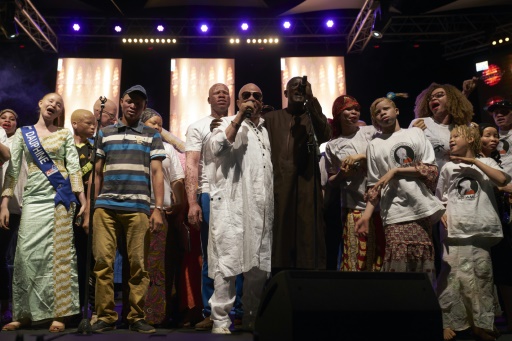
Mali: Salif Keïta gives a live concert in honor of a murdered albino girl

Picture shows famous Malian singer Salif Keïta (center) and members of his foundation giving a live concert in protest against the ritualistic murdering of albinos in Africa – Fana, Mali, on November 17, 2018. AFP | MICHELE CATTANI
Le chanteur malien Salif Keita (au centre) et les membres de sa fondation durant un concert destiné à dénoncer les meurtres rituels d’albinos en Afrique, le 17 novembre 2018 à Fana, au Mali | AFP | MICHELE CATTANI

Au Mali, un concert événement de Salif Keïta rend hommage à une fillette albinos assassinée

Mali: Salif Keïta gives a live concert in honor of a murdered young girl with albinism

Published: November 18, 2018
By: Kassim Traoré – Fana (Mali) (AFP)

Saturday night, legendary Malian singer Salif Keïta gave a live concert, presenting his latest album, in Fana, a small town in the south of Mali, where a 5-year old girl with albinism was found dead – murdered – in May of this year. The live concert was in honor of all murdered albinos in Africa and in protest against these horrible crimes.

In a football stadium packed to capacity in this small town of some 20,000 inhabitants – 120 km from the capital Bamako – 69-year old Salif Keïta, himself albino, was accompanied by Ismaël Lô (from Senegal), Bera, an albino artist from Georgia, Malian comedian Yao and singers Safi Diabaté (Mali) and Maah Koudia Keït (Senegal), all fighting for the noble cause of people living with albinism in Africa.

On May 13, a five-year old girl, Ramata Diarra, was kidnapped by armed men while sleeping at her parents’ place. Her dead body was found a few hours later, beheaded, next to a mosque. People immediately linked her death to a ritual killing in view of the forthcoming elections in the country. (….)

Translated by the webmaster FVDK

For more information see ‘Albino girl abducted and killed in Mali’, dated May 16, 2018 and related articles – on the present website.

The original article, in French, is much longer and reads as follows:

La légende de la musique africaine Salif Keïta a présenté samedi soir son nouvel album à Fana, petite ville du Mali où une fillette albinos de cinq ans a été assassinée en mai, lors d’un concert hommage destiné également à dénoncer les meurtres rituels d’albinos en Afrique.

Dans un stade de football archi-comble, un événement jamais vu dans cette localité de quelque 20.000 habitants située à 120 km de Bamako, le musicien de 69 ans, atteint lui-même d’albinisme, s’était entouré du Sénégalais Ismaël Lô, de l’artiste géorgien albinos Bera, de l’humoriste malien Yaro ou encore des chanteuses malienne Safi Diabaté et sénégalaise Maah Koudia Keït, militante elle aussi de la cause des personnes albinos.

Le 13 mai, la petite Ramata Diarra, cinq ans, avait été enlevée en pleine nuit par des hommes armés alors qu’elle dormait dans la cour de la concession familiale. Son corps décapité avait été retrouvé quelques heures plus tard à côté d’une mosquée. Des associations avaient alors dénoncé un “crime rituel” à l’approche de l’élection présidentielle.

“Pourquoi ôter la vie d’une innocente, d’une fillette de cinq ans? Pourquoi s’attaquer aux albinos? Nous sommes comme tous les autres humains. Nous ne voulons plus voir ça au Mali. Il faut que nos autorités prennent des dispositions, parce que désormais, nous n’allons plus nous taire”, a dit sur scène Salif Keïta.

Chaque année, des dizaines d’albinos sont victimes en Afrique d’attaques, tués et amputés de leurs membres qui sont ensuite utilisés pour des rituels censés apporter richesse et chance.

“Aujourd’hui, tout le monde sait qu’une fillette de cinq ans a été assassinée à Fana parce qu’elle est albinos. Le monde s’est mobilisé pour la cause de ma fille, que ce monde ne baisse plus les bras afin que les albinos puissent vivre en paix partout dans le monde”, a confié à l’AFP, en marge du concert, la mère de la fillette, Diarra Awa Touré.

“Au début je me sentais seule, mais avec ce grand concert et les condamnations faites devant le monde, je ne me sens plus seule”, a-t-elle ajouté.

– ‘Dernier album’ –

Dans l’espace réservé aux invités, juste devant la scène, Ousmane Wélé Diallo, tout de blanc vêtu, explique être venu de Bamako avec sa femme et ses enfants pour “suivre le concert et soutenir notre cause en rendant hommage à Ramata Diarra”. “Je n’aime pas quand il y a trop de lumières, surtout les ampoules géantes de la scène, mais ce soir j’accepte pour notre cause”, ajoute le père de famille, qui comme de nombreux albinos souffre de problèmes de vue.

“Nous sommes ici pour que ce qui est arrivé à Ramata ne se reproduise plus jamais, et cela doit être le combat de nous tous. Plus jamais ça à Fana, au Mali, en Afrique et dans le monde”, a lancé depuis la scène Ismaël Lô. “Personne ne doit sacrifier un albinos pour son pouvoir, personne ne doit vendre les cheveux ou les organes d’un albinos”, a exhorté Safi Diabaté. “Je suis Fana, je suis Ramata, je suis toutes les victimes des ignominies de certains assoiffés de pouvoir”, a ajouté le slameur malien Karim Diallo.

Alors que la soirée est déjà bien avancée, Salif Keïta monte sur scène pour un show de 45 minutes au cours duquel il défend son album “L’autre blanc”, son dernier selon lui, pour lequel il a fait appel à de vieux complices comme l’Ivoirien Alpha Blondy ou la Béninoise Angélique Kidjo, tout en multipliant les clins d’oeil à la jeune génération.

“Je voulais dire au revoir à tous mes fans, parce que si je vais peut-être encore faire de la musique par-ci par-là, je ne prendrai plus le temps de faire un album”, a-t-il confié à l’AFP, estimant avoir “droit à un repos” après 50 ans de carrière.

Source:
Au Mali, un concert événement de Salif Keïta rend hommage à une fillette albinos assassinée

Related article:

Mali: Salif Keïta rend hommage à une fillette albinos assassinée
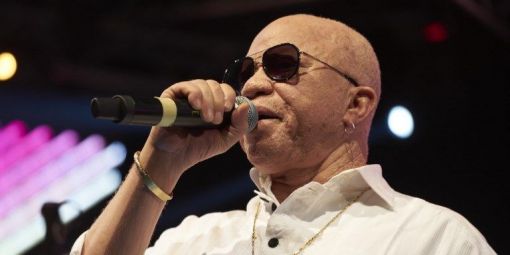
Malian singer Salif Keïta performing at a live concert in Fana, Mali, on November 17, 2018. Le chanteur malien Salif Keita lors d’un concert de sensibilisation aux violences contre les albinos, le 17 novembre 2018 à Fana (Mali), où une fillette albinos âgée de 5 ans a récemment été assassinée.
© MICHELE CATTANI / AFP

Published: November 19, 2018 – 14:35 PM
By: Géopolis (avec AFP )

Saturday night, legendary Malian singer Salif Keïta gave a live concert, presenting his latest album, in Fana, a small town in the south of Mali, where a 5-year old girl with albinism was found dead – murdered – in May of this year. The live concert was in honor of all murdered albinos in Africa and in protest against these horrible crimes. (…)
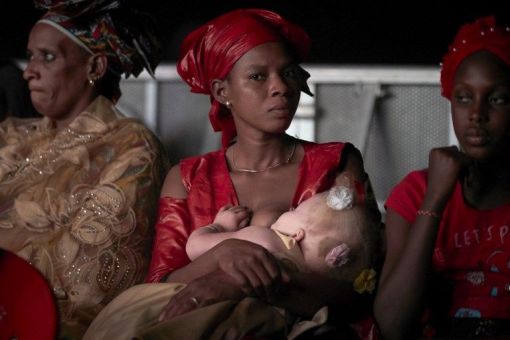
A young Malian woman holds her albino baby at a concert given by famous Malien singer Salif Keïta. Une Malienne tient son bébé albinos alors qu’elle assiste au concert de Salif Keita visant à sensibiliser le public aux violences contre les albinos le 17 novembre 2018 à Fana. © MICHELE CATTANI / AFP

“We are here to prevent that what happened to Ramata will ever happen again. This is our common struggle. Never again in Fana, in Mali, in Africa, in the world.”, Ismaël Lô shouted on stage. “Nobody should sacrifice a person with albinism to become richer or stronger; nobody should sell the hair or organs of an albino”, Safi Diabaté cried. “I am Fana, I am Ramata, I am the victim of all these atrocities committed by power-hungry people”, Karim Diallo added.

Translated by the webmaster FVDK

«Nous sommes ici pour que ce qui est arrivé à Ramata ne se reproduise plus jamais, et cela doit être le combat de nous tous. Plus jamais ça à Fana, au Mali, en Afrique et dans le monde», a lancé depuis la scène Ismaël Lô. «Personne ne doit sacrifier un albinos pour son pouvoir, personne ne doit vendre les cheveux ou les organes d’un albinos», a exhorté Safi Diabaté. «Je suis Fana, je suis Ramata, je suis toutes les victimes des ignominies de certains assoiffés de pouvoir», a ajouté le slameur malien Karim Diallo.

Alors que la soirée est déjà bien avancée, Salif Keïta monte sur scène pour un show de 45 minutes au cours duquel il défend son album L’autre blanc,son dernier selon lui, pour lequel il a fait appel à de vieux complices comme l’Ivoirien Alpha Blondy ou la Béninoise Angélique Kidjo, tout en multipliant les clins d’œil à la jeune génération.

«Je voulais dire au revoir à tous mes fans, parce que si je vais peut-être encore faire de la musique par-ci par-là, je ne prendrai plus le temps de faire un album», a-t-il confié à l’AFP, estimant avoir «droit à un repos» après 50 ans de carrière.
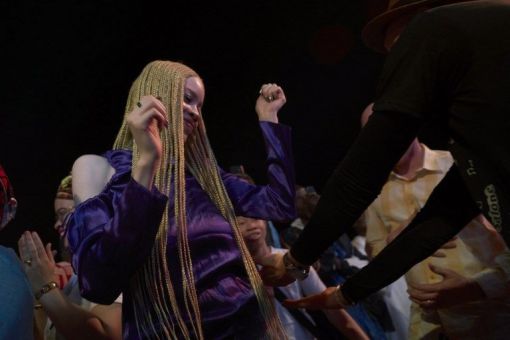
A young woman with albinism dances at a live concert given by famous Malian singer Salif Keïta in Fana (Mali) where recently a 5-year old girl with albinism was murdered. Une jeune femme malienne albinos danse lors du concert du chanteur malien Salif Keita, le 17 novembre 2018 à Fana, où une fillette albinos âgée de 5 ans a récemment été assassinée. © MICHELE CATTANI / AFP

Source: Mali: Salif Keïta rend hommage à une fillette albinos assassinée
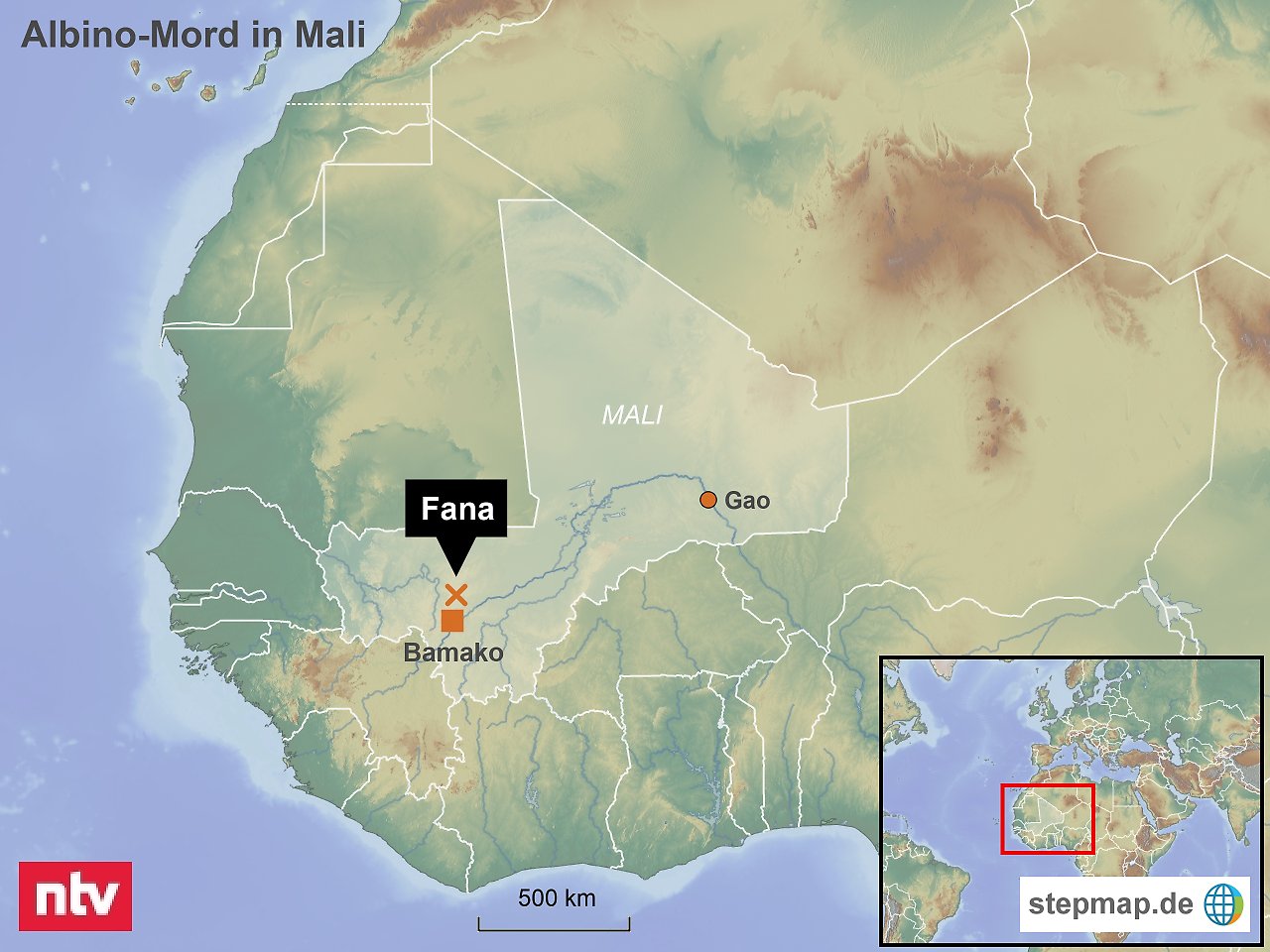
In Fana, Mali, a five-year old girl with albinism was murdered in May 2018.
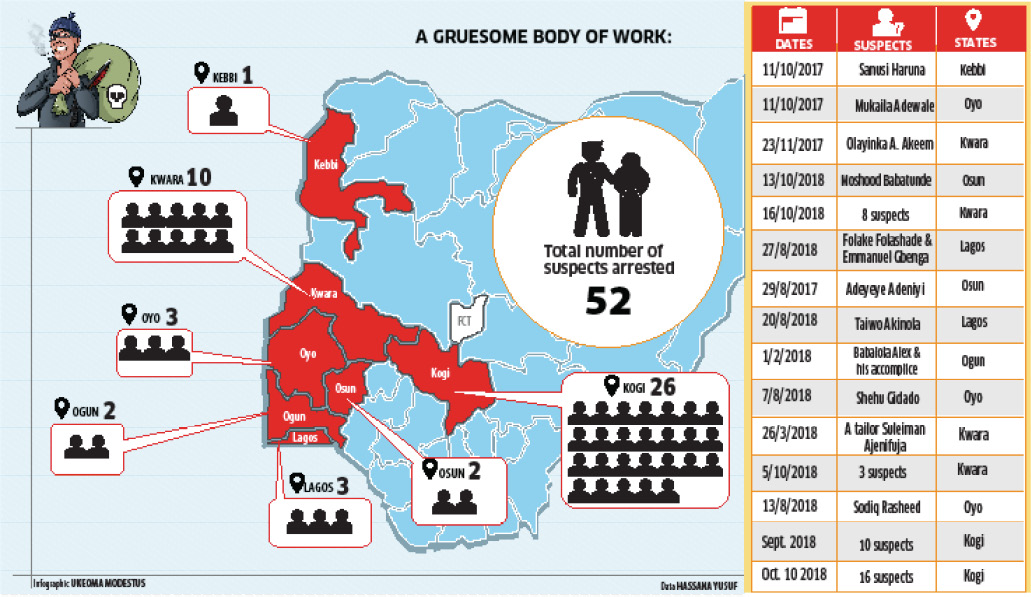
Nigeria: ritual murders, human parts dealers on the rise

Published: November 10, 2018 – 2:25 AM
By: Nathaniel Bivan (Abuja) & Itodo Daniel Sule (Lokoja)
Ritual killings and trade in body parts is one crime that has refused to go away in Nigeria. So far, not less than 55 suspects have been arrested in the past one year for human parts-related crimes in states such as Kebbi, Oyo, Kwara, Osun, Lagos, Ogun, Kogi and Nasarawa.

One of the most recent took place in Nasarawa State, where three men were arrested by the Nasarawa State Police Command for allegedly being in possession of human parts. They were reported to have, on November 1, exhumed a freshly buried corpse from a cemetery at Mararaban-Akunza and chopped off an arm.

Then in Ankpa LGA of Kogi State, neighbouring communities have had long-drawn cases of abductions, ritual killings, harvests of human parts, deadly cult activities and gruesome murders. Alarmed, some locals lodged complaints to the police. After months of discreet investigations, the Inspector General of Police Special Tactical Squad first busted a 10-man gang that allegedly specialized in selling  human parts, also responsible for various crimes perpetrated in Ankpa and environs sometime in September 2018.

The kingpin of the gang, 39-year-old Yakubu Hamidu, had prior to their arrest held positions of Secretary of the Local Vigilante Group for five years and was its chairman for one year in Ankpa LGA where he hails from.

Hamidu told the police that in his capacity as leader of the vigilantes, he had access to arms and ammunitions with which he hunted down victims for human parts, especially male and female private organs. He also revealed how they killed four local vigilante men and a police officer in Ofu LGA during one of their operations.

But following the mop-up of arms and ammunitions by the police as directed by the IGP, the crime business nosedived, thus forcing Hamidu to resort to recruiting youths in the community to resuscitate the human parts trade. He had allegedly promised handsome rewards to those he recruited, but the bubble burst when he failed to keep his promise. One of the gang members, 18-year old Ubile Attah decided to turn in  the group to the Inspector-General of Police Special Tactical Squad.

Following the arrest and revelations made by the 10-man gang, the police High Command made further arrests of those allegedly behind the killings and human parts trade.

Force Public Relations Officer, DCP Jimoh Moshood who paraded the suspects in Abuja, said the police began investigation into the group’s activities following repeated cases of abduction, killing, and removal of vital body parts of victims which were reported in Ankpa town and environs as well as the killing of a Police Inspector, Abdul Alfa, at Ejule Police outpost in Ofu LGA while on foot patrol on November 28, 2017. A total of 16 suspects alleged to be responsible for the criminal activities were paraded in Abuja by the police.

The suspects are: Abdulahi Ibrahim Ali, Alhaji Shaibu Adamu, Yakubu Hamidu, Ubile Attah, Julius Alhassan, Shehu Haliru, Abdullahi Tijani, Akwu Audu, Alhaji Abdullahi Zakari, Sale Adama, Musa Abdulahi, Yakubu Yahaya, Adama Shagari, Baba Isah, Isaac Alfa, and Idoko Benjamin. Arms and ammunition recovered from them, according to police, include one pump action rifle, two locally fabricated single barrel guns, and three short axes.

According to Moshood, Hamidu, 39, who is gang leader and native of Ankpa, and the vigilante leader in the community, along with his vigilante guards “are the hit-men responsible for the killings and removal of mostly male and female organs of several victims, including other body parts, such as the head, kidney, and other vital body organs, which they sell within and outside the state for rituals.”

According to the Police spokesperson, Yakubu and his members confessed to the crime and admitted that they were working for one Abdullahi Ibrahim Ali a.k.a Halims and Alhaji Shaibu Adamu a.k.a Aye-Marina, whom they sold the body parts to.

Moshood noted that Ibrahim has allegedly “used the proceeds of crime to build and own many properties, including big hotels and several filling stations in Kogi State, while Alhaji Adamu who is without any known profession or means of livelihood was suspected to have built mansions and four filling stations in Ankpa, and another four at Onyangede in Benue State with the proceeds of the crime.”

According to him, the suspects further confessed to the killings and removal of body parts of victims whose names they gave as James, Christopher, Mohammed, Small Case, Omu and one Inspector Abdul Alfa who was ambushed and axed to death in Ofu.

Some of the suspects confessed that they paid N500,000 for female organs and N300,000 for male organs by those that contracted them. The police have since charged the suspects before a Kogi Senior Magistrate Court in Lokoja.

Ibrahim, who was alleged to be one of the ‘contractors’, however said that he knew nothing about the said crime, adding that his ordeal was orchestrated by his political enemies. He is currently the All Progressives Congress’s (APC) House of Representatives candidate for Ankpa/Olamaboro/Omala constituency in the 2019 general election.

In the meantime, Ibrahim, Adamu and Ukubile had been granted bail by the court while the other suspects were still being remanded in police custody in Abuja. Hearing on the matter comes up at the Magistrate Court in Lokoja, on November 12.

The cases continue to pile up nationwide: On August 13, a suspected ritualist, Ganiyu Idowu, 62, confessed he connived with one Alfa Bamigbola Edun, to use his apprentice for money rituals. The two were paraded by the Ogun State Police Command alongside another accomplice, Matthew Odunewu, at the state police headquarters, Eleweran, Abeokuta for allegedly kidnapping Ganiyu Akanni for money rituals.

Idowu, a herbalist, said Edun asked him to provide one person for a ritual that would yield N11 million. But Edun denied the accusation, saying he only engaged the herbalist in a mutual exchange of knowledge.

The Ogun State Commissioner of Police, Ahmed Iliyasu, said the suspects were arrested at the Ogun River bank in the act of preparing to slaughter the victim for a ritual. “On interrogation, they confessed that the polythene bags found with them were to be used to collect their respective shares of the victim’s body parts after killing him,” he said.

Lagos is also not left out: In August this year a ‘mentally deranged’ couple who resided under a bridge at Cele NICA bus stop, Ojo in Mile 2, Badagry Expressway were nabbed by detectives attached to Ijanikin Police Station of the Lagos State Command, who found them in possession of various human parts.

Another case is that of an Ilorin group of eight suspects allegedly responsible for kidnapping, murder, ritual killings and exhuming dead bodies. They were also said to have been removing and trading in human skulls and other human body parts in Ilorin, Kwara State by police spokesman DCP Moshood. He narrated that during a search operation, eleven human skulls, some pieces of human bones, human hair, and powder suspected to be ground human bones and charms were recovered.

Moshood said the suspects confessed and admitted to have sold 31 human heads to some personalities in Ilorin, other towns in Kwara State and neighbouring states.

Some locals spoke to Daily Trust Saturday, expressing fears that cases will only increase, as the general elections approach. “Some of them believe in arcane things, and subscribe to fetish activities,” one of them said. “They think ritual killings or severed human parts and organs will help them win elections, but they’re wrong. They’re just monsters, with a taste for human life,” he added, “And God will certainly visit his wrath on them.”

– With data compiled by Hassana Yusuf

Source: Ritual murders, human parts dealers on the rise

Nigeria – political map

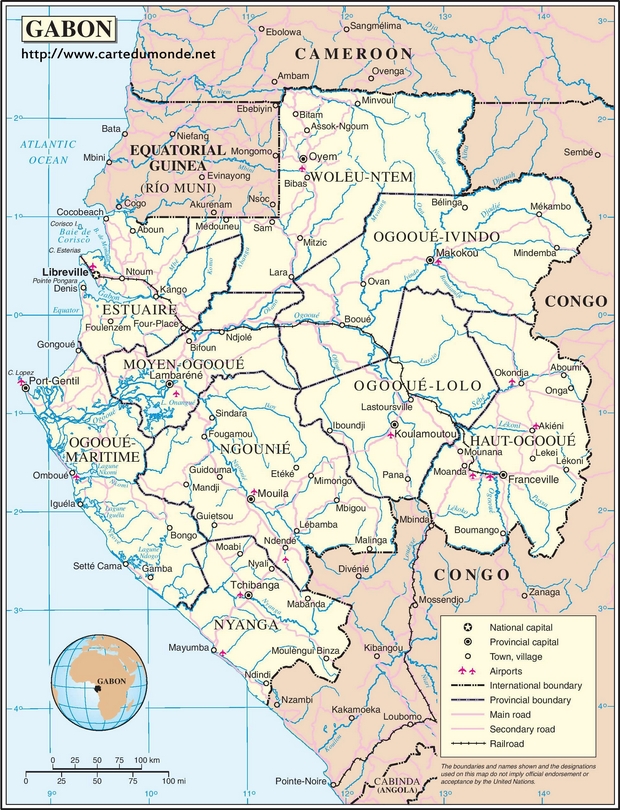
Gabon election raises fears of ritual killings (2008)

Published: April 16, 2008
Writing by Daniel Flynn; Editing by Clar NiChonghaile
Antoine Lawson
Reuters

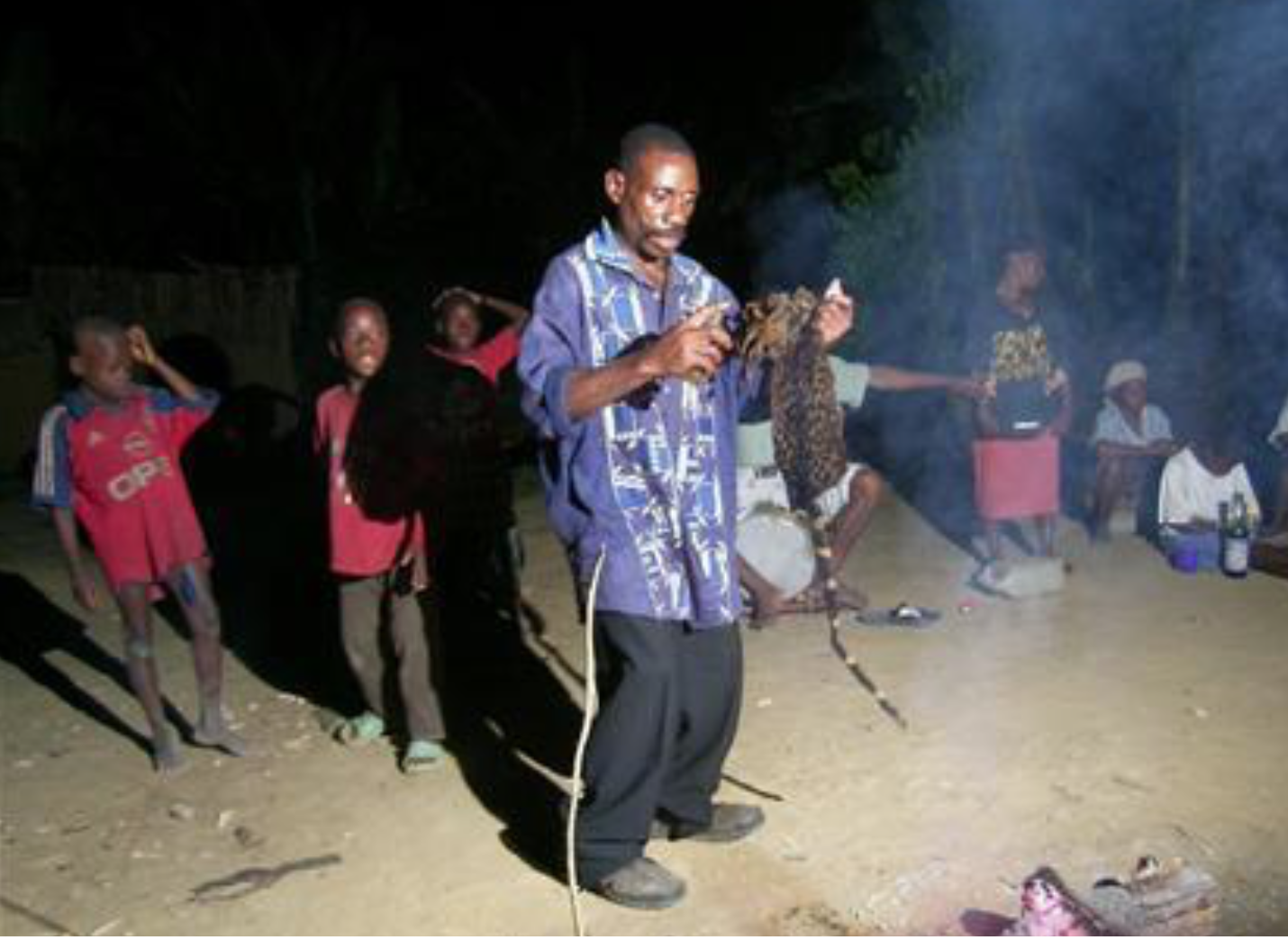
A sorcerer performs a dance in front of a sacred fire in Bitouga, some 600 km from the Gabon capital Libreville, in this September 2007 photo. REUTERS/Antoine Lawson

LIBREVILLE (Reuters) – When the body of 13-year-old Ralph Edang N’na was found drained of blood and with gaping wounds in his genitals, chest and neck last month, many in Gabon thought it was politicians who had ordered his killing.

The murder of children and young adults, whose organs are eaten or used to make magical amulets, has increased in recent years in the oil-rich central African nation. Campaigners say some Gabonese politicians use the black magic rituals to boost their chances of winning lucrative government posts.

With elections to local municipal councils due on April 27, many fear a spate of gruesome child murders.

Every week, mutilated bodies are discovered in the capital Libreville, despite police patrols, and streets quickly empty after nightfall. Anxious parents are keeping a close watch around schools to prevent children from being snatched.

“It’s before elections and ministerial reshuffles that the vilest crimes are committed and the capital empties of certain kinds of politicians who go to the interior to carry out witchcraft,” said pastor Francois Bibang, a member of the Association to Fight Ritual Crimes (ALCR).

In ritual killings, which still take place in several African countries, people, often children, are killed to obtain body parts and blood in the belief they will bring social success and political power.

The ALCR says that in February alone there were 12 such killings in Gabon.

“Unfortunately, this practice seems to be spreading again in Gabon,” said Jean-Elvis Ebang Ondo, who founded ALCR after his 12-year-old son was kidnapped, killed and mutilated in 2005.

The government set up a National Observatory for the Rights of Children in November 2006 to implement the U.N. charter on children’s rights, enshrining the right to health, education and protection from abuse.

Gabon, with just 1.6 million people, is one of sub-Saharan Africa’s largest oil producers but most of its population continue to live in poverty, while members of a rich elite drive shiny new cars along Libreville’s sea front boulevard.

Omar Bongo, the world’s longest-serving president, has ruled the country since 1967 and used the oil funds to weave a web of patronage which has created bitter competition for lucrative political jobs.

Ondo condemned “the silence of the state” and called on residents to “fight off these assassins who sow terror in the heart of Gabonese society”.

After a penal code approved in January omitted any mention of ritual crimes, Ondo called on the government to find out how many people had been killed in this way.

“Spare parts”

But no clear figures exist for how many children and teenagers are slain in ritual killings in Gabon.

The head of an association against ritual crimes, Frederic Ntera Etoua, said 290 killings had occurred since 1986 in the thick jungles of the Ogooue-Ivindo province in the northeast, where Ralph Edang N’na was killed.

“There is a pyramid organization with politicians at its head who pursue the famous ‘spare parts’ then the recruiters who are middle men and then the suppliers and sellers who find the innocent victims,” said Bibang.

Parliamentary speaker Guy Nzouba Ndama opened the latest session of the assembly on March 3 by denouncing ritual crimes by politicians.

So far no politicians have been convicted for involvement in such crimes. An attempt to prosecute a legislator from the oil-rich region of Gamba last year failed after he claimed parliamentary immunity.

Philippe Ndong, a psychology teacher at Libreville university, traces the rise in ritual crimes to 2001.

“As legislative elections approached, mutilated bodies were discovered around the country,” said Ndong. “An 8-year-old girl was snatched in Ndolou department and killed in Mouila. The man allegedly responsible was a candidate to parliament who entered the government after this crime.”

Ndong cites other ritual murders. In 2002, a man in his 20s, Lucien Bigoundou, was killed in the Digoudou forest of central Gabon while on a hunting trip with companions who cut off his genitals and other parts of his body.

In March 2005, the bodies of two 12-year-old boys were washed up on a Libreville beach — one was Ebang Ondo’s son. A month later, six-year-old Warlys Igor Mboumba was found dead in a Libreville gutter, his body drained of blood.

In January 2006, the bodies of three children under four were discovered in the trunk of a car in a private yard.

And last April, two men suspected of sodomizing a 3-year-old boy and draining his blood in a ritual killing were lynched.

“It is up to the government to put a swift end to this impunity or risk seeing a rise in mob justice,” said pastor Emile Ngoua, a member of the ALCR.

Source: Gabon election raises fears of ritual killings
April 16, 2008

Liberia’s elections, ritual killings and cannibalism (2011)

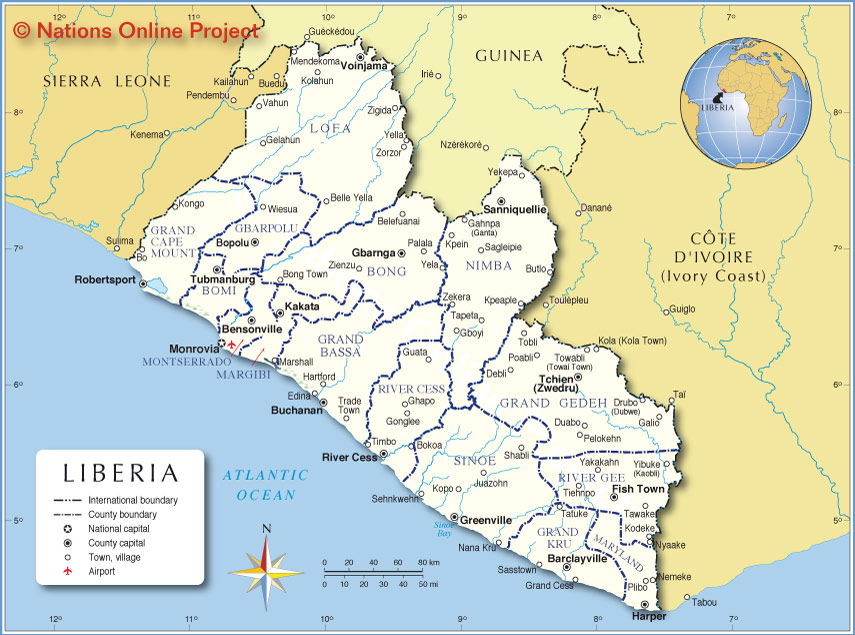
I have written extensively about Liberia’s history of ritual killings, in books, articles, and on my website ‘Liberia: Past and Present of Africa’s Oldest Republic‘, notably in the section ‘Past and Present of Ritual Killings: From Cultural Phenomenon to Political Instrument‘.

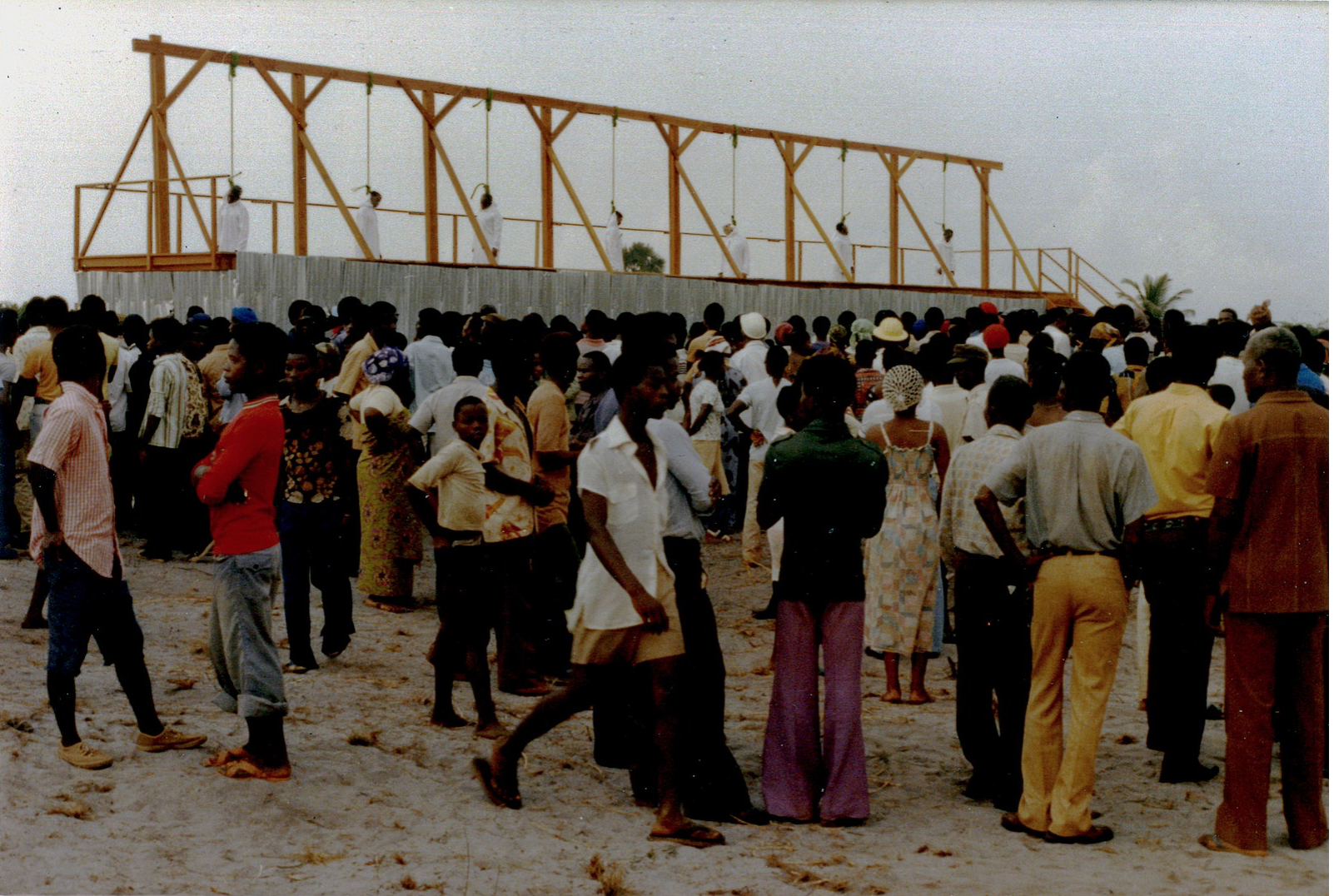
I was confronted with the phenomenon of ritualistic murders in Liberia when living in Monrovia – where I taught at the University of Liberia – and, later, in Harper, capital of Maryland County, in the second half of the 1970s. In Harper I witnessed the public execution of the Harper Seven, in 1979. They were convicted of the ritual murder of a fisherman and popular singer, Moses Tweh, and sentenced to death by hanging. The trial of the Harper Seven turned out to be Liberia’s most notorious ritual killing case.

Big shots’ were involved, such as Maryland County’s Superintendent, Daniel Anderson – son of the Chairman of Liberia’s only political party, the True Whig Party – and Allen Yancy, member of the House of Representatives for Maryland County and cousin of former Liberian president William Tubman (1944 – 1971). Reportedly, Allen Yancy had been involved in previous ritual murder cases but he was never convicted, allegedly because of Tubman’s protection.
Ritualistic killings in Liberia have been rampant, and I fear the gruesome practice has far from disappeared – as is demonstrated by the article reproduced below.

The article reproduced below summarizes well Liberia’s recent history of ritualistic murders. What used to be a cultural phenomenon – human sacrifices for the well-being of the clan or tribe – has become a political instrument, used by unscrupulous politicians and businessmen to further their interests.

I will not dwell too long here on these atrocities and outdated but persistent beliefs in supernatural powers. Readers are invited to visit my website for more details.

Last but not least, my publications on ritual murders in Liberia became the prelude to the present website on ritual killings in Africa in general. See the site’s menu, notably the section ‘Why publish this site?

Public execution by hanging of the ‘Harper Seven’, including Maryland Superintendent Daniel Anderson and Representative Allen Yancy, at dawn in Harper, Liberia on February 16, 1979. Picture taken by Fred van der Kraaij (copyrights).


Liberia’s elections, ritual killings and cannibalism

Published: August 01, 2011 · 10:52 AM UTC
By: Emily Schmall and Wade Williams

MONROVIA, Liberia — The pregnant woman was found dead in the shallows of Lake Shepherd. The fetus had been removed.

A candidate for Liberia’s Senate and a former county attorney are among those standing trial for the 2009 murder, the latest in a long history of ritual sacrifices performed for political power in Liberia.

In this case in southeastern Maryland County, prosecutors were tipped off by a witch doctor who provided a list of 18 people allegedly connected to the killing, including Fulton Yancy, the former county attorney, and President Ellen Johnson Sirleaf’s Special Envoy and Ambassador-at-Large Dan Morias.

Vials of blood were discovered in Yancy’s home. Nine were charged with murder but were released earlier this month following a Supreme Court ruling.

Liberia will have general elections later this year and the ritual killings tend to flare up during election season, according to Jerome Verdier, former chairman of Liberia’s Truth and Reconciliation Commission (TRC).

”Unfortunately it happens during elections time because people are competing for political power, they don’t know God and they believe that these supernatural powers will come to them once human blood is shed,” Verdier said.

During Liberia’s two-decades-long civil war hundreds were killed for ritual purposes, the TRC discovered during its hearings.

”During our research at the TRC we found out that bloodshedding was very, very common during the conflict. People killed indiscriminately women and children believing that it would give them some power to continue fighting and that they would be protected,” said Verdier.

Liberia’s Maryland County has traditionally been the hub for the country’s ritual murders. The killings have haunted the southeastern county for decades. In recent years, however, ritual killing cases have cropped up across the country.

Verdier said some of those who confessed at the TRC hearing gave graphic accounts of ritual killings they carried out.

“People went as far as eating their opponent’s body — when such person is killed in battle they cook their body to eat, believing that the spirit, the powerful spirit of that person, will come to them and by eating them, the person’s power is completely destroyed, so there can be no reemergence in that person’s family line or their ethnic line.”

‘General Butt Naked’, a notorious warlord in Liberia’s First Civil war (1989 – 1997) testified and confessed before the Truth and Reconciliation Commission that he committed numerous ritualistic murders and ate body parts of his victims.

A former warlord who calls himself General Butt Naked and who fought against former Liberian dictator Charles Taylor, confessed in 2008 to taking part in human sacrifices that included the killing of a child and “plucking out the heart, which was divided into pieces for us to eat.”

In 2005, the leader of Liberia’s transitional government, Gyude Bryant, pledged to hang anyone found guilt of ritual killing.

Dispatched to Maryland County by President Johnson Sirleaf to calm residents’ fears earlier this year, Justice Minister Christiana Tah acknowledged that “there are still lots of unresolved cases of this nature,” according to a report in the daily New Democrat.

In a case from the 1970s known as the Maryland Murders, seven people, including Fulton Yancy’s older brother Allen Yancy, a member of the House of Representatives, were hanged for killing a fisherman (see picture above). The following year Defense Minister Gray D. Allison was convicted of killing a police officer whose body was discovered on the Bong Mines railroad, apparently used in a ritual sacrifice. The government at the time displayed blood drained in gallons believed to be that of the dead man.

Dan Morias, one of those accused of the 2009 killing of a pregnant woman, is planning to run for senator in the upcoming legislative elections in October. He has maintained that the charges against him are politically motivated. He must be cleared of the charges to be eligible to run for office.

Morias is listed in the TRC report for alleged abuses committed while he served as Minister of Internal Affairs for the Charles Taylor regime. When reached by GlobalPost, Morias said he could not comment on the case as it would be “prejudicial,” but insisted that the evidence against him — namely the testimony of a witch doctor — was “weak.”

Earlier this year, President Johnson Sirleaf warned Maryland County citizens against seeking retribution for the killings with a traditional practice called “sassywood” or “trial by ordeal.”

The government insists that trial by ordeal is illegal and Johnson Sirleaf banned the practice in April 2007. Since then traditional leaders have been pleading with the government to allow them to practice the act which they believe is the only way justice can be served in cases like these.

“Sassywood” is the insertion of an accused person’s extremity into hot oil or the placing of a heated metal on a suspect’s body. If the suspect is burned then it is concluded that he or she is guilty but if there is no burn then the suspect is deemed innocent and set free. Those found guilty are killed.

The police are working to stamp out both the ritual killings and the “sassywood” practices, said George Bardue, spokesman for the Liberia National Police: “The police are doing everything possible to make sure that these things do not happen.”

Emily Schmall is a multimedia journalist now based in Monrovia, Liberia, where she serves as country director for New Narratives, a journalism mentorship project for women. Wade Williams is a New Narratives fellow and an editor at FrontPage Africa, Liberia’s most widely circulated newspaper.

Source: Liberia’s elections, ritual killings and cannibalism
GlobalPost

Wave of Ritual Killings Spark Panic in Cameroon (2013)

The two articles reproduced here date from 2013, hence the reported cases of ritual killing are no recent ones. Be that as it may, I believe they are authentic and the reported cases are genuine.
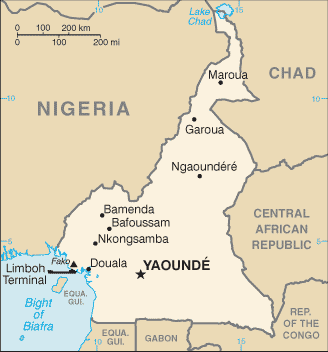
Late 2012 the population of Yaoundé, the capital of Cameroon, was terrified after the disappearance of 18 young women and the subsequent discovery of their mutilated bodies. In September 2013, parliamentary elections were held in Cameroon. They were originally scheduled for July 2012, but were repeatedly postponed: February 2013, July 2013, and finally held on September 30, 2013, alongside local elections. It has never been proven that the wave of ritual killings in 2012 was linked to the planned elections, but observers of ritualistic murders in Africa point to the fact that often there is an increase in ritual killings during election campaigns. Also, as one of the articles states, ritual killings were common in Cameroon until the 1970s though more recently the number of ritualistic murders has decreased. (webmaster FVDK)

Ritual Killings: 18 Young Women Found Murdered With Brains, Eyes, Genitals Missing

Published on January 23, 2013
By: Naij.com

A series of ritual killings of young women in the West African nation of Cameroon has caused panic in the capital city Yaoundé.

Families are now refusing to let their daughters go out after a spate of gruesome killings of young girls who were abducted by the drivers of motorcycle taxis before being murdered and dismembered.

Police have found 18 mutilated bodies on the streets of the capital in the past two weeks, five of them outside a nursery school, and all are believed to be linked to occult rituals.

In some parts of the country traditional healers believe that body parts including eyes, genitals, breasts and tongues have mystical powers, with many believing they bring riches and other good fortune.  Others believe that performing a human sacrifice will bring good luck.

Ritual killings were common in Cameroon until the 1970s but as education spread, the number of murders decreased.

Now families fear the practice is coming back, with the latest wave of killings causing near-hysteria in the capital city.

This week, the sister of a 17-year-old girl whose corpse was found on Friday outside a nursery school, minus the genitals, tongue, eyes, hair and breasts, wrote to Cameroon President Paul Biya demanding action to prevent further killings.

Deborah Ngoh Tonye Epouse Mvaebeme said her sister, Michele Mbala Mvogo, a student at the government bilingual High School Yaoundé was abducted three days before her body was found outside a nursery school. She accused the city’s commonly-used motorcycle taxi drivers of facilitating the murder, and said the government had failed to do enough to protect the victims, who were from the poverty-stricken neighbourhoods of Mimboman and Biteng.

One local said: ‘The moto-taxi drivers are the assassins’ accomplices, and their targets are girls aged 16-25 who get the taxis after nightfall.  For a large sum of money, these girls are delivered to men in the suburbs who do the rest.’

The head of a Mimboman nursery school told afrik.com how she found one of the bodies outside her school.

She said: ‘It was a strong smell of rotting that drew my attention, so I decided to do a tour of the school. ‘That’s how I found, behind one classroom, a body of a young girl in an advanced state of decomposition, with her underwear placed on her feet, before my very eyes.’

Families in the neighbourhood are said to be in a state of hysteria, banning their girls from taking motorbike taxis and keeping them indoors after dark.

Communication minister Tchiroma Bakary said: ‘Ritual sacrifices with a demoniac connotation are unacceptable and intolerable, and the government will do all it can to put a stop to it.’

Ngoh Tonye, whose sister was murdered, told CNN: ‘There is laxity in the forces in ensuring security in the capital.’

The bodies of the five most recent victims were identified yesterday, according to a State security official who said most of the victims were high school students aged 15-26.

Two men have been arrested in connection with the killings but so far no charges have been brought.

The Cameroon capital, which has a population of just over two million, is in a state of distress with families staying behind locked doors as soon as darkness falls. Police warn pedestrians to walk in groups at all times and have cracked down on local bars frequented by criminals, shutting them down in the dozens. Vigilante groups of young men guard the streets at night and hunt for the killers, as the people of Yaoundé say the police are not doing enough to keep the city safe.

The new wave of gruesome killings in the capital has also seen dozens of complaints about mutilated corpses in the mortuaries of Yaoundé’s public hospitals, according to Health Minister André Mama Fouda.

Source:
Ritual Killings: 18 Young Women Found Murdered With Brains, Eyes, Genitals Missing

Yaoundé, capital of Cameroon

Related article:

Wave of Ritual Killings Spark Panic in Cameroon, Increase Safety Measures

Published: 28th February 2013, 14:15 GMT+11
By: Global Press Institute – Nakinti Nofuru

BAMENDA, CAMEROON When Sarah Ewang, 41, heard about the homicide and dismemberment of 18 young women in Yaoundé, the capital of Cameroon, she cried and prayed to God to give strength to the victims families.

Ewang, a jewelry trader in Bamenda, the capital of the Northwest region, can understand the pain the girls endured during the moments before they were slain by alleged ritual killers. I came so close with ritual killers, she says. God delivered me from the hands of those evil men.

During 2005, Ewang traveled from Bamenda to Douala, the capital of the Littoral region, to buy jewelry to restock her shop. In Douala, she entered a taxi already occupied by two men, who appeared to be passengers. As they drove, another woman stopped the taxi. Moments after picking up the second woman, one of the men in the car pointed a gun at them and ordered them to keep quiet. I tried to shout, but one of the men slapped me very hard, Ewang says.

The taxi took a sharp turn off the main road and drove for more than an hour into an isolated forest. Eventually, the car stopped at a strange-looking hut, constructed of sticks, grass and old bags. I knew my life was coming to an end, Ewang says, and the next thing I thought of was my 3-months-old baby.

She says she cried out and received a second slap from the man carrying the gun, causing her to pass out. When she awoke, she discovered that they had removed her from the car. The driver and one of the men walked into the hut, but the man with the gun remained with them. She says they were ritual killers. They didnt request for anything from us, Ewang says, so they didnt look like armed robbers or thieves.

Finally, the two men emerged, along with four other men carrying cutlasses. Desperate, Ewang cried aloud in her local dialect, Bakossi. Oh my God, I will die and leave my 3-months-old daughter to who? she says she cried. Oh God, please come and help me.

Immediately after she spoke, the man with the gun walked up to her and looked her in her eyes but did not say a word, she says. He then led the other men back into the hut, where they remained for more than 45 minutes. Eventually, the man with the gun returned and asked her and the other woman to get into the car.

The men returned them to Douala and told them to walk away without causing any alarm. As they walked away, the man with the gun spoke. Go and look after your 3-months-old baby, she says that he told her in Bakossi. Extend my greetings to her. Tell her that her forest uncle sends his greetings. Your fluency in your dialect has saved your soul.

As soon as she heard the man speaking her dialect, Ewang stopped, fell to the ground and wept. She says he must have been from the same tribe as her in the Southwest region, where she is originally from. The men drove away, probably to look for the next victim, Ewang says.

Now, eight years later, news of recent killings in Yaoundé has brought fear to Ewangs home in Bamenda as she recalls her own experience.

It is an experience I will live to remember, she says, her voice breaking, and then bursts into tears. May God come to our rescue. Her youngest daughter, who was 3 months old at the time, is now 8. She uses her right hand to dry her mothers eyes. Mummy, dont cry, she says.

Since the discovery of nearly 20 young womens corpses in December and January, women in Bamenda say they will stop at nothing to ensure the safety of their daughters from ritual killers. Young women advise each other to not go out at night. Teachers report that lectures on safety tips for their pupils have intensified in their schools. Local police state that they are working to maintain peace and security for the population.

The dismembered corpses of 18 young women were discovered in Yaoundé, some hidden in bushes and one discovered by a headmistress in a primary school classroom, says Mark, a member of the Rapid Intervention Battalion in Bamenda, who declined to publish his last name for reasons of job security. The battalion is a special branch of the police force in Cameroon tasked with responding to emergency situations.

News reports also reached Bamenda that vital parts of the corpses were missing, including the womens breasts, eyes, kidneys and heart, Mark says.

A lecturer at the University of Bamenda, who requested anonymity to ensure his safety, explains that the removal of those body parts is what marks the deaths of these young women as ritual killings.

He explains that ritualists pay killers to come back with certain body parts, which the ritualists then take to witch doctors or use themselves. Ritualists are usually people seeking fame, money, or positions in government and politics.

Although there were occasional reports of ritual killing in Cameroon before, he says, they were not as large in scope or frequency as the massive killing that recently occurred in Yaoundé.

Beatrice Ngwe, a mother of four girls and one boy, lives with her family in Bamenda. Ngwe says she feels the pain of the mothers in Yaoundé who lost their daughters to ritualists.

Being a mother of four girls is not easy, she says with a heavy voice. I fear for their life all the time.

Ngwes friends daughter disappeared during 2008 after the woman sent her 9-year-old to deliver a message, Ngwe says. The girls body has not been found, leading the town to suspect she became a victim of a ritual killing.

Ngwe says she would not want to live with the guilt of being the author of any of her daughters or sons misfortune, so she is taking extra safety precautions. These days, she fears even more that they may be killed for ritual purposes.

I will die to protect my daughters, Ngwe says. If an errand is very important that it cant wait to see the light of the next day, I prefer to go on it myself.

Melanie Vishiy, 22, is a student at Trinity Computer Training Center in Bamenda. She says she fears for her life because of the news of ritual killings of young women in Yaoundé as well as of another girl during January in Nkambe, a town in the Northwest region.

Since I heard of the death of the young girls in Yaoundé and in Nkambe, I dont go out after 6 p.m., she says, shaking her head. No, I dont, not even to urinate at night. I do that in a small bucket meant for the purpose.

Vishiy had heard of incidents of ritual killings before. But she says that she didnt understand the reality of it and was never scared until news broke about the recent series of deaths.

Now, she says she has never been so scared and alert in her life. She doesnt trust any man she comes across while walking alone.

If a man is on a path with me, just two of us, I make sure I start preparing my heels for running, she says. I look at him directly into his face and try to keep a reasonable distance from him.

Vishiy advises girls to stay indoors for their safety.

I am calling on girls and women to stay close to homes, she says. I am not saying that they shouldnt go out there and have fun, but they should do it with limitation and reasoning.

Beyond the home, teachers in Bamenda are doing their part to spread the message of safety.

Sarah Koye is a teacher at Government Bilingual Primary School Group 2 in Bamenda. She says the recent killings in Yaoundé have prompted teachers to introduce safety tips to their pupils.

We ask them to always move in groups when coming to school and when going back home, Koye says.

Some teachers go as far as asking pupils to tell their parents that they should not send them on errands in the dark or on lonely roads.

The children know what is going on in the nation, she says. When she asked her students whether they had heard about the killings, some children shouted that they had watched it on the news, while others had heard about it from their parents and friends. At school, children shared safety tips that they had received at home.

Because all victims since December have been women, Koye focuses extra training on female students. Some ritual killers begin by violating the children sexually, so she has also introduced some elementary sex education and lessons on morality.

Koye helps the students understand that they are too young for sexual activities and advises them to run and scream if a man makes such advances. She asks them not to follow strange men into homes or bushes. Teachers also tell pupils not to speak with or to accept gifts from strangers on the way to and from school.

In our days, we could receive things from strangers, talk with strange people on the way, without any strings attached, she says. Today, such interactions may only lead to danger. We tell our pupils to be very careful and alert.

The students are doing their best to take the advice that they are being given in school, Koye says.

Outside of school and the home, the police is working to protect the population of Bamenda.

Ever since the ritual killing cases in Yaoundé, the commissioner of police has asked the force to be more vigilant, Mark of the Rapid Intervention Battalion says. They are to arrest and interrogate anybody walking the streets late at night.

We patrol the town all night just to make sure that nothing goes wrong, he says. We have arrested and interrogated many suspects that we find in suspicious places in the heart of the night.

Mark says the battalions lines are open to all. They have received many calls both day and night from people who find themselves in difficult situations. He says the force always goes to their rescue and doesnt spare any suspect from questioning and possible detainment.

He says the number of calls they receive and suspects they have pursued is confidential. But so far, there have been no cases of ritual killing in Bamenda.

Security has stepped up in all the towns of Cameroon, Mark says. He asks the public to trust the capabilities of the police.

We will stop at nothing to put this town under serious surveyance, he says.

Source: Wave of ritual killings spark panic in Cameroon, increase safety measures

eSwatini: Security fears keep 250 pupils away from school (Swaziland)

Swaziland King Mswati III, Africa’s last absolute monarch, has renamed his country ‘the Kingdom of eSwatini’.

On April 18, 2018 King Mswati III of Swaziland announced that he was renaming the country ‘the Kingdom of eSwatini’. The new name, eSwatini, means ‘land of the Swazis’.

King Mswati III is Africa’s last absolute monarch. He is being criticized by human rights organizations and activists for not allowing political parties and discriminating against women. See e.g. Richard Rooney’s blog.

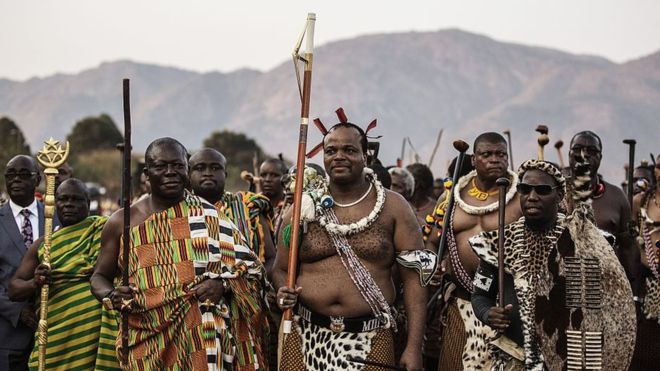
King Mswati is known for his many wives, 15 – though this is much less than the number of wives his father, King Sobhuza II, had: 125 – and for his adherence to traditional dress (see picture below).

Ritual murder especially of children is a common experience in the Kingdom of eSwatini, formerly known as Swaziland. The number of ritual murders increases at election time. As reported earlier (see my June 19 posting), in 2003, King Mswati III urged Swaziland’s politicians not to engage in ritual killings to boost their chances. Five years later, Prime Minister Absalom Themba Dlamini issued a similar warning (2008).

We’re now in 2018 and apparently nothing has changed. The Swaziland Action Group Against Abuse (SWAGAA) has issued a statement recently, saying it is “(…) deeply alarmed and distressed by recent media reports of abductions and kidnappings resulting in mutilations and killings. Children, both girls and boys, are especially targeted (…). The fact that there are widespread speculations on whether or not these abductions are for ritual purposes linked to the upcoming Parliamentary elections in Eswatini cannot be ignored.”

So far, about 45 people have been abducted, killed and mutilated in countrywide attacks that are believed to be associated with ritual activities ahead of parliamentary elections later this year (read article below).

(webmaster FVDK)

King Mswati III, centre, has ruled the country for more than 30 years (since 1986).

eSwatini: Security fears keep 250 pupils away from school

Published: June 18, 2018
APA News, Journal du Cameroun.com

Some 250 pupils from one community in eSwatini have abandoned school over fears linked to the recent spate of ritual kidnappings and murders.

Residents of Mafutseni, about 50km from Manzini, decided to withdraw their children from schools following incidents of attempted murder in the space of two weeks.

“At least residents pulled their children out of school and did not take the law into their own hands by hunting and killing the murder suspects,” said community headman, Mamilela Maphosa.

The first incident occurred two weeks ago when a 15-year-old boy was captured by three men and his throat slot in an attempted murder apparently over ritual purposes.

The boy escaped and is currently admitted to a hospital.

The other case involved a community policeman who fled from an attack by three men whom he believed wanted to abduct him last week.

The two incidents forced parents of pupils at a nearby primary school to keep their children at home until they were assured of their safety.

On Tuesday residents held a march around the area carrying placards that condemned such acts.

So far, about 45 people have been abducted, killed and mutilated in countrywide attacks that are believed to be associated with ritual activities ahead of parliamentary elections later this year.

Source: eSwatini: Security fears keep 250 pupils away from school
JournalDuCameroun, June 28, 2018.

Also read my June 18 (2018) posting.

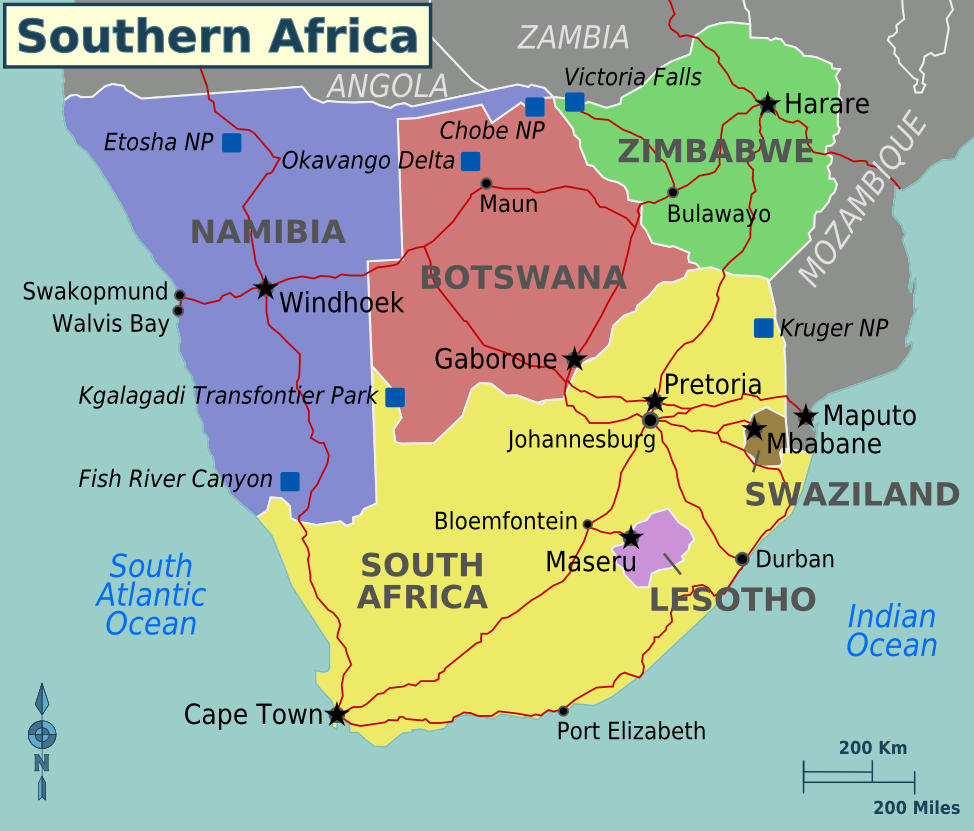
Swaziland, or ‘the kingdom of eSwatini’ as the country is being named since April 2018, is a landlocked country and smaller than the US state of New Jersey.

Gambia – President Barrow denies killing his son for ritual purposes to become president

The big news of this article is NOT what its heading suggests. I have no doubt, president Barrow is speaking the truth. However, the real meaning of this article – and that’s why I include it here – is that it underscores one of my firm beliefs: “Ritual killings are a – daily – reality in many African countries”. If ritual killings would never occur in the Gambia, this rumor would not have existed. The fact alone that the president of the Gambia finds it necessary to publicly deny any involvement in the ritual killing of his son, says a lot about what’s in peoples’ mind in the Gambia. Also, apparently, the (supposed) link between presidential elections and ritual killing is a logical one, also in the Gambia.

Ritualistic killings, superstition and rumors thrive where there is lack of education and proper information. Hence the key to a better future lies in a better education, accessible to all.

President Barrow denies killing his son for ritual purposes to become president

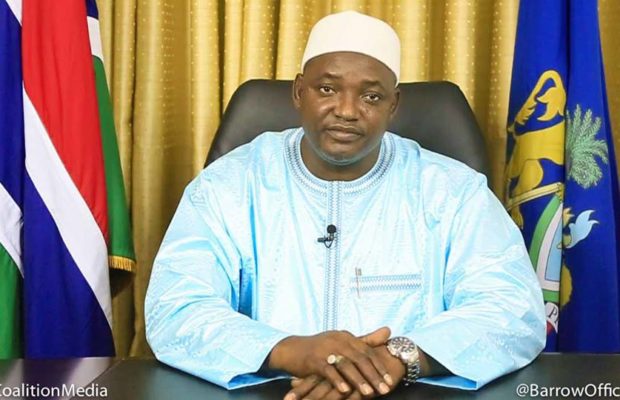
Adama Barrow won the 2016 presidential election, defeating eccentric dictator Yahya Jammeh (1994 – 2017). Jammeh refused to recognize his defeat and Barrow fled to Senegal. After a diplomatic ECOWAS intervention Jammeh was forced to go into exile. Barrow returned to the Gambia on January 26, 2017 and was installed as Gambia’s third president since independence in 1965.

Published: June 27, 2018
By Pa Nderry M’Bai
Freedom Newspaper 

President Adama Barrow has denied reports attributed to him that he allegedly killed his son for ritual purposes so that he can be elected into office as Gambia’s President. The president made the denial through his Press Director Amie Bojang Sissoho, who addressed a news conference on Wednesday at the President’s office in Banjul. This followed, a statement made by President Barrow, during a recent visit to Faraba Banta, where he was quoted as having said that he (Barrow) had to sacrifice his own son, wealth, and life in order for The Gambia to be freed from Jammeh’s twenty-two years dictatorship. Barrow was in Faraba last week to sympathize with the bereaved families, whose loved ones were killed by Gambia’s police intervention unit— the (PIU).

“ When he lost his son, is because he left the Gambia, as president elect. When his son died, he had to leave the children behind. If he was not the president, he would not have done that at that point in time; he wouldn’t have left his family behind. That is what he was trying to explain; that even he has lost his family, but he had to move on because he has taken a responsibility of serving the country,” State House Press Director Amie Bojang Sissoho clarified.

Mr. Barrow’s statement attracted a huge reaction on social media. Many Gambians were taken aback by Barrow’s statement, in which he allegedly made the appearance that he sacrificed his son for ritual purposes to become the country’s President. But the State House was quick to dismiss such reports saying that the President’s statement was being blown out of proportion. It also says Barrow’s statement was being interpreted out of context.

“We have to understand things into context. And remember that when people are in a difficult situation; we have to understand how, and what was the context in which things happened. And this was what simply he was trying to explain. And that is simply what he was trying to explain. That in a process, anything could happen. This is what happened; these lives were loss because of a cause; to show that even he himself lost his child because of a cause. His child died,” Mrs. Bojang Sissoho further clarified.

Mr. Barrow’s son was bitten by a stray dog, and he died in the process. Barrow and his two wives were in Dakar, Senegal, at the time of the incident. His son was buried in his absence.

Mr. Barrow left the Gambia for Mali, to attend a regional Summit over Gambia’s political impasse. He later resettled in Dakar, Senegal, in the wake of the country’s month long political impasse. Former Gambian dictator Yahya Jammeh had refused to concede defeat during Gambia’s December 2016 Presidential elections, which had thrown the impoverished West African country into a state of turmoil.

“And it was difficult time. We all know that..; when his son died, he was president elect; he was not sworn in; he left the country, but that did not stop him to move on. It is not that he did not feel it; what he was trying to say is that we have our difficult times, but we have to move on as a country,” Mrs Bojang Sissoho told journalists.

“I think people have to calm down on receiving information. What the president was emphasizing was that; we all have lost somebody for the sake of the Gambia; We have been either directly or indirectly affected,” she added.

Source: Freedom Newspaper, June 27, 2018

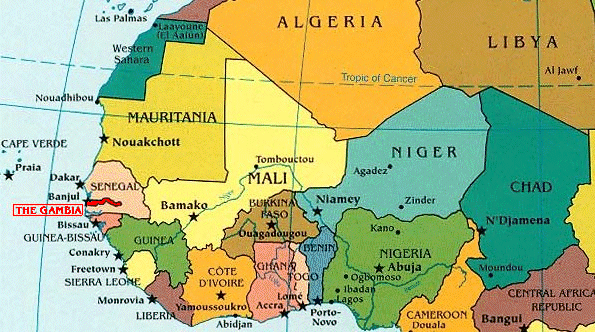
With a territory of 10,689 square kilometres (4,127 sq mi) the Gambia is the smallest country within mainland Africa.

Albinism in Tanzania: slow progress in combatting violence and discrimination

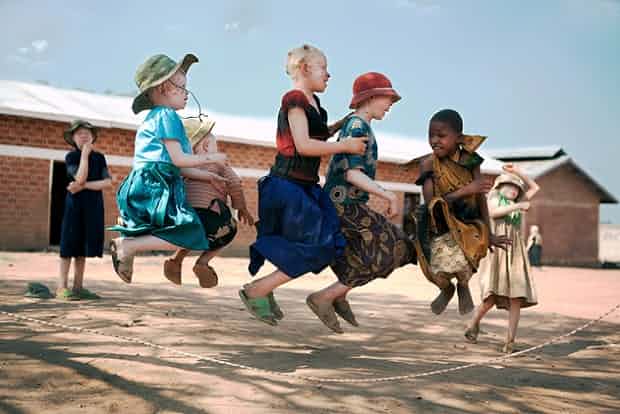
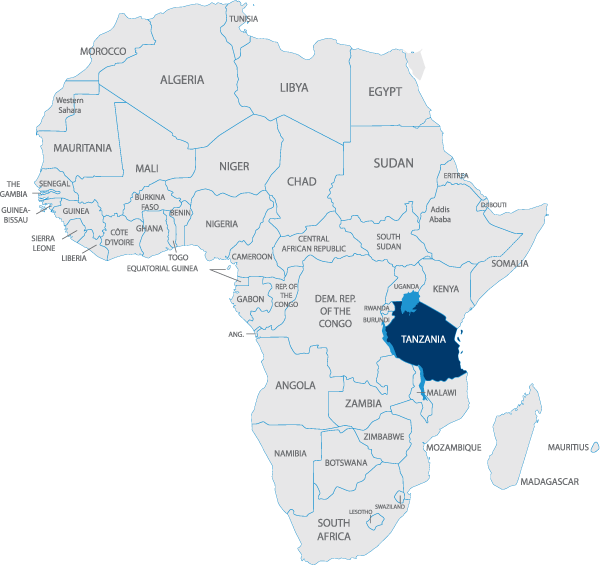
In 2008 a wave of murders of albinos in eastern and central Africa attracted worldwide attention and condemnation even though it wasn’t the first time albinos were targeted in countries like Tanzania, Burundi and Malawi.

In June 2008, a New York Times online edition aired a news brief on albino killings in Tanzania, which caused a sensation. In July 2008, a BBC journalist, Vicky Ntetema, posed as a businesswoman who wanted to get rich quick and consulted 10 witchdoctors in Tanzania. Several witchdoctors promised to get her a magic concoction mixed with ground albino organs. The starting price was $2,000 for the vital organs. Later she had to go in hiding after receiving death threats because of her undercover work. A BBC video on the horrifying spate of killings of albinos in Tanzania, broadcast in August of the same year, was later taken off the air. Also in July Al Jazeera presented a video on the fate of albinos in Tanzania (Part 1 and Part 2). The European Union condemned the ritual murdering of albinos (September, 2008), followed by UNICEF (December, 2008). By then, according to the Tanzania Albino Society (TAS), more than 35 albinos had been killed in 2008 alone, with many other such cases unreported. For more cases, covering the 2003 – 2010 period, you’re welcome to visit my archives. Unfortunately, many links have expired. (For this reason I copy all articles and publish them on the present site while acknowledging their origin).
It’s important to mention that ‘Under The Same Sun’ founder Peter Ash estimates the total number of deadly victims to be twice the official figure in a December 3, 2008 interview. Viewers are warned that the interview can be shocking because of the graphic nature of the story.

The NGO Under The Same Sun helps people with albinism overcome often deadly discrimination through education and advocacy. UTSS was started by Peter Ash, a former pastor and Canadian businessman with albinism, and Vicky Ntetema, mentioned earlier, Tanzania’s BBC bureau chief whose report in July 2008 broke the story to the world of the gruesome murders of persons with albinism in Tanzania. UTSS was founded in 2008. Visit the impressive site of Under The Same Sun, a comprehensive site about Persons with Albinism in Tanzania.

Under The Same Sun helps people with albinism overcome often deadly discrimination through education and advocacy

The following article dates from 2015 but as forthcoming posts will also demonstrate, the fight against discrimination of people with albinism is far from over, and therefor I want to congratulate Under The Same Sun, the Tanzania Albinism Society, and other organizations supporting the same cause for their valuable work and wish them success in the future. May their work soon be no longer needed! (webmaster FVDK)

Published on May 13, 2015
By Daniel Wesangula
The Guardian

Around 30,000 people with albinism are thought to be living in Tanzania. Photograph: Ana Palacios

Albinos live with the risk of being killed, their body parts fetching high prices for witchcraft – but NGOs hope that change is coming.

“This is possibly the worst time to be a person living with albinism in Tanzania,” says Amir Manento.

In October, citizens will go to the polls to vote in presidential and parliamentary elections. “Every election period brings with it a new cycle of killings. In between we have other smaller elections translating to more abductions, more killings.” Manento, a retired judge and human rights activist, has been at the forefront of campaigning for the rights of people living with albinism for decades. “We see an increase of witchcraft and the use of human body parts, particularly albino body parts, in the run-up to the general elections.” Albino body parts are associated with good luck, and as the country gears up for the elections, the demand for good luck charms goes up. Sacrifices during this time are thought by some to be a sure way of guaranteeing victory in the polls.

“Albino hunting came into the limelight around 10 years ago, particularly within the fishing and mining communities,” says Dr Benson Bana, a political science and public administration lecturer at the University of Dar es Salaam. Bana believes that some of the roots of the problem lie in the financial downturn in the area around Lake Victoria, one of the regions where there have been the most killings and abductions.

“A certain poverty touched our people after the privatisation of fishing activities in Lake Victoria,” says Bana. “Everything was being controlled, from where one could fish to the size of the holes in his fishing net. The result was diminished harvests. Every above-average catch by the little guys was then attributed to superstition. This is when witchdoctors started peddling the belief that people living with albinism or their body parts, most of whom coincidentally live in these regions, could be used as good luck charms.”

Bana believes that this devastating association was then passed on to neighbouring mining communities. “Eventually it caught wind and was looked upon as a legitimate way of acquiring riches and power by some individuals. Hence the association with politicians.”

Tanzania is thought to have one of the world’s largest populations of people living with albinism, a congenital disorder that robs skin, eyes and hair of their pigment. But for years this population of about 30,000 people has existed under the threat of abductions and ritual killings, and in recent years the situation appears to have worsened.

According to a report by the International Federation of Red Cross and Red Crescent Societies, a complete set of Albino body parts – including all four limbs, genitals, ears, tongue and nose – can fetch up to $75,000 (pdf).

The Tanzania Albinism Society says it is almost impossible to know the numbers of those abducted or killed since the beginning of the year. What they are sure of, though, is that the number of victims will be higher than the two cases that made it into police records in 2013.

“Even last year the numbers might have been higher because these crimes are very intimate. Mostly a close family member, even a father, is involved in the killings and abductions. In such cases silence wins; his wife will probably be an accomplice in the crime. Nothing will be said of the matter again and the police will have no chance of prosecuting anyone,” says Severin Edward, programme coordinator for the Tanzanian Albinism Society.

A total of 155 cases of violation of albino rights have been reported to Tanzanian authorities since 2009, according to a study (pdf) released in March by Under The Same Sun, an NGO working to combat discrimination against people with albinism.

“Of these cases, 75 were deaths. We have also received 18 reports of grave violations,” said Don Sawatzky, director of operations for UTSS. The study, which gathered together data from 25 different countries in Africa, found reports of 145 albino killings, in addition to 226 violations that include mutilations, other forms of violence, and kidnappings.

UTSS has been actively pushing the United Nations for four key resolutions aimed at ending all forms of discrimination of people living with albinism.

A total of 155 cases of violation of albino rights have been reported to Tanzanian authorities since 2009.
Photograph: Ana Palacios

However, Sawatzky argues that to describe the killings as a phenomenon propelled by recent economic hardship would be “to accept the easy answer”.
“Nobody really knows the origin of the killings, since documentation in Africa is not common other than through oral tradition. All we know for sure is that albinism has been ‘mythologised’ since time beyond memory. Muti murders, or ‘medicine’ killings, have a deep, longstanding history, and are a familiar concept to most Africans,” he says. In Kenya’s capital, Nairobi, the nation’s first albino member of parliament, Isaac Mwaura, says it is time measures are put in place to end these killings and abductions, and that existing laws need to be adhered to by all affected countries.

“Kenya has strict trafficking laws, the same as Tanzania. What makes it possible for criminals to take our children, mothers, fathers or brothers across borders and sell them off like commodities to witch doctors? Enforcement of laws is one of the weakest links in this war. We have become the hunted. Neither we nor our children are safe. Fathers are betraying their children’s trust and selling them off like unwanted baggage. Mothers are conspiring to traffic their own flesh and blood to senseless deaths.”

In Tanzania the government has been working with NGOs and civil society, and results are now being seen. “Never before have we seen so much effort from the government and the general public. At least we are now getting convictions, primarily because investigations are more thorough and new laws are being set up,” says Manento. “Although no executions have taken place, a total of 17 individuals have received the death sentence, some of them as recently as March, when four individuals, including the husband of the murdered victim, were convicted,” he said.

To win this war, NGOs at the forefront believe collusion within the community must come to an end. “We must educate families to understand that having such a child is not a gateway to quick riches. We then encourage the rest of the community to speak up,” says Edward. “The society needs to be more empowered and supported to co-operate. For instance, when family members are involved in killings or abductions it is quite difficult to get witnesses, because even they are not assured of their security.”

Sawatzky also believes that the war will be won, just not in the near future. “Like all forms of discrimination, it will take several generations to achieve. I will not see the war won in my lifetime. The youth and future generations are the best answer to this war,” he said.

More community sensitisation needs to be achieved, says Justus Kamugisha, regional police chief in Shinyanga, in the north of the country. “We need to make our people understand that there are no shortcuts to prosperity. Only hard, honest work pays. Taking the life of someone else, regardless of his condition, is simply murder, for which you will be charged.”

Source: The Guardian, May 13, 2015

More:

Albinism in Tanzania: safe havens in schools and support centers – in pictures
Photographs by Ana Palacios – May 13, 2015

Tanzania bans witchdoctors in attempt to end albino killings,
The Guardian, January 14, 2015

Tanzania albino murders: ‘More than 200 witchdoctors’ arrested
BBC, March 12, 2015

Witchcraft and the law in Tanzania
The Guardian, September 26, 2008

Six people with albinism will stand for election to fight stigma in Malawi

Candidates hope to combat sharp rise in killings of people with albinism, whose body parts are used in ritual practices

Published on June 26, 2018
By Charles Pensulo
The Guardian

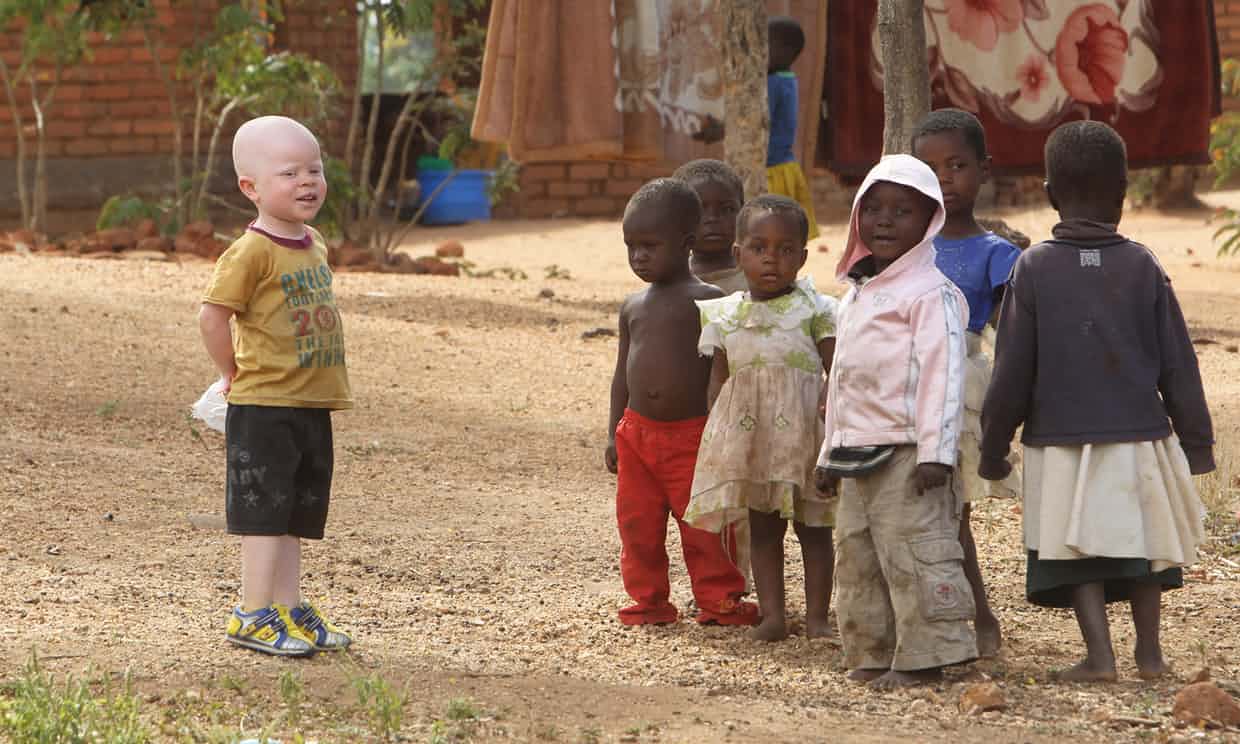
Cassim Jaffalie, three, with his friends at his family home in Machinga, southern Malawi. His father has given up work to protect his son. Photograph: Tsvangirayi Mukwazhi/AP

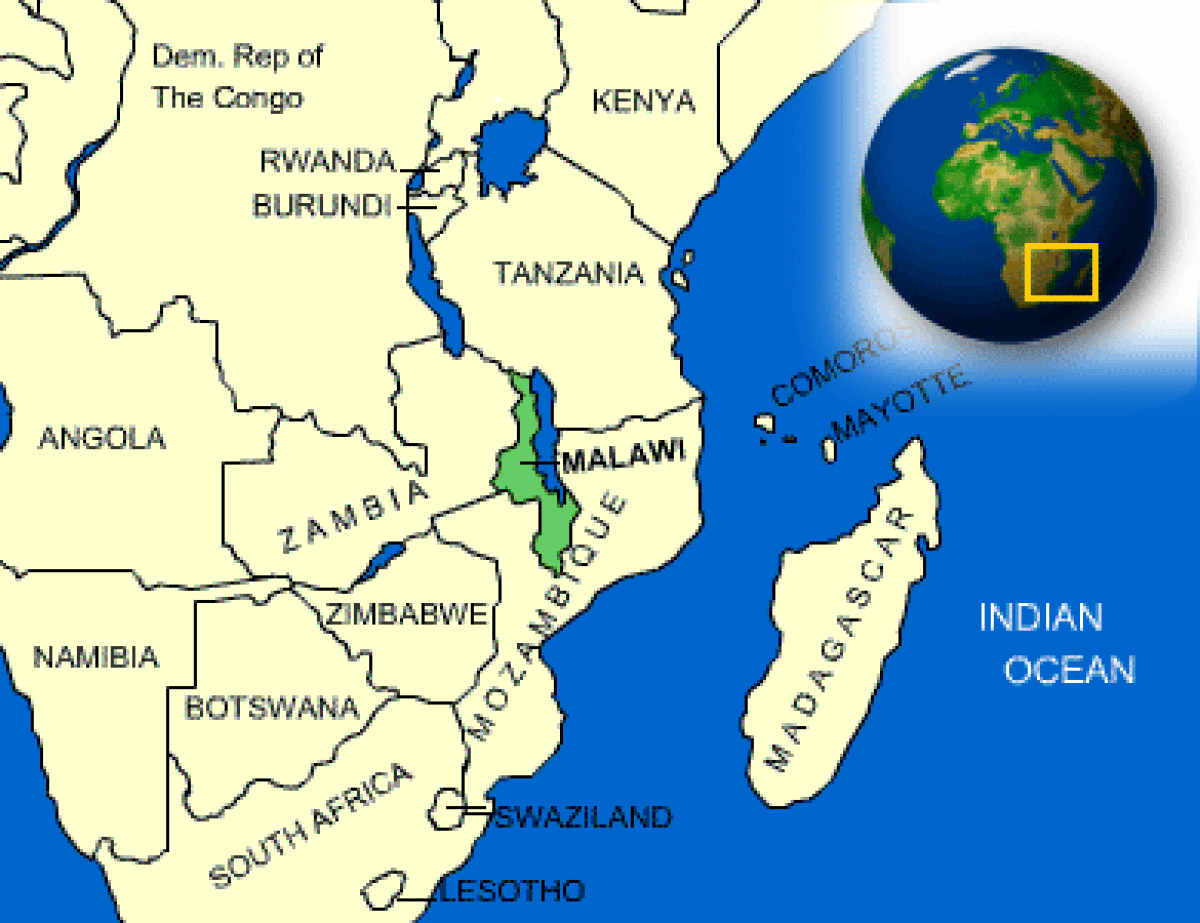
Being born with albinism can be a death sentence in Malawi. With 22 recorded murders in the past four years, dozens more people have been reported missing – suspected abducted and killed.

Now an association of people with albinism in Malawi has announced it will put forward six candidates for next year’s presidential and parliamentary elections, in an unprecedented move to combat stigma.

Malawi is one of the most dangerous countries in the world for people living with albinism – a lack of pigmentation in the skin, hair and eyes – who are targeted so that their body parts can be used in magic potions and other ritual practices.

The unprecedented rise in ritual and witchcraft-related killing for body parts that has also been documented in Tanzania and Burundi has led to the UN creating a special mandate to protect people with the genetic disorder.

Overstone Kondowe, director of the Association of People with Albinism in Malawi, said fielding political candidates would go a long way in changing how people with albinism were viewed in Malawi.

“We want to show the public that we are more than our skin,” he said.

Elizabeth Machinjiri is one of those planning to stand as a member of parliament in Blantyre. The director of a local charity, Disability Rights Movement, Machinjiri said her experience was key.

“What I have seen is that disability issues are ignored in the country,” she said. “In our parliament there are only one or two people that have a disability. I understand one will not even [stand in] the next election. We need to be represented. Other people may not understand the pain and hard things that we go through every day.”

Machinjiri said she would lobby for schools and hospitals to be disability-friendly.

“Mostly people choose [an MP] because they are rich. I am saying no, because that money is personal and cannot be used for developmental projects. Once elected, I will make sure that I present the voices and wishes of people living in my area and not only my views.”

Machinjiri said that stopping abductions of people living with albinism in the country will take huge political will. She may not find it easy to convince people, and still has to raise money to fund the campaign process.

“We need political commitment in fighting this,” she said, emphasising that attacks are becoming more commonplace. “People should know that I am standing for a reason. I won’t hide evil since I am a courageous person.”

Source: The Guardian, June 26, 2018

Ritual killings linked to elections – Swaziland

Unfortunately, also in Swaziland the number of ritual murders increases at election time. I remember a BBC article of June 2, 2003, reporting that King Mswati III had urged Swaziland’s politicians not to engage in ritual killings to boost their chances in the general elections later that year.

Five years later Prime Minister Absalom Themba Dlamini issued a warning to aspiring members of parliament against committing ritual murders to win the vote. When speaking during the Ascension prayer service held at Embangweni Royal Residence on May 4, 2008, the PM said it was very disturbing that, already, there were reported incidents of people disappearing under a cloud of controversy as the elections dates draw closer. He said King Mswati III issued a similar warning.

We’re now in 2018 and apparently nothing has changed. The Swaziland Action Group Against Abuse (SWAGAA) has issued a statement recently, saying it is “(…) deeply alarmed and distressed by recent media reports of abductions and kidnappings resulting in mutilations and killings. Children, both girls and boys, are especially targeted (…). The fact that there are widespread speculations on whether or not these abductions are for ritual purposes linked to the upcoming Parliamentary elections in Eswatini cannot be ignored.”
(webmaster FVDK)

Swaziland Action Group Against Abuse (SWAGAA) is a non-governmental organization which has been working for over 20 years to eradicate Gender-Based Violence (GBV) and Human Trafficking in Swaziland.

‘Ritual murder has long been part of Swazi life.’, as Richard Rooney said.

More in the following article written by Richard Rooney.

Published: Thursday, 31 May 218

BY RICHARD ROONEY Y
SWAZI MEDIA COMMENTARY – INFORMATION AND COMMENTARY ON HUMAN RIGHTS IN SWAZILAND

There are ‘widespread speculations’ across Swaziland that a number of recent abductions resulting in mutilations and killings might be related to the ongoing national election in the kingdom, the Swaziland Action Group Against Abuse (SWAGAA) said.

SWAGAA said, ‘Children, both girls and boys, are especially targeted; however, this does not mean adults cannot be a target in future. For this reason, all people should remain on high alert.’

It said in a statement, ‘The fact that there are widespread speculations on whether or not these abductions are for ritual purposes linked to the upcoming Parliamentary elections in Eswatini [Swaziland] cannot be ignored.

Swaziland has a history of abductions and ritual killings in the run-up to national elections that are held every five years. Voter registration is currently taking place and ends on 17 June 2018. The date for the actual election has yet to be announced.

In June 2017, during a voter-education workshop, Swaziland’s Elections and Boundaries Commission (EBC) called for an end to ritual killings around voting time. It was concerned about reports of people mysteriously disappearing across the kingdom.

At KaLanga in the Lugongolweni constituency EBC educator Cynthia Dlamini said ritual murder reports increased during election time. The Swazi Observer reported at the time, ‘Dlamini said this was one belief driven by lunacy which tarnishes the image of the country in the process. She said the commission condemns such beliefs and called for intensive investigations against those who would be suspected of ritual killings.’

At the last election in 2013, The Swaziland Epilepsy Association warned that cases of the abduction of epileptic people always increased during elections. Mbuso Mahlalela from the association told the Swazi Observer at the time it was common for the vulnerable to be targeted and abducted. He spoke after a report that a 13-year-old epileptic boy might have been abducted for ritual purposes.

Before the election in 2008 a march by civil society groups to draw attention to ritual killings was banned by the government amid fears that it would bring bad publicity to Swaziland and might embarrass King Mswati III, the kingdom’s absolute monarch, who had spoken out against the practice.

The Times of Swaziland reported at the time the march had been motivated by the mystery disappearances and murders of women. Some of these had been found mutilated fuelling speculating that they were related to rituals.

Some Swazi people believe body parts can be used as ‘muti’ which is used to bring good fortune to candidates at the election and help them to win seats in parliament.

In 2008, it was strongly rumoured in Swaziland that the reason why members of the government wanted to ban discussion on the ritual murders was that some of them had themselves used ‘muti’ to get elected.

In March 2018, a campaign called ‘Don’t kill us, we are human beings too’ was launched to raise awareness about people with albinism, a group at particular risk at election time. The Stukie Motsa Foundation is using social media to dispel the false belief that people with albinism cleanse bad luck and bring fortune to people.

There have been concerns in Swaziland for years that people with albinism have been targeted and murdered. Witchdoctors use the body parts to make spells that they claim bring people good luck.  Sport teams have also been known to use spells to bring them good fortune during matches. Witchdoctors’ services are especially sought after by candidates contesting parliamentary and local elections.

In January 2017, the Director of Public Prosecution’s office in Swaziland told witchdoctors in the kingdom to stop murdering people for body parts. The witchdoctors, also known as tinyanga, were advised to go to the Ministry of Health for body parts, such as bones.

During the national elections in Swaziland in 2013, people with albinism lived in fear that their body parts would be harvested by candidates seeking good luck.

Independent Newspapers in South Africa reported at the time, ‘In the past [people with albinism], who lack the skin pigment melanin, as well as epileptics have been specifically targeted, prompting the police to set up registries.

‘In 2010, the killing and mutilation of [people with albinism], including in one instance the decapitation of two children in Nhlangano, prompted panic.’

In August 2013, Independent Newspapers quoted an academic at the University of Swaziland, who did not want to be named, saying, ‘Ritual killings to achieve elected office are a natural outgrowth of a government based not on rationality or democratic principles but on superstitious beliefs.

‘The Swazi king claims power through an annual Incwala festival where a bull is brutally sacrificed and mysterious rituals occur, and this sets the tone. No one knows how office-holders are appointed in Swaziland. It’s all done in secret, without recourse to merit or any rhyme or reason, so this fuels irrational beliefs.

‘Ritual murder has long been part of Swazi life.’

Source: Ritual killings linked to elections, May 31, 2018